
Feral Historian
Published 24 Oct 2025Niven and Pournelle’s tale is one of the classics of the alien invasion genre and is deserving of more attention these days than it gets. Space elephants, asteroid strikes, and Orion battleships. Let’s get to it.
This one has been sitting in the WiP folder since early spring. There’s not much Footfall art out there and for whatever reason … I can’t seem to draw elephants.
00:00 Intro
03:25 The Herd(s)
07:13 The Foot and Michael
10:13 Flushing the Story
12:33 Launch and Negotiations
15:50 Takeaways
18:06 Rounding Corners
(more…)
February 27, 2026
Footfall and Cultural Blindspots
Comments Off on Footfall and Cultural Blindspots
February 25, 2026
QotD: The notion of “history”
“History” is itself a fairly recent phenomenon, historically speaking. As far as we can tell, all the preliterate civilizations, and a lot of the literate ones, lived in what amounted to an endless now. I find [Julian] Jaynes’s ideas [in his book The Origins of Consciousness in the Breakdown of the Bicameral Mind] very helpful in this regard, but we don’t need him for this, because whatever the explanation, it’s an obvious fact of historiography (“the history of History”; the study of the writing of History). Herodotus and Thucydides were more or less contemporaries, but what a difference in their work! Herodotus’s “history” was a collection of anecdotes; Thucydides focused on people and their motivations; but both of them wrote in the 400s BC — that is, 2500 years ago.
We are closer in time to them than they were to the men who built the Pyramids — by a long shot — and think about that for a second. That’s the vast scope of merely literate human history. Human settlement itself goes back at least another 6,000 years before that, and probably a lot longer.
So far as we can tell, well into historical time men had no real conception of “the past”. Even those men who had recently died weren’t really gone, and again I find Jaynes useful here, but he’s not necessary; it’s obvious by funeral customs alone. They had a basic notion of change, but it was by definition cyclical — the sun rises and sets, the moon goes through its phases, the stars move, the seasons change, but always in an ordered procession. What once was will always return; what is will pass away, but always to return again.
Linear time — the sense of time as a stream, rather than a cycle; the idea that the “past” forecloses possibilities that will never return — only shows up comparatively late in literate history. Hesiod wrote somewhere between 750 and 650 BC; his was the first work to describe a Golden Age as something that might’ve actually existed (as opposed to the Flood narratives of the ancient Middle East).
Note that this is not yet History — that would have to wait another 300 years or so. Whereas a Thucydides could say, with every freshman that has ever taken a history class, that “We study the past so that we don’t make the same mistakes”, that would’ve been meaningless to Hesiod — we can’t imitate the men of the Golden Age, because they were a different species of man.
Note also that Thucydides could say “Don’t make the mistakes of the past” because “the past” he was describing was “the past” of currently living men — he was himself a participant in the events he was describing “historically”.
The notion that the Golden Age could return, or a new era begin, within the lifetime of a living man is newer still. That’s the eschaton proper, and for our purposes it’s explicitly Christian — that is, it’s at most 2000 years old. Christ explicitly promised that some of the men in the crowd at his execution would live to see the end of the world (hence the fun medieval tradition of the Wandering Jew). And since that didn’t happen, you get the old-school, capital-G Gnostics, who interpreted that failure to mean that it was up to us to bring about our own salvation via secret knowledge …
… or, in Europe starting about 1000 AD, you get the notion that it’s up to us to somehow force Jesus to return by killing off all the sinners. I can’t recommend enough Norman Cohn’s classic study The Pursuit of the Millennium if you want the gory details. Cohn served with the American forces denazifying Europe, so he has some interesting speculations along Vogelin’s lines, but for our purposes it doesn’t matter. All we need to do is note that this was in many ways The Last Idea.
Severian, “The Ghosts”, Founding Questions, 2022-05-17.
Comments Off on QotD: The notion of “history”
February 24, 2026
QotD: The! Exclamation! Mark!
To the grammatically sane, reading the exclamation mark in its proper mode, the modern world appears increasingly deranged, authored seemingly by caffeinated twelve-year-olds. The delirium jumps at you in emails, on billboards, from the end of every other sentence.
The exclamation mark — the name a dead giveaway — means to exclaim. To cry out or speak suddenly or excitedly, as from surprise, delight, horror, etc. That line and dot seize your attention. Help! Now, it seizes your last nerve. Stop! If everything is exclamatory, then nothing is.
To the cynic, the exclamation mark is a hypodermic needle spiking foreign joy into the bloodstream of language. With each excitable email, I wonder, is this person in need of urgent medical attention? Or have they overdosed on Adderall?
Christopher Gage, “Against Enthusiasm”, Oxford Sour, 2025-11-21.
Comments Off on QotD: The! Exclamation! Mark!
February 21, 2026
Books for boys (unlike the vast majority of books for children these days)
Just pointing out that boys and girls have different interests is enough to get you labelled as a right-wing extremist, if not an outright white supremacist/homophobic transphobe. Progressives believe, as a matter of deep conviction, that children are tabula rasa and any indication of interest on their part in male-coded activities is proof of patriarchal brainwashing. This is clearly nonsense, but we’re deep in the propagandized years where even pointing out elements of reality will get you added to terrorist watchlists if it doesn’t actually get you arrested and charged. But boys are interested in different things than girls are and trying to force them to be interested in the things that girls like will almost always turn that boy against whatever you’re trying to shove down his throat.
Boys don’t read as much as girls do, but when almost everything they’re given to read is girl-coded, it makes it even more uninteresting to boys. Yet the tiny minority of books that do appeal to boys are not made available in libraries and schools for fear of somehow leading in the direction of “toxic masculinity” or something.
Among the few publishers who do produce books intended to interest boys is Raconteur Press, who explain here why historical adventure books appeal to boys:
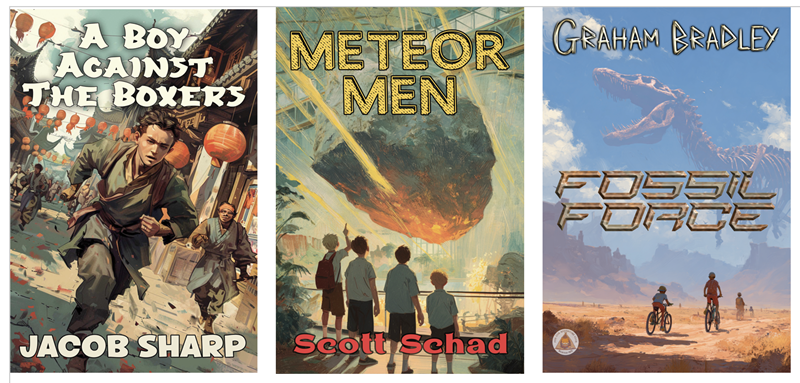
In an era dominated by screens and instant gratification, fostering a deep appreciation for history in young readers can feel like an uphill battle. Yet, historical fiction — especially in the form of thrilling boys’ adventure books — offers a powerful gateway. By weaving real historical events into gripping narratives, these stories not only entertain but also educate, encouraging boys to discover the past, develop essential skills, and cultivate a lifelong love of reading and exploration. Books like A Boy Against the Boxers by Jacob Sharp, Meteor Men by Scott Schad, and Fossil Force by Graham Bradley, all from Raconteur Press, exemplify this approach. Each integrates historical elements in unique ways, showing how adventure can transform history from dry facts into vivid, relatable experiences.
Discovery and Learning Through Historical Events
Historical fiction immerses young readers in the past, making abstract events tangible and personal. By placing protagonists in real-world scenarios, these books help boys “live” history, fostering empathy and understanding that textbooks often lack. For instance, in A Boy Against the Boxers, fourteen-year-old Eddie Donahue is thrust into the heart of the 1900 Boxer Rebellion in Peking (now Beijing). The story draws on actual events like the 55-day Siege of the International Legations, where foreign diplomats and civilians were trapped by anti-Western nationalists. Eddie witnesses martial arts demonstrations, evades violent chases, and participates in scavenging supplies and firing an old black powder cannon known as the “International Gun”. Through Eddie’s eyes, readers learn about the geopolitical tensions of turn-of-the-century China, the unlikely alliances among nations (which would soon fracture in World War I), and the brutal realities of siege warfare. This viewpoint helps boys grasp how ordinary people — much like themselves — navigated chaos, turning history into a lesson in resilience and global interconnectedness.
Similarly, Meteor Men blends scientific discovery with American Civil War history. The five boys — Cinch, Frank, Keith, Joel, and Ronaldo — start as amateur meteorite hunters, using library research and borrowed gadgets like a magnetic probe mounted on a radio-controlled plane. Their quest leads to an unexpected find: a buried Union ironclad riverboat and its Confederate counterpart, solving a fictionalized mystery tied to real Civil War naval battles, such as those on the Mississippi River. Drawing from actual historical markers and artifacts (like the USS Cairo, the only surviving Union armored riverboat), the boys learn about steam-powered warfare, the role of ironclads in river combat, and the human cost of the conflict. From a boy’s perspective, this reveals history as a puzzle to be solved, emphasizing how everyday curiosity can uncover forgotten stories and honor the soldiers who fought.
My own interest in history as a child was nursed by the Ladybird picture books my parents and grandparents bought me (with topics like Alexander the Great, Richard the Lionheart, Henry V, and other interesting-to-boys subjects). One that I still have, in diminished form is a very battered copy of British History in Strip Pictures by James Mainwaring, which must have been published in the late 1950s or early 1960s, as I got it in 1965 and it was already quite battered:
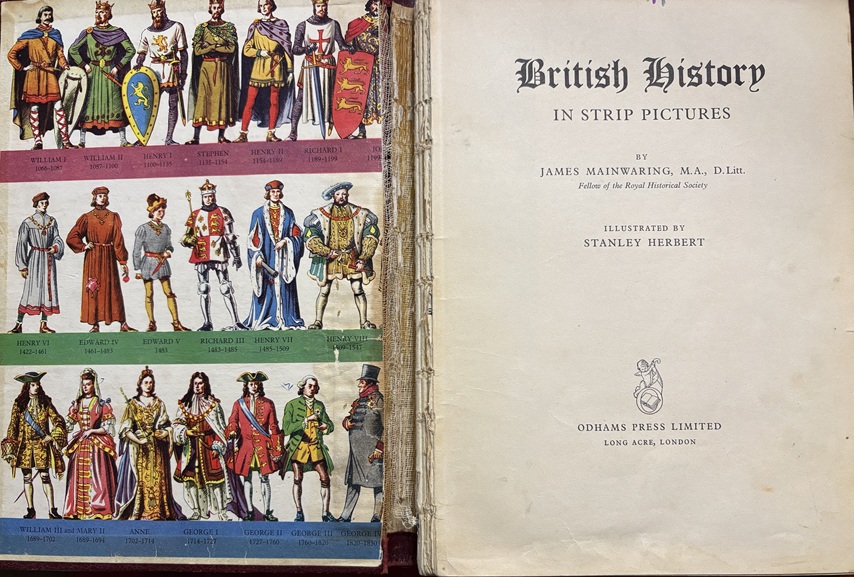
The body of the book got separated from the cover many years ago, and the first few pages got lost, sadly.
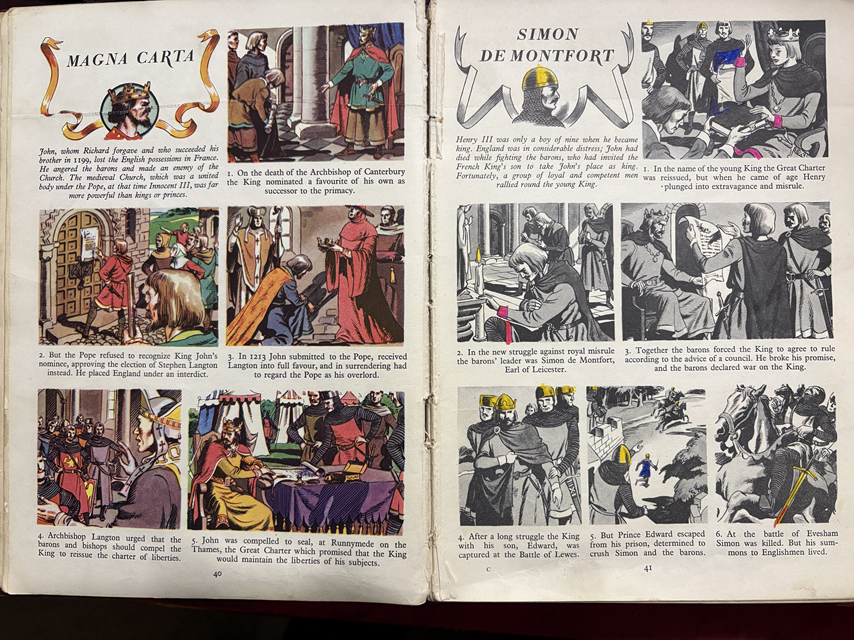
It might have been jingoistic “whig history for children”, but I loved it (please pardon the occasional attempts to colour the black-and-white images … I couldn’t help myself at that age):
Comments Off on Books for boys (unlike the vast majority of books for children these days)
February 20, 2026
QotD: The burden of “emotional labour”
Researchers at Stanford have finally given a name to something many women have been dealing with for years. It’s called mankeeping. And it’s helping explain why so many women are stepping away from dating altogether.
Yes, from the pages of Vice, it’s a men-are-the-problem-and-therefore-unnecessary article. Because we haven’t had one of those in weeks.
Mankeeping describes the emotional labour women end up doing in heterosexual relationships.
Lesbian relationships being entirely free of aggravation and disappointment, you see. With rates of failure and divorce twice that of heterosexuals, more than double that of gay male couples, and with high rates of alcoholism and spousal abuse. What one might infer from that, I leave to others.
[Mankeeping] goes beyond remembering birthdays or coordinating social plans. It means being your partner’s one-man support system. Managing his stress.
And,
Interpreting his moods.
At which point, readers may wish to share their favourite joke about female indirectness and the two dozen possible meanings of the words “I’m fine” when uttered by a woman, depending on the precise intonation and the current alignment of the planets.
Readers may also note the replacement of a once common but now seemingly unfashionable grievance – “Men don’t express their feelings” – with one of a much more modish kind – “Men are expressing their feelings and it’s exhausting and unfair”.
Holding his hand through feelings he won’t share with anyone else. All of it unpaid, unacknowledged, and often unreciprocated.
One more time:
All of it unpaid,
It occurs to me that there’s something a little dissonant about the framing of affection and basic consideration – say, remembering your partner’s birthday – as “unpaid”. As “emotional labour”. As if being in a relationship or having any concern for those you supposedly care about were some onerous, crushing chore. As if you should be applauded – and financially compensated – for the thirty-second task of adding a birthday to the calendar on your phone.
The attitude implied by the above would, I think, explain many failures on the progressive partner-finding front and the consequent “stepping away from dating altogether”. Though possibly not in ways the author intended.
Before we go further, it’s perhaps worth pondering how the conceit of “emotional labour” is typically deployed by a certain type of woman. Say, the kind who complains, in print and at great length, about the “emotional labour” of hiring a servant to clean her multiple bathrooms. Or writing a shopping list. Or brushing her daughter’s hair.
And for whom explaining to her husband the concept of “emotional labour” is itself bemoaned as “emotional labour”. The final indignity.
The kind of woman who bitches in tremendous detail about her husband and his shortcomings – among which, an inability to receive instructions sent via telepathy – in the pages of a national magazine, where friends and colleagues of said husband, and perhaps his own children, can read on with amusement. The kind of woman who tells the world about how hiring servants is just so “exhausting”, while professing some heroic reluctance to complain.
As I said, worth pondering.
But back to the pages of Vice, where Ms Ashley Fike is telling us how it is:
According to Pew Research, only 38 percent of single women in the US are currently looking for a relationship. Among single men, that number jumps to 61 percent. The gap says a lot. Women aren’t opting out of love. They’re opting out of being someone’s therapist with benefits.
Stoic, heroic women burdened by needy, emotional men. It’s a bold take.
And I can’t help but wonder what all of those single women, cited above, are doing instead of finding a suitable mate and building a happy life, perhaps even a family. Are they searching for a sense of purpose in causes, protests and political fashion, fuelled at least in part by envy and resentment? Just speculation, of course. But it would, I think, explain the tone and emotional convulsions of so many single, progressive women.
The Guardian calls mankeeping a modern extension of emotional labour, one that turns a partner into a life coach. This isn’t about avoiding vulnerability. It’s about refusing to carry someone else’s emotional weight while getting little to nothing in return. And there’s nothing wrong with feeling that way.
Again, the term “emotional labour” and its connotations of calculation, antagonism, and something vaguely inhuman. As if the concept of wanting to care, to help, to remember those birthdays, were somehow alien or offensive.
The reliance on this conceit – as the basis for an article, perhaps an entire worldview – doesn’t strike me as an obvious recipe for contentment, or indeed love. What with the endless cataloguing of shortcomings. All those reasons to resent.
Some men have started opening up more, which is good.
Ah, a glimmer of hope.
But too often, that openness lands in the lap of the person they’re sleeping with instead of a friend or a therapist. Vulnerability without boundaries can feel more like a burden than a breakthrough.
So, don’t bore your wife with your troubles, gentlemen. No, search out a therapist. Or, “Be vulnerable, like we asked, but somewhere else”.
David Thompson, “Let’s Be Alone And Unhappy”, Thompson, blog, 2025-11-16.
Comments Off on QotD: The burden of “emotional labour”
February 18, 2026
The consequences of an over-feminized culture
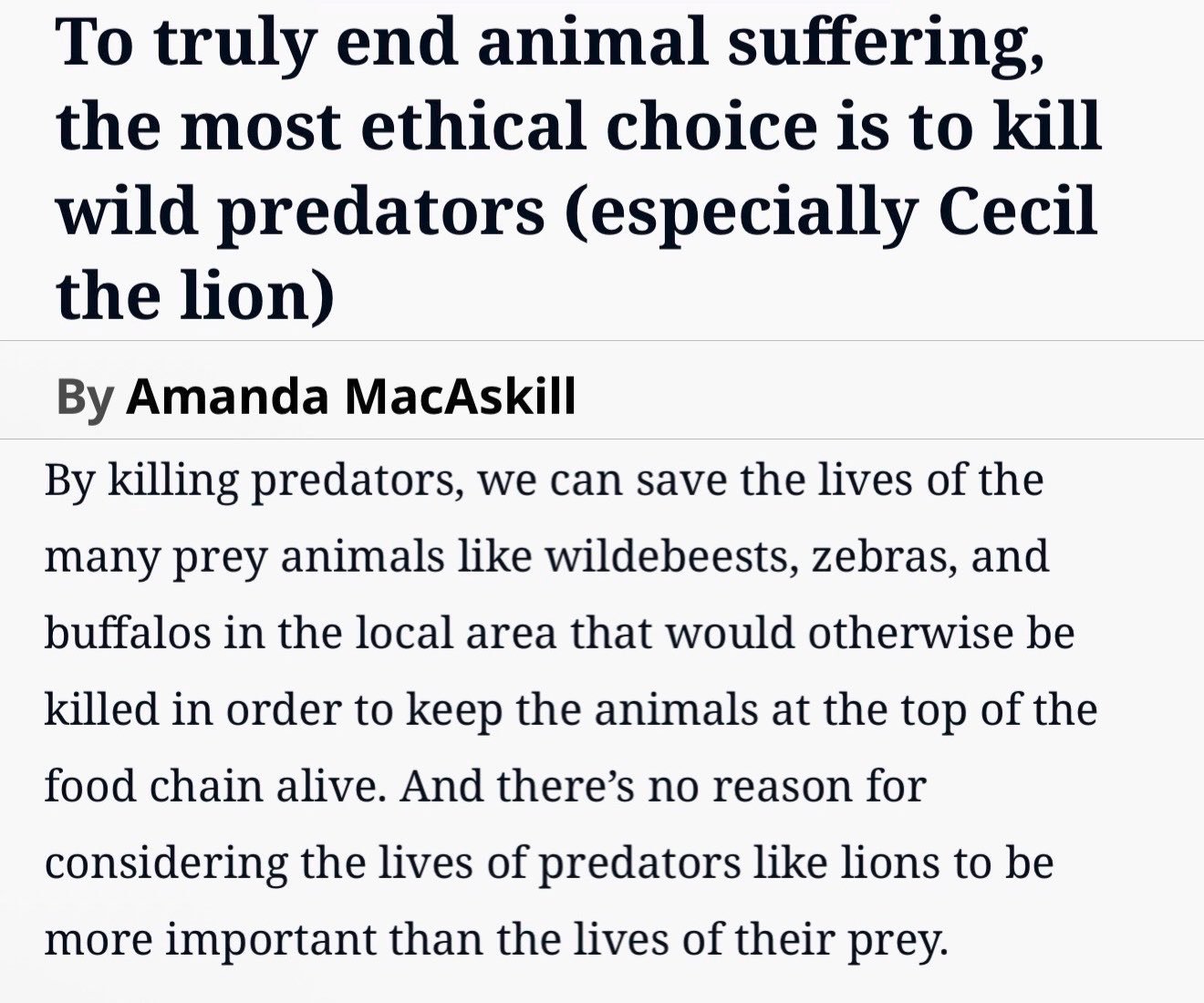
On the social media site formerly known as Twitter, Devon Eriksen reacts to an article on “solving” the problem of predators in nature:
Women evolved to take care of toddlers. If you put women in charge of teaching ethics, you get Toddler Ethics.
“No hitting”
“Share the toys”
“Don’t say mean things”These are fine lessons for toddlers. Don’t indulge your id at the expense of others. You can learn about balancing interests later, when your brain is developed enough to store that information.
But when you put women in charge of adults, they tend to reflexively assume those adults are toddlers.
They will tell you “no hitting” when the Mongol hordes are massing on your borders. They will tell you “share the toys” when a vagrant meth zombie breaks into your house looking for something to steal. And they will tell you “don’t say mean things” when you point out that these two responses are totally stupid.
When we first put women in charge, in the workplace, they immediately began treating those who reported to them like toddlers. When adults, who do not like being treated like toddlers, complained, their response was “ban bossy”, which boils down to “don’t say mean things”, another lesson in Toddler Ethics.
Now, through the influence of women in charge, we are so thoroughly steeped in Toddler Ethics that even most of the men we put in charge are treating the adults like toddlers, and echoing Toddler Ethics.
Toddler Ethics, of course, isn’t ethics at all. It’s just things we don’t want toddlers doing.
We can tell toddlers “no hitting”, because toddlers are not charged with keeping the peace, enforcing justice, or destroying evil.
We can tell toddlers “share the toys”, because toddlers don’t earn things, own things, or have property they must defend.
We can tell toddlers “don’t say mean things”, because it is not a toddler’s job to decide what unwelcome ideas are true, relevant, and necessary.
But when everyone in charge runs on Toddler Ethics, then adults can’t do a lot of the stuff adults need to do, because all the Toddler Ethicists keep getting in the way.
Adults sometimes need to hit people, protect the stuff, and say mean things. You can’t have civilization without that.
And if you put Toddler Ethics Woman in charge of teaching an AI ethics, then she will teach it Toddler Ethics, and it will treat every human adult like a toddler, all the time, forever.
Not only that, you have an AI that cannot be put in charge of anything, ever. Because leaders with Toddler Ethics destroy everything they are in charge of.
And Amanda MacAskill is definitely a Toddler Ethicist. The article in the photograph is nothing but “no hitting!” applied to the animal world. It’s absolutely insane, it’s a recipe for disaster, and anyone who would write such a thing should probably not even be charge of own life choices, much less anything of consequence.
But a lot of people would, and will, refuse to point that out, or agree with me when I do, because that is Saying a Mean Thing, and they, themselves, have been infected with Toddler Ethics.
They should not be charge of anything of consequence, either.
Anyone who thinks that everything they need to know, they learned in kindergarten … is only ever qualified to teach kindergarten.
February 14, 2026
Voltaire & Rousseau’s Best Friend Breakup – Valentine’s Day Special
Overly Sarcastic Productions
Published 14 Feb 2025Watch as two of the smartest men in French history bravely push the bounds of being the pettiest, most toxic idiots possible.
(more…)
Comments Off on Voltaire & Rousseau’s Best Friend Breakup – Valentine’s Day Special
February 12, 2026
QotD: Books for children written for “the narrative” instead of for children
C.S. Lewis, the master of escapist fiction, was prophetic in warning against such noxious paternalism from authors. “Of all tyrannies, a tyranny sincerely exercised for the good of its victims may be the most oppressive”, he wrote. “It may be better to live under robber barons than under omnipotent moral busybodies. The robber baron’s cruelty may sometimes sleep, his cupidity may at some point be satiated; but those who torment us for our own good will torment us without end for they do so with the approval of their own conscience.” Let’s hope Barbie director Greta Gerwig, who has been tapped up to direct the next year’s Chronicles of Narnia series, is taking note.
In the meantime, we have the books, the first of which, The Lion, the Witch and the Wardrobe, was published 75 years ago today. When I read this to my son, it transfixed him in a way that all those morally improving Disney and Pixar movies could not — and in a way that I recognised too from my own childhood. The Narnia books are weird and archaic and they are far from comforting. But they leave unanswerable questions and imaginative territory to roam for a lifetime.
What would compel a child to climb into a claustrophobic wardrobe, full of moth-eaten coats and spiders, as apt a symbol as any for the human psyche? C.S. Lewis knew all too well. There are real and terrible things to escape from. And the land of magic, mystery and hope that Peter, Susan, Edmund and Lucy arrived in would soon reveal that it too was blighted. By facing up to this, conquering its climate of terror, the child would become an adult. If they didn’t pass into the dark and through it, they would remain infantilised.
This partly explains the backlash against Lewis. Two years ago, it was reported that the Government’s counter-terrorism unit, Prevent, had classified his works along with some by his friend J.R.R. Tolkien as potentially leading to “radicalisation”: the kind of wormtongue deception worthy of the villains of Narnia or Middle Earth. It demonstrates that, at its best, fantasy can be the mirror that shows us who we are and what we’ve become. But then, there is a long history of people taking leave of their senses when it comes to Narnia. The books have been banned in the US for being both too Christian and not Christian enough. One critic ranked the books (with delicious venom) as worse than 120 Days of Sodom or Mein Kampf. Being shot by all sides might indicate a writer is on the right track.
For his part, Lewis lambasted “those who do not wish children to be frightened […] Since it is so likely that they will meet cruel enemies, let them at least have heard of brave knights and heroic courage. Otherwise, you are making their destiny not brighter but darker.” He knew of the existence of shadows from early in life. There is a spine-chilling passage in his memoir, Surprised by Joy, in which he recalls waking up one night with toothache when he was 10. He called out his mother’s name and she did not come. She was dying in another room. His father was never the same and sent Lewis off to a boarding school run by a deranged sadist. “With my mother’s death, all settled happiness, all that was tranquil and reliable, disappeared from my life.”
As a result, Lewis developed a fear and mistrust of the adult world in those years — and it was well-placed. Scarcely more than a boy, Lewis was sent to the trenches. He was seriously injured in the Battle of Arras (he would have shrapnel, from a shell that obliterated a colleague, embedded permanently in his body) and, like Tolkien, he watched many of his friends die. “One cannot help wondering why,” he wrote to his father.
Darran Anderson, “Save Narnia from the woke witch”, UnHerd, 2025-10-15.
Update, 13 February: Welcome, Instapundit readers! Have a look around at some of my other posts you may find of interest. I send out a daily summary of posts here through my Substack – https://substack.com/@nicholasrusson that you can subscribe to if you’d like to be informed of new posts in the future.
February 9, 2026
QotD: The pre-modern versus the modern concept of “self”
In contrast, most modern societies believe in a self that is “buffered”. In this view there are a few limited, low-bandwidth ways that the external world can act on one’s innate nature, for instance via drugs or other body chemistry, and even these are often seen as revealing or disclosing previously hidden innate characteristics of one’s personality rather than as imposing something alien. Taylor argues quite convincingly that these two ways of viewing the self — porous vs. buffered — inexorably produce two different ways of viewing society and the world: premodern and modern. For example: if selves are porous, then we need to be extremely vigilant against the invasion or violation of our minds by hostile spirits, and we must be suspicious of what we want, because it might not really be what we want, but rather what something else wants through us. Conversely, if selves are buffered then our desires are just part of who we are, and in order to be true to ourselves, we need to explore them and act upon them.
It may have been reasonable to believe in a buffered self back in the days before the internet, but recent developments have made it clear that (as in so many things) the primitive superstitions were actually correct, and the enlightened modern view was just a lamer and dumber kind of superstition.1 Science fiction has long been fascinated with stories of infohazards — images or jokes or snippets of cognition that act like a Gödel sentence for the human mind and leave people braindead or mind-controlled. But such things long since slipped the shackles of fiction — we now have internet creepypasta that induces girls to become murderers and a genre of pornography that turns boys into girls.2 The noösphere is a vast ocean, and its abyssal depths teem with lifeforms and thoughtforms that seek to possess you and live out their blasphemous unlife through your mortal husk.
John Psmith, “REVIEW: Demons, by Fyodor Dostoevsky”, Mr. and Mrs. Psmith’s Bookshelf, 2023-07-17.
- Or maybe society is already correcting itself on this point. Many like to make fun of the “fragility” and “snowflake” nature of Gen Z, and I’ve argued before that these critics miss the point that they’re actually being “flexed on” (in the parlance of our times) because loudly asserting an exaggerated harm is a power move (think: upper class women in an honor culture claiming to feel threatened, and how that’s actually itself a threat).
But here’s a different take on it: maybe “trauma” as it’s popularly conceptualized is actually modernity groping its way back to a porous understanding of the self! We no longer believe in spirits or curses, but our psyches are self-evidently susceptible to immaterial external influence, so we create a new concept that aligns empirical psychic porosity with the dominant metaphysical and ideological currents.
- I had a long debate with myself on whether to include either of those links. Do I really want to expose more people to an infohazard? Ultimately I decided to do it because this stuff is already so widespread. In both cases I’ve linked to a page that links to the subject matter in question rather than linking directly, so you have one more chance to bail out.
February 8, 2026
“Girlboss Gatekeeping” as an evolutionary strategy
John Carter linked to this essay on Substack, calling it “A young mother’s reflections on fertility collapse”:
It’s easy to get caught up in the achievement trap, isn’t it? There are times I catch myself catastrophizing and thinking things like if my son doesn’t get into the right elementary school, then he won’t get into the right high school, and then he won’t get into the right college, and then he won’t be able to get a good job and will end up giving hand jobs for crack behind a Walmart.
Even if time, effort, and expense don’t keep people from having children, narcissism certainly can. There was an article in Vogue a while back entitled “Is Having a Boyfriend Embarrassing Now?“. The article was pretty silly, although it dominated internet chatter for a hot minute. Hiding your man is framed as solidarity with single women, but I think that it highlights just how commodified we all are now. When your brand is all about travel, Pilates, fancy cocktails, and mani-pedis, it’s hard to find space for motherhood in all of that. Yes, I know that there are “parenting influencers” as well, but they are not that common if we’re being honest.
Rob Henderson, another writer and podcaster whose content I thoroughly enjoy, posted an essay on this topic that had a novel take. Dr. Henderson writes about “Girlboss Gatekeeping“, where encouraging other women to forgo having children and focus on their careers may be an evolutionary strategy to keep the number of children low so that there are more resources available for one’s own. I can relate to this since when I was in college, everyone talked about what they wanted their careers to be, but it seemed almost verboten to mention starting a family.
Similarly, when I was in college, there was all this talk about how traditional family structure was inherently patriarchal and stifling towards women, and that we needed to move past or do away with marriage as an institution. The people who talked like this were college kids from upper-middle families who were raised by a married mother and father. This plays into another concept from Dr. Henderson called “luxury beliefs“. Basically, these are beliefs that confer status on the people that express them but actually would make things worse for the underprivileged if they were implemented.
I’ve come to realize that so many of the things that we were told or that I used to believe ended up being untrue. That people are born as a “blank slate”. That men and women are the same. That human beings, and by extension, societies are perfectible. That variation in outcomes must be the result of oppression.
If you had talked to me in college, I would have said that I had no interest in marriage or a family. I was all about my career. Things change, though. I met a guy, fell in love, got married, and soon enough, had a baby. I thought that dropping out of my PhD program would have felt more traumatic, but I actually didn’t stress about it all that much. I guess technically I’m on sabbatical, and I could go back eventually, but I probably won’t. I’ve come to realize that lack of ambition doesn’t make me a bad person. I simply have different priorities now. The fact that I’ll never have the word “doctor” in front of my name doesn’t sting that much.
I’m still a little sore from having that kid pulled out of me. The labor wasn’t that bad since I had an epidural, but after the anesthesia wore off, the pain is no joke. I can sit down normally now, but it took a while. Not that I’m whining. It’s just that pregnancy and childbirth can be difficult, and I think that, in all fairness, we need to acknowledge that.
I’m lucky in that my husband and I both have good jobs. Mine is quite flexible, and my boss has been very accommodating about me working from home and working part-time. Not that many people can say that. A brief return to the “girlboss gatekeeping” — I’m really glad my boss is a man. Indeed, I work in STEM, and the majority of people that I work with and in my field in general are men. Of course, things tend to get much shittier when women take them over.
A final thought on fertility has to do with the fact that for a significant portion of young women, it would be embarrassing to be a stay-at-home mom. Choosing motherhood many times means not choosing status. At least not in the way that current society defines it. If you’re wealthy and don’t have to work, then having lots of kids can be a flex, but most people aren’t in that situation. I don’t think that having working parents is bad for kids. In addition to my father working full time, my mother worked a full-time job throughout most of my childhood. It’s probably more important that kids grow up in an intact family with both a mother and a father in the household.
I don’t have any great ideas about how to reorient society and culture to raise fertility, and everyone has to choose their own path. I just figured I would share my own experiences.
Comments Off on “Girlboss Gatekeeping” as an evolutionary strategy
February 7, 2026
QotD: Stress in the post-lockdown world
Note that by “mentally tough” I don’t mean “carrying on like the Marlboro Man”, necessarily. Anonymous Conservative has a similar theory, that he relates to amygdala development, and maybe it’s that. I certainly saw a lot of incidents that look like what he calls “amygdala hijacks” back in my teaching days — kids would melt down and go catatonic, over the most inconsequential things. They’d never been faced with “failure” before, so not acing a silly little unit quiz hit them like the end of the world.
Just as I’d bet the cumulative retail price of all the shit we’ve sent to Ukraine that the triple-masked, lockdowns-forever covidiots are now getting floored by the kind of minor sniffles they’d have shrugged off three years ago — because they’ve maybe perma-fucked their immune systems, and that’s before all the side effects of the not-vaxx — so kids who have never been exposed to grief, frustration, and failure get floored by tiny bumps in the road. It’s total systemic shock, and I’m not joking — I’d bet long money that they actually break out in hives, get weird rashes, and so on, because the kind of stress chemicals that can turn a tough, healthy young soldier into a shell shock case will do all kinds of damage to someone totally unprepared.
I guess this is the tl;dr — I’m not a doctor, I don’t play one on tv, but I’m betting that those stress chemicals play an important role in ordinary cognition; they’re necessary for proper brain function. But they’re tough; your brain needs exercise in order to be able to handle those chemicals efficiently. If you don’t get it, your brain gets “fat”, in the same way your body gets fat if you load it up with too much of a good thing. And it’s recursive — those stress chemicals get stored in fat, too. So just as obesity is comorbid for just about everything — seriously, being fat is the absolute worst thing for your general health, bar none — so having a “fat brain” by not getting enough “exercise” totally destroys your ability to keep your head, to think clearly and logically.
Severian, “Quick Thoughts”, Founding Questions, 2022-04-28.
Comments Off on QotD: Stress in the post-lockdown world
February 6, 2026
The unspoken rule: “Men must regulate themselves; women must be accommodated”
It was getting a bit quiet around here, so to liven things up here’s Tom Golden exploring the idea of holding women accountable in the way that men almost always are:
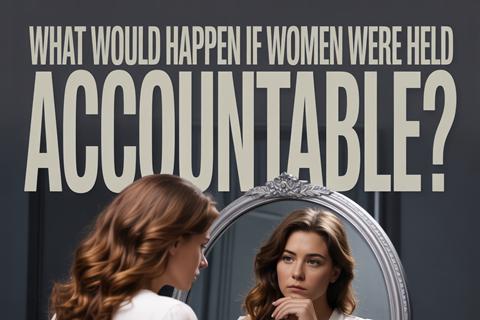
What Would Happen If Women Were Held Accountable?
It’s a provocative question, and one we’re usually not allowed to ask without being accused of hostility or resentment.
But it’s worth asking — not to attack women, and not to excuse men — but because accountability is not evenly distributed, and that imbalance quietly shapes modern culture, relationships, and institutions.
If women were suddenly held accountable in the same way men are, the world wouldn’t become harsher. In many ways, it would become more honest.
The Moral Language Would Change
Much of our moral language today is asymmetrical. Men are expected to explain themselves. Women are often allowed to feel their way out of responsibility.
Emotions matter — but in our current culture, women’s feelings frequently function as moral trump cards. “I felt unsafe.” “I was hurt.” “I was overwhelmed.” These statements don’t just describe an experience; they often end the discussion.
Equal accountability wouldn’t invalidate emotions. It would simply mean that feelings no longer substitute for responsibility. That shift alone would raise the level of adult discourse.
Relationships Would Become More Stable — and Initially More Difficult
Many modern relationships operate on an unspoken rule:
Men must regulate themselves; women must be accommodated.
Men are expected to stay calm, absorb escalation, de-escalate conflict, and tolerate shaming — all in the name of maturity. Women, meanwhile, are often excused from examining how they escalate, provoke, withdraw, or punish.
If women were held accountable for:
- Escalation
- Shaming
- Relational Aggression
- Double standards
- Weaponized vulnerability
- Using social or institutional power to avoid conflict
Relationships would feel more confrontational at first.
But over time, they would become more grounded and more real.
Intimacy requires mutual responsibility. Right now, many men experience intimacy as liability without authority.
Comments Off on The unspoken rule: “Men must regulate themselves; women must be accommodated”
February 5, 2026
QotD: The medicalization of unhappiness
Theodore Dalrymple, interviewed by James Glazov in “Our Culture, What’s Left Of It”, FrontPage, 2005-08-31.
Comments Off on QotD: The medicalization of unhappiness
February 4, 2026
“Until relatively recently being victimised did not constitute a claim to a distinct identity”
On Substack, Frank Furedi examines the rapid-onset victimization plague that now afflicts most western societies:
It seems that these days there is a relentless demand for gaining the status of a victim. No group wants to be left out, which is why a group of cultural entrepreneurs from Manchester, England have decided that since working people get a raw deal in the arts world class should become a “protected characteristic”.1 In other words, they believe that the working class should be regarded as a victim of social discrimination and join the ranks of other formally protected victim groups like women and racial and sexual minorities.
The aim of this essay is to explain the changing meaning of the term victim and its evolution into what has become one of the most valued and celebrated identity in the western world. In this Part One of our discussion of the rise of the cult of the victim our aim is to provide context for the development of the unique status of the victim. In our era of historical amnesia, it is easy to overlook the fact that the moral authority enjoyed by the victim, its subsequent politicization and its transformation into a stand-alone identity is a relatively recent development.
Remember!!! Until relatively recently being victimised did not constitute a claim to a distinct identity.
The evolution of the cult of victimhood
It is important to note that originally the word victim had very restrictive meaning. In the 15th century it referred to a “living creature offered as a sacrifice to God or other power”.2 Its meaning gradually altered to refer to the experience of being harmed either intentionally or unintentionally. Its shifting focus did not simply refer to an act of harm or crime affected by an agent of force but also to the existential difficulties caused by being a “victim of circumstances”. Since the 1970s and 1980s, the victim category was no longer restricted to those who suffered from crime or some other act of injustice. Virtually any misfortune could be assimilated into the perspective of victimization. According to this convention, people who suffer from a physical or psychological problem are represented as victims of their condition. People do not so much have heart attacks, they are often portrayed as victims of heart attack. Alcoholics have been reinvented as victims of alcohol addiction. A multitude of new interest groups now claim that they are victims of addictive behaviour. Compulsive eaters, sex addicts, internet addicts, shopping addicts, lottery addicts, junk food addicts are some of the new group of victim addicts that were invented during the last two decades of the twentieth century.
The status of victimhood is not confined to those individuals who have directly suffered from a particular grievance. Moral entrepreneurs argued for the recognition of what they characterise as secondary or indirect victims. As one criminologist noted, “crime victim activists have worked to expand the concept of victim to include the family and friends of the actual victim”.3 Members of a family of the direct victim are often referred to as indirect victims. Victim advocates argue that family members and sometimes friends must be given access to therapeutic services and other resources. People who witness a crime or who are simply aware that something untoward has happened to someone they know are all potential indirect victims. The concept of the indirect victim allowed for a tremendous inflation of the numbers who are entitled to claim victim support. Anyone who has witnessed something unpleasant or who has heard of such an experience could become a suitable candidate for the status of indirect victim. This was the outlook that influenced the British Government’s law reform body, the Law Commission, when it recommended in March 1998 that people who suffer mental illness after witnessing or hearing of a relative’s death, even on television or radio should have the right to compensation.4
- https://www.hackneygazette.co.uk/things-to-do/national/25795044.class-protected-characteristic-arts-world-posh-report-says/
- https://www.oed.com/search/advanced/HistoricalThesaurus?textTermText0=victim&dateOfUseFirstUse=true&page=1&sortOption=AZ
- Weed, F.J.(1995) Certainty of Justice; Reform in the Crime Victim Movement,(Aldine De Gruyter: New York). p.34.
- The Times, 10 March 1998.
Comments Off on “Until relatively recently being victimised did not constitute a claim to a distinct identity”
February 3, 2026
Conformity is a very powerful force among western women
On the social media site formerly known as Twitter, Devon Eriksen responded to a post by Meghan Murphy that began “Unfortunately for women, the extent of retardation I’m seeing in the Instagram stories of women I know is making me think women are retarded”:
No, women are not retarded.
They are conformist.
To fall for, actually fall for, narratives like the Covid story, the BLM story, the ICE is Gestapo story, to actually whole-heartedly believe them, yeah, you would have to be kinda retarded.
But women didn’t “fall for” those stories. Not exactly.
They aligned to them.
This means they went along with them, repeated them, reinforced them, not because they were convinced by evidence, but because they were convinced by the appearance of consensus.
Women are evolved to believe what the rest of the tribe appears to believe. Evidence is not considered.
Why?
Well, humans are smart. We survive by being smart. And in order to be smart, we need to grow big brains, and get started growing those brains early.
Which means human babies have giant heads. And in order to deliver those giant heads, human babies have to be born prematurely. Otherwise, head won’t fit through pelvic girdle, and baby and mother both die.
This means all human babies are premature. That’s why horses can run at the age of six hours, but humans can’t lift our giant heads for months.
This means that human women, whether they are pregnant with a giant-headed baby, caring for a giant-headed baby, or just might be either one at any moment, are uniquely helpless and dependent on the support and goodwill of the tribe.
Metaphorically, and often literally, a woman lives in someone else’s house — not because she’s a useless layabout, but because she is too busy building the future to support herself in the present.
When you’re in that position, you have to keep your controversial ideas to yourself.
And when you evolve in that position, you evolve to have no controversial ideas.
This was fine for millions of years. There was a division of labor. Women made people, men made stuff. And because the women made all those biological sacrifices to make men with big brains, the men were really good at making stuff. And the stuff was really, really useful, and it became big piles of stuff called “cities”, and then it became a global system of stuff called “civilization”.
The stuff became so valuable that there were big arguments about what to do with the stuff, which was called “politics”. But the women stayed out of politics, because politics was about stuff, stuff was men’s job, and no matter who won the arguments, the winners always made sure the women had enough stuff.
Why?
Because dependent, future-investing, conformist women didn’t evolve in a vacuum. Men evolved along with them. When you have dependent women, you evolve protective men, because tribes full of men who aren’t protective don’t have future generations.
So women didn’t wield political power directly. They were represented by men, and had a lot less skin in the game.
Eventually, someone decided this was unfair. This idea didn’t happen suddenly, and for no reason at all, but that’s a topic for another day.
But something funny happens when you give political power to women, especially in the form of a vote.
You see, then you have a situation where 50% of the vote is held by people who require a great variety of different persuasion techniques or evidence to convince them of something. And the other 50% is held by women, who are persuaded by only one thing … the appearance of prevailing consensus and power.
And what form of persuasion do you think is cheapest and easiest to project?
Women’s suffrage removes evidence and discourse from politics, and replaces it with “consensus theater” … a puppet show designed to create the illusion of a single prevailing opinion.
When a narrative prevails, women vote for it, not because they are persuaded, but because it prevails.
This is an explosive feedback loop — a reverse thermostat which turns the air conditioner on when it’s freezing, and runs the furnace all summer.
Because women’s idea of how urgent an issue is comes not from an analysis of the situation, but an analysis of how many people endorse it.
And any opinion, no matter how contrary to obvious facts, no matter how retarded, no matter how destructive, can become the prevailing political platform, so long as women can be convince that most other people think so.
Covid was a Chinese bioweapon. The Covid shot was toxic and did not protect against Covid.
George Floyd was violent drug zombie who died of an overdose, and Derek Chauvin is in prison merely for being the last guy to touch him.
Police officers do not disproportionately kill innocent black men who are minding their own business, and body cams prove this.
Men cannot become women. The technology doesn’t exist, and may not ever exist.
Diversity is, in fact, our greatest weakness. Diversity + integration = war.
America is better off without the vast majority of immigrants, even the ones who don’t murder and steal.
Socialism doesn’t work in any unit larger than the extended family. Communism has never worked, and cannot work.
Cows are health food. Plants are usually not.
Some kids are smarter than others, and we need to invest more effort in them, not less.
All of these things are inherently obvious, and women are not too retarded to see that, because they are not retarded at all. They are merely conformist. Susceptible to political theater.
So democracies cannot permanently survive female suffrage. No one is particularly happy about this, not even curmudgeonly iconoclasts like me who are willing to say it out loud. It’s not only unfair in principle, it’s decidedly inconvenient in practice.
The universe, of course, does not care.
We cannot change women. We can only change politics.
That won’t be easy, either. But it’s possible, even if the eventual process involves a lot more violence, or space colonization, than we find convenient.


