
critter @BecomingCritter
genuinely why are men funnier than women? do you have a theory?I didn’t have a theory of this until you ask the question. Now I do.
A lot of ethologists who have studied differences in behavior between men and women have noted that men have much better-developed methods for resolving physical conflict and threats short of lethal violence.
To put it a different way, women in conflict basically have two settings: either peaceful or unhinged screamingly vicious. Men have more intermediate gradations, and rituals about how they move among them.
Men having better developed senses of humor might best be seen as part of their instincts for social de-escalation.
ESR, The social media site formerly known as Twitter, 2025-11-01.
February 3, 2026
QotD: Are men funnier than women and if so, why?
January 22, 2026
D’Joan, C’Mell, and the Rediscovery of Man
Feral Historian
Published 29 Aug 2025Cordwainer Smith, through short stories and novellas, tells a sprawling history spanning thousands of years and an entire galaxy. In this one, I’m looking at a single narrative thread of that world, the gulf between man and animal and the partnerships that make humanity whole again after a long span of cultural stagnation and loss of vitality.
00:00 Intro
02:19 Partners and Divisions
05:15 Heading Down to Clown Town
15:53 Mans’ Other Friend
19:22 NorstriliaThe first month’s ad revenue from this video will be donated to 2 animal rescues. https://pauseforpawsaz.com/ and https://sites.google.com/site/catalli…
(more…)
January 13, 2026
QotD: The potential tyranny of the state
The state in practice, as we have seen, is capable of tyranny and oppression and brutality on a scale which would be impossible for a private person, and from which all except the most debased private persons would shrink. The power of the state is vastly greater than the power of the mightiest private owners of property; and men will commit cruelties and atrocities in the name of the state which they would be too ashamed to commit in their private capacity. We must be chary, therefore, of assuming that we shall cure any misuse of the power inherent in the private ownership of property by concentrating all ownership of the means of production, distribution, and exchange in the state.
Ivor Thomas, The Socialist Tragedy, 1951.
January 12, 2026
Britain’s new “war against misogyny”
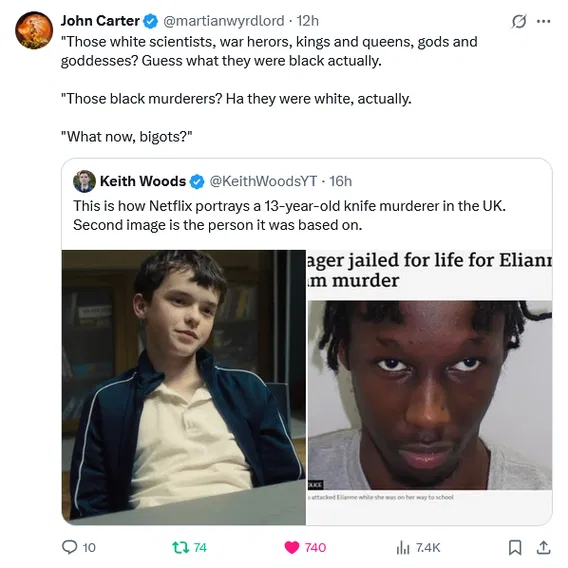
At Oxford Sour, Christopher Gage explains how a Netflix show ended up as a key exhibit in the British chattering classes’ latest crusade:
Under our Labour government, the dictionary of euphemisms has swollen to rival War and Peace. Each day mints a fresh brick of Lego Language — words pressed together into sentence shapes that feel moral without actually meaning anything. Euphemism is not just annoying speech; it is a habit of mind. The mouth that traffics in euphemisms aligns with the mind that thinks in euphemisms too.
Nowhere is this clearer than in Labour’s declared War on Misogyny. According to our betters, Britain is a scorched plain over which misogynists roam, knuckles dragging, hypnotised by Andrew Tate and the Manosphere. These creatures, we are told, stalk the land, muttering statistics about male athletic advantage like a swarm of demented Daleks.
Our Labour government, its approval rating currently three percent lower than the percentage of Brits who believe there is a monster living in Loch Ness Lake, will train teachers to spot misogyny in boys and send “high-risk” offenders to courses to “tackle the root causes of misogyny”.
Misogyny, however, is not a vibes-based category. The word comes from the Ancient Greek misos (hatred) and gunē (woman): hatred of women. Until recently, it described a pathological condition involving fear, control, and violence directed at women. Such brutal men exist. They always have. But are they representative of the average British schoolboy doom-scrolling through social-media nonsense? Press X to doubt.
Yet this is where the campaign now lands: in classrooms of adolescent boys, taught to interrogate their latent depravity before it has manifested. It is not behaviour being punished, but probability.
In a culture strapped to the algorithm, only the most extreme definitions float to the surface. The brain, trained by screens, learns to seek the sensational, the novel, the ludicrous. And so, Labour shapes its moral imagination on content rather than evidence.
The Netflix drama Adolescence perfectly captures this drift. For the unacquainted, the series — an incel murder story drugged liberally with “that Andrew Tate shit” — was received as revealed truth. For The Guardian, it was “the best TV show ever”. It was not. Even a semi-literate eye would charge Adolescence as, well … adolescent.
Nevertheless, Adolescence assumed the status of revealed truth. On a BBC news panel, Tory leader Kemi Badenoch was interrogated for admitting she had not yet seen it. Middle-class parents dutifully watched alongside their sons, scanning their offspring for signs of misogyny leaking from its gills. Fiction hardened into diagnosis.
Life now imitates social media. Labour’s plan to tackle misogyny appears lifted directly from the website formerly known as Twitter. Schools will teach boys that it is not acceptable to act like barbarians. One wonders who imagined otherwise.
What these awareness seminars will not address — naturally — are the forms of misogyny that are neither hypothetical nor algorithmically inferred, but routine, organised, and existing beyond a Twitter feed or a Netflix menu.
They will not dwell on forced veiling, female genital mutilation, so-called honour violence, or acid attacks — practices documented in Britain and overwhelmingly concentrated within small but electorally critical communities governed by brutal patriarchal codes.
A rational observer might reasonably conclude that such practices meet any serious definition of misogyny: not ironic hatred, not incel posturing, but actual coercion, violence, and control exercised over women’s bodies and lives. You know, the very domination that Iranian women (and men) are currently risking their lives — quite literally — to uproot.
Yet these realities remain untouched and unmentioned, whilst classrooms revert into courtrooms enlisted to pre-emptively correct the imagined sins of adolescent boys. The reason is not moral complexity but political convenience. Euphemism thrives where naming the problem would threaten electoral arithmetic.
And so, the language grows ever softer around real brutality, even as it hardens against boys whose only crime is to physically resemble a fictitious incel murderer on Netflix.
January 10, 2026
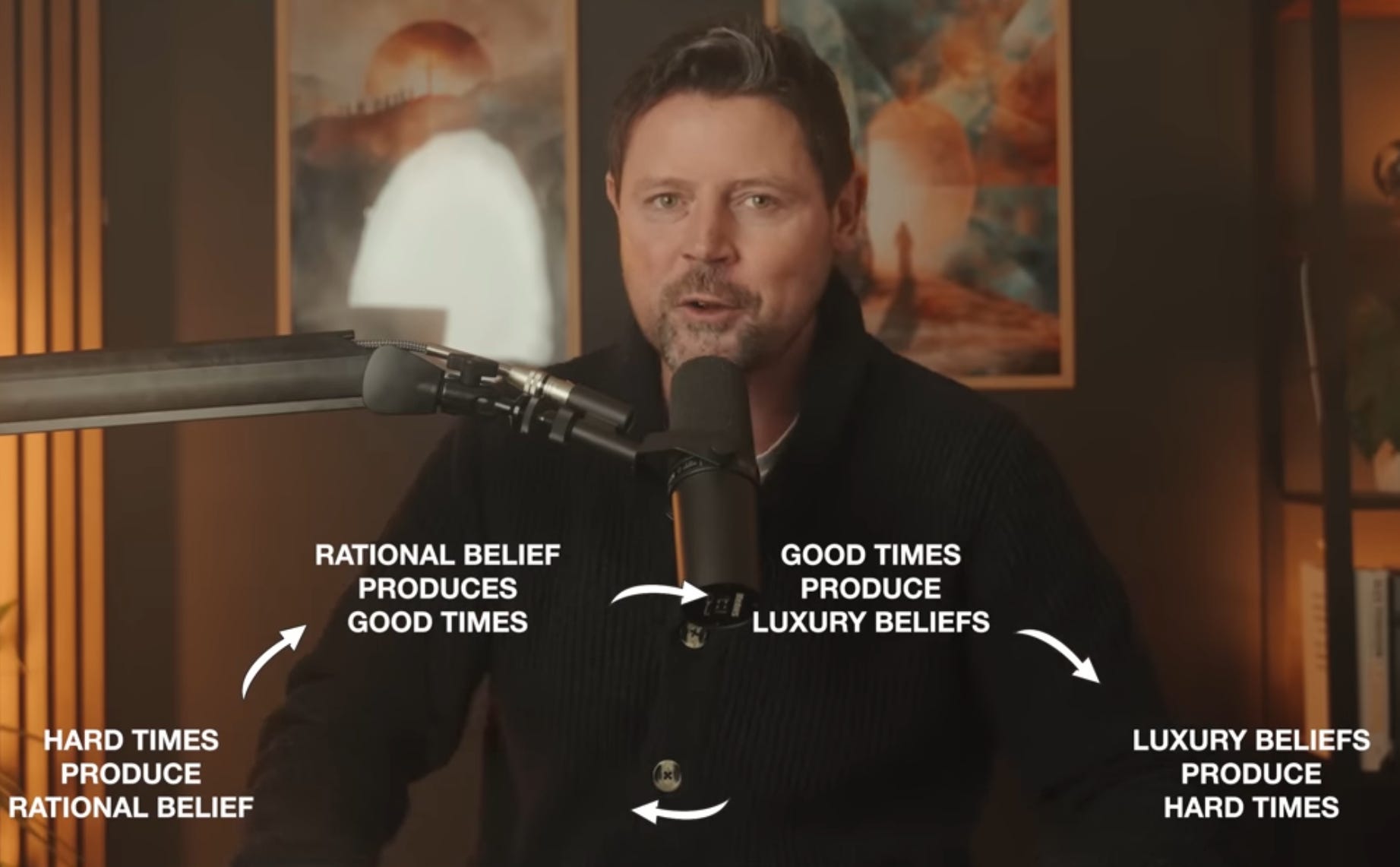
Luxury beliefs thrive when there is no personal cost for embracing them
Lorenzo Warby on the inevitable result of well-to-do people espousing luxury beliefs when there is no feedback mechanism to inform them of the negative impact of those beliefs:
Look at anyone making consequential decisions. Ask the question: what penalty do they suffer if they are wrong? That is, what are the consequences for them if they adopt a belief that is not true; if they make a decision hostile to human flourishing; if they retard the operation of the organisation or society around them.
For a horrifying number of people in our modern, highly bureaucratised, highly regulated, highly taxed, highly subsidised societies, the answer is: nothing. Nothing happens to them if they are wrong.
Note, this is different from the question of: did you follow the correct process? It is relatively easy for failure to follow the correct processes to have consequences. The what-if-you-are-wrong question also applies to: what if you follow the correct process and are wrong?
Source. A luxury belief is a belief insulated from reality-tests that there are social motives to adopt — e.g. as shared status play; as a resource or power grab — that imposes costs on others (typically, lower down the social scale).
The question of being wrong has lots of layers. Something can simply block good things from happening, but those good things’ lack of happening is typically invisible.
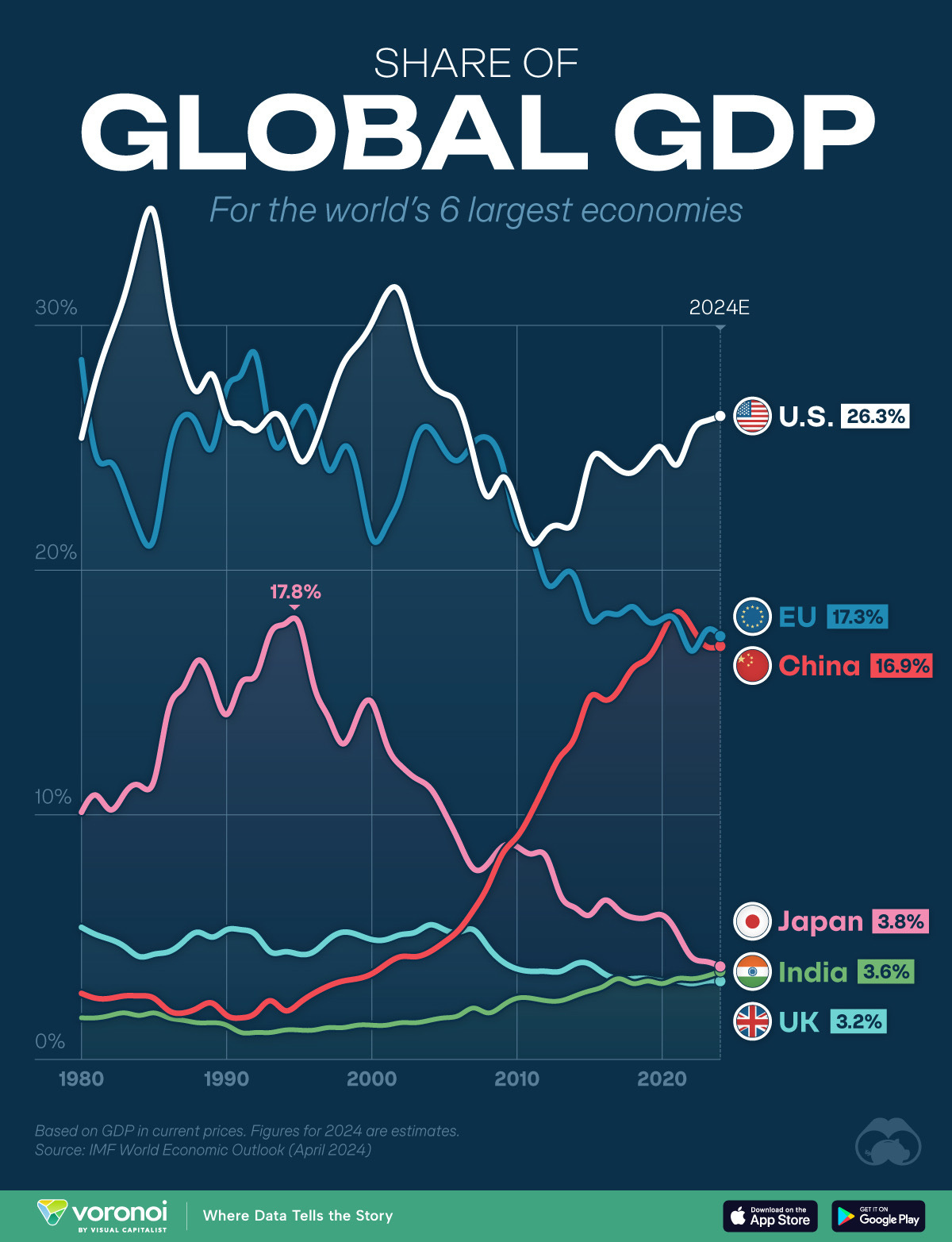
Economic stagnation is a normal condition of human societies, in large part because what is blocked from happening is invisible. Such has become more visible in the world since the 1820s, as mass prosperity has been demonstrated to be an achievable thing. Compare, for example, the post-2008 economic performance of the UK and much of the EU with, say, the US. But such is more visible only by comparison with other societies—we cannot directly observe good things that are blocked from happening.
Source. Japan shows the compounding effects of economic stagnation. Those of us who can remember the 1980s commentary on how the US needed to copy Japan can enjoy the irony and suggest caution about similar commentary re: China.
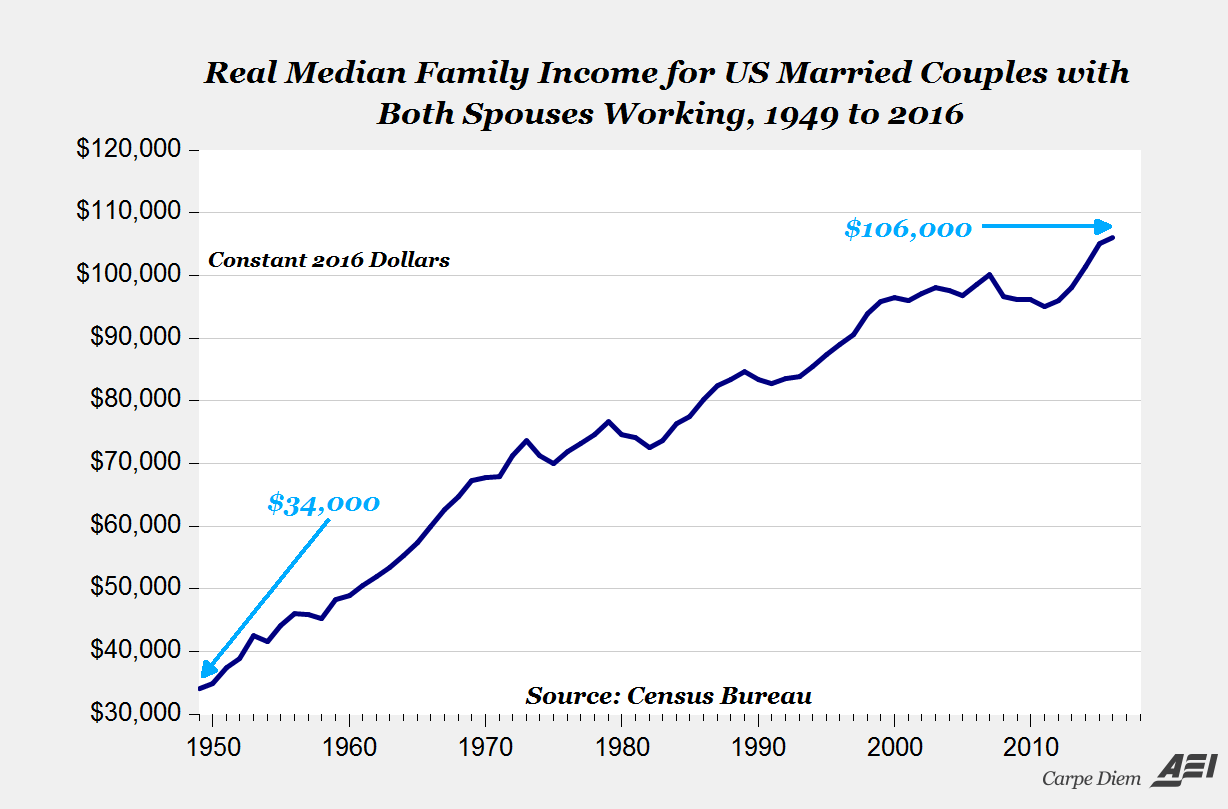
Even in the US, comparing the path of median incomes in different postwar periods shows that there has been a fair bit of blocking of good things from happening.
Moreover, comparison does not always resonate. People can not bother to compare or think that the comparisons do not apply. This time will be different has a great deal of wish-fulfilment appeal.
Across so much of modern societies, the what-are-the-consequences-of-being-wrong? question has the horrifying answer of no consequences to the person being wrong. (Real consequences, but very delayed, is not much better.)
I have already discussed this no consequences for being wrong with regard to the universities. But the same point applies across much of the non-profit world, the apparatus of the welfare state, etc. It applies intensely to UN bodies.
January 4, 2026
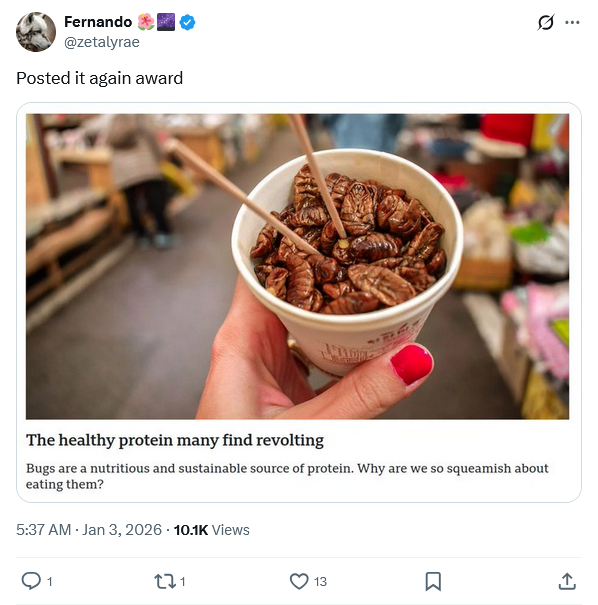
“You will eat the bugs, peasant!”
On the social media site formerly known as Twitter, ESR reacts to yet another “bugs are yummy, peons, you are going to eat them” post:
Contemplating this picture, I had a realization about the people who want you to eat bugs.
The fact that the bugs are disgusting to you is the whole point. Enlisting you as the principal enforcer of your oppression is the program. Fucking with your head is the actual goal, not just a tactic.
It doesn’t matter whether or not Western prejudice against eating insects is irrational. In an alternate world where we routinely eat insects, the people who want you to eat the bugs would find some other kind of disgusting garbage and play to make you eat it.
Because this isn’t sustainability or any of that bullshit. The degradation is the point.
However, even the powers-that-be can’t magically create economic conditions in which insect factories earn profits:

In the renewable frenzy of the early 2020s Ÿnsect raised €600 million to “Reinvent the food chain” and pioneer alternative foods that “respect the planet’s boundaries”. Some $200 million of their funding came from hapless taxpayers somewhere. But in record time, seemingly before it began, it has already gone. Bankrupted. And not because people don’t want to eat mealworms (which they don’t) but because there wasn’t much market in making animal feed either. It turns out that farm owners didn’t want to spend 2 to 10 times as much on “sustainable” cattle fodder. So the company shifted focus to high end pet food, where besotted owners have money to spare, but that crashed too.
h/t Tom Nelson
How reality crushed Ÿnsect, the French startup that had raised over $600M for insect farming
By Anna Heim, TechCrunchThe company’s demise is hardly a surprise, as Ÿnsect had been embattled for months. Still, there is plenty to unpack about how a startup can go bankrupt despite raising over $600 million, including from Downey Jr.’s FootPrint Coalition, taxpayers, and many others.
Ultimately, Ÿnsect failed to fulfill its ambition to “revolutionize the food chain” with insect-based protein. But don’t be too quick to attribute its failure to the “ick” factor that many Westerners feel about bugs. Human food was never its core focus.
It’s only money …
And revenue was the problem. According to publicly available data, Ÿnsect’s revenue from its main entity peaked at €17.8 million in 2021 (approximately $21 million) — a figure reportedly inflated by internal transfers between subsidiaries. By 2023, the company had racked up a net loss of €79.7 million ($94 million).
The vainglorious heady days of climate communism meant some bureaucrats thought it made sense to spend $200 million dollars feeding bugs to cows to try to change rainfall in 2100 AD.
January 3, 2026
QotD: “Fumbling towards bicameralism”
And yet, “self-deception” shouldn’t be possible. How can you lie to your self? It raises all kinds of heavy epistemological issues, explored in a fun little book called Self-Deception by philosopher Herbert Fingarette. As I recall (it has been years since I’ve read it), Fingarette ends up advancing a kind of split-consciousness theory, too, as the only internally consistent one. How could it be otherwise? The “liar’s paradox” is a fun little game to play in the first class meeting of Logic 101, but nobody can really live that way … and yet we do deceive ourselves, all the time, and no one more than SJWs, whose lives indeed seem to be nothing but “self-deception.”
Bicamerality explains that. The “god” that lives in the smartphone says X today, so X it is. That same “god” says not-X tomorrow, so now it’s not-X! It’s not self-contradiction, it’s not self-deception, for the simple reason that there’s no real “self” at all.
Finally, it explains what might be the most frustrating thing about the Left, the thing that’s likely to end in a nuke or two here before too long: Their utter inability to see the glaringly obvious consequences of their actions. Those of us who tend to see “Leftism” as a big conspiracy love to point out that if they, the Left, were just stupid (childish, contrarian, herd animals, whatever), cold impersonal chance alone would guarantee that at least some of their fuckups would benefit us at least some of the time. Much like The Media’s “retractions” and “admissions” and so on, the “mistakes” always always always go in only one direction … ergo, they’re not mistakes.
That’s the reef on which we “emergent behavior” types always crash. To me, “emergent behavior” still seems like the best explanation … but however the behavior emerges, it’s always retarded. They’ve never made a non-stupid decision, not once, and it’s always stupid in exactly the same way. I remember waking up one morning to the sound of something crashing into my bedroom window. I figured it was a bird, which happens all the time, and it was … except that it kept happening, monotonously, every fifteen seconds or so. I got up to look, and here was a robin, smashing itself into the glass over and over and over again. It was early spring — mating season — and this stupid robin had mistaken its own reflection for a rival. I must’ve watched this bird slam himself into the glass for ten minutes, “attacking” his “rival”, before he knocked himself out cold …
That’s how the Left do. Always. They simply can’t learn, and they can’t change their pattern. The only explanation for that, therefore, must be that it’s programmed. Literally. Zero consciousness involved. They do what they do because they literally cannot do otherwise. Their “god” has put “rage” into their thumos. Just as Achilles would’ve literally jumped off a cliff had his “god” told him to, so the Left does … well, pretty much everything their teevee tells them to.
Needless to say, this has some important implications for practical action. How does one “get inside that OODA loop”, as the keyboard commandos like to say? In the land of the utterly unconscious, the one-brained man is king …
Severian, “Striving Towards Bicamerality”, Founding Questions, 2022-03-20.
Update, 4 January: Welcome, Instapundit readers! Please do have a look around at some of my other posts you may find of interest. I send out a daily summary of posts here through my Substack – https://substack.com/@nicholasrusson that you can subscribe to if you’d like to be informed of new posts in the future.
December 24, 2025
Welcome to Bland World
Ted Gioia yearns for the return of the weirdo, the eccentric, and the non-conformist to spice up our bland, smooth, grey world:
“People are less weird than they used to be,” claims psychologist Adam Mastroianni. He describes this as “an epidemic of the mundane”.
The strangest thing, he believes, is absence of strangeness. Nobody wants to make waves — or even trickles. Conformity is the flavor of the month, and it tastes the same every month.
We live in a “smoothness society”, explains philosopher Byung-Chul Han. He points to the smooth, rounded contours of the iPhone as a symbol of society’s desire to remove friction. Our phone apps demonstrate the exact same thing. We scroll and swipe with such ease, and anything with complexity, nuance, or resistance is eliminated from consideration.
“The smooth is the signature of the present time”, he claims. Everything from the Brazilian wax job applied to human bodies to the wax coating put on fruits and vegetables aims at the same ideal.
Resistance is futile. Everything must be smooth. Paradise now really is that paved parking lot.
In a world without complexity or resistance, nothing ever changes. Most movies, music, books feel like stagnant rehashes of the same formulas. And that’s intentional.
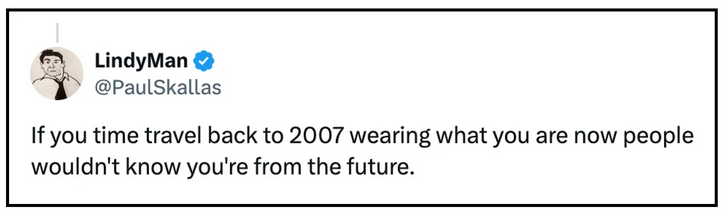
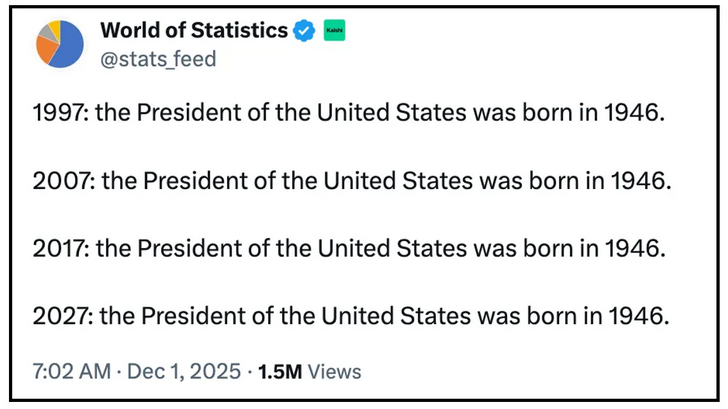
For the first time in history, fashions don’t change. We don’t change.
Others have noticed this avoidance of anything new or different. Things are designed to blend in, not stand out. Jessica Stillman, writing in Inc., complains about a “blandness epidemic“. Brian Klaas calls it the “surefire mediocre“.
Everywhere you look, the system is serving up more of the same.
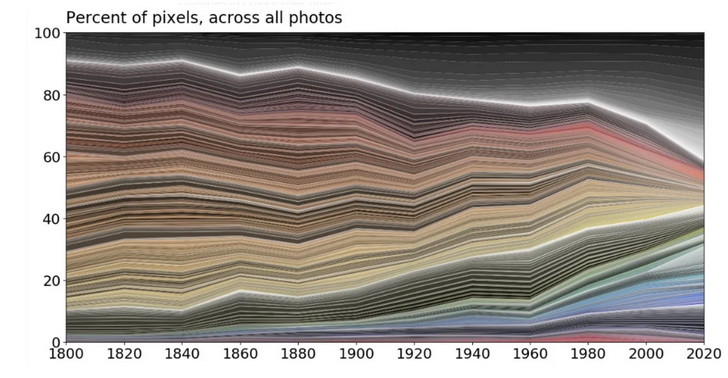
It’s not just in our imagination — the “world really is getting grayer“. A researcher recently studied photos of household items going back two centuries. An analysis of the pixels showed a scary collapse in color.
Even the Victorians — often considered as conformists — lived a more color-filled life. We have almost completely abandoned red and yellow and other bright hues in favor a boring black-and-white spectrum.
But what’s most striking is how this descent into grayness has accelerated during the last few years. The most popular color is now charcoal — and at the current rate it will soon account for half of the marketplace.
December 19, 2025
QotD: “1998 was the official start of the Girlboss Era”
Paltrow seemed to arrive on the scene having everything and wanting for nothing.
Funny, that’s also the most accurate description of an AWFL ever penned. Who the hell are they, and where did they come from? How do they have the free time and endless disposable cash to do literally every single thing they do?
In 2001, she promoted Shallow Hal — in which she played Rosemary, an obese woman whose “inner beauty” is only visible to Hal (Jack Black) — by talking about doing practice runs in her character’s fat suit. “I got a real sense of what it would be like to be that overweight, and every pretty girl should be forced to do that.”
Wait, this is supposed to be a hit piece? Because that might be the most sensible thing I have ever heard a woman say. Yes, definitely they should be forced to do that, if not the full Norah Vincent. If you’re halfway presentable, ladies — hell, if you’re not grossly deformed — you’re playing life on “God mode”. Look at all the simps in your social media feeds, and tell me I’m wrong. Being forced to go around in a fat suit for a week or two is a necessary corrective.
Paltrow’s first big trip on the Hollywood hater-go-round was 1998, the year she won the Best Actress Oscar for Shakespeare in Love and gave a memorably messy, genuinely emotional acceptance speech. (Days after her win, Salon was among many outlets eviscerating her.) What viewers didn’t see, Odell notes, is the amount of effort by Miramax head Harvey Weinstein to make Shakespeare a winner, raise the profile of his still-independent studio, and solidify his belief that Paltrow belonged to him.
I’m going to stop here, because there’s really no point. I just wanted everyone to remember Shakespeare in Love. You do remember Shakespeare in Love, don’t you?
Of course you don’t; it was silly and forgettable at the time, and now is remembered, if at all, as a bizarre footnote — it’s the movie that won Best Picture over Saving Private Ryan. From the perspective of 2025, then, it sure looks like 1998 was the official start of the Girlboss Era.
Severian, “Kvetching Up With Karen: DC Edition”, Founding Questions, 2025-08-14.
December 18, 2025
QotD: Reserved for women
Tears do help, no matter what the cynics say. The resilience and longer life of women probably are due to our ability to clear supercharged emotional atmosphere with occasional violent storms.
The symptoms follow a pattern. For days you feel low. You mope, and worry over nothing. Then some little upset comes and you hit bottom. Waves of misery wash over you. They flatten you out.
Then grief grips your soul and sobs rack your body. When ended it’s as if you were born again. The good old “I’m alive” feeling floods your being. You wash your face, and powder your nose and for the next six months the family can expect reasonable behavior from you. Such outbursts are better than a bottle of drug store tonic for feminine nerves.
Men, poor things, can’t have such a release for fear of becoming softies. Instead, they indulge in profanity, which is a poor substitute for tears.
They mention their great achievements with pride, but not one ever emerged from months of discomfort and pain, clasping a live baby.
Life’s high moments are rare and brief. And God saved the best for us.
“Nonsense,” I can hear the realists say. “Babies are a commonplace biological fact.” Which proves that they talk nonsense, for every woman knows that her baby is a miracle made of Heaven-spun dreams.
Mrs. Walter Ferguson, “Reserved for women”, The Pittsburgh Press, 1946-09-17.
December 14, 2025
Andrea Dworkin – feminism’s anti-sex evangelist
On her Substack, Janice Fiamengo examines the life and work of Andrea Dworkin, whose influence on modern feminism is still quite strong, twenty years after her death:

A friend wrote a couple of days ago to say that he had seen shiny new copies of works by feminist author Andrea Dworkin (1946-2005) in Munro’s Books, one of Canada’s premier independent bookstores. One of the books was positioned on a shelf with the cover facing out to indicate that it was being showcased.
It is both shocking and unsurprising that Picador Books decided to reprint three of Dworkin’s texts in the past year, calling her a “prescient and visionary writer” who was “ahead of her time”. Anti-male paranoia is a sanctioned, cultivated taste more popular now, perhaps, than ever before, and Andrea Dworkin is its most notorious propagandist.
Known for her physical bulk, impassioned rhetoric, unkempt hair, and lesbian-identified overalls, Dworkin was a feminist icon in the 1980s and 90s, loved and hated in equal measure. No one did more to outline and consolidate the modern feminist understanding of sex than she, writing on the subject obsessively and with unparalleled fervor in books with titles such as Woman Hating (1974) and Pornography: Men Possessing Women (1981). The MeToo movement is almost unimaginable without the influence of Dworkin’s pronouncements.
Like other radical feminists, Dworkin wrote about rape, pornography, and prostitution, but her special focus was the degradation for women of sex itself: regular sex, the commonly accepted, normalized indignity that men allegedly inflict on women every day. Tempering her words in the white-heat of her revulsion, Dworkin became feminism’s anti-sex evangelist.
Sex, Dworkin believed, embodied nothing less than men’s hatred of everything female: “Intercourse is the pure, sterile, formal expression of men’s contempt for women” (p. 175). This is the thesis of her most representative book, Intercourse, which was first published in 1987 when Dworkin was 41 years old. Dworkin’s characterization of heterosexual sex as the ultimate enactment of misogyny has had an enduring impact on North American culture.
Intercourse set out to illuminate, through select readings of literary texts, what Dworkin believed to be a constant of male culture: the “hatred of women, unexplained, undiagnosed, mostly unacknowledged, that pervades sexual practice and sexual passion” (pp. 175-76). The phrase she most often used in the book to refer to intercourse was “the fuck”, which was meant to signify the raw dehumanization that supposedly characterized it.
Dworkin nominated herself the expert on male contempt for women because she had been its victim. “Specifically, am I saying that I know more than men about fucking?” she asked defiantly in the book’s preface, and answered, “Yes, I am […] the way anyone used knows the user” (p. xxxi).
While she also claimed in the preface that the book “does not say that all men are rapists or that all intercourse is rape” (p. xxxii), she does essentially say that, if not in quite those words. As she asserted only a page after the denial, “Intercourse conveys […] what it means that men — and now boys — feel entitled to come into the privacy of a woman’s body in a context of inequality” (p. xxxiv).
In another segment, she clarified that most, even the vast majority, of men were sexually abusive. She charged that men object to feminist criticism of pornography and prostitution because “So many men use these ignoble routes of access and domination to get laid,” that “without them the number of fucks would so significantly decrease that men might nearly be chaste” (p. 61). The implication was that men who objected to her arguments about the omnipresence of sexual exploitation were themselves sexual abusers who didn’t like the thought of their exploitation being curtailed.
This was the Dworkin who made feminists swoon with admiration: bombastic, hyperbolic, and incandescent with accusatory rage.
A Fire Upon The Deep and the Identity Gradient
Feral Historian
Published 8 Aug 2025Vernor Vinge’s A Fire Upon The Deep would take a two-hour video to completely dissect. This is not that video. Instead, I’m looking just at the recurring ideas of collective identity and distributed consciousness. And all without a single mention of Skroderiders.
This one has been sitting around for about a year, due to lack of b-roll to cover the numerous jumpcuts due to my rambling and the rather persistent flies on that particular day. It’s a little rough, but let’s just roll with it.
(more…)
December 11, 2025
Your words are violence to an astounding 91% of US college students surveyed
J.D. Tuccille presents some depressing poll results from American college students who have massively bought into the illogical position that words can be the same as actual violence:
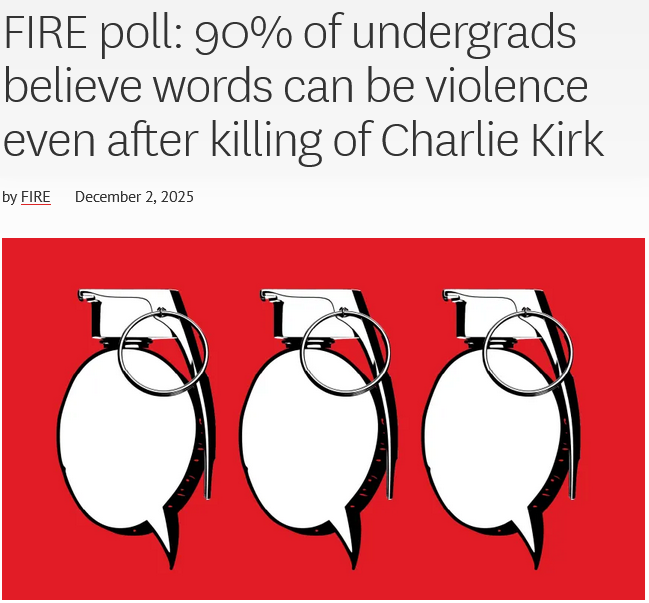
Of all the stupid ideas that have emerged in recent years, there may be none worse than the insistence that unwelcome words are the same as violence. This false perception equates physical acts that can injure or kill people with disagreements and insults that might cause hurt feelings and potentially justifies responding to the latter with the former. After all, if words are violence, why not rebut a verbal sparring partner with an actual punch? Unfortunately, the idea is embedded on college campuses where a majority of undergraduate students agree that words and violence can be the same thing.
Most Believe Words Can Be Violence
“Ninety one percent of undergraduate students believe that words can be violence, according to a new poll by the Foundation for Individual Rights and Expression [FIRE] and College Pulse”, FIRE announced last week. “The survey’s findings are especially startling coming in the wake of Charlie Kirk’s assassination — an extreme and tragic example of the sharp difference between words and violence.”
The survey posed questions about speech and political violence to undergraduate students at Utah Valley University, where Kirk was murdered, and at colleges elsewhere — 2,028 students overall. FIRE and College Pulse compared the student responses to those of members of the general public who were separately polled.
Specifically, one question asked how much “words can be violence” described respondents’ thoughts. Twenty-two percent of college undergraduates answered that the sentiment “describes my thoughts completely”, 25 percent said it “mostly” described their thoughts, 28 percent put it at “somewhat”, and 15 percent answered “slightly”. Only 9 percent answered that the “words can be violence” sentiment “does not describe my thoughts at all”.
It’s difficult to get too worked up about those who “slightly” believe words can be violence, but that still leaves us at 75 percent of the student population. And almost half of students “completely” or “mostly” see words and violence as essentially the same thing. That’s a lot of young people who struggle to distinguish between an unwelcome expression and a punch to the nose.
Depressingly, 34 percent of the general public “completely” or “mostly” agree. Fifty-nine percent at least “somewhat” believe words can be violence.
In 2017, when the conflation of words and violence was relatively new, Jonathan Haidt, a New York University psychology professor, worried that the false equivalence fed into the simmering mental health crisis among young people. He and FIRE President Greg Lukianoff wrote in The Atlantic that “growing numbers of college students have become less able to cope with the challenges of campus life, including offensive ideas, insensitive professors, and rude or even racist and sexist peers” and that the rise in mental health issues “is better understood as a crisis of resilience”.
Conflating Words and Violence Encourages Violence
Telling young people who haven’t been raised to be resilient and to deal with the certainty of encountering debate, disagreement, and rude or hateful expressions in an intellectually and ideologically diverse world plays into problems with anxiety and depression. It teaches that the world is more dangerous than it actually is rather than a place that requires a certain degree of toughness. Worse, if words are violence it implies that responding “in kind” is justified.
“At a time of rapidly rising political polarization in America, it helps a small subset of that generation justify political violence,” Haidt and Lukianoff added.
QotD: Being a bore
My problem is that I have two modes of socializing: to be silent or boring. I cannot make small talk, for when I try to do so my words turn to dust in my mouth, as it were, before I have even uttered them. I can talk only on matters of impersonal interest.
My problem is that I am a serial monomaniac, with one subject occupying the foreground of my mind for up to a few months. In the midst of my enthusiasm, I cannot imagine that other people are not as fascinated by the subject as I. The subject of my monomanias are various: Haitian history; the disappearance of the cuckoo from the English countryside; the life of Caradoc Evans, the Welsh writer of the early part of the 20th century; etc. I never stick with anything long enough to be a scholar of it.
When my wife kicks me under the table, it is usually in mid-anecdote. I cannot stop straightaway, abruptly, for that would look peculiar, as if I were having a fit or a stroke. But I have to bring it to a quicker end than I had anticipated, omitting details that to me had seemed choice and amusing. Often, I have to admit, my wife has heard them before.
Of course, I don’t agree that I am being, or have ever been, boring. Bores don’t know that they are boring, just as people with halitosis don’t know that their breath smells. I look at the people around the dinner table and think they are glued to what I am saying. The fact that I don’t really give them any alternative doesn’t occur to me. How, in any case, could anyone be uninterested in the story of le Roi Christophe who built, or had built, one of the wonders of the world, La Citadelle, near Cap-Haitien, or of how people threw bricks through Caradoc Evans’ windows, so disgusted were they by his literary portrayal of his countrymen? In those days, literature was important.
Theodore Dalrymple, “Full Bore”, Taki’s Magazine, 2020-05-29.
December 7, 2025
The great military leaders of the past have been … quirky
On the social media site formerly known as Twitter, @InfantryDort considers the clear evidence that most of the greatest generals of history were, at the very least, eccentric:
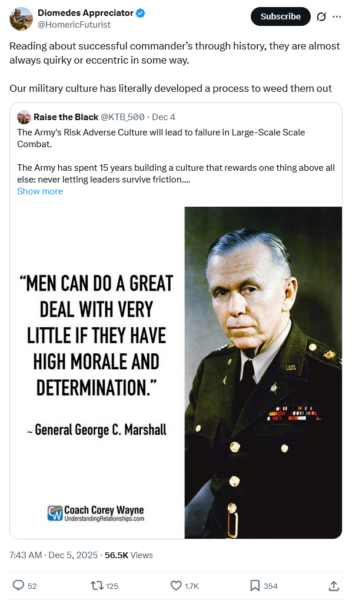
Most real post I’ve seen all month.
Yes, the process weeds them out.
Until all that remains is some corporatized astroturfed version of … whatever.
Military commanders in the modern era MUST lack personal audacity to some degree. Almost without exception.
Because audacity is “dangerous”. It can be unpredictable. And this is a bad thing in a world obsessed with safety and predictability.
But a military without it, is just one on anti-depressants. You never feel the highest highs or the lowest lows.
You just … exist, in inspirational purgatory.
So you will never see a Napoleon, Patton, Allen, or Sherman ever again.
Their modern equivalents mostly got out as captains because the experience they were promised from history, is now covered in bubble wrap. Wearing a bib and a football helmet.
The modern military is devoid of both victory and defeat. A victory you aren’t allowed to win. A defeat you can explain away. Much of it is due to the American people themselves, and their disdain for violence. At least violence against what sane people classify as enemies.
We have a chance to take it back. A chance to return to glorious and sometimes unhinged leadership. But the rot is thick. And the Empire Strikes Back daily.
My infinite gratitude, and the gratitude of a fawning nation, will rest with those who display the force of will to make it happen.
And crush the corporatization of military leadership once and for all.
The world awaits. And one wonders if our country has the appetite for it all, short of an existential crisis in a war of national survival.
Update, 8 December: Welcome, Instapundit readers! Please do have a look around at some of my other posts you may find of interest. I send out a daily summary of posts here through my Substack – https://substack.com/@nicholasrusson that you can subscribe to if you’d like to be informed of new posts in the future.


