Unless you’re an engineer, then, friction works best as a metaphor for human interaction. Creativity, for instance. Lots of very creative folks have tried to describe the creative process. Stephen King (I think) came up with the notion of grit in an oyster — something gets under your shell and irritates you until something beautiful forms around it. I like that, but being a social guy I prefer the notion of friction. You spend your days rubbing against people (not like a Japanese businessman on a crowded train, you sickos); sometimes that friction sparks something. Maybe it’s friendship, romance, whatever; or maybe it’s a story, poetry, music. Whatever the spark catches on fire depends on the interests, training, and talent of whatever pile of tinder it lands on.
On the other hand, most people aren’t artistes, so a well-ordered society is a well-lubricated society (“ah so!” yells our Japanese businessman, and look, y’all, much like my poor old high school physics teacher, we’re just going to have to ignore the obvious sexual connotations for the sake of the lesson). “Better a false ‘good morning!’ than a sincere ‘go to hell!'”, the old proverb runs, and that’s because the false “good morning!” is social lubricant; it keeps the friction of living packed cheek-to-jowl with a bunch of strangers down to a manageable level.
That’s what that mystifyingly old-timey word “manners” really means. What the frustrated artistes of the 20th century decried as stultifying conformity is actually lubricant. You don’t do that whole bourgeois thing, maaaannn, because you like being a sheep; you do it because that’s what keeps your world from catching on fire. Replace enough false good mornings with sincere go to hells, and pretty soon you’ve got Chicago, Philadelphia, Bodymore Murderland …
Alas, modern prosperity enables the sandpaper people. If normal people oil themselves up with manners before they go out into the world, these freaks wrap themselves in sandpaper. The really gritty stuff, too, the real paint-strippers you load onto big belt sanders. The kind of assholes who make up elaborate pronouns for themselves and get theatrically mad on social media when normal people can’t figure out what the hell they’re talking about, for instance.
And in an at least Alanis-level irony, the sandpaper people do some of their most abrasive work by pretending, high school physics-style, that obviously frictive situations are frictionless. […]
And so it goes … except physics is a real thing that exists. Our high school teacher instructed us to ignore things like wind resistance in order to teach us the basics. We all knew there was a lot more than F=MA to answering even so basic a question as whether or not Mickey Mantle’s line drive cleared the fence. Not only do the sandpaper people not know that, they wouldn’t care if they did, because equations be rayciss. Alas for them — and us — friction is real. Ever seen a car engine catch fire? Too much friction for the lubricant to handle, and the lubricant becomes a fire accelerant.
Severian, “The Sandpaper People”, Founding Questions, 2022-01-03.
May 21, 2025
QotD: The sandpaper people
May 17, 2025
Learning racism in Japan
John Carter recounts how his views and opinions on racism changed while living for an extended period in Japan:
We started the conversation talking about the Shiloh Hendrix affair, but ultimately got onto the subject of the Land of the Rising Sun. As it turns out, Alexandru and I have both spent quite some time living in Japan, an experience which contributed to both of us becoming incorrigible racists. This is a very common occurrence: almost anyone who spends a significant amount of time living in a very different country will start to draw conclusions about the differences between human groups. Your levels of epistemic closure need to be extraordinarily high to avoid this.
When I first moved to Japan I was, in most ways, an unreconstructed liberal. I took the axiomatic precept of the Boomer Truth Regime – that stereotypes are both incorrect and evil, because all people are basically the same – more or less for granted. This was very easy for me to do: I’d grown up in a remote, homogeneously Anglo part of rural Canada, and while I’d had some degree of exposure to different ethne at university, this was during a period in which Canada was making a real effort to filter immigrants for quality, and most of the non-white, second-generation immigrants I interacted with were heavily westernized. I wasn’t unaware of cultural differences, but I generally assumed that it went no deeper than that, and that inside every human being there was a liberal Anglo struggling to break free.
Japan of course is a completely alien culture. Among the many profound differences with the contemporary West is that the Japanese are, famously, intensely and unashamedly racist, or “xenophobic” as it is usually framed. I was initially taken aback by how frank the Japanese could be about this, for instance by asking questions about me that were clearly in rooted in their stereotypical understanding of what young North American white boys were generally like. But there were two things about this experience that quickly made me stop and think. First, these questions were almost never hostile, but rather came from a place of genuine curiosity: they were simply trying to get to know me, which they would do by starting with a default mental picture and then testing to see if and how I conformed or departed from that picture so that they could update their model accordingly. Yet I had been assured my entire life, by every TV show, movie, and teacher, that stereotypes were always hateful! Second, a great many of their stereotypical assumptions about me were uncomfortably accurate. Yet I had been assured my entire life, by every TV show, movie, and teacher, that stereotypes were always wrong!
It didn’t take me long to get over this cognitive dissonance, which I resolved by the simple expedient of concluding that I’d been lied to by my culture, which is something that even then I’d realized happens a lot. This then gave me internal permission to observe the Japanese themselves, to notice the myriad differences in character and behaviour as compared to my own people, and to connect these individual level differences to their emergent societal consequences.
Learning racism in Japan is a humbling experience for a Westerner. I’ve travelled to a lot of different countries, and everywhere else I’ve either felt like my own people were basically on the same civilizational level (Europe), or at a noticeably higher level (South America). Japan is the only place I’ve ever been where I felt like an unlettered, uncouth, savage, stinky barbarian primitive one step removed from the cave – where it was obvious that my own people could learn quite a bit about how to comport themselves in a civilized fashion. Then again, at the same time, this taught me to value that very barbarism: it’s quite possible, as the Greek understood when regarding the Mede, to be overcivilized.
I could go on about this subject for hours, but I’ve got things I need to do today – like go to the gym and get some work done on other projects I’ve been engrossed in – and I wanted to get this out fast. In any case, I did go on about this subject for hours, with Alexandru and Phisto, so if you’d like to hear more about Japan you’ll just have to click through and listen.
May 16, 2025
For some reason, men who sleep around don’t want to marry women who sleep around
Young women who approach casual sex the way that young men do (or used to, anyway) are shocked to find that men don’t want to settle down in a long term relationship with a woman with a similar “bodycount”:
First of all, men are very different than women, but guys are also fairly simple creatures.
Here are the fundamentals, ladies …
If a man sees you as a potential match, is attracted to you, you feed him, seem to want to take care of him, you’re a good mom (if you have kids), have good sex with him, are nice to him, he enjoys talking to you and you genuinely seem to think he’s great, he will think he’s the luckiest guy on earth. The great thing about all of this is that it’s mostly under your control. Yes, you might have to dress up and have some open conversations about what the two of you like in bed, but it’s a doable list. Being 6’4′ or making $500,000 per year to get some woman’s attention may be outside of a man’s control, but if a man considers a woman relationship material, she is probably capable of locking him in if she wants to do it.
Of course, like everything else in life, there is some nuance involved here.
For one thing, good sex is a key part of a good relationship, BUT unlike a lot of women, men are also generally very comfortable with the idea of having sex OUTSIDE OF RELATIONSHIPS. A lot of men can enjoy sex with women they just met, women they know they’ll never see again, or even women THEY DON’T EVEN LIKE AS HUMAN BEINGS. Men just have a biological drive toward sex, the same way, for example, a lot of dogs have a biological drive toward prey. The second my dog sees a cat; she wants to chase it. If she catches up to the cat, she doesn’t even know what to do, but she does know she wants it to run so she can have the fun of running after it. It’s an innate drive for her and most men have that same kind of innate drive around sex, even though most of us never have the opportunity to fully express it.
[…]
For example, all other things being equal, just about every man would prefer a virgin to a woman with say 50 previous partners. Why? Well, in a man’s book, being promiscuous is a huge negative in a woman you’re interested in long term for reasons great and small, fair and unfair.
Like what?
Well, first and foremost, the traditional concern is that if she’s sleeping around, how do you know your child is yours? The last thing any man wants to do is get cucked and end up spending his life raising a child some other man impregnated his wife with right under his nose. Along similar lines, the more a woman has slept around, the more likely it is that she may cheat. After all, unless you’re the absolute peak of the pyramid for men, having sex requires a lot of effort and work. For women? Not so much. She’ll have easy opportunities every day of the week, probably multiple times per day, and if she feels comfortable sleeping around, can you trust her?
How easy is it? Well, once, I remember talking to a female friend of mine who had moved to another city, was lonely, and she complained to me that she “Just needed to get laid.” I laughed at her over the phone and told her something like, “All you have to do is dress up, go to a hotel bar, look for any attractive single man, sit next to him, and talk to him for 5 minutes, then ask him to take you up to his room. You’ll be having sex 5 minutes after. It’s that easy” – and it is, for women.
We can go on. Promiscuous women are statistically less likely to stay married. You also have to think they probably aren’t going to be as satisfied in bed if they’re comparing you to a large number of men. You know, “Well, Brett had that amazing 8 pack, Jimmy was really hung, Paul could go forever, and Todd did that really cool thing with his tongue, so how good is this compared to those guys?” Furthermore, it’s natural for men to want large numbers of female partners, but not so much for women, which usually means women who sleep around have issues. How many mentally healthy, happy women are racking up truly large numbers of guys? Not many.
May 13, 2025
For boys, sometimes a touch of competition is all that’s required
Jon Miltimore was concerned when a report from his son’s school indicated that his son was lagging behind in reading compared to his classmates:

“Old Victorian Childrens’ Books” by pettifoggist is licensed under CC BY-SA 2.0 .
So the fact that my own son — who is quite bright and scores extremely high in math — was struggling hit me a little, but it was not a surprise. Like many children, he had fallen behind in reading during the pandemic, and our efforts to get him caught up at home were pretty ineffective. Part of the problem was that as parents we did not do a good enough job of finding the right books to naturally kindle his interest and curiosity, but another issue was that at some point he began to feel self-conscious about this reading, which created an aversion to books.
[…]
A few months later, I had just finished reading a story to my 6-year-old son, who shares a bedroom with his older brother. I went to flick the light off when my older son said something I’d never heard before.
“Can I read for just ten more minutes,” he pleaded, showing me his book on pro football players.
I quickly gave my approval, then went downstairs to tell my wife. She was not as surprised as I was.
“They’re doing a reading competition at school. It’s boys against girls,” she said. “Every minute he reads is now added to their score. So now he wants to read — because it’s a competition.”
My wife did not say this disapprovingly, but she said it in a way that said of course he wants to read now. (My son is competitive.)
Over the next several weeks I watched as my son made a point of reading every night. Oftentimes he’d ask — just like on that first night — if he could read just 10 more minutes. Many nights he’d fall asleep with a book on his chest.
I have to admit that at first I found this strategy a tad cynical, but then I got the results. Over the span of seven weeks, my son leapt nearly two reading levels. He’s reading comfortably at the third-grade level and we’re now focusing more on reading comprehension than reciting sentences. He’s asking for books on World War I, World War II, and Vietnam for Christmas.
“His fluency has improved so much! I am so proud of him,” his teacher later told me.
Competition as a Virtue
I don’t doubt that some will look on this strategy with disdain.
We’re taught today that competition is crass, even harmful. George Soros, in a highly read piece from the 1990s published in The Atlantic, could have been speaking for many when he wrote that competition can “cause intolerable inequities and instability”. For many, competition is a dirty word, a sinister force to be suppressed and controlled.
This is nonsense, of course. Competition isn’t just innate to humans; it brings out the best in us.
It’s the force that drove Roger Bannister to break the four-minute mile. It’s given us the achievements of Michael Phelps and Michael Jordan. Socially, competition is what prompted the Brooklyn Dodgers to do the unthinkable and sign Jackie Robinson, breaking the color barrier and forever changing sports and America.
May 6, 2025
QotD: World War I shattered the European notion of what “war” actually was
Echoes of those views continue to appear in western literature until the impersonal carnage of the Western Front seem to finally snuff them out. But it isn’t that the generations and generations before 1914 had never experienced war, but that war had changed.
We’ve actually talked before about just how profoundly our modern view of war and battle (and battlefields) is conditioned by the experience of the first world war and the vast literary production of the generation that went through those trenches. Certainly for English (and German and French, etc.) literature, World War I seems to almost snap the tradition in half, making everything before it feel trite and washing the whole of war literature in grim tones of field grey.
And, of course, that is the point. World War I was a new kind of war that shattered the old certainties born out of the old kinds of war. It is often a mistake to assume those old certainties had been born out of some eternal peace, but while the 1800s had not seen a general European war, they had seen many wars, in the many imperial possessions of European countries, on the edges of what the British or French considered “Europe” and also in the heart of Europe itself (not to mention a few dust–ups in the Americas). These were not peaceful societies confronting their first war and shocked by the experience, but very bellicose societies encountering for the first time a new sort of war and being stunned at how different it was from what they had expected, from the wars of their (recent!) past.
All of which is to say war, war really does change. And warriors with it.
Bret Devereaux, “Collections: The Universal Warrior, Part IIb: A Soldier’s Lot”, A Collection of Unmitigated Pedantry, 2021-02-05.
May 4, 2025
QotD: Women and depression
Why wouldn’t powerlessness cause depression in women too?
Well, in a backwards sort of way it actually does.
The difference is this: women feel powerful when they are loved, and powerless when they are not, because their instinct wiring tells them that safety lies in being able to form social coalitions and attract a strong mate.
Women, in general (there are always outlier exceptions) don’t get major antidepressive help from just going outside and chopping up a cord of firewood, the way men do. Because the woman’s game is to give a man a good reason to chop firewood for her.
It’s when she can’t do *that* that she feels powerless.
ESR, Twitter, 2024-05-06.
April 29, 2025
April 16, 2025
April 7, 2025
Confessions of a book-hoarder
In the latest SHuSH newsletter, confessed book-hoarder Ken Whyte has a confession to make:

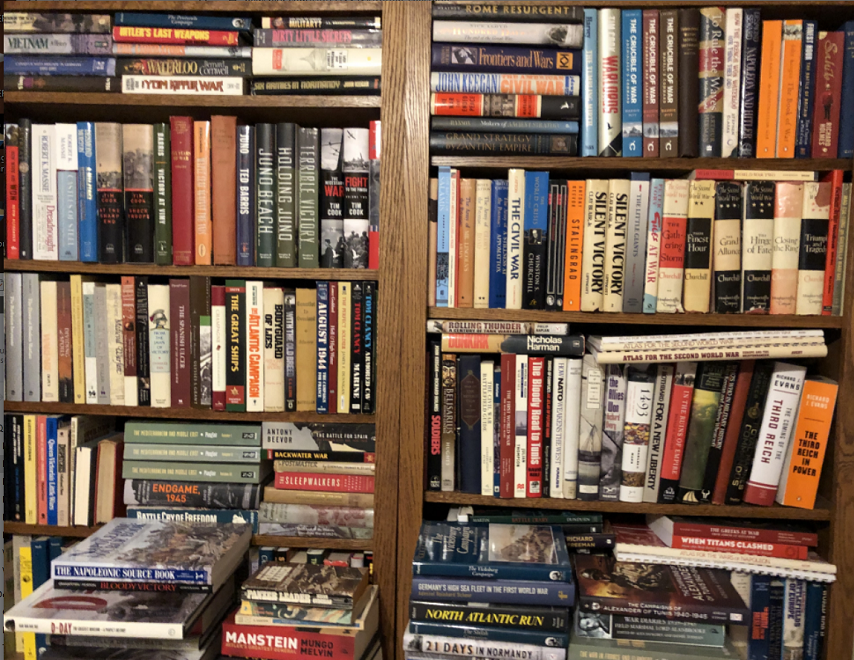
A small portion of my own book hoard. These shelves at least have a bit of commonality to them, unlike a lot of other shelves I could share.
I’ve been trying to reduce my hoard of books in recent months and it’s not going well.
And let’s be clear, it is a hoard, not a collection. A collection implies the books were selected with deliberation; that they are organized around subjects, themes, authors; that they are displayed with care. In a word, curated.
My books have been accumulated over time, some for work, some for pleasure. More were acquired impulsively than purposefully. Most people would not discern any organizational principles on my shelves. The fiction tends to be separate from the nonfiction, and books I’ve used to write books of my own tend to be grouped together, but not always. Hardbacks are mixed with paperbacks. I have some first editions that may be moderately valuable, although I’m not positive about that and I’ve never checked.
The hoard has been culled on occasion, usually in response to domestic complaints. The last major cull was a decade ago and since then I’ve been on a book diet, meaning that I can’t bring a new book home without getting rid of one already there.
I cheat on my diet all the time.
This part of the post could just as easily have been written by me … except that my sudden ejection from working life ten years back put me on an involuntary book-buying hiatus. From my peak buying years where I’d be accumulating multiple volumes per week, I was down to less than half a dozen new (or new-to-me) books through all of 2024.
That I’ve enjoyed a surplus of space for most of the last six years — the Sutherland House office is just two blocks from home — has abetted the cheating. The first week I took possession of the office, I lined it with solid metal shelves in optimistic anticipation of Sutherland House books to come. A good number of those shelves soon filled with boxes of personal books I could no longer keep at home and couldn’t bring myself to dump (along with a rather impressive archive of materials related to the founding of the National Post relocated from home to office for similar reasons).
Now Sutherland House is producing more books in one year than we produced in total over our first three years, and there are more of us in the office. Space is getting tight. I’ve been telling myself every weekend since before Christmas that I need to reduce the hoard.
It should not be difficult to jettison a quarter, a third, or even half of an impulsively amassed, haphazardly organized pile of books. You just face the shelf and pull out the ones you least want to keep. First to go are the never-cracked: anything that’s been sitting on the shelf for more than a decade without an attempt at reading. Next, books you’ve read and you know you’ll never want to read again. Then the yellowest paperbacks. Those three rules alone ought to get rid of half.
On a Saturday afternoon in mid-March. I faced a bookcase of eight shelves with about forty books per shelf. I challenged myself to get rid of one book for every book I kept. An hour later, I had half the books on the floor. Hurrah.
The next step was to put the unwanted books in boxes and haul them away.
They’re still sitting on the floor.
[Raises hand sheepishly] Yeah, I’ve got a few piles of books in various rooms of the house that failed the initial culling, yet somehow never made their way to the next stage of leaving the house.
I walk past them regularly and doubt my choices. I ask myself what harm would come from putting them all back on the shelves — makes more sense than leaving them on the floor. I wonder if a better solution to my storage problems wouldn’t be more shelves, or a storage locker.
I’ve read all the reasons why it’s difficult to get rid of books (or records, or art, or collections or hoards of any variety). The individual objects are companions, the scaffolding of your intellectual and emotional life, tokens of time, experience, identity, aspirations. Psychologists talk of loss aversion, the endowment effect that makes things feel more valuable simply because you own them, and the sunk-cost fallacy that leads you to hold onto and keep investing in things because you’ve already invested in them.
None of that makes me feel any better about my hoard (or the more than 10,000 photos and 30,000 emails I have on my laptop). The psychological explanations are just embarrassing.
When I’m levelling with myself, I can admit there are less than a hundred books I own where it genuinely matters to me to keep my particular copy. The rest are fungible. I freely admit that if I were to later miss any individual title I discarded, I could chase down a replacement in a day (in a minute electronically) at modest expense.
It used to matter to me to be surrounded by books in my living space. Now that I’m surrounded by books in my work space, not so much. For every instance when I spot a title on a shelf at home and think I really want to read that one someday, there are many more instances when I look at a whole shelf and think I’m never going to read any of these—they’re just taking up space. And I have a dust allergy, for christ sake.
Yet I can’t seem to do anything about it.
March 29, 2025
QotD: Becoming a human being
“So how does it feel to be a human being now?” That wasn’t the question I expected to get from my aunt, the first time I saw her after my oldest kid was born. For starters she was a feminist, a prominent academic1 with several books to her name, and somebody who’d always struck me as mercilessly unsentimental. “Do you get it now?” she pressed on. “Before this your life was in shadow, it was fake. Now you’re in the sunlight, now it means something.”
She had kids, so despite having some ideological resistance to getting it, she got it. I got it too. It’s hard to describe what “it” is if you haven’t gotten it, but I’ll try to explain. The moment I first held my child, I had a vision of every human being who had ever done the same. I stood paralyzed, rooted to the spot while before my eyes a whole field of ancestors stretched back into the forgotten past, each cradling a baby just like I was doing. What was I without them? Nothing at all. A cosmic joke, a fluke, or a random collection of atoms. But with them, I was one stage of a process, a chapter of a story.
And not only that, but I was also no longer alone. It had always seemed to me that the problem of intersubjectivity could never be conquered, that between minds there yawned an unbridgeable epistemic chasm. Yet here was an experience that I shared with countless others from the most varied places and times, an experience I shared with emperors and with slaves. André Maurois once said: “Without a family, man, alone in the world, trembles with the cold”. I had always thought he meant this in a practical, or perhaps an emotional sense, but I now realized it was even truer cosmically. I had, as my aunt said, become a human being.
I didn’t just see the past. In that moment, the future also resolved itself into dreadful clarity. I had always known intellectually that someday I would die, and that the world would continue mostly as it had, but I never really believed it. Anything beyond the horizon delimited by my lifetime had been hazy and indistinct. Not anymore. Now I regarded the newborn squirming in my arms, and knew with absolute certainty that if things went well this child would bury me, and then continue living. Suddenly the far-future mattered, I had skin in the game now. I was no longer a temporal provincial, past and future both had an immediate and urgent reality, and I knew that I would never think the same way about them again.
John Psmith, “REVIEW: The Children of Men by P.D. James”, Mr. and Mrs. Psmith’s Bookshelf, 2023-04-17.
1. This was in the days before cancellation, I’ve often wondered since then whether she would have allowed herself to think the thought today.
2. It also caused me to wonder whether people without living descendants should be permitted any political representation at all.
March 28, 2025
Mistaking popular fiction for real life
At Postcards from Barsoom, John Carter recounts an odd but revealing experience with a young progressive entity:
Some years ago I was provided a fascinating psychological experience in the form of a young graduate student in the English literature program, whom I encountered because they (you heard me) was (God that’s grammatically awkward) married to a colleague. She (I’m not doing this anymore) specialized in the study of propaganda, by which of course she meant everything her backwards conservative parents in Nowhere, Nebrahoma believed, and not anything she believed. One evening, after enthusiastically explaining the symbolism of the inverted pentagram tattooed on her shoulder, she informed me with invincible confidence that not only was gender an arbitrary social construction, but that even the idea of biological sex was nothing more than convention. Her reasoning, which I presume she’d gleaned from a seminar on radically liberatory queer theory, was that testosterone levels fluctuated during the day, so “males” changed their degree of “maleness” all the time, and how can something that’s constantly changing be used as the basis for a hard binary distinction?
“But that’s not how biological sex is defined,” I replied. “Testosterone is just a hormone. It’s only present in vertebrates. Insects don’t have it, and neither do plants, but they still have biological sex. Sex is defined according to whether an organism produces mobile gametes or sessile gametes, which is basically universal across multicellular life forms.”
“I don’t understand what that means,” she chirped, still thinking we were playing language games. “Like I don’t know what a ‘sessile gamete’ is.”
“Oh,” I responded helpfully, “A gamete is just a reproductive cell. Sessile means it doesn’t move. So –”
The horrible reality of what I was saying dawned upon her. “I just realized that this isn’t a conversation I should be having,” she cut me off, and walked away.
It was remarkable. The mindworm parasitizing her consciousness had detected a threat to its structural integrity, and ordered its host to remove herself from the interaction before she consumed a malinformative infohazard. She didn’t even pretend that this wasn’t what she was doing. I’d never before seen something quite like it.
There’s a long-standing joke that liberals don’t know things, that their entire worldview seems to be formed by the ersatz experiences of visual entertainment. When they discuss the war in Ukraine, they express it in terms of Marvel comic book movies or Star Wars; when thinking of President Trump, in terms of Harry Potter. Black people are all wise and benevolent and great dancers because this is what Fresh Prince and Morgan Freeman told them; white men are all inbred stupid Klansmen because of Mississippi Burning and Roots; girls are just as strong as boys (stronger, actually) because Black Widow kicks butt; and so on. Even their favourite point of historical reference – World War Two, the Nazis, Hitler – seems to be almost entirely a palimpsest of Steven Spielberg movies like Saving Private Ryan and Schindler’s List.
It isn’t just that they use fictional references as metaphors or allusions. That’s a very human thing to do, and the right is certainly no stranger to Tolkien analogies. But liberals seem to do this a lot, with only the most tenuous connection back to reality. Their inner world is a series of self-referential fantasies. The right uses fictional references as metaphors to explain facts; the left substitutes fictional metaphors for facts, and then forgets that it does this.
The recent Netflix drama Adolescence is a striking case in point. It portrays the fictional story of a 13-year-old white boy who stabs a female classmate to death because his brain was twisted into a pretzel by exposure to the incel subculture over social media. Following its premier, the British government has been using it to gin up a moral panic, with calls to censor social media to tackle the urgent problem of toxic masculinity.
March 25, 2025
QotD: The nature of kingship
As I hammer home to my students, no one rules alone and no ruler can hold a kingdom by force of arms alone. Kings and emperors need what Hannah Arendt terms power – the ability to coordinate voluntary collective action – because they cannot coerce everyone all at once. Indeed, modern states have far, far more coercive power than pre-modern rulers had – standing police forces, modern surveillance systems, powerful administrative states – and of course even then rulers must cultivate power if only to organize the people who run those systems of coercion.
How does one cultivate power? The key factor is legitimacy. To the degree that people regard someone (or some institution) as the legitimate authority, the legitimate ruler, they will follow their orders mostly just for the asking. After all, if a firefighter were to run into the room you are in right now and say “everybody out!” chance are you would not ask a lot of questions – you would leave the room and quickly! You’re assuming that they have expertise you don’t, a responsibility to fight fires, may know something you don’t and most importantly that their position of authority as the Person That Makes Sure Everything Doesn’t Burn Down is valid. So you comply and everyone else complies as a group which is, again, the voluntary coordination of collective action (the firefighter is not going to beat all of you if you refuse so this isn’t violence or force), which is power.
At the same time, getting that compliance, for the firefighter, is going to be dependent on looking the part. A firefighter who is a fit-looking person in full firefighting gear who you’ve all seen regularly at the fire station is going to have an easier time getting you all to follow directions than a not-particularly-fit fellow who claims to be a firefighter but isn’t in uniform and you aren’t quite sure who they are or why they’d be qualified. The trappings contribute to legitimacy which build power. Likewise, if your local firefighters are all out of shape and haven’t bothered to keep their fire truck in decent shape, you – as a community – might decide they’ve lost your trust (they’ve lost legitimacy, in fact) and so you might replace them with someone else who you think could do the job better.
Royal power works in similar ways. Kings aren’t obeyed for the heck of it, but because they are viewed as legitimate and acting within that legitimate authority (which typically means they act as the chief judge, chief general and chief priest of a society; those are the three standard roles of kingship which tend to appear, in some form, in nearly all societies with the institution). The situation for monarchs is actually more acute than for other forms of government. Democracies and tribal councils and other forms of consensual governments have vast pools of inherent legitimacy that derives from their government form – of course that can be squandered, but they start ahead on the legitimacy game. Monarchs, by contrast, have to work a lot harder to establish their legitimacy and doing so is a fairly central occupation of most monarchies, whatever their form. That means to be rule effectively and (perhaps more importantly) stay king, rulers need to look the part, to appear to be good monarchs, by whatever standard of “good monarch” the society has.
In most societies that has traditionally meant that they need not only to carry out those core functions (chief general, chief judge, chief priest), but they need to do so in public in a way that can be observed by their most important supporters. In the case of a vassalage-based political order, that’s going to be key vassals (some of whom may be mayors or clerics rather than fellow military aristocrats). We’ve talked about how this expresses itself in the “chief general” role already.
I’m reminded of a passage from the Kadesh Inscription, an Egyptian inscription from around 1270 BC which I often use with students; it recounts (in a self-glorifying and propagandistic manner) the Battle of Kadesh (1274 BC). The inscription is, of course, a piece of royal legitimacy building itself, designed to convince the reader that the Pharaoh did the “chief general” job well (he did not, in the event, but the inscription says he did). What is relevant here is that at one point he calls his troops to him by reminding them of the good job he did in peace time as a judge and civil administrator (the “chief judge” role) (trans. from M. Lichtheim, Ancient Egyptian Literature, vol 2 (1976)):
Did I not rise as lord when you were lowly,
and made you into chiefs [read: nobles, elites] by my will every day?
I have placed a son on his father’s portion,
I have banished all evil from the land.
I released your servants to you,
Gave you things that were taken from you.
Whosoever made a petition,
“I will do it,” said I to him daily.
No lord has done for his soldiers
What my majesty did for your sakes.Bret Devereaux, “Miscellanea: Thoughts on CKIII: Royal Court”, A Collection of Unmitigated Pedantry, 2022-02-18.
March 24, 2025
Postcards from academia’s zombie apocalypse
Ted Gioia points out exactly why them there kids ain’t learnin’ no more:
[High school students] just care about the next fix — because that’s how addicts operate. They have no long term plan, just short term needs.
They can’t get back to their phones fast enough.
How bad is it for educators right now?
Check out this commentary from one experienced teacher, who finds more engaged students in prison than a college classroom.
This comes from Corey McCall, a member of The Honest Broker community who recently posted this comment:
I saw this decline in both reading ability and interest occur firsthand between 2006 and 2021 … I had experience teaching undergrads who hadn’t comprehended the material before, but hadn’t faced the challenge of students who could read it but who simply didn’t care …
Since 2021 I’ve been teaching part-time in prison, and incarcerated students really want to learn. They love to read and think along with authors such as Plato, Descartes, and Simone de Beauvoir. I am teaching Intro to Theater this semester (the story of how this happened is interesting, but is irrelevant here) and students have been poring over Oedipus the King and asking why this amazing play isn’t performed more regularly alongside plays like Hamilton and The Lion King.
I believe that there is hope for the humanities and perhaps for culture more generally, but it will be found in unusual places.
I’ve made a similar claim in this article — where I look outside of college for a rebirth of the humanities. It would be great if it happened in classrooms, too, but I fear that they are now the epicenter of the zombie wars.
Alas, I fear the number of zombie students is still growing — and at an accelerated pace.
Jonathan Haidt, who has taken the lead in exposing this crisis — and thus gets attacked fiercely by zombie apologists — shares horrifying trendlines from Monitoring the Future.
This group at the University of Michigan has studied student behavior since 1975. But what’s happening now is unprecedented.
Students are literally finding it too hard to think. So they can’t learn new things.
Below are more ugly numbers from another in-depth study — which looks at how children spend their day. It reveals that children under the age of two are already spending more than an hour per day on screens.
YouTube usage for this group has more than doubled in just four years.
Poor and marginalized communities are hurt the most. As your income drops, your children’s screen time more than doubles.
Source: 2025 study by Common Sense
In other words, these children are getting turned into screen addicts long before they enter the school system.
This is why teachers are speaking out. They see the fallout every day in their classrooms.
March 10, 2025
QotD: The “Basic College Dude” of the 2020s
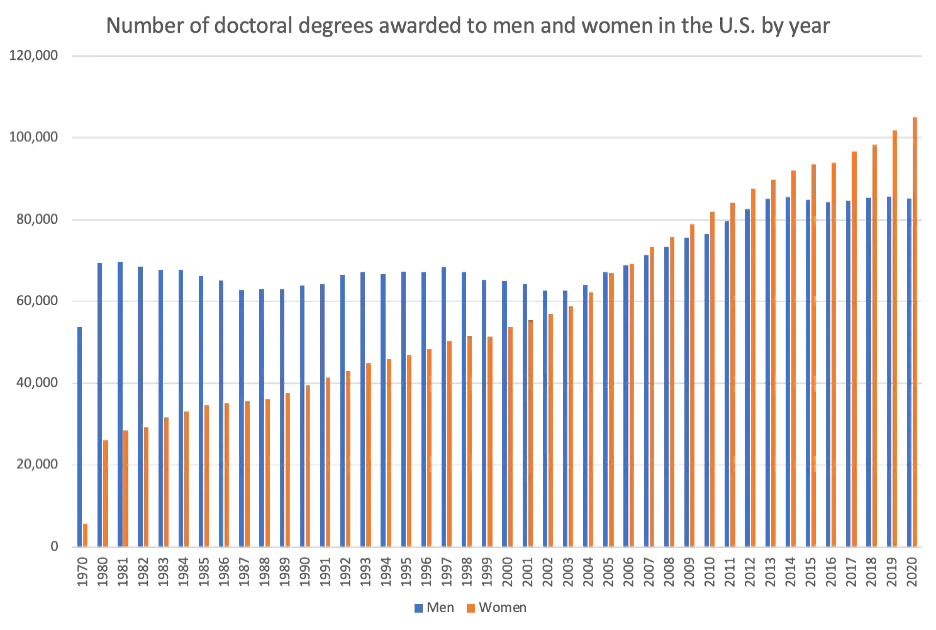
… though I have written probably 50,000 words on the Basic College Girl over the years, I have spent almost no time on her opposite number, hereby christened the Basic College Dude (BCD). Admittedly some part of this is structural: There just aren’t that many Persyns of Penis in college these days — nationwide, college enrollment is something like 65% female and climbing; I bet there are more than a few small colleges that, while technically coed, are almost exclusively female. Also, I taught mostly freshman-level History classes, and since I was one of the few dinosaurs who didn’t make attendance a part of the class grade, only the congenital rule-followers, i.e. chicks, showed up.
But mostly it’s just because none of them stick in my memory. The #1 characteristic of the Basic College Dude is that even if he’s there, he’s not there. He’s checked out — mentally, emotionally, spiritually (if that even means anything anymore). Unlike the girls, all of whom seem to be in 72 different clubs and organizations (and list them all on their email auto-signatures, such that by junior year, their honorifics are longer than my entire resume), the guys don’t seem to do much of anything. How do they while away their hours? I assume with social media, like everyone, and with video games and blackout drinking …
… the latter of which I have seen, a lot, and if you’ll permit a brief digression, if you really want to know how fucked our society is, go to a student bar on a Friday night. I myself was a bit of a party animal in college, and like everyone I went over the line a few times, but college kid drinking these days is almost Soviet — they’re aiming to get knee-walking, gutter-puking, total-blackout shitfaced, and they set about it as grimly and efficiently as possible. The girls, too, with the added bonus that they’re all on Ambien and Klonopin and every other happy pill you’ve ever heard of, which makes for some interesting, by which I mean terrifying, behavior …
[…]
But mostly it’s because college dudes have had their libidos beaten out of them. […]
Not only does the BCD not know how to do this, as Nikolai says, he apparently doesn’t actually want to. Constant stimulation by blinking screens, shit diets, and a lifetime of indoctrination have reversed the sexual dilithium crystals. Heartiste used to go on about this, and while I’m no biochemist, either, I think his theory is sound: There’s so much environmental estrogen floating around that men develop the emotional equivalent of gynecomastia, while women turn butch. Throw nth wave feminism into the mix, and you’ve got women acting like the crudest, most obnoxious male stereotypes (they call this “being strong and empowered”), while the men mope and sigh to their diaries.
The end result is that the BCD walks around like he’s shellshocked. He does the bare minimum, hoping to just grind it out without any further affronts to his basic human dignity … but so mal-educated is he, that the phrase “basic human dignity” doesn’t even register with him.
Severian, “The Basic College Dude”, Founding Questions, 2021-10-05.
March 7, 2025
Trump marks the overdue end of the Long Twentieth Century, part 2
In The Conservative Woman, N.S. Lyons continues his essay contending that the arrival of Donald Trump, version 2.0, may finally end the era we’ve been living in since immediately after the end of WW2:
The Long Twentieth Century has been characterized by these three interlinked post-war projects: the progressive opening of societies through the deconstruction of norms and borders, the consolidation of the managerial state, and the hegemony of the liberal international order. The hope was that together they could form the foundation for a world that would finally achieve peace on earth and goodwill between all mankind. That this would be a weak, passionless, undemocratic, intricately micromanaged world of technocratic rationalism was a sacrifice the post-war consensus was willing to make.
That dream didn’t work out, though, because the “strong gods” refused to die.
Mary Harrington recently observed that the Trumpian revolution seems as much archetypal as political, noting that the generally “exultant male response to recent work by Elon Musk and his ‘warband’ of young tech-bros” in dismantling the entrenched bureaucracy is a reflection of what can be “understood archetypally as [their] doing battle against a vast, miasmic foe whose aim is the destruction of masculine heroism as such”. This masculine-inflected spirit was suppressed throughout the Long Twentieth Century, but now it’s back. And it wasn’t, she notes, “as though a proceduralist, managerial civilization affords no scope for horrors of its own”. Thus now “we’re watching in real time as figures such as the hero, the king, the warrior, and the pirate; or indeed various types of antihero, all make their return to the public sphere”.
Instead of producing a utopian world of peace and progress, the open society consensus and its soft, weak gods led to civilizational dissolution and despair. As intended, the strong gods of history were banished, religious traditions and moral norms debunked, communal bonds and loyalties weakened, distinctions and borders torn down, and the disciplines of self-governance surrendered to top-down technocratic management. Unsurprisingly, this led to nation-states and a broader civilization that lack the strength to hold themselves together, let alone defend against external threats from non-open, non-delusional societies. In short, the campaign of radical self-negation pursued by the post-war open society consensus functionally became a collective suicide pact by the liberal democracies of the Western world.
But, as reality began to intrude over the past two decades, the share of people still convinced by the hazy promises of the open society steadily diminished. A reaction began to brew, especially among those most divorced from and harmed by its aging obsessions: the young and the working class. The “populism” that is now sweeping the West is best understood as a democratic insistence on the restoration and reintegration of respect for those strong gods capable of grounding, uniting and sustaining societies, including coherent national identities, cohesive natural loyalties, and the recognition of objective and transcendent truths.
Today’s populism is more than just a reaction against decades of elite betrayal and terrible governance (though it is that too); it is a deep, suppressed desire for long-delayed action, to break free from the smothering lethargy imposed by proceduralist managerialism and fight passionately for collective survival and self-interest. It is the return of the political to politics. This demands a restoration of old virtues, including a vital sense of national and civilizational self-worth. And that in turn requires a rejection of the pathological “tyranny of guilt” (as the French philosopher Pascal Bruckner dubbed it) that has gripped the Western mind since 1945. As the power of endless hysterical accusations of “fascism” has gradually faded, we have – for better and worse – begun to witness the end of the Age of Hitler.