
World War Two
Published 25 Sep 2022WW2 historians Indy Neidell, Spartacus Olsson, and Paul Woodadge moderated by Ryan Socash discuss the meaning and significance of D-Day from historical, current, and future perspectives. Recorded on the road while shooting in Normandy for TimeGhost’s 24-hour documentary on the events of June 6, 1944.
(more…)
September 26, 2022
Did D-Day win WW2? – a WW2 expert discussion
August 31, 2022
Tank Chats #153 | Jagdpanther | The Tank Museum
The Tank Museum
Published 6 May 2022Discover the origins of Jagdpanther with Curator David Willey and learn more about this German tank destroyer.
(more…)
Comments Off on Tank Chats #153 | Jagdpanther | The Tank Museum
August 30, 2022
Barbarian Europe: Part 10 – The Vikings and the End of the Invasions
seangabb
Published 5 Sep 2021In 400 AD, the Roman Empire covered roughly the same area as it had in 100 AD. By 500 AD, all the western provinces of the Empire had been overrun by barbarians. Between April and July 2021, Sean Gabb explored this transformation with his students. Here is one of his lectures. All student contributions have been removed.
(more…)
Comments Off on Barbarian Europe: Part 10 – The Vikings and the End of the Invasions
August 19, 2022
How Accurate is Saving Private Ryan? – WW2 D-Day Special
World War Two
Published 16 Aug 2022How accurate is that famous beach scene in Saving Private Ryan? Is it true to the history or just another Hollywood story? Seeing as we’re about to start the filming for our massive D-Day project, we figured we’d break it down, shot by shot.
(more…)
Comments Off on How Accurate is Saving Private Ryan? – WW2 D-Day Special
June 7, 2022
D Day: The First Canadian Parachute Battalion and the Battle for the Village of Varaville
The History Guy: History Deserves to Be Remembered
Published 6 Jun 2022There are so many stories of heroism involved in the massive Operation Overlord, among them the extraordinary story of the little-known first Canadian Parachute Battalion. The lightly armed Canadians were among the first allied soldiers to hit the ground in France on D-Day.
Check out our new community for fans and supporters! https://thehistoryguyguild.locals.com/
This is original content based on research by The History Guy. Images in the Public Domain are carefully selected and provide illustration. As very few images of the actual event are available in the Public Domain, images of similar objects and events are used for illustration.
You can purchase the bow tie worn in this episode at The Tie Bar:
https://www.thetiebar.com/?utm_campai…All events are portrayed in historical context and for educational purposes. No images or content are primarily intended to shock and disgust. Those who do not learn from history are doomed to repeat it. Non censuram.
Find The History Guy at:
New community!: https://thehistoryguyguild.locals.com/
Please send suggestions for future episodes: Suggestions@TheHistoryGuy.netThe History Guy: History Deserves to Be Remembered is the place to find short snippets of forgotten history from five to fifteen minutes long. If you like history too, this is the channel for you.
Awesome The History Guy merchandise is available at:
teespring.com/stores/the-history-guyScript by THG
#history #thehistoryguy #DDay

Comments Off on D Day: The First Canadian Parachute Battalion and the Battle for the Village of Varaville
May 28, 2022
QotD: Breaking the trench stalemate with tactical air power
The first function aircraft were put to in WWI was reconnaissance. In 1914, that might mean locating the enemy in a fast-moving battlefield, but as soon as the trench stalemate set in, reconnaissance mostly meant identifying enemy buildups along the line and – still more importantly – serving as spotters for artillery. It wasn’t a huge cognitive leap to go from having aircraft which identified targets for the artillery to thinking that the aircraft could be the artillery. But as with tanks, the technical limitations of the platforms in use meant that actually meaningful close air support was still two decades away when the war ended. The rapid development of aircraft in these early days means that there is a truly bewildering array of aircraft designs in use during the war, but the Farman F.50 is a good sample for what the most advanced bombers in common use looked like towards the war’s end. It carried a maximum of eight 44kg (totalling 352kg) bombs under the wings, which were dropped unguided. With a maximum speed of less than 100mph and a service ceiling under 5000m, it was also an extremely vulnerable platform: fragile, slow and with a relatively low flight ceiling. The French mainly used bombers at night for this reason.
But how much airpower does it take to really move a division out of position? In 1944, at the start of Operation Cobra as part of the Normandy breakout, it was necessary for US forces to move the powerful armored division Panzer Lehr out of its prepared positions outside of St. Lo. Over the course of an hour and a half, the U.S. Eighth Air Force hit Panzer Lehr with approximately three thousand aircraft, including 1,800 heavy bombers (each of which might have had bomb-loads of c. 2-3,500kg; the attack would have been the equivalent of about 13,000 Farman F.50s (of which only a hundred or so were built!)). By this point, even medium bombers carried bomb loads in the thousands of pounds, like the B-25 Mitchell medium bomber, with a bomb load of 3000lbs (1360kg). This was followed by a hurricane artillery barrage! Despite this almost absurdly awesome amount of firepower (which, to be clear, inflicted tremendous damage; by the end of Operation Cobra, Panzer Lehr – the heaviest and most powerful Panzer division in the west – had effectively ceased to exist), Panzer Lehr, badly weakened was still very capable of resisting and had to be pushed out of position by ground attack over the next three days.
Needless to say, nothing on offer in 1918 or for a decade or more after, was prepared to offer that kind of offensive potential from the air. That kind of assault would have required many thousands of aircraft with capabilities far exceeding what even the best late-war WWI bombers could do. Once again, while close air support doctrine was developed with one eye on the trench stalemate and the role airpower could play in facilitating a breakthrough and restoring maneuver (either by blasting the breakthrough or – as in Soviet Deep Battle doctrine – engaging enemy rear echelon units to bog down reinforcements). But the technology wasn’t anywhere near the decisive point by 1918. Instead, the most important thing aircraft could do was spot for the artillery, which is mostly what aircraft continued to do, even in late 1918.
Bret Devereaux, “Collections: No Man’s Land, Part II: Breaking the Stalemate”, A Collection of Unmitigated Pedantry, 2021-09-24.
Comments Off on QotD: Breaking the trench stalemate with tactical air power
February 7, 2022
History Summarized: Vikings
Overly Sarcastic Productions
Published 14 Jul 2017Huge thanks to our friend Shad at Shadiversity! Check out his channel for historical weaponry and much more: https://www.youtube.com/user/shadmbrooks
Grab your swords and hop in your longboats, because it’s time to learn a thing or two about the Vikings!
This video was produced with assistance from the Boston University Undergraduate Research Opportunities Program.
Thanks to patron Karl Erik L Hoftaniska for suggesting this topic!
PATREON: www.patreon.com/user?u=4664797
MERCH LINKS:
Shirts – https://overlysarcasticproducts.threa…
All the other stuff – http://www.cafepress.com/OverlySarcas…Find us on Twitter @OSPYouTube!
From the comments:
Finn Chitwood
4 years ago
In the words of a brilliant Icelandic magazine: “Viking was a seasonal, temporary occupation, not an ethnicity.”
Comments Off on History Summarized: Vikings
October 4, 2021
History Summarized: Sicily
Overly Sarcastic Productions
Published 1 Oct 2021The plot twist of Medieval Italian History is that the main event was happening in the South — In the centuries before the Renaissance, Sicily and southern Italy were sporting one of the most spectacular cultures in the world, combining the greatest hits of Mediterranean history in one place. It’s way cool, you guys.
SOURCES & Further Reading: Sicily: An Island at the Crossroads of History by John Julius Norwich, The Great Cities in History by John Julius Norwich, Great Courses Lectures “Muslims in the Court Of Roger II – 1130” from Turning Points in Middle Eastern History by Eamonn Gerron and “Renaissance Italy’s Princes and Rivals” from Renaissance: The Transformation of the West by Jennifer McNabb
This video’s topic was requested by our patron Salvatore Corasaniti. Thank you for supporting our channel!
Our content is intended for teenage audiences and up.
PATREON: https://www.Patreon.com/OSP
PODCAST: https://overlysarcasticpodcast.transi…
DISCORD: https://discord.gg/osp
MERCH LINKS: http://rdbl.co/osp
OUR WEBSITE: https://www.OverlySarcasticProductions.com
Find us on Twitter https://www.Twitter.com/OSPYouTube
Find us on Reddit https://www.Reddit.com/r/OSP/
From the comments:
Overly Sarcastic Productions
2 days ago
I can’t even begin to describe how much Ancient Sicily Content™ I had to cut for time.
Fear not, Magna Graecia will get the spotlight it deserves in another video.
-B

Comments Off on History Summarized: Sicily
June 12, 2021
Normandy – 1944 | Movietone Moment | 11 June 2021
British Movietone
Published 11 Jun 2021On this day in 1944, five days after the D-Day landing, the allied forces converged in Normandy. Here is a British Movietone report covering the event.
More and more reinforcements and supplies arrive in Normandy each day. In the skies Allied air power continues to bomb and strafe the enemy. Captured German film shows Rommel and von Rundstedt visiting the vast concrete fortifications on the coast which were thought to be impassable. Mr Churchill arrived onboard HMS Kelvin and was greeted by General Montgomery as he came ashore.
Cut story – Dusk or dawn shot of destroyer with sun rising or sinking in background. Sunrise with armada in fore. Yanks board LCIs. Shots of LCTs. Beached equipment unloaded. GV of activity on beach. British troops of LTC. CU Tedder on bridge of ship. GS of Ramsay & Vian. Tedder, Ramsay & Vian walk along raft into camera. Elevated shot of activity on beach, very good. Troops build airstrip, bulldozers etc. at work. Plane takes off. Camera gun – shooting up trains, transport, & other targets, several large explosions. British pass through street, Frenchmen look on. AFU – British soldiers at look-out with field glasses. Troops (Canadian or British) run through fields & wooded country. Troops through street, French clap. Army transport passes through street, directed by soldier. Yanks march through streets. POW along roads, & over beach, wade out to LCT, one attempts to pull up sock while walking. Captured German reel GS of Rommel & Rundstedt. CU Rommel. SCU of coastal guns, & various shots of fortifications, pillboxes etc. Rommel & Rundstedt walk round inspecting same, look at double barrel coastal gun. SCU of barrel of guns, & various shots of Atlantic Wall (AFU British troops knock part of “Wall” down which they have captured). Eisenhower, Marshall & Arnold on bridge of ship. GV of destroyer Kelvin at sea – very good. CU Churchill in Trinity House uniform, wearing glasses. Churchill assists Brooke with “Mae West” life jackets. Both seated on deck Kelvin at sea. CU Churchill. Kelvin passes Nelson, Ramillies & other warships also large part of armada. Churchill transfers … ships, sailors cheer as he leaves. CU Churchill. CU Smuts both very good. Churchill, Smuts & Brooke in “Duck” [DUKW]. Churchill leans over side talks to Montgomery, Churchill alights from “Duck”. Shakes hands with Monty. The above four in group on beach, walk through crowds of soldiers. AFU – Monty stands on raised platform addresses troops (silent) Monty & Churchill through crowds. Churchill with Monty & climbs into Jeep. SEE STORY NUMBER 44914/2 & 44914/3 FOR CUTS
AP Has HD copy – HD ProRes 422 4:3 – 24fpsDisclaimer: British Movietone is an historical collection. Any views and expressions within either the video or metadata of the collection are reproduced for historical accuracy and do not represent the opinions or editorial policies of the Associated Press.
You can license this footage for commercial use through AP Archive – the story number bm44914
#Normandy #WWII #DDay
Find out more about AP Archive: http://www.aparchive.com/HowWeWork
Twitter: https://twitter.com/AP_Archive
Tumblr: https://aparchives.tumblr.com/
Instagram: https://www.instagram.com/APNews/
Comments Off on Normandy – 1944 | Movietone Moment | 11 June 2021
June 6, 2021
Turning Point of History: D-Day Juno Beach
ch1201
Published 8 Nov 2014Examines Canada’s role on June 6th, 1944 and the advance through Normandy, France.
Comments Off on Turning Point of History: D-Day Juno Beach
May 30, 2021
The History of the English Flag
History With Hilbert
Published 13 Apr 2018Most people know that the Union Flag (sometimes incorrectly called the Union Jack by normies) is made up of the various flags of the United Kingdom combining things like the Scottish Saltire and the English Saint George’s Cross. But what is the history behind these symbols and why were they adopted by these nations, and what is more, why these flags, and what about the competitors who if history had been different might have come to symbolise these nations. In today’s episode, I’m going to explore the history and symbolism behind England’s flag, the Saint George’s Cross, as well as the other banners that were once seen as being representative of the English people.
Music Used:
“Sneaky Snitch” – Kevin MacLeod
“Pippin the Hunchback” – Kevin MacLeod
“Angevin” – Kevin MacLeod
“Gregorian Chant” – Kevin MacLeod
“Ever Mindful” – Kevin MacLeod
“Ever Mindful” – Kevin MacLeod (incompetech.com)
Licensed under Creative Commons: By Attribution 3.0 LicenseAll images are from the Public Domain of Wikimedia Commons and Pixabay.
Comments Off on The History of the English Flag
March 29, 2021
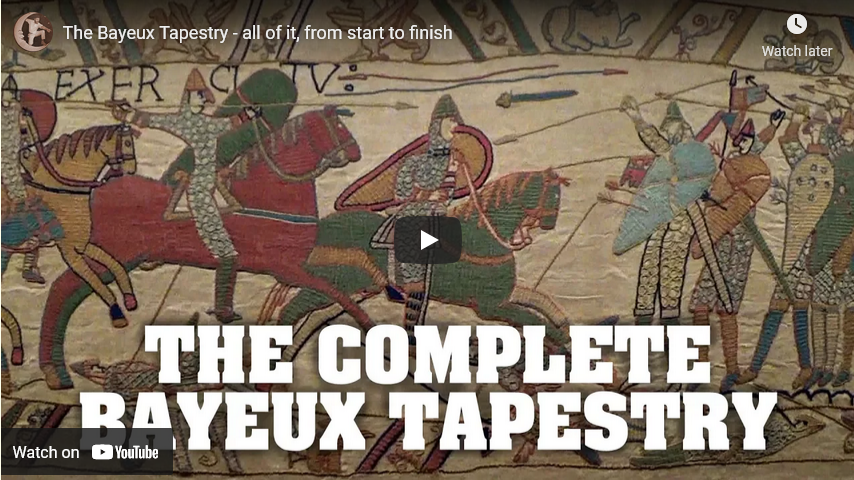
The Bayeux Tapestry – all of it, from start to finish
Lindybeige
Published 18 Oct 2017A complete guide to the story as depicted on the famous Bayeux Tapestry. There is a lot more to it than just the Battle of Hastings.
Support me on Patreon: https://www.patreon.com/Lindybeige
Other than The Adventures of Stoke Mandeville, this is the longest editing job I have ever done. It took eleven very long days of work to put this together from the opportunist footage I snatched when changing trains near the museum where it is on display. The shoot was not without its problems, one of which was the fact that because the tapestry is behind glass, and the museum has many illuminated displays, the reflections in the glass were a bane, and I didn’t manage to get rid of them all. Another was that my stills camera refused to work after taking a small number of pictures. It had always worked fine before, and has always worked fine since. It wasn’t the battery and it wasn’t the SD card. It was a mystery.
For the curious, the edit involved seventeen tracks on the timeline, and has twenty-two animated scenes. Unfortunately, the main animation software I was using could not handle full HD images, and so there is a slight loss of picture quality during most of the animated scenes. You will notice that the close-ups have a better picture quality than the wide shots. This is because they were taken with the camera pushed up against the glass, which improved focussing, and got rid of almost all of the haze and reflections caused by the glass.
It is important to understand that this ‘tapestry’ is a piece of propaganda, and does not tell an accurate version of events. The story I tell here is the one depicted, not what actually happened.
I have enough material for more videos on the tapestry, but am in no great hurry to spend many more days editing this difficult footage. Trying to match the writing and speaking of narration to panning camerawork that had no notion when shot of what might need to be said about some passing scene, was a nightmare, and many editing compromises had to be made, with some scenes skipped past quickly, and others drawn out.
Clarification on the nudity: I said that the figure under the mysterious Cleric and woman was the the only figure displaying genitals on the tapestry. This was misleading. Several animals clearly are pictured with genitals, and on the tapestry in Bayeux today it looks as though a couple of other human figures have genitals. Some of these may have been added later, and these are not being ‘displayed’ as the displaying figure is clearly doing, but look more incidental.
I describe the tall figure emerging from the building with a lance and pennant, being brought his horse, as “William”. It occurred to me after making the video that all the sources I consulted describe this figure as William, but the text does not name him as William, so possibly he is just a Norman knight, representing any and all of the knights setting out for the battle, and that this figure is meant to be “William” could be a modern tradition that has become accepted fact just by repetition.
Buy the music – the music played at the end of my videos is now available here: https://lindybeige.bandcamp.com/track…
Lindybeige: a channel of archaeology, ancient and medieval warfare, rants, swing dance, travelogues, evolution, and whatever else occurs to me to make.
▼ Follow me…
Twitter: https://twitter.com/Lindybeige I may have some drivel to contribute to the Twittersphere, plus you get notice of uploads.
website: www.LloydianAspects.co.uk
Comments Off on The Bayeux Tapestry – all of it, from start to finish
March 16, 2021
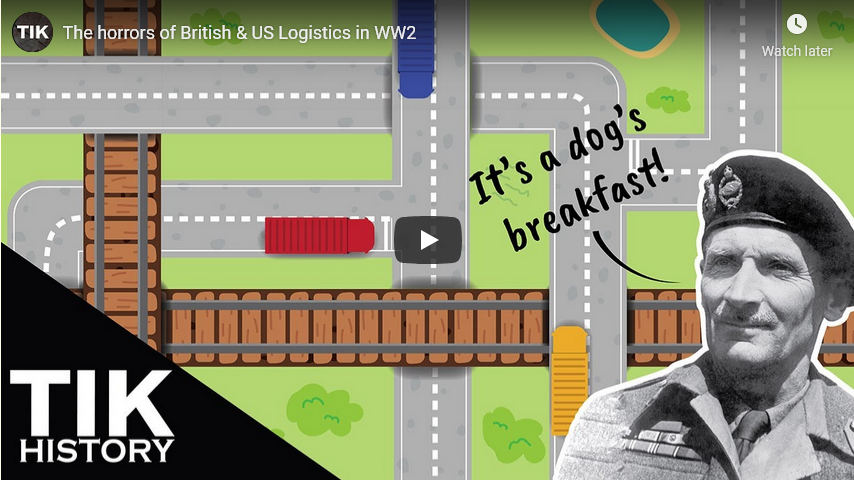
The horrors of British & US Logistics in WW2
TIK
Published 15 Mar 2021The Allies may have had a lot of resources, manpower and industry, but that didn’t mean that their logistics weren’t inefficient or a disorganized mess. Today, we’re going to look at how the British railways were disaster during WW2, how the Americans ran out of fuel on the way to Germany, and why Montgomery called the planning for the invasion of Sicily a “dog’s breakfast”.
⏲️ Videos EVERY Monday at 5pm GMT (depending on season, check for British Summer Time).
The thumbnail for this video was created by Terri Young. Need graphics? Check out her website here https://www.terriyoungdesigns.co.uk/
– – – – –
📚 BIBLIOGRAPHY / SOURCES 📚
Dunn, W. The Soviet Economy and the Red Army, 1930-1945. Praeger Publishers, 1995.
Garvey, J. Operation Husky: The Untold Story of the logistics of the Sicily Invasion. Farm Publications, Kindle 2019.
Hazlitt, H. Economics in One Lesson: The Shortest & Surest Way to Understand Basic Economics. Three Rivers Press, 1979.
MacDonald, J. Supplying the British Army in the Second World War. Pen & Sword Military, Kindle 2020.
Molony, C. The Mediterranean and Middle East, Volume V, The Campaign in Sicily 1943 and The Campaign in Italy 3rd September 1943 to 31st March 1944. The Naval & Military Press LTD 2004, first published in 1973.
Wolmar, C. Fire & Steam: How the Railways Transformed Britain. Atlantic Books, Kindle 2007.British Government, Railways Act 1921, https://www.legislation.gov.uk/ukpga/…
Full list of all my sources https://docs.google.com/spreadsheets/…
– – – – –
⭐ SUPPORT TIK ⭐
This video isn’t sponsored. My income comes purely from my Patreons and SubscribeStars, and from YouTube ad revenue. So, if you’d like to support this channel and make these videos possible, please consider becoming a Patreon or SubscribeStar. All supporters who pledge $1 or more will have their names listed in the videos. For $5 or more you can ask questions which I will answer in future Q&A videos (note: I’m behind with the Q&A’s right now, and have a lot of research to do to catch up, so there will be a delay in answering questions). There are higher tiers too with additional perks, so check out the links below for more details.
https://www.patreon.com/TIKhistory
https://www.subscribestar.com/tikhistoryThank you to my current supporters! You’re AWESOME!
– – – – –
ABOUT TIK 📝
History isn’t as boring as some people think, and my goal is to get people talking about it. I also want to dispel the myths and distortions that ruin our perception of the past by asking a simple question – “But is this really the case?”. I have a 2:1 Degree in History and a passion for early 20th Century conflicts (mainly WW2). I’m therefore approaching this like I would an academic essay. Lots of sources, quotes, references and so on. Only the truth will do.
This video is discussing events or concepts that are academic, educational and historical in nature. This video is for informational purposes and was created so we may better understand the past and learn from the mistakes others have made.
Comments Off on The horrors of British & US Logistics in WW2
September 25, 2020
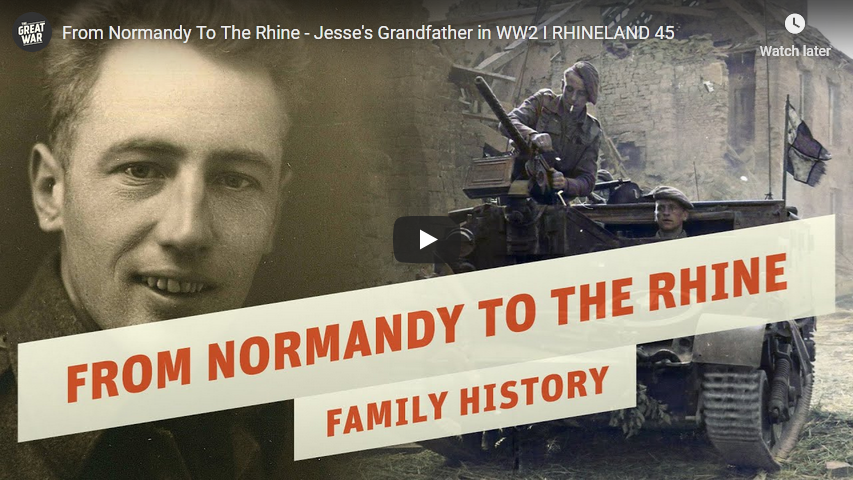
From Normandy To The Rhine – Jesse’s Grandfather in WW2 I RHINELAND 45
The Great War
Published 23 Sep 2020Back Rhineland 45: https://realtimehistory.net/rhineland45
Jesse shares the service history of his grandfather James who fought in the Canadian Army.
Contains licensed material by getty images
All rights reserved – Real Time History GmbH 2020
Comments Off on From Normandy To The Rhine – Jesse’s Grandfather in WW2 I RHINELAND 45
September 5, 2020
History Summarized: The Viking Age
Overly Sarcastic Productions
Published 4 Sep 2020The Vikings are enjoying a new wave of enthusiasm in popular culture, but these seafaring Norsemen are still quite clearly a misunderstood force in medieval European history. So let’s take a wide look at the European world during The Viking Age!
Check out Yellow’s livestreams over at https://Twitch.tv/LudoHistory
SOURCES & Further Reading: The Vikings by Walaker Nordeide and Edwards, Vikings: A Very Short Introduction by Richards, Age of the Vikings and The Conversion of Scandinavia by Winroth, The Vikings By Harl via The Great Courses, The Viking World by Graham-Campbell, The Viking Way by Price.
This video was edited by Sophia Ricciardi AKA “Indigo”. https://www.sophiakricci.com/
Our content is intended for teenage audiences and up.
DISCORD: https://discord.gg/kguuvvq
PATREON: https://www.Patreon.com/OSP
MERCH LINKS: https://www.redbubble.com/people/OSPY…
OUR WEBSITE: https://www.OverlySarcasticProductions.com
Find us on Twitter https://www.Twitter.com/OSPYouTube
Find us on Reddit https://www.Reddit.com/r/OSP/

From the comments:
Ludohistory
23 hours ago (edited)
Thanks so much for having me on and letting me help out! It was a lot of fun (even if I talked a little too fast sometimes)! To clarify a piece that I know I did cover too briefly — missionary trips to Scandinavia occurred in Denmark around 823, on the orders of Louis the Pious, and in Sweden in 829, when Ansgar, a Frankish monk, traveled to the town of Birka, where he found a very small Christian community, probably mostly enslaved or formerly enslaved people, and converted a couple of Norse people, including the town prefect. (The graveyard for that town, incidentally, is where the 10th century “female warrior” that made waves a few years ago was buried).There’s a lot we didn’t get a chance to talk about about the diaspora and its ending, so if there’s anything you all are curious on or find unclear, let me know here or on twitter 🙂
Finally, if you liked this, all the VODs for my personal streams (where I try to ramble about history in games) can be found by clicking on my name, and tomorrow I’ll be streaming CKIII on twitch (link in the description)!
Comments Off on History Summarized: The Viking Age


