
World War Two
Published 6 Jun 2023With wide gaps struck in the Atlantic Wall, it is now up to the Allies to secure the beachheads and move inland. There they will face off with new German defenses, and the Norman geography.
(more…)
June 7, 2023
Piercing the Atlantic Wall – D-Day [Part 3]
Comments Off on Piercing the Atlantic Wall – D-Day [Part 3]
A Harbour goes to France – Mulberry Harbours – Normandy Landings
British Army Documentaries
Published 24 Jun 2020Mulberry harbours were temporary portable harbours developed by the United Kingdom during the Second World War to facilitate the rapid offloading of cargo onto beaches during the Allied invasion of Normandy in June 1944. After the Allies successfully held beachheads following D-Day, two prefabricated harbours were taken in sections across the English Channel from UK with the invading army and assembled off Omaha Beach (Mulberry “A”) and Gold Beach (Mulberry “B”).
(more…)
Comments Off on A Harbour goes to France – Mulberry Harbours – Normandy Landings
QotD: A “second front” in 1943
Which brings us to the debate about the possibility of an invasion in 1943 – Roundup. Something that a surprising number of historians, and even a few not entirely incompetent generals, have suggested might have been possible, and should have been tried.
There are some points in their favour. The invasions of North Africa definitely took resources that could have been built up in Britain, and therefore slowed things down. (And the withdrawal of the new escort carriers, escort groups, and shipping from the Battle of the Atlantic for the North African adventure, definitely did huge damage in the loss of shipping and supplies, slowing things down further.) As a result the huge buildup in North Africa was much easier to use against Italy before moving on to France. Certainly another distraction or delay … but only if you don’t think that knocking Italy out of the war would make Germany weaker!
But once Sledgehammer [the plan to invade France in 1942] was abandoned, this operation was the only possible way to get US troops into combat in Europe, short of shipping some to Russia. It was also the only possible way of coming close to keeping Roosevelt’s ridiculous promise to the Russians.
[…]
Nonetheless it is wrong to think that the British never had any intention of [mounting Operation] Roundup. Despite what Roosevelt and many other Americans convinced themselves, the British were, at the start of 1942, far more optimistic about the possibility of invading Europe through France in 1943 than they had been about Sledgehammer. Their studies seemed to show that Germany would only have to be weaker, not suddenly collapse, to make invasion in 1943 a realistic possibility. Realistic that is as long as the rest of the plans for training and shipping troops, building and concentrating invasion craft, and moving enough supplies to make it sustainable, all came together.
They didn’t.
For the British, the middle of 1942 revealed how little would be available in time for the middle of 1943. Even on the best assumptions of American training and preparation, there was no chance that the majority of forces for Roundup would not be British … assuming they could supply them either. In practice mid-1942 saw the Axis continue to advance on every front. Burma collapsed; the Allied position in New Guinea was under threat; the Japanese were still expanding to places like Guadalcanal; Rommel was advancing in Egypt; the Germans were advancing on the Caucasian oil fields and towards the Middle East; and more and more was needed just to keep Russia in the war. As a result British troops, shipping and supplies were continuing to flow away from Britain, not towards it.
Much of the Royal Navy was trying to save the dangerous losses caused by [US Chief of Naval Operations Admiral] King’s refusal to have convoys in American waters (too “defensive-minded” he thought.) These alone, the worst eight months of the war, were threatening to scupper Roundup. The rest was so busily deployed in the Indian and Pacific Oceans against the Japanese, or North Atlantic trying to fight supplies through to Russia (a high proportion of tanks and planes defending Moscow were British-supplied), that there was virtually nothing left in the Med to slow Rommel’s advance. The merchant ships surviving the fight across the oceans were actually more vitally needed to take men and equipment from the UK to other places than to bring in a buildup for the UK.
Nor was the American buildup going to plan. Less well-trained troops were becoming available too slowly, could not be shipped in adequate numbers anyway, and were in no condition to face German veterans. (The very best US units to go into action in 1942 – the Marines in Guadalcanal – and 1943 – the 1st Infantry and 1st Armored divisions which were actually professional troops not conscripts in North Africa – had very steep learning curves. Particularly at Kasserine. They were clearly not fit to face German veterans yet.
And American resource buildup was also not up to promises. King and MacArthur were milking supplies far beyond what had originally been agreed under “Germany first”. In practical terms they were doing so for the same reasons the British were: an immediate desperate situation had to be saved before a future ideal one could be pursued.
Nonetheless I have read all sorts of apparently serious suggestions that after North Africa was cleared, or at the very least after Sicily was cleared, an invasion of France should have happened.
Delusional.
Nigel Davies, “The ‘Invasion of France in 1943’ lunacy”, rethinking history, 2021-06-21.
Comments Off on QotD: A “second front” in 1943
June 6, 2023
Through The Gates of Hell – D-Day [Part 2]
World War Two
Published 6 Jun 2023When the amphibious landings begin, they run straight into Hitler’s Atlantic Wall. Eisenhower has predicted a third of his troops may fall. While they land, the news breaks across the world.
(more…)
Comments Off on Through The Gates of Hell – D-Day [Part 2]
Invasion by Air – D-Day [Part 1]
World War Two
Published 5 Jun 2023In the early hours it is up to the Allied airborne troops to secure the battlefield perimeter, and protect the operation. Now they will find out if the Germans have been deceived, or are ready and waiting with mortal force.
(more…)
Comments Off on Invasion by Air – D-Day [Part 1]
Juno Beach: The Fighting Canadians on D-Day | History Traveler Episode 194
The History Underground
Published 6 Feb 2022When one thinks about where the most violent fighting took place on D-Day, you wouldn’t be wrong in citing Omaha Beach where the highest number of casualties were inflicted. But as a percentage of the landing force, the Canadians on Juno Beach suffered more than any other Allied nation. In this episode, we’re joined by Paul Woodadge of @WW2TV to explore a few of the areas along Juno Beach where men to the 3rd Canadian Infantry Division landed on June 6th.
(more…)
Comments Off on Juno Beach: The Fighting Canadians on D-Day | History Traveler Episode 194
QotD: “A second front” in 1942
[…]
A plan put together for the incredibly unlikely event of sudden German collapse, was Sledgehammer. This was the understanding of Sledgehammer adopted by most Americans. A very limited offensive by very inadequate forces, which could only succeed had Germany already gone close to collapse. Given the circumstances this was somewhat delusional, but it never hurts to plan for eventualities, and the British were happy to go along with this sort of plan.
[…]
Any attempt at Sledgehammer would of course have failed. The German army had not yet been bled dry on the Eastern front, and the Luftwaffe was still a terrifying force which could be (and regularly was) easily moved from Russian mud to Mediterranean sunshine and back again in mere weeks. Even ignoring the opposition, the British were gloomily aware that the Americans had not a clue of the complexities of such a huge amphibious operation. At the time of discussion – May 1942 – the British were using their first ever Landing Ship Tanks and troopships equipped with landing craft to launch a brigade-size pre-emptive operation against the Vichy French on Madagascar. (Another move many historians think was useless. But coming only months after the Vichy had invited the Japanese into Indo-China – fatally undermining the defenses of Malaya – and the Germans into Syria, it was probably a very sensible precaution. Certainly Japanese submarines based in Madagascar [could] have finally caused the allies to lose the war at sea!)
The British deployed two modern aircraft carriers, and a fleet of battleships, cruisers, destroyers and escorts and a large number of support ships, on this relatively small operation. It was the first proper combined arms amphibious operation of the war, and was very helpful to the British to reveal the scale of amphibious transport needed for future operations. By contrast the US Marines hit Guadalcanal six months later from similar light landing craft, and with virtually the same Great War-vintage helmets and guns that the ANZACS had used at Gallipoli. Anyone who reads the details of the months of hanging on by the fingernails at Guadalcanal against very under-resourced Japanese troops, will be very grateful that the same troops did not have to face veteran German Panzer divisions for several years.
So I do not know of any serious historian who imagines that an invasion of France in 1942 could have led to anything except disaster. There are no serious generals who thought it either. (Only Marshall and his “yes-man” Eisenhower consistently argued that it might be possible. And Eisenhower later came to realise – when he was in charge of his third or fourth such difficult operation – that his boss was completely delusional in his underestimation of the difficulties involved. See Dear General: Eisenhower’s Wartime Letters to Marshall for Eisenhower’s belated attempts to quash Marshalls tactical ignorance about parachute drops and dispersed landings for D-Day.)
In practice no matter how much Marshall pushed for it, only British troops were availabe for such a sacrificial gesture, and the British were not unnaturally reluctant to throw away a dozen carefully nurtured and irreplaceable divisions on a “forlorn hope”, when they would prefer to save them for a real and practical invasion … when circumstances changed enough to make it possible.
Unfortunately Roosevelt told the Soviet foreign minister Molotov that “we expect the formation of a second front this year”, without asking even Marshall, let alone wihtout consulting his British allies who would have to do it with virtually no American involvement. The British Chiefs of Staff only had to show Churchill the limited numbers of landing craft that could be available, and the limited number of troops and tanks they could carry, to make it clear that this was ridiculous. Clearly this stupidity was just another example of Roosevelt saying stupid things without asking anyone (like “unconditional surrender”) that did so much to embitter staff relations during the war, and internationaly relations postwar. But it seems likely that the British refusal to even consider such nonsense was taken by Marshall and Stimson as a sample of the British being duplicitous about “examining planning options”.
The British fixed on a “compromise” to pretend that a “second front” could be possible. North Africa, could be conquered without prohibitive losses. It was not ideal, and in practical terms not even very useful. But it might satisfy the Americans and the Russians. Nothing else could.
Marshall in particular spent the rest of the war believing that when the British assessment clearly demonstrated that action in Europe was impractical and impossible, they had just been prevaricating to get what they always intended: operations in the Med. In some ways he was correct. The British had done the studies on France despite thinking that it was unlikely they would be practical, and were proved right. Marshall and Eisenhower had just deluded themselves into thinking an invasion might be practical, and could not accept that there was not a shred of evidence in favour of their delusion.
Nigel Davies, “The ‘Invasion of France in 1943’ lunacy”, rethinking history, 2021-06-21.
Comments Off on QotD: “A second front” in 1942
June 5, 2023
The Longest Day: 75 Things You Don’t Need to Know
A Million Movies
Published 6 Jun 2019In honor of the 75th anniversary of the D-Day invasion, I’m taking a look at my favorite D-Day movie … The Longest Day.
Also, unlike most of my other videos, there are some things in here I think you do need to know. Number one on that list is to hear some of the true stories of the men and women featured in this movie. They, along with hundreds of thousands of other heroes and heroines, saved the world.
Fair warning: My pronunciation of anything French is going to be amazingly bad. No disrespect intended.
Comments Off on The Longest Day: 75 Things You Don’t Need to Know
June 4, 2023
D-Day Series: RCN and Operation Neptune
Valour Canada
Published 28 Dec 2015This video describes the Royal Canadian Navy’s (RCN) invaluable contributions to the invasion on D-Day, June 6, 1944. Operation Neptune was the name of the English Channel-crossing portion of the larger Normandy invasion (named Operation Overlord).
1. Overview (0:00)
Dawn. June 6, 1944. D-Day. Operation Overlord, the largest amphibious invasion in history, is about to begin. This is a description of the battlefield prior to the attack and also tells how the RCN played an important role both in the English Channel and along the French coast.2. Stop the U-boats (2:55)
Churchill said that the only thing that scared him during the war were the U-boats. This describes the problematic German U-boats and how the British and Canadian Navies (Operation Neptune) worked together to find, track, and destroy the underwater menace prior to D-Day.3. Clear the Mines (6:27)
“There is no doubt that the mine is our greatest obstacle to success” – British Admiral Bertram Ramsay. The size and effectiveness of the German minefield that guarded the D-Day beaches and how the Allied Navies worked together to prepare a route through which the invasion could occur.4. Cover the Beaches (9:49)
The Canadian Tribal-class destroyers played a significant role in eliminating the German Navy’s major surface warships’ threat to the invasion fleet. The RCN destroyer squadron and their mission of clearing the English Channel of German ships before, during, and after the invasion. A battle between the Canadian destroyers Haida and Huron and four German ships near the port of Brest on June 9 is discussed. Also covered are the two Canadian destroyers, Algonquin and Sioux, that were tasked with shore bombardment at Juno Beach.5. Land the Troops (13:01)
Shortly after dawn and following a forty-minute naval barrage at Juno Beach, the first Canadian soldiers came ashore. By noon, the beach was held by the Canadians and millions of tons of supplies were being brought ashore. This section describes the first waves of the invasion and the tanks, artillery, vehicles, and supplies that were soon to follow.
(more…)
Comments Off on D-Day Series: RCN and Operation Neptune
June 3, 2023
Why Was Normandy Selected For D-Day?
Real Engineering
Published 28 Mar 2020In the debut episode of the Logistics of D-Day we explore the logic and planning that resulted in Normandy being chosen as the location for the largest amphibious invasion in the history of human kind.
(more…)
Comments Off on Why Was Normandy Selected For D-Day?
May 29, 2023
The Moment D-Day Was Announced
World War Two
Published 28 May 2023D-Day is just around the corner, we’re in the end game now. You can learn more about the project and how to get involved at http://DDay.TimeGhost.tv
Comments Off on The Moment D-Day Was Announced
May 22, 2023
What Happened Behind a Photographer’s Lens on D-Day
World War Two
Published 21 May 2023Robert Capa has gone down in history as one the most groundbreaking war correspondents in all of journalism. His account of what happened on D-Day was something we wanted to share with all of you.
(more…)
January 12, 2023
Early royal “spares” in English history
Ed West considers the time-honoured Ottoman habit of strangling the new Sultan’s half-brothers on his accession to the throne and notes that after the practice was discontinued, many notables in the empire thought it also marked a down-turn in the quality of later Sultans. The British crown never had such a formal tradition, although brotherly love seems to have been in very short supply a thousand years ago:
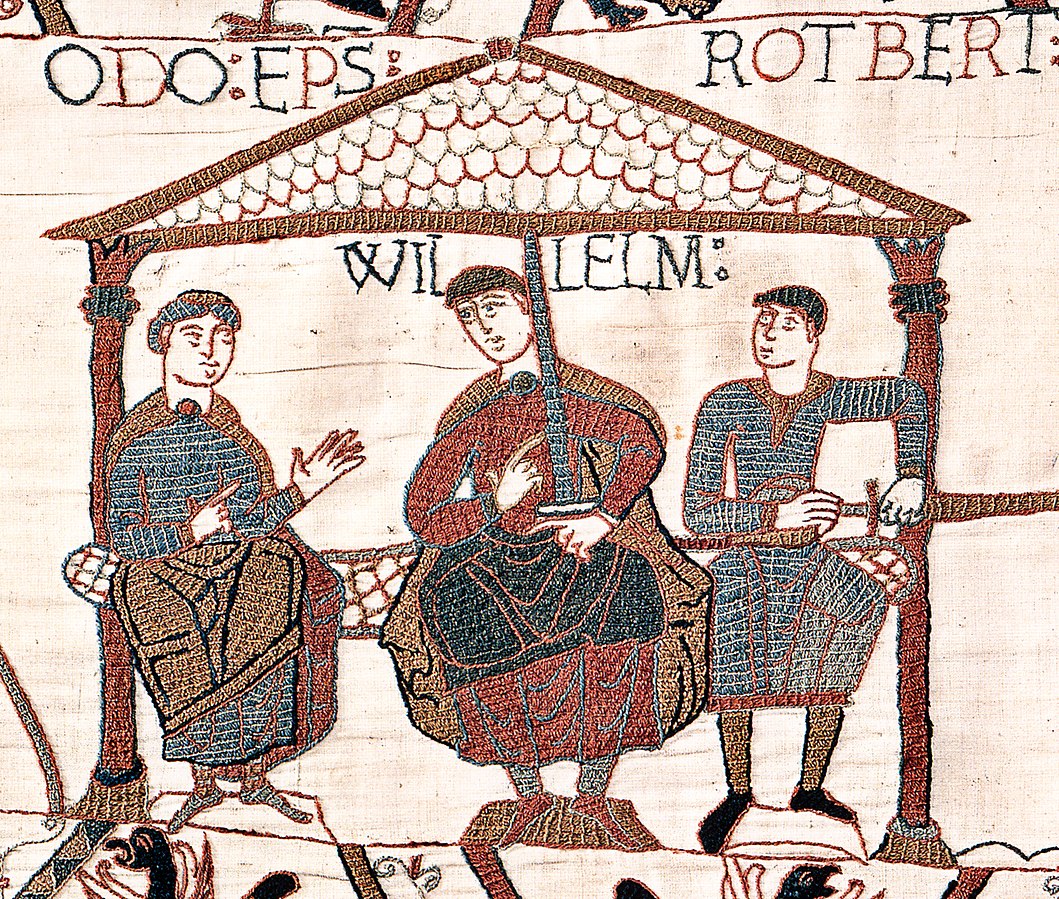
Panel from the Bayeux Tapestry – this one depicts Bishop Odo of Bayeux, Duke William, and Count Robert of Mortain.
Scan from Lucien Musset’s The Bayeux Tapestry via Wikimedia Commons.
Tales of royal brothers at war are a common theme, a staple of Norse sagas in particular, a recent example being the television series Vikings, and the brothers Ragnar and Rollo. William and Harry’s own family story in England begins with a tale told in one 14th century Icelandic saga, Hemings þáttr, which draws on older Norwegian stories to recall two royal brothers who became deadly rivals, Harold and Tostig.
Harold, as Earl of Wessex and the second most powerful man in England, had had his brother installed as Earl of Northumbria, where he had made himself immensely unpopular and provoked an uprising. When in 1065 Harold did a deal with the northerners to remove his sibling — presumably in exchange for the Northumbrians supporting his claim to the throne when the ailing King Edward passed away — Tostig fled abroad, embittered and determined to get revenge. Later accounts suggest that Harold and Tostig were rivals from an early age, one story having the young brothers fighting at the royal court as youngsters. Who knows, maybe Harold got the bigger room.
Tostig, now an exile, travelled around the North Sea looking for someone to help him invade England, finally finding his man with the terrifying Norwegian giant Harald Hardraada. Tostig had told all the Norwegians he was popular back home, but when they arrived in York they found that their English ally was in fact widely despised, and that not a single person came out to greet the former earl.
Tostig was killed soon after, in battle with his brother, having first (supposedly) exchanged words in this legendary meeting.
Harold himself would follow soon, victim of the English aristocracy’s great forefather William the Conqueror, whose success is illustrated by the naming patterns that followed. Harold’s brothers were Sweyn, Tostig, Gyrth, Leofwine and Wulfnoth; the Conqueror’s sons Robert, Richard, William and Henry. We haven’t had any Prince Wulfnoths recently.
The Conqueror’s son Richard having died in a hunting accident, the surviving Norman brothers had similarly fallen out, by one account the feud starting with a practical joke where William and Henry had poured a bucket of urine over eldest brother Robert. But mainly it was over land and power: after their father’s death Robert was made Duke of Normandy, the middle brother became William II of England, while Henry had to make do with just a cash payment.
Yet when William died in a mysterious hunting accident in the New Forest in 1100, Henry was conveniently close enough to reach the Treasury at Winchester within an hour to claim the crown. Six years later he invaded Normandy, with a partly English army, and captured his surviving brother, keeping Robert imprisoned for the rest of his life.
Henry I ruled for 35 years, but his long reign was followed by a civil war between his daughter Matilda and nephew Stephen, resulting in the rise of a new dynasty, the House of Anjou, or Plantagenets — so defined by internal conflict that Francis Bacon called them “a race much dipped in their own blood”.
Matilda’s husband Geoffrey Plantagenet had his brother Elias imprisoned, and Geoffrey’s son, King Henry II, had also gone to war with his younger brother, also Geoffrey. Even Geoffrey Plantagenet’s grandfather Fulk “the Quarreller” had spent over 30 years fighting for control of the county with his older brother, yet another Geoffrey.
Henry II in contrast fought his four sons and, after his death, his heir Richard I would also face rebellion from his younger brother John. When the Lionheart returned from crusade to deal with his deeply unlovable sibling he was remarkably forgiving, telling him: “Think no more of it, brother: you are but a child who has had evil counsellors.” This was despite John being 27 at the time.
More than two centuries later the House of Plantagenet came crashing down with a war pitting cousin against cousin, although brothers also fell out in the form of Edward IV and George, Duke of Clarence.
Both men were tall, blond and handsome, and both had a cruel and violent streak, but here the younger brother was impulsive, vain and foolish. He lacked maturity or self-control, was easily flattered and tempted into unwise decisions. He had been given vast estates and a lavish household but resented his older brother, who had also blocked his marriage to the daughter of the country’s largest landowner.
So Clarence had joined in the overthrow of Edward in 1470, while the youngest brother Richard, Duke of Gloucester, had remained loyal. However, when Edward returned to England the following March and Clarence led 4,000 men out to fight him, he was talked into changing sides again.
Clarence was forgiven, but the two brothers looked upon each other “with no very fraternal eyes”, and five years later he seems to have lost his mind after his wife died during childbirth. He accused the king of “necromancy” and of poisoning his subjects, and when brought before his brother made things much worse by claiming that Edward was a bastard. He was put to death.
Apparently, a soothsayer had also told King Edward that “G” would take his crown, and this must have fuelled his paranoia about George; after all, his other brother, the loyal Richard of Gloucester, would never do such a thing.
Such fraternal feuding ended with the rise of the Tudors and the conflicts between the House of Stuart and Parliament. There would be no more point in younger brothers threatening the monarch because the monarch no longer really had power; the royal family had evolved into a business, “the firm”, one in which hierarchies were clear and immovable, and the fortunes of family members were clearly joined.
Comments Off on Early royal “spares” in English history
November 28, 2022
Mulberry Harbours – Rhinos, Whales, Beetles, Phoenixs and Spuds against the Axis
Drachinifel
Published 13 Jul 2022Today we take a look at the artificial harbours designed, built and then installed on the Normandy beaches in 1944.
Many thanks to @Think Defence for finding and collating so many images and letting me use them! Follow them on Twitter or on their website for more interesting articles!
(more…)
Comments Off on Mulberry Harbours – Rhinos, Whales, Beetles, Phoenixs and Spuds against the Axis
October 29, 2022
Your Thoughts on Our D-Day Coverage So Far – WW2 – Reading Comments
Updated with re-uploaded video, 3 Nov 2022. The original video was taken down within a few hours. This is the same video less one short rant that Indy reconsidered and has chosen to omit.
World War Two
Published 28 Oct 2022Indy and Sparty pick out some of the best, most interesting, and even controversial comments by you under our videos. Stay for the PJs.
(more…)
Comments Off on Your Thoughts on Our D-Day Coverage So Far – WW2 – Reading Comments


