Quotulatiousness

July 3, 2020

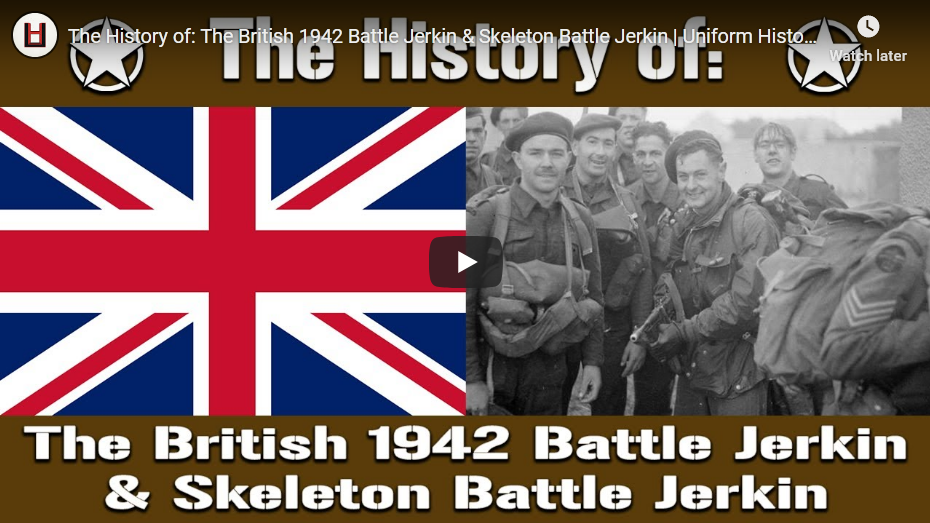
The History of: The British 1942 Battle Jerkin & Skeleton Battle Jerkin | Uniform History

Filed under: Britain, Cancon, History, Military, WW2 — Tags: , , , , , — Nicholas @ 02:00

Uniform History
Published 24 Mar 2020

The start of another two parter, in this one we cover the British Battle Jerkin family as it helped inspire the US Normandy Assault Vest’s creation.

Music by: https://www.juliancrowhurst.com/

June 16, 2020

QotD: A thumbnail history of the English language

Filed under: Britain, France, History, Humour, Law, Quotations — Tags: , , , , , — Nicholas @ 01:00

Languages are anything but static. Some change very slowly, like French — which owes much of its ponderousness to a government department specifically tasked with rooting out heretic words that creep in from the outside. Other languages undergo periods of very rapid change — the English of Chaucer (late 1300s) would be very confusing to Shakespeare (late 1500s and early 1600s). Two hundred years seems like a long period of time, but in the history of an entire country, it’s a drop in the bucket.

English doesn’t just borrow words; it lifts whole phrases and grammatical ideas from other languages without so much as a by-your-leave. With the coming of the Saxons to Britain, Germanic languages crashed headlong into Brythonic and became Old English. Then the Vikings went for a multi-century beer run starting in the late 700s and left behind a bunch of Norse words, because who doesn’t invent a new language every time they go out carousing? In 1066, William the Bastard decided he didn’t like his name, and brought Norman French with him when he went to the town clerk’s office to have his name legally changed to William the Conqueror.

For the next two hundred years, the English upper classes spoke French and the lower classes spoke a zillion dialects of Middle English (travel was difficult for poor people, so regional variations survived). All legal business was done in French, which was often translated on the spot into Latin for the official records. A person couldn’t even submit a legal plea in English until 1362. But with the start of the Hundred Years’ War in 1337, Edward III decided that speaking French was très passé, and began encouraging English as a spoken and written language, with a little French thrown in, just to keep things interesting. And ever since, English has been debating how sophisticated it wants to be, while making rude gestures across the Channel at France and grumbling when the French sneer northwards.

Blake Smith, “A Brief History of English and Why it Matters”, Mad Genius Club, 2018-03-07.

June 8, 2020

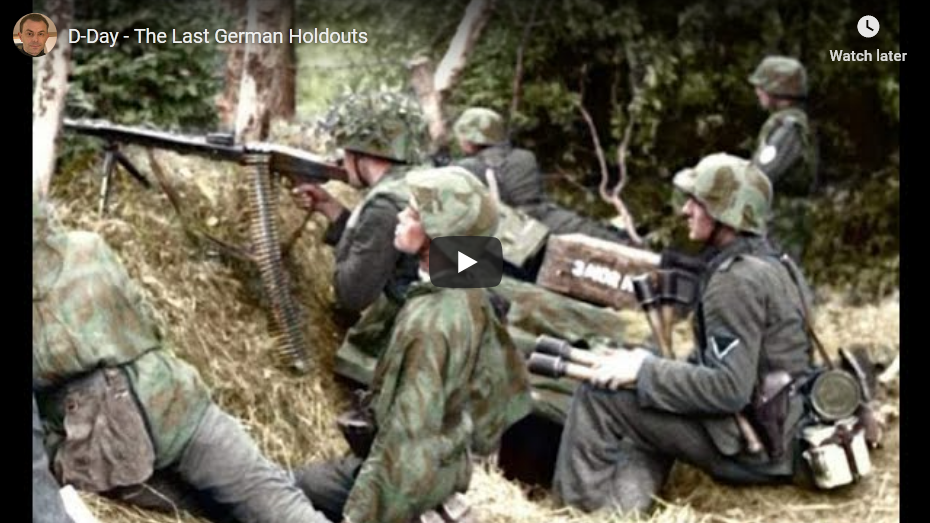
D-Day – The Last German Holdouts

Filed under: Britain, Cancon, Germany, History, Military, WW2 — Tags: , , , , — Nicholas @ 04:00

Mark Felton Productions
Published 6 Jun 2020

Some German coast defences managed to survive on D-Day and fought on behind Allied lines. One was the massive Douvres Radar Station bunker complex between Juno and Sword Beaches. It held out for 12 days after D-Day, and required a special operation to knock it out.

Visit my audio book channel ‘War Stories with Mark Felton’: https://youtu.be/xszsAzbHcPE

Help support my channel:
https://www.paypal.me/markfeltonprodu…
https://www.patreon.com/markfeltonpro…

Disclaimer: All opinions and comments expressed in the ‘Comments’ section do not reflect the opinions of Mark Felton Productions. All opinions and comments should contribute to the dialogue. Mark Felton Productions does not condone written attacks, insults, racism, sexism, extremism, violence or otherwise questionable comments or material in the ‘Comments’ section, and reserves the right to delete any comment violating this rule or to block any poster from the channel.

Credits: YouTube Creative Commons; WikiCommons; Google Commons; Google Maps; Mark Felton Productions; Sartorlelg

May 5, 2020

Killer Tanks – The Cromwell

Filed under: Britain, History, Military, Weapons, WW2 — Tags: , , , , — Nicholas @ 04:00

gusty9053
Published 12 Jul 2014

Confusingly, the tank shown in the thumbnail isn’t a Cromwell, and many later tanks are shown in footage that is supposed to be from the Dunkirk evacuation during the Battle of France in 1940 (including wrecked Churchill tanks on the beach at Dieppe in August 1942). The video covers the genesis of the tank in WW1 and the British interwar neglect of tanks, but almost completely ignores light tanks and infantry tanks to concentrate on “cruiser” tank development. Wikipedia has a useful summary of the Cromwell family of tanks:

The Cromwell tank, officially Tank, Cruiser, Mk VIII, Cromwell (A27M), was one of the series of cruiser tanks fielded by Britain in the Second World War. Named after the English Civil War leader Oliver Cromwell, the Cromwell was the first tank put into service by the British to combine high speed from a powerful and reliable engine (the Rolls-Royce Meteor), and reasonable armour. The intended dual-purpose high velocity gun could not be fitted in the turret and the medium velocity dual purpose gun fitted proved inadequate. An improved version with a high velocity gun became the Comet tank.

The name “Cromwell” was initially applied to three vehicles during development. Early Cromwell development led to the creation of the A24 Cavalier. Later Cromwell development led to the creation of the competing Tank, Cruiser, Mk VIII, Centaur (A27L) design. The Centaur tank was closely related to the Cromwell, both vehicles being externally similar. The Cromwell and Centaur tanks differed in the engine used; the Centaur had the 410 hp Liberty engine, the Cromwell had the significantly more powerful 600 hp Meteor.

The Cromwell first saw action in the Battle of Normandy in June 1944. The tank equipped the armoured reconnaissance regiments of the Royal Armoured Corps, in the 7th Armoured Division, 11th Armoured Division and the Guards Armoured Division. While the armoured regiments of the latter two divisions were equipped with M4 Shermans, the armoured regiments of the 7th Armoured Division were equipped with Cromwells. The Centaurs were not used in combat except for those fitted with a 95 mm howitzer, which were used in support of the Royal Marines during the amphibious invasion of Normandy.

[…]

Post war

After the war, the Cromwell remained in British service, and saw service in the Korean War with the 8th King’s Royal Irish Hussars.

Cromwell Tanks were used by Czechoslovakia and Israel.

Fifty-two Centaur I tanks were donated in early 1946 to the Greek Army, during the opening stages of the Greek Civil War but they were kept in storage due to the lack of trained personnel. In 1947, the first Greek officers returned from training courses in the United Kingdom and training of tank crews began. In April 1948, the Centaurs were organised in three Centaur tank companies initially numbered II, IX and XI, but a year later were renumbered 381, 382, 383 and temporarily attached to Reconnaissance Regiments 391, 392, and 393. The Centaurs saw limited service in the war because battles were fought mainly on mountainous areas, but proved useful in supporting infantry units and in defence of inhabited areas. After the end of the war, in October 1949, the three Centaur companies were organised into the 391 Tank Regiment. The Centaurs were replaced by US built M47s and in 1962 were sold and scrapped. One Centaur is preserved in the Greek Army Tank Museum.

The British army, Austria and Jordan used the upgraded Charioteer version of the Cromwell post-war. Jordanian vehicles saw action in conflicts in the Middle-East.

April 29, 2020

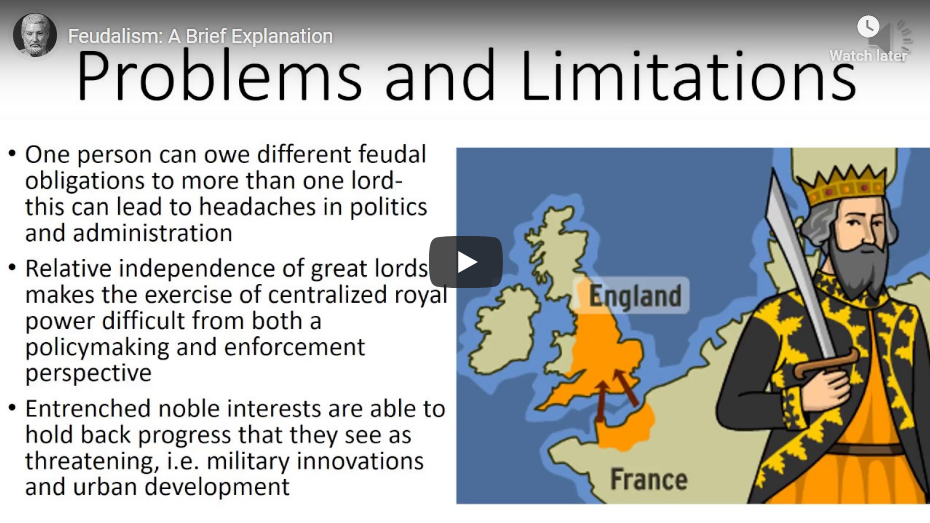
Feudalism: A Brief Explanation

Thersites the Historian
Published 26 Oct 2017

In this video, I try to bring order to the chaos that is feudalism and render it comprehensible.

April 14, 2020

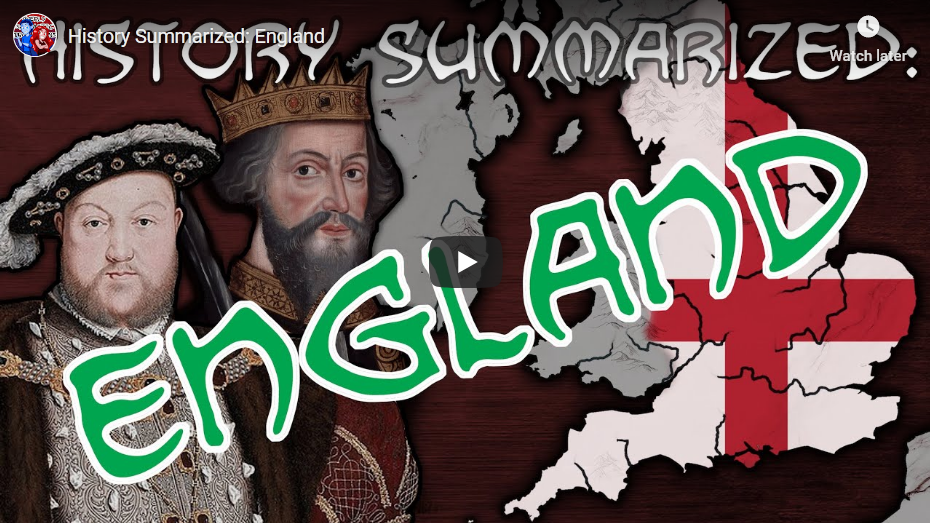
History Summarized: England

Overly Sarcastic Productions
Published 10 Apr 2020

English history has a reputation for being nigh incomprehensible — what with all the kings, civil wars, succession crises, and slapfights with France. But with the right perspective (and a little royal-restraint), England can become quite a straightforward story. So let’s take a look at this slice of Britain, and see how it grew into the master of the Isles.

SOURCES & Further Reading: “History of England from the Tudors to the Stuarts”, lecture series for The Great Courses by Robert Bucholz, a great look at Renaissance and Early Imperial England.
“Ten Minute History of England and Britain” Parts 1-18, by History Matters, a lengthy chronicle of English history from the Roman conquest through the Union of the Crowns. Good watch if you have the time.
Foundation by Peter Ackroyd, the first book in a mammoth 6-volume History of England, which covers everything up to the death of Henry VII. If you really want to dig into English history, this is the book for you.

This video was edited by Sophia Ricciardi AKA “Indigo”. https://www.sophiakricci.com/
Our content is intended for teenage audiences and up.

PATREON: https://www.Patreon.com/OSP

DISCORD: https://discord.gg/h3AqJPe

MERCH LINKS: https://www.redbubble.com/people/OSPY…

OUR WEBSITE: https://www.OverlySarcasticProductions.com
Find us on Twitter https://www.Twitter.com/OSPYouTube
Find us on Reddit https://www.Reddit.com/r/OSP/

February 24, 2020

Norman Conquest of England | 3 Minute History

Filed under: Britain, History, Military — Tags: , , , — Nicholas @ 02:00

Jabzy
Published 15 Jan 2015

Norman Conquest

January 29, 2020

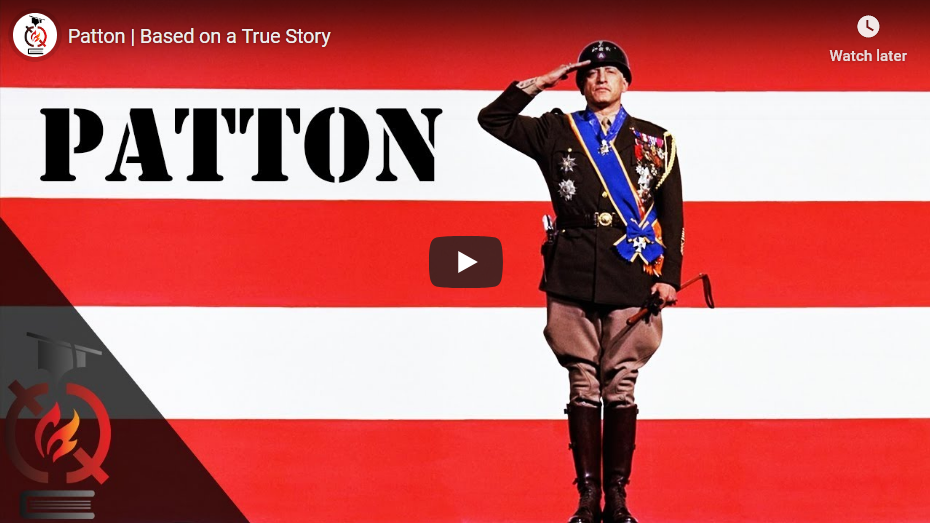
Patton | Based on a True Story

Filed under: History, Media, Military, USA, WW2 — Tags: , , , , , , — Nicholas @ 04:00

The Cynical Historian
Published 30 Aug 2018

It’s finally time to review Patton! I have a lot to say about it, as you can tell by the time stamp. Way back when I started the Based on a True Story series, the second episode was a bit about what I considered to be the best ones — and this movie was at the top. I love this film, but for more reasons than most of you could know — so this is going to be a deep dive into the film and its subject matter. It’s ambiguous, narrowed in subject, and just a perfect examination of the man. As the New Yorker said during the movie’s release, “[Patton] appears to be deliberately planned as a Rorschach test.”
————————————————————
references:
Brian Sobel and George S. Patton IV, The Fighting Pattons (Westport: Praeger Publishing, 1997). https://amzn.to/2u2WI57

MacMillan Compendium, America at War (New York: Macmillan Library Reference, 1994), 726-727. https://amzn.to/2m6o4mx

John Keegan and Andrew Wheatcroft, Who’s Who in Military History: from 1453 to the Present Day, (London: Routledge, 1996), 231-232. https://amzn.to/2KWv53M

Paul Fussell, “Patton”, in Past Imperfect: History According to the Movies, ed. Mark Carnes (New York: Henry Holt and Company, 1996). https://amzn.to/2J5iGc7

Jonathan Vankin and John Whalen, Based on a True Story: Fact and Fantasy in 100 Favorite Movies, (Chicago: A Cappella Books, 2005), 269-272. https://amzn.to/2m2sSZQ

Frank Sanello, Reel v. Real: How Hollywood Turns Fact into Fiction (Lanham: Taylor Trade Publishing, 2003), 177-181. https://amzn.to/2N072BB

http://www.historynet.com/patton-film…

https://dailyhistory.org/How_accurate…

http://jbell2ja.umwblogs.org/history-…

https://www.theguardian.com/film/2008…

https://www.moviemistakes.com/film960

Special thanks to my mom, dad, and uncle for making sure this was accurate and providing media for the end bit, especially my father (Mark Hall-Patton), who proofread the script as well.
————————————————————
Support the channel through Patreon:
https://www.patreon.com/CynicalHistorian
or pick up some merchandise at SpreadShirt:
https://shop.spreadshirt.com/cynicalh…

LET’S CONNECT:
https://discord.gg/Ukthk4U
https://twitter.com/Cynical_History
————————————————————
Wiki:
Patton is a 1970 American epic biographical DeLuxe Color war film about U.S. General George S. Patton during World War II. It stars George C. Scott, Karl Malden, Michael Bates and Karl Michael Vogler. It was directed by Franklin J. Schaffner from a script by Francis Ford Coppola and Edmund H. North, who based their screenplay on the biography Patton: Ordeal and Triumph by Ladislas Farago and Omar Bradley’s memoir A Soldier’s Story. The film was shot in 65 mm Dimension 150 by cinematographer Fred J. Koenekamp and has a music score by Jerry Goldsmith.

Patton won seven Academy Awards, including Best Picture, Best Director and Best Original Screenplay. Scott won Best Actor for his portrayal of General Patton, but declined to accept the award. The opening monologue, delivered by George C. Scott as General Patton with an enormous American flag behind him, remains an iconic and often quoted image in film. The film was successful, and in 2003, Patton was selected for preservation in the United States National Film Registry by the Library of Congress as being “culturally, historically or aesthetically significant”. The Academy Film Archive preserved Patton in 2003.
————————————————————
#History #Patton #Review #Accuracy #GeneralPatton

January 15, 2020

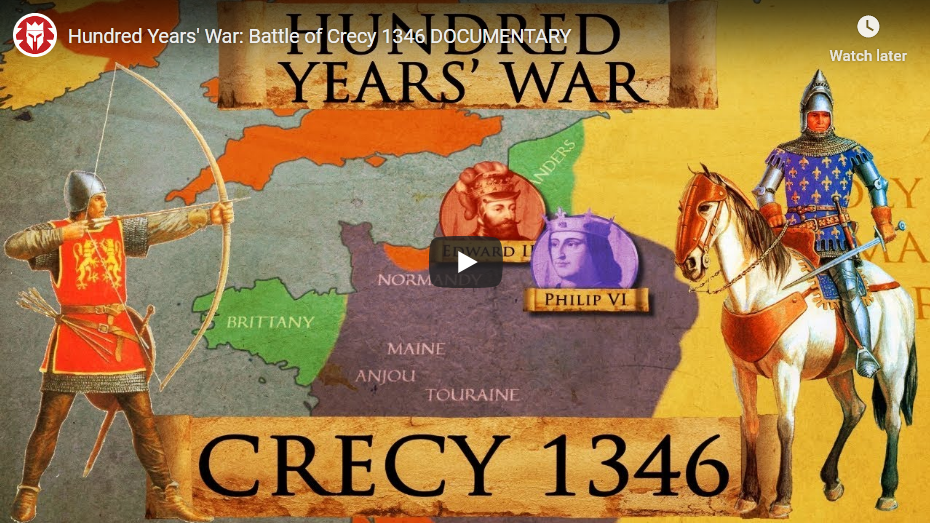
Hundred Years’ War: Battle of Crecy 1346

Filed under: Britain, France, History, Military — Tags: , , , , — Nicholas @ 02:00

Kings and Generals
Published 7 December 2017

The Hundred Years’ War of 1337-1453 between France and England is one of the most crucial conflicts in the history of Europe. It changed the social, political and cultural outlook of the countries involved, influenced the change in warfare, brought the end of feudalism closer. The first phase of this war is called the Edwardian War, and one of the most decisive engagements of this conflict was the battle of Crecy (1346). This series will have 5 videos, so don’t hesitate to like, subscribe and share. And if you want to support us, you can do it on Patreon: http://www.patreon.com/KingsandGenerals or Paypal: http://paypal.me/kingsandgenerals

We are grateful to our patrons, who made this video possible: Ibrahim Rahman, Koopinator, Daisho, Łukasz Maliszewski, Nicolas Quinones, William Fluit, Juan Camilo Rodriguez, Murray Dubs, Dimitris Valurdos, Félix Gagné-Dion, Fahri Dashwali, Kyle Hooton, Dan Mullen, Mohamed Thair, Pablo Aparicio Martínez, Iulian Margeloiu, Chet, Nick Nasad, Jeyares, Amir Eppel, Thomas Bloch, Uri Sternfeld, Juha Mäkelä, Georgi Kirilov, Mohammad Mian, Daniel Yifrach, Brian Crane, Muramasa, Gerald Tnay, Hassan Ali, Richie Thierry, David O’Hare, Christopher Commins, Chris Glantzis, Mike, William Pugh, Stefan Dt, indy, Bashir Hammour, Mario Nickel, R.G. Ferrick, Moritz Pohlmann, Russell Breckenridge, Jared R. Parker, Kassem Omar Kassem, AmericanPatriot, Robert Arnaud, Christopher Issariotis, John Wang, Joakim Airas, Nathanial Eriksen and Joakim Airas.

This video was narrated by our good friend Officially Devin. Check out his channel for some kick-ass Let’s Plays. https://www.youtube.com/user/Official…

The Machinimas for this video is created by one more friend – Malay Archer. Check out his channel, he has some of the best Total War machinimas ever created: https://www.youtube.com/user/Mathemed…

Inspired by: BazBattles, Invicta (THFE), Epic History TV, Historia Civilis and Time Commanders

Machinimas made on the Total War: Attila engine using the great Medieval Kingdoms mod.

Production Music courtesy of Epidemic Sound: http://www.epidemicsound.com

October 21, 2019

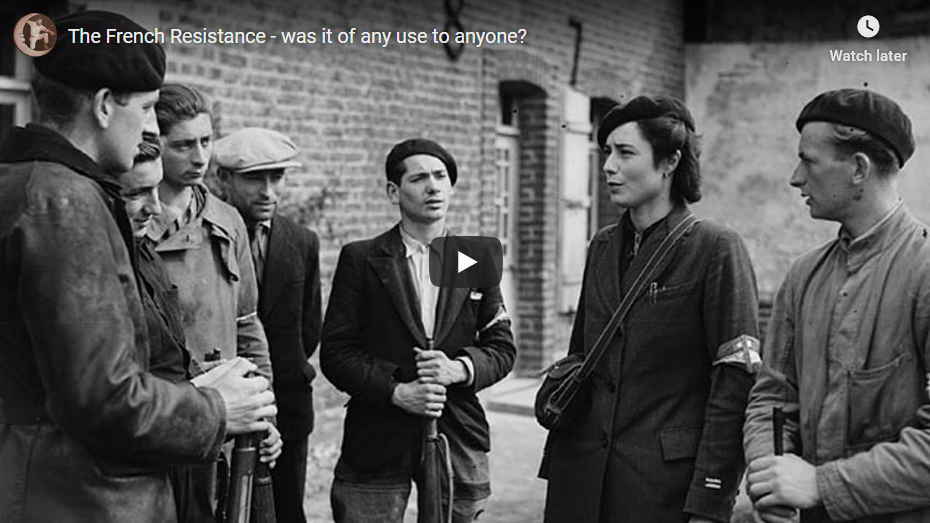
The French Resistance – was it of any use to anyone?

Filed under: France, Germany, History, Military, WW2 — Tags: , , , — Nicholas @ 02:00

Lindybeige
Published on 19 October 2016

Who organised the French Resistance? Did it ever do much?
Support me on Patreon: https://www.patreon.com/Lindybeige

I had planned to say a lot more, but this should be long enough. In take one, which I had to ditch because my sound recorder packed in half-way through it (but I didn’t notice, so carried on), I talked quite a bit about Wing Commander F.F.E. Yeo-Thomas AKA “The White Rabbit” who did a lot of organising the French Resistance, and I was also planning to talk about “R.A.F. blackmail sabotage” but perhaps that will come out in another video another day. Probably not, though. Never mind – sixteen minutes should be long enough for anyone.

Many of the figures I quote were fresh in my mind because I had just read them in Dadland by Keggie Carew. Another influential book on this video was The White Rabbit about Wing Commander FFE Yeo-Thomas.

Lindybeige: a channel of archaeology, ancient and medieval warfare, rants, swing dance, travelogues, evolution, and whatever else occurs to me to make.

▼ Follow me…

Twitter: https://twitter.com/Lindybeige I may have some drivel to contribute to the Twittersphere, plus you get notice of uploads.

website: http://www.LloydianAspects.co.uk

September 23, 2019

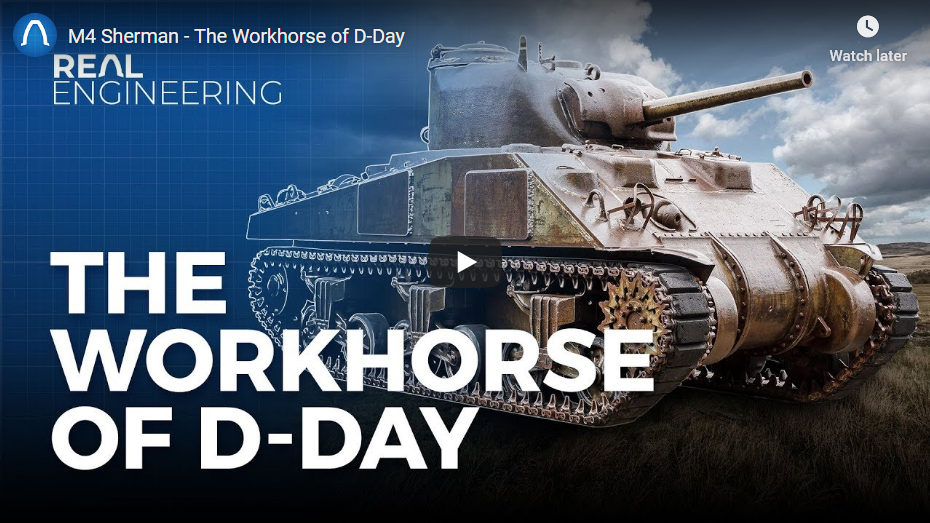
M4 Sherman – The Workhorse of D-Day

Filed under: History, Military, USA, Weapons, WW2 — Tags: , , — Nicholas @ 04:00

Real Engineering
Published on 21 Sep 2019

Watch over 2,400 documentaries for free for 30 days by signing up at http://www.CuriosityStream.com/realen… and using the code, “realengineering

New streaming platform: https://watchnebula.com/

Patreon:
https://www.patreon.com/user?u=282505…
Twitter:
https://twitter.com/thebrianmcmanus
Discord:
https://discord.gg/s8BhkmN

Thank you to AP Archive for access to their archival footage

August 27, 2019

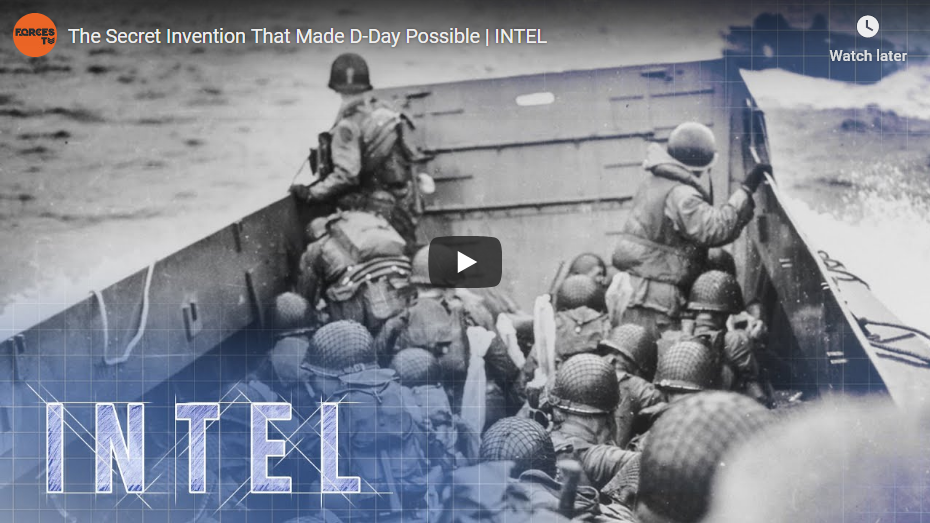
The Secret Invention That Made D-Day Possible | INTEL

Filed under: Britain, France, History, Military, Technology, USA, WW2 — Tags: , , , — Nicholas @ 04:00

Forces TV
Published on 7 Jun 2019

As much as the success of D-Day was down to the bravery of soldiers … it was made possible by inventions and new machines. These Mulberry Harbours were a real World War 2 engineering victory.

More Mulberry: https://www.forces.net/d-day/mulberry-harbours-how-allies-floated-concrete-win-d-day
Forces Net D-Day Hub: http://forces.net/dday

June 7, 2019

The almost-forgotten 1st Canadian Parachute Battalion on D-Day

Filed under: Cancon, History, Military, WW2 — Tags: , , — Nicholas @ 03:00

Colby Cosh reminds us that Canadian troops landed in Normandy in at least one other location than on Juno Beach:

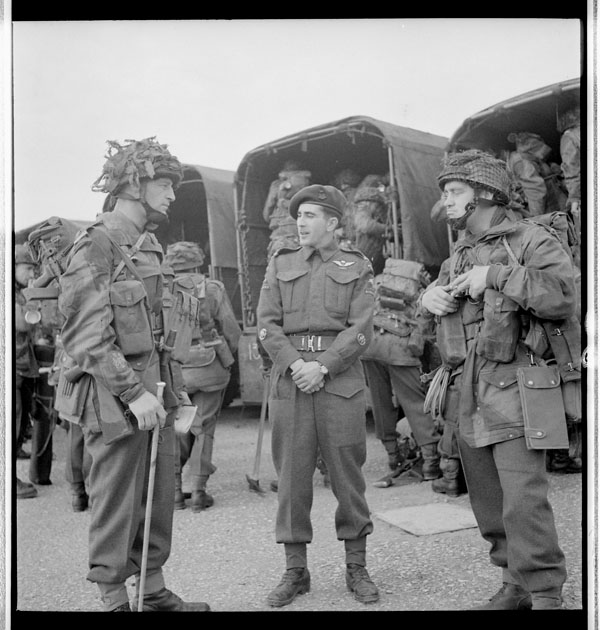
From left to right, Regimental Sergeant-Major “Knobby” Clark, Company Sergeant-Major Norbert Joseph and Company Sergeant-Major Outhwaite of the 1st Canadian Parachute Battalion getting ready to leave Carter Barracks for their D-Day transit camp, May 1944.
Canada. Dept. of National Defence / Library and Archives Canada / e002852749

Col. C.P. Stacey’s 1946 history of 1st Canadian Parachute Battalion in Normandy describes the expectations of high command chillingly. For the purposes of the invasion, the Canadians operated as a component of the British 6th Airborne Division, assigned to blow up bridges, seize crossroads and establish advance observation posts deep in enemy territory. The War Office estimated, Stacey wrote, “that the wastage for the first month would be at the double intense rate, i.e., 50 per cent of War Establishment for officers and 40 per cent for other ranks.”

With regard to the Canadian airborne, this accounting proved largely accurate: 541 men from the battalion left England to be dropped into the battle of Normandy, the enumerated casualties for June 6 alone were two “presumed killed,” 18 dead, six wounded, and 81 taken prisoner. The unit lost no more to capture after the first day, but by June 17, when the battalion was removed from the front line for the first time, the other categories had swelled to 48 killed and 113 wounded. Stacey’s calculation of the actual “wastage” rate is that it was 59 per cent for officers and 39 per cent for other ranks.

If you have read about the paras, it is perhaps not the casualty figures that strike you so much as the unique Gothic horror of their particular experience of D-Day. The Americans’ use of parachute attacks in Sicily had taught planners that putting soldiers right on the intended drop zone never went as well as in training. Pilots who were comfortable flying slow and at suitable height over Fort Benning inevitably found themselves less cool over enemy terrain dotted with anti-aircraft guns and small arms.

In some cases evasive manoeuvres flung the airborne infantry out of the hatch without warning. Meanwhile, flat areas that had looked like green fields in photos turned out to be algae-covered swamps, some intentionally flooded by the Germans. Anyone who had volunteered for the paratroops in the hope of avoiding drowning could be in for a dreadful surprise. The historian Dan Hartigan, son of a 1st Battalion vet of the same name, describes a close shave for Sgt. W.R. Kelly, later killed in the Battle of the Bulge. “One man found Sergeant Kelly hanging upside down with his head in the water, from a huge deadwood tree. … The canopy had caught on a limb and suspended Kelly so he was submerged from the top of his head to his neck.” Kelly was rescued by a nearby comrade, but some soldiers in similar predicaments dropped alone and were not so lucky. In darkness and confusion, others landed badly, broke limbs, and were out of action at once.

June 6, 2019

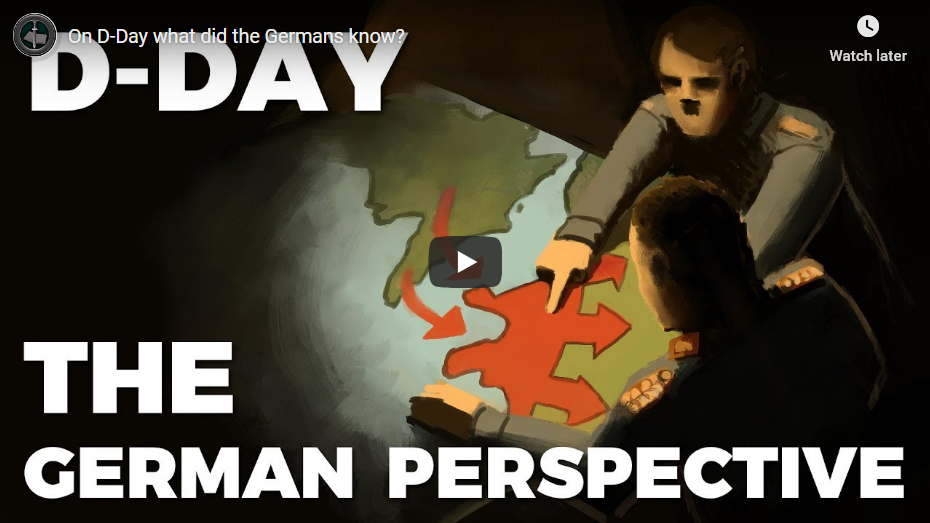
On D-Day what did the Germans know?

Filed under: Britain, France, Germany, History, Military, USA, WW2 — Tags: , — Nicholas @ 04:00

Military History Visualized
Published on 28 May 2019

When it comes to D-Day and the German perspective there are a few bits out there, but the sources are sometimes lacking. So, for this, we will be looking at some proper sources namely, the situation report of Operations Staff of the Wehrmacht and the war diary of the 7th German Army.

Cover design by vonKickass.

»» SUPPORT MHV ««
» paypal donation – https://paypal.me/mhvis
» patreon – https://www.patreon.com/mhv

» SOURCES «

Mehner, Kurt (Hrsg.): Die geheimen Tagesberichte der Deutschen Wehrmachtführung im Zweiten Weltkrieg 1939-1945. Band 10: 1. März 1944 – 31. August 1944, Biblio Verlag: Osnabrück, 1985.

Schramm, Percy E.: (Hrsg.): Kriegstagebuch des OKW 1944-1945. Teilband I. Eine Dokumentation. Bechtermünz: 2005.

Lieb, Peter: Unternehmen Overlord. Die Invasion in der Normandie und die Befreiung Westeuropas. C.H. Beck: München, 2014.

Horst Boog, Gerhard Krebs, Detlef Vogel: Das Deutsche Reich und der Zweite Weltkrieg. Band 7. Das Deutsche Reich in der Defensive – Strategischer Luftkrieg in Europa, Krieg im Westen und in Ostasien 1943 bis 1944/45, Deutsche Verlags-Anstalt, Stuttgart 2001.

Germany and the Second World War. Volume 7. The Strategic Air War in Europe and the War in the West and East Asia 1943–1944/5. 2006.

Citino, Robert M.: The Wehrmacht’s Last Stand. The German Campaigns of 1944-1945. University Press of Kansas: USA, 2017.

Fennell, Jonathan: Fighting the People’s War. The British and Commonwealth Armies and the Second World War. Cambridge University Press: Cambridge, UK, 2019

Harrison, Gordon A.: Cross-Channel Attack. United States army in World War II. Center of Military History, United States Army, Washington D.C., 1993

Blumenson, Martin: Breakout and Pursuit. United States army in World War II. Center of Military History, United States Army, Washington D.C., 1993

Messenger, Charles: The D-Day Atlas. Anatomy of the Normandy Campaign, Thames & Hudson: London, 2014 (2004).

Penrose, Jane (ed.): The D-Day Companion. Leading Historians explore history’s greatest amphibious assault. Osprey Publishing: Oxford 2009 (2004).

Töppel, Roman: Kursk 1943. The Greatest Battle of the Second World War. Helion: Warwick, UK: 2018.

Document for June 6th: D-day statement to soldiers, sailor, and airmen of the Allied Expeditionary Force, 6/44 https://www.archives.gov/global-pages…

The Invasion of France, June 6, 1944, House of Commons https://winstonchurchill.org/resource…

Bloody Normandy: Juno Beach and Beyond – Part 1

Filed under: Cancon, France, History, Military, WW2 — Tags: , , , , — Nicholas @ 02:00

canmildoc
Published on 17 Sep 2011

Part 1 of 5

Documentary “Stories from the Second World War: Bloody Normany”.

Juno or Juno Beach was one of five sectors of the Allied invasion of German-occupied France in the Normandy landings on 6 June 1944, during the Second World War. The sector spanned from Saint-Aubin, a village just east of the British Gold sector, to Courseulles, just west of the British Sword sector. The Juno landings were judged necessary to provide flanking support to the British drive on Caen from Sword, as well as to capture the German airfield at Carpiquet west of Caen. Taking Juno was the responsibility of the 3rd Canadian Infantry Division and commandos of the Royal Marines, with support from Naval Force J, the Juno contingent of the invasion fleet, including ships of the Royal Canadian Navy (RCN). The beach was defended by two battalions of the German 716th Infantry Division, with elements of the 21st Panzer Division held in reserve near Caen.

The invasion plan called for two brigades of the 3rd Canadian Division to land in two subsectors — Mike and Nan — focusing on Courseulles, Bernières, and Saint-Aubin. It was hoped that preliminary naval and air bombardment would soften up the beach defences and destroy coastal strongpoints. Close support on the beaches was to be provided by amphibious tanks of the 2nd Canadian Armoured Brigade. Once the landing zones were secured, the plan called for the 9th Canadian Infantry Brigade to land reserve battalions and deploy inland, the Royal Marine commandos to establish contact with the British 3rd Infantry Division on Sword, and the 7th Canadian Infantry Brigade to link up with the British 50th (Northumbrian) Infantry Division on Gold. The 3rd Canadian Division’s D-Day objectives were to capture Carpiquet Airfield and reach the Caen-Bayeux railway line by nightfall.

The landings initially encountered heavy resistance from the German 716th Division; the preliminary bombardment proved less effective than had been hoped, and rough weather forced the first wave to be delayed until 07:35. Several assault companies — notably those of the Royal Winnipeg Rifles and The Queen’s Own Rifles of Canada — took heavy casualties in the opening minutes of the first wave. Strength of numbers, as well as coordinated fire support from artillery and armoured squadrons, cleared most of the coastal defences within two hours of landing. The reserves of the 7th and 8th brigades began deploying at 08:30 (along with the Royal Marines), while the 9th Brigade began its deployment at 11:40.

The subsequent push inland towards Carpiquet and the Caen-Bayeux railway line achieved mixed results. The sheer numbers of men and vehicles on the beaches created lengthy delays between the landing of the 9th Brigade and the beginning of substantive attacks to the south. The 7th Brigade encountered heavy initial opposition before pushing south and making contact with the 50th Infantry Division at Creully. The 8th Brigade encountered heavy resistance from a battalion of the 716th at Tailleville, while the 9th Brigade deployed towards Carpiquet early in the evening. Resistance in Saint-Aubin prevented the Royal Marines from establishing contact with the British 3rd Division on Sword. When all operations on the Anglo-Canadian front were ordered to halt at 21:00, only one unit had reached its D-Day objective, but the 3rd Canadian Infantry Division had succeeded in pushing farther inland than any other landing force on D-Day. – http://en.wikipedia.org/wiki/Juno_beach

« Newer PostsOlder Posts »

Powered by WordPress