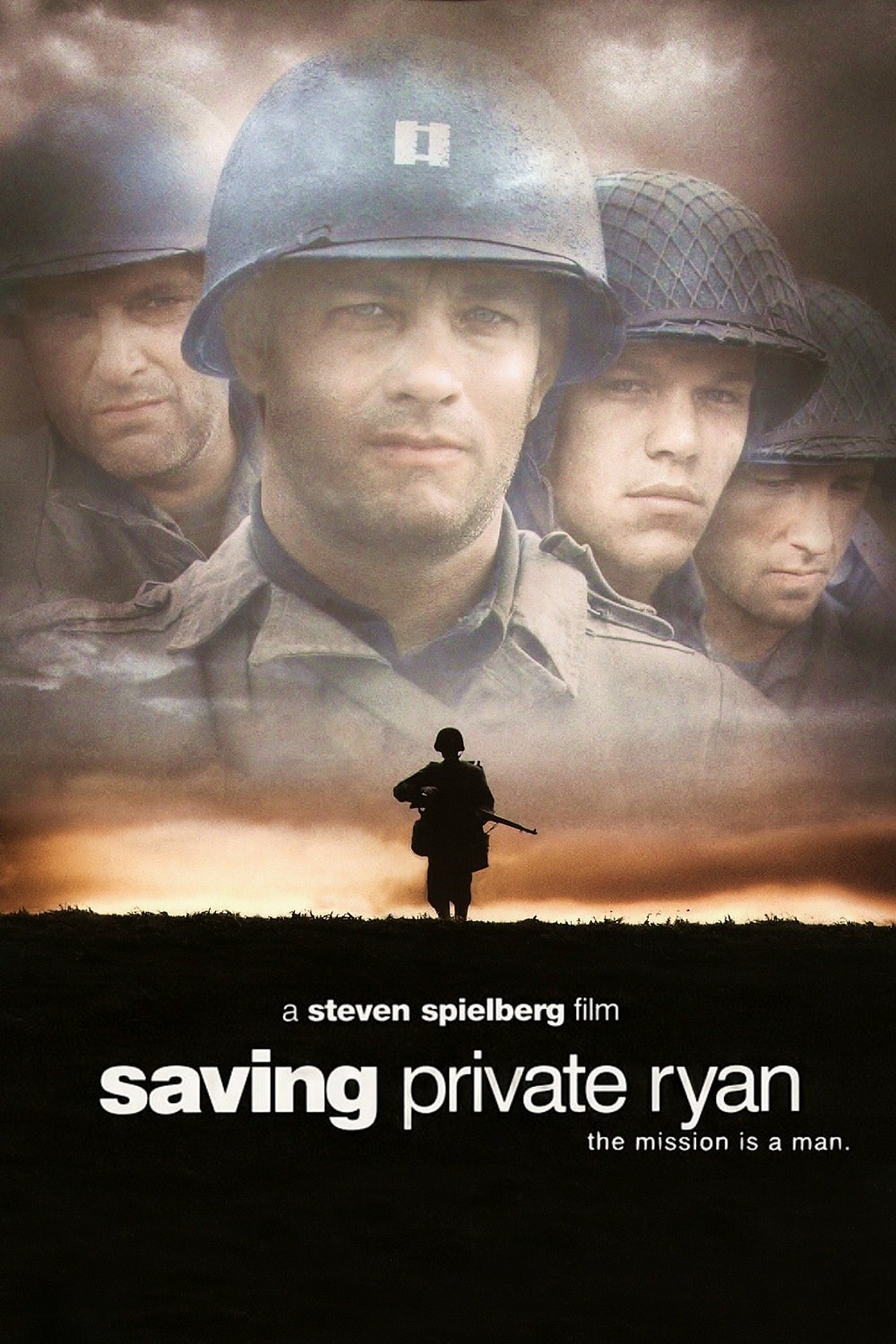
When Saving Private Ryan was released in America, I made a mild observation to the effect that its premise was a lot of hooey, and received in response several indignant letters pointing out that it was “based on a true story”, that of the Sullivan brothers. Er, not quite. The Sullivans’ story is stirringly told in The Fighting Sullivans (1942, directed by 42nd Street’s Lloyd Bacon): after Pearl Harbor, all five brothers enlist — and all five die aboard the [cruiser] Juneau at Guadalcanal. As a result, to avoid the recurrence of such a freakish tragedy, the United States changed its policy on family members serving together. Steven Spielberg’s film is not “based” on the Sullivans, except insofar as General George C. Marshall, the US Army’s chief of staff, mentions their fate to explain his decision.
Rather, the film is a kind of extension of the thinking behind the policy change: when three out of four Ryan brothers are killed in action, General Marshall orders a rescue mission to retrieve the sole surviving sibling, whose general whereabouts are somewhere behind enemy lines in Normandy — and all this a couple of days after D-Day. No such incident took place: no Allied commander would have thought it worth the risk in lives to assuage one distraught mother’s potential further bereavement.
Spielberg’s mistake is that, as one of the last remaining hardcore Clinton groupies, he’s thinking in Clintonian terms — about publicity, image, spin: the death of another Ryan brother would not “look good”. When Spielberg has General Marshall read out a letter from Lincoln to a mother whose sons all died in the Civil War, we’re certainly meant to find his consoling words — that they gave their lives in a great and noble cause — inadequate. It’s a measure of the gulf between 1944 and 1998 that The Fighting Sullivans was released during the war because it was thought the supreme sacrifice of one family would be inspiring. Alas, not to baby boomers.
So much has been written about the unprecedented “realism” of this film’s war scenes that the equally unprecedented unrealism of its thinking has passed virtually unnoticed. You’ve probably seen a zillion articles about the film’s prologue — a recreation of D-Day which lasts almost as long and doubtless cost a lot more — so I’ll say only this: yes, it’s impressive; yes, every shot of blood and tissue and body parts is underlined by adroit effects; yes, every moment is a testament to Spielberg’s command of cinematic technique; but that’s the problem — you react to it as technique, as showmanship. There’s one perfect shot after another: the silence underwater, with its dangerous illusion of respite; the pitterpatter of rain on leaves gradually blurring into rifle fire. The whole thing is oddly pointless: you’re not engaged by the predicament of the troops because you’re so busy admiring the great film-maker behind them. A film cannot really be “authentic” if all you notice is the authenticity.
Mark Steyn, The Spectator, 1998-09-12 (linked from SteynOnline).
June 6, 2019
QotD: Reviewing Saving Private Ryan
April 17, 2019
Tank Chats #46 Ram Kangaroo | The Funnies | The Tank Museum
The Tank Museum
Published on 16 Feb 2018As part of the Funnies mini-series, David Fletcher takes a look at the troop-carrying Ram Kangaroo.
Towards the end of World War Two, Canadian Ram tanks were converted into Armoured Personnel Carriers called Kangaroos.
Support the work of The Tank Museum on Patreon: ► https://www.patreon.com/tankmuseum
Or donate http://tankmuseum.org/support-us/donateVisit The Tank Museum SHOP: ►https://tankmuseumshop.org/
Twitter: ► https://twitter.com/TankMuseum
Tiger Tank Blog: ► http://blog.tiger-tank.com/
Tank 100 First World War Centenary Blog: ► http://tank100.com/ #tankmuseum #tanks
December 11, 2018
Viking Expansion – Lies – Extra History
Extra Credits
Published on 8 Dec 2018Writer Rob Rath talks about all the cool stories and facts we didn’t get to cover in the already expansive Viking Expansion series.
Join us on Patreon! http://bit.ly/EHPatreon
7:08 – Rob learns he has a linguistic tic about being able to correctly distinguish “ancestor” and “descendant”
17:10 – Olga of Kiev scared Matt to death… really though…
25:23 – Walpole Connection
28:05 – what’s next on Extra HistorySome other works to check out: The Sea Wolves: A History of the Vikings, by Lars Brownworth / The Vikings, by Else Roesdahl / Podcast: Norse by Northwest
November 6, 2018
Viking Expansion – Rollo the Walker – Extra History – #2
Extra Credits
Published on 3 Nov 2018Rollo the Walker led the Great Heathen Army and had his sights set on sacking Paris, in a time when relations between the Vikings and the Franks had become, essentially, getting paid to raid. Eventually his sights would turn to stability — and he became the founder of Normandy.
Join us on Patreon! http://bit.ly/EHPatreon
June 10, 2018
D-Day – Lies – Extra History
Extra Credits
Published on 1 Aug 2017D-Day is too vast and important a topic to be completely covered by four short videos, but we hope our series offered some new insights into the massive effort that went into the Normandy beach landings. James Portnow and Richard Cutland, Wargaming’s Head of Military Relations, take some time to chat about some more important D-Day stories.
June 9, 2018
D-Day – IV: The Atlantic Wall – Extra History
Extra Credits
Published on 29 Jun 2017The Germans had established a secure barrier against the Allied invasion of France – or so they believed, until the D-Day landings in Normandy caught them by surprise and the Atlantic Wall quickly fell apart.
June 8, 2018
D Day – III: La Résistance – Extra History
Extra Credits
Published on 20 Jun 2017Although the French government surrendered to the German invasion, French people rose up and formed resistance groups to take their country back. Charles de Gaulle and his Free French took advantage of these independent movements to help organize actions that would greatly aid the Allied landings at Normandy.
June 7, 2018
D-Day – II: The Secret War – Extra History
Extra Credits
Published on 13 Jun 2017The Germans expected the Allies to invade France to re-open the Western Front, but they did not know when or where the invasion would start – thanks largely to the operations of MI5, British intelligence services, who staged an elaborate deception called Operation Bodyguard designed to make the Germans think they would be invading Pas de Calais instead of their real target: Normandy.
June 6, 2018
D-Day: Canada at Juno Beach
Yesterday Today
Published on 3 Jun 2017D-Day: Canada at Juno Beach
6 June 1944
Of the nearly 150,000 Allied troops who landed or parachuted onto the Normandy coast, 14,000 were Canadians. They assaulted a beachfront code-named “Juno”.
The Royal Canadian Navy contributed 110 ships & 10,000 sailors in support of the landings while the RCAF had helped prepare the invasion by bombing targets inland. On D-Day & during the ensuing campaign, 15 RCAF fighter & fighter-bomber squadrons helped control the skies over Normandy and attacked enemy targets. On D-Day, Canadians suffered 1074 casualties, including 359 killed.
D-Day – I: The Great Crusade – Extra History
Extra Credits
Published on 6 Jun 2017D-Day: June 6, 1944, the day when Allied forces stormed the beaches of Normandy to retake France from the Germans. They hoped to take the Germans by surprise, and their decision to brave rough weather to make their landings certainly accomplished that, but despite these small advantages, the American forces at Utah and Omaha Beach had to overcome monumental challenges to establish a successful beachhead.
June 6, 2017
Where was the Luftwaffe on D-Day? – German Response to Operation Overlord, Normandy
Published on 26 May 2017
The 73 Anniversary of D-Day is nearly upon us so let us talk about the Luftwaffe‘s involvement in the Battle of Normandy!
July 3, 2015
QotD: “US tankers were notorious for identifying everything as a Tiger tank”
When you read unit accounts, whether it’s the actual unit after action reports or the published books, everyone talks about Tiger tanks. But in looking at it in both German records and US records, I’ve only found three instances in all the fighting from Normandy to 1945 where the US encountered Tigers. And by Tigers I mean Tiger 1, the type of tank we saw in the film [Fury]. I’m not talking King Tigers, the strange thing is that the US Army encountered King Tigers far more often than Tigers. That’s partly because there weren’t a lot of Tigers left by 1944, production ends in August 1944. There were not a lot of Tigers in Normandy, they were mostly in the British sector, the British saw a lot of Tigers. Part of the issue is that US tankers were notorious for identifying everything as a Tiger tank, everything from Stug III assault guns to Panzer IV and Panthers and Tigers.
There was one incident in August of 1944 where 3rd Armored division ran into three Tigers that were damaged and being pulled back on a train, they shot them up with an anti-aircraft half-track. And then there was a single Tiger company up in the Bulge that was involved in some fighting. And then there was one short set of instances in April 1945, right around the period of the film, where there was a small isolated Tiger unit that actually got engaged with one of the new US M26 Pershing tank units. They knocked out a Pershing and then in turn that Tiger was knocked out and the Pershing tanks knocked out another King Tiger over the following days. So I found three verifiable instances of Tigers encountering, or having skirmishes with US troops in 1944-45. So it was very uncommon. It definitely could have happened, there are certainly lots of gaps in the historical record both on the German side and the US side. I think the idea that the US encountered a lot of Tigers during WW2 is simply due to the tendency of the US troops to call all German tanks Tigers. It’s the same thing on the artillery side. Every time US troops are fired upon, it’s an 88, whether it’s a 75mm Pak 40 anti-tank gun, a real 88, a 105mm field howitzer, they were all called 88’s.
“Interview with Steven Zaloga”, Tank and AFV News, 2015-01-27.
June 8, 2015
QotD: German troops on the Atlantic Wall
Formations transferred from the eastern front, especially Waffen-SS divisions, believed that the soldiers garrisoned in France had become soft. “They had done nothing but live well and send things home,” commented one general. “France is a dangerous country, with its wine, women and pleasant climate.” The troops of the 319th Infanterie-Division on the Channel Islands were even thought to have gone native from mixing with the essentially English population. They received the nickname of the “King’s Own German Grenadiers”. Ordinary soldiers, however, soon called it “the Canada Division”, because Hitler’s refusal to redeploy them meant that they were likely to end up in Canadian prisoner of war camps.
Anthony Beevor, D-Day: The Battle for Normandy, 2009.
June 7, 2015
QotD: Air power on D-Day
Allied fighter-bombers continued to attack not only front-line positions, but also any supply trucks coming up behind with food, ammunition and fuel. The almost total absence of the Luftwaffe to contest the enemy’s air supremacy continued to provoke anger among German troops, although they often resorted to black humour. “If you can see silver aircraft, they are American,” went one joke. “If you can see khaki planes, they are British, and if you can’t see any planes, then they’re German.” The other version of this went, “If British planes appear, we duck. If American planes come over, everyone ducks. And if the Luftwaffe appears, nobody ducks.” American forces had a different problem. Their trigger-happy soldiers were always opening fire at aircraft despite orders not to because they were far more likely to be shooting at an Allied plane than an enemy one.
Anthony Beevor, D-Day: The Battle for Normandy, 2009.
June 6, 2015
Canada at War – Normandy, June 1944
Uploaded on 10 Jan 2012
Part 1 of 3
June – September 1944. D-Day, June 6, 1944. In the early morning hours, infantry carriers, including 110 ships of the Royal Canadian Navy, cross a seething, pitching sea to the coast of France, while Allied air forces pound enemy positions from the air. Cherbourg, Caen, Carpiquet, Falaise, Paris are liberated. Canadians return, this time victorious, to the beaches of Dieppe.
H/T to Gods of the Copybook Headings for the link.