
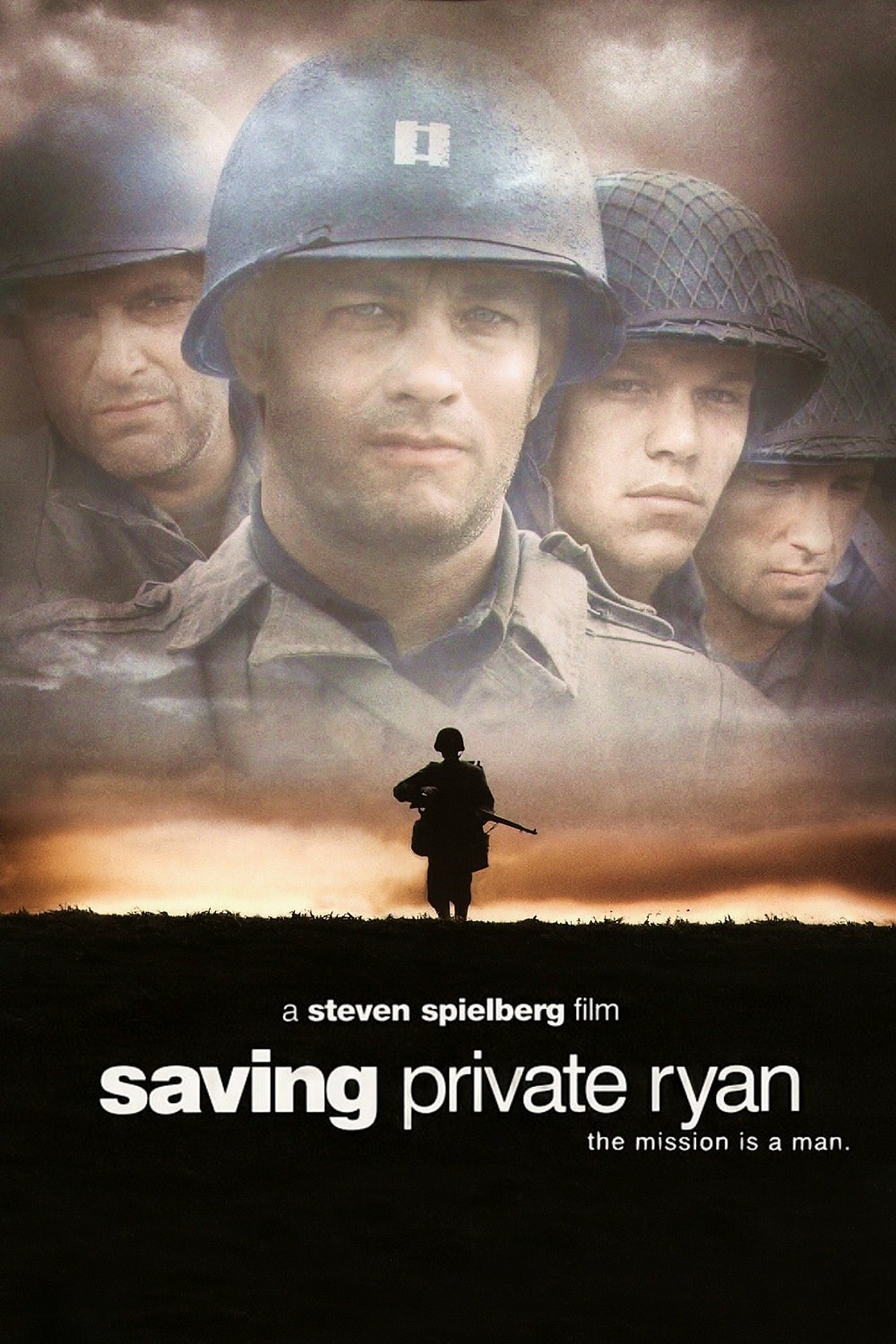
When Saving Private Ryan was released in America, I made a mild observation to the effect that its premise was a lot of hooey, and received in response several indignant letters pointing out that it was “based on a true story”, that of the Sullivan brothers. Er, not quite. The Sullivans’ story is stirringly told in The Fighting Sullivans (1942, directed by 42nd Street’s Lloyd Bacon): after Pearl Harbor, all five brothers enlist — and all five die aboard the [cruiser] Juneau at Guadalcanal. As a result, to avoid the recurrence of such a freakish tragedy, the United States changed its policy on family members serving together. Steven Spielberg’s film is not “based” on the Sullivans, except insofar as General George C. Marshall, the US Army’s chief of staff, mentions their fate to explain his decision.
Rather, the film is a kind of extension of the thinking behind the policy change: when three out of four Ryan brothers are killed in action, General Marshall orders a rescue mission to retrieve the sole surviving sibling, whose general whereabouts are somewhere behind enemy lines in Normandy — and all this a couple of days after D-Day. No such incident took place: no Allied commander would have thought it worth the risk in lives to assuage one distraught mother’s potential further bereavement.
Spielberg’s mistake is that, as one of the last remaining hardcore Clinton groupies, he’s thinking in Clintonian terms — about publicity, image, spin: the death of another Ryan brother would not “look good”. When Spielberg has General Marshall read out a letter from Lincoln to a mother whose sons all died in the Civil War, we’re certainly meant to find his consoling words — that they gave their lives in a great and noble cause — inadequate. It’s a measure of the gulf between 1944 and 1998 that The Fighting Sullivans was released during the war because it was thought the supreme sacrifice of one family would be inspiring. Alas, not to baby boomers.
So much has been written about the unprecedented “realism” of this film’s war scenes that the equally unprecedented unrealism of its thinking has passed virtually unnoticed. You’ve probably seen a zillion articles about the film’s prologue — a recreation of D-Day which lasts almost as long and doubtless cost a lot more — so I’ll say only this: yes, it’s impressive; yes, every shot of blood and tissue and body parts is underlined by adroit effects; yes, every moment is a testament to Spielberg’s command of cinematic technique; but that’s the problem — you react to it as technique, as showmanship. There’s one perfect shot after another: the silence underwater, with its dangerous illusion of respite; the pitterpatter of rain on leaves gradually blurring into rifle fire. The whole thing is oddly pointless: you’re not engaged by the predicament of the troops because you’re so busy admiring the great film-maker behind them. A film cannot really be “authentic” if all you notice is the authenticity.
Mark Steyn, The Spectator, 1998-09-12 (linked from SteynOnline).
June 6, 2019
QotD: Reviewing Saving Private Ryan
Comments Off on QotD: Reviewing Saving Private Ryan
No Comments
No comments yet.
RSS feed for comments on this post.
Sorry, the comment form is closed at this time.


