
The Rest Is History
Published 27 Jan 2025The Roman historian Suetonius’ The Lives of the Caesars, written during the early imperial period of the Roman Empire, is a seminal biography covering the biographies of the early emperors of Rome, during two spectacular centuries of Roman history. Delving deep into the personal lives of the Caesars and sparing no detail, no matter how prurient, pungent, explicit or salacious, it vividly captures Rome at the peak of her power, and those colourful individuals at the heart of everything. It is an unsettling yet fascinating portrait of the alien and the intimate, that sees some of history’s most famous characters revealed as almost modern men, plotting a delicate line between private and public, respectability and suspicion. From the showmanship of Augustus, the first Caesar, and his convoluted family melodramas, to Tiberius, a monster in the historical record famed for his sexual misdeeds, to Caligula, who delighted in voyeuristic moral degeneracy, and the looming shadow of Nero; all will be revealed …
00:00 A humble plug from Tom
02:55 The most spectacular two centuries in Roman history
05:25 The value of Suetonius as a biographer
08:43 Suetonius’ interest in the love lives of the Caesars
12:58 Suetonius’ influence on popular culture
16:15 Augustus: Rome’s greatest actor
21:25 Roman politics as spectacle
21:55 Augustus as the model of a good emperor
24:30 What kind of monarchy was this?
28:00 The life of Suetonius
35:52 How did Roman histories work?
39:04 Why Romans had no idea of privacy
40:05 Did Roman emperors sexual misdemeanours matter
42:08 How we see sexual relations different to the Romans
(more…)
July 7, 2025
Augustus: Visionary Statesman or Destroyer Of The Republic?
June 29, 2025
QotD: People in the past believed their own religion
What I think this show [Game of Thrones] has fallen into is the assumption – almost always made by someone outside a society looking in – that the local religion is so silly that no one of true intelligence (which always seems to mean “the ruling class” – I am amazed how even blue-collar students will swiftly self-identify with knights and nobles over commoners when reading history) could believe it. This is the mistake my students make – they don’t believe medieval Catholicism or Roman paganism, and so they weakly assume that no one (or at least, none of the “really smart” people) at the time really did either. Of course this is wrong: People in the past believed their own religion.
It is an old mistake – Polybius makes it of the Romans, writing in c. 150 BC. Polybius notes that Roman religion was “distinctly superior” for maintaining the cohesion of the Roman state, but that “they (= the ruling class) have adopted this course for the sake of the common people” (Plb. 6.56.6-8), by which he means for the sake of the “fickle multitude” which must be “held in invisible terrors and pageantry”. Polybius, I should note, immediately contradicts himself – one benefit of this religion, he says, is that Roman magistrates (read: elite Senators) do not steal from the public treasury even when they are not watched, which would seem to imply that even many very elite Romans believed their own religion (also, irony alert: those famously incorruptible Romans …). Poor men, after all, are not elected to watch the treasury.
Fortunately, Polybius is not our only source on Roman culture, so it is possible to say – and I want to be clear here – Polybius is wrong (on this point at least). Roman elites took their religion very seriously. There are exceptions, of course – Julius Caesar was an Epicurean philosophically, although this does not seem to have altogether disrupted his performance of the duties of Rome’s highest priesthood (he was Pontifex Maximus). Nevertheless, such philosophically minded men were generally regarded with scorn by even the Roman elites (Cicero heaps such scorn on Cato in the Pro Murena in what were clearly intended as friendly “ribbing” before a mostly elite audience), who nevertheless greatly valued religious character (in contrast, Cicero is quick to accuse his hated enemy Catiline of irreligion before the Senate). Roman leaders vowed temples and sacrifices in duress, and built and gave them in victory. Lavish dedications to the gods from all levels of Roman society confirm the overall picture: the Romans believed their religion. Yes, even the elite Romans (there is, I should note, some complicated in that elites tended to separate what they viewed as religion from common “superstition”, but that’s a topic for another day.) And, if anything, the evidence for elite “buy-in” to Medieval religion is far more voluminous.
Yet none of the main characters of Game of Thrones, apart from perhaps Catelyn Stark, is devoted to their region’s traditional religion in any private sense. I cannot recall at any point any character protesting an action on account of religion – no marches held up by high holy days (a regular occurrence in ancient and medieval literature), no groups, individuals or places religiously exempt from violence. The Faith has certain rules about sexuality, but they’re rules that are not only flouted privately by individuals in the show, but also quite publicly by the last ruling dynasty for centuries.
Moreover, none of the ruling characters seem to have any religious functions – or if they do, they simply ignore them most of the time. Keep in mind, these people believe that their gods – be it the Seven or the Old Gods – are powerful divine beings who are directly and immediately interested in the world and who act on that interest. Keeping such beings happy is vitally important – it is not an afterthought. No society, so far as I can tell, has ever believed there is enough gold or enough armies to save you if you have enraged the gods. There is simply no off-setting an angry divinity (and before the smart guy asks, “what about a favorable divinity?” the Greeks had an answer for that – go read Euripides’ Hippolytus. It ends badly for the mortals).
The lack of religious duties or functions for characters who are kings is particularly surprising. Kingship has three core roles in almost all human cultures where the institution appears: kings are 1) chief judge, 2) chief general, and 3) chief priest. That third role appears more or less prominently in almost all societies. In ancient Egypt and (at times) in Mesopotamia, kings were held to literally be either earthly incarnations of major gods or minor gods in their own right. Roman Emperors held the office of Pontifex Maximus, and took over as the chief priest of the state, before becoming gods on their deaths. The Chinese emperor was the “Son of Heaven” and was tasked with maintaining the right relationship with the divine (the “mandate of heaven”). The emperors of Japan are purported to be direct descendants of the goddess Amaterasu (and they have a family tree to back it up).
The relationship between medieval kings and the Church was more complicated, because of the existence of a clear religious head (the Pope) outside of secular authority, but medieval kingship retained a strong sense of religious purpose. Coronation rituals often involved the clergy and were essentially religious rituals, because kingly power was still thought to be bestowed by God. Kings, in turn, had a special role in keeping their kingdom in right relationship with the divine, both through just rule (which included protecting the Church) and through the performance of religious rituals. Those rituals, of course, worked both ways: both believed to be religious efficacious (as in they helped bring about God’s good favor), but also valuable tools of building royal legitimacy (hat tip to my colleague Elizabeth Hassler’s excellent dissertation on the topic of holy kingship). In some places (England and France most notably), kings were thought holy enough to be able to heal certain diseases miraculously by touch – a king who couldn’t was clearly insufficiently pious.
Bret Devereaux, “New Acquisitions: How It Wasn’t: Game of Thrones and the Middle Ages, Part II”, A Collection of Unmitigated Pedantry, 2019-06-04.
June 25, 2025
QotD: Marie Antoinette and the “Diamond Necklace” scandal
The origins of the affair stretched back to Louis XV, who wished to lavish on his mistress, Madame du Barry, a splendid diamond necklace containing 647 stones and weighing 2,800 carats (worth roughly $15 million today). But Louis XV died before the sale of the necklace was concluded. And when young Louis XVI took the throne, the Paris jewelers Boehmer and Bassenge hoped the new king would purchase the same necklace for his own queen, Marie Antoinette. However, she refused to accept a piece of jewelry that had been created for the previous king’s mistress.
Meanwhile, a socially ambitious minor aristocrat named Jeanne de la Motte was plotting to get her hands on the necklace. Married to the Comte de la Motte, she was also the mistress of Cardinal de Rohan, former French ambassador to Marie Antoinette’s native Austria. Madame de la Motte managed to convince Cardinal de Rohan not only that Marie Antoinette wished to possess the necklace, but that she was acting on the Queen’s behalf. He could ingratiate himself at court, she insisted, by obtaining it. Cardinal Rohan foolishly purchased the necklace on credit, under the naive belief that he’d be repaid by Marie Antoinette. The scam concluded with Madame de la Motte stealing the necklace from the cardinal and, using her husband’s louche connections, selling it in pieces through fences in England.
This tawdry business was closer to comic opera than an affair of state. But when the fraud was discovered, the scandal gripped Parisian society. Louis XVI was so infuriated that he had Cardinal de Rohan arrested and imprisoned in the Bastille, which only heightened public interest. Marie Antoinette was already being caricatured in pamphlets as a depraved nymphomaniac. It was now open season.
In some caricatures, she appeared as a wild beast, a tiger feeding on the French nation. In others, she was depicted as an ostrich, a French wordplay with her home country Autriche, for Austria, which reads like autruche for ostrich. Even worse, she was depicted in pornographic postures, legs open and genitals gaping, cuckolding her obese husband with a succession of lovers, including lesbian trysts. Allusions to her sexual appetites suggested a carnal relationship with Satan. Robespierre’s publication Le Journal des hommes libres described her as “more bloodthirsty than Jezebel, more conniving than Agrippina”. The pamphlets blamed Marie Antoinette for all the nation’s misfortunes, including economic recession. She was so hated by the French public that there were serious concerns for her physical safety.
[…]
Cardinal de Rohan, meanwhile, was tried for his role in the Diamond Necklace affair. Astonishingly, he was acquitted. The scheming Madame de la Motte met a different fate. She was found guilty of theft and sentenced to be whipped and branded on the shoulder with the letter V for voleuse (thief). She was also incarcerated in the Salpêtrière prison in Paris, but escaped to London. In 1789, she published a book, Mémoires justificatifs, a scathing tell-all memoir about Marie Antoinette. It was a good year to attack the French monarchy, for the revolution was just getting going. Madame de la Motte was never returned to France to face justice. Exiled in London, she died in 1791 after falling from a window, apparently fleeing debt collectors. She was buried in St. Mary’s Churchyard in south London.
Matthew Fraser, “Marie Antoinette: Figure of Myth, Magnet for Lies”, Quillette, 2020-06-24.
June 10, 2025
QotD: From Witan to Magna Carta
After a few hundred years of trial and error, and given a king who really was wicked and stupid, too, they, the barons as they were then known, went to war with their king and bent him to their will by forcing him to agree to a great charter of their rights. There was a bit of ringing language about no free man being taken except after a trial by a jury of his peers, but, basically, in very typically English fashion, the rights about which the great charter was most concerned were property rights because the barons had learned, over the centuries that only by controlling the pursestrings could they really control the king.
A few hundred years later, one of liberalism’s and democracy’s greatest voices told us that we have three absolutely fundamental, natural rights: to life, to liberty and to property. These rights were not and still are not unlimited. There were and are ways to lawfully and properly deprive a person of his property and his liberty and, in some countries, even his life.
A few centuries after John Locke another philosopher wanted to do away with the right to property: “From each according to his ability, to each according to his need”, Karl Marx wrote, and many, far too many, believed. The only real problem with Marx’s notion is that it requires that humans are perfect … and most of us know how rare that is. Here in Canada, especially since the early years of the 20th century, we have had far too much Marx and far too little Locke.
Ted Campbell, “Democracy is in peril”, Ted Campbell’s Point of View, 2020-06-12.
June 4, 2025
“Asshole Britain”
In The Line, Greg Quinn indulges in a bit of struggle sessioning about his earlier disagreements with the editors of The Line about Britain and Canada (protip: don’t search for images to go along with that particular headline, especially if you have “safe search” filters turned off):
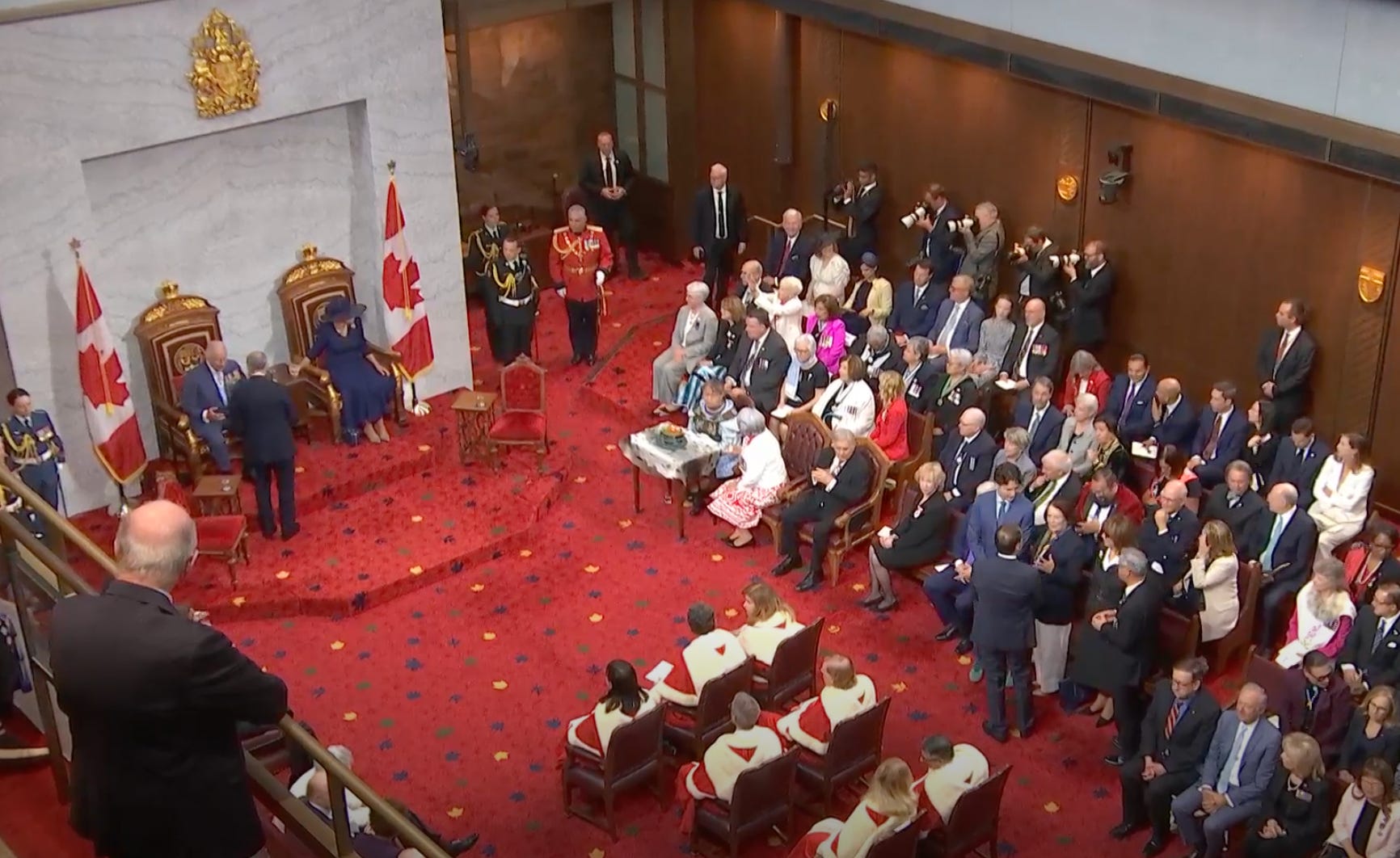
Yeah, let’s go with an inoffensive photo of His Royal Majesty and his Canadian First Minister chatting in the Senate chamber, rather than anything remotely to do with the headline of this post.
Photo by Paul Wells from his Substack
On February 12th of this year, I wrote in The Line about how my country, the United Kingdom, had “ghosted” Canada by refusing to come out strongly in reaction to U.S. President Donald Trump’s egregious attacks on the country and his calls for it to become the 51st state. In writing that piece, I didn’t beat around the bush — I called the U.K.’s actions what they were at the time: cowardice and sycophancy.
Since February, there have been a few (many?!) developments in Canada’s — and the world’s — relationship with President Trump.
Not least among these are Matt Gurney and Jen Gerson’s depiction (or technically, implication) of the U.K. as “Asshole Britain”. As other regular Line readers will know, “Asshole Canada” or “Maximum Canada” is an idea the editors floated here some months ago, where they asserted that Canada should abandon its typical desire to be seen as a global do-gooder and simply assert its national interests, vigorously and unapologetically, and if other countries, even allies, object, well, to hell with them. Editor Gurney, in a recent podcast, cited the just-concluded visit of His Majesty the King to Canada to deliver the Throne Speech — the first time a monarch has done so since 1977 — as an example of that. Prime Minister Mark Carney issued the invite to the King despite obvious discomfort with the idea among senior officials in my government.
Carney didn’t care. The King is the sovereign of Canada, too, and Carney didn’t let British discomfort deter him.
I have to say that HM the King’s speech was a blinder and (in its own royal diplomatic way) left no doubt as to where His Majesty’s sympathies lie and how he supports Canada’s sovereignty and independence. Whether you are a royalist or a republican, the fact that HM the King made the trip and read the speech should be welcomed. And I entirely agree with the editors here — Canadians should and must ignore the comments from the U.K. Who cares? HM the King was acting in his capacity as Canada‘s monarch — the views of anyone in the U.K. (government or otherwise) are irrelevant.
I wish I could condemn Jen and Matt for their (again, implied) characterization of the U.K. — Britain has needed no urging to unapologetically assert its own interests in this revived era of Trump. But I can’t. They are absolutely correct. And every day that passes, I’m sorry to say that the U.K. becomes more and more “Asshole Britain” when it comes to its relationship with Canada and the U.S.
The reasons remain much the same as I identified before: cowardice and sycophancy. To that, I’d now like to add venality. We think we have a special relationship with the U.S., as demonstrated by our recent trade agreement — except the impact of that agreement is open to some question. We seem to be afraid of saying anything that might upset President Trump, in case he reacts. Although we fail to understand that upsetting the President does not follow a rational process. He could (and does) get upset and react extremely easily at the simplest and most unexpected of things.
The President continues to make unacceptable claims against Canada, including reiterating his call for it to become the 51st state shortly after the King’s visit concluded. His latest iteration of this includes claims that Canada could save U.S.$61 billion it “should” be charged for the so-called Golden Dome (what is it with adjectives and this President?) if it joins the U.S. This, of course, fails to grasp the simple strategic fact that if you want a defence shield like this over North America, then you’re going to have to use sensors and other infrastructure on Canadian soil. Is he expecting to be provided that land for free?
By continuing to refuse to stand up to President Trump and clearly express our support for Canada, we are submitting to his attempts to divide and rule those of us who remain like-minded. At its worst, we are now venal — selling out to the president.
Instead, we should be standing true to our roots — as defenders of the free market and democracy. We should be leading the way, and we should be building an alliance of those who continue to share our values.
That is what we should be doing. That we aren’t is nothing short of a disgrace.
Update: Fixed broken link to Greg Quinn’s article. Doh!
May 31, 2025
Depending on how you read the tea leaves, are all the signed treaties now to be ignored?
In The Free Press Rupa Subramanya discusses King Charles’s land acknowledgement at the start of the Throne Speech earlier this week:
Mark Carney joins our visiting King in the traditional Making of the Small Talk.
Photo by Paul Wells from his Substack
Canadians have a fondness for land acknowledgments, [NR: while some of us think they’re merely virtue signalling on steriods which will end up causing more mischief in the long run] which have now become common at police press conferences, on Air Canada flights, at hockey games, and even at a Taylor Swift concert.
But nothing has caused more commotion than the spectacle of King Charles III opening the 45th legislative session of Parliament on May 27 with a land acknowledgment, when he declared from his throne: “I would like to acknowledge that we are gathered on the unceded territory of the Algonquin Anishinabe people. This land acknowledgment is a recognition of shared history as a nation.”
People will point out that King Charles’s speech was written by Canadian prime minister Mark Carney’s government (true) and that as the monarch he was being respectful to Canadian traditions (fine). But there is something deeply funny about the literal King of England talking about the lands his predecessors brutally conquered centuries ago like they’re still up grabs.
Kicking off Parliament with a speech is a time-honored tradition, but it’s rare for the monarch to deliver it in person, and is normally delivered by the governor general, Canada’s official stand-in for the king. The reason the king was there was to push back against the idea that Canada is for sale.
“There is no better way to assert Canada’s sovereignty than by inviting the sovereign,” said Philippe Lagassé, a constitutional expert at Carleton University in Ottawa, Ontario. “Carney invited the king as part of his renewed emphasis on Canadian nationalism rooted in our institutions and history.” (Unlike the U.S., which broke from Britain in 1776, Canada remained a colony until 1867, when it became a constitutional monarchy with a British-style parliamentary system and the UK monarch as head of state.)
Lagassé added that Carney’s invite to Charles was also likely done to “leverage President Trump’s affection for the king in Canada’s favor.”
Trump may love the monarchy, but Canadians have traditionally been indifferent towards it. But that’s changing, thanks to Trump’s “51st state” rhetoric.
According to a recent poll, 66 percent of Canadians now believe the monarchy helps set the country apart from the United States, up from 54 percent in April 2023. In 2023, 67 percent thought the royal family should have no formal role in Canadian society; today, that number has dropped to 56 percent.
In his speech, King Charles didn’t mention Trump by name, but the subtext was hard to miss: “Canada faces another critical moment. Democracy, pluralism, the rule of law, self-determination, and freedom are values which Canadians hold dear, and ones which the government is determined to protect.”
Social Hierarchy in the Early Roman Empire
seangabb
Published 31 Dec 2024The second lecture in the series – an exploration of social divisions within the Early Roman Empire. Contents include:
00:00:00 – Introduction
00:05:37 – The Roman Social Structure
00:09:02 – The Position of the Emperor
00:11:49 – Perception and Role of the Emperor
00:19:24 – Evolution of the Imperial Senate
00:22:19 – What Kind of Men became Senators?
00:25:34 – The Functions of Senators
00:27:41 – The Equestrian Order
00:30:56 – Local Government
00:35:49 – The Imperial Bureaucracy
00:37:16 – Narcissus, Pallas, Felix
00:42:12 – Ordinary People
00:43:06 – Roman Citizenship
00:45:15 – How to Become a Citizen?
00:47:21 – Justice According to Class
00:51:34 – How was Status Legally Determined?
00:59:44 – Patron and Client
(more…)
May 29, 2025
The King of Canada
In the National Post, Colby Cosh tweaks the berries of the tiny number of dedicated Canadian republicans:
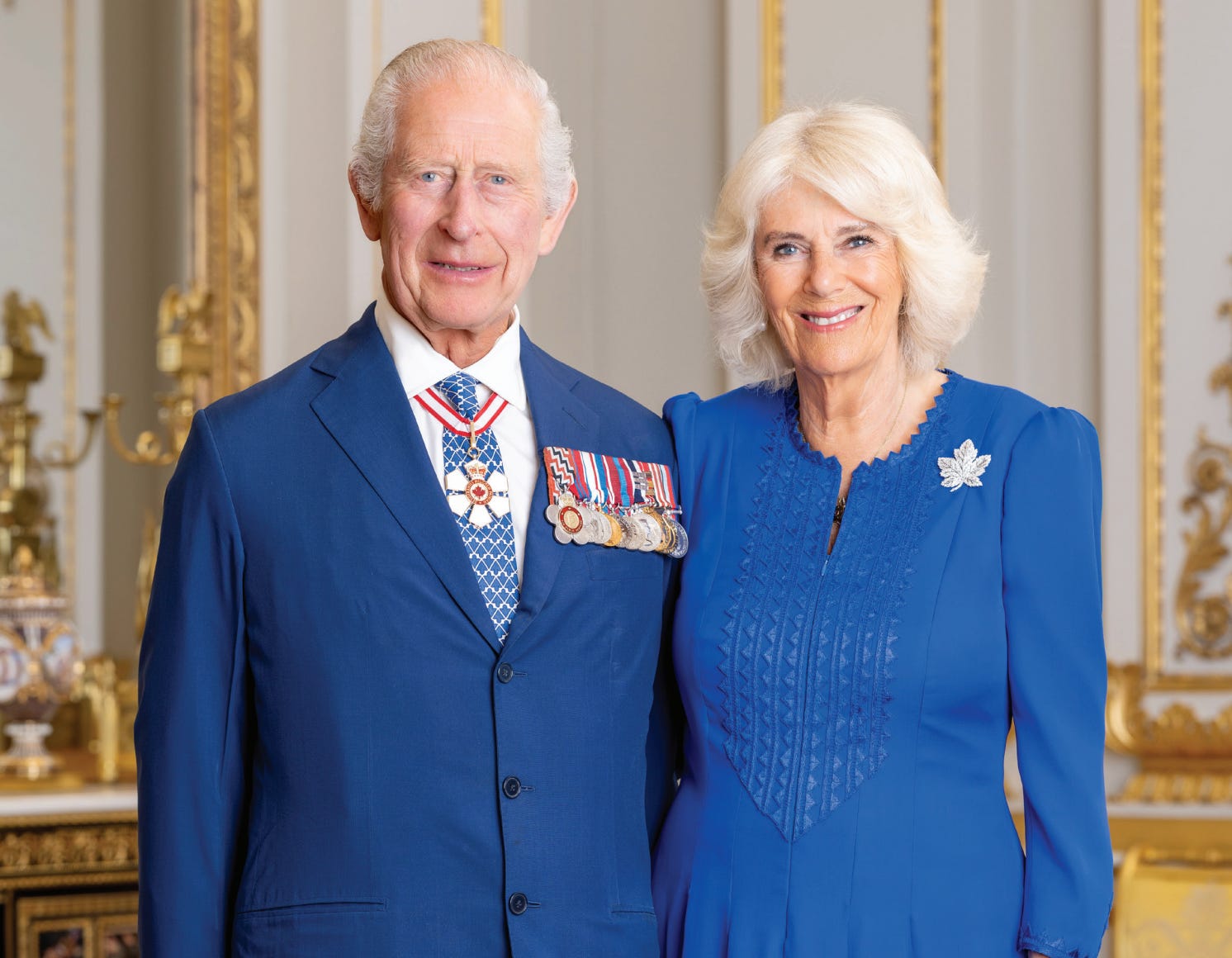
King Charles III and Queen Camilla, official portrait by Millie Pilkington.
The Post and other Canadian organs have been full of conscious praise for our unusual absentee monarchy lately, what with the King being in the capital to give the throne speech in person. But Canadian republicans must be hoping that our people will instinctively reject the spectacle, and at least see the genuine need for that blessing without which no sovereign state can hope to be taken seriously — a president.
There are rumblings about behind-the-scenes diplomatic tensions between Canada and the United Kingdom over the royal visit, rumblings which the Sunday Times (of London) put in print this weekend. The crux of the story is that Canada and the U.K. are not quite using the same playbook in dealing with the volatile and cutthroat Trump administration.
Sir Keir Starmer’s Labour government is applying lots of soft-soap, using Trump’s fondness for the British monarchy and its highly ornamented nature as a means of getting special treatment in trade negotiations. Meanwhile, Canada and its government hope to use the presence in Canada of Canada’s King as a subtle way of asserting independence, determination and strength as we bear the economic blows of Trumpian whim.
And — wait for it — the crazy part is, THOSE TWO KINGS ARE THE SAME EXACT DUDE. WHAAAT?
To a republican, this seems like a mystery concocted to obfuscate a logical weakness in the system. No doubt they see it just the same way an atheist looks at the centuries of early Christian debate over the Holy Trinity. It’s not exactly as though the U.K. and Canada are at war, or as though there is any overt disharmony between the two states. But the monarchists have to concede at least this much: when mutually sovereign countries have a shared head of state, you do in fact end up with the exotic possibility that George XIV of Canada might one day, in theory, have to issue a declaration of war on George XIV of Great Britain and Northern Ireland. This is baked into the improvised post-Imperial ontology of our government and of Britain’s.
This is why Canadian monarchists are so fussy about the independent constitutional footing on which the Canadian Crown rests. We do this, implicitly insisting that our system of government was reinvented in 1931, while at the same time arguing that the advantages of monarchy include antiquity, historical continuity and the preservation of a special bond between Commonwealth realms. Perhaps we are sneaky imperialist (or racist) hypocrites. Perhaps we just feel that those advantages are legitimate and important, and that the Statute of Westminster is an optimum compromise that preserves them while guaranteeing our sovereign freedom of action in the interplay of governments.
May 28, 2025
The Throne Speech
On his Substack, Paul Wells reports on the first Throne Speech delivered by the reigning monarch since the 1970s:
Mark Carney joins our visiting King in the traditional Making of the Small Talk.
Photo by Paul Wells from his Substack
We’re like Charlie Brown with Lucy’s football, or I guess, since the new PM is said to prefer British spellings, Charlye Brownne with Lewsey’s Foote Ball. Each generation of Canadian leadership tries to find a new way to make throne speeches exciting. These attempts are forever doomed, because no generation of Canadian leadership is exciting and because the format — a statement of intent from a dignitary who is forbidden to harbour autonomous intent — tends to short-circuit the delivery.
This time the delivery mechanism was the King of Canada, Charles Philip Arthur George, popping over from his secondary residence at Buckingham. His French tops Mary Simon’s, though his Inuktitut is shaky. He did his best to sound excited, or resolute, about the CBSA’s “new powers to examine goods”.
A quarter-century ago the reliably impish John Fraser told me he was preparing a book called Eminent Canadians that would survey recent developments in four Canadian institutions. The institutions he’d selected were the office of the Prime Minister; the Globe and Mail; the Anglican Church; — and here Fraser urged me to guess the fourth. Canadian institution? I dunno, the armed forces? The NHL? “The Crown”, Fraser said with a twinkle. Thus was I prepped for this week’s extended round of you-know-he’s-really-the-king-of-Canada browbeating.
This throne speech was like many before it, though out of deference for the deliverer it was on the short side, 21 pages tucked inside wide margins. In substance it was a paraphrase of Mark Carney’s already-semi-legendary Single Mandate Letter for cabinet ministers. There were sections on redefining Canada’s relationship with the United States; on internal trade; on crimefighting and national defence; and on “spending less and investing more”, which, I mean, we’ll see.
The mandate letter seems to have supplanted the Liberal election platform as the main blueprint for Carney’s action. The two aren’t wildly incompatible, but the mandate letter/throne speech is streamlined and puts stuff in different order.
I saw two surprises big enough to make me write today, but first I want to point to a few elements that are worth noting in the less-surprising stuff. That’s right, I’m trying to be useful, not just smart-assed, so here’s a way to thank me. […]
First, Carney (through His Majesty) makes claims for the “new economic and security relationship with the United States” that seem unrealistic. He expects “transformational benefits for both sovereign nations”. But surely any cross-border negotiation can only be, at best, an exercise in damage control? Any security costs that would be newly borne by Canada would represent a net cost. Trade arrangements short of the substantially free trade we’ve enjoyed for 40 years will also represent a net cost. The point of seeking “one Canadian economy” and taking relations with third countries more seriously is to offset the cost of a degraded Canada-US relationship, no?
Under “more affordable”, the throne speech repeats campaign promises for income-tax cuts and cuts to GST on new homes. The list of tangible financial benefits to individuals doesn’t go much past that. “The Government will protect the programs that are already saving families thousands of dollars every year. These include child care and pharmacare.” “Protect” is an old Ottawa word meaning “not extend”.
The goals for the “one Canadian economy” now include “free trade across the nation”, at both federal and provincial levels of government, “by Canada Day”. Which is 34 days away. The staffing and mandate of another new entity, a single-wicket “Major Federal Project Office”, may end up mattering more to this government’s success and Canada’s prosperity than the name of the PM’s next chief of staff, so put an asterisk next to that.
The government repeats a mysterious claim I’ve found shaky since Carney became a Liberal leadership candidate. It “will take a series of measures to catalyse new investment to create better jobs and higher incomes for Canadians. The scale of the Government’s initiative will match the challenges of our times and the ambitions of Canadians.” The challenges of our times, at least, are large.
So again: if the Canada Infrastructure Bank, the Canada Growth Fund and the Freeland-Sabia investment tax credits are sufficient to catalyse (British spelling) new investment, why duplicate them?
And if they haven’t worked, why keep them?
May 27, 2025
Augustus and his family – the start of the Julio-Claudians
Adrian Goldsworthy. Historian and Novelist
Published 17 Dec 2024An extra session for the Augustus and politics episode, with a look at Augustus and his extended family, using family trees from my biography of Augustus.
May 23, 2025
Did Germany Just Choose a King? – Rise of Hitler 17, May 1931
World War Two
Published 22 May 2025May 1931: 150,000 Stahlhelm men parade through Breslau before Crown Prince Wilhelm and other imperial relics, reviving monarchist hopes. Hitler hails his SA and calls for eastern expansion. But it’s economic collapse that dominates — Austria’s top bank nears default, threatening Germany’s own system. As Berlin pushes for a reparations pause and clings to its customs union with Vienna, France stands firm. And in Oldenburg, the Nazis take their first Landtag.
(more…)
May 15, 2025
QotD: The Donatist heresy
But like all things theological in the Christian Centuries, Donatism had important socio-political implications. Again, I’m about the furthest thing from a medievalist, but as I understand it, Jan Hus — a proto-Luther if anyone was — advanced a kind of Donatist argument against the Holy Roman Emperor (and / or the King of Bohemia, I forget which, or even if they were separate guys at that point). He was also, IIRC, echoing the English heretic John Wyclif, whose arguments had a similar political import in a similarly anarchic time. They held (again IIRC, which I might not) that since kings derive their authority from God, any king that is obviously on the outs with the Lord has lost his right to rule. A heretic or schismatic king, in other words, is no king at all.
You could call this a Christian version of the old Chinese idea of “The Mandate of Heaven”, and if you want to do that I’m not going to argue with you, but it’s considerably easier to identify a heretic. A Christian king’s most basic responsibility is to his own spiritual health; closely followed by his obligation to his realm’s spiritual health. It’s pretty easy to tell when a king’s not doing that.
Severian, “The New Donatism?”, Founding Questions, 2021-11-20.
May 8, 2025
Augustus and the creation of the Principate – The Conquered and the Proud 13
Adrian Goldsworthy. Historian and Novelist
Published 11 Dec 2024Continuing the series “The Conquered and the Proud”, this video looks at the political system created by Augustus — the Principate or rule of a princeps or “first”. We look at the twin elements of his formal power, the tribunician potestas and the maius imperium proconsulare. Next time we we look at Augustus, the provinces and imperial expansion.
May 6, 2025
If “a trade imbalance constitutes an American ‘subsidy’ justifying annexation of that country, then the US is going to have to annex most of the planet”
Despite getting his preferred choice elected as Canadian Prime Minister, US President Donald Trump still seems determined to troll Canadians about becoming the “51st state”. Among his shifting set of justifications for this is the trade imbalance between the US and Canada, which Trump chooses to interpet as a “huge” subsidy the US is providing to Canada. On that basis, there are going to have to be a lot more US states in the future:
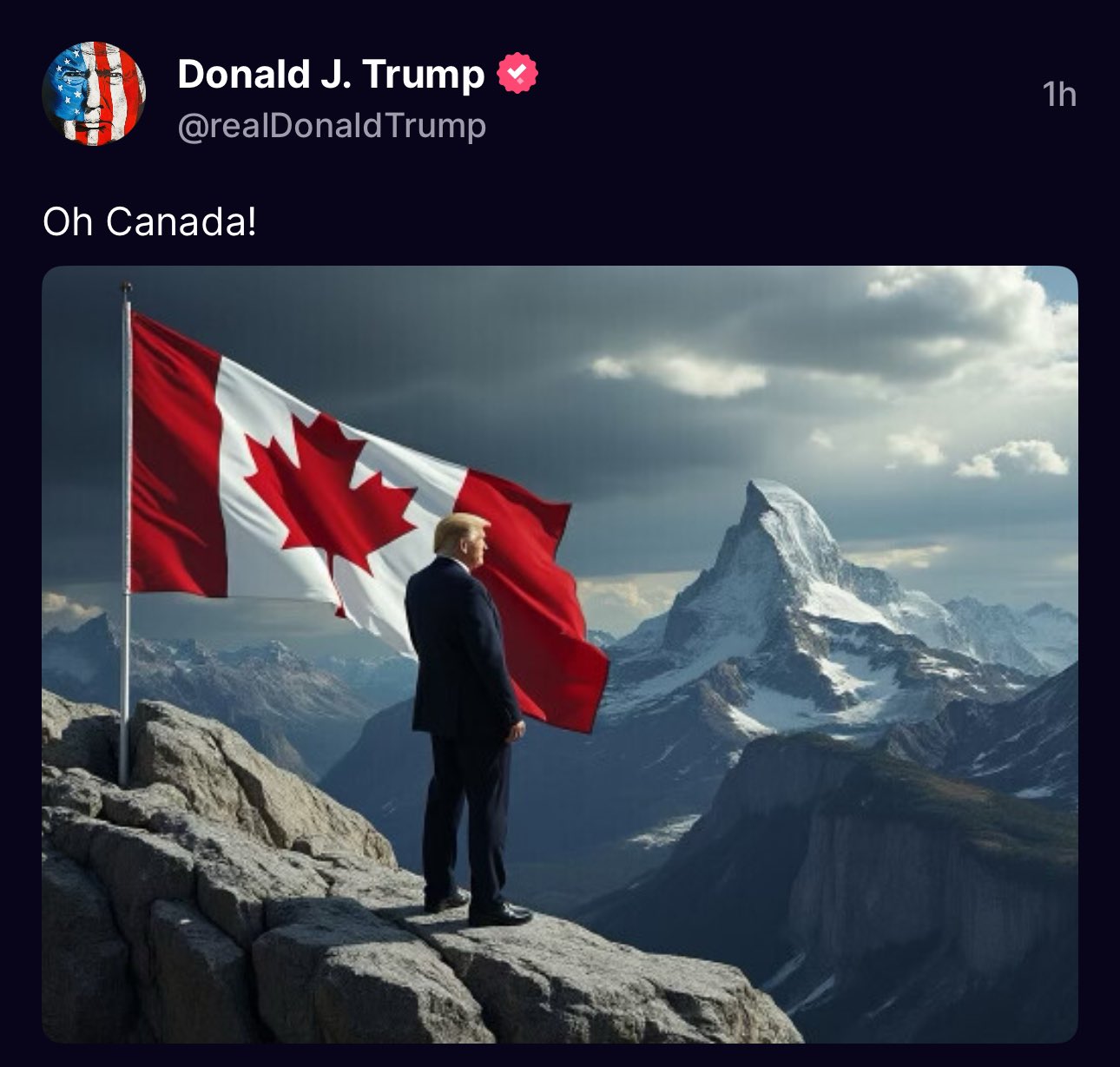
So now we have serious commentators gaming out the pros and cons of war with Canada. What started out as a mildly amusing bit of presidential “trolling” is now being discussed as next year’s Donbass.
If, for the purposes of argument, one accepts the President’s line that a trade imbalance constitutes an American “subsidy” justifying annexation of that country, then the US is going to have to annex most of the planet: last year Washington had a one-and-a-quarter trillion-dollar imbalance with the world. It’s not hard to figure out why: over recent decades the uniparty turned a country that used to make things into a crappy low-wage service economy. […] The US now has trade imbalances with — or “subsidies” of — not only the countries that you’d expect (China, Mexico, Germany, Japan, India) but a lot of ones you wouldn’t (Finland, Algeria).
True, Canada is closer than Algeria, so there are national-security implications for Washington: the country and its politicians (Trudeau, Carney) have been entirely hollowed out by Peking, but then so it goes south of the border (Biden, McConnell). And Trump’s plan for a “fifty-first state” will not solve that problem.
The “fifty-first state” shtick can’t ever have been serious, can it? Geographically, the fifty-first state would be bigger than the other fifty combined, and with a bigger population than California’s. Last time they added stars to the flag, both parties got something out of it: the GOP Alaska and the Dems Hawaii. So wouldn’t it make more sense to make Canada’s ten provinces and three territories a baker’s dozen of new American states with a couple of senators apiece? Yeah, sure – if you want Republicans never to win a national election again.
So, aside from last week’s vote, how is the other side reacting? Last Thursday’s print edition of The Spectator contained a curiously phrased squib from my old editor, Charles Moore:
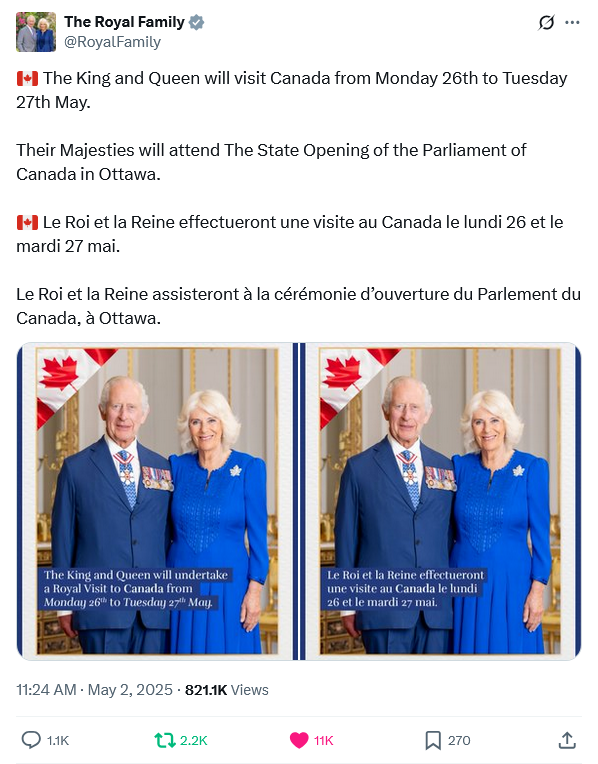
The President may be only hazily aware that the King, of whom, he says, he has the “honour to be a friend”, is also King of Canada. If, as seems likely, the King follows his mother’s twice-used precedent and opens the new Canadian parliament in person, Trump may come to see that his next-door neighbour is part of a long-standing, legitimate order which Canadian voters are happy to endorse.
Let’s just run that again:
If, as seems likely, the King follows his mother’s twice-used precedent and opens the new Canadian parliament in person …
The last time his mother opened Parliament in Ottawa was in 1977 — her Silver Jubilee year. Trudeau-wise, Justin’s father Pierre was not keen on it, but didn’t feel he could pick and win a fight with the Palace over it. A quarter-century later, Trudeau’s successor Jean Chrétien, a towering colossus of micro-pettiness, was annoyed at being given a crappy seat at the Queen Mum’s funeral and so scuttled Her Majesty’s Golden Jubilee throne speech.
So why would Charles Moore think it “likely” that the King would be opening Parliament in Ottawa later this month? If, as it was in my day, Speccie columns for Thursday’s magazine have to be filed on Tuesday, that would make Moore the first guy in either the Canadian or UK media to know what was not revealed to the world until Friday […]
The King has travelled far less in the first three years of his reign than his mother did: shortly after her Coronation, the Queen set off on a tour of parts of the Commonwealth that kept her away from London for six months. Her son can’t do that because he’s very sick with cancer. So it’s quite something that he’ll land in Ottawa on Monday May 26th, deliver the throne speech the following day, and then fly out again. Carney wouldn’t be doing this if he weren’t going to take the opportunity to put his view of Canadian sovereignty into the Sovereign’s mouth.
So, if Trump really has the “honour to be a friend” of the King, the only point of this 24-hour flying visit is so His Majesty can send the message that friends don’t let friends threaten to steal each other’s countries. In fact, he has made a point of referring to himself as “King of Canada” quite a bit of late. […] The “King of Canada” bit was done at the instigation of Carney. Which is odd. Especially from a party that has spent half-a-century diminishing and degrading the Crown, and for a monarch who is, unlike his mother, largely unloved and unloveable. Yet Carney seems belatedly to have come around to the old-school monarchist view that, without the Sovereign, there is insufficient to distinguish Canada from its domineering southern neighbour — especially when that neighbour keeps talking about taking it. On the other hand, both the King and his Canadian prime minister are bigtime players at the World Economic Forum, so they’re not the most obvious choice for defenders of national sovereignty. On the other other hand, it’s one thing to surrender it to fellow globalists, quite another to surrender it to Donald Trump.
I have no idea where this is headed, and if anyone can enlighten me I’d be happy to hear it. But Trump has doubled down on it, and Carney is playing the King card to oppose it. As longtime readers know, I have a general preference for smaller nations as happier homes for their people. If Alberta or Quebec voted to secede, why would you take the trouble to do that just to become a minor and inconsequential part of another big country?
But, that aside, why would it be in America’s interest to absorb a hostile population of mostly lefties over a vast and unpoliceable landmass? The history of the last thirty years is that China has shown there are subtler ways of taking over the world without firing a shot, while America has persisted in doing it the old-fashioned way and, in Iraq, Afghanistan, Ukraine and elsewhere, has gotten nowhere. Why add Canada to the list?
May 5, 2025
The Bloody Battle of Agincourt | Animated Episode
The Rest Is History
Published 30 Nov 2024“We few, we happy few, we band of brothers”.
The Battle of Agincourt in 1415 endures as perhaps the most totemic battle in the whole of English history. Thanks in part to Shakespeare’s masterful Henry V, the myths and legends of that bloody day echo across time, forever enshrining the young Henry as the greatest warrior king England had ever known. So too the enduring idea of the English as plucky underdogs, facing down unfavourable odds with brazen grit. And though the exact numbers of men who fought in the two armies is hotly contested, the prospect was certainly intimidating for the English host looking down upon the vast French force amassed below them the day before the battle. Hungry and weary after an unexpectedly long march, and demoralised by the number of French that would be taking to the field, the situation certainly seemed dire for the English. One man amongst them, however, held true to his belief that the day could still be won: Henry V. An undeniably brilliant military commander, he infused his men with a sense of patriotic mission, convincing them that theirs was truly a divinely ordained task, and therefore in this — and his careful strategic planning the night before the battle — he proves a striking case of one individual changing the course of history. However, the French too had plans in place for the day ahead: total warfare. In other words, to overwhelm the English in a single devastating moment of impact, sweeping the lethal Welsh archers aside. So it was that dawn broke on the 25th of October to the site of King Henry wearing a helmet surmounted by a glittering crown and bearing the emblems of both France and England, astride his little grey horse, and riding up and down his lines of weathered silver clad men, preparing them to stride into legend … then, as the French cavalry began their charge, the sky went black as 75,000 arrows blocked out the sun. What else would that apocalyptic day hold in store?
Join Tom and Dominic as they describe the epochal Battle of Agincourt. From the days building up to it, to the moment that the two armies shattered together in the rain and mud of France. It is a story of courage and cowardice, kings and peasants, blood and bowels, tragedy and triumph.
00:00 What is to come …
00:50 Shakespeare and Henry V
02:53 Agincourt is exceptional
04:15 The battle is a test of God’s favour
05:27 The English see the French forces …
09:30 The French aren’t offering battle
10:40 Why the French delay
11:13 The French think they’re going to win
11:35 An ominous silence
12:35 Henry’s plan
20:50 The French plan
24:28 How big were the armies
28:49 The lay of the land
34:50 Henry makes the first move
37:00 The French charge into darkness
38:57 The French army advances
45:50 Reaction to the slaughter
(more…)


