Quotulatiousness

June 28, 2020

“Viking” was the word for “Incel” in the early Middle Ages

Filed under: Books, China, Europe, Health, History, India, Military — Tags: , , , , , , — Nicholas @ 05:00

At least, that’s one interpretation offered by Mary Harrington at UnHerd:

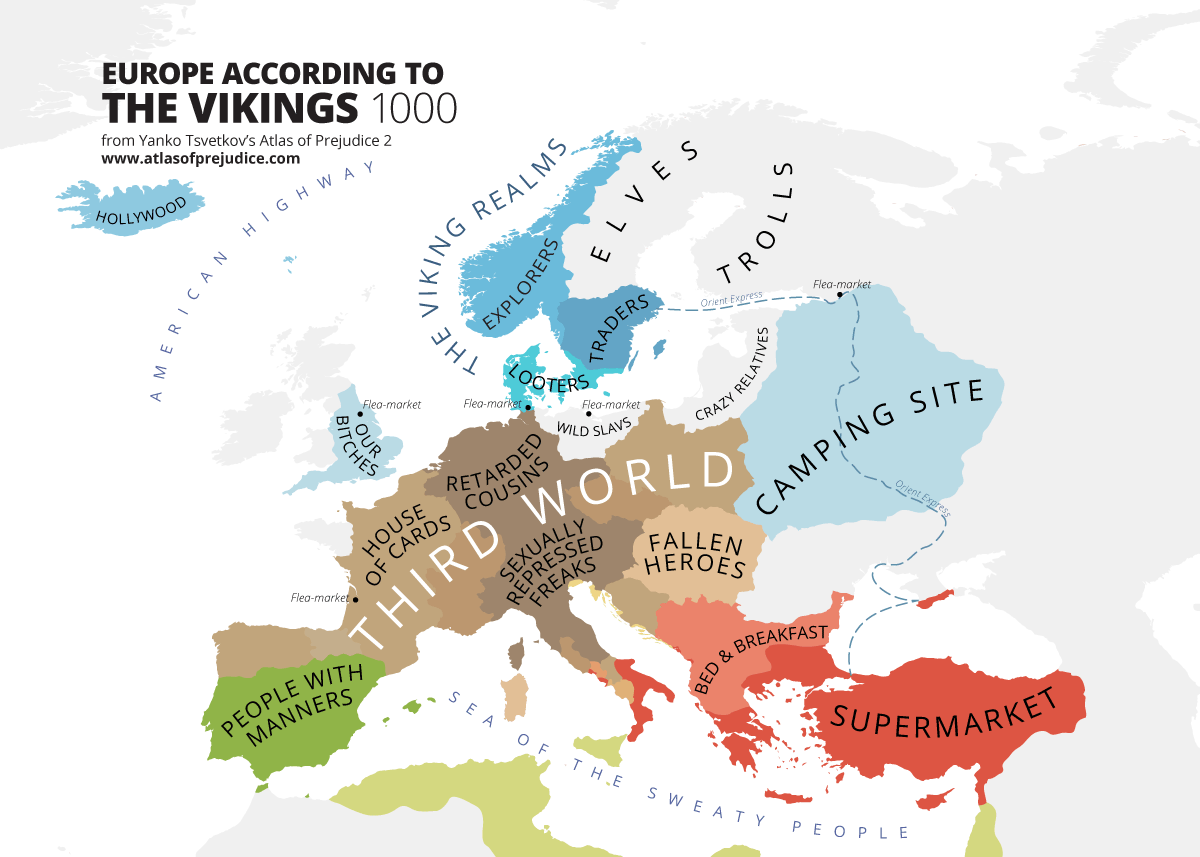
Europe According to the Vikings (1000) from Atlas of Prejudice 2 by Yanko Tsvetkov.

Last week, World War 3 nearly started in Ladakh. A dry, high-altitude region of Indian Kashmir on the Himalayan border with China, it’s been the site of escalating tensions and military buildup for some time. On June 15, the first physical confrontation between the Indian and Chinese militaries for 45 years erupted, killing at least 20 Indian and 45 Chinese soldiers.

There are all sorts of geopolitical reasons cited for the escalating tension between the world’s two most populous countries, but there is one more central and timeless problem that is going to drive both countries towards violence and instability — women. Or a lack of them.

In his History of the Normans, written circa 1015, Dudo of St Quentin argued that the reason the Vikings went raiding was because they couldn’t find wives, an idea echoed by the Tudor antiquarian William Camden in his 1610 book Britannia. “Wikings”, Camden suggested, were what you got when there weren’t enough women to go round, resulting in an excess of young men hanging around full of machismo but without any prospect of finding a nice girl and settling down. (Viking literally means raider.)

So, whenever these spare males “multiply’d themselves to a burdensom community”, Camden reports that an area would draw lots. Those of the young troublemakers chosen in the lottery would be sent off on a ship to make a nuisance of themselves overseas. Which they did.

In evolutionary biology, the “operational sex ratio” is a term used to count the proportion of males and females in a given species that are seeking a reproductive mate. As soon as the ratio tilts away from 50:50, the sex that’s over-represented will have to compete to secure a mate from among the less-plentiful potential partners of the opposite sex.

Though they wouldn’t have used that phrase, both Dudo of St Quentin and William Camden were both describing this phenomenon in human males. Where potential wives are scarce and the “burdensom community” of spare men multiplies, the result is more violence and crime. One 2019 study showed that where polygyny — that is, multiple wives — is a social norm for higher-status men, attacks on neighbouring ethnic groups skyrocket. With a few men monopolising eligible women, the rest are forced to seek status and resources by attacking other tribes.

India and China both have an extremely “burdensom community” of spare males. The normal ratio of newborn boys to girls is around 105:100. But as Mara Hvistendahl documents in Unnatural Selection, thanks to prenatal ultrasound and sex-selective abortion the ratio in China is around 118:100, and 108:100 in India. In some regions of India, the ratio rises as high as 150 males to 100 females. Though sex-selective technology is now banned in India, it’s still widespread, and the country now has some 37 million more men than women. Studies estimate that China has around 30 million excess men.

June 18, 2020

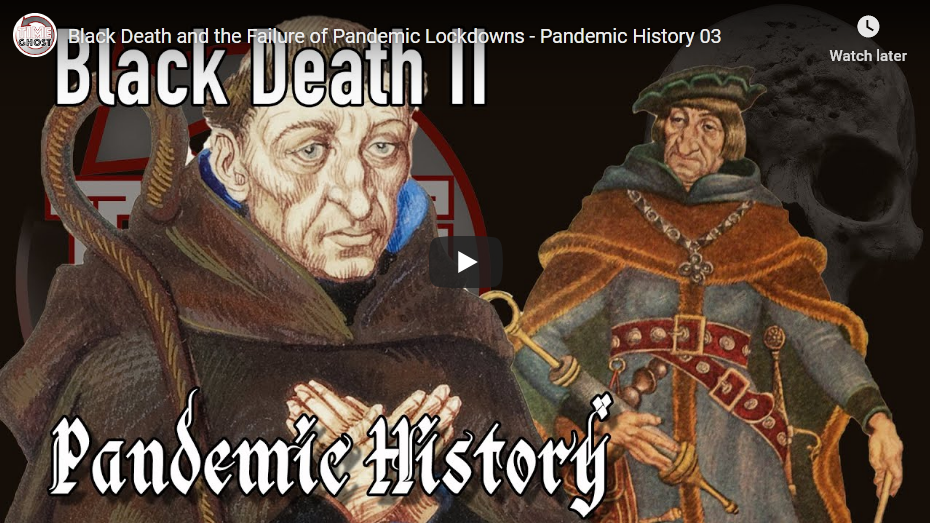
Black Death and the Failure of Pandemic Lockdowns – Pandemic History 03

Filed under: Europe, Health, History, Science — Tags: , , , , , — Nicholas @ 04:00

TimeGhost History
Published 17 Jun 2020

Starting in 1347 and for three centuries, the second plague pandemic provides ample time to learn how to deal with the recurring outbreaks. And yet, fears of ruining the economy, political expediency, and refusal to accept reality leaves those trying to implement protection measure to fight an uphill battle. The result is even worse economic consequences, and unfathomable death.

Join us on Patreon: https://www.patreon.com/TimeGhostHistory

Hosted by: Indy Neidell and Spartacus Olsson
Written by: Indy Neidell and Spartacus Olsson
Directed by: Astrid Deinhard
Executive Producers: Astrid Deinhard, Indy Neidell, Spartacus Olsson, Bodo Rittenauer
Creative Producer: Joram Appel
Post-Production Director: Wieke Kapteijns
Research by: Spartacus Olsson, Indy Neidell, and James Currie
Edited by: Karolina Dołęga
Sound Engineer: Marek Kamiński
Graphic Design: Ryan Weatherby

Visual Sources:
Wellcome Images
Patrick Gray on Flickr: https://www.flickr.com/photos/1360415…
Paul K on Flickr: https://www.flickr.com/photos/bibliod…
Quinto Tiberio Angelerio and New Measures for Controlling Plague in 16th-Century Alghero, Sardinia digitalized by Google, original from Universidad Complutense de Madrid

Icons from The Noun Project by: Ben Mullins, parkjisun, Muhamad Ulum & Adrien Coquet

Music:
“A Far Cry” – Flouw
“Fire Building Ext 3” – SFX Producer
“Last Point of Safe Return” – Fabien Tell
“London” – Howard Harper-Barnes.mp3
“Please Hear Me Out” – Philip Ayers
“Scream Female 3” – SFX Producer
“Scream Male 6” – SFX Producer
“Superior” – Silver Maple
“Symphony of the Cold-Blooded” – Christian Andersen
“Barrel” – Christian Andersen

Archive by Screenocean/Reuters https://www.screenocean.com.

Research Sources:
Quinto Tiberio Angelerio and New Measures for Controlling Plague in 16th-Century Alghero, Sardinia Raffaella Bianucci, Ole Jørgen Benedictow, Gino Fornaciari, and Valentina Giuffra
“The Path to Pistoia: Urban Hygiene Before the Black Death”, G. Geltner, Past & Present, Volume 246, Issue 1, February 2020, Pages 3–33
Encyclopedia of the Black Death, Joseph Patrick Byrne
“Epidemiological characteristics of an urban plague epidemic in Madagascar, August–November, 2017: an outbreak report”, The Lancet, Rindra Randremanana, PhD, *Voahangy Andrianaivoarimanana, PhD, Birgit Nikolay, PhD, Beza Ramasindrazana, PhD, Juliette Paireau, PhD, Quirine Astrid ten Bosch, PhD, et al
Yersinia pestis, the cause of plague, is a recently emerged clone of Yersinia pseudotuberculosis, Mark Achtman, Kerstin Zurth, Giovanna Morelli, Gabriela Torrea, Annie Guiyoule, and Elisabeth Carniel
Insights into the evolution of Yersinia pestis through whole-genome comparison with Yersinia pseudotuberculosis, P.S.G. Chain, E. Carniel, F.W. Larimer, J. Lamerdin, P.O. Stoutland, W.M. Regala, A.M. Georgescu, L.M. Vergez, M.L. Land, V.L. Motin, R.R. Brubaker, J. Fowler, J. Hinnebusch, M. Marceau, C. Medigue, M. Simonet, V. Chenal-Francisque, B. Souza, D. Dacheux, J.M. Elliott, A. Derbise, L.J. Hauser, and E. Garcia
Distinct Clones of Yersinia pestis Caused the Black Death, Stephanie Haensch, Raffaella Bianucci, Michel Signoli, Minoarisoa Rajerison, Michael Schultz, Sacha Kacki, Marco Vermunt, Darlene A. Weston, Derek Hurst, Mark Achtman, Elisabeth Carniel, and Barbara Bramanti

A TimeGhost chronological documentary produced by OnLion Entertainment GmbH.

From the comments:

TimeGhost History
2 days ago
As you have seen in this episode collective learning takes time. Some of you might infer one to one parallels between the situation during the second plague pandemic and our current pandemic in 2020. That would not be entirely correct and definitely not our intention. History doesn’t as much repeat itself as it echos into the present. While there are similarities between all pandemics, and we continue to struggle to find the correct response and countermeasures, our times are very different from the medieval and renaissance world. Science has developed further, society has evolved, and we have much more than one form of response to disease available. Moreover the pandemic that started in 1347 is in relative numbers (percentage of lethality) the worst pandemic to hit humanity in known history.

In the end we are historians, not health professionals or epidemiologists. Our contribution can never be what to do about COVID 19, that is too complex an issue for us to digest. What we can contribute is a historical perspective on what went wrong back then, and how we developed from there. The main takeaway from the Black Death should from that long term historical perspective be positive. The response lay the foundation of modern health care in hospitals. It helped create the beginnings of professional, trained, and vetted doctors, it changed the view on sanitation, and it started to shift our collective view on disease from superstition and conspiracy myths to factual analysis and a scientific response.

And there in that very last point lies perhaps the one and only thing that we can say with certainty that we need to remember in 2020 — listen to the scientists, not the hacks and politicians on all sides that base their rhetoric on, self interest, political expediency, and populism.

Never forget!

Spartacus

PS apologies for the audio problems on my mic during the first half of the video — it was scratching against my jacket and no one noticed, sadly we can’t get it out in post.

June 16, 2020

QotD: A thumbnail history of the English language

Filed under: Britain, France, History, Humour, Law, Quotations — Tags: , , , , , — Nicholas @ 01:00

Languages are anything but static. Some change very slowly, like French — which owes much of its ponderousness to a government department specifically tasked with rooting out heretic words that creep in from the outside. Other languages undergo periods of very rapid change — the English of Chaucer (late 1300s) would be very confusing to Shakespeare (late 1500s and early 1600s). Two hundred years seems like a long period of time, but in the history of an entire country, it’s a drop in the bucket.

English doesn’t just borrow words; it lifts whole phrases and grammatical ideas from other languages without so much as a by-your-leave. With the coming of the Saxons to Britain, Germanic languages crashed headlong into Brythonic and became Old English. Then the Vikings went for a multi-century beer run starting in the late 700s and left behind a bunch of Norse words, because who doesn’t invent a new language every time they go out carousing? In 1066, William the Bastard decided he didn’t like his name, and brought Norman French with him when he went to the town clerk’s office to have his name legally changed to William the Conqueror.

For the next two hundred years, the English upper classes spoke French and the lower classes spoke a zillion dialects of Middle English (travel was difficult for poor people, so regional variations survived). All legal business was done in French, which was often translated on the spot into Latin for the official records. A person couldn’t even submit a legal plea in English until 1362. But with the start of the Hundred Years’ War in 1337, Edward III decided that speaking French was très passé, and began encouraging English as a spoken and written language, with a little French thrown in, just to keep things interesting. And ever since, English has been debating how sophisticated it wants to be, while making rude gestures across the Channel at France and grumbling when the French sneer northwards.

Blake Smith, “A Brief History of English and Why it Matters”, Mad Genius Club, 2018-03-07.

June 5, 2020

Hundred Years War | 3 Minute History

Filed under: Britain, France, History, Military — Tags: , , , — Nicholas @ 02:00

Jabzy
Published 18 Oct 2015

Thanks to Xios, Alan Haskayne, Lachlan Lindenmayer, William Crabb, Derpvic, Seth Reeves and all my other Patrons. If you want to help out – https://www.patreon.com/Jabzy?ty=h

Apologies, especially to the Patreon supporters for not uploading recently, I’ve changed jobs/moved house etc. I should be back on the usual schedule now.

Plus, thanks for the 12,000 subs.

June 1, 2020

The true GOAT

Filed under: Britain, History, Military, Sports — Tags: , — Nicholas @ 03:00

Nigel Davies explains why even the greatest athletes and sportspersons of today are no match for the Greatest Of All Time – William the Marshal, 1st Earl of Pembroke:

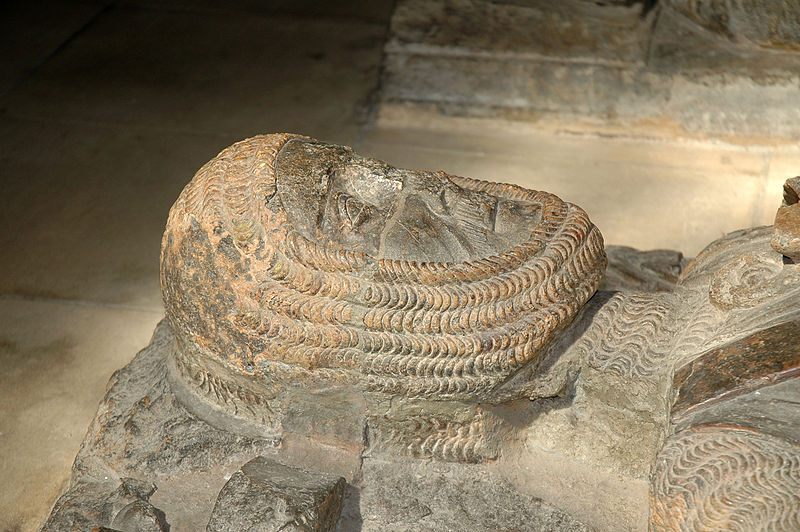
Head of the effigy of William Marshal, 1st Earl of Pembroke, in Temple Church, London.
Photo by Kjetil Bjørnsrud via Wikimedia Commons.

William the Marshall is almost universally recognised as “the best knight that ever lived”, by all those who consider his extraordinary career as a fighter, warrior, war leader, political leader, guardian, and shining light of courtly and knightly achievements at the height of the chivalric and troubadouring shift (that moved culture from adoring thugs who hit hard, to adoring all round “renaissance men” who could dance, sing, write poetry, play chess, fight, and negotiate treaties that bought peace to generations). He was one of the men whom the word “paragon” — a person or thing regarded as a perfect example of a particular quality — was invented for.

But he was also the GOAT athlete and sportsman.

Tournament fighting and jousting were the Olympic Games of the medieval world, and — far from being an elitist sport, or an act of middle class pretention — tournament fighting in both its foot and horseback forms is a sport common to all classes from all cultures throughout most of human history … from the Olympics and gladiatorial combats, to the foot combat of Fencing and Kendo and Judo, to the horse archery of most of the nomadic tribes of Asia and Africa and even the American Indians: combat games are virtually the only universal human sport there has ever been.

William the Marshall was competing at a sport — armed combat — that is universal, worldwide, and largely classless. Admittedly he was competing at the most elite level (only the Samurai or Persian or Eastern Roman Cataphracts really come close to European kinghts for an equivalent dedication to a lifetime of training and specialist equipment and expense). But you can confidently say that here was a sport whose experts could face any other expert in any other combat sport in the world without confusion or fear.

And you could confidently predict that William the Marshall could defeat the equivalent character in any of those other combat sports … (As he apparently did when he fought Muslim horse archers or Mameluke foot soldiers in his brief years on Crusade.)

As a man whose prowess in his chosen field could adapt to all equivalent fields, he certainly outranks Muhammed Ali: who is the closest competitor on the above list to a world class showman and rough and tumble performer for the crowds.

As a person who statistically outperformed even Donald Bradman in comparison to his competition. He comes out in front there too.

As a winner above all others — his deathbed comment that he had bested more than 500 knights in hs career from all over Europe and the Middle East is not something that a squash player with 555 wins is likely to compare.

And as an athletic freak, even Usain Bolt or Michael Phelps — with their scant decade or so of dominance, could dream of competing with.

William the Marshall won his first international class tournaments in his teens, and was still winning them in his 60s. His unsurpassed competitiveness lasted not a few years, but several decades. He beat the GRANDCHILDREN of his previous conquests. And did so in a deadly serious full contact sport, not a namby pamby game like tennis or golf!

April 29, 2020

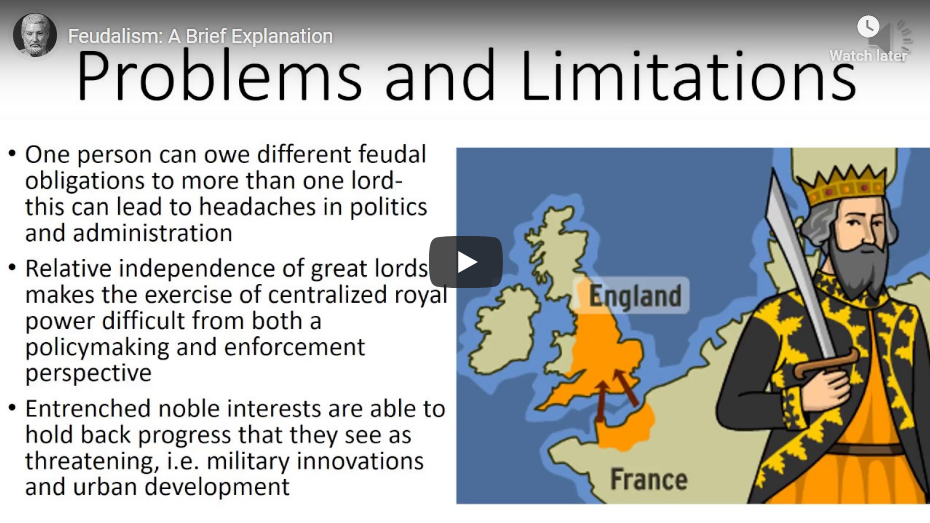
Feudalism: A Brief Explanation

Thersites the Historian
Published 26 Oct 2017

In this video, I try to bring order to the chaos that is feudalism and render it comprehensible.

April 25, 2020

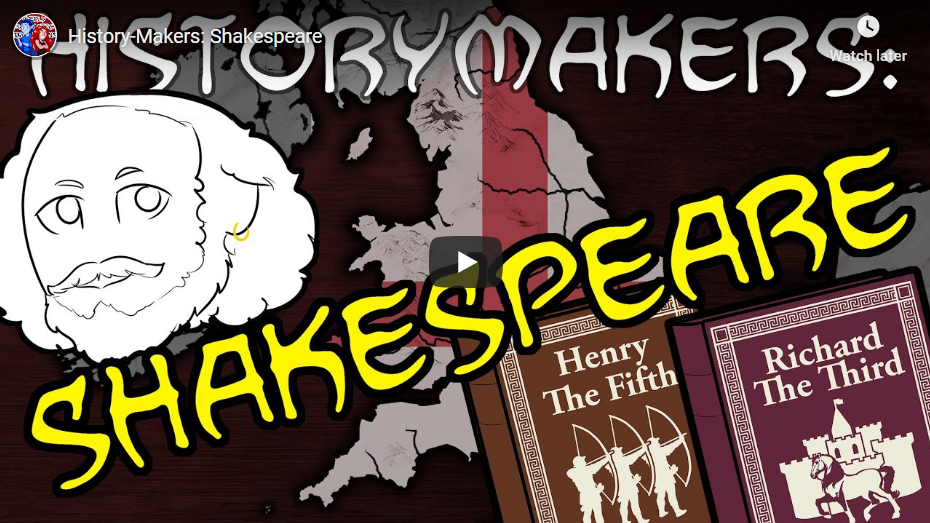
History-Makers: Shakespeare

Overly Sarcastic Productions
Published 24 Apr 2020

“The Bard” is not only an essential class in any D&D party, but a byword for England’s most famous writer. We’ve covered a bit of Shakespeare before on OSP — just a bit, really, nothing major, only a dozen — but today we’ll look at how William got to Bard-ing, and how he accidentally became England’s biggest Historian.

SOURCES and Further Reading: The Introduction and play-texts of the Folger Shakespeare Library (The best way to read Shakespeare), “Shakespeare: A Very Short Introduction” by Wells

This video was edited by Sophia Ricciardi AKA “Indigo”. https://www.sophiakricci.com/
Our content is intended for teenage audiences and up.

PATREON: https://www.Patreon.com/OSP

DISCORD: https://discord.gg/h3AqJPe

MERCH LINKS: https://www.redbubble.com/people/OSPY…

OUR WEBSITE: https://www.OverlySarcasticProductions.com
Find us on Twitter https://www.Twitter.com/OSPYouTube
Find us on Reddit https://www.Reddit.com/r/OSP/

April 13, 2020

QotD: Foucault’s “Ship of Fools”

Filed under: Books, Europe, Health, History, Quotations — Tags: , , , , — Nicholas @ 01:00

And so, Foucault tells us, in the fifteenth century there is a sudden emergence of a complex of artistic and philosophical themes linking madmen, the sea, and the terrible mysteries of the world. These culminate in the “Ship Of Fools”:

    Renaissance men developed a delightful, yet horrible way of dealing with their mad denizens: they were put on a ship and entrusted to mariners because folly, water, and sea, as everyone then knew, had an affinity for each other. Thus, “Ships of Fools” crisscrossed the seas and canals of Europe with their comic and pathetic cargo of souls. Some of them found pleasure and even a cure in the changing surroundings, in the isolation of being cast off, while others withdrew further, became worse, or died alone and away from their families. The cities and villages which had thus rid themselves of their crazed and crazy, could now take pleasure in watching the exciting sideshow when a ship full of foreign lunatics would dock at their harbors.

This was such a great piece of historical trivia that I was shocked I’d never heard it before. Some quick research revealed the reason: it is completely, 100% false. Apparently Foucault looked at an allegorical painting by Hieronymus Bosch, decided it definitely existed in real life, and concocted the rest from his imagination.

Foucault apologists try to rescue this, say that he was just being poetic in some way. He wasn’t. Page 8 in my copy: “Of all these romantic or satiric vessels, the Narrenschiff [Ship Of Fools] is the only one that had a real existence — for they did exist, these boats that conveyed their insane cargo from town to town.” He really, really doubled down on this point. As far as I can tell, this is just as bad a failing of scholarship as it sounds – and surprising, since everything else about the book gives the impression of Foucault as an incredibly knowledgeable and wide-ranging scholar.

Scott Alexander, “Book review: Madness and Civilization”, Slate Star Codex, 2018-01-04.

March 18, 2020

A classic “dirty book” of the late Middle Ages

Filed under: Books, Health, History — Tags: , , , — Nicholas @ 03:00

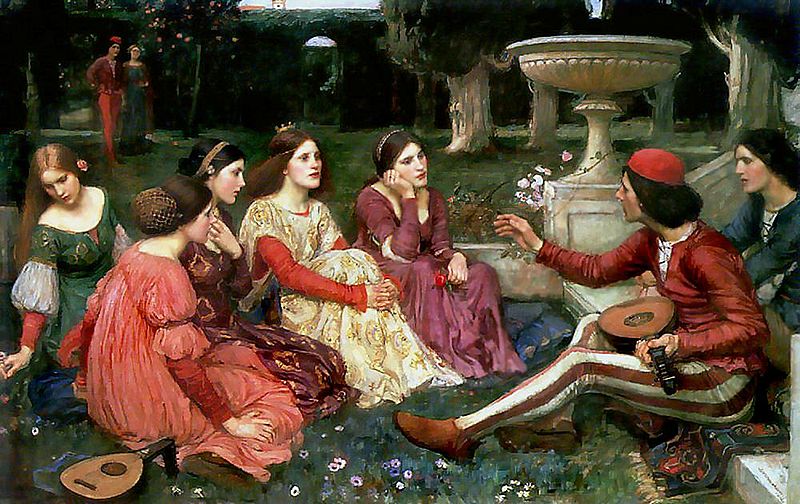
I’m not well read in the classics, being much more of a history reader myself, so I didn’t know anything about The Decameron. Arthur Chrenkoff provides a helpful thumbnail of the book:

“A Tale from the Decameron” by John William Waterhouse (1916).
Image from the Lady Lever Art Gallery via Wikimedia Commons.

Giovanni Boccaccio had written The Decameron in the aftermath of the Black Death pandemic of 1348, which carried away somewhere around one third of the European population. The book is set in a monastery, where seven young women and three young men, the Millennials of the day, self-quarantine themselves for ten days to avoid the plague and while away their days (there was no internet in those days, you see) telling each other stories, ten each day, all based around a chosen theme, such as love that ends happily or the tricks that women play on men. Many of the stories are a bit dirty, which is why The Decameron was put on the Catholic Church’s index of prohibited books; more interestingly, it was also banned in Australia until 1973, on pretty similar grounds.

March 2, 2020

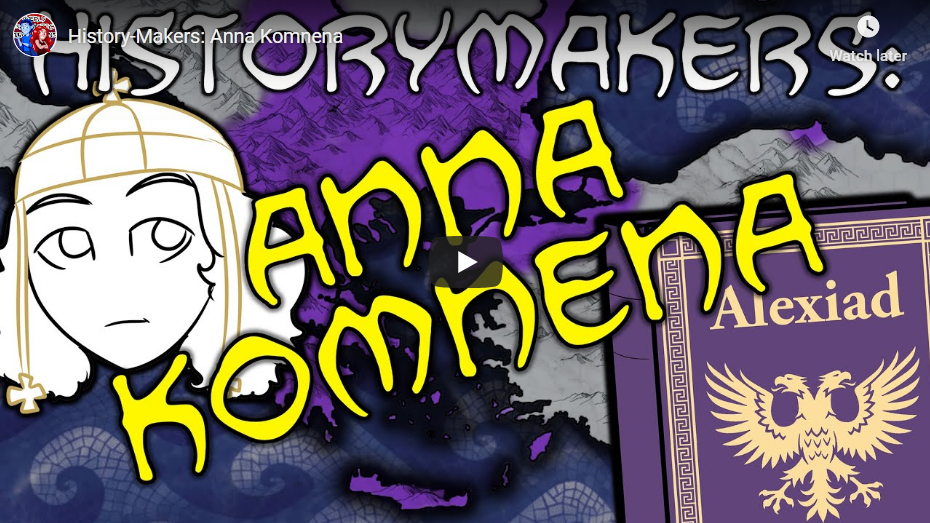
History-Makers: Anna Komnena

Overly Sarcastic Productions
Published 28 Feb 2020

She’s a Princess! She’s a Poet! She’s a Historian! She’s Anna Komnena — the COOLEST writer in the Byzantine Empire! On this episode of History-Makers, jump into the reign of Alexios Komnenos from the perspective of his daughter Anna, and learn about the emperor who saved the Byzantines from certain doom, as well as the traits that make Anna’s Alexiad a masterpiece.

This video was edited by Sophia Ricciardi, AKA “Indigo”.
Our content is intended for teenage audiences and up.

Sources & Further Reading: The Alexiad — obviously, what are you waiting for? (Also Norwich’s Byzantium)

PATREON: https://www.Patreon.com/OSP

DISCORD: https://discord.gg/h3AqJPe

MERCH LINKS: https://www.redbubble.com/people/OSPY…

OUR WEBSITE: https://www.OverlySarcasticProductions.com
Find us on Twitter https://www.Twitter.com/OSPYouTube
Find us on Reddit https://www.Reddit.com/r/OSP/

March 1, 2020

The Black Death of the 14th Century

Filed under: Europe, Health, History — Tags: , , , , , , — Nicholas @ 05:00

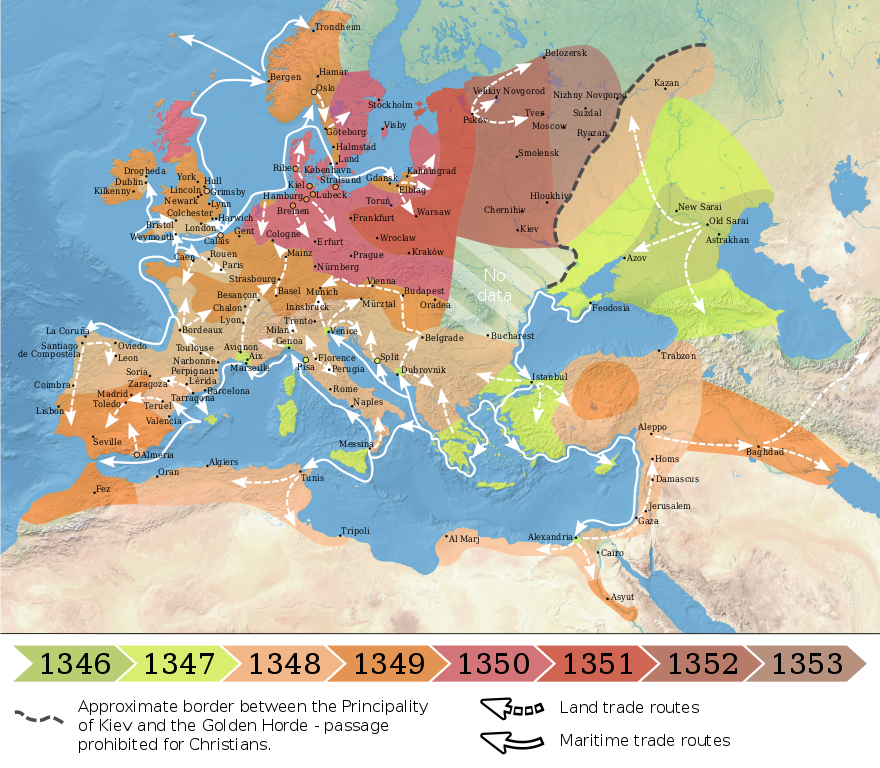
Ed West looks at what we know of the spread of the worst plague to hit western Europe in the 1300s:

Map showing the spread of the Black Death in Europe between 1346 and 1353.
Map by Flappiefh via Wikimedia Commons.

There had never been a terror like it, and the “Great Mortality” as it was known — and much later, the “Black Death” — has seared itself in the European imagination. It changed the culture and tested the institutions of the time, and as we anxiously await the arrival of another — thankfully far less deadly — contagion from Italy its legacy and impact are worth remembering.

Epidemics have been around as long as civilization. Plaga — from the Greek for “strike” or “hit” — devastated classical Athens in the 5th century BC, when the historian Thucydides nursed sufferers; the Antonine Plague — probably smallpox or measles — killed as many as five million Romans at the empire’s peak. Far more deadly was the Plague of Justinian in the sixth century, which had a toll of 25 million and emptied whole regions of the eastern (Byzantine) Empire. Only in the 21st century did researchers confirm that this was the same illness that would appear eight centuries later — the Bubonic Plague.

Empires were particularly affected by these horrific epidemics, because empires are a form of globalisation — bringing different people into contact with each other and, more dangerously, into contact with other mammals, who act as disease vectors.

Another danger is climate change, which might turn a mild virus into a deadly one, or cause disease-carrying animals to migrate. This is what happened during the 14th century when the northern hemisphere became considerably cooler, soon after the Mongols had created the largest contiguous empire in history.

Genghis Khan’s people have generally received a historical bad press — people are more likely to recall the pyramid of skulls and the Tigris flowing black and red — yet their rule had opened up trade routes, allowing goods and people to cross Asia. Whether brought at the point of a sword or a trade deal, globalisation always brings the new: new cultures, new ideas, new languages and new pathogens.

Yersinia pestis had been living on gerbils and other rodents in central Asia, but unstable climate conditions in 1330s caused the disease to jump onto the rat flea. It was killing people by 1339, and in the mid-1340s Christians first heard of a disease raging in the Islamic world, which some at least took as divine punishment for the crusades.

After two centuries of Holy War this was understandable, yet hatred was not universal and during these conflicts Italian merchants had continually done business with Muslims, much to the Church’s fury. Now this trade, once the source of prosperity and peace, proved deadly: plague reached Europe via the Genovese colony of Caffa on the Black Sea (now Feodosiya, in the Ukraine). In October 1347, four ships escaping the diseased city had turned up in Sicily, condemning Italy to its fate.

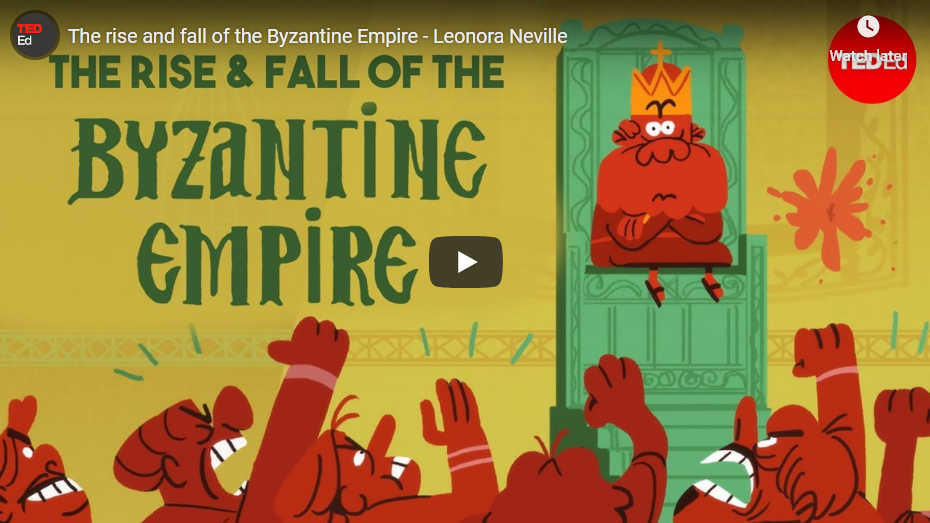
The rise and fall of the Byzantine Empire – Leonora Neville

TED-Ed
Published 9 Apr 2018

Check out our Patreon page: https://www.patreon.com/teded

View full lesson: https://ed.ted.com/lessons/the-rise-a…

Most history books will tell you that the Roman Empire fell in the fifth century CE, but this would’ve come as a surprise to the millions who lived in the Roman Empire through the Middle Ages. This Medieval Roman Empire, today called the Byzantine Empire, began when Constantine, the first Christian emperor, moved Rome’s capital. Leonora Neville details the rise and fall of the Byzantine Empire.

Lesson by Leonora Neville, animation by Remus & Kiki.

Thank you so much to our patrons for your support! Without you this video would not be possible! Abhijit Kiran Valluri, Mandeep Singh, Sama aafghani, Vinicius Lhullier, Connor Wytko, Marylise CHAUFFETON, Marvin Vizuett, Jayant Sahewal, Quinn Shen, Caleb ross, Elnathan Joshua Bangayan, Gaurav Rana, Mullaiarasu Sundaramurthy, Jose Henrique Leopoldo e Silva, Dan Paterniti, Jose Schroeder, Jerome Froelich, Tyler Yoshizumi, Martin Stephen, Justin Carpani, Faiza Imtiaz, Khalifa Alhulail, Tejas Dc, Govind Shukla, Srikote Naewchampa, Ex Foedus, Sage Curie, Exal Enrique Cisneros Tuch, Vignan Velivela, Ahmad Hyari, A Hundred Years, eden sher, Travis Wehrman, Minh Tran, Louisa Lee, Kiara Taylor, Hoang Viet, Nathan A. Wright, Jast3 , Аркадий Скайуокер, Milad Mostafavi, Singh Devesh Sourabh, Ashley Maldonado, Clarence E. Harper Jr., Bojana Golubovic, Mihail Radu Pantilimon, Sarah Yaghi, Benedict Chuah, Karthik Cherala, haventfiguredout, Violeta Cervantes, Elaine Fitzpatrick, Lyn-z Schulte, cnorahs, Henrique ‘Sorín’ Cassús, Tim Robinson, Jun Cai, Paul Schneider, Amber Wood, Ophelia Gibson Best, and Cas Jamieson.

February 20, 2020

So that’s why John Cabot got hired!

Filed under: Britain, History, Technology — Tags: , , , , — Nicholas @ 05:00

Anton Howes explains something that I’d wondered about in the latest edition of his Age of Invention newsletter:

Route of John Cabot’s 1497 voyage on the Matthew of Bristol posited by Jones and Condon: Evan T. Jones and Margaret M. Condon, Cabot and Bristol’s Age of Discovery: The Bristol Discovery Voyages 1480-1508 (University of Bristol, Nov. 2016), fig. 8, p. 43.
Wikimedia Commons.

… in 1550 the English were still struggling with latitude. Their inability to find it, unlike their Spanish and Portuguese rivals, was one of the main things holding them back from voyages of exploration.

The replica of John Cabot’s ship Matthew in Bristol harbour, adjacent to the SS Great Britain.
Photo by Chris McKenna via Wikimedia Commons.

The traditional method of navigation for English pilots was to simply learn the age-old routes. They were trained through repetition and accrued experience, learning to recognise particular landmarks and using a lead and line – just a thin rope weighted with some lead – to determine their location from the depth of the water. Cover the lead with something sticky, and you might bring up some sediment from the sea floor to double-check: a pilot would learn the kinds of sand and pebbles from to expect from different areas. And when they travelled out to sea, away from the coastline, they used a basic system of dead reckoning, taking their compass bearings from a known location, estimating their speed, and keeping in a particular direction for long enough. Or at least hoping to. They might keep track of their progress on a wooden traverse table, inserting pegs to indicate how far they had sailed, but it was ultimately a matter of rough estimation. Should they make any mistake — in terms of their speed, heading, or point of departure — they might easily get lost. But it was still a matter of trying to follow an already-known route. And English mariners of the 1550s did not even know that many routes.

For a voyage of exploration, by contrast, landmarks and sediment from the sea floor would be seen for the first time rather than recalled. By definition, there was no route to follow. So to launch their own voyages of discovery, the English needed to learn a new skill. They needed to look to the heavens.

Celestial navigation — measuring the altitude of heavenly bodies and then using geometry to determine one’s latitude on the earth’s surface — was by the 1550s already hundreds of years old. It had primarily been used to cross the deserts of North Africa and the Middle East — seas of sand, in which there might also be no landmarks from which to take bearings — and to navigate the Indian Ocean. Thus, while pilots in the Atlantic and the Mediterranean stuck to dead reckoning and soundings, Islamic navigators had for centuries used quadrants and astrolabes to take their bearings at sea. By the mid-fifteenth century, these instruments and techniques had found their way to Europe, where they were put to use especially by Portuguese, Spanish, and Italian explorers, along with additional instruments such as the cross-staff.

[…]

So for decades, English explorations relied on foreigners who either knew the routes that the English pilots didn’t, or who at least possessed the skill of mathematical, celestial navigation. The Italian explorer John Cabot (Zuan Chabotto), when he sailed to Newfoundland from Bristol in the late 1490s, was able to take latitude readings (he may even have been familiar with the older Islamic navigational practices, as he claimed to have visited Mecca). When Cabot died, the English expeditions that set out from Bristol in 1501-3 relied on Portuguese pilots from the mid-Atlantic islands of the Azores. And John Cabot’s son, Sebastian Cabot, who was involved in a few English expeditions, was so expert in mathematical navigation that he was eventually appointed pilot major for the entire Spanish Empire, making him responsible for the training and licensing of all its pilots — a position he held for three decades. When he led a voyage of exploration on behalf of Spain in 1526-30, a few English merchants became investors so that they could justify sending with him an English mariner, Roger Barlow, to secretly learn the Spanish routes across the Atlantic and have immediate knowledge if an onward route to Asia was discovered (as it turned out, South America got in the way).

February 17, 2020

Sieges and Siege-craft

Lindybeige
Published 2 Jun 2016

Sieges in the ancient and medieval worlds were on quite different scales. 10,000 men can do things differently from 500.

Support me on Patreon: https://www.patreon.com/Lindybeige

This video’s subject was chosen by Jack Sargeant, the winner of the DeepArt art competition a couple of weeks ago. The topic is a large one, but I hope I gave it a decent enough shot.

Castle illustration by Mathew Nielsen.

Buy the music – the music played at the end of my videos is now available here: https://lindybeige.bandcamp.com/track…

Lindybeige: a channel of archaeology, ancient and medieval warfare, rants, swing dance, travelogues, evolution, and whatever else occurs to me to make.

▼ Follow me…

Twitter: https://twitter.com/Lindybeige I may have some drivel to contribute to the Twittersphere, plus you get notice of uploads.

website: http://www.LloydianAspects.co.uk

February 4, 2020

Anglo-Saxon Invasion | 3 Minute History

Filed under: Britain, Europe, History — Tags: , , , — Nicholas @ 02:00

Jabzy
Published 22 May 2017

« Newer PostsOlder Posts »

Powered by WordPress