Quotulatiousness

February 20, 2020

So that’s why John Cabot got hired!

Filed under: Britain, History, Technology — Tags: , , , , — Nicholas @ 05:00

Anton Howes explains something that I’d wondered about in the latest edition of his Age of Invention newsletter:
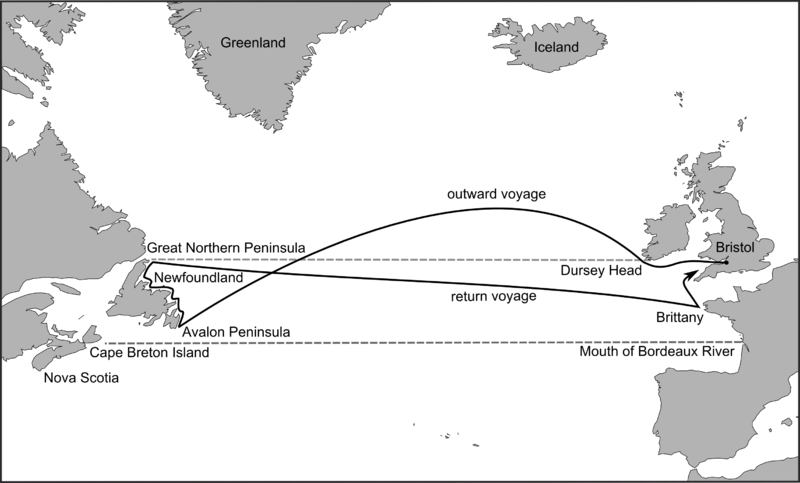
Route of John Cabot’s 1497 voyage on the Matthew of Bristol posited by Jones and Condon: Evan T. Jones and Margaret M. Condon, Cabot and Bristol’s Age of Discovery: The Bristol Discovery Voyages 1480-1508 (University of Bristol, Nov. 2016), fig. 8, p. 43.
Wikimedia Commons.

… in 1550 the English were still struggling with latitude. Their inability to find it, unlike their Spanish and Portuguese rivals, was one of the main things holding them back from voyages of exploration.

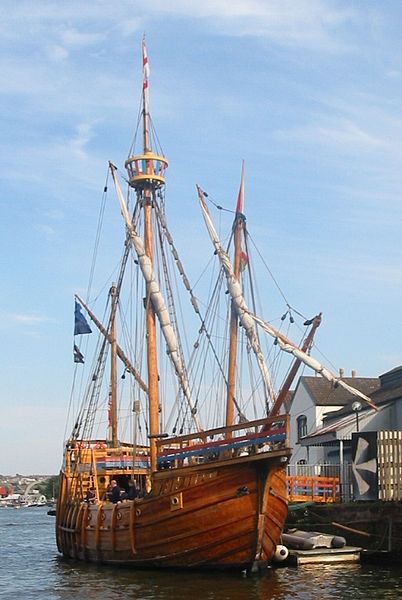
The replica of John Cabot’s ship Matthew in Bristol harbour, adjacent to the SS Great Britain.
Photo by Chris McKenna via Wikimedia Commons.

The traditional method of navigation for English pilots was to simply learn the age-old routes. They were trained through repetition and accrued experience, learning to recognise particular landmarks and using a lead and line – just a thin rope weighted with some lead – to determine their location from the depth of the water. Cover the lead with something sticky, and you might bring up some sediment from the sea floor to double-check: a pilot would learn the kinds of sand and pebbles from to expect from different areas. And when they travelled out to sea, away from the coastline, they used a basic system of dead reckoning, taking their compass bearings from a known location, estimating their speed, and keeping in a particular direction for long enough. Or at least hoping to. They might keep track of their progress on a wooden traverse table, inserting pegs to indicate how far they had sailed, but it was ultimately a matter of rough estimation. Should they make any mistake — in terms of their speed, heading, or point of departure — they might easily get lost. But it was still a matter of trying to follow an already-known route. And English mariners of the 1550s did not even know that many routes.

For a voyage of exploration, by contrast, landmarks and sediment from the sea floor would be seen for the first time rather than recalled. By definition, there was no route to follow. So to launch their own voyages of discovery, the English needed to learn a new skill. They needed to look to the heavens.

Celestial navigation — measuring the altitude of heavenly bodies and then using geometry to determine one’s latitude on the earth’s surface — was by the 1550s already hundreds of years old. It had primarily been used to cross the deserts of North Africa and the Middle East — seas of sand, in which there might also be no landmarks from which to take bearings — and to navigate the Indian Ocean. Thus, while pilots in the Atlantic and the Mediterranean stuck to dead reckoning and soundings, Islamic navigators had for centuries used quadrants and astrolabes to take their bearings at sea. By the mid-fifteenth century, these instruments and techniques had found their way to Europe, where they were put to use especially by Portuguese, Spanish, and Italian explorers, along with additional instruments such as the cross-staff.

[…]

So for decades, English explorations relied on foreigners who either knew the routes that the English pilots didn’t, or who at least possessed the skill of mathematical, celestial navigation. The Italian explorer John Cabot (Zuan Chabotto), when he sailed to Newfoundland from Bristol in the late 1490s, was able to take latitude readings (he may even have been familiar with the older Islamic navigational practices, as he claimed to have visited Mecca). When Cabot died, the English expeditions that set out from Bristol in 1501-3 relied on Portuguese pilots from the mid-Atlantic islands of the Azores. And John Cabot’s son, Sebastian Cabot, who was involved in a few English expeditions, was so expert in mathematical navigation that he was eventually appointed pilot major for the entire Spanish Empire, making him responsible for the training and licensing of all its pilots — a position he held for three decades. When he led a voyage of exploration on behalf of Spain in 1526-30, a few English merchants became investors so that they could justify sending with him an English mariner, Roger Barlow, to secretly learn the Spanish routes across the Atlantic and have immediate knowledge if an onward route to Asia was discovered (as it turned out, South America got in the way).
February 17, 2020

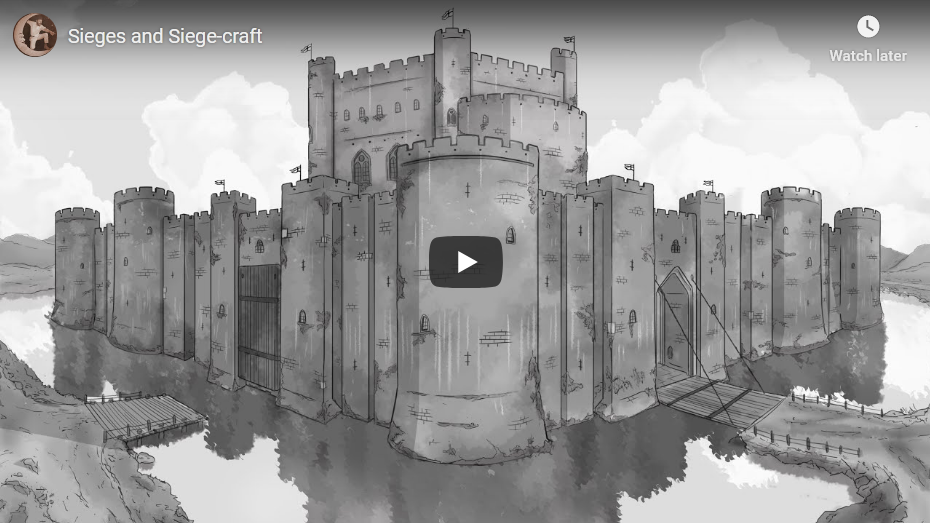
Sieges and Siege-craft

Lindybeige
Published 2 Jun 2016

Sieges in the ancient and medieval worlds were on quite different scales. 10,000 men can do things differently from 500.

Support me on Patreon: https://www.patreon.com/Lindybeige

This video’s subject was chosen by Jack Sargeant, the winner of the DeepArt art competition a couple of weeks ago. The topic is a large one, but I hope I gave it a decent enough shot.

Castle illustration by Mathew Nielsen.

Buy the music – the music played at the end of my videos is now available here: https://lindybeige.bandcamp.com/track…

Lindybeige: a channel of archaeology, ancient and medieval warfare, rants, swing dance, travelogues, evolution, and whatever else occurs to me to make.

▼ Follow me…

Twitter: https://twitter.com/Lindybeige I may have some drivel to contribute to the Twittersphere, plus you get notice of uploads.

website: http://www.LloydianAspects.co.uk

February 4, 2020

Anglo-Saxon Invasion | 3 Minute History

Filed under: Britain, Europe, History — Tags: , , , — Nicholas @ 02:00

Jabzy
Published 22 May 2017

February 1, 2020

History Summarized: Byzantine Empire — The Golden Age

Overly Sarcastic Productions
Published 31 Jan 2020

What do you do when life takes away half of your empire? Well, if you’re the Medieval Byzantines, you make comprehensive structural reforms to better manage a changing geopolitical landscape — And then you make an absolute crapload of mosaics.

Our content is intended for teenage audiences and up.

This video was edited in part by Sophia Ricciardi, AKA “Indigo”.

FURTHER SOURCES: A Short History of Byzantium by John Julius Norwich.

PATREON: https://www.Patreon.com/OSP

DISCORD: https://discord.gg/h3AqJPe

MERCH LINKS: https://www.redbubble.com/people/OSPY…

OUR WEBSITE: https://www.OverlySarcasticProductions.com
Find us on Twitter https://www.Twitter.com/OSPYouTube
Find us on Reddit https://www.Reddit.com/r/OSP/

January 30, 2020

QotD: Nutrition and aging from the middle ages to the 20th century

Filed under: Europe, Food, Health, History, Quotations — Tags: , , , — Nicholas @ 01:00

Those of us who didn’t grow up in the first world (second and a half at best!) know d*mn well how people lived in the 20th century, with nominal indoor plumbing, but without a lot of changes of clothing, washers and dryers, heated houses, etc. (The trains from the mountains, where it was colder, in winter, smelled like a mix of VERY unwashed bodies and wood smoke. You never forget that smell.) The particular etc. I have in mind in this case is the lack of refrigeration.

Look Portugal is fertile enough that a careful planner can feed a family on less than an acre of land (particularly the area I come from, apparently one of the oldest inhabited in Europe and whose name in Indo European translated as wet and fertile valley.) I’m sure the food available to us in the 20th century when you could buy improved seeds, etc. was way better than the one available to people in the middle ages.

But … yeah, no. We didn’t eat like people do now. Not even close. For one, meat was fairly scarce. We mostly ate fish (thanks to the coasts!) and vegetables. Oh, and we were relatively lucky. A lot of people got almost no protein. The most common lunch among the people was the “isca” that is a bit of fried flour which might or might not have a couple of shreds of codfish in it. The very poor ate a lot of vegetable soup.

And again this was in the 20th century. In winter vegetables more or less vanished and the only fruit available were the wrinkled, flour-like apples.

Christmas treats were dried fruit, not cookies. It tells you all you need to know. (Yes, it was healthy too except for the scarce protein for most people, but no one said the way we eat is particularly healthy.)

I’m not complaining, but I know that we ate massively better than my parents did in the mid 20th century. And they ate better than their parents. So, kindly, do not tell me some serf on a medieval estate got his choice of however many flavors of ice-cream.

Sure the very rich ate well, if sometimes oddly. But the average person, not so much.

And as for living as long? Yeah, no.

I still remember vividly — as do many our age — when 60 was old, 70 VERY old.

Yes, I’m concerned for my parents in their late eighties. And that’s, as my dad puts it “after 80, that’s old”. But it would surprise no one is they lived another 10 years. Because a lot of people do now. And now one makes a big deal of people who turn 100. (Even though 114 seems to be, a little inexplicably, our hard drop-off limit.)

And besides we KNOW. Shakespeare at 58 — two years older than I’m now — was “very old.”

So kindly take your “people lived about as long,” fold it all in corners and put it where the sun don’t shine, even if people in the arctic in winter will be a little puzzled by it.

Sarah Hoyt, “What if I Told You?”, According to Hoyt, 2019-11-05.

January 18, 2020

History Summarized: Classical India

Overly Sarcastic Productions
Published 17 Jan 2020

Classical and Medieval Indian History is a tale of constant flux — but in between the dozens and hundreds of states at play across the peninsula, there are clear trends that arise. Let’s take this chapter of history as an opportunity to dig into different types of sources, and try and wrap our heads around a story that doesn’t fit neatly into a single chronology.

FURTHER SOURCES: The Discovery of India by Jawaharlal Nehru, “A History of India” by Michael H. Fisher (lecture courtesy of The Great Courses).

Our content is intended for teenage audiences and up.

PATREON: https://www.Patreon.com/OSP

DISCORD: https://discord.gg/y7uUnzJ

MERCH LINKS: https://www.redbubble.com/people/OSPY…

OUR WEBSITE: https://www.OverlySarcasticProductions.com
Find us on Twitter https://www.Twitter.com/OSPYouTube
Find us on Reddit https://www.Reddit.com/r/OSP/

January 15, 2020

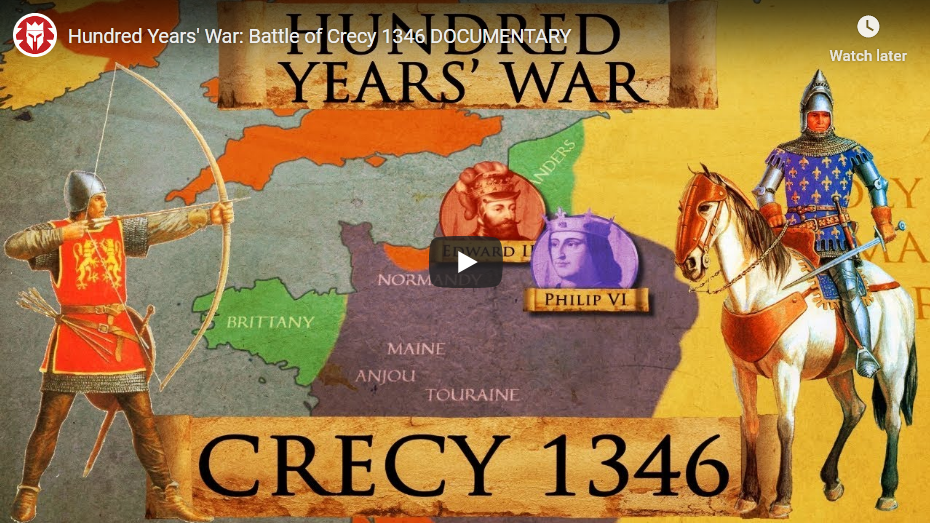
Hundred Years’ War: Battle of Crecy 1346

Filed under: Britain, France, History, Military — Tags: , , , , — Nicholas @ 02:00

Kings and Generals
Published 7 December 2017

The Hundred Years’ War of 1337-1453 between France and England is one of the most crucial conflicts in the history of Europe. It changed the social, political and cultural outlook of the countries involved, influenced the change in warfare, brought the end of feudalism closer. The first phase of this war is called the Edwardian War, and one of the most decisive engagements of this conflict was the battle of Crecy (1346). This series will have 5 videos, so don’t hesitate to like, subscribe and share. And if you want to support us, you can do it on Patreon: http://www.patreon.com/KingsandGenerals or Paypal: http://paypal.me/kingsandgenerals

We are grateful to our patrons, who made this video possible: Ibrahim Rahman, Koopinator, Daisho, Łukasz Maliszewski, Nicolas Quinones, William Fluit, Juan Camilo Rodriguez, Murray Dubs, Dimitris Valurdos, Félix Gagné-Dion, Fahri Dashwali, Kyle Hooton, Dan Mullen, Mohamed Thair, Pablo Aparicio Martínez, Iulian Margeloiu, Chet, Nick Nasad, Jeyares, Amir Eppel, Thomas Bloch, Uri Sternfeld, Juha Mäkelä, Georgi Kirilov, Mohammad Mian, Daniel Yifrach, Brian Crane, Muramasa, Gerald Tnay, Hassan Ali, Richie Thierry, David O’Hare, Christopher Commins, Chris Glantzis, Mike, William Pugh, Stefan Dt, indy, Bashir Hammour, Mario Nickel, R.G. Ferrick, Moritz Pohlmann, Russell Breckenridge, Jared R. Parker, Kassem Omar Kassem, AmericanPatriot, Robert Arnaud, Christopher Issariotis, John Wang, Joakim Airas, Nathanial Eriksen and Joakim Airas.

This video was narrated by our good friend Officially Devin. Check out his channel for some kick-ass Let’s Plays. https://www.youtube.com/user/Official…

The Machinimas for this video is created by one more friend – Malay Archer. Check out his channel, he has some of the best Total War machinimas ever created: https://www.youtube.com/user/Mathemed…

Inspired by: BazBattles, Invicta (THFE), Epic History TV, Historia Civilis and Time Commanders

Machinimas made on the Total War: Attila engine using the great Medieval Kingdoms mod.

Production Music courtesy of Epidemic Sound: http://www.epidemicsound.com

January 7, 2020

Wars of the Roses | 3 Minute History

Filed under: Britain, History, Military — Tags: , , , , — Nicholas @ 02:00

Jabzy
Published 23 Jan 2015

Of course there’s a lot I left out.

And when I say “Lancaster”, it sounds out of place because I had to just record over me continuously saying “Lancashire”.

December 30, 2019

How A Man Shall Be Armed: 13th Century

Filed under: History, Military, Weapons — Tags: , , — Nicholas @ 02:00

Royal Armouries
Published 20 Feb 2017

Discover how knights of the 13th Century would prepare themselves for battle, as armourers sought more creative and practical solutions to counter the threat of new weaponry.

December 22, 2019

History-Makers: Dante

Overly Sarcastic Productions
Published 20 Dec 2019

From the visionary creator who brought you the Self-Insert Fanfic comes… the invention of Worldbuilding and the most revolutionary literature in history? Woah, that was unexpected.

Grab your nearest Virgil, because we’re about to dive into Dante’s complex afterlife and learn how a Florentine poet used an ancient genre of poetry to kickstart what would become the Renaissance.

Further Reading: I would highly recommend Allen Mandelbaum’s translation of the Divine Comedy (Bantam Classics makes it), specifically because it features an opposite-facing translation, so the English appears directly adjacent to the original Italian. Regardless of your familiarity with Italian, Dante’s use of language is beautiful to listen to. It’s also just a good translation in general. Please do yourself a favor and read through some Dante.

Our content is intended for teenage audiences and up.

DISCORD: https://discord.gg/sS5K4R3

PATREON: https://www.Patreon.com/OSP

MERCH LINKS: https://www.redbubble.com/people/OSPY…

OUR WEBSITE: https://www.OverlySarcasticProductions.com
Find us on Twitter https://www.Twitter.com/OSPYouTube
Find us on Reddit https://www.Reddit.com/r/OSP/

December 18, 2019

History Summarized: Pope Fights

Filed under: Europe, France, History, Humour, Italy, Religion — Tags: , , , , — Nicholas @ 02:00

Overly Sarcastic Productions
Published 24 Aug 2018

The Medieval Catholic Church was … an interesting place, to put it lightly. Sometimes there was more than one Pope at a time, and sometimes they fought each other for power. Ladies and Gentleman, I present to you Pope Fights! The most absurd chapter in all of Catholicism.

Pope Francis’ Rock Album, if you’re still not convinced: https://www.youtube.com/watch?v=hW3az…

PATREON: https://www.patreon.com/user?u=4664797

Find us on Twitter @OSPYouTube!

December 16, 2019

QotD: The Great Pestilence of 1348

Filed under: Britain, Health, History, Quotations — Tags: , , , , — Nicholas @ 01:00

Long I have been curious about the Great Pestilence that trimmed the population of Britain and Europe by a third or more, in the fourteenth century. I make too much of it; the plague was a recurring event for centuries before and after. I notice from the tabloids that it is returning, through Africa this time. I know there will be pestilence to come, when we will all think it terribly important. It rivetted attention, I’m sure, in the autumn of 1348, and through the summer of 1349. And yet within a generation it is hardly mentioned.

England, below the Ribble and Tees, is special, thanks to the Domesday Book of the invading, tax-loving Normans, and their general propensity to good record-keeping. The towns and villages ennumerated in 1086 can be traced to the present day; nineteen in twenty are still there. Having figures to start, and through the parish books later, we can track an economic and demographic history with an accuracy possible in no other country. We can know, for instance, of the population boom through the twelfth and thirteenth centuries, which had slackened well before the “Black Death.” And with that boom, impressive advances in farming, technology, and building, as today. Nothing conduces to technical improvement, as a bit of crowding.

This proportion I cited — the nineteen-in-twenty (or more) — which I have from reading in economic history mostly years ago, fascinates my attention. We know large tracts were depopulated, we find the archaeological evidence easily enough. They were planting rye within the walls of Winchester, and many other towns. Everywhere, they had elbow-room again. Our deep ecologists would have been pleased — those who think life on this planet would be better had a few billion souls not been born. As Christianity, and environmentalism, are mortally opposed, and the fourteenth century was overwhelmingly Christian, I expect complaints of overpopulation were differently expressed at the time. Mostly it would have been moaning from younger brothers about the distribution of inherited land.

Always, there have been younger brothers. Always, there have been survivors. What delighted me was the speed with which all the vacant places were filled. As we’ve seen, too, after ghastly wars, demography abhors a vacuum.

David Warren, “Death the real illusion”, Essays in Idleness, 2017-11-04.

December 8, 2019

History Summarized: Florence

Overly Sarcastic Productions
Published 6 Dec 2019

Get 3 months of Audible for just $6.95 a month. That’s more than half off the regular price. Visit http://www.audible.com/overlysarcastic or text overlysarcastic to 500 500.

Can’t start a Renaissance without building a few *Domes* — You’ve seen the memes, now learn the history behind the magnificent city of Florence!

It may sound like sacrilege, but many years ago, Florence was the first Italian city that little Blue had a cartoonishly-overblown obsession for — move over, Venice. In fact, Florentine history is basically THE reason I ever started caring about History in the first place. So I hope that you find this exquisite chapter in world history as enjoyable as I do.

SOURCES & Further Reading:
Death in Florence — Paul Strathern https://www.audible.com/pd/Death-in-F…
Florence: The Biography of A City — Christopher Hibbert
Be Like The Fox: Machiavelli In His World — Erica Benner

Our content is intended for teenage audiences and up.

DISCORD: https://discord.gg/sS5K4R3

PATREON: https://www.Patreon.com/OSP

MERCH LINKS: https://www.redbubble.com/people/OSPY…

OUR WEBSITE: https://www.OverlySarcasticProductions.com
Find us on Twitter https://www.Twitter.com/OSPYouTube
Find us on Reddit https://www.Reddit.com/r/OSP/

November 9, 2019

Ten Minute English and British History #11 – King John and the Magna Carta

History Matters
Published 1 Jan 2018

Twitter: https://twitter.com/Tenminhistory
Patreon: https://www.patreon.com/user?u=4973164

This episode covers the reign of King John and the problems he had securing the Angevin inheritance and the subsequent issues his barons posed. These problems culminated in the signing of the Magna Carta in 1215 which severely limited the strength of John and his son, Henry III, whose reign was overshadowed by the document.

Ten Minute English and British History is a series of short, ten minute animated narrative documentaries that are designed as revision refreshers or simple introductions to a topic. Please note that these are not meant to be comprehensive and there’s a lot of stuff I couldn’t fit into the episodes that I would have liked to. Thank you for watching, though, it’s always appreciated.

October 31, 2019

A mathematical revolution in late medieval English ship design and construction

Filed under: Britain, History, Technology, Woodworking — Tags: , , , , — Nicholas @ 03:00

In the latest installment of Anton Howes’ newsletter on the Age of Invention, he discusses how geometry and mathematics helped transform late Medieval English shipbuilding:

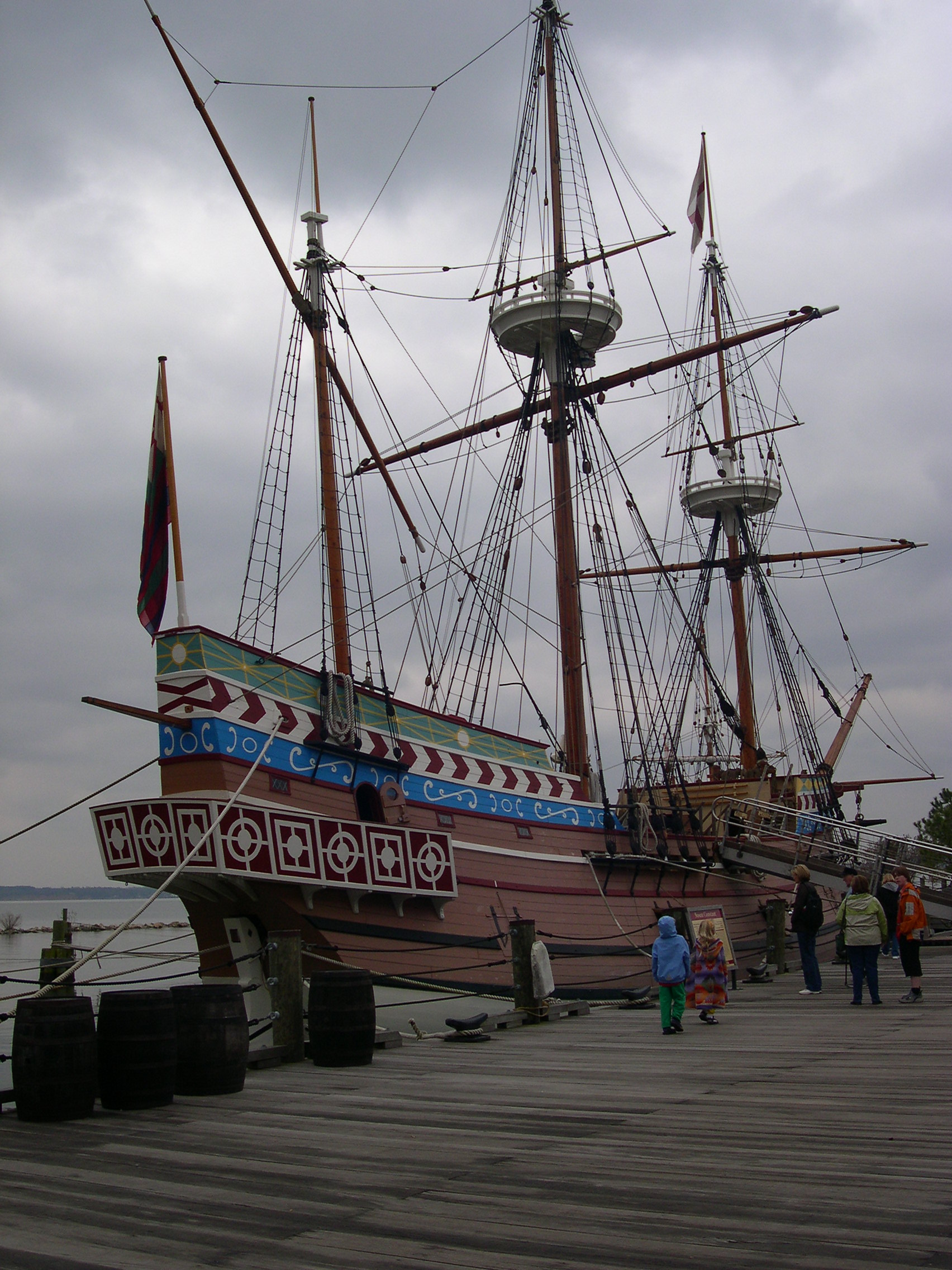
An English ship of a slightly later period: this is a replica of the Susan Constant at the Jamestown Settlement in Virginia. The original ship was built sometime before 1607 and rented by the Virginia Company of London to transport the original settlers to Jamestown.
Photo by Nicholas Russon, March 2004.

Since about 1500, an Italian and Portuguese method of making ships had come into ever wider use in northern Europe. This was to construct the ship’s skeleton first, and then lay the planking around it. This contrasted with the older “clinker” method, by which the planks were laid from the keel upwards, with each plank slightly overlapping the one below – the rest of the skeleton was filled in later to strengthen it. The new “carvel” method, instead of having overlapping planks, allowed for a smooth hull. But it also required more planning.

The master shipwright had to first design full-sized templates, or frames, which were placed along the keel to determine the width and height of the hull, like cross-sections up and down the length of the ship. To the edges of these frames were then fixed ribbands — long, pliable boards running down the ship’s length. Altogether, the frames and ribbands formed a temporary, basket-like structure, to guide the moulding of the ship’s permanent hull around it.

But calculating the size of the frames at each point was tricky. After the placement of the first few, which might be pre-specified in size, the next ones along were typically determined according to the curve of the ribbands. Calculation was certainly involved, but it took place in the form or marking and adjusting the wood itself. Design and construction both took place in the shipyard, and through the medium of wood.

What Matthew Baker did in the 1570s was to take the design process out of the shipyard, and onto paper. He drew his ships, to scale. And by using pen and paper, with geometry to make such drawings possible, he opened up grand new possibilities for design. His process allowed him to jot down the latest innovations from the Mediterranean, to speculate about the designs of Noah’s ark and the ships of the ancient world, and to cheaply conduct his own experiments. He drew out new designs for frames, using geometry to work out how any variation would affect the overall shape of the hull, as well as its weight and carrying capacity – all at the cost of only time, ink, and paper, and avoiding the huge potential waste of conducting experiments at full scale in wood. His process allowed him to innovate more easily, and even to design new measuring instruments.

« Newer Posts — Older Posts »

Powered by WordPress