A Canadian Broadcasting [Corporation] program also debuted a new term this past week: “non-straight cisgender people.” This is the newly approved newspeak for gay people, parsed through the language of critical queer studies. The proponents of this new language seem eager to retire familiar terms like “gay men” or “lesbians” — perhaps because they suggest that the homosexual experience is rooted in basic human nature and can exist outside the parameters of structural oppression. So they find ways to define us in terms of queer theory, insisting there are only oppressed LGBTQ+ people. That’s also why, for example, so many on the left insist that gay white men had very little to do with Stonewall, which was led, we’re told, by trans women of color, subsequently betrayed by white men, who stole the movement from them. That this is untrue is irrelevant. It’s a narrative which serves to dismantle structures of oppression. And that’s all that matters.
Leading progressive maternity and doula organizations now deploy and encourage a whole array of “gender-neutral language” with respect to sex, birth, labor, and parenting. And so we now have the terms “chest-feeding,” “persons who menstruate,” “persons who produce sperm,” and “birthing person” for breastfeeding, women, men, and mothers, respectively. And instead of a butthole, we have a “back-hole”; instead of a vagina, we have a “front hole.” “Ovaries” and “uterus” are now rendered as “internal organs,” which may strike you as somewhat vague. These may sound completely absurd now, but given the choke hold critical gender theory has on almost all elite organizations, you can be sure you’ll hear them soon enough. They’ll likely be mandatory if you want to prove you’re not a transphobe. It was an objection to one of these terms — “people who menstruate” — that got J.K. Rowling tarred again as a bigot.
Those of us who oppose this abuse of the English language, who try to abide by Orwell’s dictum to use the simplest, clearest Anglo-Saxon words to describe reality, are now instantly suspect. Given the fear of losing your job for resisting this madness, most people will submit to this linguistic distortion. As you can see everywhere, the stigma of being called a bigot sweeps away all objects before it. But the further this goes — and there is no limiting principle in critical theory at all — the less able we are to describe reality. Which is, of course, the point. Narratives, only narratives, exist. And power, only power, matters.
Andrew Sullivan, “China Is a Genocidal Menace”, New York, 2020-07-03.
October 5, 2020
QotD: Language changes to accord with critical studies theory
October 4, 2020
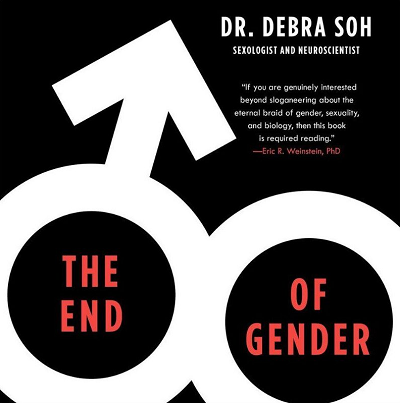
The End of Gender by Dr. Debra Soh
In The Critic, Louise Perry reviews Debra Soh’s recent book The End of Gender:
Contrary to what is commonly believed, sex is defined not by chromosomes or our genitals or hormonal profiles, but by gametes, which are mature reproductive cells. There are only two types of gametes: small ones called sperm that are produced by males, and large ones called eggs that are produced by females. There are no intermediate types of gametes between egg and sperm cells. Sex is therefore binary. It is not a spectrum.
The chapters in the first two thirds of the book are mostly concerned with the transgender movement. Soh works through trans activist claims with admirable thoroughness — no, not all people with gender dysphoria will benefit from transitioning; yes, natal males do have a physical advantage over natal females in sports; no, not all trans people are motivated to transition for the same reasons.
This last point is particularly explosive in political terms, but there is no doubt that Soh is on firm ground scientifically. Researchers have long been aware of the existence of two distinct categories of trans women — that is, natal males who identify as women. One group — sometimes called “homosexual transsexuals” — usually transition at a young age, have sexual relationships exclusively with men, and tend to be stereotypically feminine from childhood.
Another group — known as “autogynephiles” — have a very different profile: transitioning later, usually having sexual relationships exclusively with women, and often living as conventionally masculine men until they begin the transition process. And this second group are motivated to transition as a result of autogynephilia (sexual arousal at the idea of being a woman), a fact that trans activists are reluctant to acknowledge, preferring, as Soh puts it, “to neutralise the sexual aspect of their wishes to transition”. But she attempts an optimistic argument for tolerance:
In our sex-negative culture, trans women’s concerns are dismissed as a sexual fetish if anything about transitioning relates to sexual desire … I advocate for compassion and not being judgmental.
Soh, who writes for Playboy and other outlets, describes herself as sex-positive and supports destigmatising all discussion of sexual desire. Although I sometimes grew bored with the regular detours in which Soh writes about how much she loves going clubbing with her gay friends, or describes the confiding relationships she has formed with the parents of trans-identifying children, I understand the purpose of these sections: reassurance. This is a book written by a liberal for liberals, which prescribes a medicinal dose of yet more liberalism — more tolerance, more scientific inquiry, and more intellectual diversity. And liberal readers will no doubt be comforted that Soh’s live-and-let-live framing allows them to play the role of open-minded progressive, rather than (as trans activists would have it) bigoted reactionary.
August 22, 2020
Debra Soh’s new book is “a cancel-culture grenade”
Jen Gerson knows that any positive mention of Debra Soh’s The End of Gender: Debunking Myths About Sex and Identity has a strong resemblance to square-dancing in a minefield. Cancellations may fall like raindrops on the career of anyone so unenlightened as to even acknowledge the existence of such a work:
For that, at its heart, is what Soh’s book is: a lucid discussion of the best science we have to date on the nature of gender and sex, written for a lay audience. What gives the title its sizzle is not the content, but rather the cultural climate in which it is being published.
It maps the depth, scope and scale of current Culture War trenches in this particular theatre of battle. The End of Gender stomps on tripwires like the gender binary, whether transgender women are women, autogynephilia, Rapid Onset Gender Dysphoria, bathroom bans, and more.
It’s a cancel-culture grenade.
That’s not because these subjects ought to be contentious. Soh’s approach and tone are largely neutral. Rather, the controversy the book will inevitably incite is a reflection of a culture that has been warped into a state of existential terror by the very notion that these ideas can be responsibly discussed.
Soh begins by defining her terms.
So much of the debate around the most difficult topics of sex and gender stem from the simple fact that we are misusing the basic language. For example, sex and gender are not interchangeable concepts, even though they are often treated as such.
Sex is a term of biology. One’s sex, Soh argues, is determined by his or her gametes. With the exception of rare intersex disorders, 99 per cent of the population has a clearly defined biological sex that slots into one of two dimorphic categories: male or female.
Gender is more complicated. It’s now popular to state that there are more than two genders, but Soh disputes this. She argues that gender — or the set of characteristics that signal one’s sex to society — is also dimorphic. For 99 per cent of the population, gender correlates with sex. Further, even when expressions of gender are at odds with one’s biological sex, this, too, is mediated by biology. Whether one presents as gender typical or gender atypical is the result of prenatal testosterone exposure.
Soh notes that claiming to be gender non-binary, or gender fluid — or any one of a thousand variations that transcend the limiting concepts of male and female — is increasingly trendy, especially among teenagers and young adults. It seems to be the latest form of identity experimentation.
There are two reasons for this trend.
The first is that seeing the world through an intersectional framework encourages progressives to reverse the traditional hierarchies of race, sex and power. Therefore, claiming a marginalized identity — like genderqueer non-binary unicorn — accrues status within progressive peer circles.
The second is that the culture has undergone a massive awakening to transgender rights over the past decade. This has contributed expressive categories and vocabularies for people who otherwise might have struggled to find the language to explore their most authentic selves. As the cues, like cosmetics and dress, that we used to signal our gender are socially constructed, gender expression is limited only by our creativity.
July 26, 2020
J.K. Rowling receives an apology
In his first Weekly Dish newsletter, Andrew Sullivan reports on the retraction and apology by The Day to J.K. Rowling:

J.K. Rowling’s Harry Potter books have been pivotal for many Millennials in encouraging them to move away from traditional religious beliefs.
We’re used to public apologies by now, but this one is a little different. It comes from a magazine for schoolchildren in England, called The Day. It reads:
We accept that our article implied that … JK Rowling … had attacked and harmed trans people. The article was critical of JK Rowling personally and suggested that our readers should boycott her work and shame her into changing her behaviour … We did not intend to suggest that JK Rowling was transphobic or that she should be boycotted. We accept that our comparisons of JK Rowling to people such as Picasso, who celebrated sexual violence, and Wagner, who was praised by the Nazis for his antisemitic and racist views, were clumsy, offensive and wrong … We unreservedly apologise to JK Rowling for the offence caused, and are happy to retract these false allegations and to set the record straight.
The Day had been referring to JK Rowling’s open letter on trans issues, which you can read in its entirety here and judge for yourself.
I have to say it’s good to see this apology in print. It remains simply amazing to me that the author of the Harry Potter books, a bone fide liberal, a passionate feminist and a strong supporter of gay equality can be casually described, as Vox’s Zack Beauchamp did yesterday, as “one of the most visible anti-trans figures in our culture.” It is, in fact, bonkers. Rowling has absolutely no issue with the existence, dignity and equality of transgender people. Her now infamous letter is elegant, calm, reasonable and open-hearted. Among other things, Rowling wrote: “I believe the majority of trans-identified people not only pose zero threat to others, but are vulnerable for all the reasons I’ve outlined. Trans people need and deserve protection.”
She became interested in the question after a consultant, Maya Forsteter, lost a contract in the UK for believing and saying that sex is a biological reality. When Forsteter took her case to an employment tribunal, the judge ruled against her, arguing that such a view was a form of bigotry, in so far as it seemed to deny the gender of trans people (which, of course, it doesn’t). Rowling was perturbed by this. And I can see why: in order either to defend or oppose transgender rights, you need to be able to discuss what being transgender means. That will necessarily require an understanding of the human mind and body, the architectonic role of biology in the creation of two sexes, and the nature of the small minority whose genital and biological sex differs from the sex of their brain.
This is not an easy question. It requires some thinking through. And in a liberal democracy, we should be able to debate the subject freely and openly. I’ve done my best to do that in this column, and have come to many of the conclusions Rowling has. She does not question the existence of trans people, or the imperative to respect their dignity and equality as fully-formed human beings. She believes they should be protected from discrimination in every field, and given the same opportunities as anyone else. She would address any trans person as the gender they present, as would I. Of course. That those of us who hold these views are now deemed bigots is, quite simply, preposterous.
[…]
It pains me to see where this debate has gone. There’s so much common ground. And I do not doubt that taking into account the lived experiences of trans people is important. But if we cannot state an objective fact without being deemed a bigot, and if we cannot debate a subject because debating itself is a form of hate, we have all but abandoned any pretense of liberal democracy. And if a woman as sophisticated and eloquent and humane as JK Rowling is now deemed a foul bigot for having a different opinion, then the word bigotry has ceased to have any meaning at all.
June 12, 2020
June 11, 2020
QotD: Equal rights
We must separate the moral dimensions of a subject from the empirical questions surrounding it. For example, on the radioactive issue of sex (or gender) differences in cognitive abilities, there is the empirical question of whether or how men and women diverge in certain tasks, and then there is the moral question of how men and women should be treated. Empirically, there is much evidence that in some tasks women excel over men, and in other tasks, men excel over women. For example, women are more dexterous while men are better at throwing; women are superior in visual memory whereas men are better at mentally rotating shapes; women are better at mathematical calculation while men are better at mathematical problem-solving; in terms of overall general intelligence (g), however, there is no gender difference. Morally, however, none of this matters. We should support women’s rights regardless of any physical or cognitive differences between the sexes. To yoke one’s moral evaluation to empirical questions like this is a big mistake; worse is to assume that this is what people always do and therefore we must suppress any empirical evidence that there are differences, as this will only tilt people’s moral judgments toward empirical outcomes.
This reminds me of the debate in the late 1980s through mid-1990s about whether homosexuality was nature or nurture, something you were born to be or a lifestyle choice. Conservatives and Christians argued for the “choice” position and this led to efforts to “convert” gays to straight (or “pray the gay away”) because something that is learned can be unlearned. This led the gay community and supporters thereof to argue for the “born this way” position. The cumulative evidence from multiple lines of inquiry led to the nature position more than that of nurture, but this was another example of confusing the empirical question of the origin of homosexuality with the moral question of the rights of gays and lesbians (today the LGBTQ community). It should go without saying — but unfortunately in these times it must be said again and again — it doesn’t matter what the origins of homosexuality turn out to be, gays and lesbians and everyone else in the LGBTQ community are entitled to the same rights and privileges as everyone else protected by the constitution of their nation (and those nations that have yet to extend legal rights to gays and lesbians need to change their constitutions).
Michael Shermer, interviewed by Claire Lehmann, “The Skeptical Optimist: Interview with Michael Shermer”, Quillette, 2018-02-24.
March 25, 2020
December 21, 2019
November 26, 2019
“Women’s sports are dying, and very quickly”
Mark Steyn outlines the rise and sudden fall of women’s sports:

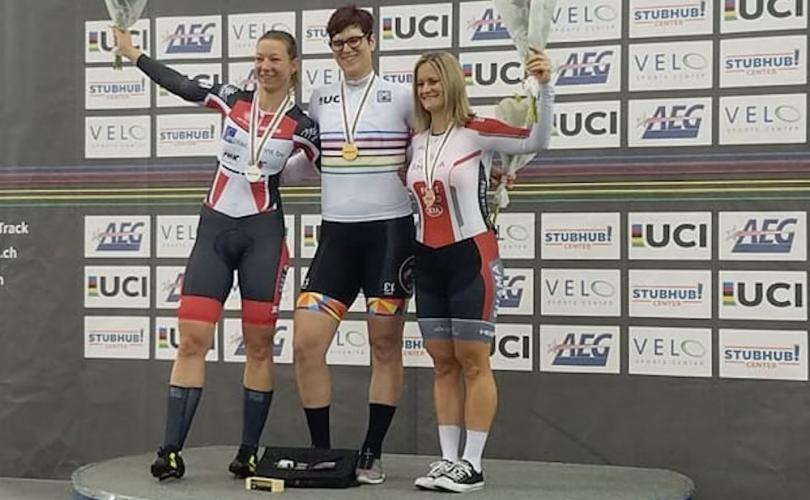
Rachel McKinnon on the podium after winning the Union Cycliste Internationale Masters Track Cycling World Championship, October 2018.
When the Olympic Games was revived in 1896, it was assumed by all that, as in the ancient games of Greece, the competitors would be men. The inclusion of women, said Baron de Coubertin, founder of the modern Olympiad, would be “impractical, uninteresting, unaesthetic and incorrect”.
By “uninteresting”, he meant that the innate differences between the male and female bodies ensured that women’s participation would require one to feign interest in races that were slower and jumps that were shorter. In a competitive celebration of excellence, what’s the point? So the first female Olympians were women who could hold their own with men and compete in the chaps’ events — such as Hélène de Pourtalès, who won a gold medal at the 1900 Paris Olympics as part of the Swiss sailing crew. A week later Mesdames Guerra and Moulin competed, unsuccessfully, in the hacks and hunter rounds of the equestrian events. In the croquet competition, seven men and three women participated, with the men taking all the medals.
And then came the tennis, for which they introduced a ladies’ singles event, at which Miss Charlotte Cooper (a five-times Wimbledon champ) prevailed.
These were the two models for female sportsmen, if you’ll forgive the expression: Compete in mixed events and spend most of your life losing to blokes, or compete only against other women where the lesser achievements are, as M le Baron saw it, “uninteresting”. In the case of certain activities, male sports felt obliged to spin off more genteel and (in Coubertin terms) even less interesting female variants — softball and netball, rather than baseball and basketball.
In the second half of the twentieth century, the latter model — female-only sports — prevailed, as part of what was understood by the general trend of “women’s rights”, loosely defined, and indeed more explicitly so by things like America’s Title Nine legislation.
In the second decade of the twenty-first century, the Charlotte Cooper model is collapsing, very fast. Women are back to losing to rivals who, whatever their lipstick, skirts or breast implants, are biologically male with all the inherent advantages. Miss Hannah Mouncey, for example, is six-foot-two and 220 pounds, which is rather heavier than me and an inch taller. The average Australian woman is five-foot-four-and-a-quarter and just under 157 pounds. If you have to catch a ball, standing six inches above anybody else on court comes in helpful:
Seleção feminina de handebol da Austrália.
.
É só isso o tuíte.— Ana Paula Henkel (@AnaPaulaVolei) November 23, 2019
Did Miss Mouncey procure her advantages over her sisters through a rigorous workout regime? No. She gained them by being born male. She played for Oz’s national men’s handball team until 2016, when she revealed she was transitioning and thus would henceforth play for the women’s team. She also announced she was taking up Aussie football, again for the ladies.
November 7, 2019
Blanchard’s transsexualism typology
At Quillette, Louise Perry interviews Dr. Ray Blanchard about transsexualism, and his controversial-in-the-LGBT-community typology of transsexualism:
Ray Blanchard is an adjunct Professor of Psychiatry at the University of Toronto who specialises in the study of human sexuality, with a particular focus on sexual orientation, paraphilias, and gender identity disorders. In the 1980s and 1990s he developed a theory around the causes of gender dysphoria in natal males that became known as “Blanchard’s transsexualism typology“. This typology — which continues to attract a great deal of controversy — categorizes trans women (that is, natal males who identify as women) into two discrete groups.
The first group is composed of “androphilic” (sometimes termed “homosexual”) trans women, who are exclusively sexually attracted to men and are markedly feminine in behaviour and appearance from a young age. They typically begin the process of medical transition before the age of 30.
The second group are motivated to transition as a result of what Blanchard termed “autogynephilia”: a sexual orientation defined by sexual arousal at the thought or image of oneself as a woman. Autogynephiles are typically sexually attracted to women, although they may also identify as asexual or bisexual. They are more likely to transition later in life and to have been conventionally masculine in presentation up until that point.
Although Blanchard’s typology is supported by a wide range of sexologists and other researchers, it is strongly rejected by most trans activists who dispute the existence of autogynephilia. The medical historian Alice Dreger, whose 2015 book Galileo’s Middle Finger included an account of the autogynephilia controversy, summarises the conflict:
There’s a critical difference between autogynephilia and most other sexual orientations: Most other orientations aren’t erotically disrupted simply by being labeled. When you call a typical gay man homosexual, you’re not disturbing his sexual hopes and desires. By contrast, autogynephilia is perhaps best understood as a love that would really rather we didn’t speak its name. The ultimate eroticism of autogynephilia lies in the idea of really becoming or being a woman, not in being a natal male who desires to be a woman.
I interviewed Blanchard over email and Skype. The text has been lightly edited for clarity.
September 16, 2019
QotD: If we’d been taken over by aliens, how would we know?
Look around you – if we in the West and we humans, in general, had been invaded by aliens, what would be different?
- Our schools in America teach that the system under which America lives, from constitutional protections to (relatively … very relatively) free markets are evil and the cause of all evils in the world.
- Our schools further teach that all the problems in the world at large are the fault of “Imperialists” to include not just America, but the West which is America’s mother culture. They ignore the sins of other nations, many of which, still today, commit female mutilation and slavery, to concentrate ONLY on the West and the sins of the West, thereby obviating any possible pride the students might have in their own culture.
- Further, the schools, under the guise of environmentalism, promote the view that humanity is the worst plague on the planet. Without pointing out that any species can drive others to extinction, or that humans are the only species capable of self-regulating their impact on the environment, they concentrate on those extinctions humans have caused and fantasize that without humans the world would be a paradise.
- Without pointing out the difficulty of global censuses or that in fact we don’t and can’t know how large the world population is, our learning institutions, our cultural institutions, even our entertainment continually scare us with the idea of overpopulation. Without taking into account that there are more trees now in North America than when the colonists arrived, they picture humanity as creating deserts. Schools push middle schoolers to sign agreements never to reproduce.
- As if this weren’t enough, feminists picture women – in Western, well off, more or less equalitarian (at least before the law as it existed before feminist tampering made it take sides with women most of the time) systems – as perpetual victims, stoke a sense of outrage and anger at any and all males, and encourage women to consider normal intercourse “rape” and marriage a prison.
- As if this weren’t enough, the insanity has descended to preaching that there is no such thing as biological sex, and that one’s gender is a sort of “mood” which can be determined before a child is even fully developed. Parents giving hormones to children, to change their sex before the age of reason (let alone physical or emotional maturity) and effectively encouraging castration/neutering and precluding future generations aren’t considered deranged abusers. In fact, educational and medical establishments will encourage parents to thus destroy their progeny and will take the children away if the parents don’t do it, on the flimsiest of pretexts based on stereotypes, such as a boy who disdains male toys, or a girl who doesn’t like dolls. The rich panoply of human expression is ignored in a – dare we say it – alien attempt to make individual people fit stereotypes.
- Three generations into this, our leading lights in intellectual life, be it fiction, non-fiction, academia or even research, get plaudits and advancement ONLY from conclusions and policies that objectively hurt humans and prevent humans from reproducing. A subset of this is hate of the West, the most successful culture in the world, ever, in terms of extending life, preventing early death, preventing or curing disease and preventing and curing famine. Another and even more vociferous subset is the hatred of America, which took all of Western virtues and made them more so.
If aliens, hostile to the very idea of humanity and wanting to prevent us from prospering, let alone going into space (another cause that all so called “progressives” hate with a burning passion and try to prevent by all means possible, from telling us that there is still need on Earth so we shouldn’t spend money on going to space, to telling us that we must first learn to “take care of this planet” to just sustained screaming that the human plague shouldn’t propagate) had managed to take control of our culture, what would they do differently?
Sarah Hoyt, “What if We Have Been Invaded by Aliens?”, PJ Media, 2017-07-21.
June 16, 2019
QotD: Critical gender studies
The first thing you must understand is that gender is a social construct. “Woman” and “man” are concepts arbitrarily invented by society. They have nothing to do with reality. A child is assigned one of these labels randomly at birth by primitive, backward-thinking doctors who, for no good or objective reason, have decided that a human child with a penis must be a boy and a human child with a vagina must be a girl. These words are all interchangeable, as are the body parts. None of it means anything, really.
But remember that the generic people we meaninglessly call “women” are beautiful and powerful and their arbitrary womanhood should be constantly celebrated. Women must band together and lift each other up. Women must be represented equally in all of our institutions. Women are truly wonderful, splendid, special creatures.
But there is nothing special about women. Literally anyone can be a woman. A woman is not anything in particular. A person with a penis can be a woman. A person with a vagina can be a woman. If a bucket of sand came to life and wanted to be a woman, it could be a woman. There is no aspect of womanhood that is ingrained or biological or inaccessible to males. And womanhood certainly has nothing at all to do with your body parts.
But if you don’t have a uterus then you shouldn’t be giving your opinion on women’s rights. No uterus, no opinion. That’s the motto. We’re tired of men making decisions about women’s bodies.
But there is no such thing as a woman’s body. Transwomen are women, too. A transwoman is just a much a woman as any other woman. There is absolutely no difference between the two and to suggest otherwise is the height of bigotry.
Matt Walsh, “Explaining Progressive Gender Theory To Right Wing Bigots”, The Daily Wire, 2019-05-14.
April 18, 2019
Shakespeare’s work is merely used to highlight the brilliance and originality of modern theatrical directors
Anthony Daniels reports for Quadrant Online of how he recently attended a performance of a play by some unimportant dead English white guy:
The precise date of the discovery by theatre directors that they are greater than Shakespeare cannot be specified: the discovery was more a process than an event. But by the time I saw a production of Richard II at the Almeida Theatre a few weeks ago, the superior genius of any director over that of Shakespeare was an established principle and indisputable fact.
[…]
But if I had an elevated conception of Shakespeare, how naive and mistaken I was! I knew nothing of Richard II — the play, that is, not the king — until I saw the production by Joe Hill-Gibbins. How narrow had been my previous conception of it! I discovered, among other things, that Richard was a short, fat fifty-eight-year-old in a black T-shirt, with a crown of the kind that is awarded to the person who finds the fève in the galette des rois that the French eat on the sixth of January, that the Duke of Norfolk was a woman dressed like a cleaning lady, and that all the action of the play takes place in what looks like a large biscuit tin, without exit or entrance. All this, of course, means something far deeper than anything that a mere Shakespeare could convey, being deeply symbolic, and therefore required real inventive genius on the part of the director to bring forth.
While the same actress took the parts of the Duke of Norfolk, Bushy and Green (all of them looking like cleaning ladies and each indistinguishable from the other because they could not leave the stage even to change costume), and the parts of both the Earl of Northumberland and the Bishop of Carlisle by other actresses, actual women’s roles such as that of Richard’s Queen were expunged entirely from the text. Between them, three actresses played five male parts and only one female. There is a profound lesson in this somewhere, no doubt in enlightened gender fluidity.
Most of the lines were delivered as if they were a religious incantation in a dead language that both the celebrants and the congregation desired to get over with as quickly as possible, clear diction being one of the many tools by which class hegemony is so unjustly exercised. The actor who took the part of Richard, it is true, was comprehensible, but made the acting of Sir Henry Irving appear taciturn by comparison. If emphasis is good, overemphasis must be better: no more stiff upper lip, we are all hysterics now, and can understand nothing that is not accompanied by gesticulation.
The director fortunately realised that Shakespeare got the order of his play wrong: Richard’s great speech in Act V scene 5 (“I have been studying how I may compare / This prison unto the world …”) was actually a prologue. The director is not the interpreter of Shakespeare, but rather Shakespeare is, and ought to be, the occasion, the opportunity, for the director to place his own immortal (and highly original) genius before the world.
March 15, 2019
QotD: Gender correctness
Five years ago, if someone had told you it would soon become tantamount to a speechcrime to say ‘There are two genders’, you would have thought them mad.
Sure, we live in unforgivably politically correct times. Ours is an era in which the offence-taking mob regularly slams comedians for telling off-colour jokes, demands the expulsion from campus of speakers who might offend students’ sensibilities, and hollers ‘Islamophobe’, ‘homophobe’ or ‘transphobe’ at anyone who transgresses their moral code on anything from same-sex marriage to respecting Islam. (A phobia, we should always remind ourselves, is a mental malaise, a disturbance of the mind. How very Soviet Union to depict your opponents essentially as mentally diseased.)
And yet for all that, surely it would never become a risky business to utter the opinion: ‘There are men and women and that’s all.’ Well, that has now happened. It is now looked upon as hateful, sinful and phobic, of course, to express a view that has guided humanity for millennia: that humankind is divided into two sexes, and they are distinctive, and one cannot become the other.
Say that today in a university lecture room packed with right-on millennials and watch their faces contort with fury. Write it in a newspaper column or blog post and witness the swift formation of a virtual mob yelling for you to be fired. Say it on TV and there will be protests against you, petitions, demands that you and your foul, outdated ideology be denied the oxygen of televisual publicity.
Brendan O’Neill, “It isn’t TERFs who are bigoted – it’s their persecutors”, Spiked, 2019-01-28.