Quotulatiousness

June 12, 2022

“Culture is upstream of politics; and the culture is clearly changing”

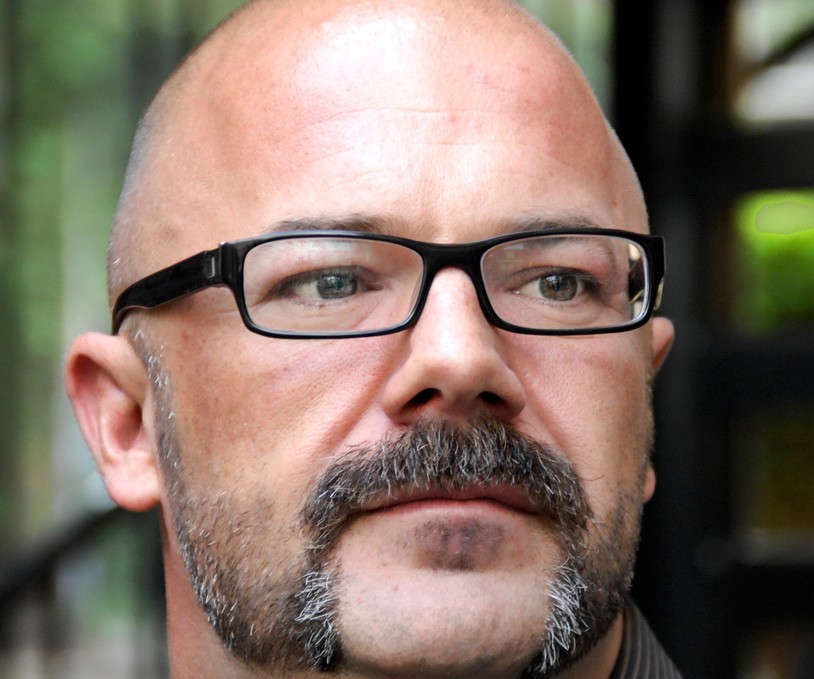
In the free-to-cheapskates segment of Andrew Sullivan’s Weekly Dish, he discusses some of the cultural sea change convulsing American society and how that will inevitably feed into the political situation in an election year:

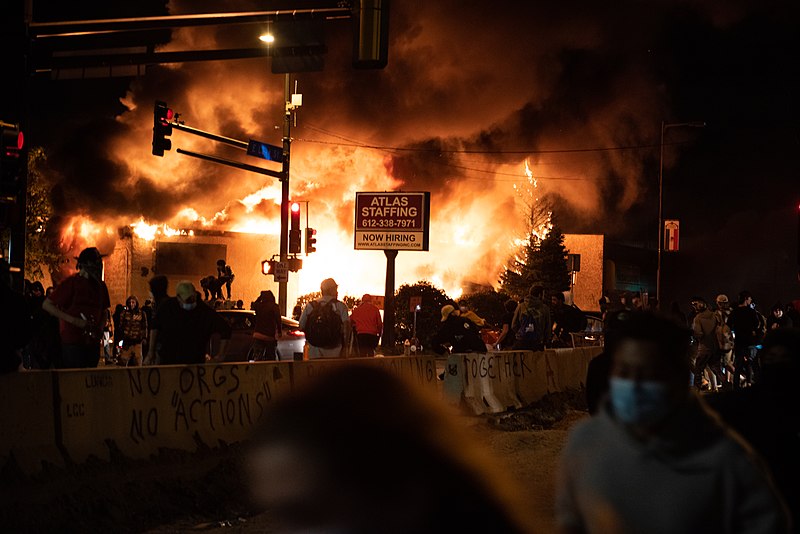
A building burning in Minneapolis following the death of George Floyd.
Photo by Hungryogrephotos via Wikipedia.

We]re now two years out from what may in retrospect be seen as peak “social justice”. In the summer of 2020, a hefty section of the elite was enthralled with the idea of the police being defunded, demobilized and demonized. Critical theory’s critique of liberal democracy as a mere mask for “white supremacy” everywhere. Countless people were required to read woke tracts — from DiAngelo to Kendi — as part of their employment. Corporate America jumped in, shedding any pretense of political neutrality; mainstream media swiftly adopted the new language and premises of critical theory. The Trump madness, and his attempted sabotage of an election, largely silenced liberals in their clash with the left. They had a more immediate threat. And rightly so.

But now look where we are.

Last year, Eric Adams became mayor of New York City, propelled by minority voters horrified by surging crime and chaos. This past week, DA Chesa Boudin, scion of leftwing terrorists, was ousted by minority voters in San Francisco, after he allowed much of the city to become a chaotic hellhole in pursuit of “racial justice”.

Recent polling suggests a sea-change in attitudes. Pew found that only three percent of African-Americans put “racism/diversity/culture” as the most important issue to them while 17 percent cited “violence/crime”, and 11 percent said “economic issues”. (Among Democrats overall, “49% now view racism as a major problem, down from 67% about a year ago”.) New York City voters now put “crime” ahead of “racial inequality” as their most urgent concern by a huge ratio of 12:1. Polling in San Francisco found that 67 percent of Asian-Americans wanted Boudin gone — a sign that the Democrats’ ascendant coalition of non-whites is now fast-descendant.

Hispanics also appear to be fleeing the left. In the usually Dem-friendly Quinnipiac poll last month, “48% of Hispanic registered voters said they wanted Republicans to take control of the House of Representatives, while just 34% said they wanted Democrats in power. In addition, 49% of Hispanic voters said they wanted the GOP to win the Senate, while 36% said they wanted Democrats to remain in control of the chamber.” Biden’s approval among Hispanics is now 24 percent. I’m not sure what to make of this, but even if it’s half true, it’s an electoral emergency for Democrats.

Some Dem pols have noticed the vast cultural gap between most Latino voters and wealthy white leftists, and adjusted. Democratic Congressman Ritchie Torres last week criticized the use of the absurd term “Latinx” — because denying the sex binary is not exactly integral to a culture where the language itself is divided into masculine and feminine. AOC, of course, demurs.

Elite imposition of the new social justice religion — indoctrinating children in the precepts and premises of critical race and gender theory — has also met ferocious backlash as parents began to absorb what their kids were being taught: that America is a uniquely evil country based forever on white supremacy; that your race is the most important thing about you; that biological sex must be replaced by socially constructed genders of near-infinite number; and that all this needs to be taught in kindergarten. Yes, some of this was politically exploited or hyped by the right. But if you think there is no there there in this concern about schooling, you’re dreaming.

Across the country, school boards are thereby in turmoil, with those supporting less ideological education on the march. On the question of trans rights, there is broad support for inclusion — but most Americans are understandably uncomfortable with pre-pubescent kids having irreversible sex changes, and with trans women competing with women in sports. For which those normies are called “hateful”.

April 16, 2022

How much of teenagers identifying as transgender is “social contagion and the development of a new youth subculture”?

Filed under: Health, Media, USA — Tags: , , , , , , — Nicholas @ 03:00

The sheer number of children and teens who are deciding that they are “trans” is far in excess of previous generations. How much of this phenomena may be accounted for by social contagion?

My teenage daughter has decided that she is “trans”. So have all her friends. Not some of them. Not most of them. Every. Single. One.

She had never heard of trans, and had no signs of gender dysphoria, until she was moved to a new, cool trans-friendly school by her unsuspecting, politically liberal parents. There she met a group of geeky (or dare I say nerdy?), smart, slightly (but not very) gender nonconforming, artsy kids. As I understand it, they all discovered “trans” together. The old “cis” friends were swiftly discarded in favour of this exciting new peer group.

Exploring “trans stuff” online with friends is a source of great interest and excitement — a real social event. What’s not to love about 245 gender identities, complete with their own unique flags? Then there are those cool neo-pronouns. Forcing your out-of-touch old parents to refer to you as “ze” or “ey” (how do you pronounce that again??) in the name of “inclusivity” is just too delicious to resist. The manga, the cute avatars in computer games, the blue or pink hair — all part of the fun as well. Mocking the outgroup (in this case so-called “cis” people in general and the dreaded TERFs in particular) is also good for a laugh — especially if they happen to be your parents as well.

There is even a special vocabulary with lots of new terms — deadnaming, misgendering, sex assigned at birth, and much more. If these concepts need to be explained to your uncool parents (accompanied by eye rolls of course), so much the better.

Bonding with friends, searching for their identity and place in life, working out their sexuality, separating from family — these are all normal developmental tasks for teens. For many, youth subcultures can be a natural part of that. Some are harmless. Some, like drug use and extreme dieting, not so much. But in the case of the latter, sensible adults usually intervene to help steer the young people in the right direction. Not in the case of trans. Here we have adults steering kids down a dangerous path, which involves permanent, life altering drugs and surgeries for which there is no good evidence base.

For many of these kids, LGBTQ+ is a youth subculture. It really is as simple as that. Recent surveys have been identifying skyrocketing rates of “trans” or “queer” identification in young people. One found that an astonishing 39% of young adults in the US aged between 18-24 identified with the label LGBT — the figure for teens <18 may well be even higher. Of course this figure includes gay and lesbian people as well as those identifying as trans. Another poll, which looked only at gender, found that nearly 10% of US high schoolers identified as “gender diverse”. Yet another survey gives a lower figure of 1.8%. Whichever figure is correct, this is a huge explosion in numbers over a very short period of time. As endocrinologist Dr Will Malone asks; “How do we reconcile these numbers with 2013 data reporting the prevalence of adult gender dysphoria to be a rare 2-14 in 100,000?”

Social contagion and the development of a new youth subculture, that’s how.

H/T to Blazing Cat Fur for the link.

January 26, 2022

“Last year, we’re told, was the ‘deadliest’ year for transgender people since records began”

Filed under: Britain, Health, Law — Tags: , , , — Nicholas @ 05:00

Tish Still, parent of a child who identifies as transgender, was worried about the “epidemic” of trans murder victims:

Facts always matter — but they take on a particular importance when they’re being used to claim that your child could be murdered. So I decided to delve into the research used to inform these claims. For me, it was personal.

The Government doesn’t publish data on the number of transgender people in the UK, though in 2018 it “tentatively” estimated that the figure stood between “approximately 200,000-500,000”. What proportion of that number must have been killed to warrant today’s warnings of trans murder epidemic? 10? 100? 1,000?

To find out, I analysed data collected by the trans-led organisation Transgender Europe, which has received more than a million dollars from the Arcus Foundation, who are based in the US and take a keen interest in transgender issues. As well as donating almost $150,000 to Stonewall, in 2015 the Arcus Foundation handed $312,000 to Transgender Europe specifically to supply reliable global data on transgender murders. The website it created provides an interactive map and links to documents naming the transgender victims.

Looking at Transgender Europe’s list of cases, it became clear — to my relief — that the total murders reported for the United Kingdom since 2008 amounted to 11. This translates as a murder rate of around 0.165%.

Now, that is still significantly higher than the murder rate for the UK as a whole: the ONS reports that the homicide rate in the UK for the year ending March 2020 was 11.7 per million people, rising to 17 per million among men. But look a bit closer at the list of trans murder victims, and that figure of 11 becomes increasingly suspect.

For instance, two of the listed victims, Vikki Thompson and Jacqueline Cowdry, appear to have been erroneously included. Thompson died by suicide while incarcerated in HMP Leeds, while Cowdry’s death was ultimately ruled as non-suspicious. This reduces the total to nine unlawful deaths, all of whom were born male. (By contrast, the number of homicides committed by transgender people between 2008 and 2017 was 12.) For context, the number of women killed by men during the same period was 1800. So much for our alleged “cis-privilege”.

Searching for more information led me to the work of Karen Ingala-Smith, who founded the Counting Dead Women project in 2012 after she realised that there was no central record of the extent of femicide here in the UK; thanks to her, a list of murdered women is read out in the House of Commons each year to imprint the rate of femicide on the minds our political class. Ingala-Smith’s tireless work focusses on female victims of, predominantly, male violence, though she made an exception to highlight the discrepancy between the mass hysteria about transgender victims of homicide compared to the treatment of woman-killing as mere background noise. (There is still no equivalent to the Trans Day of Remembrance for the much greater number of women killed by male violence.)

Crucially, her research sheds a vital spotlight on the nine remaining victims identified by the Trans Murder Monitoring report. Reading it, two things become clear. The first is that it is not entirely certain that all the victims themselves identified with the label “transgender”. The second is that the motives behind these crimes are more complex than straightforward “transphobia”.

January 16, 2022

Is the narrative about the Trans Movement about to change?

Filed under: Health, Media, Politics — Tags: , , , , — Nicholas @ 03:00

In the latest Weekly Dish, Andrew Sullivan marks a perhaps significant change in how mainstream media outlets are discussing the Trans Movement:

An unusual thing happened in the conversation about transgender identity in America this week. The New York Times conceded that there is, indeed, a debate among medical professionals, transgender people, gays and lesbians and others about medical intervention for pre-pubescent minors who have gender dysphoria. The story pulled some factual punches, but any mildly-fair airing of this debate in the US MSM is a breakthrough of a kind.

Here’s the truth that the NYT was finally forced to acknowledge: “Clinicians are divided” over the role of mental health counseling before making irreversible changes to a child’s body. Among those who are urging more counseling and caution for kids are ground-breaking transgender surgeons. This very public divide was first aired by Abigail Shrier a few months ago on Bari’s Substack, of course, where a trans pioneer in sex-change surgery opined: “It is my considered opinion that due to some of the … I’ll call it just ‘sloppy’, sloppy healthcare work, that we’re going to have more young adults who will regret having gone through this process.” Oof.

The NYT piece also concedes another key fact: that puberty blockers are neither harmless nor totally reversible. Money quote:

    Some of the drug regimens bring long-term risks, such as irreversible fertility loss. And in some cases, thought to be quite rare, transgender people later “detransition” to the gender they were assigned at birth. Given these risks, as well as the increasing number of adolescents seeking these treatments, some clinicians say that teens need more psychological assessment than adults do.

I would think that, just as a general rule, minors making permanent, life-changing decisions should receive more psychological treatment than adults. How on earth is this not the default? In what other field of medicine do patients diagnose themselves, and that alone is justification for dramatic, irreversible medication?

The NYT doesn’t give you the data for the “increasing number” of transitions because it’s hard to find in the US. In the UK, however, the data show a 3,200 percent rise in adolescents seeking transition over a decade — 70 percent of whom are girls seeking to become boys, a break from historical norms where boys/men were much more likely to seek transition. Nor does the NYT give any data for “detransitioners”. But any brief look online suggests they are not exactly “quite rare”. They are, in fact, becoming a small but recognizable and tenacious part of the trans landscape. And among the risks of puberty blockers that the NYT does not mention are neurological damage, bone-density loss, and a permanent inability to experience sexual pleasure. And in almost every case (98 percent in one report), puberty blockers are never reversed.

October 24, 2021

Andrew Sullivan – “They are the Dana Carvey church ladies of our time, except instead of saying ‘Could it be Satan?!’ when confronting some cultural or moral transgression, they turn to the camera, clutch their pearls, and say ‘Could it be whiteness?!'”

Filed under: Media, Politics, USA — Tags: , , , , , , — Nicholas @ 03:00

Andrew Sullivan on what he titles “The Betrayal Of Our Gay Inheritance”:

It was, as it turned out, a bit of a non-event. The walkout by transgender Netflix employees and their supporters to demand that the company take down and apologize for the latest Chappelle special attracted “dozens”, despite media hype.

But the scenes were nonetheless revealing. A self-promoting jokester showed up with a placard with the words “We Like Jokes” and “We Like Dave” to represent an opposing view. He was swiftly accosted by a man who ripped the poster apart, leaving the dude with just a stick, prompting the assailant to shout “He’s got a weapon!” Pushed back by other protestors, he was then confronted by a woman right in front of him — shaking a tambourine — and yelling repeatedly into his face: “Repent, motherfucker! Repent! Repent!”

This is the state of what’s left of the gay rights movement in America. Judgmental, absolutist, intolerant, and hysterical, it looks to shut down speech it dislikes, drive its foes out of the public square, compile enemies’ lists of dangerous writers, artists, and politicians, and cancel and protest anything that does not comport with every tiny aspect of their increasingly deranged ideology.

The generation that now leads the movement does not seem to know the actual history of the gay rights movement, or the centrality of free expression to gay identity. They also seem to have no idea of the history of the movement against gay rights. Because if they did, they might be shocked at the ironies involved.

Anti-gay forces, hegemonic for centuries, were just like these trans activists. They were just as intent on suppressing and stigmatizing magazines, shows, and movies they believed were harmful. They too targeted individual artists and writers for personal destruction. They too believed that movies and comedy needed to be reined in order to prevent social harm. They protested in front of movie theaters. They tried to get shows canceled. And if you’d marched in any gay demo or Pride in the 1990s, you’d always be prepared to confront a grimacing Christianist yelling “Repent! Repent!” in your face.

In fact, it’s hard not to see the trans far left as a farcical replay of the Religious Right of the past. They are the Dana Carvey church ladies of our time, except instead of saying “Could it be Satan?!” when confronting some cultural or moral transgression, they turn to the camera, clutch their pearls, and say “Could it be whiteness?!”

This was never, ever the spirit of the gay rights movement in the past. In fact, it was America’s guarantee of free expression and free association that made the gay rights movement possible. It was the First Amendment, and the spirit of the First Amendment, that was easily the most important right for gays for decades. From the fledgling Society for Human Rights, formed in Chicago in 1924, and its pioneering magazine, Friendship and Freedom, to the struggles against censorship in the 1950s, with One Magazine, and erotic Physique pamphlets under siege, it was the First Amendment that, especially under Oliver Wendell Holmes, allowed gay people to find each other, to develop arguments for their own dignity and self-worth, and to sustain free associations when the entire society viewed them as perverts and undesirables and child molesters.

October 10, 2021

“The NSBA letter is a blood libel against America’s dissenting parents”

Filed under: Bureaucracy, Education, Government, USA — Tags: , , , , , , — Nicholas @ 03:00

In this Substack essay, C. Bradley Thompson calls the National School Boards Association’s (NSBA) demand that the federal government treat dissenting parents as “domestic terrorists” a declaration of war against ordinary American citizens:

On September 30, the National School Boards Association (NSBA) sent a letter to the Biden administration denouncing the nationwide parental protests taking place at school board meetings against Critical Race Theory, Critical Gender Theory, pornography in the classroom, mask mandates, vaccine requirements, and remote learning. It turns out that parents all over the country are upset about the indoctrination and censorship in America’s government schools. An army of moms (and dads) have been asserting their parental responsibilities and their constitutional rights by showing up to school board meetings and voicing — sometimes angrily — their contempt and disgust for those school boards and teachers promoting and sanctioning ideas and ideologies opposed by the parents.

The NSBA letter (see here) begins rather ominously by declaring that “America’s public schools and its education leaders are under an immediate threat” and that “immediate assistance” is therefore “required to protect our students, school board members, and educators who are susceptible to acts of violence affecting interstate commerce because of threats to their districts, families, and personal safety.” The NSBA is essentially declaring a “State of Emergency” for America’s government school system. Let that sink in for a moment.

[…]

Let’s be clear about what the NSBA letter means in practice: first, it is dog-whistling a message which says that protesting parents are engaged in “domestic terrorism and hate crimes” (including, presumably, against their own children); and, second, it is requesting that the Biden administration use the full coercive power of the United States government — power that it has only previously been used against Islamic terrorists and foreign enemies of the United States — to monitor, investigate, arrest, interrogate, prosecute, convict and jail upset parents who are protesting AGAINST the teaching of systemic racism (i.e., CRT), pornography in the classroom, and the unscientific mask mandates for children.

The NSBA letter is saying, in effect, that complaining parents are the moral equivalent of jihadi terrorists, who are out to commit acts of violence and terror against America’s school board members, its teachers, and, yes, even the children. As such, these parents should be treated as a national security threat, and they must be dealt with by all means necessary.

The NSBA letter is a blood libel against America’s dissenting parents. In a decent, free, and just society such a letter would be condemned and dismissed out of hand, but that is not the kind of society in which we live today.

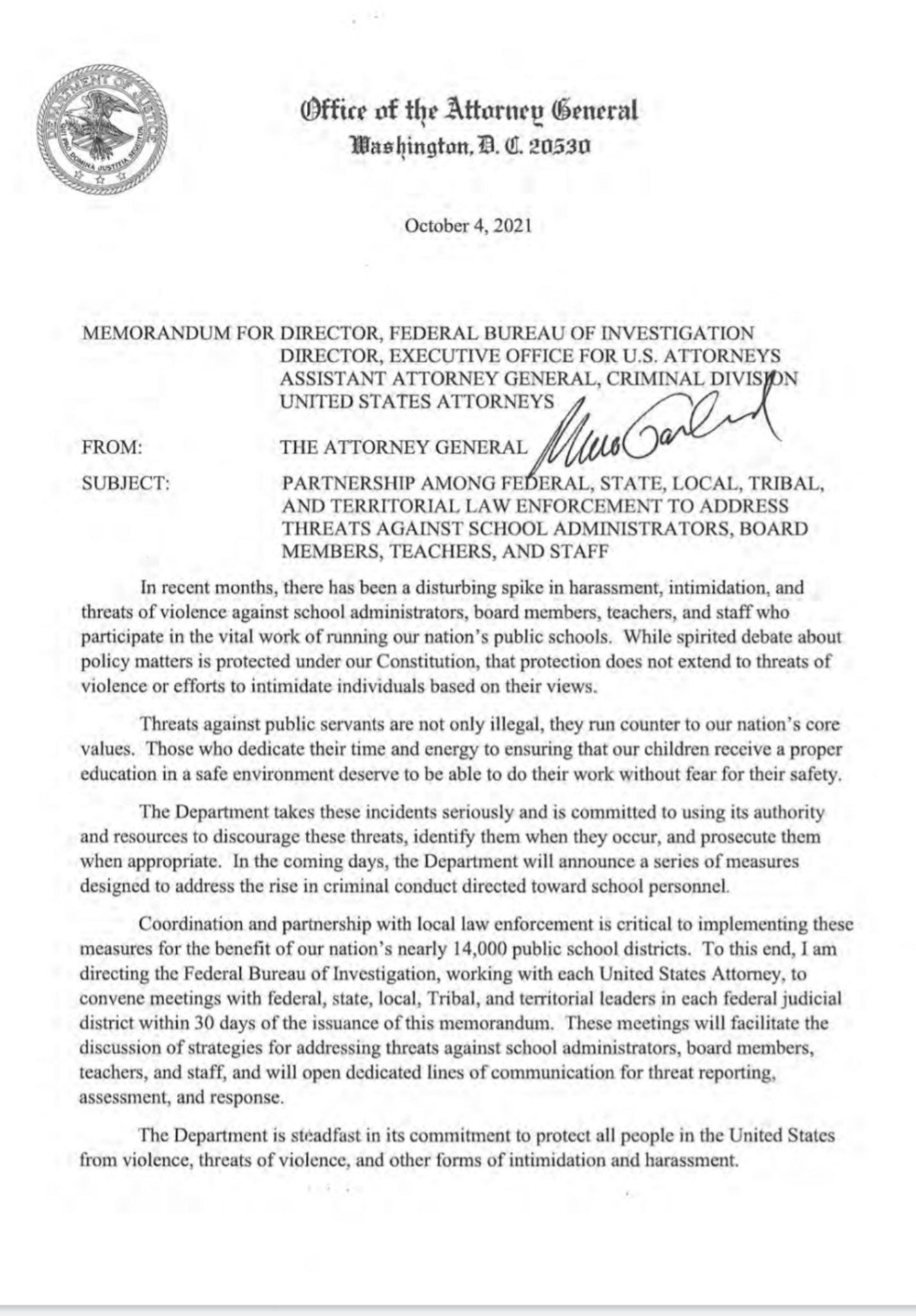
Rather than tossing the NSBA letter in the trash where it belongs, the Attorney General of the United States, Merrick Garland, read it and immediately ordered the FBI and America’s National Security State to mobilize its immense power against parents whose only real crime is to take seriously the education of their children. He did this within just a few days of receiving the NSBA letter.

I encourage you to read — and to read slowly — Garland’s official memorandum sent to the Director of the FBI and to various other law enforcement agencies, offices, and divisions.

Garland’s letter is a moral, political, and constitutional abomination. To say there are serious problems with the Attorney General’s Orwellian letter would be an understatement. The letter asserts, for instance, that “there has been a disturbing spike in harassment, intimidation, and threats of violence against school administrators, board members, teachers, and staff.” It claims as fact a “rise in criminal conduct directed toward school personnel”. Neither the NSBA nor the Justice Department have provided any credible or meaningful evidence to support this unfounded claim, nor does Garland’s passive-aggressive letter specify what it classifies as “criminal conduct” or “domestic terrorism”. (Not surprisingly, Garland’s letter neglects to mention that some school board members and the teachers’ unions have been harassing and threatening parents for months. See here, here, here, here, and here.) The simple fact of the matter is that virtually no violence has occurred at school board meetings this year.

In support of the NSBA request, Garland’s memorandum announced that he has directed the FBI and each U. S. Attorney to convene meetings immediately with “federal, state, local, Tribal, and territorial leaders in each federal judicial district” in order to “facilitate the discussion of strategies” for dealing with threats against school officials. The Department of Justice will also “open dedicated lines of communication for threat reporting, assessment, and response”. In other words, the government will establish “snitch” lines against parents. If a school board member doesn’t like what they hear in a public meeting, they will be able to report (presumably anonymously) threats of harassment and intimidation.

September 7, 2021

QotD: Calvin was right

Filed under: Education, Humour, Quotations — Tags: , , , — Nicholas @ 01:00

Calvin: “I used to hate writing assignments, but now I enjoy them. I realized that the purpose of writing is to inflate weak ideas, obscure poor reasoning, and inhibit clarity. With a little practice, writing can be an intimidating and impenetrable fog! Want to see my book report?”

Hobbes: “‘The Dynamics of Interbeing and Monological Imperatives in Dick and Jane: A Study In Psychic Transrelational Gender Modes.'”

Calvin: “Academia, here I come!”

Bill Watterson, Calvin and Hobbes.

August 7, 2021

QotD: “The English spoke of the ‘German custom’, the French referred to the vice allemande, and Italians called gay men and women ‘Berlinese'”

Filed under: Germany, Health, History, Quotations — Tags: , , , , , — Nicholas @ 01:00

Beginning in the nineteenth century, Germany was closely associated with homosexuality. The English spoke of the “German custom”, the French referred to the vice allemande, and Italians called gay men and women “Berlinese”. Queer people existed across Europe, of course, but German thinkers actively studied non-heteronormative sexualities and openly debated the rights of queer people, inaugurating the field of sexology. In the first decade of the twentieth century, more than a thousand works on homosexuality were published in German. Researchers from England to Japan cited German sexologists as experts and often published their own works in Germany before their home countries.

The Weimar Republic, the zenith of modernism, witnessed new social liberalization and experimentation. Fritz Lang premiered his Expressionist film Metropolis in 1927, Alfred Döblin published his dizzyingly innovative novel Berlin Alexanderplatz in 1929, and the following year Hannah Höch unveiled her Dadaist photomontage Marlene. And alongside reinventing traditional forms of artistic expression, Germans began interrogating gender roles and sexual identities. As the historian Clayton Whisnant observes, “Perhaps more than anywhere else, Weimar Germany became associated with experimentation in sexuality.” Berlin was the undisputed queer capital of Europe. By 1900, over fifty thousand gay men and lesbians lived there, and countless more visited, looking for friendship, love, and sex. By 1923, some hundred gay bars in Berlin catered to diverse groups: men and women, the old and the young, the affluent and the working class. Nightclubs like the Mikado, the Zauberflöte, and the Dorian Gray became international hot spots, and the city’s elaborate queer balls attracted worldwide attention. Associations offered opportunities for socializing and political organization. Crucially, relaxed rules of censorship allowed for the publication of dozens of pulpy gay novels, queer periodicals, and even personal ads. The British writer Christopher Isherwood, whose account of his thirties stay in Germany inspired the musical Cabaret, put it simply: “Berlin meant boys.” In 1928, the poet W. H. Auden similarly described the German capital as “the bugger’s daydream.” In her famous guide to the Berlin lesbian scene from the same year, Ruth Margarete Roellig concluded, “Here each one can find their own happiness, for they make a point of satisfying every taste.”

The experience was different for trans people. The Third Sex [likely the world’s first magazine devoted to trans issues] bore the subtitle “The Transvestites”, but at the time, the historian Laurie Marhoefer notes, the term meant different things to different people. German speakers were in the middle of developing a critical vocabulary to describe the expansion of recognized identities. Karl-Maria Kertbeny coined the word homosexual in 1869, and in 1910 Magnus Hirschfeld invented the term transvestite. It described both cross-dressers and transgender people. According to contemporary self-reports, some transvestites considered themselves homosexual, but most did not. Many wore clothes traditionally associated with the opposite sex only on special occasions. Others lived fully as a gender different from their sex at birth. A majority seemed interested in passing and adhering to expectations of respectability, while a minority sought to challenge the normative order. Gender affirmation surgeries were available — the first such operation was conducted in 1920 by, no surprise, a German doctor — but uncommon. From today’s perspective, it is therefore unclear whether an individual who identified as a transvestite in thirties Germany, including Hans Hannah Berg, was what we would today consider transgender, nonbinary, a cross-dresser, or something else altogether. In the very first issue of The Third Sex, an essay by Dr. Wegner acknowledges the richness of the term. “Just as people are all different in their outward appearance and inner attitudes, so are the characteristics of transvestites.” Many queer activists in the Weimar Republic were concerned that the population of gender variant people was too fragmented. Trans people were not as visible or as organized as gays and lesbians. Friedrich Radszuweit, the leader of the Federation for Human Rights and the publisher of several queer periodicals, saw a solution. To foster a trans community, he produced The Third Sex.

Matthew H. Birkhold, “A Lost Piece of Trans History”, The Paris Review, 2019-01-15.

July 14, 2021

QotD: The unlikely hermaphrodites in The Left Hand of Darkness

Filed under: Books, Media, Quotations, Science — Tags: , , , , , , , — Nicholas @ 01:00

I’m strange only in that I was very young and that the book that caused this reaction was a classic of science fiction, The Left Hand of Darkness.

Let me start by saying that I LIKED the book. Loved it even. Mostly because it was different and it made me think. (Like other books of the time, it didn’t age well, mostly on language, but also structure, which I guess was innovative and daring at the time, but strikes me as “too early seventies” for words. Now this might be JUST ME but there’s a whole batch of books — one Heinlein — I can’t stand to re-read. I came of age in the seventies and eventually grew to loathe that false-craft feel of art at that time. No one else is forced to agree with me.)

But part of what made me think — because my relaxing reads are books on evolution and animals and their biology and behavior (guys, I read Konrad Lorenz for fun) is that the left (and at the time anyone with even vague intellectual pretensions was at the very least soft left, because the zeitgeist was) was very funny about humans.

They often opened their books on humans by gesticulating broadly at imaginary religious fanatics and rubbing said fanatics’ noses in the fact that “we are animals. No, we’re really animals.” And then proceeded to go a little bananas, sometimes in supposed non-fiction, like Desmond Morris in The Naked Ape, which assured us only humans killed their own species, or something equally ridiculous (I read it at around 14 or 15, I just remember his thesis that humans were uniquely vile made me snort-giggle at the time. Because, you know, you can sustain that if you’re religious, and say humans should aspire to the divine image, but if we’re really just animals, there is NO vile. We do what instinct and nature tell us, no judgement, right?)

But mostly this dysfunction showed in science fiction, particularly at the time. “We’re just animals. If we just changed/removed/tweaked x y z we’d be communitarian, sharing, no war animals.”

The way hermaphrodites behave in TLHOD made me snort/giggle too for various reasons, the first being that hermaphrodite species on Earth (granted mostly very small) have some of the most violent mating behaviors in the world. Makes sense since at least in live-bearing, or for that matter those who care for eggs, species, the cost falls on the one who carries young or sits on eggs. The other one just goes off, whistling his merry way and lives to mate another day. So in a species where either of the couple can bear, there would be a “war” (There are several books on war of the sexes in various species, which has led to things like praying mantises and duck penises.) to determine who bears. And yes, she did get right that in an intelligent species, value would have to be put on children-of-the-body or no one would want to do it. (Or most children would be conceived by rape. Which to be fair, is most hermaphrodite species on Earth.)

What she got wrong, related to that, is then having the kids raised in some sort of hippie dippie commune.

In fact, the whole setup makes perfect sense as a professional woman’s fantasy. “I want to have kids, but someone else raises them, and it will be the perfect communitarian family and no one will think it’s bad if I’m not there, or take no more interest in them than in any of the family kids.”

In point of fact, from evolutionary POV, an hermaphrodite species would have a hell of an attachment to their own biological “of the body” kids, for the simple reason that otherwise, being intelligent and able to circumvent instinct, no one would have kids “of the body” and those born of rape would be abandoned to die. World’s shortest species/race/breed.

Yes, I’m sure that some human (and these were supposed to be modified humans) tribes have done the communitarian child raising, but it’s not the norm, it’s not usually as communitarian as it looks and … oh, heck, even extended family raising the kids, which it sort of is, is nowhere nearly what US leftists think it is. There’s squabbles, politics, and the mothers very much care and “pull” for their own kid.

Anyway, it amused me because it was nowhere near the only. There was this trend back then for hermaphrodite modified humans that somehow made them more cooperative/better at not warring, etc, which I found absolutely mind bogglingly bizarre and made me wonder why people thought injecting the fierce young-protecting instinct of the female into a species at large would make it more sharing and caring, not the other way around. (And lord, study any society with multiple concubines and wives. Women protect THEIR children, there is no sisterhood or love all babies, when yours is in the mix. Some of the most horrific tales of mankind are the vengeance wrought by a woman on rival women AND THEIR BABIES.)

Sarah A. Hoyt, “Remaking People”, According to Hoyt, 2018-11-19.

June 10, 2021

“That’s a nice Pride flag you’ve got there. Be a shame if something were to happen to it …”

Filed under: Media, Politics, USA — Tags: , , , — Nicholas @ 03:00

In The Line, Allan Stratton argues against replacing the common “rainbow” Pride flag with a new “Progress” variant:

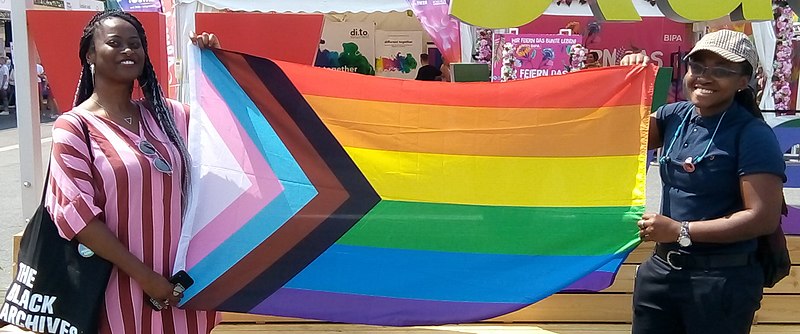
Two people at EuroPride 2019 in Vienna holding an LGBTQ+ pride rainbow flag featuring a design by Daniel Quasar; this variation of the rainbow flag was initially promoted as “Progress” a PRIDE Flag Reboot.
Photo by Bojan Cvetanović via Wikimedia Commons.

Question: What do the following have in common: A hammer and sickle, a Union Jack, five interlocked rings, a Black fist, a cross, a Star of David, and the Rainbow flag?

Answer: They are internationally recognized symbols. Not spring fashions. Not cool memes. No. Symbols that communicate across all languages and countries in the world.

That’s what’s so infuriating about the push by hashtag activists to replace the Rainbow flag with the so-called “Progress flag”. The Progress flag takes the pink, blue, and white stripes of the trans flag, adds black and brown stripes for race, turns those five stripes into a chevron tipped on its side, and ploughs it into the rainbow in an eleven-colour pile-up. It’s a regressive, ill-considered mess that looks like a child’s Crayola box.

Naturally, it’s the creation of a Portland designer who whipped it off one night while suffering insomnia. The story of Daniel Quasar (ze/them) and their flag is a real-life satire, featuring moxie, hustle, viral posts and a Kickstarter campaign. Ze and their (not surprisingly) all-white team have leveraged ze’s design into Quasar Digital, a company that sells Progress flags, pins, patches, T-shirts, tank tops, notebooks, clutch bags, coffee mugs, stickers, slappers, socks and more, individually and in bundles.

Marketed with the trendy buzzwords progress, diversity and inclusion, the Progress flag has been a viral hit with woke straights and nouveau queers as well as corporate PR departments at places like Goldman Sachs and TD Bank, who signal virtue while screwing customers of every gender. But by separating specific races and a single identity from the rainbow, the Progress flag creates divisions, hierarchies and exclusions. And it trashes the power and weight that a 43-year-old symbol of hope and strength gives to people worldwide who continue to be imprisoned, beaten and murdered for being LGBT+.

[…]

Slapping the “Progress” chevron on the Rainbow is like slapping the fleur de lys on the Maple Leaf. It creates resentment and division to the sole benefit of performative social climbers keen to wave their Alphabet status and cachet. Step outside the West to see what it really means to have people out to “deny your very existence”. To trade the Rainbow, the symbol of our suffering and resilience, for a viral craze is bourgeois privilege at its self-indulgent worst.

May 9, 2021

QotD: Boys

Filed under: Education, Health, Quotations — Tags: , — Nicholas @ 01:00

I was also forced to acknowledge by the time I had two sons that the male mind really does approach problems differently than the female mind. Before I had the second son, I put down the differences between the male and female minds as all due to the socialization process. Two sons tipped the balance. It’s like this; the bookcases looked cool to climb to the Last Amazon. She tries once when my attention is on other matters; falls and deduced that it was a bad idea. The sons’ perceive the bookcases as a mountain to be conquered at all costs and they are prepared to pay any price to crown themselves King of the Bookcases. See the bookcases, take the bookcases; or die in the attempt. It did not matter how many times they were thwarted or injured, they refused to give up. Each time they went into the assault with the premise that this time it will end in triumph.

[ … ]

I admit to being a little more than angry and frustrated myself. Partially it is at a school system that won’t allow boys any physical activities where they can blow off steam. No football, soccer, hockey, baseball, dodge ball, or any other kind of game that “promotes aggression” or the “possibility of injury”. Volleyball and cross country running are all well and good but they are seasonal, and frankly, to a lot of boys; it blows. I do understand that not all boys are the “physical” sort but more are than not. While I realize no parent wants their child injured; it just seems that by denying that boys really do need a way to physically deal with aggression, you set them up for horseplay which eventually leads to fighting. How can anyone expect boys to spend all recess at the wall or standing around chatting about the weather?

Kate “The Last Amazon”, “When Biology is Destiny”, The Last Amazon, 2005-03-02.

April 25, 2021

The causes and effects of “ostrich parasitic syndrome”

Filed under: Media, Politics, Science — Tags: , , , , , — Nicholas @ 03:00

Barbara Kay on Canadian academic Gad Saad, who sometimes lets his “inner honey badger” get out on social media:

Gad Saad 2010 JMSB Faculty Portrait

Saad, 57, is a professor of marketing at the John Molson School of Business at Montreal’s Concordia University. His domain is evolutionary psychology as applied to business — a niche field, to be sure. He’s written such papers as “Gender differences in information search strategies for a Christmas gift,” and “Menstrual cycle effects on prosocial orientation, gift giving and charitable giving,” which provide valuable information to guide marketing strategies.

You’d be hard pressed to find any academic in Canada who’s more deeply steeped in knowledge about the ineluctable differences between the sexes. (Speaking of “the sexes,” business schools may be the last places left in academia to use those words to designate men and women and acknowledge their differences. Perhaps because their students want to succeed in the real world.)

[…]

Since then, Saad has understood the absolute necessity for critical thinking and freedom of speech. In the present, unhealthy climate, feelings rule, while critical thinking’s value declines daily. Just as our immune systems are designed to cope with novel intruders or atrophy, if we live in an intellectual bubble — as university students do now, rarely confronting opposing views — our cognitive immune systems atrophy, Saad says.

The consequence is what Saad calls “ostrich parasitic syndrome” (OPS). This disorder, in his words, “causes a person to deny realities that are otherwise as clear as the existence of gravity.” Science, reason, infinite data, common sense — all are rejected.

Cognitively disarmed, OPS sufferers accept alternate realities: climate change is “related to terrorism” (Bill Nye, the “science guy”); it is “gross and racist” to suggest Islam is connected to Islamism (Ben Affleck); the Israeli military “dehumanizes” Palestinian women by choosing not to rape them (not a typo: this was the thrust of an award-winning thesis by a radically leftist Israeli sociologist); men can literally be women (nearly everyone says this now, for fear of being labelled transphobic).

It used to be that you could “stand off on the sidelines” when you called out postmodern BS. No longer. There’s no middle ground anymore. You call out the BS or you keep schtum. If you choose the former, as Saad’s writing and actions demonstrate, you need to cultivate your own inner honey badger. Nothing else works.

April 18, 2021

Take a moment to reflect on the plight of those poor, alienated students at Haverford College in Pennsylvania

Filed under: Education, Health, USA — Tags: , , , , , , — Nicholas @ 03:00

In Quillette, Jonathan Kay outlines some of the issues faced by the students of an expensive elite academic institution and how it impacts their mental health:

In December, I wrote a detailed report for Quillette about the race-based social panic that had recently erupted at Haverford College in Pennsylvania. One of the reasons why the meltdown seemed so surreal, I noted, is that this elite school appears to the outside world as picturesque and serene. The average annual cost of attendance is about US$76,000. And most of these students live extremely privileged lives, insulated (physically and otherwise) from what any normal person would regard as suffering. Nor is there much in the way of substantive political discord on campus. According to survey results released in late 2019, 79 percent of Haverford students self-identify as politically liberal, while only 3.5 percent self-identify as conservative. It’s as close to an ideological monoculture as you can find outside of a monastery or cult. On paper, it resembles one of those utopian micro-societies conceived by science-fiction writers or 19th-century social theorists.

The survey results I’m alluding to originate with Haverford’s “Clearness Committee,” an excellent resource for anyone seeking to understand the attitudes of students at hyper-progressive schools. The most recent Clearness survey, completed by more than two-thirds of Haverford students in 2019, contained 133 survey questions pertaining to everything from how much students sleep, to how many friends they have, to how they feel about campus jocks. There is also a substantial section dedicated to the theme of “marginalization.” Amazingly, 43 percent of respondents said they felt personally marginalized on campus because of some aspect of their identity. This included 61 percent of gay students, and more than 90 percent of trans students.

This is an odd-seeming result given the sheer number of LGBT individuals on Haverford’s campus. No fewer than 31 percent of student respondents identified themselves as something other than straight. In regard to gender, almost six percent self-identified as trans or some variant of non-binary. Both of these percentages exceed the overall American average by an order of decimal magnitude. Despite having only about 1,300 students (smaller than many public high schools), Haverford has a resource center for LGBT students, a pro-LGBT hiring policy, an LGBT studies program, dedicated LGBT living arrangements, a health insurance policy that covers hormone replacement therapy, and numerous other resources. Outside of other similarly liberal campuses, it is hard to imagine a more welcoming environment for LGBT youth anywhere on the planet.

It’s also telling that self-reported marginalization rates for Haverford’s gay students are almost identical to those for self-described bisexuals (62 percent) and asexuals (59 percent); and that the rate for students who self-identify under the loose category of “non-binary” (89 percent) is almost identical to the rate for students who, being trans, experience actual gender dysphoria (91 percent). The report authors conclude that there is “a series of immediate crises facing Haverford’s transgender population.” Yet despite the abundant write-in information supplied by surveyed students, no real evidence of these crises appears. What we get instead are vague testimonials about perceived attitudes and atmosphere. (“As a nonbinary person, athletics is inherently exclusive because it is gendered. We need to put that phrase to rest and start talking about the real divisions on campus—such as who feels comfortable going to parties hosted by athletes and who doesn’t.”) Even amidst the melodramatic throes of last year’s student strike, at a time when every imaginable identity-based grievance was described in lengthy student manifestos, no one could point to a single recent incident of real homophobia or transphobia targeting Haverford students.

March 26, 2021

When the science becomes problematic to the narrative

Filed under: Health, Media, Politics, Science, USA — Tags: , , , , — Nicholas @ 03:00

Alexander Riley looks at a few of those awkward points where actual “scientific” science conficts with the deeply held beliefs of the “I heart SCIENCE!” community:

… human and nature cannot so easily be pried apart. The evidence of the biological reality of the sex difference — not just in gonads and sex cells, but in personality characteristics and behavioral profiles, on average — is overwhelming, and science is daily producing more. Male and female brains are structurally different in ways that map on to the emerging neuroscientific knowledge on how brain structure affects behavior and capabilities. The feminist claim that these differences are wholly a product of socialization becomes more implausible the more we know. In societies where egalitarian gender ideology is arguably most widespread, such as in Northern Europe, there has been no disappearance of traditional sex differences in choices concerning careers. Men are still overrepresented in fields that focus on systems and objects, and women are still the overwhelming majority in fields dedicated to extensive human interaction and social services.

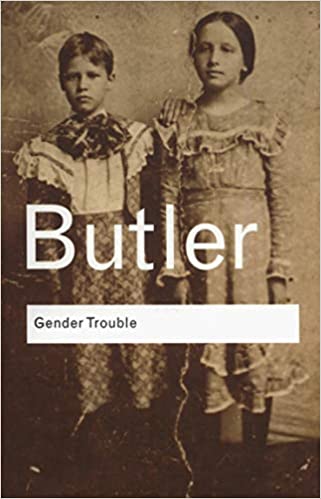
The radical spirit of ’90s feminism represented by [author Judith Butler’s] Gender Trouble did not stop at “deconstructing” gender in the effort to move toward a world in which gender roles are divorced from biological sex. Sex too had to be subjected to such “problematization.” Radicals used the writing of Anne Fausto-Sterling, a biologist who admitted her work was fundamentally shaped by her “1960s street-activist heart,” to suggest that the sex binary was also an oversimplified social construction. Fausto-Sterling insisted there are at least five sexes: males, females, “true hermaphrodites” with one testis and one ovary, male pseudohermaphrodites with testes and “some aspects of female genitalia” but no ovaries, and female pseudohermaphrodites with ovaries and “some aspects of male genitalia” but no testes. Perhaps, she asserted, several of every hundred people might be in one of the three intersex categories, with — the clincher — an “infinitely malleable continuum” between them.

It was quickly pointed out that Fausto-Sterling had been deceptive in her estimate of the frequency of intersexuality. Leonard Sax, in the Journal of Sex Research, noted that she had counted phenomena such as Klinefelter’s Syndrome (biological males with an extra X chromosome), Turner’s Syndrome (biological females with only one X chromosome), and several other conditions typically not recognized as intersex. One of these alone — late-onset congenital adrenal hyperplasia (LOCAH), which involves the overproduction of adrenal androgens — accounts for 90 percent of Fausto-Sterling’s claimed figure of 1.7 percent of the population that is intersex. But LOCAH is not an intersex phenomenon. Many individuals who have it are never diagnosed because the symptoms are so mild, and all who have it are born with typical male or female genitalia that correspond to the male and female genotypes. Nearly all such individuals go through puberty with the typical sexual development for their genotype, as the condition generally does not manifest in women until the early 20s and in men much later. The true estimate of intersex individuals, Sax argued, is roughly 0.018%, about 100 times lower than Fausto-Sterling’s estimate. That is, more than 99.98% of humans are clearly either male or female in terms of biological sex.

But the attack on “standard sex difference science” was undeterred by this decimation of Fausto-Sterling’s case. In Gender Trouble, Butler criticized the work of an MIT group that had just discovered the region on the Y chromosome responsible for sex differentiation, claiming these scientists ultimately had to invoke cultural symbols of patriarchy to legitimate their explanations. In her view, this betrayed the very notion of an objective science of sex difference. We are always trapped in culture, she wrote, which means we are always trapped in patriarchy. A science of sex is impossible. Radical sex/gender ideology attacked science as male knowledge and elevated female knowledge as superior on the basis that women as a class were treated as inferior. Like blacks and other powerless groups, women — at least, women with a feminist outlook — could critically understand the point of view of men and supplement its lacunae with the fuller vision of the female perspective. Marx made similar claims about the superiority of working-class consciousness, though he did not attempt to cast the very notion of science as a tool of oppression.

The MIT group’s finding that what we now know as the SRY gene determines sex is universally accepted science today, and Butler’s ideological criticism has aged poorly in scientifically literate circles. So has her wild overestimation that perhaps one in ten people is outside the normal sex binary.

November 25, 2020

Jan Morris, RIP

Filed under: Books, Britain, History — Tags: , , — Nicholas @ 03:00

By an odd co-incidence, I began reading the third volume of Morris’s British Empire trilogy just last night and today I discovered that she recently died at age 94. The particular edition I have has Morris’s original male name on the cover, but her female name in the “note about the author”:

Jan Morris, who died last week at the age of 94, may have lived one of the more various and accomplished lives on record. She was, in turn, a soldier, a newspaper correspondent with a number of scoops to her name, a fine memoirist, and a writer of books whose scope encompassed the world.

Any dutiful obituarist must also note something else which happened fifty years ago. It is likely for ever to feature in the first paragraph, if not the first line, of everything written about Morris. She was born a man, named James by her parents, and underwent what her publishers and profilers term “a change of sexual role” in 1972 – back when such a thing was a rarity and rather dangerous to accomplish.

I hope to leave that subject aside for a moment while contemplating her place in letters. By the end of her long life, Morris had become something of a national treasure and an institution. Her quixotic obsessions – a personal, mythical interpretation of the Welsh side of her family and her home in that country, and the late First Sea Lord Jackie Fisher – became the subject of stories shared by friends, editors and admirers.

She gave wise and funny interviews to the papers about savouring mussels without dignity and why whether what one is doing is kind ought, in a good world, to be the modest test applied to action.

Other profilers note her long companionship with Elizabeth (née Tuckniss) – first through marriage, then a legally-divorced close friendship, and finally a civil partnership, with the ceremony witnessed by a local couple who afterwards invited the two for tea. Elizabeth survives Jan, but a visiting journalist or two was shown the headstone which is planned for both of them. They will lie on a Welsh island they owned in the Dwyfor, a river that runs by their home. The stone reads: “Here lie two friends, at the end of one life”.

These are beautiful stories, but they should not retroactively colour in fully our impressions of Morris. Nor should a sense – repeated in some otherwise careful obituaries – that as “James”, Morris’s “written voice always sounded certain”. Whereas as Jan, her writing grew more introspective and aware of the ways that time and tide conspire to decay the facades of men as much as they do institutions and places. This was exhibited notably in her Pax Britannica trilogy, which chronicled Britain’s imperial decline.

« Newer PostsOlder Posts »

Powered by WordPress