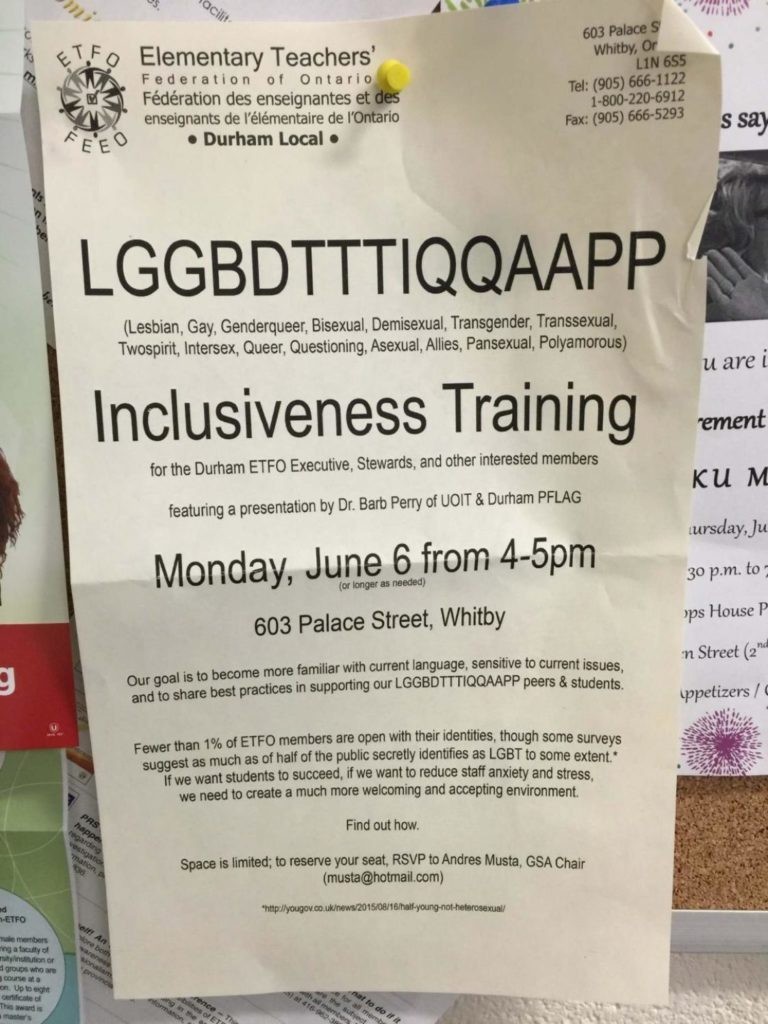
My lifelong gender dysphoria has certainly been a primary inspiration for my entire career as a researcher and writer. I have never for a moment felt female — but neither have I ever felt male either. I regard my ambiguous position between the sexes as a privilege that has given me special access to and insight into a broad range of human thought and response. If a third gender option (“Other”) were ever added to government documents, I would be happy to check it. However, I have never believed, and do not now, that society has any obligation to bend over backwards to accommodate my particular singularity of identity. I am very concerned about current gender theory rhetoric that convinces young people that if they feel uneasy about or alienated from their assignment to one sex, then they must take concrete steps, from hormone therapy to alarmingly irreversible surgery, to become the other sex. I find this an oddly simplistic and indeed reactionary response to what should be regarded as a golden opportunity for flexibility and fluidity. Furthermore, it is scientifically impossible to change sex. Except for very rare cases of intersex, which are developmental anomalies, every cell of the human body remains coded with one’s birth sex for life.
Beyond that, I believe that my art-based theory of “sexual personae” is far more expansive and truthful about human psychology than is current campus ideology: who we are or want to be exceeds mere gender, because every experimental persona that we devise contains elements of gesture, dress, and attitude rich with historical and cultural associations. (For Halloween in childhood, for example, I defiantly dressed as Robin Hood, a Roman soldier, a matador, Napoleon, and Hamlet.) Because of my own personal odyssey, I am horrified by the escalating prescription of puberty-blockers to children with gender dysphoria like my own: I consider this practice to be a criminal violation of human rights. Have the adults gone mad? Children are now being callously used for fashionable medical experiments with unknown long-term results.
In regard to the vexed issue of toilets and locker rooms, if private unisex facilities can be conveniently provided through simple relabeling, it would be humane to do so, but I fail to see why any school district, restaurant, or business should be legally obligated to go to excess expense (which ultimately penalizes the public) to serve such a minuscule proportion of the population, however loud their voices. And speaking of voices: as a libertarian, I oppose all intrusion by government into the realm of language, which belongs to the people and which evolves organically over time. Thus the term “Ms.” eventually became standard English, but another 1970s feminist hybrid, “womyn”, did not: the populace as a whole made that decision, as it always does with argot or slang filtering up from ethnic or avant-garde subgroups. The same principle applies to preferred transgender pronouns: they are a courtesy that we may choose to defer to, but in a modern democracy, no authority has the right to compel their usage.
Camille Paglia, “Prominent Democratic Feminist Camille Paglia Says Hillary Clinton ‘Exploits Feminism’”, Washington Free Beacon, 2017-05-15.
September 7, 2022
QotD: Gender Dysphoria
August 30, 2022
The plasticity of language, slippery definitions, and the ongoing gender wars
In The Line, Allan Stratton considers some of the reasons for misunderstanding, argument, and anger in the suddenly huge gender wars in western culture:

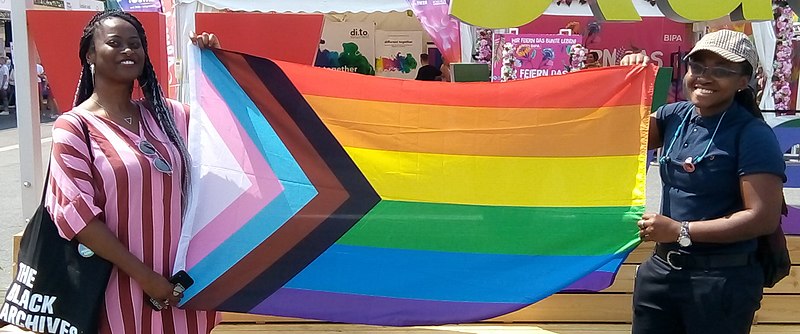
Two people at EuroPride 2019 in Vienna holding an LGBTQ+ pride rainbow flag featuring a design by Daniel Quasar; this variation of the rainbow flag was initially promoted as “Progress” a PRIDE Flag Reboot.
Photo by Bojan Cvetanović via Wikimedia Commons.
From my perspective, much of the controversy stems from academic redefinitions of language and concepts over the past 60 years. As these changes affected a small subculture, mainstream society paid them no mind. But language has consequences.
I’m a gay man in his early seventies, who’s paid close attention to the decades of linguistic manipulations that have turned sense into nonsense. Once, words and concepts had clear understandings that helped to create widespread support for LGBT rights. More recently, they have been conflated and inverted, and threaten to negatively affect the rights of women, the safety of gender-nonconforming children, and the lives of gays, lesbians, and transexuals.
A quick primer on the change in key terms may help to clarify our current mess and suggest a way forward:
Today the trans umbrella is understood to be a single movement within the Alphabet alliance, but in 1960s North America, it referred to three specific groups: self-identified transsexuals, transvestites and transgenders. There was some overlap, but none of the three were specifically attached to the fight for gay rights at all.
Transsexuals gained public prominence thanks to American Christine Jorgensen. After serving in the United States Army, Jorgensen had a sex change operation in Denmark before returning to America in 1953. She never identified as homosexual, but, rather, said she had born in the wrong body. Jorgenson was extraordinarily popular. I urge you to watch these two interviews, one from the ’60s and the other from the ’80s. Her wit, charm, self-assurance and intelligence demonstrate the power of persuasion, especially notable at a time far less tolerant than our own.
Transvestites (a term now considered derogatory) dressed and used the pronouns of the opposite sex, but fully acknowledged the material reality of their biology. Some were gay like the legendary Sylvia Rivera and Marsha P. Norman, who co-founded Street Transvestite Action Revolutionaries. Most, however, were straight men like Virginia Prince, who published Transvestia Magazine, founded the Society for the Second Self, and published the classic How to be Woman Though Male. They distanced themselves from the gay community, fearing the association hurt their image. “True transvestites,” Prince assured, “are exclusively heterosexual … The transvestite values his male organs, enjoys using them and does not desire them removed.”
The term transgender, coined by psychiatrist John Oliven in 1965, was designed to distinguish transsexuals, who wanted to surgically change sex, from transvestites, whose inclinations were limited to gendered feelings and presentation. But its definition soon morphed to ungainly proportions. By the ’90s, trans academic Susan Stryker had re-re-re-defined it as (deep breath) “all identities or practices that cross over, cut across, move between, or otherwise queer socially constructed sex/gender boundaries (including, but not limited to) transsexuality, heterosexual transvestism, gay drag, butch lesbianism, and such non-European identities as the Native American berdache (now 2 Spirit) or the Indian Hijra.”
It’s key to remember that, at this time, trans people typically considered themselves the opposite sex spiritually and socially, but not literally: To repeat, trans women like Virginia Price insisted they were straight male heterosexuals, and would have been outraged at the suggestion that they were lesbians. As a result, women’s rights were never infringed. No one insisted that “sexual attraction” and “biologically sexed bodies” be defined out of existence. Nor were “tomboys” and “sissies” expected to seek gender clinics or consider puberty blockers, cross-sex hormones and surgery.
Under those circumstances, trans people gradually gained public support for human and civil rights protections. It’s easy to empathize with the distress of feeling trapped in the wrong body, and the horror of wanting to claw one’s way out. And how can a live-and-let-live world justify discrimination against people for simply wanting to imagine and present themselves as they wish? Progress, though imperfect and incomplete, was real.
But, as we have seen practically every day in the last few years, for true Progressives, mere “progress” isn’t enough and there are no waypoints on the road to Utopia…

August 21, 2022
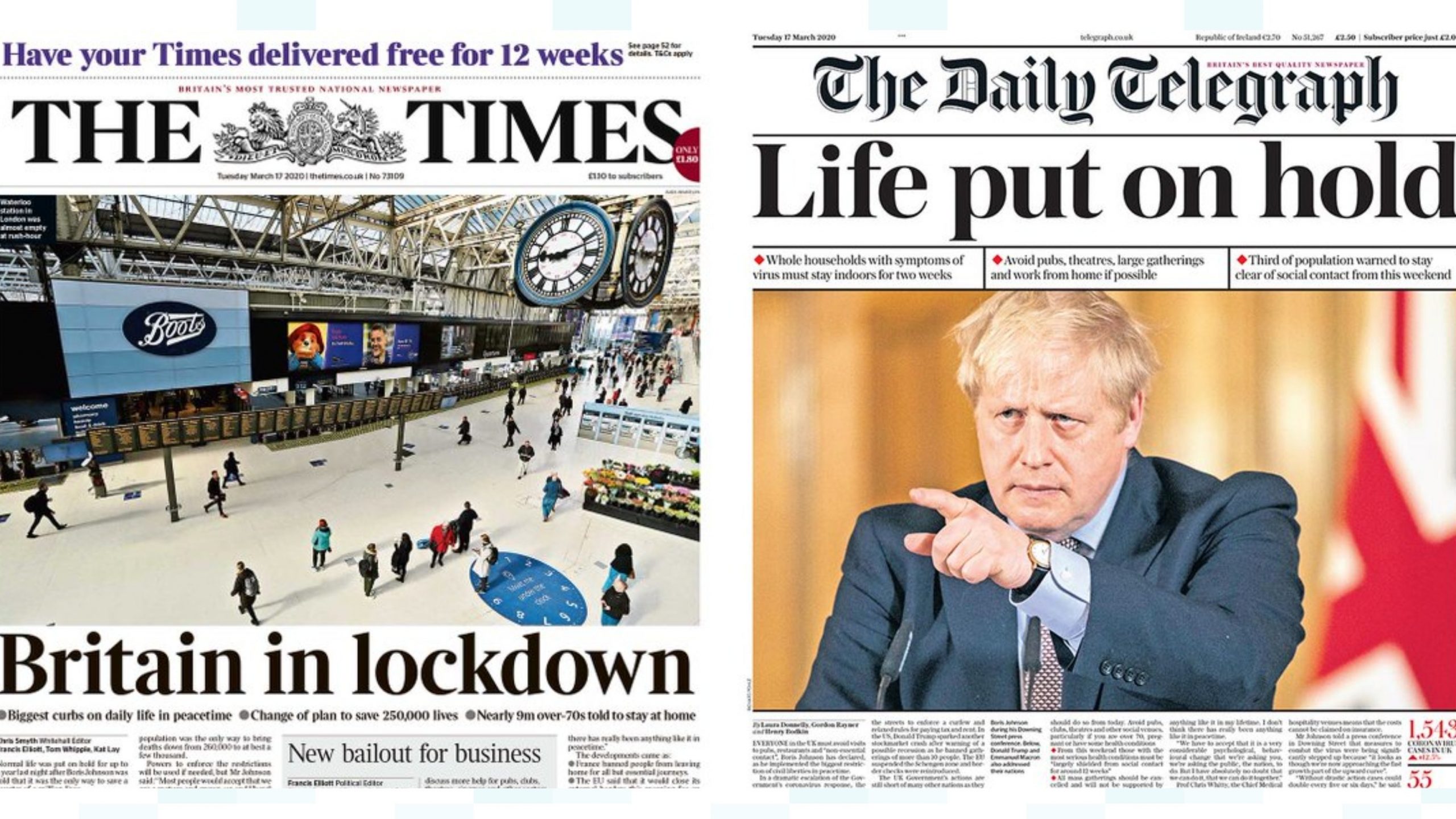
The pandemic lockdowns heralded the “worldwide end of the Nuremburg code”
At Samizdata, Perry de Havilland considers how British culture has been impacted by many of the worst notions coming out of American culture in the last few years:
… support for Brexit, by no means confined to the lumpenproletariat of Guardian reader’s imagination, might not indicate what purveyors of the high status opinion fondly imagine. The conflation of Brexit with the “Trump phenomenon” was always overblown, given the deep social and structural differences between UK and USA. Yes, we are influenced by America, but we are not the same in oh so many ways.
But western civilisation, not just Britain, is undeniably going through a very strange phase. The insane and demonstrably pointless covid lockdowns seem to have had a pressure cooker effect, with every -ism being dialled up several notches. The mainstreaming of transsexuality, a largely harmless hobby until a lunatic fringe grabbed hold of it, indicates the world is not running in well-oiled grooves. An inability to define “what is a woman?”, by sages and politicians who nevertheless expect to be treated as serious people, would have seemed implausible just a few years ago.
But the covid lockdowns, that is the “biggie”: an egregious abridgement of liberty & common sense that placed the global economy into repeated bouts of cardiac arrest. The worldwide end of the Nuremburg code.
The lockdowns were an even more polarising issue that Brexit or Trump or indeed anything else. Why? Because there was no opt-out, you could not just go to work, or visit granny, no ability to ignore the whole thing and just head down the pub or retire for a macha latte in some café. The effects of that will be enduring. That was the issue that taught a lot of people to fear what other people believe to be true, and people always hate what they fear.
Now just wait to see what happens when the green lunacy that stopped investment in reliable power supply and new reservoirs means we start running out of power and water. I suspect that will be what makes the cork finally blow off.
July 31, 2022
American publishing has a race problem, but it has an even bigger gender problem
In the latest edition of the SHuSH newsletter, Kenneth Whyte considers a recent online brouhaha featuring novelist Joyce Carol Oates and notes that while she was being dragged by the usual online mob for her perceived defence of “white” authors, an even bigger problem for the ever-diminishing number of “big” publishing houses is their gender balance:
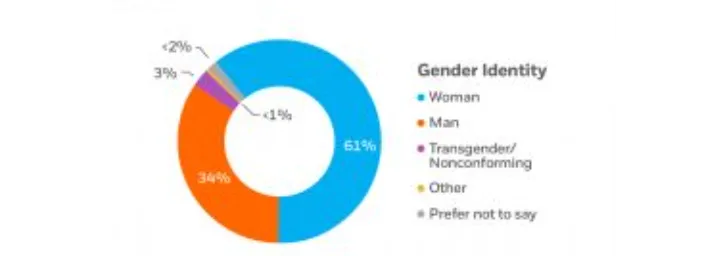
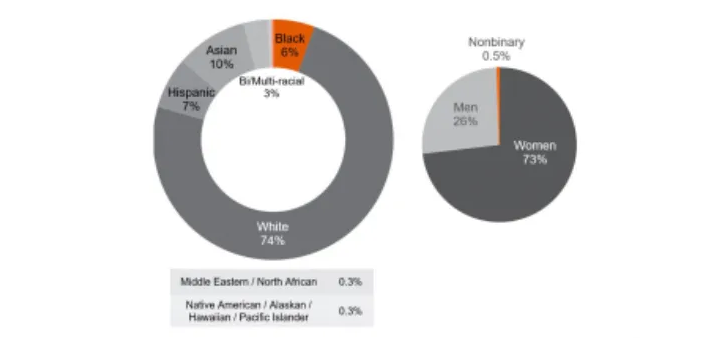
Publishing also has a gender problem. Only 34 per cent of the Penguin Random House workforce is male.
When you eliminate the warehouse staff, that figure drops to 26 per cent.
A Lee & Low survey from 2019 put the male component of the US publishing workforce at 24 per cent and a Canadian survey (referenced in SHuSH 90) found our publishing sector is 74 per cent women and 18 per cent men. Oates’ critics, many of them women, skated over this part of the equation.
That’s not unusual. Most people in publishing skate over this part of the equation. A few years back, when it was revealed that men are just 20 per cent of the fiction reading public, the question arose, might that have something to do with the lack of men acquiring and marketing books. Hardly anyone in publishing thought so. As I noted at the time, a Random House spokesperson said the gender composition of the firm was “not an issue of concern or even much contemplation for us”. And the head of Columbia U’s publishing program asserted that “great literature transcends gender in terms of editors”. A UK literary agent attributed the gender disparity in fiction to merit: some men, she said, “just aren’t very good”.
I spoke to several agents this week to see if the agent mentioned by Oates was an anomaly. What I heard suggests not. My agents were not surprised by the assessment of the anonymous agent. One just shrugged, as in, “what’s new?”
Whether the comments following the Oates’ tweet are valid — “it’s about time”, or “welcome to the oppressed, now you know what it feels like” — I’m probably not qualified to say. The real issue, which seems to be missed in this conversation, is that work is very often not judged by its quality but by who the author is and what the author represents. (Not a wholly new phenomenon in the world.) It is heartbreaking to see work of real talent, maybe even genius, being rejected by publishers (and I do see this in action) in favour of an author who has the right name and biometrics.
Not all of my agents agreed with Oates’ anonymous agent. One said, “It’s equally hard to sell everybody in this market. I’ve got white authors, black authors, brown authors. It’s hard to get a good deal anywhere. The consolidation in the industry is real: there are fewer editors to pitch books to than there used to be.”
This agent admits that the trend is now toward loading up on BIPOC authors but believes that will blow itself out, as all trends do, and the publishing houses will all chase after the next shiney thing. As for the situation inside publishing houses, “it’s been tough for guys as long as I’ve been in the business. Talk to the white male editors who sit on editorial boards at publishing house and they’ll tell you, it’s tough, there’s a lot of pushback from the other voices around the table.”
This agent also noted that the agency world is starting to break down along gender lines. Not surprisingly, literary agents are overwhelmingly white women. Increasingly, they are representing only women.
July 27, 2022
July 18, 2022
“Sophisticated liberals” yawning in synchrony
Ed West linked to this Jacob Siegel post about the tactical use of the “yawn” response to deflect and avoid discussion of topics “sophisticated liberals” want to avoid:
An American who wants to understand how political change occurs in their country must study what I’ve come to think of as the “yawning” habit of sophisticated liberals.
The yawn is an avoidance tactic that feigns moral and intellectual superiority while exhibiting dullness and cowardice. It is deployed when some flagrantly abnormal thing is occurring, which the sophisticated liberal is too sophisticated to defend outright — since to do so would expose them to potential mockery and loss of status — but too cowardly to condemn, since that would risk placing them on the wrong side of Progress.
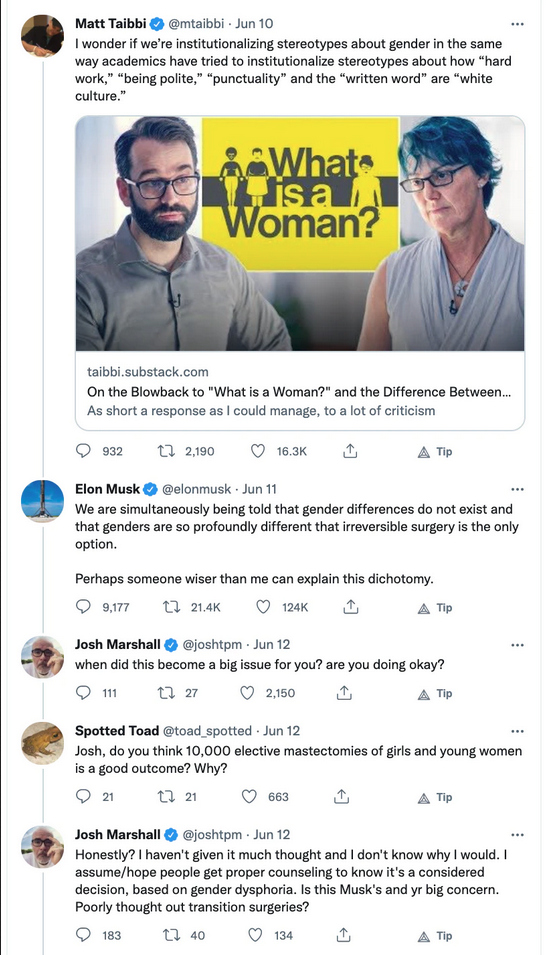
Here we can observe the liberal pundit Josh Marshall, yawning as loud as he can in response to questions about the precepts of gender ideology.
Marshall has not given much thought to why thousands of people, including adolescents, have suddenly decided to alter their bodies in irreversible ways. He’s not just incurious, he’s bragging about it. Only right-wing, extremist Putin lovers (of course, Marshall was a Russiagate conspiracist) would possibly care about an historically unprecedented, institutionally directed revolt against sexual dimorphism. A 2018 study by the British government found that the number of minors being referred for gender treatments, including hormone injections, increased by more than 4,000% in a single decade … How uninteresting. Yawn. The World Professional Association for Transgender Health just lowered the minimum age for children to receive puberty blockers or undergo transition surgery from 16 to 14. Double yawn.
“I’d like to know why you care,” the conservative pundit Matt Walsh is asked repeatedly in his new agitprop documentary What Is a Woman? The academics and other gender experts whom Walsh interviews clearly view this as an effective response to his line of questioning. It tells you something about the moral and intellectual vitality of contemporary liberalism that they simply assume that the people whose opinions they care about would agree there’s something very suspicious and déclassé about insisting on a definition of woman.
July 2, 2022
The “preferred pronoun” problem
Jim Treacher is having pronoun problems … not choosing the ones he wants to use or for others to use for him, but the whole “preferred pronoun” imposition on the rest of society to learn, remember, and use properly the bespoke pronoun choices for all the extra, extra-special snowflakes:
Remember when you could just use the pronouns that self-evidently described a person? If you were talking about a fella, you’d say stuff like, “He did this” and “Here’s what I said to him.” Or if you were talking about a lady, you’d say things like, “The 19th Amendment says she can vote now, good for her.” It was a simpler time.
Now pronouns are a frickin’ minefield. You put one little tippy-toe on the wrong pronoun and … BOOM!! A heedless “misgendering” can get you in big trouble. You can get banned from the internet and/or lose your job. For some reason, you’re expected to enable the delusions of any person with trendy mental health issues. It’s not enough for a trans person to call him-, her-, or themselves whatever he, she, or they want. The rest of us are all obligated to go along.
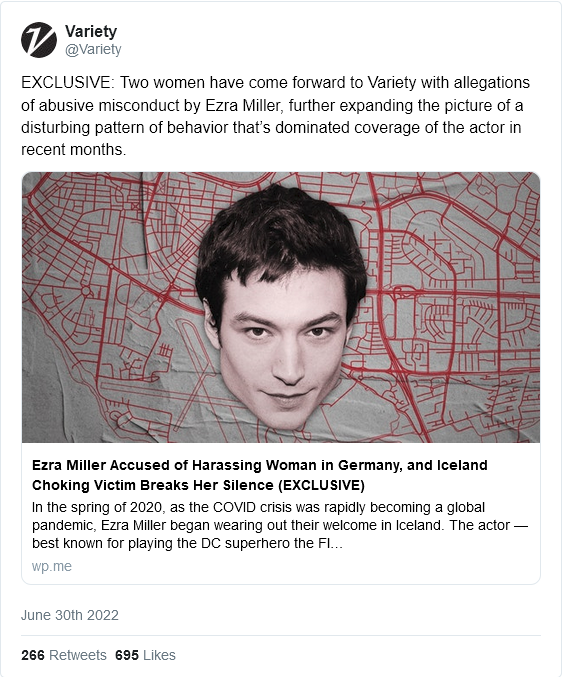
Even if he’s a scumbag criminal like Ezra Miller.
And what’s even worse, this bizarre phenomenon renders news stories about “nonbinary” people almost indecipherable. Just look at this latest story about the ex-Flash actor going around the world being a violent lunatic:
The actor — best known for playing the DC superhero the Flash in several films for Warner Bros. — was set to start filming the studio’s latest entry in the “Harry Potter” franchise, Fantastic Beasts: The Secrets of Dumbledore, in London when the shoot was halted on March 15, 2020, due to COVID. In the weeks after, Miller, who identifies as nonbinary and uses “they/them” pronouns, became a regular at bars in Iceland’s capital, Reykjavík, where locals came to know and even befriend them. Many recognized Miller from their earliest breakout movies, 2012’s The Perks of Being a Wallflower and 2011’s We Need to Talk About Kevin, where they played a troubled teen who brought a bow and arrow to school and murdered his classmates.
It’s a grammatical nightmare. “Many recognized Miller from their earliest breakout movies.” Oh, so those Icelanders worked with Miller on those movies? No, you see, “their” is supposed to refer to him.
And this part is just madness: “They played a troubled teen who brought a bow and arrow to school and murdered his classmates.” So it’s not “They murdered their classmates,” because the character he was playing wasn’t nonbinary? What is this gibberish?
Tom Hanks recently said he regrets playing a gay man in Philadelphia because he’s not gay. I always thought that was just called “acting”, but what do I know. If that’s the case, though, why should a nonbinary person be allowed to play a normal person?
June 22, 2022
June 14, 2022
Gender dysphoria and body dysmorphia
Once upon a time, in the dark recesses of ancient history (say, 2015 or so), most of the people expressing dissatisfaction with their birth gender were male. Shortly after that, the numbers inverted significantly and today it’s predominantly females demanding “gender affirming” treatment:
Girls who reject femininity or self identify as male or “non-binary” actually have a form of body dysmorphia. Rejecting their feminine body parts, for instance by flattening their chests, shows repulsion toward the areas they feel are not fit for acceptance. The trend of “binding” to produce a flat, androgynous body is dangerous, cutting off the air supply and possibly causing permanent damage, but it is encouraged as a precursor to transitioning from female to male.
In fact, transgendered people who were born women tend to suffer from eating disorders in an “extremely high proportion”, according to the Duke University Health System.
Make no mistake, a young woman who is dieting obsessively does not wish to look feminine or capable of having children. Many women who achieve their desired weight by extreme dieting cease to have periods and even grow downy hair on the face which resembles the incoming beard of a pre-pubescent man.
So is gender dysphoria essentially interchangeable with body dysmorphia? The woke people working at the NHS and gender reassignment clinics would never admit it, and would deny any correlation despite the statistics. But they are seeing more gender dysphoric young women than ever.
According to this article, entitled “Why Are So Many Females Coming out as Trans/Non-Binary?” in recent years the proportion of young women coming out as trans as opposed to men has increased dramatically. This shows a reversal from the previous trend years ago of more men wishing to become the opposite sex. But the incidence of actual transitions carried out does not show a corresponding rise for women, and that should prove many young women eventually grow out of identifying as trans, or “desist” from the desire to become male. “Desistance” refers to the situation where a young person who experiences gender dysphoria eventually “grows out of it” and decides not to go through with a sex change.
The occurrence of desistance among youngsters supports the position that they should not be allowed to undergo irreversible operations such as mastectomy or be pumped full of hormones (including puberty blocking “treatments”) which they are likely later to regret. Sadly, many medical “experts” don’t believe the figures cited for desistance among young people and discount them as flawed due to the looser criteria for diagnosing gender dysphoria used in the past. In other words, young boys who liked to wear dresses and would have been diagnosed as transgendered in previous years would not so qualify today, but young girls who hate their bodies and want to mutilate their breasts would be eligible for such “treatments”. The reasoning goes on that a whole raft subsisted of boys who were merely “gay boys who may have been experimenting with different ways of expressing gender but who were never really transgender in the first place”.
Such conclusions defy common sense or any logic or human decency. This article cites the findings of one Thomas Steensma, a clinician and researcher at the Centre of Expertise on Gender Dysphoria at the VU University Medical Centre in Amsterdam. He conveniently found in a study that desistance rates were lower in older, female children than in young boys.
H/T to Blazing Cat Fur for the link.
June 12, 2022
The “w-word” is no longer allowed, please update your Newspeak Dictionary, citizens
Brendan O’Neill on how the dreaded “w-word” is being actively erased from woke vocabulary [Note — to avoid being prosecuted under some progressive British law, I’m protecting the innocent eyes of my readers by substituting [the “w-word”] in this article to avoid offence]:

Two people at EuroPride 2019 in Vienna holding an LGBTQ+ pride rainbow flag featuring a design by Daniel Quasar; this variation of the rainbow flag was initially promoted as “Progress” a PRIDE Flag Reboot.
Photo by Bojan Cvetanović via Wikimedia Commons.
Over the past week we have witnessed two biological males – or men, as we used to call them – winning first and second place in a [the “w-word”]‘s cycling race. We’ve watched as the Crown Prosecution Service has hired a diversity consultant who is trans and who has previously suggested that [the “w-word”] could be replaced with “womxn”. We’ve heard that civil servants have received equality training telling them that the phrase “adult human female” – which is the dictionary definition of [the “w-word”] – is a transphobic dogwhistle. We’ve seen the publication of a new study by King’s College London which suggests that one way around sex / gender controversies might be to change the wording of questions in official documents like the census. For example, you could ask respondents “Do you menstruate?” rather than “Are you a [the “w-word”]?”.
Anyone who doubts that the word [the “w-word”], and the entire idea of [the “w-word”]hood, is being erased, sacrificed at the altar of the ideology of transgenderism, will surely have had a rude awakening these past few days. When men can claim [the “w-word”]‘s sporting prizes, it is clear that [the “w-word”]‘s sport risks becoming a thing of the past. When powerful institutions like the CPS and the civil service flirt with the idea that it is sinful to utter the words “adult human female”, it is obvious that even talking about [the “w-word”] has become a risky business. When even someone as globally influential as Michelle Obama uses the unpronounceable word “womxn”, as she did in a story shared to her Instagram page, you know that it’s not just time-rich, purple-haired campus crazies who have tumbled down the rabbit hole of genderfluidity. No, from the sporting world to the political world, from the justice system to the state bureaucracy, the idea that sex can be changed, and that language must be changed to avoid offending the trans minority, is orthodox now.
Strikingly, Mrs Obama’s use of the word “womxn” was related to the Roe v Wade controversy. She shared on Instagram a series of slides created by the nonprofit campaign group When We All Vote. One of them said: “State lawmakers will have the power to strip womxn of the right to make decisions about their bodies and their healthcare.” There is a dark irony to this comment, and one that exposes just how messed up the war on [the “w-word”]hood has become. That Obama-endorsed IG slide frets about [the “w-word”] being stripped of the right to control their bodies and yet it implicitly strips [the “w-word”] of the right to use certain words when they talk about themselves and what they need. “Womxn” is a reprimanding word, used to remind the female masses that their kind includes men now too. As Dictionary.com said of “womxn” when it added it in 2019, it is designed to be “inclusive of trans and non-binary” people. That is, blokes. In stripping out the old, supposedly problematic word “[the “w-word”]“, even as it wrings its hands over [the “w-word”] – sorry, womxn – being stripped of their bodily autonomy, When We All Vote unwittingly highlights the profound confusions and deep illiberalism behind today’s erasure of [the “w-word”]hood.
Barely a day passes without fresh reports about the linguistic war on [the “w-word”]kind. So the recent civil-service story involves a group called A:gender, which supports trans and intersex people who work in government departments. The Times got hold of some training videos A:gender has produced, which are shown to thousands of civil servants every year, one of which claims that it is impossible to define [the “w-word”] and that saying “adult human female” can be “transphobic”. Beware, these woke educators warn the civil service, of “transphobia [that] is increasingly presented as feminism”. To reiterate, this is civil servants we’re talking about, the people responsible for the smooth functioning of the nation. And they’re being told that if you say out loud what the dictionary says [the “w-word”] is, then you are a bigot. They’re being told that the likes of JK Rowling, whose great thoughtcrime is to understand biology, promote hatred dressed up as feminism.
April 16, 2022
How much of teenagers identifying as transgender is “social contagion and the development of a new youth subculture”?
The sheer number of children and teens who are deciding that they are “trans” is far in excess of previous generations. How much of this phenomena may be accounted for by social contagion?
My teenage daughter has decided that she is “trans”. So have all her friends. Not some of them. Not most of them. Every. Single. One.
She had never heard of trans, and had no signs of gender dysphoria, until she was moved to a new, cool trans-friendly school by her unsuspecting, politically liberal parents. There she met a group of geeky (or dare I say nerdy?), smart, slightly (but not very) gender nonconforming, artsy kids. As I understand it, they all discovered “trans” together. The old “cis” friends were swiftly discarded in favour of this exciting new peer group.
Exploring “trans stuff” online with friends is a source of great interest and excitement — a real social event. What’s not to love about 245 gender identities, complete with their own unique flags? Then there are those cool neo-pronouns. Forcing your out-of-touch old parents to refer to you as “ze” or “ey” (how do you pronounce that again??) in the name of “inclusivity” is just too delicious to resist. The manga, the cute avatars in computer games, the blue or pink hair — all part of the fun as well. Mocking the outgroup (in this case so-called “cis” people in general and the dreaded TERFs in particular) is also good for a laugh — especially if they happen to be your parents as well.
There is even a special vocabulary with lots of new terms — deadnaming, misgendering, sex assigned at birth, and much more. If these concepts need to be explained to your uncool parents (accompanied by eye rolls of course), so much the better.
Bonding with friends, searching for their identity and place in life, working out their sexuality, separating from family — these are all normal developmental tasks for teens. For many, youth subcultures can be a natural part of that. Some are harmless. Some, like drug use and extreme dieting, not so much. But in the case of the latter, sensible adults usually intervene to help steer the young people in the right direction. Not in the case of trans. Here we have adults steering kids down a dangerous path, which involves permanent, life altering drugs and surgeries for which there is no good evidence base.
For many of these kids, LGBTQ+ is a youth subculture. It really is as simple as that. Recent surveys have been identifying skyrocketing rates of “trans” or “queer” identification in young people. One found that an astonishing 39% of young adults in the US aged between 18-24 identified with the label LGBT — the figure for teens <18 may well be even higher. Of course this figure includes gay and lesbian people as well as those identifying as trans. Another poll, which looked only at gender, found that nearly 10% of US high schoolers identified as “gender diverse”. Yet another survey gives a lower figure of 1.8%. Whichever figure is correct, this is a huge explosion in numbers over a very short period of time. As endocrinologist Dr Will Malone asks; “How do we reconcile these numbers with 2013 data reporting the prevalence of adult gender dysphoria to be a rare 2-14 in 100,000?”
Social contagion and the development of a new youth subculture, that’s how.
H/T to Blazing Cat Fur for the link.
January 26, 2022
“Last year, we’re told, was the ‘deadliest’ year for transgender people since records began”
Tish Still, parent of a child who identifies as transgender, was worried about the “epidemic” of trans murder victims:
Facts always matter — but they take on a particular importance when they’re being used to claim that your child could be murdered. So I decided to delve into the research used to inform these claims. For me, it was personal.
The Government doesn’t publish data on the number of transgender people in the UK, though in 2018 it “tentatively” estimated that the figure stood between “approximately 200,000-500,000”. What proportion of that number must have been killed to warrant today’s warnings of trans murder epidemic? 10? 100? 1,000?
To find out, I analysed data collected by the trans-led organisation Transgender Europe, which has received more than a million dollars from the Arcus Foundation, who are based in the US and take a keen interest in transgender issues. As well as donating almost $150,000 to Stonewall, in 2015 the Arcus Foundation handed $312,000 to Transgender Europe specifically to supply reliable global data on transgender murders. The website it created provides an interactive map and links to documents naming the transgender victims.
Looking at Transgender Europe’s list of cases, it became clear — to my relief — that the total murders reported for the United Kingdom since 2008 amounted to 11. This translates as a murder rate of around 0.165%.
Now, that is still significantly higher than the murder rate for the UK as a whole: the ONS reports that the homicide rate in the UK for the year ending March 2020 was 11.7 per million people, rising to 17 per million among men. But look a bit closer at the list of trans murder victims, and that figure of 11 becomes increasingly suspect.
For instance, two of the listed victims, Vikki Thompson and Jacqueline Cowdry, appear to have been erroneously included. Thompson died by suicide while incarcerated in HMP Leeds, while Cowdry’s death was ultimately ruled as non-suspicious. This reduces the total to nine unlawful deaths, all of whom were born male. (By contrast, the number of homicides committed by transgender people between 2008 and 2017 was 12.) For context, the number of women killed by men during the same period was 1800. So much for our alleged “cis-privilege”.
Searching for more information led me to the work of Karen Ingala-Smith, who founded the Counting Dead Women project in 2012 after she realised that there was no central record of the extent of femicide here in the UK; thanks to her, a list of murdered women is read out in the House of Commons each year to imprint the rate of femicide on the minds our political class. Ingala-Smith’s tireless work focusses on female victims of, predominantly, male violence, though she made an exception to highlight the discrepancy between the mass hysteria about transgender victims of homicide compared to the treatment of woman-killing as mere background noise. (There is still no equivalent to the Trans Day of Remembrance for the much greater number of women killed by male violence.)
Crucially, her research sheds a vital spotlight on the nine remaining victims identified by the Trans Murder Monitoring report. Reading it, two things become clear. The first is that it is not entirely certain that all the victims themselves identified with the label “transgender”. The second is that the motives behind these crimes are more complex than straightforward “transphobia”.
January 16, 2022
Is the narrative about the Trans Movement about to change?
In the latest Weekly Dish, Andrew Sullivan marks a perhaps significant change in how mainstream media outlets are discussing the Trans Movement:
An unusual thing happened in the conversation about transgender identity in America this week. The New York Times conceded that there is, indeed, a debate among medical professionals, transgender people, gays and lesbians and others about medical intervention for pre-pubescent minors who have gender dysphoria. The story pulled some factual punches, but any mildly-fair airing of this debate in the US MSM is a breakthrough of a kind.
Here’s the truth that the NYT was finally forced to acknowledge: “Clinicians are divided” over the role of mental health counseling before making irreversible changes to a child’s body. Among those who are urging more counseling and caution for kids are ground-breaking transgender surgeons. This very public divide was first aired by Abigail Shrier a few months ago on Bari’s Substack, of course, where a trans pioneer in sex-change surgery opined: “It is my considered opinion that due to some of the … I’ll call it just ‘sloppy’, sloppy healthcare work, that we’re going to have more young adults who will regret having gone through this process.” Oof.
The NYT piece also concedes another key fact: that puberty blockers are neither harmless nor totally reversible. Money quote:
Some of the drug regimens bring long-term risks, such as irreversible fertility loss. And in some cases, thought to be quite rare, transgender people later “detransition” to the gender they were assigned at birth. Given these risks, as well as the increasing number of adolescents seeking these treatments, some clinicians say that teens need more psychological assessment than adults do.
I would think that, just as a general rule, minors making permanent, life-changing decisions should receive more psychological treatment than adults. How on earth is this not the default? In what other field of medicine do patients diagnose themselves, and that alone is justification for dramatic, irreversible medication?
The NYT doesn’t give you the data for the “increasing number” of transitions because it’s hard to find in the US. In the UK, however, the data show a 3,200 percent rise in adolescents seeking transition over a decade — 70 percent of whom are girls seeking to become boys, a break from historical norms where boys/men were much more likely to seek transition. Nor does the NYT give any data for “detransitioners”. But any brief look online suggests they are not exactly “quite rare”. They are, in fact, becoming a small but recognizable and tenacious part of the trans landscape. And among the risks of puberty blockers that the NYT does not mention are neurological damage, bone-density loss, and a permanent inability to experience sexual pleasure. And in almost every case (98 percent in one report), puberty blockers are never reversed.
October 24, 2021
Andrew Sullivan – “They are the Dana Carvey church ladies of our time, except instead of saying ‘Could it be Satan?!’ when confronting some cultural or moral transgression, they turn to the camera, clutch their pearls, and say ‘Could it be whiteness?!'”
Andrew Sullivan on what he titles “The Betrayal Of Our Gay Inheritance”:
It was, as it turned out, a bit of a non-event. The walkout by transgender Netflix employees and their supporters to demand that the company take down and apologize for the latest Chappelle special attracted “dozens”, despite media hype.
But the scenes were nonetheless revealing. A self-promoting jokester showed up with a placard with the words “We Like Jokes” and “We Like Dave” to represent an opposing view. He was swiftly accosted by a man who ripped the poster apart, leaving the dude with just a stick, prompting the assailant to shout “He’s got a weapon!” Pushed back by other protestors, he was then confronted by a woman right in front of him — shaking a tambourine — and yelling repeatedly into his face: “Repent, motherfucker! Repent! Repent!”
This is the state of what’s left of the gay rights movement in America. Judgmental, absolutist, intolerant, and hysterical, it looks to shut down speech it dislikes, drive its foes out of the public square, compile enemies’ lists of dangerous writers, artists, and politicians, and cancel and protest anything that does not comport with every tiny aspect of their increasingly deranged ideology.
The generation that now leads the movement does not seem to know the actual history of the gay rights movement, or the centrality of free expression to gay identity. They also seem to have no idea of the history of the movement against gay rights. Because if they did, they might be shocked at the ironies involved.
Anti-gay forces, hegemonic for centuries, were just like these trans activists. They were just as intent on suppressing and stigmatizing magazines, shows, and movies they believed were harmful. They too targeted individual artists and writers for personal destruction. They too believed that movies and comedy needed to be reined in order to prevent social harm. They protested in front of movie theaters. They tried to get shows canceled. And if you’d marched in any gay demo or Pride in the 1990s, you’d always be prepared to confront a grimacing Christianist yelling “Repent! Repent!” in your face.
In fact, it’s hard not to see the trans far left as a farcical replay of the Religious Right of the past. They are the Dana Carvey church ladies of our time, except instead of saying “Could it be Satan?!” when confronting some cultural or moral transgression, they turn to the camera, clutch their pearls, and say “Could it be whiteness?!”
This was never, ever the spirit of the gay rights movement in the past. In fact, it was America’s guarantee of free expression and free association that made the gay rights movement possible. It was the First Amendment, and the spirit of the First Amendment, that was easily the most important right for gays for decades. From the fledgling Society for Human Rights, formed in Chicago in 1924, and its pioneering magazine, Friendship and Freedom, to the struggles against censorship in the 1950s, with One Magazine, and erotic Physique pamphlets under siege, it was the First Amendment that, especially under Oliver Wendell Holmes, allowed gay people to find each other, to develop arguments for their own dignity and self-worth, and to sustain free associations when the entire society viewed them as perverts and undesirables and child molesters.