Quotulatiousness

August 17, 2022

To understand Justin Trudeau, you need to look at his relationship with his mother

Filed under: Cancon, History, Politics — Tags: , , , , , — Nicholas @ 03:00

Janice Fiamengo on how a lot of Justin Trudeau’s personal quirks may be directly traced to his upbringing and particularly his relationship with Margaret Trudeau:

Malia and Sasha Obama talk with Prime Minister Trudeau and his mother Margaret Trudeau during a reception on the Truman Balcony, 10 March, 2016.
Official White House photo by Pete Souza via Wikimedia Commons.

Cue the popularity of Justin Trudeau, who at first seemed all sincerity, even to the point of public spectacles of tearfulness and child-like ebullience. He was the first Canadian leader to march in the Gay Pride Parade as if it were his natural milieu, not merely a vote-seeking opportunity. His enthusiasm for Bollywood-style gyving, Hindu fancy dress, and participation in Islamic prayer, though heavily criticized, seemed genuine, at least in a high-school drama teacher way.

When he refused to give a real answer to the question of why it was necessary to appoint a gender-equal cabinet as one of his first actions upon assuming office in 2015, his insouciant quip “Because it’s 2015” suggested an unstudied feminist commitment. His comments after the Boston bombings emphasized that empathy rather than harshness was the appropriate response to murderous acts of terror.

But there has always been a harsher side to Trudeau, a fondness for dictators, an attraction to brute power, and an inability (or unwillingness) to hide his contempt for political opponents. Perhaps his empathy for the Boston bombers was respect or even admiration for their willingness to use violence. Many were shocked by his open admission that one of the countries he most admired was the “basic dictatorship” of China. When churches burned across Canada in the summer of 2021 in response to the alleged discovery of “mass” graves at a residential school (a discovery that has not yet yielded a single body), Trudeau condemned the arson but hastened to say it was “understandable”. About Canadians who chose not to take the Covid-19 vaccines, he could not control his impatience, unleashing a volley of stigmatizing, scapegoating rhetoric. For the truckers who camped out in Ottawa amid a sea of Canadian flags and bouncy castles demanding vaccine mandates be revoked, he had a brutal contempt.

Which is he: the soft feminist with the fancy socks, joy in Gay Pride, and empathy for the marginalized? Or the hard, contemptuous leader who could oversee without flinching a violent RCMP crackdown on the Convoy protest that saw an Indigenous woman trampled under the hoofs of a police horse?

The answer is: both. A clue to his doubleness may be found in his relationship with his mother.

I recently watched an old interview with Margaret Trudeau that offers some illuminating glimpses into the character of the woman who mothered Justin. The interview took place in 1979, after Margaret had left Pierre Trudeau, Justin’s father, who was Prime Minister of Canada from 1968 until 1982. Pierre had primary custody of their three young children.

The interview shows a very beautiful woman whose consciousness of her attractiveness is a paramount part of her identity. She is not, as has sometimes been claimed, stupid; many of her answers to the interviewer are clever in the manner of a wayward adolescent convinced she can get away with nearly anything so long as she charms. At times she flirts openly, smiling suggestively, tongue protruding through her lips, confident in her sexual power.

The overall impact of her answers is horrifying for a viewer who fails to be enchanted. This is a woman who takes herself seriously but evidently does not take seriously her position as a mother to three young sons (all of them under 10 years old at the time) — and certainly not her position as estranged wife to the leader of the country.

She boasts girlishly about smoking marijuana, listening to psychedelic music, and giving up guilt over failing to meet others’ expectations. Spouting feminist rhetoric about being true to herself, she makes clear that she is more interested in having lovers than in looking after her children. She dismisses her husband’s shock at her unfaithfulness as owing to “old-fashioned principles of fidelity”, and indicates that Canadian society would be better off if more people heeded their “feelings” rather than stodgy moral precepts.

I cringe to think of Justin Trudeau, even today, watching this interview. The woman who presented herself therein — self-preoccupied, proudly promiscuous — must also have been evident to the son who watched her flamboyantly “find herself”, feminist-style, as his parents’ marriage crumbled.

H/T to Brian Peckford for the URL.

June 12, 2022

The “w-word” is no longer allowed, please update your Newspeak Dictionary, citizens

Filed under: Britain, Media, Politics, USA — Tags: , , , , , — Nicholas @ 05:00

Brendan O’Neill on how the dreaded “w-word” is being actively erased from woke vocabulary [Note — to avoid being prosecuted under some progressive British law, I’m protecting the innocent eyes of my readers by substituting [the “w-word”] in this article to avoid offence]:

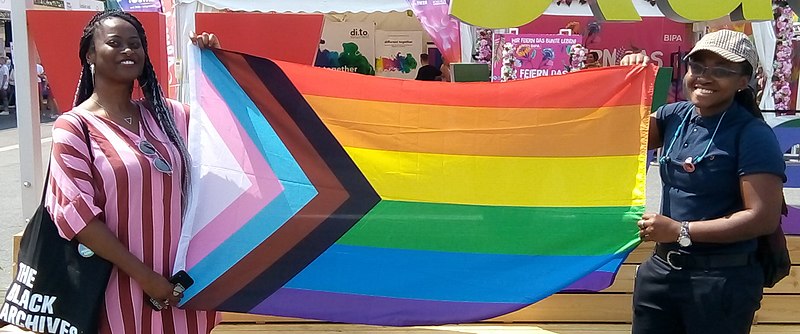
Two people at EuroPride 2019 in Vienna holding an LGBTQ+ pride rainbow flag featuring a design by Daniel Quasar; this variation of the rainbow flag was initially promoted as “Progress” a PRIDE Flag Reboot.
Photo by Bojan Cvetanović via Wikimedia Commons.

Over the past week we have witnessed two biological males – or men, as we used to call them – winning first and second place in a [the “w-word”]‘s cycling race. We’ve watched as the Crown Prosecution Service has hired a diversity consultant who is trans and who has previously suggested that [the “w-word”] could be replaced with “womxn”. We’ve heard that civil servants have received equality training telling them that the phrase “adult human female” – which is the dictionary definition of [the “w-word”] – is a transphobic dogwhistle. We’ve seen the publication of a new study by King’s College London which suggests that one way around sex / gender controversies might be to change the wording of questions in official documents like the census. For example, you could ask respondents “Do you menstruate?” rather than “Are you a [the “w-word”]?”.

Anyone who doubts that the word [the “w-word”], and the entire idea of [the “w-word”]hood, is being erased, sacrificed at the altar of the ideology of transgenderism, will surely have had a rude awakening these past few days. When men can claim [the “w-word”]‘s sporting prizes, it is clear that [the “w-word”]‘s sport risks becoming a thing of the past. When powerful institutions like the CPS and the civil service flirt with the idea that it is sinful to utter the words “adult human female”, it is obvious that even talking about [the “w-word”] has become a risky business. When even someone as globally influential as Michelle Obama uses the unpronounceable word “womxn”, as she did in a story shared to her Instagram page, you know that it’s not just time-rich, purple-haired campus crazies who have tumbled down the rabbit hole of genderfluidity. No, from the sporting world to the political world, from the justice system to the state bureaucracy, the idea that sex can be changed, and that language must be changed to avoid offending the trans minority, is orthodox now.

Strikingly, Mrs Obama’s use of the word “womxn” was related to the Roe v Wade controversy. She shared on Instagram a series of slides created by the nonprofit campaign group When We All Vote. One of them said: “State lawmakers will have the power to strip womxn of the right to make decisions about their bodies and their healthcare.” There is a dark irony to this comment, and one that exposes just how messed up the war on [the “w-word”]hood has become. That Obama-endorsed IG slide frets about [the “w-word”] being stripped of the right to control their bodies and yet it implicitly strips [the “w-word”] of the right to use certain words when they talk about themselves and what they need. “Womxn” is a reprimanding word, used to remind the female masses that their kind includes men now too. As Dictionary.com said of “womxn” when it added it in 2019, it is designed to be “inclusive of trans and non-binary” people. That is, blokes. In stripping out the old, supposedly problematic word “[the “w-word”]“, even as it wrings its hands over [the “w-word”] – sorry, womxn – being stripped of their bodily autonomy, When We All Vote unwittingly highlights the profound confusions and deep illiberalism behind today’s erasure of [the “w-word”]hood.

Barely a day passes without fresh reports about the linguistic war on [the “w-word”]kind. So the recent civil-service story involves a group called A:gender, which supports trans and intersex people who work in government departments. The Times got hold of some training videos A:gender has produced, which are shown to thousands of civil servants every year, one of which claims that it is impossible to define [the “w-word”] and that saying “adult human female” can be “transphobic”. Beware, these woke educators warn the civil service, of “transphobia [that] is increasingly presented as feminism”. To reiterate, this is civil servants we’re talking about, the people responsible for the smooth functioning of the nation. And they’re being told that if you say out loud what the dictionary says [the “w-word”] is, then you are a bigot. They’re being told that the likes of JK Rowling, whose great thoughtcrime is to understand biology, promote hatred dressed up as feminism.

December 17, 2021

QotD: The Kafkatrap that is known as “white feminism”

Filed under: Media, Politics, Quotations — Tags: , , , , , — Nicholas @ 01:00

There is a logical fallacy called the Kafka Trap. It describes the condition of always being wrong. If you are accused of something, and you deny it, that denial is taken as an admission of guilt; only a guilty party would go out of their way to deny an allegation of wrongdoing. Alternatively, if you say nothing in the face of the allegation, that’s also an admission of guilt: your silence means you have accepted the allegation.

Many describe Franz Kafka’s disenchanted fables as tragic. And this is certainly true. But they are also farcical. To watch someone being relentlessly wrong can be grimly enjoyable — as long as you’re not the person in question.

The term white feminism, as it is commonly used today, is a classic example of the Kafka Trap. If you show too much interest in the lives of people of colour, you risk being accused of white saviourism — which is another way of saying you have a suspiciously condescending attitude to people of colour. But if you don’t show enough interest, you are insufficiently intersectional. You only care about the white, middle-class cisgendered women in your social circle.

White feminism is a classic example of the Kafka Trap because whatever you do is either too much or not enough. You are never right.

Tomiwa Owolade, “The problem with white saviours”, UnHerd.com, 2021-09-12.

November 18, 2021

QotD: Hormones, puberty, and menopause

Filed under: Health, Quotations — Tags: , , , , — Nicholas @ 01:00

… in the early twentieth century, women that made it to positions of prominence, where they became known for professional excellence, had to be GOOD at it. Amazing, in fact.

And even then, they might hit a glass ceiling, because they were the nail that stuck up. Everything conspired to bring them down.

Female liberation was played against this. People looked at these women, knew what they’d achieved against what obstacles, and dreamed that “if only women were allowed to be on an even footing with men, they’d be the best at everything. Every woman would be a leader.”

[…]

Having gone the full ride on the hormonal roller coaster, being a woman built mostly by nature to make more humans, let me tell you, it ain’t easy. The hormonal ramp up of puberty is probably worse for boys, but the monthly ride of women is … interesting. I had years of having really bad pains, which meant if I had a test on one of those days I had to work DESPITE it. How bad? well, neither of my giving-birth experiences were worse, and in fact the second was much milder, until they gave me pitosin (the second started out with pitosin) and then with the ramping up of pain of pitosin, and giving birth in one and a half hours (long story. Let’s say they believed the report on the first birth, which had been doctored (ah!) and should never have given me the d*mn thing) was about the same as I used to endure for two or three days straight. And yes, I studied and took finals under that kind of pain, with no pain killers because most of them just make me more ill and woozy.

Then there were my middle years where I’d get unreasonably angry and borderline-violent for about a week before. It took a lot of engineering my own brain and knowing “this isn’t real, it’s hormonal” to stop myself being hell to live with. And sometimes I didn’t manage it. I’d be in the back of my brain, watching the rest of me rage and go “what the heck? Why am I doing that.”

And then there were various dysfunctions. We won’t go there, because most women don’t get those. But menopause … well … it’s special. I seem to have elided most of it, because I went into it surgically and with a hammer, having everything removed and having to cope, which at least was over in a few months. But I’ve seen relatives and friends go through it: it can stretch to five years of having NO discernible mind. You forget everything, lose everything, can’t sleep, can’t keep commitments, etc. And we still haven’t come up with a replacement that has no bad effects and makes actual sense. We’re trying.

Anyway, so yeah, women are running with their feet in a sack. But most of them are about average for normal human beings. So, yeah, they can do jobs and perform well, despite all of that. What you’re never going to get is “every woman excels”. Even if you stop the hormonal side effects, most women will lack the drive, the brain or the NEED to excel.

Men’s testosterone makes them more competitive, and so in a way gives them a bit more drive, but most of them are still unfocused/not ambitious enough to SACRIFICE to be the best. Because, guess what, success always requires sacrifice. And human beings don’t like to sacrifice.

So, women entered the workforce and most of them became … average. Which of course they would.

But feminist insanity required every woman to be exceptional. And so theories to explain it came up, including seeing patriarchy and oppression in ever-smaller things, including “she’s bossy” and “boys will be boys.”

Sarah Hoyt, “Bad Crazy”, Libertarian Enterprise, 2019-01-20.

September 30, 2021

QotD: Hate speech

Filed under: Liberty, Politics, Quotations — Tags: , , , — Nicholas @ 01:00

Cultivating hatred for another human group ought to be no more acceptable when it issues from the mouths of women than when it comes from men, no more tolerable from feminists than from the Ku Klux Klan.

Daphne Patai, Heterophobia: Sexual Harassment and the Future of Feminism, 1998.

September 3, 2021

“Watching our feminist prime minister uncomfortably defend and explain away decidedly unfeminist behaviour has become an evergreen moment for our nation”

Filed under: Cancon, Media, Politics — Tags: , , , , — Nicholas @ 03:00

The NP Platformed newsletter is in the hands of Kathryn Marshall while Colby Cosh is on vacation, and she offers yet another golden moment of hypocrisy on the part of Justin Trudeau:

Standing in the fenced-in corner of a backyard during a press conference this Tuesday, Justin Trudeau was cornered in more ways than one.

Faced with questions from the media as to why he was allowing an incumbent Liberal candidate who had been repeatedly accused of sexual harassment to run for his party, an exasperated Trudeau was once again faced with his hypocrisy when it comes to his feminist credentials.

Only the day before, Trudeau was touting the Liberals “zero-tolerance” policy for sexual harassment. Of course, that was in the context of a Conservative candidate who had been accused of sexual misconduct. Notably, that candidate was very swiftly given the boot by leader Erin O’Toole, which was the correct response.

Now Trudeau finds himself in the exact same position that the Conservative leader was in. Following a CBC report, it has come to light that one of the Liberal candidates, two-term MP Raj Saini, has been the subject of numerous sexual harassment allegations from a number of staff going all the way back to 2015. I have no idea if these allegations are true, but they are deeply disturbing and should be taken seriously. As reported by the CBC, there are seven different sources who “described four different cases where Saini allegedly made unwanted sexual advances or inappropriate comments.” One of the allegations involves a former staff member who filed a human rights complaint with the Canadian Human Rights Commission and tried to end her own life.

It should be a ludicrously easy call for Trudeau. The Liberal party has a zero-tolerance policy for sexual harassment, right? Obviously, Saini needs to go and an individual who is facing allegations of this nature is in no position to be running for public office, period.

Except for one small hiccup. The allegations have come to public light after the candidate cut-off date for the election, which was Monday. So if Trudeau gets rid of Saini, it means they can’t replace him with someone else, and the result is no Liberal candidate on the ballot in a safe Liberal seat. Call me cynical, but if I had to guess, I would say this likely has something to do with the fact that overnight, the Liberal’s “zero-tolerance” policy appears to have evaporated into thin air.

June 20, 2021

L’Affaire Annamie Paul – “… it’s like every Liberal across the land forgot about politics”

Filed under: Cancon, Media, Politics — Tags: , , , , , , — Nicholas @ 05:00

The weekly wrap-up from The Line wonders why Canadian media outlets pay so much attention to the Green Party (far in excess of their political influence normally), but recent Green Party fratricidal bun-fighting merits attention just because of the injured bystander, the Prime Minister of the current year:

The background of all of this is complicated, and we’re not going to bother recapping it. If you care enough about Canadian politics to follow the Greens, you know it all already. What’s interesting to us — and funny as all hell — is how angry the PM’s die-hard fanbase was, how shocked and sincerely surprised they were, when Paul turned her guns on the PM instead of her own rebelling party executives and grassroots:

    “To the prime minister, Justin Trudeau,” Paul said at a press conference, “I say to you today, you are no ally. And you are no feminist. Your deeds and your words over these past weeks prove that definitively. A real ally and feminist doesn’t end their commitment to those principles whenever they come up against their personal ambition.”

And, gosh. Liberals everywhere were just stunned.

It was cute. As we said, it’s like every Liberal across the land forgot about politics. And that’s ridiculous. Canadian Liberals are the most ruthlessly effective vote winners precisely because they are relentlessly amoral and craven. We don’t even mean this as an insult! Your typical Canadian Liberal constitutes the purest sample of raw partisanship known to human science — which is why they’re so good at winning.

And that’s why they should have instantly understood what Paul was doing when she attacked the PM. She was picking a fight she could win because she’s losing the one she’s actually facing. Paul is a black woman. She’s Jewish. She’s obviously lost control of her own party. The only chance in hell she has of surviving is to lay every possible identity group card down on the table, declare herself the champion of those oppressed groups, and then dare her own party to purge her. She’s adopting the mantle of the WOC woke champion. It’s a lot easier for Paul to fight that battle against the PM than it is for her to fight it against her own party.

As much as Liberals hate to admit it — and they really, really, really hate to admit it — the PM is vulnerable to accusations of hypocrisy on the feminism and racial equality files. Obviously.

Paul is desperate. She’s in a fight for her political life, and she seems to be losing. So she’s picked a fight with a powerful white man to play up her own “voice of the oppressed” credentials. It’s cynical and desperate. Frankly, the Liberals ought to be honoured. What’s that they say about imitation and flattery?

February 24, 2021

QotD: Margaret Thatcher

Filed under: Britain, History, Politics, Quotations — Tags: , , , , , — Nicholas @ 01:00

I know I’m supposed to hate Margaret Thatcher. I know that someone with my politics is meant to detest her as a union-busting, milk-snatching, women’s-lib-baiting, Belgrano-sinking, Section-28-devising, society-destroying nightmare. I know that when Gillian Anderson was cast as Thatcher in series four of The Crown, I should have played up a shudder of disgust at Gillian Anderson, who is good, playing Thatcher, who is bad.

But here’s the thing: I don’t hate Thatcher. It’s not that I’m a huge fan of her legacy or anything (although anyone who thinks that industrial relations were doing fine before her or that the Falklands were some kind of unjustified expedition is clearly a fantasist), it simply doesn’t matter whether I like her or not because she is just too interesting.

Thatcher wasn’t the first woman to lead a country, but unlike her predecessors, Indira Gandhi in India or Isabel Martínez de Perón in Argentina, she didn’t arrive sanctified by a political dynasty. She was, as Prince Phillip snobbily points out to the Queen in The Crown, a grocer’s daughter. In real life, such condescension came strongly from the Left. The Blow Monkeys, one of the bands involved in the Red Wedge tour to support Labour, released an album called She was only a Grocer’s Daughter in 1987; and even though several pop songs fantasised about her death, that never seemed quite as ugly as supposed defenders of the working class announcing that Thatcher was just too common to rule.

Sarah Ditum, “How Thatcher rejected feminism”, UnHerd, 2020-11-15.

November 18, 2020

QotD: Feminism and gender equality

Filed under: Politics, Quotations, USA — Tags: , , , , — Nicholas @ 01:00

It takes one’s breath away to watch feminist women at work. At the same time that they denounce traditional stereotypes they conform to them. If at the back of your sexist mind you think that women are emotional, you listen agape as professor Nancy Hopkins of MIT comes out with the threat that she will be sick if she has to hear too much of what she doesn’t agree with. If you think women are suggestible, you hear it said that the mere suggestion of an innate inequality in women will keep them from stirring themselves to excel. While denouncing the feminine mystique, feminists behave as if they were devoted to it. They are women who assert their independence but still depend on men to keep women secure and comfortable while admiring their independence. Even in the gender-neutral society, men are expected by feminists to open doors for women. If men do not, they are intimidating women.

Thus the issue of Summers’s supposedly intimidating style of governance is really the issue of the political correctness by which Summers has been intimidated. Political correctness is the leading form of intimidation in all of American education today, and this incident at Harvard is a pure case of it. The phrase has been around since the 1980s, and the media have become bored with it. But the fact of political correctness is before us in the refusal of feminist women professors even to consider the possibility that women might be at any natural disadvantage in mathematics as compared with men. No, more than that: They refuse to allow that possibility to be entertained even in a private meeting. And still more: They are not ashamed to be seen as suppressing any inquiry into such a possibility. For the demand that Summers be more “responsible” in what he says applies to any inquiry that he or anyone else might cite.

Harvey Mansfield, “Fear and Intimidation at Harvard”, Weekly Standard, 2005-03-07.

November 2, 2020

QotD: The Patriarchy

Filed under: History, Media, Politics, Quotations — Tags: , , , — Nicholas @ 01:00

Since anything men utter is tainted by their place in the power hierarchy and their implicit desire to maintain that power – a homeless man at Grand Central station may be surprised, even delighted, to learn that he occupies a “privileged” position in this hierarchy – nothing a man says can be taken at face value because, consciously or unconsciously, it is imbued with patriarchal values and language. Whether they realise it or not, all men are engaged in a struggle to consolidate and extend their power, particularly over women. This is doubtless why, according to this theory, rape is considered a manifestation of male dominance – of the patriarchy – rather than an expression of sexual desire. Power is everything – which tells you something, perhaps, about the status anxiety of this theory’s most fanatical adherents.

Thus it is okay to hate all men – they are all infected by the canker of patriarchy which, unlike individual thoughts and motivations, is a kind of all-powerful super-organism, a hive mind controlling its male worker bees. Men as individuals are simply tokens of something deeper – structural misogyny embedded in institutional power. If you’re a man who thinks you are not a misogynist, who in fact thinks you like women perfectly well, you are deluding yourself. For such men, their sexism is simply unconscious, just as in classical Marxism the “good” bourgeois was unconscious of the fact that he could not avoid exploiting his workers or employees, even though he might be providing them with a decent wage, good working conditions, and health and pension benefits.

This analysis, given a moment’s thought, doesn’t make a lot of sense. Even if you accept that all the ills of the world are down to patriarchy and the dominance of men, you have to concede the corollary – that all the triumphs of humankind are down to the patriarchy also, from medicine and science to the highest reaches of art and culture.

Women may point out that they have been excluded from these fields until now, and that’s largely true, although biology – the lack of control women have historically had over their own fertility and the greater physical strength of men – might be a far more simple and plausible explanation than the existence of a hypothetical, all-powerful super-organism. However, the very act that men hold the balance of power is proof of the existence of patriarchy, according to this belief system.

Tim Lott, “Why It’s Not OK to Hate Men”, Quillette, 2018-08-14.

September 28, 2020

QotD: The proper role of men, according to the SCUM Manifesto

Filed under: Books, Media, Politics, Quotations — Tags: , , , — Nicholas @ 01:00

Prior to the institution of automation, to the replacement of males by machines, the male should be of use to the female, wait on her, cater to her slightest whim, obey her every command, be totally subservient to her, exist in perfect obedience to her will, as opposed to the completely warped, degenerate situation we have now of men, not only existing at all, cluttering up the world with their ignominious presence, but being pandered to and groveled before by the mass of females, millions of women piously worshiping the Golden Calf, the dog leading the master on a leash, when in fact the male, short of being a drag queen, is least miserable when his dogginess is recognized — no unrealistic emotional demands are made of him and the completely together female is calling the shots. Rational men want to be squashed, stepped on, crushed and crunched, treated as the curs, the filth that they are, have their repulsiveness confirmed.

Valerie Solanas, SCUM Manifesto, 1967.

August 22, 2020

QotD: Sex-differentiated status hierarchies

Filed under: Health, Politics, Quotations, USA — Tags: , , , , , — Nicholas @ 01:00

Jordan Peterson had this to say about sex-differentiated status hierarchies:

    Girls can win by winning in their own hierarchy — by being good at what girls value, as girls. They can add to this victory by winning in the boys’ hierarchy. Boys, however, can only win by winning in the male hierarchy. They will lose status, among girls and boys, by being good at what girls value. It costs them in reputation among the boys, and in attractiveness among the girls. Girls aren’t attracted to boys who are their friends, even though they might like them, whatever that means. They are attracted to boys who win status contests with other boys.

“whatever that means”. Heh. Shivvy way to say, “which means nothing”.

When JP discusses sex differences, he could be reading CH posts. Whatever one thinks of the criticisms leveled against him (some are valid), he does have a decent grasp of the sexual market and how men and women navigate divergent routes through an ocean of mate prospects to get what they want.

However, this is one of the rare instances when I disagree with his premise. He’s generally correct that, at least within the bounds of our current cultural arrangement, women have two status hierarchies available to them while men only have one. Our gynarcho-tyranny not only encourages but aggressively impresses upon women the urgency and even moral duty of succeeding in male domains (leaning in), while simultaneously encouraging men to sacrifice their status within their own male domains to make way for more women (and consequently rendering themselves less sexually attractive to women who are now their equal or higher in social status).

Women who do succeed in the man’s world can expect to ascend the intrafemale status ladder (more precisely, the intra-feminist status ladder), but where JP is wrong is assuming these women don’t also suffer an SMV status loss the near-equivalent of the SMV status loss suffered by men who succeed at girlie games of one-uppance.

Just as girls aren’t attracted to effeminate males, and other men are repulsed by nancyboys, the inverse is as true: men aren’t attracted to masculine, status-striving girls, and other women don’t subconsciously look up to mouthy careerist shrikes with the same mix of envy and admiration that they look up to physically beautiful women.

CH, “Sex-Based Status”, Chateau Heartiste, 2018-06-04.

August 14, 2020

How Feminism Came to the Middle East – Women’s Emancipation – WW2 – On the Homefront 006

Filed under: Britain, History, Italy, Middle East, Military, WW2 — Tags: , , , , , — Nicholas @ 06:00

World War Two
Published 13 Aug 2020

While battles rage across the world, women at home are fighting for their basic emancipation. In Egypt, Huda Shaarawi stands at the centre of this struggle.

Join us on Patreon: https://www.patreon.com/TimeGhostHistory
Or join The TimeGhost Army directly at: https://timeghost.tv

Follow WW2 day by day on Instagram @World_war_two_realtime https://www.instagram.com/world_war_two_realtime
Between 2 Wars: https://www.youtube.com/playlist?list…
Source list: http://bit.ly/WW2sources

Hosted by: Anna Deinhard
Written by: Spartacus Olsson and Fiona Rachel Fischer
Director: Astrid Deinhard
Producers: Astrid Deinhard and Spartacus Olsson
Executive Producers: Astrid Deinhard, Indy Neidell, Spartacus Olsson, Bodo Rittenauer
Creative Producer: Joram Appel
Post-Production Director: Wieke Kapteijns
Research by: Fiona Rachel Fischer
Edited by: Miki Cackowski
Sound design: Marek Kamiński
Map animations: Eastory (https://www.youtube.com/c/eastory)

Colorizations by:
Daniel Weiss
Carlos Ortega Pereira, BlauColorizations – https://www.instagram.com/blaucoloriz…
Norman Stewart – https://oldtimesincolor.blogspot.com/

Sources:
TIMEA
Bundesarchiv
IWM E 817
USHMM
From the Noun Project: Letter by Mochammad Kafi

Soundtracks from the Epidemic Sound:
Rune Dale – “Scented Nectar”
Deskant – “Genie’s Bane”
Deskant – “Divine Serpent”
Deskant – “Dunes of Despair”
Sight of Wonders – “Call of Muezzin”
Philip Ayers – “Trapped in a Maze”
Skrya – “First Responders”

Archive by Screenocean/Reuters https://www.screenocean.com.

A TimeGhost chronological documentary produced by OnLion Entertainment GmbH.

August 3, 2020

QotD: History or “Her” story?

In another land, a long, long time ago, I was a student of languages. It was there that I came across the American left’s obsession with corrupting the language.

In my last year in college, I had American Literature taught by a Fullbright exchange professor. I will never forget the moment the poor man — talking to a class of 36, all women as such classes often are — let slip the innocent word “him” to mean an indeterminate gender. He paused, went white, his eyes widened, and he said, “I mean, I mean, he or she.”

Meanwhile, the class of 36 was staring at him in puzzlement. It took us a while to take it all apart and realize he thought we’d be offended by the use of “he” to mean someone generic, of indeterminate gender.

I think we patted him kindly on the shoulder and told him that no, really, we weren’t offended. The usage was the same in Portuguese and we’d been told it was the same in most Indo-European languages. And who on Earth would get offended over semantics? The language was the language. It meant nothing about us personally.

This was of course before I married, came to the U.S. and found that for the American woman circa 1985, the language was not just personal, it was personally offensive.

I remember standing in horror underneath a bookstore section proudly labeled Herstory.

Of course the etymology of the word history is not his + story, the sort of pseudo-clever deduction about language that I was used to from the near-illiterate elderly people in the village. (It would be too complex and involve Portuguese, but there was this old farmer who had somehow deduced from the Portuguese word for farmer that farmers were the only ones who would be saved at the end of time.)

History, of course, is not originally an English word. It comes from the Latin historia — meaning a relation of events — by way of the French estoire, meaning story. Note please that in neither of those languages does “his” mean “belonging to him.” And that making the same sort of illiterate assumptions about the French word, we’d get “It is oire.”

I thought that the store must have hired an illiterate employee, but no, over the next ten years, in various circumstances, and possibly still except for the fact that I’ve learned to silence such fools with a death glare, I’ve come across the same smug-idiot assumption and “corrections” of the English word, so as to “fight against the patriarchy.”

That this is done by people who paid more money than I make in a couple of years for a college degree, and who, doubtlessly, think that etymology is a dish made with onions, or perhaps a conspiracy of the patriarchy fills me with a sort of dull rage that has no outlet.

Sarah Hoyt, “The Semantic Whoredom of the Left”, PJ Media, 2018-05-11.

June 10, 2020

“Gender critical” feminism

Barbara Kay finds herself in agreement with an academic who, having come from a Marxist and radical feminist background, she would not normally have much in common:

Kathleen Lowrey, associate professor of anthropology at the University of Alberta, ascribes much of her intellectual formation to Marxism and radical feminism. Not, I think my regular readers would agree, someone with whom I would normally have a great deal in common. And yet, in this strange cultural moment, Prof. Lowrey and I find ourselves amicably united in the service of a mutually revered ideal. I write this column with ardent sympathy for her in her present predicament.

Academics’ time is generally split 40/40/20 amongst, respectively, research, teaching and “service” to their community — meaning committees, mainly. Until late March, Lowrey served as associate chair for undergraduate programs on behalf of the department of anthropology. Following anonymous complaints about her views from one or more students to the university’s office of safe disclosure and human rights, as well as to the dean of students, Lowrey was asked to resign. She was not given a precise reason, only told that because she holds “gender critical” opinions, she was making the learning environment “unsafe” for the anonymous complainants who felt that her views caused them “harm.” (It’s not clear — Lowrey believes it is doubtful — that the complainants were even taking her courses.)

“Gender critical” refers to what was shortly ago normative feminism doctrine in considering biological sex of primordial importance in fighting for women’s rights. Where the traditional rights of biological women collide with asserted rights of trans women — sport, intimate spaces, rape crisis centres, prisons — gender-critical feminists join with conservatives like me in insisting that biological women’s rights must prevail: for the sake of their safety, privacy and right to a level playing field.

Until what seems like a few minutes ago, there was nothing controversial about this opinion. But now there is. The only “correct” opinion to hold is that gender expression trumps biology in any rights-based claims. And in academic circles, Lowrey’s views, which she is at no pains to hide on campus and off, are a form of apostasy that cries out for punishment.

« Newer Posts — Older Posts »

Powered by WordPress