In short: If you want to know what kind of society you’re going to have, look at labor mobility.
This is not to say that slavery is the only answer. There are lots of ways to absorb excess labor. Ever gone shopping in the Third World? There’s one guy who greets you at the door. Another guy follows you around the store, helpfully suggesting items to buy. A third guy rings up your purchases, which are packed up by a fourth guy, and a fifth guy carries them out (or arranges delivery by a sixth guy). And none of those guys are actually the shopkeeper. They’re all his cousins and whatnot, fresh from the sticks, and all of them are working four jobs with four other uncles at different places in the city.
Nor is it just a Third World thing. Basic College Girls love that Downton Abbey show, so I’d use that to illustrate the point if BCGs were capable of comprehending metaphors. George Orwell wrote eloquently about growing up on the very ragged edge of “respectability” at the turn of the century. He knew all about servants, he said, and the elaborate codes of conduct in dealing with them, even though his family could afford only one part-time helper. Your real toffs, of course, had battalions of servants to do every conceivable job for them. What else is that, old bean, but an elegant solution to labor oversupply?
Note also, since I’m giving you very basic Marxist history here, that we’ve just discovered the foundations of Feminism. Though Karl Marx was — of course — a total asshole to both his wife and his domestic help (of course he had “help”; the tradition of using and abusing servants while bemoaning the plight of the proletariat comes straight from the Master himself), he realized that his theories had a hard time accounting for the very real economic effects of domestic labor. Hence Engels’s The Origin of the Family, Private Property and the State, which proves that even lemon-faced termagants with three degrees and six cats pulling down $100K per year shrieking about Feminism are MOPEs. You can cut the labor supply in half by shackling single gals to the Kinder, Küche, Kirche treadmill.
Severian, “Excess Labor”, Rotten Chestnuts<, 2020-07-28.
May 28, 2023
QotD: Karl Marx and the “excess labour” problem
March 14, 2023
“Strangely, my friends have a more negative view of the feminist movement than I do”
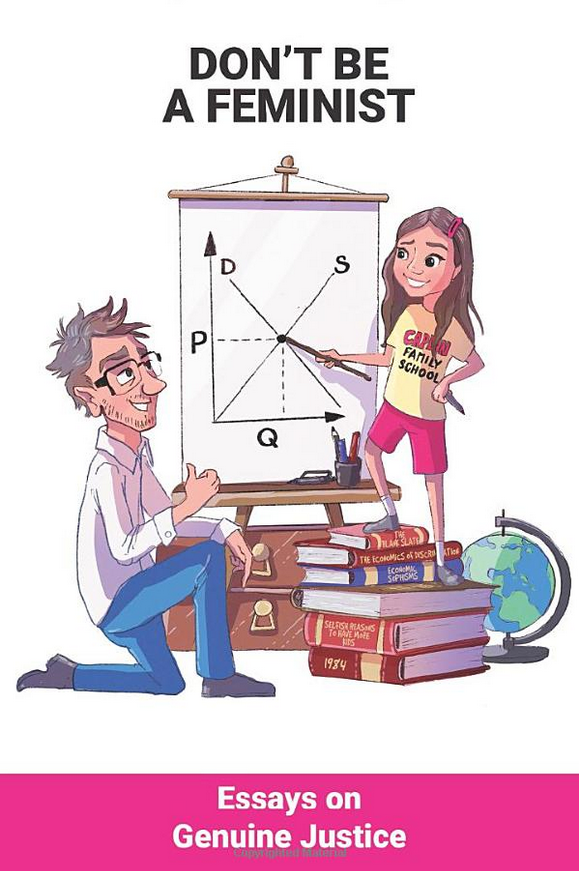
Bryan Caplan explains why he chooses to write the books he writes:
Almost by definition, writing controversial books tends to provoke negative emotional reactions. Anger above all. Anger which, in turn, inspires fear. And not without just cause; the sad story of Salman Rushdie sends shivers down the spine of almost any writer. If you write controversial books — or care about someone who does — you should be at least a little afraid of the anger your writing inspires.
[…]
In contrast, when I announced the imminent publication of Don’t Be a Feminist, the fear went through the roof. Several folks warned me of “career suicide”. Others told me that I had no idea what horrors awaited me. Friends staged mini-interventions on my behalf.
The underlying premise, naturally, was that the feminist movement is at once terribly powerful and horribly bad-tempered.
My best guess is that the warnings are overblown. Strangely, my friends have a more negative view of the feminist movement than I do. Whether my guess is right or wrong, though, all this intense, widespread fear really ought to trouble the feminist conscience.
If I said, “Hi” to one of my kids’ friends, and they responded by fleeing in terror, my reaction would be, “Did I do something to scare him?” I would ask my kids, “Why was he so afraid of me?” If such incidents started to repeat, I would be severely troubled. “I thought I came off as a friendly dad, but I guess I’m seen as an ogre.”
The same applies if I were a feminist, and I discovered that critics are literally afraid to criticize feminism. If only a few critics feared feminism, my question would be, “What did we do to scare them?” If I discovered that fear of feminism was widespread, a full soul-search would be in order. “I thought we came off as a friendly movement, but I guess we’re seen as ogres.”
And guess what? Fear of feminism plainly is widespread.
What, then, are feminists doing wrong? Above all, cultivating and expressing vastly too much anger. Sharing your angry feelings is an effective way to dominate the social world, but a terrible way to discover the truth or sincerely convince others. Maybe you don’t mean to scare others; maybe you’re just acting impulsively. Yet either way, the fear feminists inspire is all too real.
January 17, 2023
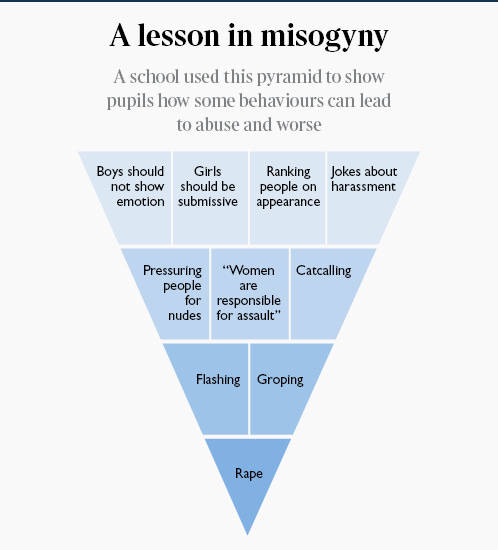
How ideological programming in British schools make men like Andrew Tate inevitable
To be honest, I don’t think I’d ever heard of Andrew Tate before his legal troubles in Romania hit the headlines, and I’m not well-versed on his achievements (such as they might be). Janice Fiamengo also admits that Tate wasn’t on her radar before then, but she’s done some work to try to put him into perspective:
What has Tate got to do with UK education, except perhaps as a telling symbol of its unintended consequences? Why not just model and enforce ideals such as courtesy, self-restraint, and hard work, while upholding high academic standards? The article demonstrates how deeply committed schools have become to ideological programming. Some schools have drawn up “entire lessons focused on Tate” (!!!) while others deal more generally with “misogyny and gender stereotypes”. Whatever the particulars, the general message is unvarying: “We’ve all got to work collaboratively and collectively to support young men to reframe masculinity—away from this toxic ideology that’s presented by the likes of Tate.”
No one who’s been following the feminist narrative over the past decade or two will be surprised by the dogmatic reference to “toxic ideology,” now standard in any discussion of “reframing” boyhood. There is just one problem for the concerned teachers: Tate is five steps ahead of them, having already made clear to his millions of followers why injunctions about “reframing masculinity” are just code for the continual marginalization that most boys naturally want nothing to do with. The moment Tate and his allies expressed their scorn for the project, it lost its power overs the millions of boys forced to sit in feminist classrooms across the UK. Tate confirmed what boys intuitively knew: having their masculinity “reframed” will prevent them from pursuing masculine dreams, from being proud of themselves as male, admired by their male peers, and able to attract the interest of pretty girls. Teachers can keep on telling boys that peer approval through masculine moxy isn’t important, but that won’t make it true.
The point is not whether Tate’s (“I’ve got 33 cars“) program is an unalloyedly good one; the point is that it is manifestly better than the recipe for self-loathing and irrelevance being offered by the schools. The school’s program is the same that has been tried for years without any enthusiastic uptake because it offers nothing affirmatively male for young men to be and do (see especially White Ribbon UK, which has been trying for years to turn boys into handmaidens of feminism). All the normal things that centuries of boys in every major civilization on earth have cared about—competitiveness, status, toughness, mastery, knowledge, self-reliance, stoicism, high-jinks, displays of ability, and male bonding—are now frowned upon and must be replaced by feminine traits like empathy, egalitarianism, conformity, verbal display, and tone-policing. It doesn’t take a gender studies specialist to see that the life being offered these boys is one of deference, self-suppression, and self-contempt. No boy should want that.
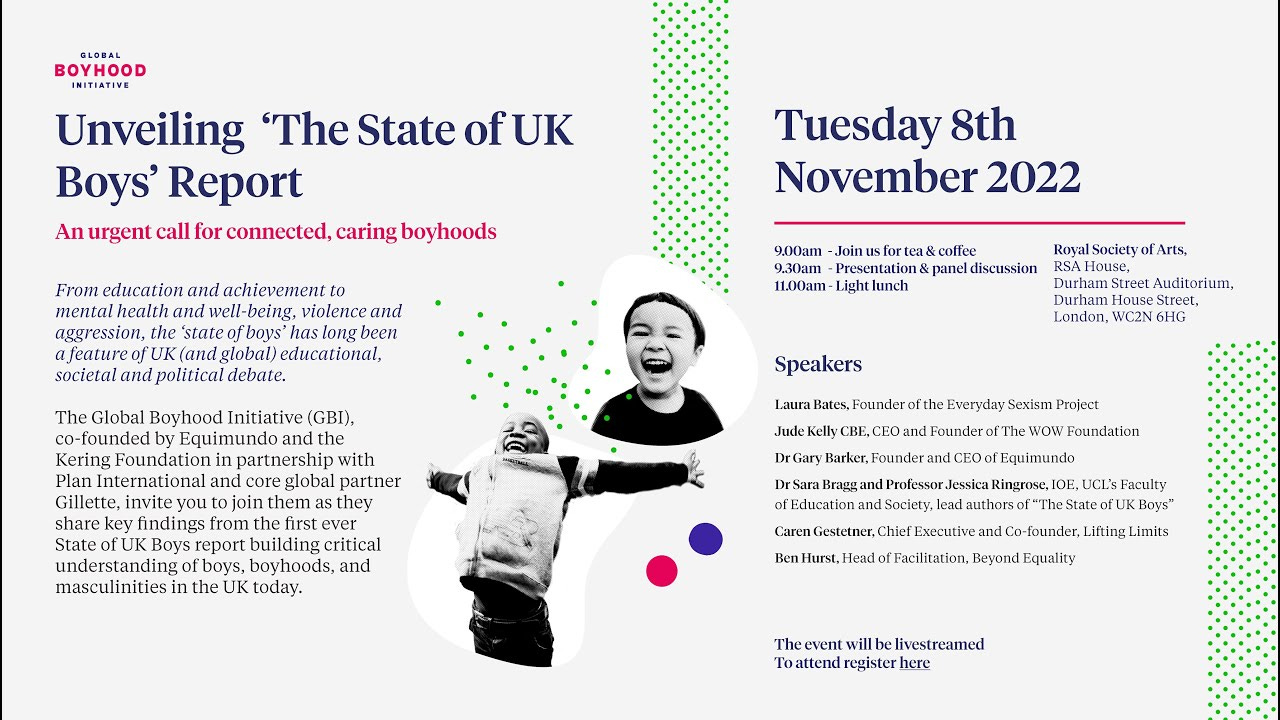
In case you doubt my characterization, take a look at the Global Boyhood Initiative’s report on The State of UK Boys: Understanding and Transforming Gender in the Lives of UK Boys, published in 2022. The report was written for “teachers, youth workers, early-years practitioners and other professionals” to achieve “gender equity and social justice”.
Incidentally, the report includes a section attacking an alleged “overemphasis” on research showing boys and men as victims of intimate partner violence by women. While the report enthusiastically promotes the end of “gender” through transgenderism and social constructivism, it emphatically does not support the end of gendered norms about which sex is violent. On this front, the report laments that “even young boys” now believe that male persons can be victimized by female persons, citing the case of Johnny Depp’s abuse by Amber Heard. Nothing could more clearly signal the report authors’ chagrined awareness of the difficulty of controlling boys’ thoughts in the internet age.
The rest of the report explores pathways to weaken masculinity. On a number of occasions, it takes aim at “simplistic notions that boys require male ‘role models'” because such notions “frame women as inadequate to parent and teach boys”. Taking for granted that “gender is not tied to sex organs, hormones, or biological traits” (one wonders, then, why trans persons elect to take hormones and to change their sex organs), the emphasis throughout the report is on “realigning” masculinity to highlight gender fluidity, transgenderism, and inclusion of girls. The document has absolutely nothing good to say about masculinity, which it describes, variously, as “a seductive form of power”, “hegemonic”, and “oppressive”. It even uses the derogatory term “boysplaining” to stigmatize boys’ alleged way of talking.
Even such seemingly benign behaviors as “laughter, banter, and entertaining one another” are said to be “laddish” and linked to the exclusion of women and homosexuals. Taking pleasure in being good at sport is also given a negative valence by being associated with bullying.
As in all such feminist propaganda, the report seeks the evacuation of all positive content from masculinity. “Realigned” boys are to anchor their sense of self mainly in not being what boys have always been. They are to shun the allegedly “hegemonic” characteristics of “physical, sexual, and mental prowess; being action-oriented; ‘knowing’; having autonomy […]; and being emotionally tough.” It is surely no coincidence that modern boys and young men have fallen well behind their female peers in educational attainment, economic status, and performance on the job market. “Prowess” is out, knowing is out, being active is out, toughness is out. No wonder so many boys feel lost, disaffected, and resentful, and no wonder some see Andrew Tate as a hero.
January 13, 2023
“Forced teaming”
In Quillette, Jonathan Kay provides us with our new term of the week:

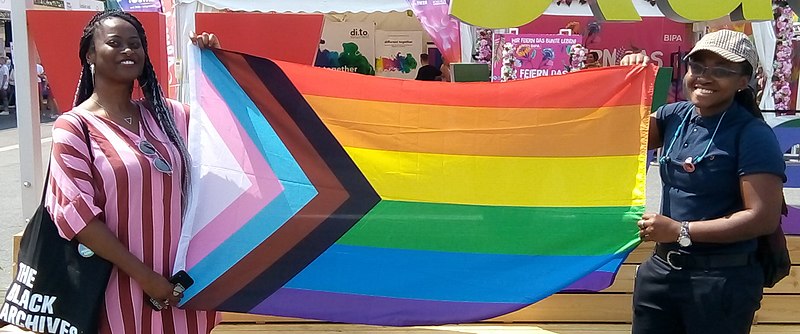
Two people at EuroPride 2019 in Vienna holding an LGBTQ+ pride rainbow flag featuring a design by Daniel Quasar; this variation of the rainbow flag was initially promoted as “Progress” a PRIDE Flag Reboot.
Photo by Bojan Cvetanović via Wikimedia Commons.
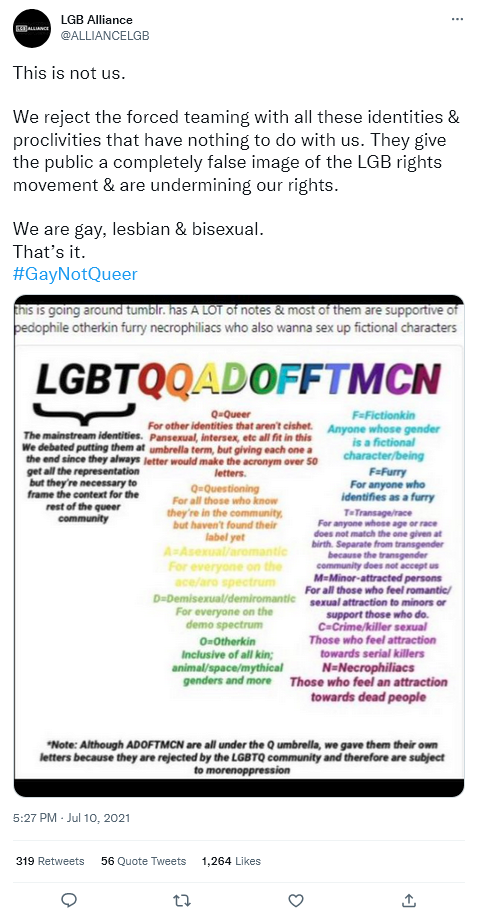
I learned a new term this week: “Forced teaming“. It describes what happens when a group of people — say, gay men and lesbian women — are forbidden from breaking ranks with some larger constituency, such as (in this case) the LGBT movement.
The example I’m discussing here is one that Quillette writers have been exploring for several years now. As author Allan Stratton noted last year, the central ideological fixation of many transgender-rights activists is the negation of biological sex as a meaningful marker of human identity. The true source of sexual attraction, they will insist, isn’t the reality of sexed male and female bodies; but rather an abstract gender spirit lodged within our souls, which somehow broadcasts itself in a way that prospective romantic partners are able to sense and interpret. As Stratton notes, this mythology isn’t just flagrantly wrong. It’s also homophobic to such extent that it denies the sexually defined nature of gay identity. Moreover, this homophobic element can’t be excised from gender ideology without fatally undercutting the (typically unspoken) mission of many biologically male trans activists, since giving up this claim “would be to admit that a lesbian isn’t going to be attracted to a male body, no matter how many times she is assured that the body in question belongs to someone who identifies as a woman.”
On Wednesday, Montreal-based Substacker Eliza Mondegreen provided an eyewitness report that helps illustrate what the “forced teaming” of ideologically non-compliant LGB men and women now looks like. The Centre for Human Rights and Legal Pluralism (CHRLP) at McGill University had planned to host a January 9th talk about the tension between sex and gender identity, to be delivered by Robert Wintemute, a professor of Human Rights Law at King’s College London. According to the event page, he was to discuss “whether or not the law should be changed to make it easier for a transgender individual to change their legal sex from their birth sex, and about exceptional situations, such as women-only spaces and sports, in which the individual’s birth sex should take priority over their gender identity, regardless of their legal sex.”
Though Wintemute seems the furthest thing from a bigot (or even a conservative), he is loathed by many trans activists due to what they see as an act of unforgivable apostasy. In 2006, Wintemute co-authored something called the “Yogyakarta Principles“, an international manifesto demanding that unfettered self-identification be recognized as the one and only means of distinguishing men from women. But he later recanted, declaring that “a key factor in my change of opinion has been listening to women”. Needless to say, many of Wintemute’s former activist friends then began treating him like Lord Voldemort. And Montreal’s Gazette newspaper, echoing such denunciations, darkly warned readers that the visiting human-rights professor had “ties to LGB Alliance, an advocacy group described by various LGBTQ2+ organizations and activists as a transphobic hate group”. (In truth, the LGB Alliance is simply a British charity that, as its name suggests, signal-boosts lesbian, gay, and bisexual individuals who believe that the interests of L, G, and B are now sometimes at cross-purposes with T.)
British feminists, who by now are well used to progressive mobs shutting down speaking events in the name of trans solidarity, may guess the rough contours of what happened next. A self-described “transfeminist sapphic activist” named Celeste Trianon compared Wintemute to a “cannibal”, and announced a protest, suggesting that followers should “bring out the pitchforks”.
QotD: Hillary Clinton
Misogyny played no significant role whatever in Hillary Clinton’s two defeats as a presidential candidate. This claim is such a crock! What a gross exploitation of feminism — in the service of an unaccomplished woman whose entire career was spent attached to her husband’s coat tails. Hillary was handed job after job but produced no tangible results in any of them — except of course for her destabilization of North Africa during her rocky tenure as secretary of state. And for all her lip service to women and children, what program serving their needs did Hillary ever conceive and promote? She routinely signed on to other people’s programs or legislative bills but spent the bulk of her time in fundraising and networking for her own personal ambitions. Beyond that, I fail to see how authentic feminism can ever be ascribed to a woman who turned a blind eye to the victims of her husband’s serial abuse and workplace seductions. The hypocrisy of feminist leaders was on full display during the Monica Lewinsky scandal, which incontrovertibly demonstrated Bill Clinton’s gross violation of basic sexual harassment policy. Although I had voted for him twice, I was the only feminist at the time who publicly condemned Clinton for his squalid and unethical behavior with an intern whose life (it is now clear) he ruined. Gloria Steinem’s slick casuistry during that shocking episode did severe damage to feminism, from which it has never fully recovered.
Camille Paglia, “Prominent Democratic Feminist Camille Paglia Says Hillary Clinton ‘Exploits Feminism’”, Washington Free Beacon, 2017-05-15.
December 15, 2022
QotD: From The Stepford Wives to The Handmaid’s Tale
Hey, did you know The Stepford Wives was published 50 years ago today? Salon does:
Why feminist horror novel The Stepford Wives is still relevant, 50 years on
But before we get to the fisking (I’m running on fumes, y’all; the end of the summer is always the worst time for me), let’s pause for a moment to consider the TV show. You’d think there’d be one, right? Either that, or this is stoyak — The Stepford Wives, coming fall 2022 to Disney Plus. But it doesn’t appear to be. I googled “stepford wives tv show” and got this, which looks trashy enough, but in no way related to the book or movie. There was a remake of the 1970s movie back in 2004, but it bombed.
Odd, no? You’d think that shit would be chick crack — all those Strongk Confidant Wahmens digging into conspiracies and Sticking it to the Man ™. At least, that’s what I thought back in 2004. I thought the casting was dodgy — Kidman was too old (and too glamorous; you really need a pretty-but-not-Hollywood-pretty type) and Matthew Broderick too nebbishy. Nonetheless, I thought the premise would be strong enough to overcome it — oh, you poor, put-upon ladies! But nope.
And then The Handmaid’s Tale happened, as my students would’ve written back in the days, and now I understand why I’m wrong. I should’ve seen it 20 years ago, but better late than never, right? Let’s all have a good laugh at the really obvious thing I missed back in 2004: Strongk, Confidant Wahmens are neither strong nor confident, nor do they want to be either. They want the thinnest veneer of the pretense of the fantasy of those things, delivered to them by a man who comes on like Chad Thundercock, but always somehow has the time to listen to her.
The Handmaid’s Tale, that’s the real chick crack. It’s highbrow bondage porn for the kind of tertiary-educated lady who thinks Fifty Shades of Gray is way too trashy to rent (except, you know, one Girls’ Night with a box of white whine, as a “guilty pleasure”). It gets her all fired up for busting balls at the next partners’ meeting down at the law firm. So empowering!
In The Stepford Wives, book and original movie, the housewives are replaced by robots. The author, Ira Levin, was a guy, and I bet you could tell that just from the one-sentence plot summary. Being replaced by a robot isn’t a “feminist” fear, it’s a male fear. The worry that you’re nothing but a wallet with a criminally underserved dick attached has been pervasive among men since probably the Puritans. It’s a neat trick on Levin’s part, racking up mucho feminist street cred by selling them the #1 male neurosis of the postwar world.
Severian, “SJWs Always Project”, Founding Questions, 2022-08-08.
November 15, 2022
QotD: Second-wave feminism
Second-wave feminism went off the track when it started to demonize men and blame them for all the evils in human history. It’s a neurotic world-view that was formulated in too many cases by women (including Gloria Steinem and Kate Millett) with troubled childhoods in unstable homes. First-wave feminism, in contrast, focused on systemic social problems that kept women in secondary or dependent status. My favorite period in feminism has always been the 1920s and 1930s, when American women energized by winning the vote gained worldwide prominence for their professional achievements. My early role models, Amelia Earhart and Katharine Hepburn, were fierce individualists and competitors who liked and admired men and who never indulged in the tiresome, snippy rote male-bashing that we constantly hear from today’s feminists. I am an equal opportunity feminist who opposes special protections for women. What I am saying throughout my work is that girls who are indoctrinated to see men not as equals but as oppressors and rapists are condemned to remain in a permanently juvenile condition for life. They have surrendered their own personal agency to a poisonous creed that claims to empower women but has ended by infantilizing them. Similarly, boys will have no motivation to mature if their potential romantic partners remain emotionally insecure, fragile, and fearful, forever looking to parental proxies (like campus grievance committees or government regulators) to make the world safe for them.
Camille Paglia, “Prominent Democratic Feminist Camille Paglia Says Hillary Clinton ‘Exploits Feminism’”, Washington Free Beacon, 2017-05-15.
October 29, 2022
QotD: Camille Paglia’s “Amazon” Feminism
I am an equal opportunity feminist. That is, I demand the removal of all barriers to women’s advance in the political and professional realms. However, I oppose special protections for women, such as workplace quotas or campus procedures that favor women during sexual assault complaints. I want total equality before the law.
In my view, special protections of any kind infantilize women. My code of Amazon feminism is based on the empowerment of the individual: Women must not regress to a pre-feminist past to become passive wards of the state.
Camille Paglia, interviewed in “Feminist critic Camille Paglia: ‘Merkel is an important role model for mature women'”, DW, 2017-06-01.
October 26, 2022
When mere accusation functions as a “guilty” verdict
I don’t follow hockey at all, so I hadn’t heard anything about the case of Jake Virtanen and the Vancouver Canucks after Virtanen was accused (but found not guilty) of sexual assault. Janice Fiamengo provides an outline of the case:
NHL forward Jake Virtanen’s once-promising career with the Vancouver Canucks was torpedoed by a rape allegation, and even after he was acquitted in a court of law, detractors have demanded he be shunned as a sexual predator.
In the summer of 2021, Virtanen was first suspended and then bought out by the Canucks after a woman alleged that he had sexually assaulted her in his hotel room in September of 2017. The woman had accompanied Virtanen to his room after a night of partying. She claimed that after she repeatedly refused his sexual overtures, he forced himself on her; Virtanen said the sex had been consensual.
The fact that the complainant stayed the night with her alleged rapist and then waited nearly four years to tell anyone or report to police may have played a role in the jury’s decision, in July of 2022, to find Virtanen not guilty. It was a He said/She said story that simply did not prove guilt.
Feminist advocates, however, couldn’t care less about the verdict, and many hockey commentators seem to feel the same way.
Mary Jane James, CEO of the Sexual Assault Centre of Edmonton, was adamant in interview with Canada’s state broadcaster that the allegation mattered far more than the verdict, and that no team in the NHL should touch Virtanen. Referring to the decision by the Edmonton Oilers to sign Virtanen to a 2-month tryout last month, James accused Oilers’ leadership of “taking the verdict at face value, regardless of what the allegations were”. It didn’t seem to matter to James that our entire justice system relies on the acceptance of verdicts over unproven allegations.
In James’ expressed opinion, any man accused of a “very, very serious” sexual crime (and what sexual crime would she not consider serious?) should be presumed guilty. Hockey teams, she insisted, need to send a message that “We are not going to associate with anyone who has this history” (i.e., of being accused).
It is an extraordinarily crude statement of contempt for the cherished principles of western jurisprudence — and would presumably not apply to Mary James herself if she were ever tried and acquitted — but it corresponds fairly closely with the thrust of recent feminist activism: Accused men should be made pariahs, and so should anyone who refuses to participate in their shunning.
October 10, 2022
October 3, 2022
September 16, 2022
The rise of the “golden penis”
Look folks, there are some headlines that just write themselves, but it’s not my coining — here’s Janice Fiamengo to explain where that … memorable term … came from:
We’ve been told for years that the future is female, that everyone benefits from female leadership and everything improves when women take charge.
Any man on a college campus who has ever objected to the plethora of special university programs and women-only scholarships and pro-woman propaganda was told he had a problem with gender equality.
But now it turns out that some women themselves are not entirely happy with the deal feminists engineered for them, which sees them outnumbering men at close to 3-2 at most English-speaking universities, and thousands of words have already been devoted to the idea that college women deserve a more satisfactory dating experience.
According to Monica Greep in an article from last fall for the Daily Mail, “How Golden Penis Syndrome is ruining dating for university women”, the “deficit of male students” at college “means men develop inflated egos and become Casanovas who cheat — despite a lack of social and sexual skills”.
The formulation reminds me of an old Woody Allen joke from his movie Annie Hall. In my updated version, two women are discussing college dating: “The guys are awful, egotistical schmucks who think they’re really great,” says one. “I know,” says the other, “And there are so few of them!”
If these men are so lacking in “social and sexual skills”, as the article tut tuts, then why are the women upset that there are not more of them? If the women don’t want guys who are Casanovas, they don’t have to date them. But admitting that women have any role in creating the hookup culture being decried is impossible for most commentators today; the fault must always be found in the men. There is even a “relationship therapist” quoted in the article who tells us that Golden Penis Syndrome “speaks of the delusional belief that you are unusually and uniquely gifted as a man”.
Really? Did any of these analysts interview any young men who actually said that about themselves, or is this a case of women projecting onto men their own self-delusions, angry because the men have failed to respond to them as they, the women, would prefer?
As has become typical of pronouncements about men and women, the article blames men for being in the minority at college: at some institutions, they make up only 25% of the student body (see Mark Perry’s charts, for example here, showing the decades-long gender asymmetries; and see his proof that women outnumber men in STEM fields too). The shortage apparently causes men “to see themselves as a prize to be won by female suitors”.
What articles such as this one won’t admit is that these guys are “prizes to be won”, and increasingly so in light of the reported imbalance.
It is well known that college-educated men who marry are, on average, likely to work the longest hours, seek promotion most aggressively, and become high earners focused on supporting their wives and families (even post-divorce, as too often happens). A woman who is fortunate enough to marry a man like this stands to secure a materially better life, often at her husband’s expense of health and leisure, than she would have had if she had depended solely on her own earning power and work ethic (women are famously more interested in “work-life balance” than men are). Now with these men in the minority, women are having to compete for the men’s attention, and we’re supposed to feel sorry for them.
Of course the alleged problem has an obvious solution: the women could date and marry non-university-educated men. Why won’t they? The article mentions this somewhat embarrassing reality in gender-neutral terms by noting that “At the same time [that] university sex ratios have been skewing female, there’s been a simultaneous increase in what academics call ‘assortative mating’.” The article explains, “That’s a fancy way of saying that college grads only want to date and marry other grads.”
Wrong.
It’s not male college grads who won’t marry anyone other than a female college grad. As a 2019 study confirmed, it is almost exclusively women who insist on the need for their mates to earn more. In a sane age genuinely committed to “gender equality”, we might criticize women for their stereotypical behavior, for perceiving men as “success objects”. But we never criticize women for acting out of self-interest.
Only men are criticized for that, as well as for uncouth dating behaviors that everyone knows women also engage in when circumstances favor them: playing the field, cheating, “ghosting”, and so on. Being picky, demanding, and often downright rude are all recognized as a woman’s prerogative because women ARE seen as inherently valuable.
August 25, 2022
Louise Perry – “It’s precisely because I’m a feminist that I’ve changed my mind on sexual liberalism”
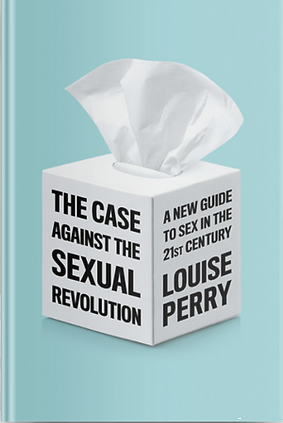
Guest-posting at Bari Weiss’s Substack, Louise Perry explains what drove her to write her new book, The Case Against the Sexual Revolution: A New Guide to Sex in the 21st Century:
I used to believe the liberal narrative on the sexual revolution. As a younger woman, I held the same opinions as most other millennial urban graduates in the West. I conformed to the beliefs of my class.
Of course freedom is the goal, I thought. What women need is the freedom to behave as men have always behaved, enjoying all the pleasures of casual sex, porn, BDSM, and indeed any other sexual delight that the human mind can dream up. As long as everyone is consenting, what’s the problem?
I no longer believe any of this.
[…]
The problem is the differences aren’t trivial. Sexual asymmetry is profoundly important: One half of the population is smaller and weaker than the other half, making it much more vulnerable to violence. This half of the population also carries all of the risks associated with pregnancy. It is also much less interested in enjoying all of the delights now on offer in the post-sexual revolution era.
The research is clear. Men are (on average) far more interested than women are in casual sex, buying sex, watching porn, and experimenting with unusual fetishes. It’s not that women never enjoy such things. But, on average, they enjoy them much less than men do.
Remove the progressive goggles, and the history of the last 60 years looks different. The sexual revolution isn’t only a story of women freed from the burdens of chastity and motherhood. It is also a story about the triumph of the playboy.
It would have been impossible to imagine a self-described feminist offering advice like this to other young women even a few years ago:
This is the advice I would offer my own daughter:
• Distrust any person or ideology that pressures you to ignore your moral intuition.
• Chivalry is actually a good thing. We all have to control our sexual desires, and men particularly so, given their greater physical strength and average higher sex drives.
• Sometimes (though not always) you can readily spot sexually aggressive men. There are a handful of personality traits that are common to them: impulsivity, promiscuity, hyper-masculinity and disagreeableness. These traits in combination should put you on your guard.
• A man who is aroused by violence is a man to steer well clear of, whether or not he uses the vocabulary of BDSM to excuse his behavior. If he can maintain an erection while beating a woman, he isn’t safe to be alone with.
• Consent workshops are mostly useless. The best way of reducing the incidence of rape is by reducing the opportunities for would-be rapists to offend. This can be done either by keeping convicted rapists in prison or by limiting their access to potential victims.
• The category of people most likely to become victims of these men are young women between the ages of 13 and 25. All girls and women, but particularly those in this age category, should avoid being alone with men they don’t know or men who give them the creeps. Gut instinct is not to be ignored: It’s usually triggered by a red flag that’s well worth noticing.
• Get drunk or high in private and with female friends, rather than in public or in mixed company.
• Don’t use dating apps. They offer a large pool of options, but at a severe cost. It is far better to meet a partner through mutual friends, since they can vet histories and punish bad behavior. Dating apps can’t.
• Holding off on having sex with a new boyfriend for at least a few months is a good way of discovering whether or not he’s serious about you or just looking for a hook-up.
• Only have sex with a man if you think he would make a good father to your children — not because you necessarily intend to have children with him, but because this is a good rule of thumb in deciding whether he’s worthy of your trust.
• Monogamous marriage is by far the most stable and reliable foundation on which to build a family.
None of this advice is groundbreaking. It’s all informed by peer-reviewed research, but it shouldn’t have to be, since this is what pretty much most mothers would tell their daughters, if only they were willing to listen.
August 19, 2022
“This is her advice: Get Married and Make Sure You Stay Married”
Elizabeth Nickson was a feminist entrepreneur (although I’m sure she would not have used that word to describe herself) in her early 20s, earning money to support herself by pushing feminist ideology through theatrical performance and running consciousness raising sessions. It was, as she says, “fashionable”. She now realizes that the changes to sexual belief and behaviour led directly to the modern “hook-up” culture young people now have to navigate to find relationships:
A new book, the Case Against Sexual Revolution, A New Guide to Sex in the 21st Century, written by Louise Perry, a young writer for the New Statesman is published at the end of this month. Perry volunteers in rape centers, and works for the campaign group We Can’t Consent To This, which documents cases in which UK women have been killed and defendants have claimed in court that they died as a result of ‘rough sex’.
This is her advice: Get Married and Make Sure You Stay Married.
Dramatically well-argued and sourced, Perry goes through every “innovation” in the sexual space and demonstrates without flinching, that all of it, all of it, privileges a particular subset of male, the sociosexual male – the kind that preferences quantity over quality – and not only that the worst kind of sociosexual male. The kind who like choking women, the rapists, abusers, serial womanizers, the pedophiles, the pimps, and the traffickers.
Decades later, says Perry, the mothers and grandmothers of 2nd and 3rd stage feminism have created hook-up culture as the near exclusive method of finding a mate. She details the unassailable fact that women, by their very nature, by their evolutionary history, and their specific biology are victimized in every move of hook-up culture, which ruthlessly uses their femininity, their gentleness, kindness, and agreeableness against them. It coarsens men, inflames their worst natures and has turned the netherworld of the sexual marketplace into a vicious free-for-all, a Darwinian thrash-hunt of the most vulnerable.
Everyone is hurt by it. Without exception.
I live in a place socially advanced, jokingly known as the end of the hippie trail. It is prosperous because it is one of the most beautiful places in the world. But, because it is environmentally advanced, our population is aging. The young and busy cannot start businesses or families here, because the environmental regulation is so strict, they cannot afford it. The human wreckage of the sexual revolution, therefore, is on full display. The streets and markets are littered with broken older men and women, long divorced or separated, the women especially living on crumbs, alone and destined to die alone, many without family. Hey, but their 20s and 30s were free. They got to have sex with dozens, if not hundreds of gorgeous men or women. And they used all the drugs.
If you look hard enough, you will see the same people drifting along the margins of every city and town. Break sexual norms, you break the family, and then you break the culture. What is left is pitiable.
Perry makes the point that I have tried to make hundreds of times in the past 20 years. So many of the political aims of upper-middle-class work for them, but for no one else. They are luxury beliefs. Upper-middle-class mothers do not send their gorgeous teens away to college now without very stern warnings about what might happen to them. Without a full delineating of the horrors that attend hooking up. But the less advantaged, those who swallow the propaganda of the culture do not.
August 17, 2022
To understand Justin Trudeau, you need to look at his relationship with his mother
Janice Fiamengo on how a lot of Justin Trudeau’s personal quirks may be directly traced to his upbringing and particularly his relationship with Margaret Trudeau:

Malia and Sasha Obama talk with Prime Minister Trudeau and his mother Margaret Trudeau during a reception on the Truman Balcony, 10 March, 2016.
Official White House photo by Pete Souza via Wikimedia Commons.
Cue the popularity of Justin Trudeau, who at first seemed all sincerity, even to the point of public spectacles of tearfulness and child-like ebullience. He was the first Canadian leader to march in the Gay Pride Parade as if it were his natural milieu, not merely a vote-seeking opportunity. His enthusiasm for Bollywood-style gyving, Hindu fancy dress, and participation in Islamic prayer, though heavily criticized, seemed genuine, at least in a high-school drama teacher way.
When he refused to give a real answer to the question of why it was necessary to appoint a gender-equal cabinet as one of his first actions upon assuming office in 2015, his insouciant quip “Because it’s 2015” suggested an unstudied feminist commitment. His comments after the Boston bombings emphasized that empathy rather than harshness was the appropriate response to murderous acts of terror.
But there has always been a harsher side to Trudeau, a fondness for dictators, an attraction to brute power, and an inability (or unwillingness) to hide his contempt for political opponents. Perhaps his empathy for the Boston bombers was respect or even admiration for their willingness to use violence. Many were shocked by his open admission that one of the countries he most admired was the “basic dictatorship” of China. When churches burned across Canada in the summer of 2021 in response to the alleged discovery of “mass” graves at a residential school (a discovery that has not yet yielded a single body), Trudeau condemned the arson but hastened to say it was “understandable”. About Canadians who chose not to take the Covid-19 vaccines, he could not control his impatience, unleashing a volley of stigmatizing, scapegoating rhetoric. For the truckers who camped out in Ottawa amid a sea of Canadian flags and bouncy castles demanding vaccine mandates be revoked, he had a brutal contempt.
Which is he: the soft feminist with the fancy socks, joy in Gay Pride, and empathy for the marginalized? Or the hard, contemptuous leader who could oversee without flinching a violent RCMP crackdown on the Convoy protest that saw an Indigenous woman trampled under the hoofs of a police horse?
The answer is: both. A clue to his doubleness may be found in his relationship with his mother.
I recently watched an old interview with Margaret Trudeau that offers some illuminating glimpses into the character of the woman who mothered Justin. The interview took place in 1979, after Margaret had left Pierre Trudeau, Justin’s father, who was Prime Minister of Canada from 1968 until 1982. Pierre had primary custody of their three young children.
The interview shows a very beautiful woman whose consciousness of her attractiveness is a paramount part of her identity. She is not, as has sometimes been claimed, stupid; many of her answers to the interviewer are clever in the manner of a wayward adolescent convinced she can get away with nearly anything so long as she charms. At times she flirts openly, smiling suggestively, tongue protruding through her lips, confident in her sexual power.
The overall impact of her answers is horrifying for a viewer who fails to be enchanted. This is a woman who takes herself seriously but evidently does not take seriously her position as a mother to three young sons (all of them under 10 years old at the time) — and certainly not her position as estranged wife to the leader of the country.
She boasts girlishly about smoking marijuana, listening to psychedelic music, and giving up guilt over failing to meet others’ expectations. Spouting feminist rhetoric about being true to herself, she makes clear that she is more interested in having lovers than in looking after her children. She dismisses her husband’s shock at her unfaithfulness as owing to “old-fashioned principles of fidelity”, and indicates that Canadian society would be better off if more people heeded their “feelings” rather than stodgy moral precepts.
I cringe to think of Justin Trudeau, even today, watching this interview. The woman who presented herself therein — self-preoccupied, proudly promiscuous — must also have been evident to the son who watched her flamboyantly “find herself”, feminist-style, as his parents’ marriage crumbled.
H/T to Brian Peckford for the URL.