Quotulatiousness

February 17, 2025

The growing problem of “America’s hat”

Filed under: Cancon, China, Government, History, India, USA — Tags: , , , , , — Nicholas @ 03:00

John Carter’s latest post is excellent — but that’s his usual standard — but it’s of particular interest to inhabitants of what used to be the proud Dominion but who now live in a “post-national state” with “no core identity” as our outgoing prime minister so helpfully explained it:

Canada and the US have been frenemies for most of the last two hundred years. With the exception of some spats in the 19th century, they’ve fought on the same side in all major wars, and haven’t taken up arms against one another. At the same time, Canada has from the very beginning fiercely guarded its independence. Through the 1950s, this came from Canada’s self-conception as an outpost of sober, orderly British traditionalism, in stark contrast to the chaotic liberal revolutionaries across the border. Following the Liberal Party’s cultural revolution in the 1960s, Canada increasingly came to see itself as different from the US primarily in that it was more liberal, in the modern sense, than it’s Bible-thumping, gun-toting redneck cousins – which is to say more socialist, leftist, multicultural, gay-friendly, internationalist, feminist, and so forth. In fairness to Canada, the British government, having long-since fallen under the sway of the Labour party, had followed the same ideological trajectory, so Canada was really just taking its cue from Mother England as it always had. In further fairness to Canada, all of this has been aggressively pushed by Blue America, which has been running American culture (and therefore everyone else’s) until about five minutes ago.

Despite these differences, the US could always rely on Canada being a stable, competently run, prosperous, and happy neighbour – perhaps a bit on the prickly side, given the inferiority complex, but much less of a headache than the entropic narcostate to the south that keeps sending its masses of illiterate campesinos flooding over the banks of the Rio Grande. Canada might be annoying sometimes, but it didn’t cause problems. To the contrary, Canada and the US have maintained one the world’s most productive trading relationships for years: America gets Canadian oil, minerals, lumber, and Canada gets US dollars, technology, and culture.

Now, however, Canada has become a problem for America. Not yet, perhaps, the biggest problem – America has a very large number of extremely pressing problems – but a significant one nonetheless, with the potential to become quite acute in the near future.

The problem is that Canada has become a security threat.

[…]

The next security problem is the border, an issue which Trump has repeatedly stressed as a justification for tariffs. The 49th Parallel is famously the longest undefended border on the planet. It is much longer than the Southern border; there are no barbed wire border fences; most of the terrain is easily traversed – forest, lake, or prairie – in contrast to the punishing desert running across the US-Mexico border. Militarizing the US-Mexico border is already a huge, costly undertaking. Doing the same on the Canadian border would be vastly more challenging.

Canada’s extraordinarily lax immigration policy has, in recent years, led to a much higher encounter rate at border crossings with suspects on the terrorism watch list. These people come into Canada legally, part of the millions of immigrants Ottawa has been importing, every year, for the last few years. When you’re bringing in over one percent of your country’s population every single year, it is simply not possible to properly vet them, and it seems that Ottawa barely even bothers to try. Given that not every such person of interest will get stopped at the border, and that not every terrorist is on a watch list, one wonders how many enemies have already slipped across into the US by way of Canadian airports.

RCMP officers with their haul from a fentanyl superlab. Only one person was arrested.

The second border problem is fentanyl. Like the US, Canada has a raging opiod epidemic. We’ve got tent cities, zombies in the streets, needles in the parks, and this is not limited to the big cities – it spills out into the small towns, as well. Like Mexico, Canada has fentanyl laboratories. Precursor chemicals are imported from China by triads, turned into chemical weapons in Canadian labs, and then distributed within Canadian and American markets by predominantly Indian truckers. The occasional busts have turned up vast quantities of the stuff, but have resulted in very few arrests. The proceeds are then laundered through casinos or fake colleges, with the laundered cash then parked in Canadian real estate. There are estimates that the volume of fentanyl money flowing through Canada’s housing markets is significant enough to be a major factor (immigration is certainly the main factor) distorting real estate prices – keeping the housing bubble inflated, propping up Canada’s sagging economy, and pricing young Canadians out of any hope of owning a home or, for that matter, even renting an apartment without a roommate or three.

It’s generally understood, though essentially never acknowledged at official levels, that poisoning North America with opiods is deliberate Chinese policy, both as revenge for the Opium Wars of the 19th century, and as one element in their strategy of unrestricted warfare i.e. the covert but systematic weaponization of every point of contact – economic, industrial, cultural, etc. – between Chinese and Western societies. By allowing the fentanyl trade to continue, the Canadian government is complicit in an act of covert war being waged by a foreign power, one whose casualties include the Canadian government’s own population.

February 16, 2025

Free-market economist grapples with a new kind of tariff

Filed under: Business, Economics, Government, Politics, USA — Tags: , , , , — Nicholas @ 03:00

With US President Donald Trump seemingly utterly entranced by the possibilities of killing off as much world trade as he can using tariffs, I did not expect to read that renowned libertarian economist David Friedman is not sure about the latest kind of tariffs being proposed:

I have finally encountered a kind of tariff that I am not sure I am against. The idea is to impose the same tariff on another country’s exports that they impose on your exports. A tariff makes the country that imposes it worse off, a fact that neither Trump or most of the media appear to understand — Vance may — but it makes the country it is imposed against worse off as well. Imposing a tariff can be in the interest of the politicians who impose it for public choice reasons, as a way of buying support from a concentrated and well organized interest group such as the auto industry at the expense of a dispersed interest group such as their customers. That is one of the two reasons tariffs exist, the other being that the false theory of trade economics is simpler and easier to understand than the true theory.1

But another country’s tariff barriers against your exports make both your country and its politicians worse off. So if imposing tariffs on their imports results in tariffs being imposed on their exports, it might be in the interest of the politicians as well as the country they rule to lower, even abolish, their tariffs — and free trade, zero tariffs, is my first best tariff policy.

Reciprocal reduction of tariffs is, of course, a routine objective of trade negotiations. What Trump appears to be proposing is to automate the process. That might have some advantages. It would reduce the amount of time and effort spent on trade negotiations. More important, it would make it harder for a government that wanted to keep its tariffs to pretend to its citizens that negotiations for mutual reductions had broken down over details.

It is not obvious what “reciprocal tariffs” means in practice, because tariffs, typically, are on particular goods. China imports oil and exports textiles. If they impose a tariff on American oil there would be no point to the US retaliating by imposing a tariff on Chinese oil — we don’t import Chinese oil.

    Under the Plan, my Administration will work strenuously to counter non-reciprocal trading arrangements with trading partners by determining the equivalent of a reciprocal tariff with respect to each foreign trading partner. (Reciprocal Trade and Tariffs Memo)

It isn’t clear what “the equivalent” means. One possible approach would be to figure how much revenue a country collects from tariffs on American exports and set a uniform tariff on that country’s exports set to bring in the same amount of revenue. That would be simple and would reduce the political support for tariffs, since they could not be targeted to protect specific industries.

For which reason I don’t expect it to happen. The closest version that seems politically plausible is a nonuniform tariff schedule that brings in the equivalent revenue. Unfortunately that would let the administration protect favored industries with tariffs high enough to reduce imports, and revenue, to near zero.

Of course, the target country could, in a true system of reciprocal tariffs, solve the problem by reducing their tariffs to zero.


February 15, 2025

“Trump marks the overdue end of the Long Twentieth Century”

Filed under: History, Media, Politics, USA — Tags: , , — Nicholas @ 05:00

At The Upheaval, N.S. Lyons suggests that the arrival of Donald Trump, version 2.0, may finally end the era we’ve been living in since immediately after the end of WW2:

The 125 years between the French Revolution in 1789 and the outbreak of WWI in 1914 was later described as the “Long Nineteenth Century”. The phrase recognized that to speak of “the nineteenth century” was to describe far more than a specific hundred-year span on the calendar; it was to capture the whole spirit of an age: a rapturous epoch of expansion, empire, and Enlightenment, characterized by a triumphalist faith in human reason and progress. That lingering historical spirit, distinct from any before or after, was extinguished in the trenches of the Great War. After the cataclysm, an interregnum that ended only with the conclusion of WWII, everything about how the people of Western civilization perceived and engaged with the world – politically, psychologically, artistically, spiritually – had changed.

R.R. Reno opens his 2019 book Return of the Strong Gods by quoting a young man who laments that “I am twenty-seven years old and hope to live to see the end of the twentieth century”. His paradoxical statement captures how the twentieth century has also extended well past its official sell-by date in the year 2000. Our Long Twentieth Century had a late start, fully solidifying only in 1945, but in the 80 years since its spirit has dominated our civilization’s whole understanding of how the world is and should be. It has set all of our society’s fears, values, and moral orthodoxies. And, through the globe-spanning power of the United States, it has shaped the political and cultural order of the rest of the world as well.

The spirit of the Long Twentieth could not be more different from that which preceded it. In the wake of the horrors inflicted by WWII, the leadership classes of America and Europe understandably made “never again” the core of their ideational universe. They collectively resolved that fascism, war, and genocide must never again be allowed to threaten humanity. But this resolution, as reasonable and well-meaning as it seemed at the time, soon became an all-consuming obsession with negation.

Hugely influential liberal thinkers like Karl Popper and Theodor Adorno helped convince an ideologically amenable post-war establishment that the fundamental source of authoritarianism and conflict in the world was the “closed society”. Such a society is marked by what Reno dubs “strong gods”: strong beliefs and strong truth claims, strong moral codes, strong relational bonds, strong communal identities and connections to place and past – ultimately, all those “objects of men’s love and devotion, the sources of the passions and loyalties that unite societies”.

Now the unifying power of the strong gods came to be seen as dangerous, an infernal wellspring of fanaticism, oppression, hatred, and violence. Meaningful bonds of faith, family, and above all the nation were now seen as suspect, as alarmingly retrograde temptations to fascism. Adorno, who set the direction of post-war American psychology and education policy for decades, classified natural loyalties to family and nation as the hallmarks of a latent “authoritarian personality” that drove the common man to xenophobia and führer worship. Popper, in his sweepingly influential 1945 book The Open Society and Its Enemies, denounced the idea of national community entirely, labeling it as disastrous “anti-humanitarian propaganda” and smearing anyone who dared cherish as special his own homeland and history as a dangerous “racialist”. For such intellectuals, any definitive claim to authority or hierarchy, whether between men, morals, or metaphysical truths, seemed to stand as a mortal threat to peace on earth.

The great project of post-war establishment liberalism became to tear down the walls of the closed society and banish its gods forever. To be erected on its salted ground was an idyllic but exceptionally vague vision of an “open society” animated by peaceable weak gods of tolerance, doubt, dialogue, equality, and consumer comfort. This politically and culturally dominant “open society consensus” drew on theorists like Adorno and Popper to advance a program of social reforms intended to open minds, disenchant ideals, relativize truths, and weaken bonds.

As Reno catalogues in detail, new approaches to education, psychology, and management sought to relativize truths, elevate “critical thinking” over character, vilify collective loyalties, cast doubt on hierarchies, break down all boundaries and borders, and free individuals from the “repression” of all moral and relational duties. Aspiration to a vague universal humanitarianism soon became the only higher good that it was socially acceptable to aim for other than pure economic growth.

[…]

The Long Twentieth Century has been characterized by these three interlinked post-war projects: the progressive opening of societies through the deconstruction of norms and borders, the consolidation of the managerial state, and the hegemony of the liberal international order. The hope was that together they could form the foundation for a world that would finally achieve peace on earth and goodwill between all mankind. That this would be a weak, passionless, undemocratic, intricately micromanaged world of technocratic rationalism was a sacrifice the post-war consensus was willing to make.

That dream didn’t work out though, because the strong gods refused to die.

Update, 17 February: Welcome Instapundit readers! Thanks for dropping by. Please do look around at some of my other posts! I think the last time I got linked by Instapundit was back in 2008/9 just before I moved to the current location. Please do read the entire N.S. Lyons post, as this is just a taster of the full essay!

February 14, 2025

Trump may start paying attention to Canadian cultural protectionist polices next

Michael Geist points out just how many Canadian federal policies and programs will likely come under scrutiny by the Trump administration for their blatant protectionism against US cultural products:

My Globe and Mail op-ed argues the need for change is particularly true for Canadian digital and cultural policy. Parliamentary prorogation ended efforts at privacy, cybersecurity and AI reforms and U.S. pressure has thrown the future of a series of mandated payments – digital service taxes, streaming payments and news media contributions – into doubt. But the Trump tariff escalation, which now extends to steel and aluminum as well as the prospect of reviving the original tariff plan in a matter of weeks, signals something far bigger that may ultimately render current Canadian digital and cultural policy unrecognizable.

Our cultural frameworks are largely based on decades-old policies premised on marketplace protections and mandated support payments. This included foreign ownership restrictions in the cultural sector and requirements that broadcasters contribute a portion of their revenues to support Canadian content production.

As we moved from an analog to digital world, the government simply extended those policies to the digital realm. But with Mr. Trump appearing to call out what he views to be Canadian protectionist policies in sensitive sectors such as banking ownership, the cultural and digital sectors may be next.

If so, there are no shortage of long-standing policies that tilt the playing field in favour of Canadians that could spark some uncomfortable conversations.

Why do U.S. companies face ownership restrictions in the telecom and broadcast sectors? Why are Canadian broadcasters permitted to block U.S. television signals in order to capture increased advertising revenue? Why do Canadian content rules exclude U.S. companies from owning productions featuring predominantly Canadian talent?

The Canadian response that this is how it has always been is unlikely to persuade Mr. Trump.

Canadian policies premised on “making web giants pay” may also be non-starters under Mr. Trump. For the past five years, the Canadian government seemingly welcomed the opportunity to sabre rattle with U.S. internet companies. This led to mandated payments for streaming services to support Canadian film, television and music production; link taxes that targeted Meta and Google to help Canadian news outlets; and the multibillion-dollar retroactive digital services tax that is primarily aimed at U.S. tech giants.

Not only have those policies raised consumer affordability and marketplace competition concerns, they have also emerged as increasingly contentious trade issues. If the trade battles with the U.S. continue, the pressure to scale back the policies will mount.

Beyond rethinking established cultural and digital policies both new and old, the bigger changes may come from re-evaluating the competitive impact of policies that rely heavily on regulation just as the U.S. prioritizes economic growth through deregulation. Proposed Canadian privacy, online harms and AI rules have all relied heavily on increased regulation, looking to Europe as the model.

For example, consider the Canadian approach to AI regulation in the now-defunct Artificial Intelligence and Data Act. It specifically referenced the European Union’s regulatory system, which establishes extensive regulatory requirements for high-risk AI systems and bans some AI systems altogether.

However, the European approach is not the only game in town. Mr. Trump moved swiftly to cancel the former Biden administration’s executive order on AI regulation, signalling that the U.S. will prioritize deregulation in pursuit of global AI leadership. Further, the arrival of DeepSeek, the Chinese answer to ChatGPT, took the world by storm and served notice that U.S. AI dominance is by no means guaranteed.

The competing approaches – U.S.-style lightweight regulation that favours economic growth against a more robust European regulatory model that emphasizes AI guardrails and public protections – will force difficult policy choices that Canada has thus far avoided.

February 13, 2025

The downfall of the “theatre kid occupied government”

Filed under: Bureaucracy, Government, Media, Politics, USA — Tags: , , , , — Nicholas @ 03:00

Theophilus Chilton says that one of the biggest weaknesses of the Biden administration was their addiction to the idea that appearances mattered far more than reality:

For the previous four years, one of the constant refrains from the Left that we kept hearing over and over was “the adults are back in charge”. Trump is “childish” while Biden was “the adult in the room,” or so the media-driven narrative kept telling us. Trump just hung out on social media and made fun of people during his first term while Democrats did the serious business of guiding the ship of state through the rocky shoals of the modern world when Biden was in office, and all that. The whole point was to mask the serious deficiencies in the previous administration and its underlying ideational premises, deficiencies that existed at both the structural and personnel levels because of the fundamental ideological puerility of the Left.

It’s become common for observers to (only partially jokingly) note that until very recently we had a “theatre kid occupied government”. What’s that mean? Well, everything we saw from the past four years (and really, a lot longer than that) was performative — it was about giving appearances rather than getting anything useful done. All the way back to the terminally midwit show The West Wing, the belief among up-and-coming leftie PMCers was that government could essentially be conducted by stagecraft. All you have to do is write the script, teach the actors their lines, and create whatever you want out of the production. More generally, the theatre kids in government thought that they could rule the world merely by wishcasting things into reality, which explains a lot of the “questionable” spending to and through USAID and various NGO organisations. They have the very juvenile tendency to think that wanting something to be a certain way can make it so, regardless of intervening realities.

Fundamentally, that is the whole character of modern Western and American progressivism. Modern leftists display a whole suite of childlike behavioural patterns that, as it turns out, are not conducive to good government. Really, progressivism is essentially based on wishful thinking and daddy issues. Once you understand this, you understand about 90% of where the Left’s thought process comes from.

One good example of this is the whole transgender push. While there is obviously an element of grooming/recruiting involved with it all, the main point to it is that it’s a means of social conditioning and control. They pretend — and demand that others pretend — that boys can become girls and that girls can become boys. Until recently, they were able to punish normal people who didn’t at least pay lip service to this. Even without this power, there is still a good deal of attempting to emotionally manipulate people about the matter (you don’t want to commit TRANS GENOCIDE do you???), which is itself a means of trying to exercise power, though in a juvenile manner.

Of course, the fact that the whole trans agenda rests of wishful thinking, on the attempt to stage manage reality into accepting something blatantly at odds with it, should go without saying. There has been a concerted effort to build a Baudrillardian hyperreality around this issue, to create a “consensus reality” that muddies the distinction between fact and fiction. Baudrillard himself defined hyperreality as “… the generation by models of a real without origin or reality”. The entire process is essentially semiotic, which explains the obsession of the modern Left (not just now, they tried this in Weimar Germany in the 1920s as well) with transgenderism — it’s a spearhead which, once successfully pierced through the veil of classical reality in this one area, can justify the same exact process being carried out in any other so that any symbolic-yet-unreal consensus can be built, even if by fraud or force.

There are real world consequences to this sort of theatre kid performativism. It leads to them impeding traffic on busy highways to protest whatever their idiotic cause du jour happens to be (physics isn’t real bro!). It’s also why (ostensibly adult) Democratic elected officials think they can impede federal immigration enforcement efforts. For so long, progressives in our TKOG were able to force everyone else to go along with their delusions or face punishment. Even though they’re now not able to do this (at least here in the USA, other places in the West aren’t so lucky), they still think they can obstruct and counteract the implementation of policy simply because they don’t want these things to happen. Like little kids who can’t accept that they lost at a game, these folks believe they can roll back the results of the latest election by throwing tantrums and trying to get in the way. Hopefully, a few arrests will clear up this misconception.

February 11, 2025

“As it turns out, you can just cut things”

Filed under: Bureaucracy, Government, Media, Politics, USA — Tags: , , , , — Nicholas @ 03:00

John Carter outlines the left’s long march through the institutions and explains why a conservative counter-operation of the same kind would utterly fail. Instead, Donald Trump (of all people) launched a political blitzkrieg that used none of the strategies of the long march — because the establishment knew intimately how those worked, as they’d used them for generations to become the establishment:

Alexander Cutting the Gordian Knot
Fedele Fischetti, 18th century.

But a counter-revolutionary long march through the institutions was always a doomed project.

The left understands the method quite well, having perfected it themselves, and its defences against counter-infiltration were well advanced. It was never enough merely to say the right things, and not say the wrong things – the left knows how easily such signals are faked, as these are mere words, and words have no meaning to an egregore which sees in discourse nothing but the currents and tokens of power. Much of the seeming insanity of the Cancelled Years is best understood as the imposition of elaborate, difficult to fake displays of loyalty: offering your child’s genitals to the hungry gender gorgon, opening your veins for the gene therapy injection. Then of course there is DEI, whose explicit intent was to simply deny opportunity to those most likely, on a demographic basis, to oppose the left. There is very little point, as a young white man, in keeping your mouth shut if you will be locked out simply because you are white, no matter what you say.

The psychological demands of stealthy infiltration are spiritually toxic. Anyone attempting this path finds himself embedded in a social context in which all of his friends and colleagues adhere to values which he privately despises, and moreover, he knows that the instant they discover his true beliefs he will be not only fired, but ostracized and isolated. Worse, he’s constantly placed in the position of betraying his own convictions, of going along with and even actively supporting things he knows are wrong, because failing to do so would be immediately suspicious. Since the left is a hive mind, he must “pretend” to give up his agency … and insofar as you are what you do, there is very little difference between pretending to give up your agency, and actually doing giving it up. Living like this is miserable. It requires iron discipline, and there is very little reward. Some of you doubtless have direct experience of this.

The most important reason that a long march was never viable, however, was that there was not enough time.

The West is in crisis. Public debt has broken up through the exosphere, its rise ever more vertical as the deficits fuelling it continue to expand, and we can all see in its meteoric rise that its inevitable descent will hit the land like rods from God. Third world invaders pour into our countries by their millions at the open invitation of seditious governments whose open aim is to reduce native white populations to second-class minorities in their own homelands within the space of a generation. These two crises of the Great Inflation and the Great Replacement could never be solved by the tactics the left used to bring them about. Even if such a long march could have succeeded in the face of the barriers the left so astutely erected, by the time it came to fruition the victors would preside over wreckage.

The left’s tactics were those of a chronic disease, gradually wasting the patient, leaching the strength from his limbs. You cannot cure a patient by becoming an opportunistic infection in your own right.

So what to do? Many, despairing, looked to civil war. A coup d’état, likely followed by blue states separating from the Union. Battle lines would be drawn, brother would be set against brother, cities would be ruined, vast pits would be excavated and filled with the stinking dead. Such a war would never have been limited to continental United States. It would have dissolved the Pax Americana, with brushfire wars springing up across the globe as great powers sought to expand their territories by grabbing resources or strategic trade corridors. Those powers would have gotten involved in the Civil War themselves, backing one side or another, prolonging the conflict in order to ensure the Union remained shattered forever.

On J6, the American government teetered on a precipice. Had Trump applied so much as the gentlest pressure with his baby finger, it would have toppled over. The other side would then have screamed that he was a tyrant who had seized power by force; his own supporters would have rallied to the cause that the election had been stolen; America, and the world, would have been bathed in blood. So Trump pulled back, allowed the heroes of J6 to be imprisoned, and permitted the sclerocracy to impose four years of malevolent mismanagement on the American people.

Many were furious with Trump. He’d lost his nerve; he was a coward.

As it turned out, they were all wrong. It was a strategic withdrawal.

And now, instead of a Long March, we are getting a blitzkrieg.

I’ve been silent for the last month partly for personal reasons that deprived me of the time and energy to write, which I won’t elaborate upon here save to note that it’s nothing anyone has to worry about. But I’ve also been silent because I haven’t been sure what to say. The last weeks have been one of those ‘weeks when decades happen’ periods, and that pace of change doesn’t appear to be letting up. Executive Orders flying off of the big man’s desk, birthright citizenship being struck down, entire government departments getting defunded, the J6 heroes being pardoned, trade wars starting and then stopping before they start, the military heading to the border, DOGE siccing broccoli-headed zoomers armed with large language models to rip through the sprawling financial records of acronym agencies like a cyclone of destruction.

As it turns out, you can just cut things.

These are all great, wonderful things. We are winning, and the pace of winning is dizzying. It’s like we’ve spent the last several years slamming again and again against a seemingly immovable wall, bashing our brains out upon it like an enraged tiger, only for that wall to suddenly turn to sand upon our final desperate push, leaving us sprawled and disoriented on the ground.

That is at least what it has felt like to me. The people on the inside of the Trump administration are not disoriented. Far from it. They are executing a detailed, thorough plan. They’ve identified the enemy nerve centres and are neutralizing them precisely, rapidly, and ruthlessly. Handpicked squads of very competent young men have been turned loose inside the Beltway. It is clear that they are not being micromanaged, but are being left to develop their own action plans on the fly as the tactical situation evolves. This is manoeuvre warfare, with small, nimble, lethal teams dropped into the heart of enemy territory and being given maximum latitude to pursue the campaign’s strategic objectives.

February 10, 2025

Trump’s EO against central bank digital currencies

Filed under: Economics, Government, Politics — Tags: , , , , — Nicholas @ 03:00

The Trudeau government’s illegal move to freeze the bank accounts of Canadians who supported the Freedom Convoy should have clearly illustrated the dangers of allowing a government to exercise that level of control over individuals’ financial affairs. (It’s hard to express just how inhumane that move was to deprive thousands of Canadians their ability to conduct any financial business at all … in the middle of the winter just because they’d chipped in small donations to a cause Trudeau didn’t like.) I don’t know if Donald Trump took note, but another of his long list of executive orders directly addresses crypto and CBDCs:

“Bitcoin – from WSJ” by MarkGregory007 is licensed under CC BY-NC-SA 2.0

While the order has upsides and downsides concerning current crypto policies, the parts of the order I’m most excited about are the portions on Central Bank Digital Currencies, or CBDCs. A CBDC is essentially a government-created centrally controlled version of cryptocurrency. As FEE has discussed in the past, CBDCs are a very dangerous idea, and it was troubling that they were being pursued by the Biden administration.

So what does the Trump executive order say about them? Take a look:

    [The Trump administration is] taking measures to protect Americans from the risks of Central Bank Digital Currencies (CBDCs), which threaten the stability of the financial system, individual privacy, and the sovereignty of the United States, including by prohibiting the establishment, issuance, circulation, and use of a CBDC within the jurisdiction of the United States.

Section 5 of the order covers how this will be done. By the order, it’s now illegal for bureaucrats within government agencies to pursue any plans to establish a CBDC unless it is required by law. In other words, barring the possibility that some bureaucrats could break the law, CBDC initiatives must immediately end unless the legislature passes bills requiring them.

This is a big step because the establishment of a CBDC would require significant political, bureaucratic, and technological infrastructure to be implemented. Trump’s order puts a pause on the building of that infrastructure which began under Biden.

On net, Trump’s order seems to have been taken well by crypto markets, with Bitcoin seeing a small price surge after the announcement of the order. So while the future of government crypto regulation remains unclear, the new administration’s commitment to stopping CBDCs and protecting the rights of those engaging in crypto mining and transactions seems to be a good sign.

February 9, 2025

A “certain niche Canadian’s” prophetic look at Western demography

Filed under: Books, Government, Politics, USA — Tags: , , , , , — Nicholas @ 03:00

Mark Steyn reminds us that it’s twenty years since he published America Alone: The End of the World as We Know It, which has become more and more accurate every year:

~As some readers may be aware, next year marks the twentieth anniversary of a certain “niche Canadian”‘s boffo international bestseller on demography. So the other day I was musing on whether it was too soon to mark the occasion — only to find I’d been beaten to the punch by the Nigerian media bigfoot Azu Ishiekwene:

    It’s nearly 20 years since Mark Steyn wrote a non-fiction book, America Alone: The End of the World as We Know It.

    Steyn, a Canadian newspaper columnist, could not have known that the kicker of this book title, which extolled America as the last bastion of civilisation as we know it, would become the metaphor for a wrecking ball.

    Steyn thought demographic shifts, cultural decline, and Islam would ruin Western civilisation. The only redeeming grace was American exceptionalism. Nineteen years after his book, America Alone is remembered not for the threats Steyn feared or the grace of American exceptionalism but for an erratic president almost alone in his insanity.

    The joke is on Steyn.

Oh, well. It was good while it lasted — which wasn’t as long as it should have, thanks to the dirty stinkin’ rotten corrupt American “justice” system (see below).

~But I thank Mr Ishiekwene for reminding me of the twin theses of my book: on the one hand, “demographic shifts, cultural decline, and Islam” and, on the other, “American exceptionalism”. The first half is undeniable: At one point last year, there were no Anglo-Celtic heads of government anywhere in the British Isles except for Northern Ireland. Nobody even talks about “demographic shifts”, with even “conservative” politicians preferring to focus on “British values” or “French values” or “[Your Country Here] values”, even as those “values”, not least freedom of speech, are remorselessly surrendered. The UK’s “Deputy Prime Minister”, Angela Rayner, is proposing as the state’s reaction to the Southport stabbings, about which the most intemperate Tweeters were less inaccurate than the state propaganda, to restrict free expression even further. Islam? In Britain, Germany, France, the Netherlands, we would rather our children be stabbed and gang-raped than do anything about it, especially if it risks being damned as “Islamophobic”. The delightful Ms Rayner, who once boasted about flashing her soi-disant “ginger growler” across the Commons to Boris Johnson at Question Time, will be keeping it under wraps in the years ahead.

~As for the second part of my book’s arguments — “American exceptionalism” — well, it’s been a rough twenty years. But, to cast Azu Mr Ishiekwene’s contempt for an “an erratic president almost alone in his insanity” in a more generous light, the last three weeks have been a useful reminder that America is still different — or, at any rate, retains the capacity to be different. In his first days in office Trump 47 yanked the US from the World “Health” Organisation and the Paris “climate” accord and the UN “Human Rights” Council. If I have been insufficient in my praise for this energy, it is only because I held out hopes that a man “alone in his insanity” might have simply nuked the WHO. But, such disappointments aside, in Britain (and in the EU it has yet to leave in any meaningful sense), no such decisive acts in the here-and-now can even be contemplated.

And just because I’ve been including a fair bit of USAID-related stuff this week, he comments on Elon Musk’s epic sidequests investigations into US government waste and corruption:

~That’s the good news — and it’s very heartening. The bad news is that almost everything the national government (it is no longer really “federal”) of the United States touches is a racket.

The United States Agency for International Development is so-called in order that gullible rubes who listen to NPR think that it’s something to do with helping starving children in Africa. The cynical rubes who follow Conservative Inc think it’s something to do with helping African dictators’ Swiss bank accounts and endlessly regurgitate the old line about “international aid” taking money from poor people in rich countries to give to rich people in poor countries. But this is the cynicism of the terminally naïve and does a great injustice to the average blood-drenched Somali warlord. As Elon Musk has pointed out, ninety per cent of USAid funds are disbursed in the Washington, DC area. Opponents of that line say, ah, yes, but that’s misleading because some of it then gets passed on outside the Beltway eventually to reach some emaciated Congolese laddie.

Well, I would doubt it. There is no legitimate reason for Bill Kristol and Mona Charen to be receiving any funds from an agency for “international development” — and they surely know it. The least we should expect from them is that they come by their Never Trumpery honestly.

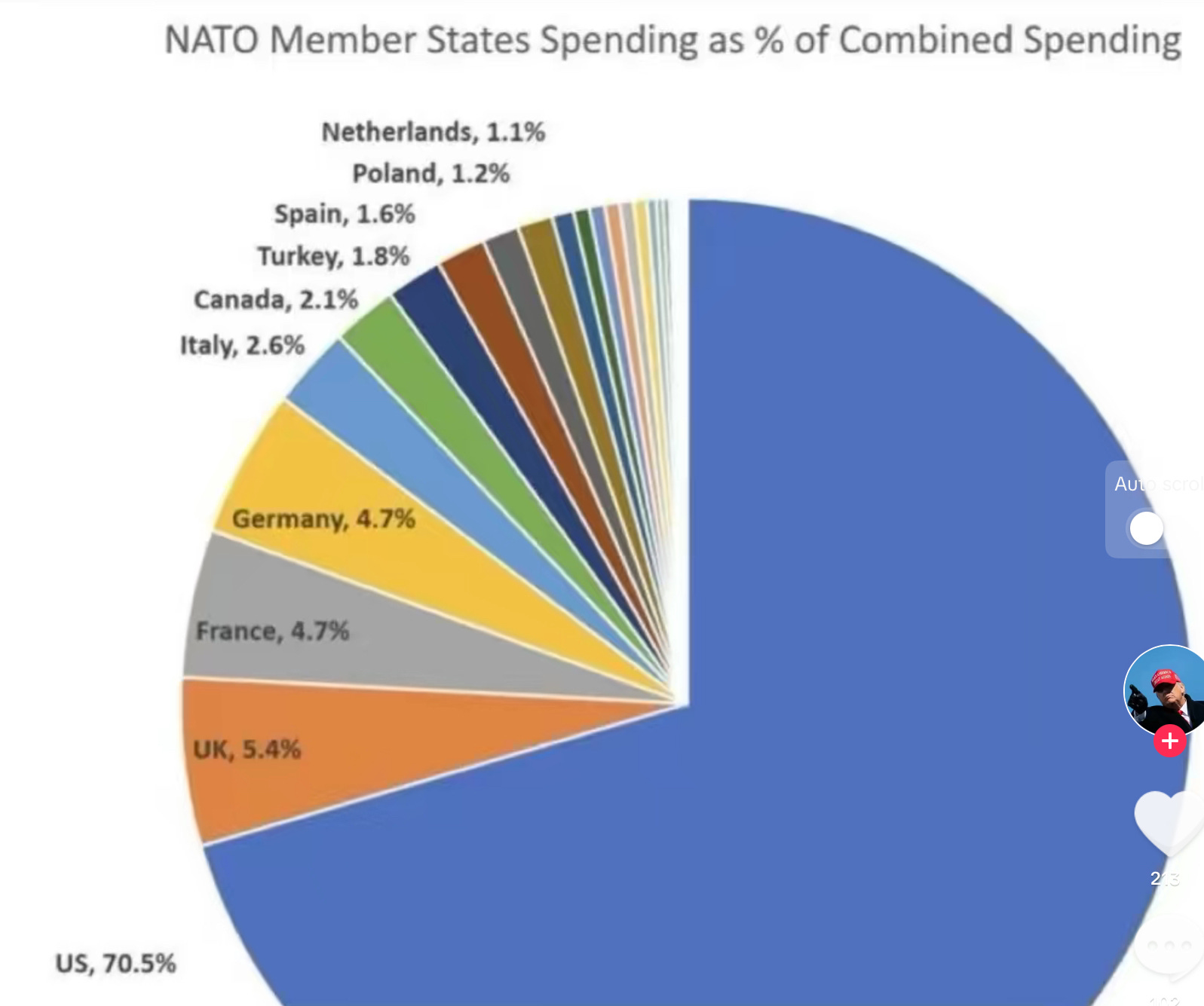
But I wouldn’t be surprised to learn that that 90-10 ratio is pretty standard. The US armed forces account for forty per cent of the planet’s total military spending. Does ninety per cent of that also get disbursed in the District of Columbia? On Thoroughly Modern Milley’s ribbon budget? It’s as good an explanation as any for the failure to win anything since VJ Day. The rube right’s antipathy to foreigners shouldn’t blind us to the fact that the overwhelming majority of the corruption is domestic — and it’s a very bipartisan sewer.

So I wish Trump, Musk et al the best of luck. But, notwithstanding that every rinky-dink District Court judge seems to be labouring under the misapprehension that he’s head of the executive branch of government, Trump has spent the last three weeks doing things. There is no sign that that is even possible in the rest of the west, where the Dutch model seems to prevail: Geert Wilders wins the election, but then gets neutered.

So, in a sense, Azu Ishiekwene is right. There is a yawning chasm between Trump and the poseur attitude-flaunting rest of the west. And yet Mr Ishiekwene is wrong on this: an erratic president is not almost alone in his insanity. In case you haven’t noticed, Panama won’t be renewing its Chinese deal on the Belt & Road Initiative, and El Salvador is happy to gaol anybody Trump sends them. It turns out that the quickest way to solve any international dispute is to threaten the recalcitrant with twenty-five per cent tariffs starting at midnight. If the forty-seventh president doesn’t seem interested in “winning hearts and minds”, it’s because he’s found something more effective.

February 7, 2025

USAID still very much in the news

Filed under: Government, Politics, USA — Tags: , , , , — Nicholas @ 03:00

Pretty much any libertarian can quote chapter and verse of how governments waste taxpayer money, but even the most doctrinaire libertarian must be boggled at the extent of waste and corruption enabled by the use of the cover organization USAID. And it’s only one federal agency! We may never be able to get a proper accounting, but it seems that a vast share of US tax revenue has been going to things never dreamed of by the framers of the Constitution or even by the legislators that set up all these various agencies.

On MeWe, Marc Adkins shared a post from a friend, discussing the USAID mess:

One of the dangers President Trump, Elon and DOGE face is that there is just so much crazy, bad, virtually unbelievable news coming out of USAID, the sheer volume [de-]sensitizes people to it.

I must admit, I’m beginning to be overwhelmed by the bad news. One begins to feel a sense of futility, especially when you have been paying taxes your entire life — for me, I have paid taxes since I was sixteen (on my part time jobs and gig jobs through high school and college) — that’s 50 years, and while what I have paid is extremely small compared to the USAID budget, it is simple math to calculate that everything I have ever paid, as well as everything many of us have ever paid has been flushed down the toilet. That is a tough thing to take.

And this has been going on since USAID was created by JFK’s executive order in 1961.

One of the hardest things to swallow in recent years is discovering that your tinfoil-hat-wearing conspiracy theorist friends may have been closer to the truth all this time. I mean, yeah, we all knew that the government wasted money as if that was their main job, but all the whacko theories about the CIA destabilizing hostile (and friendly) foreign governments (Ngô Đình Diệm waves hello), humanitarian projects being covers for espionage, all kinds of secret squirrel nonsense all over the globe … may have been far closer to the truth than what CBS, The New York Times, or PBS had to say about them. So instead of being the calm, rational people we thought ourselves to be, we’ve been the chumps for all these years. That will leave a mark.

I don’t think it is a leap too far to say that in some way, each one of us has paid for the enrichment of a vast array of US Senators, Representatives, cabinet members, agency heads and even vice presidents and presidents, as well as funding terrorists and brutal dictators worldwide. Hell, it appears we are paying lower level government employees double because the same people are drawing two paychecks!

Then there are the billions that are being automatically paid, flowing like a river to unknown entities, criminals, fraudsters, and into the accounts of programs, the authorization of which expired years and decades ago.

It is almost too much to take in, especially when, in the face of such obvious money laundering, payola, mismanagement and waste, Democrats hit the streets to protest the people uncovering all of it rather than screaming about the criminal waste and let’s not kid ourselves, this scandal is a left wing Democrat thing, they absolutely own it because this money is flowing to left wing NGOs, media and other organizations — I daresay there is a significant slice of the pie that winds up in Democrat coffers at the end of the process.

The memes are almost always on point:

The simple fact is they do not give two shits about the taxpayer working his ass off just have his entire life’s sum of his taxes from his career of working ten hours a day in the blistering sun and freezing cold just to pay his share of a USAID program for transing handicapped children in Botswana.

It is shameless, of course, but something we have come to expect from Democrats and every single Democrat who protests this should be run out of office and never allowed near government again — ever.

The problem isn’t really Democrats or even RINOs … it’s the seductive nature of political office, and the US government is the biggest, richest, most pervasive government that has ever existed. No matter how pure and noble your aims may be, prolonged contact with the vast resources of the US government and the ability to direct the efforts of that government toward your goals will overpower the scruples of the most honest of men. [Insert Elrond and Isildur “cast it into the fire” meme here.] This is, I think, why DOGE is so disruptive: it has the potential to utterly destroy vast swathes of existing government blight and perhaps even keep it from regenerating. A bit. Maybe. Even a dynamo like Elon will probably find that there’s just too much to tackle in one presidential term.

The butt hurt Democrats are beginning to parse things trying to minimize them. You heard how it works when Martha Raddatz told J.D. Vance after he mentioned that TdA gangs had taken over apartment complexes in Aurora, Colorado. She said, “The incidents were limited to a handful of apartment complexes …” as if the people in those complexes should grin and bear it because it just isn’t that bad.

Democrats have tried this when illegal aliens commit murders. They will trot out numbers that “prove’ American citizens are far more violent and it’s just a few murders anyway — as if the murders of innocents like Laken Riley are a statistic rather than a completely avoidable tragedy.

There are ludicrous people claiming that millions being sent abroad to support DEI, transgender plays, or to teach the Taliban how to be sensitive to women’s rights is just such a small number, it is OK – when, as in the Colorado gang situation, none of it should be happening.

The millions upon million that were sent to the left-wing media outlets that complied with the Democrats’ wishes to have hit pieces written about GOP candidates is harder to defend, but I’m sure some moron on MSNBC or CNN will find a way.

Here in Canada, of course, we’re much more familiar with the government of the day getting the kindest of treatment from the media … because the media get big subsidies from that very government, but at least it’s somewhat out in the open. US media may have been similarly subsidized, but until now it had been completely obscured.

Some people legitimately need help, and I am sure there are programs that do have a benefit to America, but this is the Democrats’ fault because the only way I see to fix it is to burn it all down and start over with an ironclad approval and review process. Every one of these alleged aid agencies should be required to produce an annual report for public view the same way legitimate private charities do.

And the quicker we strike the match, the faster this gets fixed.”

On Substack, Francis Turner points out that we’re only into the third week of the Trumptastrophe, and it’s glorious:

We’re in the third week of the political tsunami that is Trump 2.0. The DOGE boys are getting access to systems and turning off the money flows and the DC swamp creatures are panicking. I think they may be mistaking what happens now for about as bad as it can get, while actually what we have now is that moment when the sea retreats abruptly from the beach and poor widdle crabs and fishies are left flapping in pools that are too small for them. Although the FBI agents and DoJ persecutors prosecutors who were involved in the Jan 6 investigations and the Jack Smith fishing investigations are probably feeling the wave coming down on them. In particular I would very much not want to be the agent who pawed through Melania’s underwear.

Right now the lacka money, lacka graft and lacka future employment seems bad, and that may be all some of the bottom feeders experience, but in the weeks ahead we’re going to see just what the federal government was spending all that money on and just who was benefiting and what they were doing. People with nice modern automobiles, large houses and so on may be required to explain where the money for those possessions came from. That’s going to lead to prosecutions and, well, as Trump and the Jan 6 guys know the process is part of the punishment. Moreover, since the graft flow will have stopped, paying for defense lawyers etc. is going to be interesting. In particular it’s going to be really interesting because the big firms that might normally step up and offer pro bono support are likely to find the requests for support overwhelming and, simultaneously, their regular income from paying clients drastically reduced.

Well shucks

Mind you we have a while before that wave comes crashing down so it’s worth noting what we have learned so far.

The first is that Trump 2.0 is uninterested in slowing down. As I said in my previous post, DOGE are working 24×7 while the swamp is used to 9-5, Monday to Friday. With generous time for lunch etc. That means Trump/DOGE can (and have) got inside the OODA loop of the enemy. We can see this by how protests about DOGE actions are a couple of days after the action has happened. Moreover we see Trump people saying things like “yes we need to look at the Department of Education” which causes talking heads to rush to its defense. This is quite possibly a ruse and deliberate distraction.

February 6, 2025

The fascinating (domestic and) transnational role of USAID

Filed under: Government, Politics, USA — Tags: , , , , , , — Nicholas @ 05:00

One of the most interesting moves of the Trump administration so far has been the lightning strike to shut down the United States Agency for International Development (USAID):

On closing it down Musk said: “USAID is a criminal organisation. Time for it to die.”

On Friday last week, Elon Musk and DOGE wanted access to agency systems of the giant USAID. When senior officials refused, by Saturday they were put on leave.

    “Spent the weekend feeding USAID into the wood chipper,” Musk boasted on X.

    “It became apparent that it’s not an apple with a worm it in,” Musk said in a live session on X Spaces early Monday. “What we have is just a ball of worms. You’ve got to basically get rid of the whole thing. It’s beyond repair.” — AP News

Elon Musk and DOGE closed the doors, and sent the head honchos packing. One officeworker said staff rushed to take down things like Pride Flags and incriminating books (whatever that means), and now they have lost access to their computers, and the site is down.

As Donald Trump and Elon Musk cut back rogue government agencies, USAID looks more and more like a giant money laundering racket. It has (or had) 10,000 employees and a budget of $50 billion dollars. It’s presented as a humanitarian aid group, but the AID in US-AID means the US Agency for International Development which turns out to mean anything and everything. The humanitarian projects include giving $53 million dollars to the starving EcoHealth Alliance which used that to pay for bioweapon research in Wuhan, China, helping to create Covid-19. USAID also funded the production of heroin in Afghanistan. The WhiteHouse revealed that USAID also funded DEI projects in Serbia, and DEI musicals in Ireland. They spent US Taxpayer money on transgender operas in Colombia and a trans comic book in Peru.

As Mike Benz describes it, USAID was the Ultimate Nerve Center Of A Rogue Foreign Policy Establishment

Mike Benz, former State Department Cyber expert, has studied USAID closely and says:

    USAID grantee NGOs literally take their USAID money then turn around and lobby all key members of Congress to give more and more US taxpayer money to USAID each year in the budget. USAID buys an army of lobbyists with your tax dollars to give it more of your money.

He also wonders why USAID gave $27 million to the US fiscal sponsor of the group controlling Soros-funded prosecutors and telling them which American citizens and politicians to prosecute?

Indeed, somehow USAID is also one of the “BBC Media Actions” top ten donors? Go figure? It’s just the US of A helping out third world countries like the UK, right?

    As Mike Benz said: the “BBC was in direct cahoots with USAID leadership on Internet censorship efforts to crush BBC’s online populist news competitors since 2017. I went over 9 hours of receipts on this in a 3-part private livestream lecture for my X subscribers”.

The BBC part of The Blob takes Blob money to lobby to cripple the media outside The Blob’s control. The words “Self Serving” come to mind.

Ron Paul agrees — USAID is a key component of US Regime change, meddling in foreign affairs. The news from Ukraine is essentially being controlled by USAID. Ukrainian media is Blob media.

Jo Nova posted a follow-up the next day:

Hands up who is still reeling with the news that USAID had 50 thousand million dollars of political and media influence? The annual budget of $50 billion dollars in the hands of unaccountable activist NGOs buys a lot of “journalists”, editors and teenage protestors. Suddenly a lot of global patterns make more sense.

Today we found out that news outlets like Politico, and the New York Times were being given millions of dollars from the US government.

Benny Johnson says:

    This is the biggest scandal in news media history: No employee at Politico got paid yesterday. First time ever the company missed a pay period. This is a crisis. Now we learn Politico — a “news company” — which spent the last 10 years trying to destroy the MAGA Movement was being massively funded by USAID.

It seems some $27 million dollars went to Politico during the Biden years — and that’s just the subscriptions (not the USAID). Truly, Politico charges as much as $10,000 for a single “Politico Pro” subscription — and so the taxpayers fork out big bucks to pay for politicians “work expenses”, and the money ends up covering the salaries of journalists who are working hard to deceive the hapless taxpayers.

As ZeroHedge reminds us, Politico went in hard in the 2020 election to cover for the Hunter Biden laptop from hell.

They also point out that the Blob has many other ways to keep newspapers toeing the line…

    It’s not just the subscriptions: there are huge “ad contracts”, dinner parties DC throws itself under the guise of “media conferences”, sponsorships, etc all paid for by taxpayers. Once done with Politico look at its spawn Axios, founded by Politico veterans

Niccolo Soldo included some commentary on the USAID shutdown in his weekend post a few days back:

Today I learned that all NGOs working in foreign countries that are funded by the USGov are having their funding suspended for 90 days. This is already sending shock waves around the world, as not only are State Department officials losing their shit, but local NGO employees are wondering how they can continue operating in the meantime:

People are quickly learning just how much of a footprint the USA has in their countries and how significant an influence they have on politics in their homelands. All of their Trojan horses are being exposed at the same time, meaning that it will take some time for most people to digest the sheer scale and size of US meddling abroad.

Mainstream media is already beginning to push back against this funding suspension, using their typical tricks to try and paint this order as potentially “risking the safety of millions“:

    Marocco strode into the offices of USAid this week flanked by members of Elon Musk’s “department of government efficiency”, a special group Trump created, with clipboards in hand. Several hours later, almost 60 senior officials from the office had been put on paid leave. Veteran aid officials with decades of experience at the agency were escorted from the building by security, according to current and former USAid officials, and their email accounts were frozen.

    “They wanted to decapitate the organisation,” said a current USAid employee. “And they did it by pushing aside the leadership and decades of experience.”

    The purge followed confusion within USAid over the stop-work orders drafted by Marocco and signed by Marco Rubio, the new secretary of state, leading some to believe that limited actions could continue if funds had already been committed.

The Guardian UK has decided to focus its attacks on Mr. Marocco.

    “We have identified several actions within USAid that appear to be designed to circumvent the president’s executive orders and the mandate from the American people,” wrote Jason Gray, USAid’s acting administrator, saying the relevant staff would be put on administrative leave.

    Some employees have openly rebelled. In an email to all staff seen by the Guardian, Nicholas Gottlieb, USAid’s director of employee and labor relations, said that appointees at USAid and “Doge” had “instructed me to violate the due process of our employees by issuing immediate termination notices”.

    Calling the requests “illegal”, Gottlieb said he “will not be a party to a violation of [due process]”. Hours later, he was put on administrative leave.

    In a separate email to the sidelined USAid senior staff, Gottlieb wrote that the “materials show no evidence that you engaged in misconduct”.

Fight! Fight! Fight!

    The chaotic rollout of the ban has led to whiplash for critical programs around the world, from emergency Aids relief (which has been granted a waiver), to clean-water and sanitation programs, to the Famine Early Warning Systems Network, which the Washington Post reported on Friday had gone offline.

    Yet there are few details of a vast review program, which is supposed to evaluate thousands of foreign aid grants as well as an expected torrent of waiver requests. And a number of the senior USAid staff put on administrative leave were lawyers who had helped prepare requests for exemptions from the foreign aid freeze, sources said.

Demoralization:

    Previous cables indicated that the people involved would include Marocco or the new director of policy planning, Michael Anton, another political appointee. The state department declined to answer questions from the Guardian about who is evaluating the reviews and how many staff had been detailed to the process.

    “We’re all trying to figure out, is there a review process? Who’s part of that review?” said the former senior USAid official. “Is it Pete Marocco and his two best friends?”

    At USAid, other directives have been enacted that have both defunded and demoralised staff. Photographs of aid programs around the world have been literally stripped off the walls after a “directive has been issued to remove all artwork and photographs from the offices and common spaces across all buildings”.

    Musk’s “efficiency department” has crowed about slashing $45m in scholarships for students from authoritarian Burma.

    The $40bn a year that the US spends on foreign aid is less than 1% of its budget. But the US spends $4 out of every $10 spent globally on humanitarian aid, according to the state department, and the sudden cutoff has led to thousands of layoffs among US contractors and local partners around the world.

And of course:

    A former USAid official said the decisions could put millions of people around the world at risk.

    “If there’s a tropical cyclone that hits Cox’s Bazar tomorrow, then how are you going to save all those people, and then how are you going to rebuild if there’s a stop-work order?” said a former senior USAid official, referring to the city in Bangladesh where more than 1 million Rohingya refugees are living. “You could have people sitting there for 90 days and sitting and waiting for what? That’s what worries more.”

Critics who say that this order effectively reduces US influence abroad are absolutely correct … but what if this is part of a widely-assumed fundamental change in how the USA conducts its foreign policy?

Seen on the social media network formerly known as Twitter:

Trump tariff diary, day 5

Filed under: Cancon, Government, Media, Politics, USA — Tags: , , , , — Nicholas @ 03:00

The attention shifted away from the BOM kicking the Little Potato around as BOM floated the idea of annexing the Gaza Strip (as Eastern New Jersey?) on social media. There goes at least 24 hours of media hysteria …

Justin Trudeau’s vision of Canada

As I’ve pointed out a few times, the situation didn’t blow up out of nowhere (we’re back to the Trump tariffs, not the Gaza Strip), as Trump had given ample warning that this was an important issue for him. However, as Roxanne Halverson points out, Trudeau’s government paid it not the slightest bit of attention until Trump forced them:

This means Ontario Premier Doug Ford who threatened to cancel a $100 million dollar Starlink contract with Elon Musk to provide high-speed internet to northern and rural Ontario communities because of Musk’s strong ties to Trump. And perhaps BC Premier David Eby shouldn’t have threatened to take alcohol products from “red states” in the US off the shelves of BC liquor stores. And perhaps Team Trudeau shouldn’t been trying to play the mouse that roared by threatening to slap retaliatory tariffs on American products coming into Canada, given that it means Canadians will pay more for products like fruits and vegetables that we simply can’t get here in the winter. And that goes for all the provincial premiers, with the exception of Alberta Premier Danielle Smith.

And for all Canadians — particularly those who voted for Trudeau — who are so angry at Trump that they are blowing up the internet with memes, threatening never to vacation in the States, and booing the singing of the American anthem at hockey games — grow up and smarten up and rethink who your anger should be directed at.

Everyone needs to recognize the fact that Trump made it pretty clear about the tariffs when he was campaigning for the US presidency, after he won the presidency — but had yet been officially sworn in — and as soon as he entered the Oval Office. And yet everyone seemed so shocked when he did it — including Prime Minister Trudeau.

Trump also made it pretty clear what he was after — fix Canada’s porous border and fix the drug trafficking problem — and the fentanyl problem in particular. And thanks to the dithering of the Trudeau government — vacillating between “negotiating and diplomacy” and talking “tough”, as well as using the issue as a campaign tool, this is what it came to. Because, it would seem, Trump didn’t think his request was being taken seriously so he made it serious. One thing Trump recognizes is weakness, and it is something he is willing to take advantage of it. And in Canada he saw weakness — weak leadership and an weak economy. Another thing Trump is very good at, and that is rattling people and he did that in spades on Saturday — and by Sunday he got results.

For all the Canadians who are mad at Trump for starting these tariff wars, particularly those who voted for Trudeau. Remember this … if Canada had a strong economy that hadn’t been driven into the ground by ten years of Liberal economic, monetary, social engineering and “green” policies we wouldn’t be so vulnerable to Trump’s tariffs.

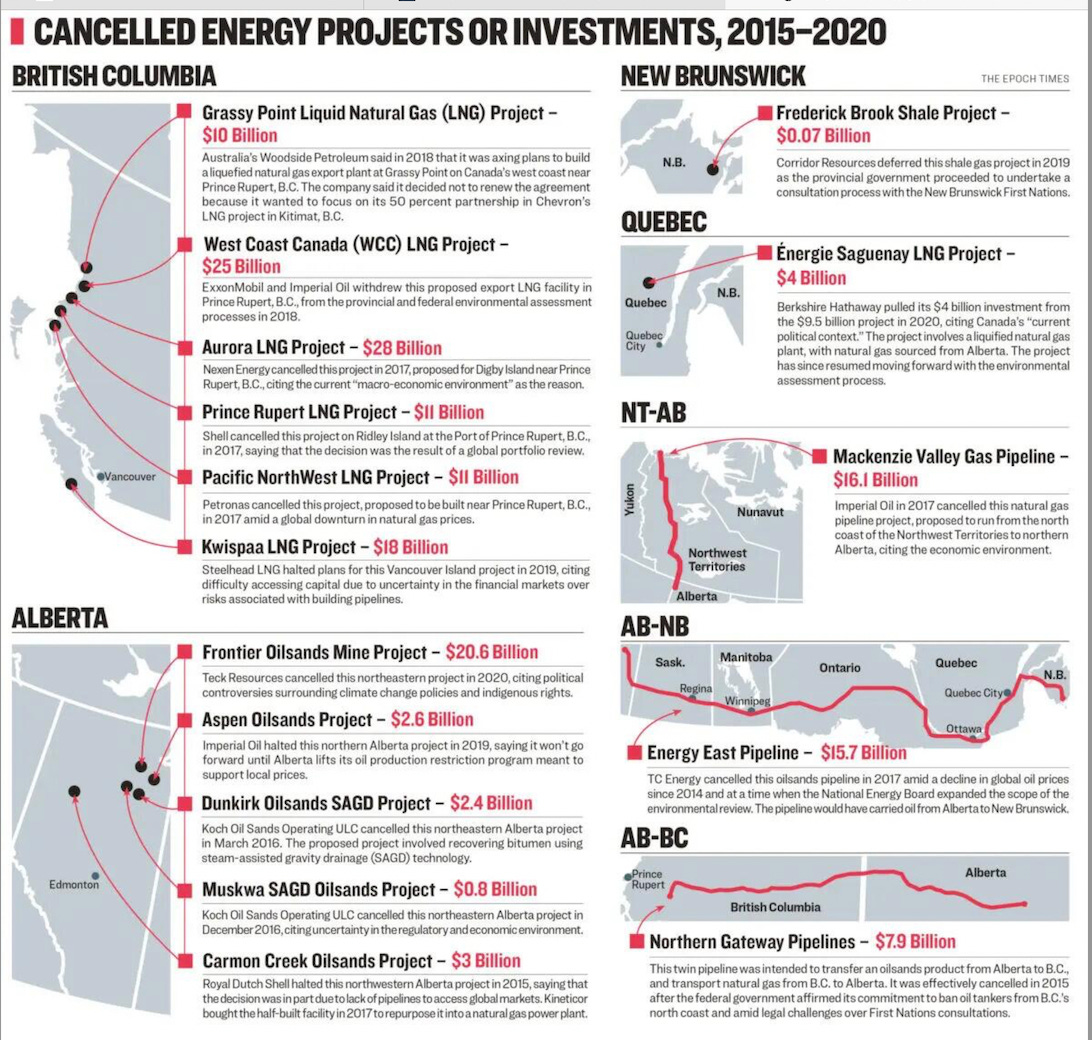
Trump didn’t halt the building of pipelines that could have taken our oil products to both eastern and western coasts to be shipped to markets overseas. This would have expanded markets for Canadian oil, meaning we wouldn’t be selling sell the bulk of it to the Americans at bargain prices. It wasn’t Trump who drove billions, if not trillions of dollars in investments out of the country by overtaxing businesses with ever increasing carbon taxes and various other in sundry operating costs, or stifling business growth with endless crippling green energy policies and regulations, or extinguishing any chance of expanding our natural gas production to sell to overseas markets by claiming “no business case” for it.

The business investment picture in Canada shows a clear decline dating almost exactly to the start of Trudeau’s time in office:

The Canadian government’s (and several provincial governments’) hostility to economic development and infrastructure expansion is clearly illustrated, I think.

February 5, 2025

Trump tariff diary, day 4

Filed under: Cancon, Government, Media, Politics, USA — Tags: , , , , , , , — Nicholas @ 03:00

The Big Orange Meanie and the Little Potato had a phone call, after which the BOM announced a 30-day delay to the imposition of tariffs. In Canada, all of “peoplekind” were relieved to hear that they won’t have to give up their American-made binkies quite yet. Some appropriate snark from The Free Press:

It was actually a phone call between the BOM and the Little Potato, but we can imagine this is what it would have looked like in person.

Mexican president Claudia Sheinbaum Speedy Gonzales’d her way to a deal with Trump yesterday, promising to deploy 10,000 Mexican troops to the border to stop the flow of illegal immigrants and drugs. In return, Trump agreed to pause his 25 percent tariff on goods coming from south of the border. Soon after, he struck a seemingly identical deal with Justin Trudeau, who said he’d appoint a “fentanyl czar” and promised to send 10,000 Canadian troops to the northern border. Who knew they even had that many?! Tariffs will still be levied against Chinese goods starting today, but Trump says he plans to talk with President Xi Jinping as soon as this week.

The FP isn’t wrong … the Canadian Army doesn’t have 10,000 spare troops just hanging around their barracks who could be sent to the border, so it’s much more likely to be a combination of Canadian Border Services Agency (CBSA) agents, RCMP officers, provincial police (if the respective provinces are willing), and whatever the army can spare. (Trudeau refers only to “nearly 10,000 frontline personnel”, not “troops” as a lot of US reports state … that seems a lot more achievable.)

You may be wondering how the US President has such disruptive and antagonistic tools at his disposal. It’s yet another hangover from the Carter years, as Congress delegated these powers to the president in 1977:

Donald Trump as Napoleon the 47th.
Image generated by Grok.

The emerging on-off-on-off trade war between Canada and the United States has everyone asking “How should we fight?” — understandably enough — but we should not move too quickly beyond the question “How is this literal nonsense at all possible?” How did the U.S. Congress’s clearly specified constitutional power to regulate the country’s commerce with foreign nations fall into naked and unapologetic decrepitude? Why is every new American president now a Napoleon, and why isn’t this at all a political issue in the U.S.?

The American Constitution, it seems, has no political party apart from a handful of cranky, tireless libertarians like Gene Healy, Clyde W. Crews or Ilya Somin, who has a new article spitballing possible litigation approaches for Americans who lie in the path of the tariffs now being wishcasted into existence by Napoleon the 47th. Somin explains that President Donald Trump is using an openly contrived “national emergency” to invoke powers delegated to the White House by Congress in 1977, powers that are to be invoked only in the face of “unusual and extraordinary threats” to the Republic.

Since the president apparently has plenary power to define an emergency, and to do so without offering anything resembling a rational explanation, this act of Congress now appears to be less of a delegation and more of a surrender — a total abandonment of constitutional principle and the classical separation of powers. I pause to observe that the cheeks every Canadian should redden with slight shame at the spectacle of frivolous recourse to the law of emergencies causing obvious and sickening injury to the rule of law in the U.S. (Oh, no, that could never happen here!)

February 4, 2025

Trump tariff diary, days 2 and 3

Filed under: Cancon, Economics, Government, Media, Politics, USA — Tags: , , , — Nicholas @ 03:00

Posted to social media yesterday:

To celebrate Groundhog Day, Governor Trudeau wore commemorative Groundhog-themed socks. Governor Trudeau’s announced counter-tariffs seem to have made no difference to the Big Orange Meany, so the Great State of Canada proceeds with plans to annex Guam and American Samoa. China has indicated interest in purchasing Vancouver Island or leasing the naval base in Esquimault. The National Post‘s Tristin Hopper suggested “Spend 10 years relentlessly kneecapping the Canadian economy for no reason to show Trump we’re not scared of him”, but we’ve already done that.

Today’s tariff diary entry was going to be:

Reports indicate that the Mexican government is folding to Trumpian pressure. Governor Trudeau insists he won’t budge, regardless of the economic damage to Canadian consumers … what a hero! A few of us may lose our jobs, our businesses, and our economic futures, but he’s willing to take that risk. Update: Trudeau folded like the cheap suit he so resembles. Tariff war on hold for 30 days as Trudeau looks for a way to sign the terms of surrender without any blame attaching to him or his party … he’ll probably blame the provincial governments and the federal NDP (who’ll still support him in Parliament, regardless).

… But the “pause” in tariff enforcement may be enough to let Trudeau and the Liberals — with the active connivance of the bought-and-paid-for Canadian legacy media propagandists — portray this as a great national victory and attempt to turn it into votes for Liberal candidates in the next federal election. I’d love to be proven too cynical here, but the Liberal track record isn’t good.

February 3, 2025

Rational response to Trumpish provocations? Don’t be silly, we must run in circles with our hair on fire!

My first entry in the “Trump tariff diary” on social media perhaps takes the situation too flippantly:

President Trump trolled Justin Trudeau about Canada becoming the 51st state.

Trump tariff diary, day 1: Governor Justin Trudeau of the Great State of Canada struck back at the Big Orange Meany by wearing particularly fashionable socks to his press conference. Ontario will remove all bottles of Jack Daniels from the government liquor monopoly distribution system. The American national anthem will be formally booed at all NHL games played in Canada from now on.

At the National Post, Tristin Hopper offers much more substantive and serious suggestions:

Order Ryan Reynolds to defame American directors until free trade is restored.

Spend 10 years relentlessly kneecapping the Canadian economy for no reason to show Trump we’re not scared of him.

Politely suggest that the U.S. may have confused us with China. Say that although both countries start with the letter C, China is the one seeking to destroy American hegemony via economic means, and we’re just an obsequious neighbour who sells them raw materials.

As a gesture of fealty to American continental supremacy, immediately adopt the U.S. Constitution as Canadian law. Uphold it about as loosely as our existing constitution so there’s no material change.

Volunteer an honour guard of Mounties to serve alongside the Secret Service. Force them to wear red serge if Trump asks.

Offer to pillory a Trudeau at Mar-a-Lago if the tariff threats stop, but don’t specify which one.

Put sugar in the crude oil so all the U.S. refineries seize up.

Instead of shutting off Canadian electricity exports, export too much electricity so that their toast burns and the coffee is too hot.

Send Trump a bentwood box filled with smoked salmon as a gesture of goodwill. When he opens it, it’s just filled with bees.

On a rather more serious note, PPC leader Maxime Bernier posted this on the social media platform formerly known as Twitter:

It’s important to understand that the 25% tariffs announced by President Trump today are NOT imposed on Canada — they will be paid by American consumers and businesses who buy goods imported from Canada. Tariffs are a tax, and Americans who will have to pay more or go without our products will be the first to suffer.

Of course, Canadian exporters of these goods will as a consequence lose clients, contracts and sales, and will be forced to cut down on production and lay off workers. Or they will lower their prices to keep market shares and will see their profits diminish.

Because 75% of our exports go south of the border, our economy will for sure be very negatively impacted by this.

The stupidest thing our government can do however to deal with this crisis is to impose the same kind of tariffs “dollar for dollar” against US imports.

The US economy is ten times bigger than ours, much less reliant on trade than ours, and much less dependent on our market than we are on theirs.

Not only would retaliatory tariffs have much less impact on American exporters, they would immediately impoverish Canadian consumers forced to pay more for imported goods, as well as destabilize Canadian businesses that need inputs from the US in their production processes. It would more than double the harm of the US tariffs to our economy.

Trade wars are bad for everyone, but they are much worse for a small country with fewer options. We simply cannot win a trade war with the US. It’s very unlikely that Trump will back down. All we will do is provoke a massive economic crisis in Canada, until we are forced to capitulate.

Another self-destructive thing to do would be to set up giant “pandemic-level” bailout plans to support everyone affected by this trade war. This will simply bankrupt our governments even more than they already are and make us even weaker.

So what should we do?

1. Double down on efforts to control our border, crack down on fentanyl dealers, deport all illegals, and impose a complete moratorium on immigration, to answer Trump’s immediate concerns about Canada.

2. Tell the US administration that we are ready to renegotiate North American free trade and put dairy supply management and other contentious issues on the table.

3. Wait and see to what extent Trump is willing to keep tariffs in place despite the harm it does to the US economy. Despite his pretenses that Americans don’t need our stuff, the reality is that on the contrary they have few other options for crucial resources like oil, lumber, uranium and other minerals, etc. He will stop acting like a bully when he sees that he can get more results by sitting down and negotiating.

3. To reduce our dependence on the US market, immediately implement an ambitious plan to tear down interprovincial trade barriers and help our impacted exporting industries find alternative markets in other countries.

4. Immediately implement a series of bold reforms to make our economy more productive, including: reduce corporate and personal taxes, abolish the capital gains tax, abolish all corporate subsidies, get rid of excessive regulation, remove impediments to the exploitation and export of natural resources, drastically cut government spending, mandate the Bank of Canada to stop printing money and start accumulating a gold reserve to prepare for the global monetary reset (which is likely part of Trump’s plan).

In short, instead of adopting a suicidal strategy to confront Trump, we must do what we should have done a long time ago to strengthen our economy and our bargaining position. The transition will be rough, but not as much as complete bankruptcy and disintegration.

My strong suspicion is that Trump’s extended tantrum directed at Canada is actually a way to provide pressure against other future tantrum targets … “if he’d do that to friendly neighbour Canada, what won’t he do to us?” An updated version of Voltaire’s quip that Britain needed to shoot an admiral every now and again pour encourager les autres.

Coyote Blog facepalms over Trump’s self-sabotage of the US economy:

Trump’s first few weeks have been a mix of good and bad for this libertarian, all against a backdrop of horror at how Imperial the presidency has become. […] Because we are all tired of those fentanyl-toting Canadians crossing the border illegally. I mean, we all saw the Proposal and know how all those Canadians are trying to cheat US immigration law.

Seriously, this is beyond awful — and not just because of the threat of retaliation, though that is real. Even if all the affected countries roll over and accept these modified tariffs without response, this is still a terrible step for the US. No matter how Trump and his very very small group of protectionist economist friends sell this, this is a tax on 300 million US consumers to benefit a small group of producers. I don’t have time right now to give an updated lesson on free trade — that will have to wait for when I am not on vacation. But I will offer a few ironies:

  • After campaigning hard on inflation, Trump is slapping a 10-25% consumption tax on foreign goods. That is a straight up consumer price increase for a variety of key products including much of the lumber we use to build homes, a lot of our oil and gas, a lot of our grain and beef, and many of our cars and appliances.
  • Much of this inflation is going to disproportionately hurt Trump’s base. No one is going to care much if a Hollywood actor has the fair trade coffee they buy at Whole Foods go up in price, but Trump voters are going to see a direct effect of this on prices at Wal-Mart.
  • Republicans have spent 4 years (rightly) condemning Federal and State governments for the economic disruptions of COVID lockdowns and restrictions. While some of the inflation of the last 4 years was due to ridiculously high government deficits, another major cause was the COVID supply chain disruptions. And now Trump is voluntarily recreating them.

The only small hope I have is that Trump is steeped from his business career in a certain style of brinksmanship bargaining that consists of taking an entirely destructive and irrational position in hopes that they folks on the other side of the table will back down and give him more than he should. My son won poker tournaments like this because he would do so much crazy stuff that no one at the table wanted to challenge him. I have always said that I don’t think Trump is a particularly good business person — he has run business after business that has failed. But he is a good negotiator, and has exited numerous bankruptcies with his creditors giving him far more than one would think was necessary.

February 2, 2025

Captain Trumpmerica versus the Post-national Maple Protectionists

Donald Trump has made picking fights with the corrupt oligarchs of Mexico and Canada a key part of his appeal to American voters. Canada used to be a proud nation, but after years of deliberate mismanagement and stubborn opposition to innovation and growth, we’ve become — as Justin Trudeau so smugly put it — the first “post-national state” that has “no core identity [and] no mainstream”, because we’re a plaything for the WEF and other transnational organizations. Elizabeth Nickson calls us a “failed state” and that swapping in globalist WEF’er Mark Carney for globalist WEF’er Justin Trudeau will make no positive difference:

25% tariffs will ruin us. The tariffs mean one million small businesses — all which sell to the U.S. — will contract and many will close their doors. And then Trump, as he promised the unions, will pull “our” auto industry. Then we’re done.

Who is to blame for this?

The following is going to be crude because Canada is so boring (that’s deliberate) that no one cares. There are a thousand ultra-complex rationales on why Canada is failing and all they do is obfuscate. I’m not pulling punches, softening rhetoric — it is bad. It is urgent. This is the death of something that 75 years ago was shining, sunlit, exciting. That country? That country was killed by the Laurentian elite, weak, cosplaying Marxism to stay in power, themselves outwitted by investment bankers who plan to steal everything not nailed down. In so doing new elements were forcibly injected into the population: envy, resentment of the successful, sloth, the refusal to grow up, be strong and independent. We effectively sit on top of the U.S., seething with envy, in wet diapers.

We are a broken country. Everyone who understands the world knows this. The only people who don’t are deluded Canadian socialists, which is to say our entire elite and all our “knowledge class”. Dissent is ignored. Or jailed.

Central banker Mark Carney, WEFer paramount, is being parachuted into the Liberal party in order to sell us off to the investment banks who will harvest us for our resources. Our people? Future serfs in Special Enterprise Zones. We already have the regulation in place. No taxes, no worker rights, no enviro controls, no self-determination, no agency, no freedom. Time frame? Ten years, twenty at the outside. The inevitable end of hard-core socialism.

That is what Carney did to Canada in the ‘08 crisis, a crisis entirely created by larcenous government and investment bankers: he loaded us up with so much debt that the moment the economy turned, the working class — and Canada is now 75% working class — paid for it through interest rates so high they crippled and broke every middle class family with a mortgage. Then, he moved to England and did it to the English. His name there? Mark Carnage. During the ’08 crisis, he in Canada and the UK and Obama in the US transferred trillions in public wealth to the investment banks to keep them going after the worst crisis since ’29. A crisis they caused. That was the people’s money, not theirs.

However, as Peter Menzies points out, our Laurentian Elite are still 100% protecting us from the baleful influence of American culture … well, the commercial bits anyway:

Next Sunday, the federal agency responsible for the flourishing of national culture and identity will be swamped with complaints. The grumbling will emanate from Canadians enraged they can’t get more American culture. Yes, America may be in the process of humiliating Canada as its lamest of lame duck leaders, Prime Minister Justin Trudeau, waddles into the sunset. And, for sure, most of us are mortified that U.S. President Donald Trump has chosen to make an example of us as he launches his mission to bring the globe to heel and Make America Great Again.

But the bitching directed in the days to come at the Canadian Radio-television and Telecommunications (CRTC) headquarters in Gatineau will originate from Canadians angry they can’t watch American Super Bowl TV ads along with the game. A perennial contender to be the most watched TV event in Canada, the Super Bowl also has traditionally been the most controversial event on the CRTC’s calendar.

The USA can slap us silly with tariffs. It can send hundreds of thousands of us into unemployment and despair. It can mock our disinterest in maintaining the essentials of nationhood and drive us into unsustainable debt. Trump can brutalize our national esteem and taunt us for our cavalier attitudes towards the defence of our sovereignty. And he can lick his big beautiful lips while pondering our potential as the 51st state.

But what will really light us up Feb. 9 will be being unable to watch Meg Ryan and Billy Crystal reinvent their famous restaurant scene from When Harry Met Sally or Michelob Ultra’s production starring Willem Dafoe and Catherine O’Hara as a couple of pickleball hustlers. Or Matthew McConaughey channeling legendary Chicago Bears coach Mike Ditka for Uber Eats. And the Clydesdales. Everyone loves those Budweiser Clydesdales, particularly the cute little foal making a debut.

It doesn’t matter that the ads cost $7 million U.S. (which will convert into heaven only knows how many bazillion loonies in the months ahead) for a 30-second spot. Or that for more than a decade many of the commercials have been available on YouTube. Canadians don’t want to watch a Super Bowl adorned with Government of Ontario and Maple Leaf Foods ads. They want to watch the game like real Americans and relish the full, unfettered American experience.

At the National Post, a sad recounting of just how badly we’ve been let down by our politicians — and not just recently … this is a decades-long list of conscious self-harm for short-term domestic political advantage:

Bold counter-attacks against the U.S. can’t work, because all the ideas Canada could have put into action to make such a response viable are collecting dust on the cellar shelf. Drop interprovincial trade barriers that amount to a $200-billion penalty on the national economy every year? That only became a serious conversation in the last month. It should have been a serious conversation 10 years ago, if not more.

End supply management? Out of the question — think of the Quebec votes such a move would cost. The Big Milk lobby is a strong one.

How about resource development? Because Canada is ultimately a resource-exporting economy? No; we’ve been cancelling energy projects at the slightest objection and building more legislation to stand in their way. Industries like mining and fishing, already mired in growth-choking regulations, are increasingly refashioned by governments into welfare and “reconciliation” initiatives, repelling private investment that would have brought prosperity to the country as a whole.

Diversify away from the Americans? We’ve only done the opposite: since 2017, Canadian trade has become more focused on the U.S.

Canada should be a prosperous, growth-oriented economy, but instead, its government — and the people who continuously vote for economy-stagnating policy — settle for subsistence and redistribution of a shrinking pie of wealth. Their choices for the past decade have left us without enough fat to get through a cold trade winter.

Prompt retaliatory counter-tariffs are hence unwise. Such a move would put Canadians in the path of two separate blows, one from the front, the other from the back. And while immediate counter-tariffs could affect Americans whose support the president depends on — as was the case in the 1930s, when Canadian counter-tariffs prolonged the American Great Depression (while inflicting domestic pain) — those Americans have much bigger economic fat stores. In a trade war of attrition, expect Canada to lose.

That leaves us, unfortunately, with the less-glamourous immediate option: play this by the book. The United States-Canada-Mexico free trade agreement, which will be violated by any across-the-board tariff Trump applies, needs to be challenged with the mechanisms agreed upon by party states. During the process, Canada must remind Trump that it’s just following the agreement that he made.

« Newer PostsOlder Posts »

Powered by WordPress