It’s very unlikely that the violent communists using the paradox of tolerance as a defense have actually read what Karl Popper said in full. They will cite a general summary and ignore the full context of what was actually written.
In note 4 of volume 1, chapter 7, of Popper’s The Open Society and Its Enemies, he clarifies his position on how best to deal with intolerant philosophies:
… I do not imply, for instance, that we should always suppress the utterance of intolerant philosophies; as long as we can counter them by rational argument and keep them in check by public opinion, suppression would certainly be unwise. But we should claim the right to suppress them if necessary even by force; for it may easily turn out that they are not prepared to meet us on the level of rational argument, but begin by denouncing all argument; they may forbid their followers to listen to rational argument, because it is deceptive, and teach them to answer arguments by the use of their fists or pistols. We should therefore claim, in the name of tolerance, the right not to tolerate the intolerant.
It is clear from Popper’s writing that it would be unwise to resort to violence against an intolerant group that is willing to discuss and debate their ideas. So long as the intolerant group is tolerant enough to agree to debate and discuss their intolerant ideas rather than resort to violence, it is better to handle them with words.
The problem is, some groups, like Antifa, respond to arguments with violence. And it is these sorts of groups that Popper claims must not be tolerated. If a group is so intolerant that they are unwilling to discuss ideas and instead rely entirely on violence, then they must be met with violence. In other words, Popper is simply saying that a nonviolent society must, at the very least, believe in a right to use violence as a form of self-defense.
Nathan Kreider, “Misconceptions of the Paradox of Tolerance”, Being Libertarian, 2019-05-31.
August 13, 2019
QotD: Karl Popper on the paradox of tolerance
August 11, 2019
QotD: Deconstructing “Minoan Crete”
Perhaps the most prominent high priestess of the Great Goddess was Lithuanian archaeologist Marija Gimbutas (1921-1994). During the 1950s and 60s Gimbutas developed her so-called “Kurgan Thesis;” basically the idea that the archaeological marker of the arrival in Europe of Indo-European-speakers was to be found in the Bronze Age Kurgan mound burials of the Pontic Steppe, a vast region incorporating most of present-day Ukraine, southern Russia and northern Kazakhstan. Controversially, Gimbutas further claimed that these nomadic Indo-Europeans brought with them a warrior-culture dominated by male sky-gods, which supplanted earlier matriarchal and goddess-worshipping cultures. In this, she echoed ideas already expressed at great length by Robert Graves in his 1948 book The White Goddess. Over the next three decades Gimbutas developed her ideas further in a series of books, articles and lectures delivered at campuses throughout America and Europe, where she was immensely influential amongst the burgeoning women’s movement. Three major works, The Goddesses and Gods of Old Europe (1974), The Language of the Goddess (1989), and The Civilization of the Goddess (1991), presented an overview of her conclusions regarding what she saw as Europe’s primeval matriarchy.
The importance of Gimbutas in the development of the matriarchal myth, and also by extension in the development of modern radical feminism, cannot be overstated. Her archaeological experience and expertise, together with her wide knowledge of linguistics and anthropology, seemed to give academic credibility to the romantic and poetic ramblings of Arthur Evans and Robert Graves. Yet in retrospect it is hard to imagine why anyone with even a modicum of common sense could have been taken in.
There were warning signals everywhere. Right from the beginning, for example, many historians were critical of Evans’ interpretation of Minoan Crete, and a devastating blow was delivered in 1974 when German author Hans Georg Wunderlich published his Wohin der Stier Europa trug? (Where did the Bull carry Europa? published in English in 1975 as The Secret of Crete). Here Wunderlich, a trained geologist, examined the structure of the “palace” of Knossos in Crete in detail and came to the conclusion that the building could never have been a palace for the living. It was, instead, a charnel house, a massive necropolis which doubled as an arena for human sacrifice. For the happy-go-lucky “bull vaulting game”, said Wunderlich, was nothing of the sort: it was a ferocious form of human sacrifice which involved young men and women being gored and trampled to death by a sacred bull. This, said Wunderlich, was the origin of the legend of the Minotaur. Since Wunderlich’s time human sacrifice has been confirmed as an integral part of Cretan religious practice, whilst the supposed “pacifism” which Evans and others had imagined, was exposed as nonsensical.
Emmet Scott, “The Myth of the Primeval Matriarchy”, The Gates of Vienna, 2016-07-13.
August 6, 2019
English has become what Esperanto was designed to be
As a teen, I was quite curious about Esperanto … enough that I ended up buying several books in the language and making a few semi-serious attempts to develop fluency. I still have those books in my library, but I never actually achieved any firm grasp of Esperanto. It was the most successful of a number of attempts to create a universal second language, intended to allow people to communicate with others who did not speak their primary tongue. When I was young, I also believed that this was a way to reduce inter-cultural frictions and in at least a small way to lower the risks of war between nations. As I got older and more cynical, I realized that Douglas Adams probably had the truth of it in describing the Babel Fish from his novels:

Anatomy of the Babel Fish as explained in the BBC TV series.
The Babel fish is small, yellow, leech-like, and probably the oddest thing in the Universe. It feeds on brainwave energy received not from its own carrier, but from those around it. It absorbs all unconscious mental frequencies from this brainwave energy to nourish itself with. It then excretes into the mind of its carrier a telepathic matrix formed by combining the conscious thought frequencies with nerve signals picked up from the speech centres of the brain which has supplied them. The practical upshot of all this is that if you stick a Babel fish in your ear you can instantly understand anything said to you in any form of language. The speech patterns you actually hear decode the brainwave matrix which has been fed into your mind by your Babel fish.
[…]
Meanwhile, the poor Babel fish, by effectively removing all barriers to communication between different races and cultures, has caused more and bloodier wars than anything else in the history of creation.
All that aside, Douglas Todd points out that despite all of its manifold complexities, the English language is actually taking on the role that Esperanto and other artificial languages were intended to do:
I recently travelled to the home of Ludwik Zamenhof, the Russian-Polish Jew who in 1873 invented Esperanto. It was intended to become the world’s first universal language.
Hoping it would end wars, Warsaw-based Zamenhof dreamed Esperanto would encourage people to come together under a common language. He thought that kind of connection would help overcome the distrust that can be exacerbated by the globe’s multi-language Tower of Babel.
Zamenhof’s vision of a common language caught on for hundreds of thousands. I have met people in Poland, South America and elsewhere who learned Esperanto as children. But, needless to say, the cause of Esperanto is now virtually lost.
Whether we like it or not, English is on the road to become the world’s lingua franca.
It is not the world’s most spoken language — that’s Mandarin. But English is arguably the language most commonly adopted as the medium of communication between speakers whose native languages are different.
I know I’m not the only Canadian who has travelled — in my case to Indonesia, Argentina, Denmark, Spain, Poland, Brazil, Turkey, Germany and elsewhere — and witnessed a collection of multilingual speakers suddenly revert to English, even if awkwardly, as they seek a shared way to talk.
It is a thing to behold. It is humbling.
As a native English speaker, I am not proud to say I only know about 1,500 words of French that I have trouble putting together in a meaningful way. I’m intimidated by new languages, whereas many friends and family are polyglots. So, for that matter, are most Europeans, where 97 per cent of 13-year-olds now study English.
It rarely ceases to amaze me when disparate multilingual people around the world show me and others their respect (and perhaps their pity) by speaking in English. Of course, most of them also like the chance to practise the language, since they know it is a key to new vistas.
August 2, 2019
QotD: What we mean by “civilization”
Which is when the dime dropped and I realized you guys immediately translated civilization to “as good as we have or better.” Which, of course, made me giggle. Because I’d have liked you to tell a Roman, with their world-bestriding empire that they weren’t civilized. Or, before that a classical Greek.
Understand I am not imagining others before us had the internal combustion engine, or steam, or trains, or … Sure, they might have, but that’s a heck of a coincidence, since those things usually come about by an individual stroke of genius, and even when they do they often aren’t used the way we did (Romans and their mechanical toys.)
To imagine other civilizations of which we’ve forgotten every trace followed exactly the same route we did to the same place we’re at requires believing that inventing steam and the internal combustion engine and harnessing electricity is as natural to humans as dams to beavers.
Now, maybe that’s true. It would certainly make for a very good science fiction story. (Short story, I think. Too much of a punchline thing for a novel.) BUT the odds defy rationality.
I was imagining, you know “builds houses of wood or stone. Domesticated SOME animals. Has villages and cities. Might have trade over long routes. MIGHT have had wheeled vehicles.” (The last, as we know, one can have quite sophisticated civilizations without.)
Look, it’s not your fault. Since the seventies, we’ve been bombarded by crazy BS about superior aliens or superior lost civilizations. (And before that, there was a trickle of it, too, going back I think to the eighteenth century, just couched in different terms.) You’ll get stuff about how the pyramids were built of stones that floated at the sound of a certain note. (A C note, or the equivalent, I bet. “Listen, Mac, you take this stone to the top of the pyramid, I give you a C Note. A hundred Amontheps in your pocket, bucko. Buys a lot of fish and falafel.”)
Part of this, and part of the reason it intensified since the seventies were the “unilateral disarmament people.” You know, those jokers who wanted us to get rid of our own nukes and stand disarmed in front of the USSR, who would then realize we were peaceful, and not attack, and everyone would live in peace and harmony with rainbows and farting unicorns. Yes, it was a stupid and crazy idea since the continued survival of the USSR depended on plunder and conquest. But I’ll remind you our last president still believes that bag of moonshine. All of it, including the unicorn farts.
Sarah Hoyt, “We Are The Superior Civilization”, According to Hoyt, 2017-05-15.
July 21, 2019
History-Makers: Marco Polo
Overly Sarcastic Productions
Published on 19 Jul 2019Go to https://NordVPN.com/overlysarcastic and and use code
OVERLYSARCASTICto get 75% off a 3 year plan and an extra month for free. Protect yourself online today!On this episode of History-Makers, Blue takes a trip alongside the legendary explorer Marco Polo to figure out how the intrepid Venetian merchant made his way to the Mongol Empire and back, and what that means for his written account of those Travels.
What History-Maker do you want to see next? Leave a comment!
NEW MERCH: “Let’s Do Some History” — https://www.redbubble.com/people/ospy…
NEW STORE: https://www.redbubble.com/people/OSPY…PATREON: https://www.Patreon.com/OSP
OUR WEBSITE: https://www.OverlySarcasticProductions.com
Find us on Twitter https://www.Twitter.com/OSPYouTube
Find us on Reddit https://www.Reddit.com/r/OSP/

July 20, 2019
QotD: Spices
Several lines of evidence indicate that spicing may represent a class of cultural adaptations to the problem of food-borne pathogens. Many spices are antimicrobials that can kill pathogens in foods. Globally, common spices are onions, pepper, garlic, cilantro, chili peppers (capsicum) and bay leaves. Here’s the idea: the use of many spices represents a cultural adaptation to the problem of pathogens in food, especially in meat. This challenge would have been most important before refrigerators came on the scene. To examine this, two biologists, Jennifer Billing and Paul Sherman, collected 4578 recipes from traditional cookbooks from populations around the world. They found three distinct patterns.
1. Spices are, in fact, antimicrobial. The most common spices in the world are also the most effective against bacteria. Some spices are also fungicides. Combinations of spices have synergistic effects, which may explain why ingredients like “chili power” (a mix of red pepper, onion, paprika, garlic, cumin and oregano) are so important. And, ingredients like lemon and lime, which are not on their own potent anti-microbials, appear to catalyze the bacteria killing effects of other spices.
2. People in hotter climates use more spices, and more of the most effective bacteria killers. In India and Indonesia, for example, most recipes used many anti-microbial spices, including onions, garlic, capsicum and coriander. Meanwhile, in Norway, recipes use some black pepper and occasionally a bit of parsley or lemon, but that’s about it.
3. Recipes appear to use spices in ways that increase their effectiveness. Some spices, like onions and garlic, whose killing power is resistant to heating, are deployed in the cooking process. Other spices like cilantro, whose antimicrobial properties might be damaged by heating, are added fresh in recipes.
Thus, many recipes and preferences appear to be cultural adaptations adapted to local environments that operate in subtle and nuanced ways not understood by those of us who love spicy foods. Billing and Sherman speculate that these evolved culturally, as healthier, more fertile and more successful families were preferentially imitated by less successful ones. This is quite plausible given what we know about our species’ evolved psychology for cultural learning, including specifically cultural learning about foods and plants.
Among spices, chili peppers are an ideal case. Chili peppers were the primary spice of New World cuisines, prior to the arrival of Europeans, and are now routinely consumed by about a quarter of all adults, globally. Chili peppers have evolved chemical defenses, based on capsaicin, that make them aversive to mammals and rodents but desirable to birds. In mammals, capsicum directly activates a pain channel (TrpV1), which creates a burning sensation in response to various specific stimuli, including acid, high temperatures and allyl isothiocyanate (which is found in mustard or wasabi). These chemical weapons aid chili pepper plants in their survival and reproduction, as birds provide a better dispersal system for the plants’ seeds than other options (like mammals). Consequently, chilies are innately aversive to non-human primates, babies and many human adults. Capsaicin is so innately aversive that nursing mothers are advised to avoid chili peppers, lest their infants reject their breast (milk), and some societies even put capsicum on mom’s breasts to initiate weaning. Yet, adults who live in hot climates regularly incorporate chilies into their recipes. And, those who grow up among people who enjoy eating chili peppers not only eat chilies but love eating them. How do we come to like the experience of burning and sweating — the activation of pain channel TrpV1?
Research by psychologist Paul Rozin shows that people come to enjoy the experience of eating chili peppers mostly by re-interpreting the pain signals caused by capsicum as pleasure or excitement. Based on work in the highlands of Mexico, children acquire this gradually without being pressured or compelled. They want to learn to like chili peppers, to be like those they admire. This fits with what we’ve already seen: children readily acquire food preferences from older peers. In Chapter 14, we further examine how cultural learning can alter our bodies’ physiological response to pain, and specifically to electric shocks. The bottom line is that culture can overpower our innate mammalian aversions, when necessary and without us knowing it.
Joseph Henrich, The Secret of Our Success: How Culture Is Driving Human Evolution, Domesticating Our Species, and Making Us Smarter, 2015.
July 18, 2019
QotD: “They might speak English, but they don’t speak Western”
But something happened to me last night, I had a kind of realization. It suddenly hit me WHY that is.
It’s because Harry Potter is literally all they collectively know.
Schools don’t teach history anymore.
They no longer teach the canon of Western literature.
They certainly don’t teach the Bible.So Millennials literally have no points of common reference. It’s not that they all just want to look like complete morons by infantilizing their political metaphor to the level of a children’s book, it’s that they have no other choice.
They’re literally bereft of the allegorical language of the West. I’m sure there’s some Harry Potter monster analogy I could use to explain it to them, how it’s like monsters have come along and literally stolen their ability to speak, their common language, and their birthright.
They can no longer express or understand the set of references we have from our past, our most prized stories, and our culture’s religious quotations. They can’t do Shakespeare, Milton, or even Mark Twain because they’ve never learned any of these while they were being taught Indonesian multicultural dancing and given participation awards. They don’t know what happened at Hastings in 1066, at Runnymede in 1215, or even at Sarajevo in 28th June 1914, because they were being given feminist diversity training instead of learning the history of their civilization. They certainly don’t know what “the least of these” refers to or where it comes from, as a recent event with a White House staffer proved.
They’ve lost the entire allegorical language of the West. They might speak English, but they don’t speak Western. To them, it’s like a foreign, dead, alien language. A set of stories they do not know.
RPGPundit, “Harry Potter and the way Millennial Leftists Don’t Even Speak Western Anymore”, The RPGPundit, 2017-02-02.
July 14, 2019
QotD: The legacy of the original hippies
Not now I’m older and wiser, I don’t. Beneath the kaftan of every other hippie beats the heart of a fascist — the intolerance, the zeal, the control-freakery — and it all stems from that moment, pinpointed in the documentary, when a left-wing activist and Berkeley drop-out named Jerry Rubin had a sudden insight: that there were more hippies than there were radicals.
The unfortunate result of this was that Rubin and his ilk realised that they could prey like vampires on these fluffy-headed flower children and turn their innocent yearning for peace, love and drug-addled sex into something much more dangerous, whose effects we are ruing to this day.
All that long hair, those beads, the patchouli, the starry eyes, the psychedelic sounds of the Grateful Dead; they were really just a kandy-kolored, tangerine-flake Trojan Horse for the values — or rather the anti-values — that have gone on to make our culture so weak, decadent and vulnerable to destruction by more iron-willed invaders.
This was, of course, exactly what influential campus thinkers of the time such as German-born cultural Marxist philosopher Herbert Marcuse wanted. For them, free love, female emancipation, black empowerment, the groovy rejection of authority and pursuit of the self — all sugar-coated with a great soundtrack and lashings of lovely psychotropics — were really just a means to an end: the death of the family, the dismantling of the system, and, ultimately the destruction of western civilisation.
James Delingpole, “Hippies gave us wonderful things, but they left an evil legacy too”, The Spectator, 2017-06-10.
July 5, 2019
QotD: The paradox of tolerance
This is now referred to as “the paradox of tolerance.”
Popper argues that unlimited tolerance is self-defeating. If a tolerant society is tolerant of the intolerant, the intolerant will defeat the tolerant. Therefore, tolerance is all well and good, but to defend itself, it must maintain a certain degree of intolerance towards the intolerant.
It it this defense of intolerance that radicals use to justify violence against their political opponents.
If one dares to question the legitimacy of “direct action” from communist groups against their political opponents, these groups will quickly cite this paradox of tolerance. When fascists are shooting up mosques and synagogues, it’s difficult to defend them against mere milkshakes.
Which is why the paradox of tolerance is constantly brought up to defend violence: It’s hard to argue against. Only the most strict pacifist will argue against violence in (the name of) self-defense. Karl Popper was right to point out that a tolerant society that is tolerant toward its enemies will be destroyed.
Nathan Kreider, “Misconceptions of the Paradox of Tolerance”, Being Libertarian, 2019-05-31.
July 3, 2019
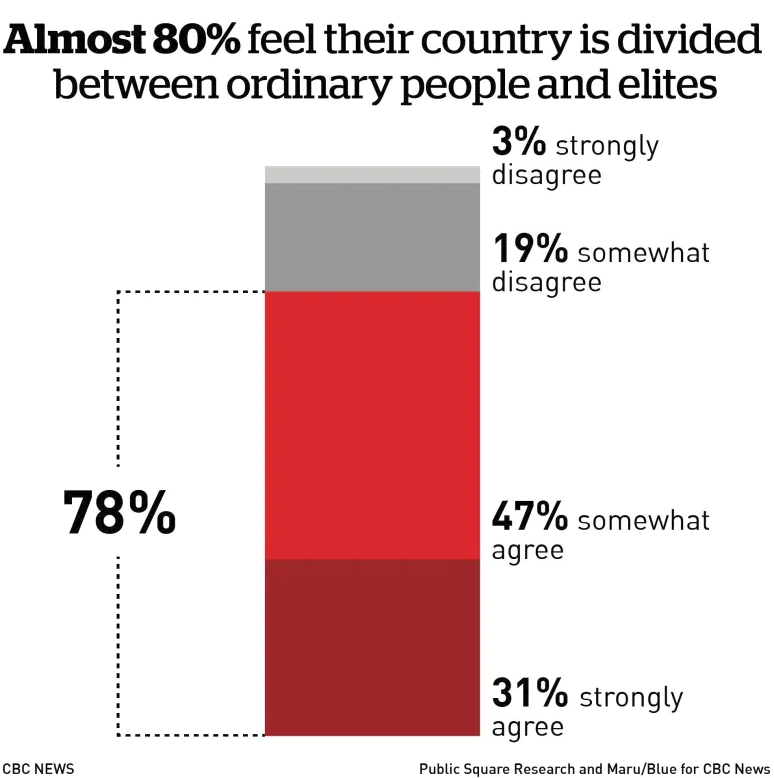
Canada’s “elite”
Jay Currie responded to a CBC article on a recent poll that found “nearly 80 per cent of Canadians either strongly or somewhat agree with the statement: ‘My country is divided between ordinary people and elites’.”
The CBC interviewee, Tony Laino, at Fordfest, said describing elites, “Those that think they’re better than me,” he said. “Because I don’t espouse their beliefs.”
Which misses the point. Elites really don’t think of guys like Tony Laino at all. Largely because, as Charles Murray points out in Coming Apart, the new upper class rarely, if ever, meets the Tony Lainos of the world. Murray was writing about white people in America but much the same social bi-furcation is taking place in Canada. Murray looks at education, wealth, marriage, access and what he refers to as the rise of the super-zips, areas where highly educated, well connected, well off people live with others of their class and kind. It is an accelerating phenomenon in the US and it is plainly visible in Canada. Murray quotes Robert Reich as calling this, “the segregation of the successful”.
Inside elite communities “the issues” look very different than they do in the more pedestrian parts of the country. A few pennies extra for gas or heating oil or natural gas to fight the universally acknowledged menace of “climate change” makes perfect sense if your income is in the hundreds of thousands of dollars a year. It is downright terrifying if you are making $50K. Only bigots and racists could be anti-imigration when you, yourself, live in virtually all white, old stock, Canadian enclaves and welcome refugees and migrants who you will never see.
The populist moment has not yet come to Canada and, if Andrew Scheer’s brand of Liberal lite wins in October, there will probably be another decade of elite consolidation before a proper populist movement gets off the ground. Whether it will be right populism a la Trump and Farange, or left populism with a firebrand NDP leader, is hard to say. However, as the Canadian elite grows more insular and disconnected from the ordinary life of Canada and Canadians, that populist moment draws closer.
June 29, 2019
Ancient Rome in 20 minutes
Arzamas
Published on 30 May 2017Caesar, The Colosseum, Republic, Nero, geese, plebeians, legions – everything that you once knew, but forgot, in a crash course video by Arzamas.
Narrated by Brian Cox.
“Ancient Rome in 20 minutes” is a Russian version of a Russian video by Arzamas.

June 25, 2019
QotD: Perpetual adolescence
SENATOR BEN SASSE: Yes, so this book is 100 percent not about politics, and it’s 99 percent not about policy. It’s about this new category of perpetual adolescence. And, first, let’s just say that, over the last two millennia or so, the emergence of a category called adolescence is a pretty special gift. We believe that, when our kids become biological adults, when they hit puberty, they don’t have to be fully formed, morally, emotionally, economically, educationally, in terms of household structure. They don’t have to go out and be fully adult immediately. They don’t have to go off to war, and they don’t have to become economically self-sufficient. That’s glorious, to have that protected space between childhood and adulthood. But it’s only glorious if you understand that it’s a transitional state, it’s a means to an end. Peter Pan’s Neverland is a hell. It’s a dystopia. And we don’t want to be — have our kids caught at a place where they’re not learning how to be adults. And, right now, we’re not tending to the habit formation aspects of a republic.
“Face the Nation transcript, May 14, 2017: Schiff, Sasse, Gates”, CBS News, 2017-05-14.
June 22, 2019
QotD: Militant Islam and the arts
Mark Steyn, interviewed by John Bloom, “Mark Steyn, Cole Porter and Free Speech”, Quadrant, 2017-05-11.
June 14, 2019
QotD: Kink-shaming
And now sexual perverts (among whom, on occasion, I happily count myself) are the latest group to demand “inclusion”. Please! When I was young, we thought nothing more desirable than being An Outsider – why are the young of today so obsessed with getting a tick on the register, rather than playing hooky? There is a happy place between believing that no one should be excluded on the basis of race, sex or social class, and believing that official validation of every life choice any person freely makes are the same. Someone who likes dressing up in a gimp mask is not Rosa Parks, and I find the increasing lack of ability to differentiate between the two in some quarters highly risible at best and downright insulting at worst.
The latest snowflake flutter is “Don’t kink-shame me!”. At a Vancouver university last year, a man insisting he was an “adult baby” pestered a university nurse to change his dirty nappy and perved over his repulsed female classmates. A whistle-blowing workplace-safety director was sacked for standing up for the women. In Wolverhampton a few months back, a tattooist calling himself “Dr Evil” was charged with grievous bodily harm after slicing ears and nipples from paying customers. He was reported as having support from “the body-modification community” who set up a petition in his favour.
Perhaps the most gobsmacking illustration of how mainstream perversion has become is a photograph of a Pride march showing a gaggle of kiddies (whose parents obviously got the memo that Pride is family-friendly) staring in what looks like confused repulsion at a man in front of them who leads a group of men, crawling on all fours and dressed as dogs, on leashes. Personally, I don’t think Pride needs to be family-friendly – it’s about the very adult desire to connect your genitalia to the genitalia of the same sex, which is pretty specific. But neither is it about kinks. Considering its origins, lesbians have far more right to be there than men who pretend to be dogs at weekends. Lesbians are now routinely removed from Pride marches by police due to their insistence that lesbians don’t have penises and the hurty feelz this causes in people who believe they can and do.
I’m a broad-minded broad, so I’m not offended by these people – but I do despise them for being so wimpy that they need their kink validated by straight society. When did perverts start being ashamed to be perverts and need to be a community? “Community” used to be such a jolly word, redolent of cheery singing or a nice place to land on the Monopoly board. Now it just means a bunch of whiners whining about stuff.
Julie Burchill, “The pervert community? Oh please”, Spiked!, 2019-05-08
June 13, 2019
American anarchism
Not all anarchists are bomb-throwers, as Christopher Schwarz explains:
The idea of pairing anarchism and design work seems – on its face – to be a ridiculous marriage. After all, design is about creating things from scratch, and anarchism is about burning everything down, right?
Well, no. Anarchism – particularly the American flavor of it – is woefully simplified and misunderstood by people on both the left and the right of the political spectrum. The truth is that most of the furniture designers and graphic designers I’ve worked with in my career possess strong anarchistic tendencies. They just don’t know what to call their urges and beliefs.
I’ve been an aesthetic anarchist for more than 25 years, after first encountering the concept in graduate school (thanks Noam Chomsky), then observing one of my cousins, Jessamyn West, an anarchist librarian. There’s a chance you might be one, too. And while I’m certain that you probably should be working on something far more pressing and billable for work at McCorp, reading this short article isn’t going to hurt anything….
The face of American anarchism. Josiah Warren is considered the father of American anarchism. Among his many accomplishments was the founding of the Cincinnati Time Store, where you traded your labor for goods. No money.
Photo via Wikimedia Commons.The Briefest Description Ever of American Anarchism
America’s individualist anarchism is not about the violent overthrow of the government and its institutions. Period. Full stop. Instead, it is a tendency to eschew the enormous organizations – churches, states and corporations – that we have created during the last 250 years.
Why do this? While working with others is generally a good thing, there is some threshold upon which an organization becomes so large that it is capable of inhumane behavior – war, slavery, environmental destruction, mass extinctions or even just failing to treat its employees and contractors fairly. These are things that individuals are (mostly) incapable of accomplishing.
Anarchists like myself avoid working with these massive and dehumanizing institutions. I don’t want to burn them down, but I also don’t want to prop them up by shopping in their stores, praying in their cathedrals or voting in their elections.
That doesn’t mean I’m opposed to making money, that I’m an atheist or that I’m uninvolved in my community. I just decline to work, pray and serve others via these institutions. Working with them gives them power, while working with the family architectural firm a few blocks away helps your neighbors in every way imaginable.