Quotulatiousness

May 25, 2020

The Problem With Civil War Reenactors

Filed under: History, Humour, Military, USA — Tags: , , , — Nicholas @ 04:00

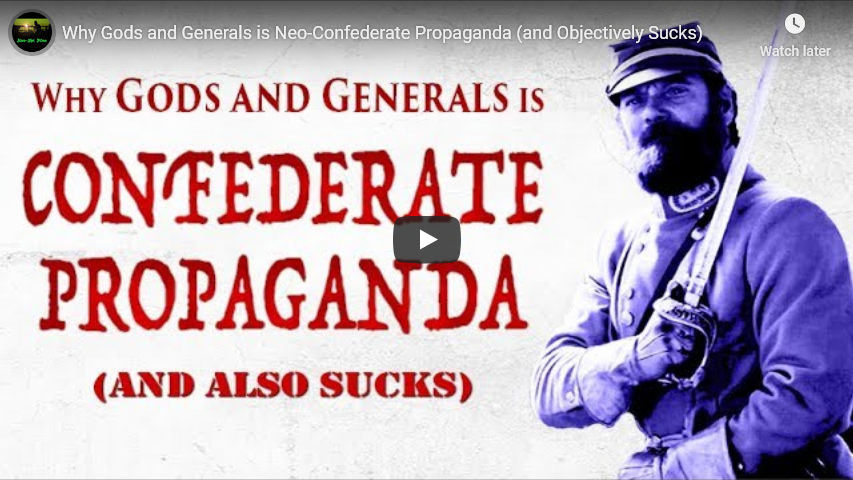
Atun-Shei Films
Published 6 Feb 2019

A former Gettysburg tour guide and confirmed farb talks smack about folks who take the hobby way too seriously.

Support Atun-Shei Films on Patreon ► https://www.patreon.com/atunsheifilms

#AmericanCivilWar #Reenactment #History

Watch our film ALIEN, BABY! free with Prime ► http://a.co/d/3QjqOWv
Reddit ► https://www.reddit.com/r/atunsheifilms
Twitter ► https://twitter.com/alienbabymovie
Instagram ► https://www.instagram.com/atunsheifilms
Merch ► https://atun-sheifilms.bandcamp.com

May 6, 2020

What’s on your bookshelf?

Filed under: Books, Britain, Media, Politics — Tags: , , , — Nicholas @ 05:00

The self-appointed censors of righteousness demand to know!

Plenty of people like to be filmed against the backdrop of their bookshelves to convey the message or at least create the impression that they are smart. This has become even more common during the current extraordinary conditions of self-isolation, where virtually all the media interviews are conducted from home rather than in studio. Ditto for all the Zoom and other teleconferences. This, in turn, has given some people the opportunity to nose around and check out just what exactly others have on their shelves – presumably having read it and not just for decoration. It should be a fun exercise, but these days of perpetual outrage no fun goes unpunished.

By contrast, the picture of a bookshelf belonging to a Tory minister Michael Gove and his wife Sarah Vine was unsolicited, which probably adds to the regret right about now.

[…]

Books, like other human artifacts, are historical records and documents of our past. You might not like the course that the history took, but it’s important to know it and remember it.

And hypocrisy, because of the double standards.

Sure, Nazis, Nazi sympathisers, Holocaust deniers and assorted other apologists are mad, bad and dangerous to know. But what about communists? How many of those having a go at Gove and his wife for owning an Irving book have on their own shelves works by Marx, if not Lenin, Mao, Che and numerous related others? Those who have been inspired by and followed Marx’s idea (whether you think correctly or not) have been responsible for some 100 million premature deaths in the 20th century and other untold misery and devastation. Mao, the author of the little Red Book, accounts for up to 60 million of those (I happen to have a copy; does that make me a Maoist and a genocide fan?). But socialism is cool and you can’t blame Marx because to do so would be to delegitimise the whole socialist project. And of course the socialist ideals are all beautiful – equality! solidarity! community! dignity! – and, in any case, everyone has had good intentions. So all good, guys.

Read and own whatever the damn you like – and don’t let the fascists of any kind dictate your bookshelf. Except for 50 Shades of Grey. We’ll all judge you for that.

The main picture: some of my shelves – feel free to judge me.

I thought to take a picture of my own shelves, but Arthur Chrenkoff appears to have a broadly similar selection of books (more heavily weighted to British politics than mine), so I just nicked his photo to save the effort. (Thanks, Arthur! Hope you don’t mind!)

May 3, 2020

Slaying Gladiator

Filed under: Europe, History, Humour, Media — Tags: , , , , — Nicholas @ 05:00

Over at Steyn Online, Kathy Shaidle tag-teamed someone else on staff (it probably rhymes with Dark Time) to put the caligulae to Ridley Scott’s Gladiator with Russell Crowe in the leading role:

Germania, 180 AD. Rome is at war with the, er, Germaniacs, who stand around in the Black Forest grunting like Brits on the piss who’ve nutted themselves in one pub fight too many. You need a cool head to take on the Roman Army, and the only one the barbarians have belongs to Caesar’s emissary, whom they thoughtfully decapitated before sending back. They wave the old noggin around like a treasured footie ball, grunting, “Ug Eugh Blug” or, translated from the original gibberish, “Over ‘ere, mate.” It’s a scene that rings oddly contemporary in the age of Isis, although when I first saw it, a year before 9/11, it gave me the giggles. But then barbarians always seem funny from a distance, don’t they? Here they scratch their pelts and grunt some more, seemingly unconcerned by the fact that the Roman legions are lighting up their blazing arrows and fireballs, the smart bombs of the day. The ensuing battle, whose outcome would seem never to be in doubt, is apparently the final bloody act in a twelve-year war.

Despite having had twelve years to get there, the Emperor’s son nevertheless shows up late. “Did I miss it?” he simpers. “Did I miss the battle?” The son’s name is Commodus. No, not Commodus, but Commodus, which sounds like he dates back to a Mel Brooks sketch circa 1962 but in fact goes all the way back to the real Roman Empire. Commodus is that old stand-by of the dynastic drama, the disappointing son. His father, Marcus Aurelius, is a noble philosopher-king, but Commodus is no chip off the old block. We can tell that from the moment we first glimpse Commodus, sprawled in his commodious caravan, but just in case we miss the point Joaquin Phoenix lays on the mincing like a trowel, and the make-up, too. He’s weak, vain, decadent, and has the hots for his sister Lucilla (Connie Nielsen). Even the Bushes would think twice before running this guy for emperor.

Having spent 25 years waging war for the glory of Rome, Marcus Aurelius (Richard Harris) senses there’s not much point leaving it in the hands of an emperor who’d be queen for a day. So he tells Commodus he will not succeed him. Instead, he is going to make his brave general Maximus a “trustee” until Rome is ready to become a republic again. Maximus (Russell Crowe) is a Colin Powell type of general: a nice fellow everyone respects who supposedly has no public ambitions. Commodus, though, has other ideas, and suffocates his father. As the old showbiz saying has it, dying is easy, Commodus is hard. The effete decadent mincer becomes emperor, and promptly orders the death of Maximus and the crucifixion of the general’s wife and child back in Spain.

But Maximus escapes, and what follows in Gladiator is the story of how he takes his revenge and becomes the eponymous Gladiator lui-même. It’s payback time, and, under Ridley Scott’s lean direction, that means there’s no room for sub-plots. Somewhere in pre-production, the archers lobbed their flaming shafts at the script and laid it as bare as those Germanic forests. Not only are there no sub-plots, there’s barely any plot for any sub-plot to be sub-. Once the wife and kid are dead, there’s nothing very emotional at stake. There’s no romantic interest, unless you count Commodus trying to get it on with sis. There’s a hint of backstory at the Senate, where the massed ranks of British Equity have gathered for a vast toga party (the Toga Party having a majority in the Senate at that time). But there’s no dialogue worth speaking of, except statements of the obvious. When the mob is being fickle, as mobs are wont to be, the Emperor is told: “The mob is fickle, sire.” All the lines have been pre-tested in earlier toga romps, and the only one that seems to have been specially written for this picture is Oliver Reed’s complaint that some crook dealer has sold him a pair of homosexual giraffes.

But none of that matters because Ridley Scott photographs the film so brilliantly and mesmerically that they could all be speaking Germaniac and it wouldn’t impair the storytelling. It helps that almost everyone in the movie is a pre-designated great actor, so you tend to assume there’s a lot of great acting going on, even though most of it’s just thoughtful reaction shots. The mob bays for blood. Cut to Derek Jacobi looking thoughtful. They bay some more. Cut to Connie Nielsen looking pensive from atop her fabulous neck. They stop baying. Cut to Russell Crowe looking thoughtful. What are they thinking so pensively? “Hmm. I wish I’d got the gay giraffe line”?

May 1, 2020

QotD: Cynicism

Filed under: Books, Media, Quotations — Tags: , , , , — Nicholas @ 01:00

Somewhere around that same eighth-grade mark where we all experimented with being mean, we get the idea that believing in things makes you a sucker — that good art is the stuff that reveals how shoddy and grasping people are, that good politics is cynical, that “realism” means accepting how rotten everything is to the core.

The cynics aren’t exactly wrong; there is a lot of shoddy, grasping, rottenness in the world. But cynicism is radically incomplete. Early modernist critics used to complain about the sanitized unreality of “nice” books with no bathrooms. The great modernist mistake was to decide that if books without sewers were unrealistic, “reality” must be the sewers. This was a greater error than the one it aimed to correct. In fact, human beings are often splendid, the world is often glorious, and nature, red in tooth and claw, also invented kindness, charity and love. Believe in that.

Megan McArdle, “After 45 Birthdays, Here Are ’12 Rules for Life'”, Bloomberg View, 2018-01-30.

April 22, 2020

QotD: Actors

Filed under: Humour, Media, Quotations, USA — Tags: , , — Nicholas @ 01:00

Why waste a whole evening, once or twice a week, in a stuffy and over-red theater, breathing zymotic air, sniffing discordant perfumery, looking at idiotic scenery, listening to the bleeding English of ignorant and preposterous actors? Have you ever, in all your life, seen five leading men who actually looked like civilized gentlemen, or even like the authentic valets, head clerks or unburied corpses of civilized gentlemen? Have you ever sat through a whole performance without wishing it were possible to take at least one of the actors out into the alley, there to do execution of the lex non scripta upon him? Eheu, Postume, what all of us have suffered at the hands of such strutting mummers and mountebanks! How we have writhed and squirmed beneath their astounding outrages upon the vulgate! What is worse than an actor? Two actors? Three actors? A whole stage full of actors! An endless succession of actors! … How we have leaped and squealed under their broad a‘s, their fearful renderings of proper names, their obscene attempts at boarding school French! How our paws have itched to grab them by the collars of their advanced coats, and to strangle them with their futurist shirts, and to anatomize them with the razor edges of their superbly ironed pantaloons! …

There are, of course, such things as good actors. Let us be just and admit it. I have seen and known a few myself, and have heard of a few more. There are half a dozen in England and as many in France. In Germany, I dare say, the police have the names of twenty. (One memorable night, in that strange land, I saw two on the stage at once!) But is the good actor, either at home or abroad, the normal actor, the average actor? Of course he is not. He is the rare actor, the miraculous actor, almost the fabulous actor. Examine a hundred bartenders and you will find that fully sixty of them actually know how to tend bar: they can mix a cocktail that, whatever its faults, is at least fit to drink, and they have the craft needed to draw a Seidel of Pilsner and to beat the cash register. But in the allied art of acting there is no such general dispersion of talent. A handful of outstanding super-actors have it all. The rest of them not only don’t know how to act, but they don’t know that they don’t know.

H.L. Mencken, “Getting Rid of the Actor”, The Smart Set, 1913-09.

April 13, 2020

QotD: Foucault’s “Ship of Fools”

Filed under: Books, Europe, Health, History, Quotations — Tags: , , , , — Nicholas @ 01:00

And so, Foucault tells us, in the fifteenth century there is a sudden emergence of a complex of artistic and philosophical themes linking madmen, the sea, and the terrible mysteries of the world. These culminate in the “Ship Of Fools”:

    Renaissance men developed a delightful, yet horrible way of dealing with their mad denizens: they were put on a ship and entrusted to mariners because folly, water, and sea, as everyone then knew, had an affinity for each other. Thus, “Ships of Fools” crisscrossed the seas and canals of Europe with their comic and pathetic cargo of souls. Some of them found pleasure and even a cure in the changing surroundings, in the isolation of being cast off, while others withdrew further, became worse, or died alone and away from their families. The cities and villages which had thus rid themselves of their crazed and crazy, could now take pleasure in watching the exciting sideshow when a ship full of foreign lunatics would dock at their harbors.

This was such a great piece of historical trivia that I was shocked I’d never heard it before. Some quick research revealed the reason: it is completely, 100% false. Apparently Foucault looked at an allegorical painting by Hieronymus Bosch, decided it definitely existed in real life, and concocted the rest from his imagination.

Foucault apologists try to rescue this, say that he was just being poetic in some way. He wasn’t. Page 8 in my copy: “Of all these romantic or satiric vessels, the Narrenschiff [Ship Of Fools] is the only one that had a real existence — for they did exist, these boats that conveyed their insane cargo from town to town.” He really, really doubled down on this point. As far as I can tell, this is just as bad a failing of scholarship as it sounds – and surprising, since everything else about the book gives the impression of Foucault as an incredibly knowledgeable and wide-ranging scholar.

Scott Alexander, “Book review: Madness and Civilization”, Slate Star Codex, 2018-01-04.

April 9, 2020

Lawrence of Arabia | Based on a True Story

Filed under: Britain, History, Media, Middle East, Military, WW1 — Tags: , , , , , — Nicholas @ 02:00

The Cynical Historian
Published 6 Nov 2015

The classic film Lawrence of Arabia, is one of the most beautiful movies of all time, but it has its flaws.
————————————————————
references:
https://en.wikipedia.org/wiki/Lawrenc…

http://www.wordandfilm.com/2013/08/wh…

http://www.pri.org/stories/2013-12-16…

most beautiful movies list:
https://www.youtube.com/watch?v=kj73a…
————————————————————

LET’S CONNECT:
https://twitter.com/Cynical_History
————————————————————
wiki:
Lawrence of Arabia is a 1962 epic historical drama film based on the life of T. E. Lawrence. It was directed by David Lean and produced by Sam Spiegel through his British company Horizon Pictures, with the screenplay by Robert Bolt and Michael Wilson. The film stars Peter O’Toole in the title role. It is widely considered one of the greatest and most influential films in the history of cinema. The dramatic score by Maurice Jarre and the Super Panavision 70 cinematography by Freddie Young are also highly acclaimed.
The film was nominated for ten Oscars at the 35th Academy Awards in 1963; it won seven in total: Best Picture, Best Director, Best Original Score, Best Cinematography (Color), Best Art Direction (Color), Best Film Editing and Best Sound Mixing. It also won the Golden Globe Award for Best Motion Picture – Drama and the BAFTA Awards for Best Film and Outstanding British Film.

The film depicts Lawrence’s experiences in the Arabian Peninsula during World War I, in particular his attacks on Aqaba and Damascus and his involvement in the Arab National Council. Its themes include Lawrence’s emotional struggles with the personal violence inherent in war, his own identity, and his divided allegiance between his native Britain and its army and his new-found comrades within the Arabian desert tribes. As well as O’Toole, the film stars Alec Guinness, Jack Hawkins, Anthony Quinn, Omar Sharif, Anthony Quayle, Claude Rains and Arthur Kennedy.
————————————————————
Hashtags: #History #LawrenceOfArabia #WWI #Review #BasedOnATrueStory

April 4, 2020

The media’s grasp of modern logistics

Kurt Schlicter — who, spoiler, isn’t a fan of our news media in general — on the demands by newsbeings for the impossible to be done immediately:

We Americans are truly blessed by having a mainstream media full of brilliant renaissance men, women, and gender non-specific entities who are masters of so many varied and intermittently useful skills and who are eager to share their knowledge with us benighted souls. The pandemic has revealed that every urban Twitter blue check scribbler, MSNBCNN panelist, NYT/WaPo doofus, and barely legal “senior editor” of a website you never heard of, is a Nobel Prize-winning epidemiologist, a master logistician, and a diversity consultant to boot.

[…]

Another hitherto unknown skill that the media believes it possesses is logistics. “Why hasn’t Trump commanded a million ventilators to appear?!” the reporters demand. It’s pretty easy to see where they might have gotten the idea that the moment one articulates a desire to possess something that it magically appears. Capitalism has pretty much made that a reality. If you want something, you can go to a store and get it 24/7, or you can go on Amazon and it’ll be at your Manhattan apartment in 48 hours. Since they have never built anything or transported anything or distributed anything, only benefited from the labor of the unhip people who do those things, it’s only natural that the delayed adolescents who make up our media class imagine that material goods can be simply wished into being. After all, for all practical purposes during normal times, because of the efforts of Americans they look down upon, material goods pretty much can be simply wished into being. But prosperity takes work, not that the media would know.

[…]

Apparently, the media class thinks there are giant warehouses with an endless supply of goods just sitting there, somewhere, waiting. They have no idea about how logistics work, how goods flow quickly from producer to market and how expected resupply levels need a few days to adjust from a 10 percent daily turnover to a 30 percent daily turnover. They have zero appreciation for inventory management because no one they know does unglamorous stuff like that.

It’s all much easier in a socialist command economy. You get nothing and like it. Or don’t like it. Whatever. Here’s your weekly bean allowance. Workers of the world unite. You have nothing to lose but access to toothpaste and toilet paper.

The best part is when the media – the same media that was collectively soiling its Dockers because that mean old Trump was barring direct flights from China because of racism and stuff – demands to know why, back in December, Trump was not commanding a zillion Wuhan Flu tests, a zillion masks, and a zillion ventilators be created, while locking down all of America. Leaving aside the whole lack of an enumerated power to do that thing, in what world would have Trump have convinced anyone – least of all the media that was slobbering over his bogus impeachment at the time – that some bat soup-derived pathogen in BumFoo, China, was going to black swan all over America’s economy? The lack of seriousness by the people who presume to be reporting the news to us is more breathtaking than the damn ChiCom grippe.

March 15, 2020

QotD: The latest breakthrough in psychological therapy

Filed under: Books, Health, Humour, Quotations — Tags: , , , , — Nicholas @ 01:00

All therapy books start with a claim that their form of therapy will change everything. Previous forms of therapy have required years or even decades to produce ambiguous results. Our form of therapy can produce total transformation in five to ten sessions! Previous forms of therapy have only helped ameliorate the stress of symptoms. Our form of therapy destroys symptoms at the root!

All psychotherapy books bring up the Dodo Bird Verdict – the observation, confirmed in study after study, that all psychotherapies are about equally good, and the only things that matters are “nonspecific factors” like how much patients like their therapist. Some people might think this suggests our form of therapy will only be about as good as other forms. This, all therapy books agree, would be a foolish and perverse interpretation of these findings. The correct interpretation is that all previous forms of therapy must be equally wrong. The only reason they ever produce good results at all is because sometimes therapists accidentally stumble into using our form of therapy, without even knowing it. Since every form of therapy is about equally likely to stumble into using our form of therapy, every other form is equally good. But now that our form of therapy has been formalized and written up, there is no longer any need to stumble blindly! Everyone can just use our form of therapy all the time, for everything! Nobody has ever done a study of our form of therapy. But when they do, it’s going to be amazing! Nobody has even invented numbers high enough to express how big the effect size of our form of therapy is going to be!

Consider the case of Bob. Bob had some standard-issue psychological problem. He had been in and out of therapy for years, tried dozens of different medications, none of them had helped at all. Then he decided to try our form of therapy. In his first session, the therapist asked him “Have you ever considered that your problems might be because of [the kind of thing our form of therapy says all problems are because of]?” Bob started laughing and crying simultaneously, eventually breaking into a convulsive fit. After three minutes, he recovered and proceeded to tell a story of how [everything in his life was exactly in accordance with our form of therapy’s predictions] and he had always reacted by [doing exactly the kind of thing our form of therapy predicts that he would]. Now that all of this was out in consciousness, he no longer felt any desire to have psychological problems. In a followup session two weeks later, the therapist confirmed that he no longer had any psychological problems, and had become the CEO of a Fortune 500 company and a renowned pentathlete.

Not every case goes this smoothly. Consider the case of Sarah. Sarah also has some standard-issue psychological problem. She had also been in and out of therapy for years, tried dozens of different medications, none of them had helped at all. Then she decided to try our form of therapy. In her first session, the therapist asked her “Have you ever considered that your problems might be because of [the kind of thing our form of therapy says all problems are because of]?” Sarah said “No, I don’t think they are.” The therapist asked “Are you sure you’re not just repressing the fact that they totally definitely are, for sure?” As soon as Sarah heard this, she gasped, and her eyes seemed to light up with an inner fire. Then she proceeded to tell a story of how [everything in her life was exactly in accordance with our form of therapy’s predictions] and she had always reacted by [doing exactly the kind of thing our form of therapy predicts that she would], only she was repressing this because she was scared of how powerful she would be if she recovered. Now that all of this was out in consciousness, she no longer felt any desire to have psychological problems. In a followup session two weeks later, the therapist confirmed that she no longer had any psychological problems, and had become the hand-picked successor to the Dalai Lama and the mother of five healthy children.

Previous forms of therapy have failed because they were ungrounded. They were ridiculous mental castles built in the clouds by armchair speculators. But our form of therapy is based on hard science! For example, it probably acts on synapses or the hippocampus or something. Here are three neuroscience papers which vaguely remind us of our form of therapy. One day, neuroscience will catch up to us and realize that the principles of our form of therapy are the principles that govern the organization of the entire brain – if not all of multicellular life.

Scott Alexander, “Book Review: All Therapy Books”, Slate Star Codex, 2019-11-21.

March 14, 2020

“The people who write such things are thinking with their epidermis and genitalia, which is to say they’re not thinking at all”

In Quillette, Matt Johnson remembers the great anti-identitarian writer and speaker, Christopher Hitchens:

Christopher Hitchens speaking at The Amaz!ng Meeting held at the Riviera Hotel, Las Vegas, Nevada on 20 January 2007.
Photo detail by ensceptico via Wikimedia Commons.

Hitchens thought fearlessly. As Martin Amis put it, he liked “the battle, the argument, the smell of cordite.” This is why he told the publisher of God is Not Great: How Religion Poisons Everything to organize a book tour that ran through the pulpits of the American South instead of remaining confined to the coasts. It’s why he relished every opportunity to lambaste Bill and Hillary Clinton in front of liberal audiences. It’s why he went after Mother Teresa and Princess Diana. He was an inveterate iconoclast — if there was a bloated reputation to puncture or a cherished dogma to deflate, he saw it as a duty and a pleasure to do so.

It’s no surprise that this oppositional inclination, coupled with blistering rhetorical ability, made Hitchens a deadly debater. After his death in December 2011, countless tributes and articles about Hitchens emphasized what a force he was in the studio and on the debate stage — his erudition and wit, his fluency, his seemingly superhuman memory. Hitchens is unforgettable for all these reasons, but people don’t miss him because he could turn a phrase or win an argument on CNN — they miss him because he thought for himself and refused to apologize for it. He didn’t want to write and speak as the representative of a community: “My own opinion is enough for me,” he told the audience at a debate on free speech in 2007, “and I claim the right to have it defended against any consensus, any majority.”

“Unpopular ideas can be silenced, and inconvenient facts kept dark, without the need for any official ban,” Orwell wrote in his original introduction to Animal Farm (which was, ironically, suppressed). He continued: “Anyone who challenges the prevailing orthodoxy finds himself silenced with surprising effectiveness.” While there was far more official censorship in Orwell’s time, we’re living through an era of pervasive self-censorship, and as Packer explains, this type of silencing is “more insidious than the state-imposed kind, because it’s a surer way of killing the impulse to think, which requires an unfettered mind.”

[…]

Hitchens detested tribal and parochial feelings of any kind, which is why he was dismayed when he witnessed the emergence of identity as a catalyst for political mobilization in the late 1960s and early 1970s. In his memoir, Hitch-22, Hitchens attacked radicals who thought it was “enough to be a member of a sex or gender, or epidermal subdivision, or even erotic ‘preference,’ to qualify as a revolutionary.” When Hitchens first heard the expression “the personal is political,” he knew “as one does from the utterance of any sinister bullshit that it was — cliché is arguably forgivable here — very bad news.” As he put it in a 2008 article:

    People who think with their epidermis or their genitalia or their clan are the problem to begin with. One does not banish this specter by invoking it. If I would not vote against someone on the grounds of ‘race’ or ‘gender’ alone, then by the exact same token I would not cast a vote in his or her favor for the identical reason.

It’s easy to imagine what Hitchens would have thought about a recent New York Times headline that declared “The Next President Should Not Be a Man” or a prominent writer and activist who announced that she “will not support white male candidates in the Dem primary.” The people who write such things are thinking with their epidermis and genitalia, which is to say they’re not thinking at all. You don’t have to bother defending candidates’ principles and positions when gender and race are the only relevant variables.

March 11, 2020

A Bridge Too Far | Military History Book Review

Filed under: Books, Britain, Germany, History, Military, USA, WW2 — Tags: , , , — Nicholas @ 02:00

TIK
Published 22 Feb 2016

The classic history book looking at the battle of Arnhem and Operation Market Garden. Cornelius Ryan’s A Bridge Too Far.

Have you seen my popular Operation Market Garden Documentary?
https://youtu.be/vTUC79o4Kmc

Also, if you haven’t done already, follow me on Twitter!
https://twitter.com/TIKhistory

March 10, 2020

The Birth of a Nation | Based on a True Story

Filed under: History, Media, USA — Tags: , , , , , , — Nicholas @ 02:00

The Cynical Historian
Published 7 Oct 2016

The Birth of a Nation was the first major motion picture success, and because of its historical inaccuracy, the Ku Klux Klan was revived for another round of terror. This is the worst case of a “Based on a True Story” film. So today is a prime time to go into why it was so bad, and get some President Wilson bashing in.

Through YouTube’s cowardice, this video has been demonetized.
————————————————————
references:
Blee, Kathleen M. Women of the Klan: Racism and Gender in the 1920s. Berkeley: University of California Press, 1991. https://amzn.to/2NzeHbl

http://www.npr.org/sections/codeswitc…

https://en.wikipedia.org/wiki/The_Bir…
https://en.wikipedia.org/wiki/The_Cla…
https://en.wikipedia.org/wiki/Ku_Klux…
https://en.wikipedia.org/wiki/Reconst…
https://en.wikipedia.org/wiki/Woodrow…
https://en.wikipedia.org/wiki/1804_Ha…
https://en.wikipedia.org/wiki/Nat_Tur…
————————————————————
contribute to my Patreon:
https://www.patreon.com/CynicalHistorian

LET’S CONNECT:
https://twitter.com/Cynical_History
—————————————–
Wiki:
The Birth of a Nation (originally called The Clansman) is a 1915 American silent epic drama film directed and co-produced by D. W. Griffith and starring Lillian Gish. The screenplay is adapted from the novel and play The Clansman, both by Thomas Dixon Jr. Griffith co-wrote the screenplay (with Frank E. Woods), and co-produced the film (with Harry Aitken). It was released on February 8, 1915.

Three hours long, the film was originally presented in two parts separated by an intermission; it was the first 12-reel film in America. The film chronicles the relationship of two families in the American Civil War and Reconstruction era over the course of several years: the pro-Union Northern Stonemans and the pro-Confederacy Southern Camerons. The assassination of President Abraham Lincoln by John Wilkes Booth is dramatized.

The film was a commercial success, though it was highly controversial for its portrayal of black men (many played by white actors in blackface) as unintelligent and sexually aggressive towards white women, and the portrayal of the Ku Klux Klan (KKK) (whose original founding is dramatized) as a heroic force. There were widespread African-American protests against The Birth of a Nation, such as in Boston, while thousands of white Bostonians flocked to see the film. The NAACP spearheaded an unsuccessful campaign to ban the film. Griffith’s indignation at efforts to censor or ban the film motivated him to produce Intolerance the following year.

The film’s release is also credited as being one of the events that inspired the formation of the “second era” Ku Klux Klan at Stone Mountain, Georgia, in the same year. The Birth of a Nation, along with the trial and lynching of Leo Frank for the 1913 murder of Mary Phagan in Atlanta, was used as a recruiting tool for the KKK. Under President Woodrow Wilson, it was the first American motion picture to be screened at the White House.

Griffith’s innovative techniques and storytelling power have made The Birth of a Nation one of the landmarks of film history. In 1992, the United States Library of Congress deemed the film “culturally, historically, or aesthetically significant” and selected it for preservation in the National Film Registry.
————————————————————
Hashtags: #History #BirthOfANation #KKK #Review #BasedOnATrueStory #WoodrowWilson #DWGriffith

March 7, 2020

History Buffs: Lawrence of Arabia

Filed under: Britain, History, Media, Middle East, Military, WW1 — Tags: , , , , , , — Nicholas @ 02:00

History Buffs
Published 17 Apr 2016

BIG THANK YOU TO THE GREAT WAR CHANNEL FOR COLLABORATING WITH ME AND MAKING AWESOME VIDEOS!

Check out their T.E. Lawrence video here –
https://www.youtube.com/watch?v=iqvcjL6ObH0

And the rest of their awesome channel here 🙂
https://www.youtube.com/user/TheGreatWar

And thank you History Buffs so very much for being patient whilst I was in Ireland working on the Vikings podcasts for the History Channel and moving house at the same time. I sincerely hope you guys enjoy this review!

● Follow us on Twitter: https://twitter.com/HistoryBuffsNH

________________________________________­­_________________________________

Lawrence of Arabia is a 1962 epic historical drama film based on the life of T. E. Lawrence. It was directed by David Lean and produced by Sam Spiegel through his British company Horizon Pictures, with the screenplay by Robert Bolt and Michael Wilson. The film stars Peter O’Toole in the title role. It is widely considered one of the greatest and most influential films in the history of cinema. The dramatic score by Maurice Jarre and the Super Panavision 70 cinematography by Freddie Young are also highly acclaimed. The film was nominated for ten Academy Awards and won seven in total including Best Director, Best Sound Editing, Best Film Editing, and Best Picture.

The film depicts Lawrence’s experiences in the Arabian peninsula during World War I, in particular his attacks on Aqaba and Damascus and his involvement in the Arab National Council. Its themes include Lawrence’s emotional struggles with the personal violence inherent in war, his own identity, and his divided allegiance between his native Britain and its army and his new-found comrades within the Arabian desert tribes.

In 1991, Lawrence of Arabia was deemed “culturally, historically, or aesthetically significant” and selected for preservation in the United States Library of Congress National Film Registry.

March 3, 2020

Arnhem by Antony Beevor Book Review

Filed under: Books, Britain, Germany, History, Military, USA, WW2 — Tags: , , , — Nicholas @ 04:00

TIK
Published 18 Jun 2018

Antony Beevor’s book Arnhem is good — but it contains a flawed argument. So flawed, that there’s a ton of counter evidence that shows it doesn’t work. Here, I will explain the events of the Nijmegen battle, what Beevor’s incorrect statement is, why he has to say it like he did, and how he could have done things differently.

Check out the pinned comment below for more information, notes, links, and sources.

Don’t forget to subscribe if you like history or gaming! And hit the little bell icon to be notified when videos like this are uploaded.

Please consider supporting me on Patreon and help make more videos like this possible https://www.patreon.com/TIKhistory

From the comments:

TIK
1 year ago

Selected Bibliography/Sources

Brereton, L. The Brereton Diaries: The War in the Air in the Pacific, Middle East and Europe, 3 October 1941-8 May 1945. Kindle, 2014.
Frost, J. A Drop Too Many. Kindle, 2009.
Hastings, M. Armageddon. Pan Books, 2004.
Robert J. Kershaw, It Never Snows in September. Ian Allan Publishing, 2007.
Mead, R. General Boy: The Life of Lieutenant General Sir Frederick Browning. Kindle, 2010.
Middlebrook, M. Arnhem 1944: The Airborne Battle, 17-29 September. 2009.
Neillands, R. The Battle for the Rhine 1944. Kindle, 2014.
Poulussen, R.G. Lost at Nijmegen. Kindle, 2011.
Ryan, C. A Bridge Too Far. Kindle, 1974
Urquhart, R. Arnhem. Kindle, 1958.
Sosabowski, S. Freely I Served. Kindle, 1982.

Links

My “REAL Operation Market Garden” documentary https://youtu.be/vTUC79o4Kmc
“The BAD BOY of Operation Market Garden” A video on General ‘Boy’ Browning https://youtu.be/Dvv8GQIRYVU
The “Who to Blame? John Frost on Operation Market Garden’s Failure” video https://youtu.be/7C_HoMVhKAI
My discussion of Market Garden’s True Purpose using Monty vs Eisenhower’s Memoirs https://youtu.be/f79KgQVL3MM
A video on Kampfgruppen where I talk about some of the Market Garden Kampfgruppen https://youtu.be/zKWczZkQ130
My Book review of It Never Snows in September https://youtu.be/-RRdWCyHpG8
My A Bridge Too Far Book Review video https://youtu.be/D6vDlbsOkQE

Add me on Twitter @TIKhistory

Thanks for watching, bye for now!

February 27, 2020

Toby Young’s Free Speech Union (FSU)

Brendan O’Neill explains why Toby Young’s FSU is so important right now:

The beautiful thing about the mad reaction to Toby Young’s Free Speech Union (FSU) is that it proves why the union is so necessary. No sooner had Young unveiled his censorship-busting union than the illiberal liberals were out in force to mock it and ridicule it and to insist that, actually, there is no free-speech crisis in the UK. It’s a right-wing myth, they claim. There is no widespread censorship. People aren’t being shipped off to gulags for expressing an opinion. Apparently, the free-speech “grift” – God, I hate the word “grift” – is just a bunch of pale, male and stale blokes pissed off that they can no longer say the N-word or talk openly about women’s boobs. Freedom of speech is not under threat, the Young-bashers claim, and anyone who says it is is probably just an Islamophobe, transphobe or some other breed of phobe itching to spout bile with “no consequences”.

This rank denialism, this blinkered insistence that free speech is not in danger in 21st-century Britain, is exactly why we need the FSU and as broad a discussion as possible about the importance of the liberty to express oneself. Because the fact that so many inhabitants of the chattering-class bubble can’t even see that free speech is dying right now confirms how naturalised and uncontroversial the new censorship has become. They don’t even see it as censorship. They see it as perfectly normal, and good, in fact, that certain views cannot be expressed in public life or on social media. That’s how cavalier the new war on heretical opinion has become. At least in the past, from Torquemada to the McCarthyites, authoritarians were honest about being censors. Today’s self-elected moral guardians of correct opinion are so hubristic, so taken with their own mortal rectitude, that they don’t even see themselves as enemies of freedom, but rather as decent, unimpeachable maintainers of a natural intellectual order.

Things have come to such a pass that these people will literally seek to censor you in one breath and then express alarm at being called censors in the next breath. Hence the Guardian could publish a piece last week claiming that the idea that there is a culture of censorship in British universities is a “right-wing myth” while simultaneously defending censorship on campus. In an act of extraordinary moral contortionism, Evan Smith mocked the “idea that there is a free-speech crisis at British universities” and then, without missing a beat, he defended the policy of No Platform and the creation of safe spaces because “the university cannot be a place where racism and fascism – as well as sexism, homophobia and transphobia – are allowed to be expressed”. The Orwellianism is staggering. “There is no censorship on campus. Except the censorship I approve of. Which is not really censorship.” That is what is being said here. The intellectual dishonesty is almost impressive.

This Orwellian denialism of the existence of censorship by people who actually support and enact censorship cuts to the heart of the free-speech crisis in the UK. The reason the illiberal liberals and woke McCarthyites and Twittermobs don’t consider themselves to be censors – even as they gleefully agitate for the censorship of feminists, secularists worried about Islamist extremism, and right-wing people opposed to mass immigration – is because they have convinced themselves that certain forms of speech are not free speech. That certain beliefs should not be afforded the liberty of expression. You hear it in their telling, baleful mantra that “Hate speech is not free speech”. And if “hate speech” is not free speech, but rather some kind of toxin, a pox on public life, then crushing it is not censorship. It is more like an act of public health: cleansing the public realm of diseased thoughts that are liable to harm certain groups. These people see themselves not as censors, but as public-health activists delousing the community of germs spread by evil men and women.

« Newer PostsOlder Posts »

Powered by WordPress