
As soon as you see the recommendation from Noam Chomsky on the cover of the book, you can pretty much guess where McQuaig is coming from. I refer to the Chomskyan school of thought as American Monist: in short, the only actor on the world stage is America. It is the sole source of evil and depredation. Everyone else is motivated solely by love and concern for humanity, whilst America is, singularly, motivated only by greed, lust for power and a general animus for all things good, sunny and nice. Only America acts; everyone else is acted upon by the Hegemon, and can’t be blamed for the consequences of their actions. America is the Primus Mobilis. And America is bad. So, for example, the notion that an economy-based increased lust for oil is driving foreign policy is solely a characteristic of America; no other nation on earth appears to give a shit about oil. Certainly not France, Russia or China; McQuaig hardly mentions them. While McQuaig is forced to acknowledge that French, Russian and Chinese support for Saddam (and attendant undermining of UN sanctions) was related in some fashion to the oil deals they had each struck with Iraq, she airily dismisses the role that oil plays in their respective foreign policies. So the “oil as the root of all evil” trope is batted away in the space of two sentences when talking about other countries, but more than 300 pages are required to explain how oil and America are mutually catalyzing demon twins. When the rapaciousness of oil companies is discussed, it is almost exclusively American oil companies which are named; hardly ever any of the European, Russian or other oil companies. Because those other oil companies don’t possess the true indicia of evil, you see: they don’t stamp their barrels “Made in the USA”.
Bob Tarantino, “LIB Review: It’s the Crude, Dude”, Let It Bleed, 2005-03-05.
April 25, 2021
QotD: “The Great Satan”
April 8, 2021
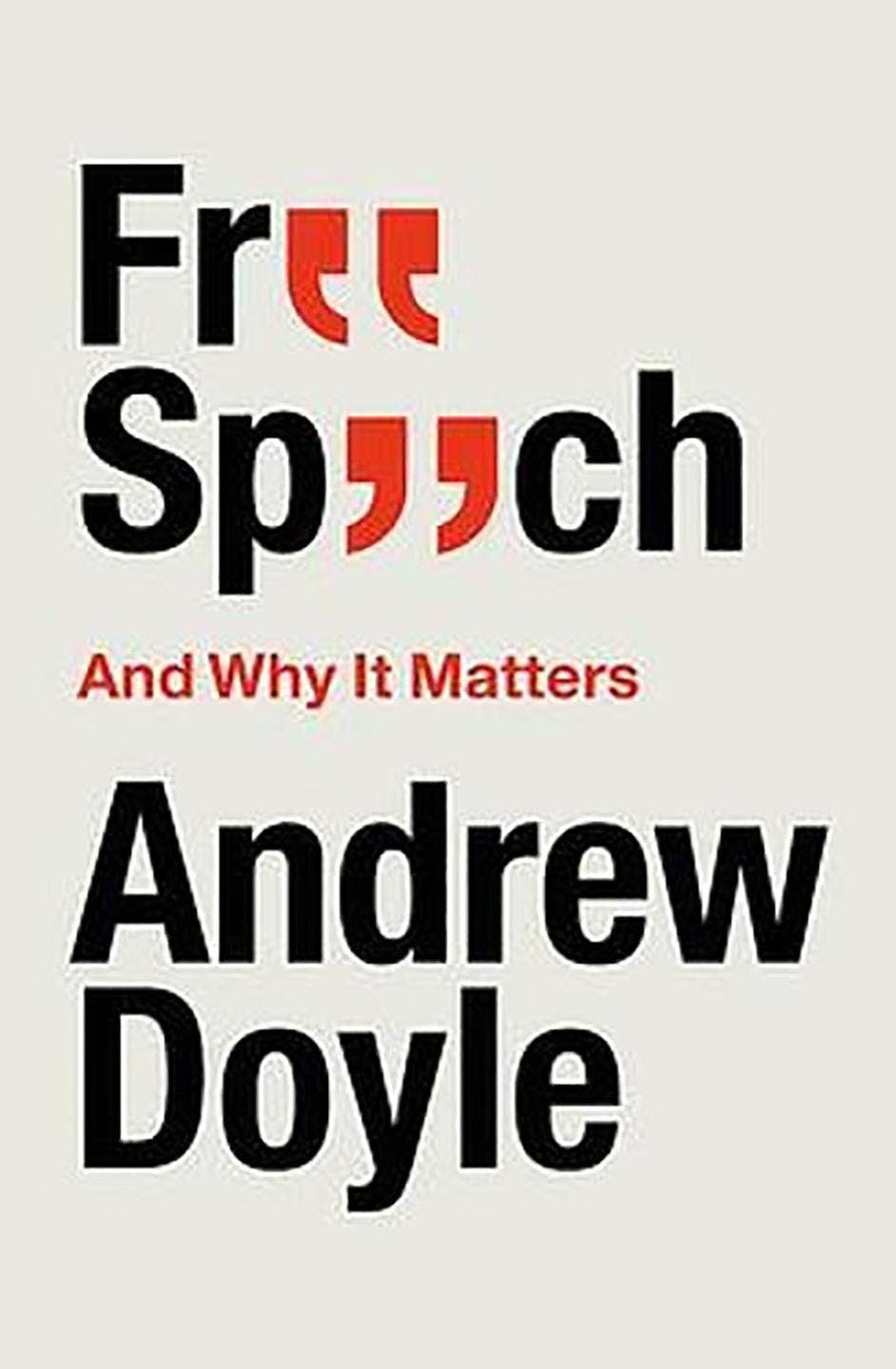
Andrew Doyle defends freedom of speech in his new book
In The Critic, Simon Evans reviews Free Speech And Why It Matters by Andrew Doyle (who is perhaps best known on this side of the pond for his ultrawoke Twitter persona “Titania McGrath”):
When I am weaker than you, I ask you for Freedom, because that is according to your principles; when I am Stronger than you, I take away your freedom because that is according to my principles.
Frank Herbert, Children of DuneIt is most peculiar. If the counter-culture had a dominant theme, it was the right to criticise the establishment and to question orthodoxy of all kinds. Back in the Sixties, it was central to its mission to Expand your Consciousness, man. And it worked. Walls came tumbling down. Yet now, everywhere you look, it seems the elements of society — students, academics, comedians — that one would most naturally associate with that freedom of expression, are introducing caveats and qualifiers to that principle faster than you can cry “Stop Little Pol-Pot, Stop!” They are turning, before our very eyes, into actual scolds.
It must be supposed that what was once the siege army, camped outside the moat like Occupy Wall Street, has captured the castle, for they are demanding that the walls be re-erected. That “hate” speech be distinguished from free speech and dealt with accordingly. That freedom of speech need not mean freedom from consequences. And a general suspicion is at large, among the young, that free speech is some sort of artefact of complacent boomer self-indulgence, like Steely Dan and second homes. No longer counter-culture, but decidedly counter-revolutionary.
I’m a comedian, and these have been strange times for our trade. Brexit saw comedians side with the mirthless neo-liberal consensus, against the humorous, sceptical grumble of the common rabble. The same thing happened in America, with bar-room stand-ups horrified by the vulgarity of Trump. And now the latest revision sees many of my fellow jesters and fools unsure whether people can really be trusted with free speech.One might have thought this issue had been settled long ago, in this country, and in liberty’s favour. But no, it seems we need to sharpen our tools once again, and Andrew Doyle’s new book is an excellent place to start.
Making the case for the defence, Doyle’s book is terse, restrained and as carefully argued as a QC’s summing-up in a top-drawer courtroom drama. Whether his command of the material comes from his doctorate in Renaissance literature or his experience of defending the comedy character Titania McGrath from infuriated wokerati, who knows? It is a beautifully balanced and comprehensive overview that will of course be read by no one who needs to hear it.
It is admirably historically literate. Doyle takes a quote from Milton’s Areopagitica as his epigram, with the old poet, declaiming over the din of the Civil War, as defiant as Satan himself, “Give me liberty to know, to utter, and to argue freely according to conscience, above all liberties.”
This sets the tone for the whole book, but Doyle also presents arguments intended to appeal to those who insist that we live in a society. With the compromises that entails. This was most famously recognised by notorious cis-hetero white man and free speech absolutist John Stuart Mill, who was surveying the world from the heights of Victorian Exceptionalism when he published the still unsurpassed On Liberty.

The Weird Years of The Simpsons (1989-1994)
J.J. McCullough
Published 2 Jan 2021The show struggled for five years to figure out what kind of show it wanted to be, and how to treat its characters. It could have been much weirder than it was.
FOLLOW ME:
🇨🇦Support me on Patreon! https://www.patreon.com/jjmccullough
🤖Join my Discord! https://discord.gg/3X64ww7
🇺🇸Follow me on Instagram! https://www.instagram.com/jjmccullough/
🇨🇦Read my latest Washington Post columns: https://www.washingtonpost.com/people…
🇨🇦Visit my Canada Website http://thecanadaguide.comHASHTAGS: #tv #animation
April 5, 2021
The Ahuman obsession
Theodore Dalrymple considers the work of an English professor who advocates for the extinction of the human race:
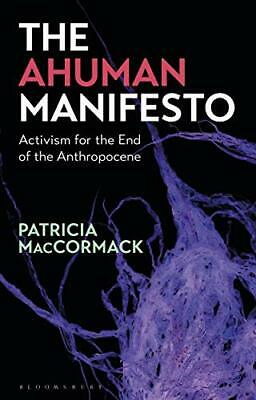
Professor MacCormack’s main idea seems to be that the only way to save the planet from destruction is for humanity not to reproduce itself and thereby to die out within a generation or two. She wants to make the world safe for the worms and the wasps, though her scheme would be hard luck on those species that parasitize only Man. They would have to die out too. But, as the Reverend Charles Caleb Colton put it in 1821, “Let no man presume to think that he can devise any plan of extensive good, unalloyed with evil.” If Man dies out, so too will Wuchereria bancrofti, one of the filarial parasites that cause elephantiasis, along with other such species, but I suppose that this is but a small price to pay for the immense benefit overall wrought by the extinction of Mankind.
Naturally, I sent for her latest book, The Ahuman Manifesto: Activism for the End of the Anthropocene. Thanks to the epidemic all the libraries were shut, though in other respects the virus’ efforts to end the Anthropocene were, from the professor’s rather special point of view, feeble or pathetic, with only 2,000,000 deaths so far and 6,998,000,000 to go. If I wanted to read the book, I would have to buy it.
I am an obsessional reader; that is to say, when I start a book I feel obliged to read it through from cover to cover. Moreover, I would rather read anything than nothing at all. Once in Los Angeles I was stuck in a hotel bedroom with nothing to read but the yellow pages (there were still telephone directories in those days), from which I learned a humiliating lesson. Books have long been at the center of my life, but I discovered how unimportant they are in the lives of most people. There was about half a page devoted in the yellow pages to bookshops, but scores to private detectives. No wonder Philip Marlowe chose Los Angeles as his place of work.
But Professor MacCormack’s book defeated me, not only sapping my will to read further but inducing a state almost of catatonia. It certainly cured me, at least temporarily, of my obsessional desire to finish any book that I have started. Her style made The Critique of Pure Reason seem as light and witty as The Importance of Being Earnest. She appears to think that the English plural of manifesto is manifesti rather than manifestos; I admit that it conjured up in my mind a new Italian dish, gnocchi manifesti.
Open the book at any page and you will find passages that startle by their polysyllabic meaninglessness combined with the utmost crudity. By chance, I opened the book to page 144 and my eye fell on the following:
The multiplicity of becoming-cunt as an assemblage reassembles the tensors upon which it expresses force and by which force is expressed upon its various planes and dimensions.
I have known deteriorated schizophrenic patients to speak more sensibly and coherently than this.
March 11, 2021
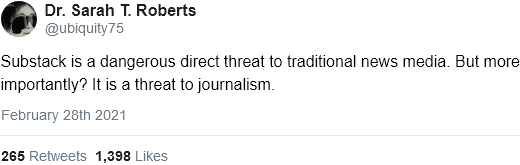
Substack is “‘incredibly dangerous and damaging’ to ‘one of the few failsafes against anti-democratic maneuvers'”
At The Line, Matt Gurney discusses Substack in the light of extreme criticism by, among others, UCLA professor of information studies Dr. Sarah T. Roberts:

It wasn’t long ago that Jen Gerson and I wrote damn similar columns within days of each other. She was writing here, at The Line, and I was writing at my personal blog, Code 47. We both discussed Substack, the digital publishing company you’re reading at this very moment — The Line is currently hosted on Substack.
Or, if you prefer, Substack is a “a dangerous direct threat to traditional news media” and “a threat to journalism.”
That is the view of Dr. Sarah T. Roberts, a professor of information studies at UCLA, who unloaded on Substack (and some of those who use it) in a recent Twitter thread. You can read it here, and should, but for our purposes, Roberts argues that Substack is bad because it lets journalists who have come up through the traditional newsroom system bail on it, stop bothering with the trouble of an editor, “cash out” on the reputation they earned in newsrooms, and transform themselves from a “journalist” to that vastly lower order of life, “an opinion writer, at best.” Ouch!
Roberts makes an explicit appeal to her Twitter followers: do not pay for Substack content. Do not write for Substack. (She does carve out exceptions for purely personal blogs on trivial topics.) But Substack as a journalism venture is, in her view, “incredibly dangerous and damaging” to “one of the few failsafes against anti-democratic maneuvers … We really can’t afford to lose [journalism] right now.”
This is my summary of what she said — perhaps she’d quibble with it, which is why I’m encouraging you, all of you, to go read her original thread. Get it in her own words and judge for yourself if I’ve been fair.
Assuming I’ve passed your muster, like, yikes. Where to start?
Roberts is, of course, as entitled to her views as any one, and if she hates Substack with a fiery passion, that’s totally fine. And I think there is some truth to her argument, as Jen and I both noted in our earlier pieces: there no doubt are some people with big profiles, who built those profiles working for traditional newsrooms, who will bail on that job to go make money — maybe lots of money! — on Substack. This is a threat to legacy media organizations, who are more reliant than ever on a few key contributors, who serve not only as click magnets, but also human avatars of an outlet’s brand. Roberts’ argument is on the money here.
But the sum of what she left out of her argument is so gigantic that it practically warrants a Substack of its own.
March 9, 2021
QotD: Canadian culture
One thinks of novelist Mordecai Richler, poet Irving Layton, critical minds Harold Innis, Marshall McLuhan and Northrop Frye, musicians Leonard Cohen and Gordon Lightfoot. Our founding father, Sir John A. Macdonald, was the ne plus ultra of our political class; there has been none like him since, which may explain why he is now on posthumous trial for war crimes and a hue and cry has gone up to remove his statues and rename eponymous schools.
The constitutive factor, however, exceptions aside, is the “howling emptiness” of a vast landmass that may partially account for the emptiness of our intellectual topography — if, as Jared Diamond had argued in Guns, Germs and Steel, geography governs the development of culture and spirit.
Any nation the preponderance of whose citizens regularly elects left-wing political parties; accepts single-payer healthcare; believes in the efficacy of the welfare state; endorses the hoax of global warming; accommodates swarms of third-world immigrants and refugees who have no love for or understanding of a country becoming an open-to-all multicultural tombola with the highest proportionate rate of immigrants in the Western world; has allowed its educational industry, from pre-school to graduate school, to be corrupted possibly beyond retrieval by lockstep Leftism, “diversity and inclusion,” and “social justice” claptrap; has caved to the feminist and campus-rape fable; dutifully takes CBC Leftist propaganda as gospel; has fallen for the 16th Century meme of the “Noble Savage” in its dealings with the aboriginal peoples; extravagantly celebrates a second-rate rock band like The Tragically Hip and names a street after it; reads (when it does read) tedious scribblers like the acclaimed Joseph Boyden and Ann-Marie MacDonald; and gives a complete ignoramus like Justin Trudeau a majority government on the strength of name and coiffure, cannot be regarded as informed, well-educated or in any way distinguished. Unlike the U.S., there are no cracks, to quote Leonard Cohen, where the light gets in. The Canadian political, cultural and academic spectrum has gone dark from end to end.
David Solway, “The Canadian Mind: A Culture So Open, Its ‘Brains Fall Out'”, PJ Media, 2018-10-10.
February 28, 2021
QotD: The essential role of writers like Twain and Mencken
A nation needs its Twains and Menckens. (We could have got by without Molly Ivins.) The excrement and sentimentality piles up high and thick in a democratic society, and it’s sometimes easier to burn it away rather than try to shovel it. But they are only counterpoints: They cannot be the leading voice, or the dominant spirit of the age. That is because this is a republic, and in a republic, a politics based on one half of the population hating the other half is a politics that loses even if it wins. The same holds true for one that relies on half of us seeing the other half as useless, wicked, moronic, deluded, or “prehensile morons.” (I know, I know, and you can save your keystrokes: I myself am not running for office.) If you happen to be Mark Twain, that sort of thing is good for a laugh, and maybe for more than a laugh. But it isn’t enough. “We must not be enemies,” President Lincoln declared, and he saw the republic through a good deal worse than weak GDP growth and the sack of a Libyan consulate.
Kevin D. Williamson, “Bitter Laughter: Humor and the politics of hate”, National Review, 2016-08-11.
February 24, 2021
An antidote to the poison of modern architecture?
In The Critic, James Stevens Curl reviews a new work by Mark Alan Hewitt that he calls “a welcome breath of sound common sense in a field where expensive insanity seems to have ruled the roost for far too long”:

Draw in Order to See: A Cognitive History of Architectural Design
by Mark Alan Hewitt
That architecture and architectural education are in a terrible state is obvious to anybody in the field. The reasons for this catastrophe are many, but some of the primary causes have been the universal embrace of the cult of inhumane modernism devoid of ornament (“a crime”), beauty, or even fun; the arrogant ditching of history and disregard of architectural precedents; the devaluation of craftsmanship through the adoption of factory-made components; and the desensitisation of architectural students terrorised and bullied into acceptance of nonsense by means of design “juries”, and by the compulsory study of false “grand narratives” of modernism that are patently distorted.
One of the worst of those pernicious texts was Nikolaus Pevsner’s Pioneers of the Modern Movement from William Morris to Walter Gropius (1936), the title of which should have been enough to put off anyone who knew anything about art history. The creation of an entirely spurious connection between Arts-and-Crafts practitioners like Morris and modernists like Gropius was part of a campaign to create respectable father-figures for disreputable modernism; to legitimise the unspeakable by giving it a fabricated historical pedigree.
It says a lot about the flabbiness of the architectural world that it so readily accepted not only Pevsner’s sacred cowdom, but his enthusiastic endorsement of the Modern Movement in architecture as the “new style” of the twentieth century; a “genuine style as opposed to a passing fashion”, and one, moreover, that was, as Pevsner approvingly noted, “totalitarian”, a remark that did not even arouse a frisson of anxiety among the dimwits. Elizabeth Cumming and Wendy Kaplan put it neatly in their The Arts and Crafts Movement (1991 & 2002): they observed that few “now accept the view of Nikolaus Pevsner, put forward in his influential Pioneers … of Arts and Crafts as an antecedent of modernism”. Unfortunately, that is not true of “schools of architecture” in which falsehoods are still taught, and people like C.F.A. Voysey, who hated the modernists and everything they stood for, was held by Pevsner, in the teeth of objections by Voysey himself, to have been such a “pioneer”, a libel still perpetrated to this day in recent publications.
The widespread acceptance of untruths, obvious errors, and false attributions can only be explained if some cognitive functions have been shut down. To swallow the sort of twaddle peddled by Pevsner one would need to disengage what one actually sees from one’s understanding: in other words, instead of looking at something with care and forming sensible judgements based on careful comparisons and observations, one has one’s vision impaired by peering through Bauhaus-tinted spectacles, and therefore sees what Pevsner & Co. want one to see. In other words, whole generations have been brought up, not to see with their eyes, but to look with their ears.
Hewitt’s intelligent new book argues persuasively for the advantages of drawing in helping us to see. So often, the camera and the mobile phone are used to record something, but it is true (and I speak from many years of experience), that one can really only understand a building or an artefact by drawing it.
February 21, 2021
QotD: Journalism
Hunter S. Thompson, Fear and Loathing in Las Vegas, 1972.
February 19, 2021
Freddie DeBoer’s arguments against successful charter schools
Scott Alexander’s extensive review of Freddie DeBoer’s book The Cult of Smart includes this discussion of DeBoer’s belief that American charter schools are fraudulent and only manage their headline-worthy educational outcomes by “cooking the books”:
I think DeBoer would argue he’s not against improving schools. He just thinks all attempts to do it so far have been crooks and liars pillaging the commons, so much so that we need a moratorium on this kind of thing until we can figure out what’s going on. But I’m worried that his arguments against existing school reform are in some cases kind of weak.
DeBoer does make things hard for himself by focusing on two of the most successful charter school experiments. If he’d been a little less honest, he could have passed over these and instead mentioned the many charter schools that fail, or just sort of plod onward doing about as well as public schools do. I think the closest thing to a consensus right now is that most charter schools do about the same as public schools for white/advantaged students, and slightly better than public schools for minority/disadvantaged students. But DeBoer very virtuously thinks it’s important to confront his opponents’ strongest cases, so these are the ones I’ll focus on here.
Success Academy is a chain of New York charter schools with superficially amazing results. They take the worst-off students — “76% of students are less advantaged and 94% are minorities” — and achieve results better than the ritziest schools in the best neighborhoods — it ranked “in the top 1% of New York state schools in math, and in the top 3% for reading” — while spending “as much as $3000 to $4000 less per child per year than their public school counterparts.” Its supporters credit it with showing “what you can accomplish when you are free from the regulations and mindsets that have taken over education, and do things in a different way.”
DeBoer will have none of it. He thinks they’re cooking the books by kicking out lower-performing students in a way public schools can’t do, leaving them with a student body heavily-selected for intelligence. Any remaining advantage is due to “teacher tourism”, where ultra-bright Ivy League grads who want a “taste of the real world” go to teach at private schools for a year or two before going into their permanent career as consultants or something. This would work — many studies show that smarter teachers make students learn more (though this specifically means high-IQ teachers; making teachers get more credentials has no effect). But it doesn’t scale (there are only so many Ivy League grads willing to accept low salaries for a year or two in order to have a fun time teaching children), and it only works in places like New York (Ivy League grads would not go to North Dakota no matter how fun a time they were promised).
I’m not sure I share this perspective. Success Academy isn’t just cooking the books — you would test for that using a randomized trial with intention-to-treat analysis. The one that I found is small-n, short timescale, and a little ambiguous, but I think basically supports the contention that there’s something there beyond selection bias. Teacher tourism might be a factor, but hardly justifies DeBoer’s “charter schools are frauds, shut them down” perspective. Even if Success Academy’s results are 100% because of teacher tourism, they found a way to educate thousands of extremely disadvantaged minority kids to a very high standard at low cost, a way public schools had previously failed to exploit. That’s not “cheating”, it’s something exciting that we should celebrate. If it doesn’t scale, it doesn’t scale, but maybe the same search process that found this particular way can also find other ways? Surely it doesn’t seem like the obvious next step is to ban anyone else from even trying?
And we only have DeBoer’s assumption that all of this is teacher tourism. Success Academy itself claims that they have lots of innovative teaching methods and a different administrative culture. If this explains even 10% of their results, spreading it to other schools would be enough to make the US rocket up the PISA rankings and become an unparalleled educational powerhouse. I’m not claiming to know for sure that this is true, but not even being curious about this seems sort of weird; wanting to ban stuff like Success Academy so nobody can ever study it again doubly so.
DeBoer’s second tough example is New Orleans. Hurricane Katrina destroyed most of their schools, forcing the city to redesign their education system from the ground up. They decided to go a 100% charter school route, and it seemed to be very successful. Unlike Success Academy, this can’t be selection bias (it was every student in the city), and you can’t argue it doesn’t scale (it scaled to an entire city!). But DeBoer writes:
After Hurricane Katrina, the neoliberal powers that be took advantage of a crisis (as they always do) to enforce their agenda. The schools in New Orleans were transformed into a 100% charter system, and reformers were quick to crow about improved test scores, the only metric for success they recognize. Whether these gains stand up to scrutiny is debatable. But even if these results hold, the notion of using New Orleans as a model for other school districts is absurd on its face. When we make policy decisions, we want to isolate variables and compare like with like, to whatever degree possible. The story of New Orleans makes this impossible. Katrina changed everything in the city, where 100,000 of the city’s poorest residents were permanently displaced. The civic architecture of the city was entirely rebuilt. Billions of dollars of public and private money poured in. An army of do-gooders arrived to try to save the city, willing to work for lower wages than they would ordinarily accept. How could these massive overall social changes possibly be replicated elsewhere? And how could we have any faith that adopting the New Orleans schooling system — without the massive civic overhaul — would replicate the supposed advantages?
These are good points, and I would accept them from anyone other than DeBoer, who will go on to say in a few chapters that the solution to our education issues is a Marxist revolution that overthrows capitalism and dispenses with the very concept of economic value. If he’s willing to accept a massive overhaul of everything, that’s failed every time it’s tried, why not accept a much smaller overhaul-of-everything, that’s succeeded at least once? There are plenty of billionaires willing to pour fortunes into reforming various cities — DeBoer will go on to criticize them as deluded do-gooders a few chapters later. If billions of dollars plus a serious commitment to ground-up reform are what we need, let’s just spend billions of dollars and have a serious commitment to ground-up reform! If more hurricanes is what it takes to fix education, I’m willing to do my part by leaving my air conditioner on “high” all the time.

February 4, 2021
The New World: A Beautiful Mess
Atun-Shei Films
Published 3 Feb 2021A review of the Terrence Malick film The New World, a lavish and beautifully shot historical epic that nonetheless falls short in a few important ways.
Support Atun-Shei Films on Patreon ► https://www.patreon.com/atunsheifilms
Leave a Tip via Paypal ► https://www.paypal.me/atunsheifilms
Buy Merch ► teespring.com/stores/atun-shei-films
#TerrenceMalick #Jamestown #Pocahontas
Original Music by Dillon DeRosa ► http://dillonderosa.com/
Reddit ► https://www.reddit.com/r/atunsheifilms
Twitter ► https://twitter.com/atun_shei

February 3, 2021
QotD: The “Parkerization” of wine
The world of wine had never seen anything like it. Parker was on a mission to demythologise all the snobby and obscure terminology under which fine wine was clouded and developed a simple 100 point scale on which wines could be judged.
As his influence grew, a Parker wine score in the 90s would pretty much guarantee considerable financial success to a vineyard. Inevitably, so the argument goes, those who made wine started to adjust the taste of their product so that it would suit the arbiter’s palate.
Parker generally likes big, dark, gutsy, jammy, tannic wines that can, his critics say, be engineered to taste that way in post-production, often by use of imported yeasts or through the use of young oak barrels. It’s more about clever chemistry than the particular charisma of the local terroir. Parker’s taste favours the muscular Californian Cabernet wines and the great Château wines of Bordeaux, yet has little appreciation for the lighter, less tannic, more subtle Pinot Noirs from Burgundy or Gamays from the Loire Valley. “Bad critics look at Pinot through Cabernet-tinted spectacles and so criticise it for being something it never set out to be,” writes Clive Coates, in a not so subtle dig at Parker, in his encyclopaedic The Wines of Burgundy.
Those who bewail Parker’s phenomenal influence speak of “parkerisation” as the wine equivalent of globalisation. The New York Times wine critic Alice Feiring writes that this is how “Rioja loses its Spanish accent”: parkerisation leads to an increasingly homogenised style of wine in which the diversity of grapes and wine tastes come to be submerged under the over powerful influence of Parker’s very particular palate. Those, like her, who prefer subtlety in their wine speak dismissively of Parker’s love for “jam bombs”.
Those who defend Parker, argue that his 100 point scale works as a kind of bullshit detector. It’s cutting through all the fancy talk and obscure (often) French classifications, to focus on the taste and the taste alone.
Giles Fraser, “Is wine starting to taste the same?”, UnHerd, 2020-10-14.
January 17, 2021
QotD: Hunter S. Thompson
James Lileks, The Bleat, 2005-02-21
January 16, 2021
Howard Anglin reviews The Riotous Passions of Robbie Burns
The Line now apparently also does book reviews:
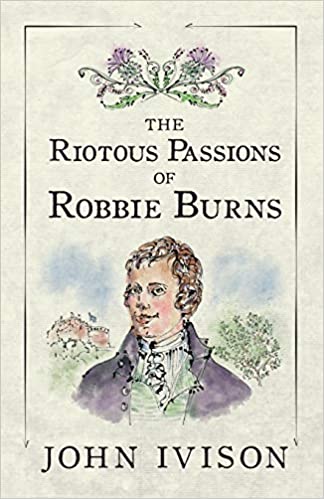
I don’t know what I was expecting before I picked up John Ivison’s new book, The Riotous Passions of Robbie Burns, but it was not this. In my head, I’d already started composing the end of my review. Something round and pat and full of holiday hygge like: “So light the fire, pour yourself a dram of Annandale whisky, and enjoy …” Because Ivison grew up in Dumfries, where Burns spent the last years of his life, I suppose I expected a more personal narrative, not a work of historical fiction. One expects fiction from political journalists in their day jobs, not in a labour of love composed off the clock.
What I really expected was more of Burns’ poetry — the source of his enduring fame, after all — and less of his person, which was the source of his contemporary infamy. Instead, Ivison gives us something more interesting and unusual: the poetry of Burns’ non-poetic speech. Ivison has taken snippets, and sometimes cribbed whole paragraphs from, Burns’s copious surviving correspondence and woven them into dialogue that carries the story of the poet’s stay in Edinburgh between 1786 and 1788. By putting Burns’ actual words into his mouth, even if sometimes out of context, Ivison gives the reader a direct and plausible impression of Burns the man. We hear verbatim both the coarse tavern wit and the elemental passion that spilled into his prolific verse — sometimes into unprintable doggerel (literally: his poems later collected as The Merry Muses of Caledonia were banned as obscene in the U.K. until 1965), sometimes into achingly beautiful verses like “Flow gently, sweet Afton” or “Ae Fond Kiss.”
Ivison’s book sets us in Edinburgh at a time when, as he writes, “it was said if you stood at the Mercat Cross with a pistol, you could hit 50 geniuses, 50 bankers, 50 lawyers and 50 rogues at any given hour” (no doubt allowing for some overlap between latter two categories). Our narrator and guide is the newly-arrived and impressionable young lawyer’s apprentice, John Bruce, a composite and Zelig-like stand in for many young men of the poet’s acquaintance. (The only record of Burns meeting a John Bruce that I can find was a Rev. John Bruce, Minister of the Highland town of Forfar, whom the poet found “pleasant, agreeable and engaging.”) Through Burns, Bruce and the reader are introduced to the ways of women, drink, the printing business, drink, aristocratic libertinism, and a little more drink.
The two main plots, such as they are, link Bruce and Burns to the notorious escapades of Deacon Brodie, whom Burns met in real life, and to the poet’s long, futile, but apparently sincere courtship of the unhappily-married Agnes (sometimes Nancy) Maclehose. The real life letters between Burns and Maclehose, written under the pseudonyms “Sylvander” and “Clarinda,” make for moving reading and, in this telling, for surprisingly convincing dialogue between Burns and Maclehose and between Burns and Bruce. The text is especially affecting when the poet is in the grip of what he called his “low spirits & blue devils” and his usually florid speech turns fatalistic, brooding, and palpably human.
But the plots are not the point of this charming book; they are frames on which to hang Burns’s words and excuses to showcase Edinburgh as it was coming of age as an intellectual and commercial capital, with all the growing pains that entailed. Filling the city with historical characters, Ivison shows us the city as Burns found it, its population bursting out of the overbuilt medieval closes and wynds that lined the Royal Mile running down the hill from the castle and spreading across the North Bridge to New Town and down to the sea port at Leith.
November 22, 2020
Douglas Murray’s Bosie: The Tragic Life of Lord Alfred Douglas
Melanie McDonagh reviews the re-released early work by Douglas Murray:
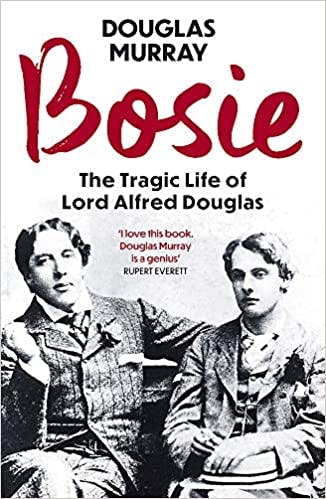
It would probably have been better for Lord Alfred Douglas to have died young. Had he died when he was still beautiful and youthful looking, he would have remained forever the gilded youth Oscar Wilde loved. That golden Alfred Douglas survives in the famous photograph on the front of Douglas Murray’s book, with Wilde sitting near Bosie, his arm extended behind the boy with something like possessiveness. Instead the boy survived until 1945, worn, lonely and poverty-stricken, his looks withered, his nose pinched, contemptuous of modernity, but still with a redemptive, blistering integrity.
Twenty years after it was first written, Douglas Murray has reissued his fine biography of Bosie: his first book, written in his gap year before he went to Oxford. Looking back now on his precocious work, he thinks he overdid a little his enthusiasm for Douglas’s poetry, understated his toxic anti-Semitism and didn’t quite do justice to the pederastic element of his early sexuality – as Bosie preferred to put it, his tastes were for youth and softness. In practice this could mean 14-year-old boys, even younger, at a time when he and Wilde had reunited following Wilde’s release from prison. Actually, I think Murray’s original estimate of Alfred Douglas’s sonnets was absolutely right; they vary in quality, but as he said, at their best they equalled the poets he most venerated.
Trouble is, not many people think of Alfred Douglas as a poet, even though they might unknowingly quote perhaps his most famous line, about the love that dares not speak its name. But there were literary critics in his own day who compared him to Shakespeare as a writer of sonnets. Remarkably he has fallen almost entirely off the literary radar now, known only as a player in Wilde’s drama, and it is a pity that the success of this biography hasn’t changed that.
One of the services Douglas Murray performs in his biography is simply to reproduce some of his finest verses so we can judge it for ourselves. Indeed, while writing the book he managed to persuade the Home Office to release the copybook in which Alfred Douglas wrote his prison verses, In Excelsis, which the authorities refused to do in his lifetime.
Even in his own time, most people thought of him as the lover of Oscar Wilde, a byword for a bugger, the boy who brought about Wilde’s destruction through the vengeful malice of his unbalanced father. That perception was powerfully reinforced by Wilde’s terrible letter written from prison, De Profundis, in which he empties his bitterness against the youth he loved in an outpouring of emotion which was in many respects unjust and untrue, especially about Bosie’s financial support for Wilde. Fatally, the letter was never given to him by Robert Ross, Wilde’s friend, and only released in full during a devastating court case.


