
TimeGhost History
Published 12 Oct 2025From Pulaski to Stone Mountain to Brown v. Board, the Ku Klux Klan evolves from Reconstruction terror to a decentralized, Cold War–era movement that bombed churches, lynched citizens, and hid behind “anti-communism”. We trace the First, Second, and Third Klans — rituals, networks, and the brutal campaign against desegregation and civil rights.
(more…)
October 14, 2025
White Hoods, Bloody Hands: The Klan as America’s First Terrorists – W2W 048
Comments Off on White Hoods, Bloody Hands: The Klan as America’s First Terrorists – W2W 048
October 7, 2025
How a Myth Started the Nuclear Arms Race – W2W 47
TimeGhost History
Published 5 Oct 2025The Bomber Gap: a mid-1950s panic that convinced Washington the USSR was outproducing the U.S. in long-range strategic bombers — and triggered a massive nuclear buildup. This episode traces Eisenhower’s New Look, Curtis LeMay and SAC’s push for jets, the Dulles brothers’ influence, the M-4 “Bison” bluff, and the Symington hearings that turned bad intel into national policy. Learn how politics, optics, and deliberate Soviet deception combined to accelerate the arms race and reshape deterrence for decades.
[NR: At Dominion Review, Palmiro Campagna discusses the missile gap and how it impacted the decision to cancel the Avro Arrow.]
(more…)
Comments Off on How a Myth Started the Nuclear Arms Race – W2W 47
September 30, 2025
How Tyrants Rise — and How to Stop Them – W2W 46
TimeGhost History
Published 28 Sept 2025Tyrants don’t just appear overnight — they rise through propaganda, fear, and control. In this episode of War 2 War, we explore how authoritarian leaders consolidated power in the 20th century, from the ruins of World War Two to the opening battles of the Cold War. How do tyrants gain control, how can you recognize the warning signs, and what can societies do to resist them? Drawing on lessons from Hitler, Stalin, and beyond, we break down the patterns of dictatorship and what history can teach us about confronting them.
(more…)
Comments Off on How Tyrants Rise — and How to Stop Them – W2W 46
September 27, 2025
AK4: Sweden’s Beefed-Up Take on the G3
Forgotten Weapons
Published 19 May 2025When Sweden decided to replace its bolt action Mausers and Ljungman semiautomatic in the 1960s, it had four main choices to pick from. One was the domestic GRAM-63, a modernized version of the Ljungman, the FAL and the G3. They ended up choosing the G3, but not without a number of changes.
Mechanically, the Swedes insisted on a longer service lifespan of the rifle than H&K rated it for. To this end, the Swedish model got a heavier recoil buffer, extending its life to 15,000 rounds. There were also changes to the stock, sights, bayonet attachment, and bolt carrier as well as the use of a clip-on rubber case deflector.
The initial batch of Swedish AK4 rifles was purchased directly from H&K, while domestic licensed production was set up at (eventually) both the star-owned Carl Gustaf factory and also the Husqvarna company.
Thanks to the Supply Battalion of the Estonian Defense Forces Support Command for giving me access to film this surprisingly hard-to-find rifle!
(more…)
Comments Off on AK4: Sweden’s Beefed-Up Take on the G3
September 22, 2025
Dien Bien Phu: The Battle that Ended French Indochina – W2W 45
TimeGhost History
Published 21 Sept 2025The First Indochina War reaches its climax at Dien Bien Phu. In late 1953 the French parachute into the valley, build a fortress under Christian de Castries, and plan to smash the Viet Minh with artillery and air power. Võ Nguyên Giáp answers with a siege: anti-air guns on the surrounding hills, trenches creeping forward, and relentless assaults on strongpoints Beatrice, Gabrielle, and Isabelle.
After weeks of bombardment and failed resupply, the fortress collapses in May 1954. At Geneva, the great powers draw the ceasefire lines: Vietnam is divided (North–South), and the Indochina War ends.
#DienBienPhu #IndochinaWar #Vietnam #ColdWar #Geneva1954 #VoNguyenGiap #FrenchIndochina
(more…)
Comments Off on Dien Bien Phu: The Battle that Ended French Indochina – W2W 45
September 17, 2025
The Korean War Week 65: Another Bloody Ridge Begins? – September 16, 1951
The Korean War by Indy Neidell
Published 16 Sep 2025Bloody Ridge is barely over, but orders have come for the UN forces to already attack the next ridge to the north, and UN planes violating the Kaesong neutral zone sabotage Matt Ridgway’s plans for conquest.
Chapters
00:00 Hook
00:49 Recap
01:27 Van Fleet’s Planning
08:44 The War and the Conference
14:28 Summary
14:46 Conclusion
15:20 Call to Action
(more…)
Comments Off on The Korean War Week 65: Another Bloody Ridge Begins? – September 16, 1951
September 15, 2025
The Cold War in Latin America Begins: Coups, Communists, and Castro – W2W 44
TimeGhost History
Published 14 Sept 2025Spy rings, covert operations, coups, street violence, and sudden regime changes. This is the turmoil that awaits Latin America after the Second World War. As new ideas from the East gain momentum, the United States tries to hold on to its role as the region’s self-appointed guardian. Which side will ultimately shape the future of this rich and populous region?
(more…)
Comments Off on The Cold War in Latin America Begins: Coups, Communists, and Castro – W2W 44
September 8, 2025
September 1, 2025
Who Killed Pakistan’s First Prime Minister, Liaquat Ali Khan? – W2W 42
TimeGhost History
Published 31 Aug 2025October 1951: Pakistan’s first Prime Minister is gunned down on stage, and the world is left asking — who ordered his death? Was it the British, the Americans, or his own allies in Pakistan? Dive deep into a tangled web of espionage, conspiracy, and Cold War politics as we follow the murder mystery that set the course for South Asia’s future.
(more…)
Comments Off on Who Killed Pakistan’s First Prime Minister, Liaquat Ali Khan? – W2W 42
August 27, 2025
The Korean War Week 62: Chinese Break Off Peace Talks! But Whose Fault Is It? – August 26, 1951
The Korean War by Indy Neidell
Published 26 Aug 2025The Chinese claim that American bombers have attacked the Kaesong conference area and break off the peace talks. The UN delegation smells a set up. Meanwhile, the Battle of Bloody Ridge is in full swing and earning its name, as the casualties mount on both sides.
Chapters
00:41 Recap
01:11 A ROK Success
01:47 Bloody Ridge
06:17 Soviet Reinforcements
07:08 Operation Strangle
11:06 Summary
11:45 Conclusion
13:37 Call to Action
(more…)
Comments Off on The Korean War Week 62: Chinese Break Off Peace Talks! But Whose Fault Is It? – August 26, 1951
August 25, 2025
Vietnam 1950: Giáp Crushes France on Route Coloniale 4 – W2W 41
TimeGhost History
Published 24 Aug 2025Viet Minh forces shift to the offensive, attacking French troops up and down the country. As guerilla war reigns in the southern half of Vietnam, more organised attacks begin in the north up near Hanoi. France cycles through multiple new commanders, trying to stem the tide. But do they truly have a hope of turning this around? Or are they just delaying the inevitable?
(more…)
Comments Off on Vietnam 1950: Giáp Crushes France on Route Coloniale 4 – W2W 41
August 23, 2025
T-55: 70 Years Old. Still in Service
The Tank Museum
Published 22 Aug 2025No tank in history has been produced in the quantities that the T-55 and its relatives have. Some sources suggest as many as 100,000 have been built since 1946, this tank is still seeing service across the globe. So how come this 80-year-old tank is still in service in 2025?
When looking at its predecessor, the T-34, the move to the T-55 looks like a massive leap in design. But there is a clear evolutionary progression – there is just a missing link. The T-44 laid the groundwork for future Soviet tank design – pioneering torsion bar suspension and a transverse engine.
It was soon decided that the T-44 would require a new 100mm gun to replace the 85mm. This new model would be called the T-54. While NATO classes both the T-54 and 55 as the same vehicle, the T-55 is a substantially better tank. A comprehensive series of upgrades made this an effective force on the battlefield.The T-55 would prove popular with forces around the world. It would even go head-to-head against itself in the Iran-Iraq War of the 1980s. Eventually the T-55 would become outdated as NATO technology became more and more advanced. But it is still in service in the conflict in Ukraine – why?
The Russian army, despite the stereotype of having unending stockpiles of weaponry, have been struggling to keep up with the astounding loss rate the Ukrainians have been able to inflict on them. This has resulted in older and older vehicles being dragged out of those large storage depots across Russia, mainly being used as mobile, protected artillery.
The T-55 has endured partly due to its sheer numbers, availability and upgradability. Its performance on the battlefield has varied, but its basic but effective design has proven itself again and again throughout the decades. It is worth reiterating how remarkable it that a vehicle conceived at the end of the Second World War is still even a consideration for armies 80 years on.
In this video, historian James Donaldson explores the history of the most-produced tank in history – the T-55. This Soviet design has its roots in the iconic T-34, evolving through the years to become an effective fighting machine that was sold around the world. Despite manufacturing ending in the 1980s, this tank is still a feature on the battlefield, with both sides making use of T-55s in the current conflict in Ukraine. It may not be engaging in tank-on-tank combat as initially intended, but the T-55 is still providing a useful, effective and relatively cheap addition to the arsenal of many armies in the 21st Century.
00:00 | Introduction
00:43 | The Missing Link
02:31 | Making the T-55
05:24 | Upgrades
08:34 | A Numbers Game
12:51 | In Action
16:41 | T-55 Today
(more…)
Comments Off on T-55: 70 Years Old. Still in Service
August 20, 2025
UK vz.59 Czech Universal Machine Gun: History and Mechanics
Forgotten Weapons
Published 21 Mar 2018In 1952, Czechoslovakia adopted a whole new family of small arms, including the vz.52 pistol, vz.52 rifle, and vz.52 light machine gun. The rifle and LMG were both chambered in the Czech 7.62x45mm cartridge, and both would be adapted to the Soviet standard 7.62x39mm a few years later, in 1957. Very shortly thereafter, the Czechs would also introduce a heavier universal machine gun version in 7.62x54mmR under the designation UK vz.59 (universal machine gun model 59).
The UK 59 was basically a scaled up sibling of the vz.52 and vz.52/57 machine guns, although it fed from a belt only, where its smaller predecessors had allowed either belt or magazine feed. It used a pivoting locking block system much like the Walther P38 and Beretta pistols, in conjunction with a long stroke gas piston much like that of the vz.26 light machine gun.
The weapon did not see much interest outside of Czechoslovakia, although it does remain in service in that region in the modernized 7.62x51mm iteration.
Thanks to Marstar for letting me examine and shoot their UK vz.59!
Comments Off on UK vz.59 Czech Universal Machine Gun: History and Mechanics
August 18, 2025
How One Treaty Split The World In Two – W2W 40
TimeGhost History
Published 17 Aug 2025After WWII, Britain and France face the decline of their empires and the looming Soviet threat. Desperate for security, they forge the Dunkirk and Brussels Pacts, but quickly realize they need American support. As old alliances shatter and Germany becomes the front line, the world divides into two camps with the formation of NATO and the Warsaw Pact. Secret deals, rearmament, and the fear of communist tanks rolling across Europe set the stage for decades of Cold War rivalry.
(more…)
Comments Off on How One Treaty Split The World In Two – W2W 40
August 14, 2025
“Just war” theory and nuclear weapons practice
On Substack, Nigel Biggar discusses the postwar argument about whether the use of nuclear weapons against Japan was justified or not:
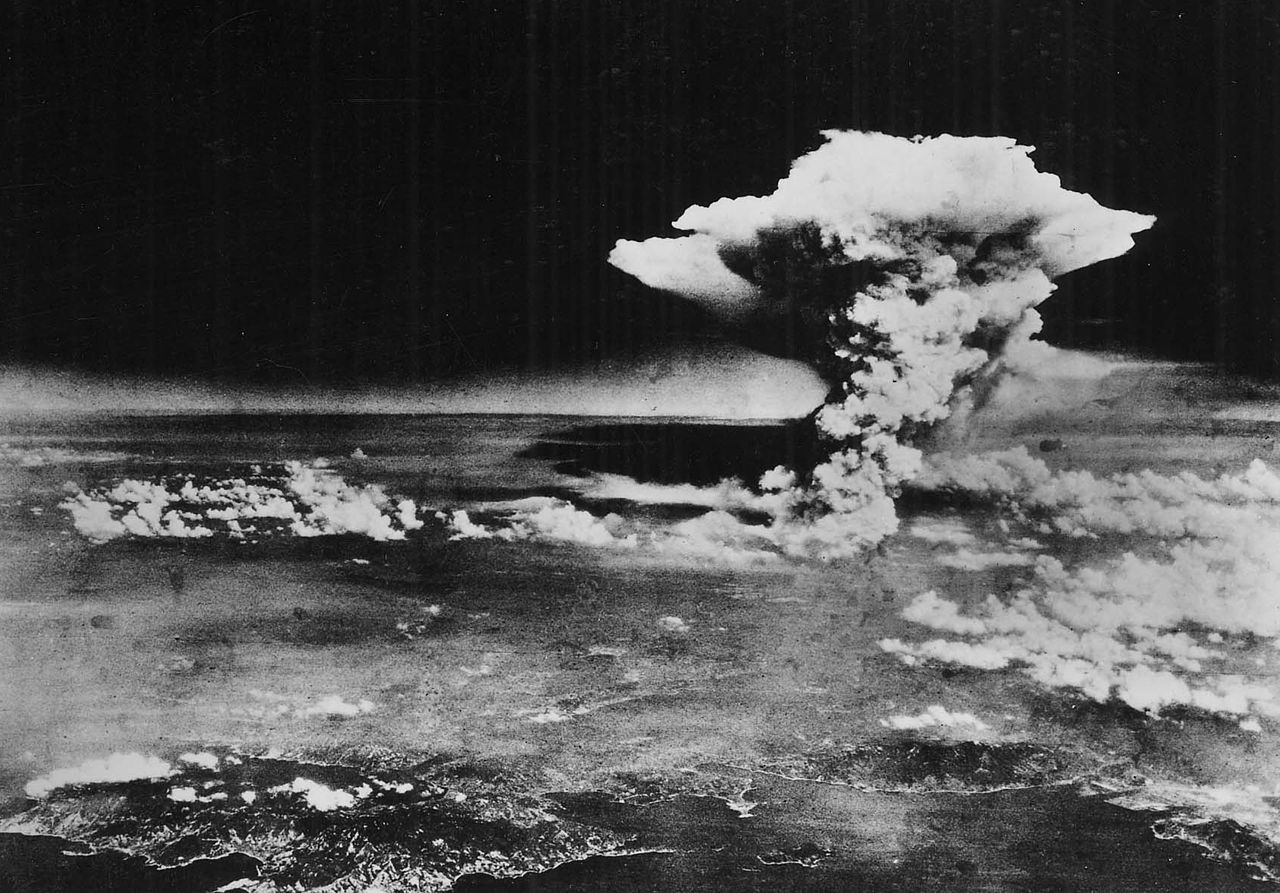
Atomic cloud over Hiroshima, taken from “Enola Gay” flying over Matsuyama, Shikoku, 6 August, 1945.
US Army Air Force photo via Wikimedia Commons.
For pacifists, Christian or otherwise, the answer is clear: since any deliberate killing is wrong, the dropping of atomic bombs on Hiroshima and Nagasaki on 6 and 9 August 1945 was wrong about two hundred thousand times over.
But that clear answer generates further questions whose answers aren’t so obvious. If killing is always wrong, then the United States should never have gone to war against Imperial Japan and therefore its ally, Hitler’s Germany. What, then, would have stopped the triumph of brutally racist Japanese imperialism in Asia and massively murderous Nazism in Europe? The noble witness of innocent non-violence?
Unfortunately, the historical evidence is that the kind of people who ran the slave-labour camps in Burma, and the likes of Dachau in Germany and Auschwitz in Poland, were not at all shamed by the face of vulnerable innocence; on the contrary, it excited their lust for domination and they fed upon it.
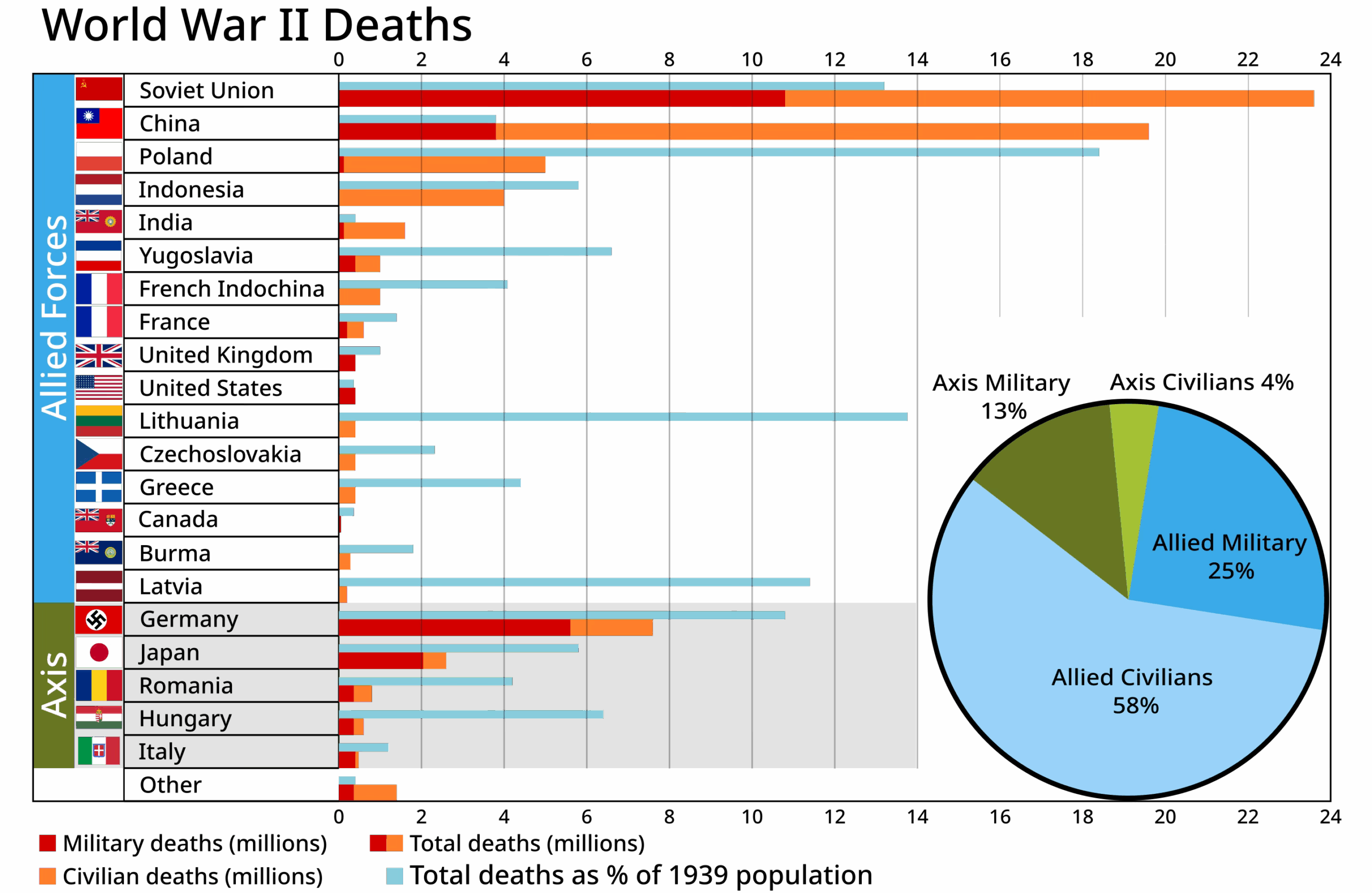
On the other hand, those who think that war can sometimes be justified, might judge that the mass killing of civilians by the atomic bombs was, simply by its massive extent, indiscriminate and therefore unjust. But there are two problems here. The first is that the vast majority of people, certainly in the UK and the USA, regard the war against Hitler and his allies as morally justified, notwithstanding the fact that that cost between 60 and 80 million deaths, well over half of them civilian.
Image credit – Wikipedia
And the second problem is that the ethical tradition of “just war” thinking doesn’t say that we may not kill civilians, even on a massive scale; it only says that we may not kill them intentionally. If a military objective can’t be achieved except by risking the possible or probable deaths of civilians, then it may still be attempted, provided that the objective is sufficiently important, militarily, and that all reasonable measures are taken to avoid or minimise the side-effect of civilian casualties. The reason for this permissiveness is that in most circumstances just war would be impossible to prosecute otherwise.
So, for the “just war” proponent, if the intention in dropping the atomic bombs on Japan was to destroy vital military or military-related targets, and if there was no more discriminate way of achieving that end, then the bombing was morally justified. It was deeply, deeply tragic—but nevertheless just.
Comments Off on “Just war” theory and nuclear weapons practice


