
TimeGhost History
Published 10 Aug 2025March 1953: Stalin’s sudden death triggers a whirlwind of conspiracies, paranoia, and a deadly battle for control inside the Kremlin. As Beria, Khrushchev, and the Soviet elite scramble for power, the fate of the world’s largest superpower hangs in the balance. Was Stalin murdered by his inner circle, or did his own regime consume him? Discover the truth behind the downfall, the rise of Khrushchev, and the birth of the KGB in the Cold War’s most dramatic turning point.
(more…)
August 11, 2025
Stalin’s Death: The Day the USSR Changed Forever! – W2W 39
Comments Off on Stalin’s Death: The Day the USSR Changed Forever! – W2W 39
Speed vs Armour: The Unexpected History of Fast Tanks
The Tank Museum
Published 21 Mar 2025Would you rather go to war in a tank that was quick but lightly armoured – or heavily armoured but slow?
The concept of fast tanks has existed since the First World War, but making a tank fast is easier said than done. You can increase the speed, but only by compromising the other two sides of The Iron Triangle.
Whilst a good power to weigh ratio is key to making a tank go fast, there are other factors that need to be considered. J Walter Christie pioneered the innovative helicoil spring suspension system – an invention that allowed tanks to cope with travelling at high speeds across country. Although not picked up by the US Army, the brilliance of Christie’s suspension was recognised by the Soviets and soon made an appearance on the BT-Series of tanks – and most effectively on the T-34.
Back in the UK, the newly mechanised cavalry was making use of some brand-new Cruiser tanks. Whilst these were fast vehicles, this was coming at the cost of effective protection. Some military thinkers advocated for the concept of “speed as armour” but results were mixed – with the Crusader and Cromwell both proving to be capable tanks.
After the war, the British Army finally moved on from “speed as armour” and settled on sacrificing a bit of speed for the sake of better protection. This was incorporated first into the concept of Universal Tanks and remains a fixture in the modern Main Battle Tank.
So, we’ll ask again. Would you rather go to war in a tank that was quick but lightly armoured – or heavily armoured but slow?
00:00 | Introduction
00:51 | What Makes it a Fast Tank?
02:39 | What is a Fast Tank For?
04:39 | Suspension of Disbelief
06:34 | Speedy Soviets
08:29 | Cruisers Replace Cavalry
11:20 | The Second Wave
13:19 | Cruising in Europe
19:08 | One Tank to Do It All
(more…)
Comments Off on Speed vs Armour: The Unexpected History of Fast Tanks
August 6, 2025
The Korean War Week 59 – Who’s Really Running the Korean War? – August 5, 1951
The Korean War by Indy Neidell
Published 5 Aug 2025The Kaesong peace talks keep dragging on, and where any demarcation line should be drawn continues to the biggest obstacle to progress. The war continues, though, and plans for new offensives and blockades are being hashed out. But who exactly are the forces fighting this war? This week we take a closer look at the Communist forces and the American chain of command.
Chapters
00:00 Hook
00:37 Intro
00:50 Recap
01:11 The 38th Parallel Issue
02:51 War Without Victory
04:58 US Chain of Command
09:21 Plans and Alternatives
10:58 UN Air Power
13:19 The Communist Forces
18:28 Summary
18:49 Conclusion
19:45 CTA
(more…)
Comments Off on The Korean War Week 59 – Who’s Really Running the Korean War? – August 5, 1951
August 5, 2025
Inside the CIA Coup That Changed Iran Forever! – W2W 38
TimeGhost History
Published 3 Aug 2025In 1953, a battle for Iran’s soul erupts on the streets of Tehran. Prime Minister Mosaddegh defies British oil interests, outwits Soviet intrigue, and faces down the Shah — but a secret Anglo-American plot changes history forever. As coups, street mobs, and betrayal plunge Iran into chaos, the nation’s fragile democracy is crushed and a brutal new order rises. This is the untold story of oil, espionage, and the coup that reshaped the Middle East.
(more…)
Comments Off on Inside the CIA Coup That Changed Iran Forever! – W2W 38
August 3, 2025
ZB37: Czechoslovakia’s Super-Heavy Machine Gun
Forgotten Weapons
Published 12 Mar 2025The ZB37 began in 1930 as a design by none other than classic Czech arms designer Vaclav Holek. The Czechoslovakian military was still using the Schwarzlose heavy MG, and wanted something to replace it. To fill all the roles intended, there would eventually be three different models of the ZB37 — one for infantry, one for fortresses, and one for vehicle mounting.
Note that the factory designation for this gun at Brno began as the ZB50, and iterated to the final version being the ZB50. However, it was identified by the military as the ZB37 (for 1937, the year of adoption).
After a series of redesigns, an early version of the gun is finally adopted in 1935 as the ZB35. A series of improvements leads to the final ZB37 model. About 500 of the early ZB35s were produced, and most of these were used to fill export sale contracts. By the time World War Two begins, the Czechoslovak military has about 5,000 of the guns in its possession.
Interestingly, the gun uses a hybrid recoil and gas operating system, with a tilting bolt. It has two rates of fire that can be chosen, and uses the rear spade grips as the charging handle. It is belt fed, using continuous 100- and 200-round metallic belts and chambered for the 8x57mm Mauser cartridge.
During the war, both German and British forces made substantial use of the ZB37. The Germans purchased ongoing production from Brno, and the British had actually purchased a production license before the war began. For the British, the gun was called the BESA and used in several armored vehicles (still in 8mm Mauser) — with about 57,000 being made during the war. A number of export sales were also made, including Romania, Persia, China, and several others. In 1946 another 3,000 were ordered and manufactured for fortress use in the Czech Republic, serving until the end of Communist control of the country.
Thanks to Sellier & Bellot for giving me access to this example to film for you!
(more…)
Comments Off on ZB37: Czechoslovakia’s Super-Heavy Machine Gun
July 23, 2025
The Korean War Week 57: Behind the Talks – A New Battle Is Brewing – July 22, 1951
The Korean War by Indy Neidell
Published 22 Jul 2025The Kaesong negotiations continue, hopefully to bring about a cease fire, but is this even possible, considering the wishes and demands of each side? They can’t even agree on what a “foreign soldier” is, let alone whether such troops should leave Korea. And both sides still prepare for war, even as they try to bring about some sort of peace.
Chapters
00:00 Hook
00:58 Recap
01:07 Kaesong Negotiations Continue
04:09 Ridgway’s Machinations
07:15 What China Has Gained
09:40 The Commonwealth Forces
11:34 Byers Takes Over
13:11 Conclusion
13:47 Summary
(more…)
Comments Off on The Korean War Week 57: Behind the Talks – A New Battle Is Brewing – July 22, 1951
July 21, 2025
Was Juan Perón a Fascist? The Cold War Origins of Peronism – W2W 037
TimeGhost History
Published 20 Jul 2025Was Juan Perón really a fascist, a socialist, or something entirely different? In this episode of War 2 War, we explore the rise of Peronism in post–World War II Argentina and how Perón tried to position his country between the superpowers of the Cold War.
Through labour reforms, nationalist rhetoric, media control, and brutal repression of dissent, Juan and Eva Perón created a powerful populist regime that borrowed ideas from both fascism and socialism, while claiming to reject both. From Argentina’s “Third Way” to its complicated ties with the US, USSR, and even Nazi fugitives, we examine the ideology, contradictions, and legacy of Peronist rule.
Was Peronism a unique form of authoritarian populism, or just another face of fascism?
Join us as we uncover the foundations of Argentina’s Cold War identity and the true political nature of Juan Perón.
(more…)
Comments Off on Was Juan Perón a Fascist? The Cold War Origins of Peronism – W2W 037
July 16, 2025
The Korean War Week 56: Ceasefire Talks Start – With Threats, Tricks, and Delays
The Korean War by Indy Neidell
Published 15 Jul 2025This week might be a big turning point in the war, for this week, ceasefire negotiations begin in Kaesong. Both sides have sent delegations, and both sides have different goals they wish to achieve. The big question is, though: what is each side willing to concede in order to create a lasting peace?
Chapters
00:00 Intro
00:53 Recap
01:27 The Communist Delegates
04:34 The First Session
08:40 The Next Few Days
11:38 Future Planning
13:21 Conclusion
(more…)
Comments Off on The Korean War Week 56: Ceasefire Talks Start – With Threats, Tricks, and Delays
July 15, 2025
Why France Couldn’t Crush the Viet Minh – W2W 36
TimeGhost History
Published 13 Jul 2025Why couldn’t France crush the Viet Minh after war broke out in Vietnam? In this episode we dive into the brutal opening years of the First Indochina War, from the outbreak of violence in Hanoi in December 1946 to France’s failed military campaigns and the rise of Vietnamese resistance.
Despite having superior weapons, colonial experience, and Foreign Legion reinforcements, France failed to defeat Ho Chi Minh’s forces. We explore why early offensives like Operation Léa and Ceinture fell short, how the Viet Minh’s rural strategy kept them alive, and why French hopes of ending the war quickly vanished.
As Mao Zedong’s Communist China consolidates power just across the border, the Viet Minh gain strength, support, and a long-term advantage that France simply cannot match.
This video is part of War 2 War, our Cold War history series covering the decade after WW2, a time of seismic global transformation.
(more…)
Comments Off on Why France Couldn’t Crush the Viet Minh – W2W 36
July 13, 2025
Q&A: Finland and Finnish Small Arms (From Berdan to New Sako AR)
Forgotten Weapons
Published 19 Feb 2025Today’s Q&A is brought to you by the fine folks at Patreon!
I figured that Finland would be a good subject for this month’s Q&A, as I am visiting the country to shoot Finnish Brutality this month. In fact, this video was filmed during the trip (the match took place last weekend, and its video coverage will be coming soon!).
00:39 – Development of the Suomi and PPSh-41 submachine guns
03:24 – Oldest guns used in Finnish Independence War
04:40 – Biggest strength and weakness of the Suomi
06:43 – Soviet use of captured Suomis?
08:52 – Finnish Maxim guns
11:41 – Finnish alcohol
17:05 – Finnish small arms that could have been globally popular but weren’t?
20:04 – Benefits of a small invaded country using the same weapons as its invader?
23:07 – Favorite and least favorite Finnish customs?
25:57 – Finnish Mosin Nagant book by Matt DiRisio
27:26 – Sisu movie
28:28 – Are the Finns masters of improving other peoples’ guns?
30:08 – Pre-independence Finnish arms production
31:47 – Shower beer or sauna beer?
32:20 – Why so few RK95 rifles made, and RK95 vs RK62M?
35:35 – Swedish Mausers in Finland
37:54 – Commercial Sako rifles before and after Beretta bought Sako
39:19 – Finnish gun laws, specifically CCW
40:58 – Interlude: Finnish Brutality 2025 match update w/ Jari Laine
42:24 – Did Finland improve the PKM and SVD like they did the AK and Mosin?
44:57 – 7.62x54R vs 7.62x53R
47:56 – Thoughts on new Sako AR for Swedish and Finnish militaries
(more…)
Comments Off on Q&A: Finland and Finnish Small Arms (From Berdan to New Sako AR)
July 9, 2025
WF-54: The Swiss FG-42 Scaled up to 7.5×55
Forgotten Weapons
Published 19 Aug 2024After World War Two the Swiss needed a new self-loading military rifle to replace their K-31 bolt actions. Two major design tracks followed; one being a roller-delayed system based on the G3 at SIG and the other being a derivative of the German FG-42 at Waffenfabrik Bern. Bern, under the direction of Adolph Furrer, had been experimenting with intermediate cartridges since the 1920s, and they used this as a basis to develop an improved FG-42 using an intermediate cartridge (7.5x38mm). The program began in 1951 and went through about a half dozen major iterations until it ultimately lost to the SIG program (which produced the Stgw-57).
Today we are looking at one of the later steps in the Bern program, the WF-54. By this point the intermediate cartridge had been discarded in favor of using the standard Swiss GP11 (7.5x55mm). The overall design was a bit simplified as well. The Bern program would continue for two more years after this rifle before ultimately losing out to the SIG 510 for Swiss military adoption.
(more…)
Comments Off on WF-54: The Swiss FG-42 Scaled up to 7.5×55
July 8, 2025
Korea: War Without End by Richard Dannatt and Robert Lyman
Taylor Downing reviews the latest co-operative work between former British Chief of the General Staff Lord Dannatt and Dr. Robert Lyman:
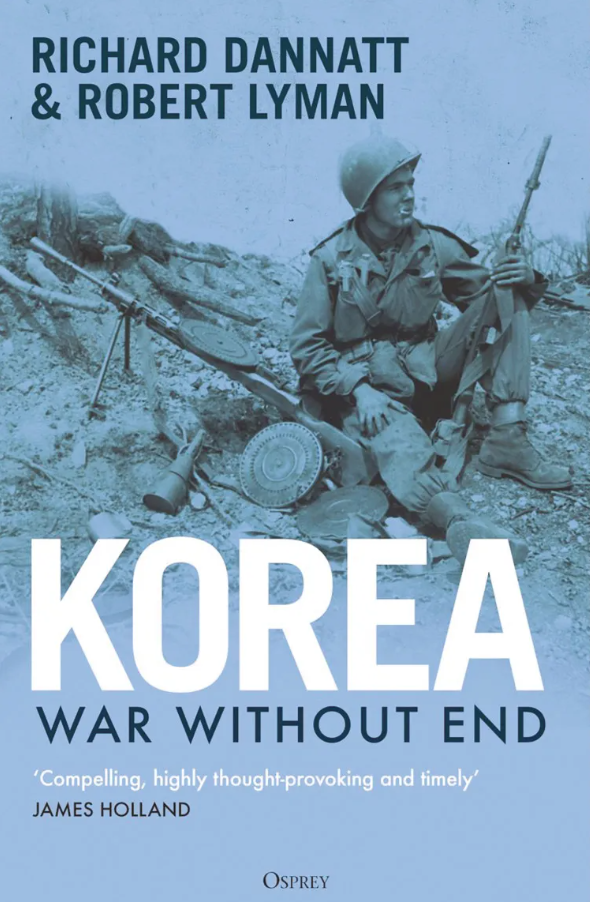
Their book has three premises. First, that the conflict in Korea is a forgotten one that very much deserves retelling. Second, that the war is very topical today partly because it shows how to fight (or not to fight) a conventional war in a nuclear age, and partly because it shows how politics must always take precedence over military ambition. And, third, the authors argue that the war was not a single conflict but was in fact two wars, quite separate but consecutive.
The “first” war is the story of the surprise invasion of South Korea by the North Korean People’s Army (NKPA), or the In Mun Gun, in June 1950 as their leader Kim Il Sung sought to reunite the Korean peninsula under Communist control without having any sense of the political response he would unleash. What followed was a rapid advance towards the southern city of Pusan in a form of Blitzkrieg that had not been seen since World War II.
This early phase covers the establishment of a US-led United Nations force for the first time in its history – only formed because the Soviet Union was boycotting the Security Council at the time. US troops finally slowed the NKPA advance and then, in a brilliant counterstroke masterminded by General Douglas MacArthur, an amphibious troop landing took place behind enemy lines at Inchon. This resulted in a complete reversal in the fortunes of the North Koreans and their retreat to pretty well their starting lines on the 38th Parallel that had divided the peninsula since 1945.
This, the authors argue, is where the war should have ended. The UN had achieved its aim of liberating the south from a Communist takeover. But instead a “second” war unfolded in which General MacArthur, convinced that he was fighting a crusade against world Communism, advanced rapidly through North Korea towards the Yalu River and the border with Communist or (as he called it) “Red” China. For him, victory had to include total defeat of the enemy. In scenes of remarkable hubris, MacArthur was convinced he had the war wrapped up and his troops would be home by Christmas. Instead, he provoked an attack by the Chinese People’s Volunteers on a massive scale, leading to the humiliating rout of US troops and a midwinter retreat back into southern Korea.
This “second” war had as its next phase the final standstill along lines roughly similar to the 38th Parallel and two years of stalemate, before an armistice was signed. The breakdown of the war into two separate conflicts is a fine way of interpreting the remarkable see-saw events of the first year of fighting. Seoul was captured and recaptured four times in nine months. Pyongyang was captured and lost, becoming the only Communist capital to have been taken in battle during the entire Cold War.
In the first stages of the conflict, UN troops, largely Americans who had been sent in from keeping the peace in Japan and who were entirely untrained and unprepared for combat, were thrown back so rapidly that many simply threw down their weapons and retreated. The NKPA, using the tactics the Japanese had used in their invasions of Malaya and Burma, completely outclassed the unprepared US forces.
Then, a few months later, the US-led advance made the Americans feel completely unstoppable as they headed north, only to be turned once more by the Chinese. Again, tactically outclassed and totally unprepared for mountain warfare in midwinter, where conditions were brutal, the UN forces collapsed. It is a remarkable story that very much merits the retelling.
Comments Off on Korea: War Without End by Richard Dannatt and Robert Lyman
July 7, 2025
Why the Cold War Gave Us LEGO, Credit Cards, and Video Games – W2W 35
TimeGhost History
Published 6 Jul 2025Think the 1950s were all poodle skirts and jukeboxes? Think again! From the first credit cards and modems to LEGO bricks, video games, and even skateboards, discover the surprisingly futuristic side of the Cold War era.
In this episode of War to War by TimeGhost, Sparty dives into the forgotten innovations of the 1950s that still shape our daily lives in 2025.
Topics covered:
• The first commercial credit card (Diners Club)
• The birth of the computer modem
• The first microchip and the rise of computing
• “Tennis for Two” – the 1950s’ video game
• LEGO and the System of Play
• Skateboards before Marty McFlyThe 50s were WAY more high-tech than you think!
#1950s #coldwar #inventions #historyyoudidntknow #SkateboardHistory #lego #timeghost #techhistory #Modem #microchips #creditcard #videogames
(more…)
Comments Off on Why the Cold War Gave Us LEGO, Credit Cards, and Video Games – W2W 35
July 2, 2025
The Korean War Week 54 – The War is One Year Old – July 1, 1951
The Korean War by Indy Neidell
Published 1 Jul 2025Over a year has passed since North Korean forces crossed the 38th Parallel and invaded South Korea, and while the war has seen the advantage switch hands time and again, one thing it has not seen is any sort of cease fire or peace negotiations. However, that might change soon, as this week both the Chinese and the Americans indicate their willingness to sit down and talk. South Korean President Syngman Rhee, however, is against any cease fire talks that do not set out to meet a big variety of his demands, demands which which the other warring parties do not see as being in their own best interests.
(more…)
Comments Off on The Korean War Week 54 – The War is One Year Old – July 1, 1951
July 1, 2025
Tibet’s Last Stand: The Snow Lion vs. The Dragon – W2W 34
TimeGhost History
Published 29 Jun 2025The fate of Tibet is decided on the roof of the world as Mao’s China sets its sights on Lhasa. This episode traces the dramatic showdown between the snow lion and the dragon — from imperial legacies and British invasions to the last years of de facto Tibetan independence. Discover how realpolitik, Cold War indifference, and the carrot-and-stick tactics of Mao’s regime sealed Tibet’s fate. Watch as the Dalai Lama faces impossible choices, world powers look away, and the dream of independence is crushed beneath the weight of history.
(more…)
Comments Off on Tibet’s Last Stand: The Snow Lion vs. The Dragon – W2W 34


