
Forgotten Weapons
Published 5 Feb 2025For political reasons, India decided to adopt the 7.62mm NATO cartridge when it needed to replace its No1 MkIII SMLE bolt action rifles with a modern self-loader. They chose the FN FAL as the rifle to adopt, but wanted a license to produce it domestically at the Ishapore rifle factory. FN insisted on the Indians buying Belgian tools as part of the agreement, which India was unwilling to do. So instead, Ishapore used the samples it had of both British L1A1 and Belgian FAL rifles to produce its own reverse-engineered drawings.
The resulting plans use a mixture of British (“inch”) and Belgian (“metric”) parts, and are not interchangeable with either standard pattern. As a result, the Indian 1A1 rifle is a clone of the FAL that is not actually parts compatible with the FAL. That did not prevent Ishapore from producing hundreds of thousands of them, with production apparently ending only in 2012.
Thanks to Sellier & Bellot for giving me access to this 1A1 example to film for you!
(more…)
June 27, 2025
India’s FAL: The 1A1 Inch/Metric Hybrid
June 23, 2025
How Sex in War Breeds Boys – W2W 33
TimeGhost History
Published 22 Jun 2025That prolonged war triggers an increase in male baby births had been ordered since at least 250 years. This “returning soldier effect” happens again during WW2 and right after. How this happens is a mystery, but research in the past decades might provide some answers.
(more…)
June 10, 2025
How Moscow Got the Atomic Bomb – W2W 31
TimeGhost History
Published 8 Jun 2025In 1949, the Soviet Union detonates its first atomic bomb — years ahead of Western expectations. This episode dives into how the USSR mobilized former Nazi scientists, forced Soviet physicists into secret cities, and relied on intelligence from spies like Klaus Fuchs. While Stalin pushes for rapid progress, Beria enforces brutal discipline, and Soviet scientists race to meet an impossible deadline. The nuclear balance of power is about to shift — forever.
(more…)
May 27, 2025
The Revolution is Crushed – Greek Civil War Part 3 – W2W 30
TimeGhost History
Published 26 May 2025The Greek Civil War ends in 1949 — in fire, blood, and betrayal. This episode explores how the Communist Democratic Army was defeated, why Yugoslavia and Tito cut off support, and how American-backed government forces brought the conflict to a brutal conclusion.
This is the final part of our Greek Civil War trilogy in War 2 War — TimeGhost’s Cold War series following the battles that refused to end even after WW2.
(more…)
May 25, 2025
When NATO “stopped being an effective military alliance” and instead “became a kind of social club”
In UnHerd, Edward Luttwak says that Europe (however you might prefer to define it) needs a new Great Power:
All through European history, the intervals of peace, during which reconstruction and progress overcame the ravages of war, were secured by a temporary equilibrium between the Great Powers of the day.
It is obvious that there was no such equilibrium on 23 February 2022, when Russian columns started rolling towards Kyiv, and Russian President Vladimir Putin had just described Ukraine not merely as Russian, but as the homeland of the very first Russian state: Kievan Rus’.
[…]
But when the moment came, and Russian tanks rolled into Ukraine, there was no cohesive and determined power ready to respond quickly and effectively. Nato had done just that several times during the Cold War, by promptly reinforcing threatened allies with thousands of air-lifted troops from the so-called “Allied Command Europe Mobile Force”.
That, however, was the old, pre-enlargement Nato, which was still a veritable military alliance of countries capable of defending themselves, and help weaker allies in trouble, and whose chronically weak Mediterranean member states, with the most resplendent uniforms and least combat strength, had no Russian troops on their borders.
But once very deserving yet utterly indefensible countries such as Estonia were included in Nato — along with Poland, which mustered just 42,000 combat soldiers out of its population of 33 million a mere three months before Putin’s full-scale invasion began — it stopped being an effective military alliance.
Instead, it became a kind of social club. The Nato calendar is full of meetings at the “Supreme Allied Headquarters” in Mons in Belgium, where all manner of military and related issues are addressed often very professionally and quite freely — except that nobody is allowed to mention, however politely, even the most glaring military shortcomings of fellow allies, which undermine important war plans.
The highpoint of the Nato calendar is the splendid summits with all flags flying, in which the arrival of new countries is greatly celebrated, regardless of their ability to actually defend themselves. Both heads of state and heads of government are invited to those gatherings on the premise that there is strength in numbers, with no concerns about the inherent difficulty of reaching any agreements in such a vast crowd.
In the last summit, held in Washington DC in July 2024, Biden’s confusion of President Zelensky with Putin added a touch of humour to otherwise gloomy proceedings: nobody in attendance offered any suggestions on how to end the war in Ukraine.
What proves that Nato is no longer a genuine military alliance was that nothing was done in the last pre-war days before Putin’s invasion finally began. The satellite intelligence that revealed Russian forces on the move also showed that they were already in assault formations. But even then, five days remained to fly fighter-bomber squadrons to forward bases.
Yet even inaction would have been better than what actually happened. Instead of ordering the rapid deployment of tactical airpower to bases in Germany, Italy and the United Kingdom, the Biden administration instead evacuated US diplomats from Kyiv, starting a panic that induced the evacuation of some 20 other diplomatic missions.
QotD: Cancellation of the Avro Arrow and destruction of the prototypes
On Friday, February 20, 1959, 14,000 employees were immediately fired and sent home, after a project they had been working on since 1953, was abruptly cancelled. That project was the military, supersonic, advanced interceptor, the Avro Arrow. The company they worked for, A.V. Roe Canada Limited, had come into being just after the war, with the express purpose of designing and building both commercial and military aircraft in Canada. Its subsidiaries included Avro, responsible for developing and building the platform and Orenda, for developing the engines.
The first project of this new company was the C-102 Jetliner, the first commercial inter-city jet to fly in North America in 1949, and the second [civilian] jet to fly in the world, behind the trans-oceanic British Comet. After being test flown successfully for three years and with potential orders pending, the Jetliner project was cancelled, allegedly in favour of committing all company resources to the development of the military sub-sonic CF-100. The Arrow was to be the successor to the latter, designed to intercept and destroy if need be, incoming supersonic bombers coming across the North Pole, from the then Soviet Union.
The Arrow was a sleek, twin engine, delta winged aircraft embodying many advanced features such as fly-by-wire controls, titanium and magnesium alloys for light weight and resistance to frictional heat, transistorized electronics and an advanced engine, the Iroquois. While some other aircraft may have included some of these advanced features, what made the Arrow unique was that all of them were built into this one singular aircraft.
Adding insult to injury, the five flying preproduction aircraft, including all technical documentation, tooling and jigs and fixtures and others in various stages of assembly, were ordered destroyed. Why was a project being hailed by aviation experts around the world, suddenly cancelled? In the absence of clear facts and in the presence of rumour and innuendo, debates have raged back and forth as to the reasons, sparking a series of myths and misconceptions about the entire affair.
In 1988, the late Canadian historian, Professor Desmond Morton, lamented the fact that he could not obtain any government archival documents on the Arrow, assuming they even existed. Out of interest, I decided to try my own hand in this endeavour. Since then I have uncovered and have had declassified thousands upon thousands of records including many Secret and Top Secret, ranging from memos, reports both scientific and financial, to minutes of meetings and letters. The list includes some from the United States and Great Britain as well.
Those documents which I deemed more critical, I have either quoted from or have reproduced in my books, with full references. Following is a discussion of some of the myths and misconceptions that the documents have helped clarify.
Arrow Destruction
Perhaps one of the most enduring myths is that the destruction of the completed Arrows and all else, was ordered by Prime Minister John Diefenbaker, due to his hatred of the President of A.V. Roe, Crawford Gordon. Alternatively, it has been argued that it was Gordon who had everything destroyed as a spite against the Prime Minister. Neither account is true.
The government records from the Department of National Defence clearly show the order to destroy came from the Minister of National Defence, George R. Pearkes, after receiving that recommendation from Hugh Campbell, Chief of the Air Staff, and after conferring with numerous others including the Deputy Minister of National Defence and the Minister of the Department of Defence Production. The documents contain the signatures of those involved, all of whom would later deny publicly having any knowledge of the destruction, leaving the Prime Minister to be subsequently vilified for it. In fact, the paper trail ends with Minister Pearkes. The matter was not discussed with the Prime Minister at all.
Even today, when the Department decides to dispose of something – it does not matter if it is an aircraft, a tank, a ship or some other equipment – there is no need to seek approval or even advise the Prime Minister as to the manner of its disposal. In fact, all departments dispose of their equipment through an arm of the government. At the time it was called Crown Assets Disposal, but today it is renamed GC Surplus. The name may change yet again.
Palmiro Campagna, “The Avro Arrow: Exploding the Myths and Misconceptions”, Dominion Review, 2025-02-20.
May 19, 2025
1949: What are those kids listening to? – W2W 29
TimeGhost History
Published 18 May 2025There seems to be an evolution, that may one day become a revolution, in popular music in the US. Songs with amplified electric guitars, wailing saxophones, and backbeat rhythms are being released more and more often, but it’s not just R&B or jump blues, this is a bit of a different style — a new style. And it’s spreading quickly thanks to a vinyl record revolution that’s also getting in gear. Looks like exciting times ahead for the youth of America, and maybe even the whole world.
(more…)
May 18, 2025
The FAL for British Troop Trials in 1954: X8E1 & X8E2
Forgotten Weapons
Published 21 Feb 2020The NATO rifle trials of the early 1950s eventually chose the 7.62mm x 51mm cartridge, and the British and Belgians agreed on the FAL rifle to shoot it (and they thought the US would as well, but that’s another story). The British government formally accepted the FAL for troop trials, and in 1954 an order for 4,000 X8E1 rifles (with iron sights) and 1,000 X8E2 rifles (with SUIT 1x optical sights) was placed. These rifles were mechanically the same as what would be finalized as the L1A1 rifle, but they include a number of differing features. Both models had 3-position selector switches allowing automatic fire, and they also had manual forward assists on the bolt handles. The iron sights had top covers with integrated stripper clip guides, as there was concern that troops would have to manually reload their magazines, and stripper clips would speed this process up.
(more…)
May 13, 2025
Mao Wins the Civil War – Chinese Civil War Part 4 – W2W 28
TimeGhost History
Published 12 May 2025By early 1949, Chiang Kai Shek’s Kuomintang is falling apart. Hundreds of thousands of Nationalist troops surrender as city after city fall to Mao Zedong. Beijing falls without a fight and the Communists cross the Yangtze. Chiang’s final plan is escape and he moves tons of gold and his best troops to Taiwan. Meanwhile, Mao declares victory and the birth of the People’s Republic of China.
(more…)
May 8, 2025
Aftermath
I’ve read a few books on what happened in Europe after the surrender of Nazi Germany in May of 1945, but there is always more to learn about a continent-wide struggle to recover from a disaster of the magnitude of World War Two:
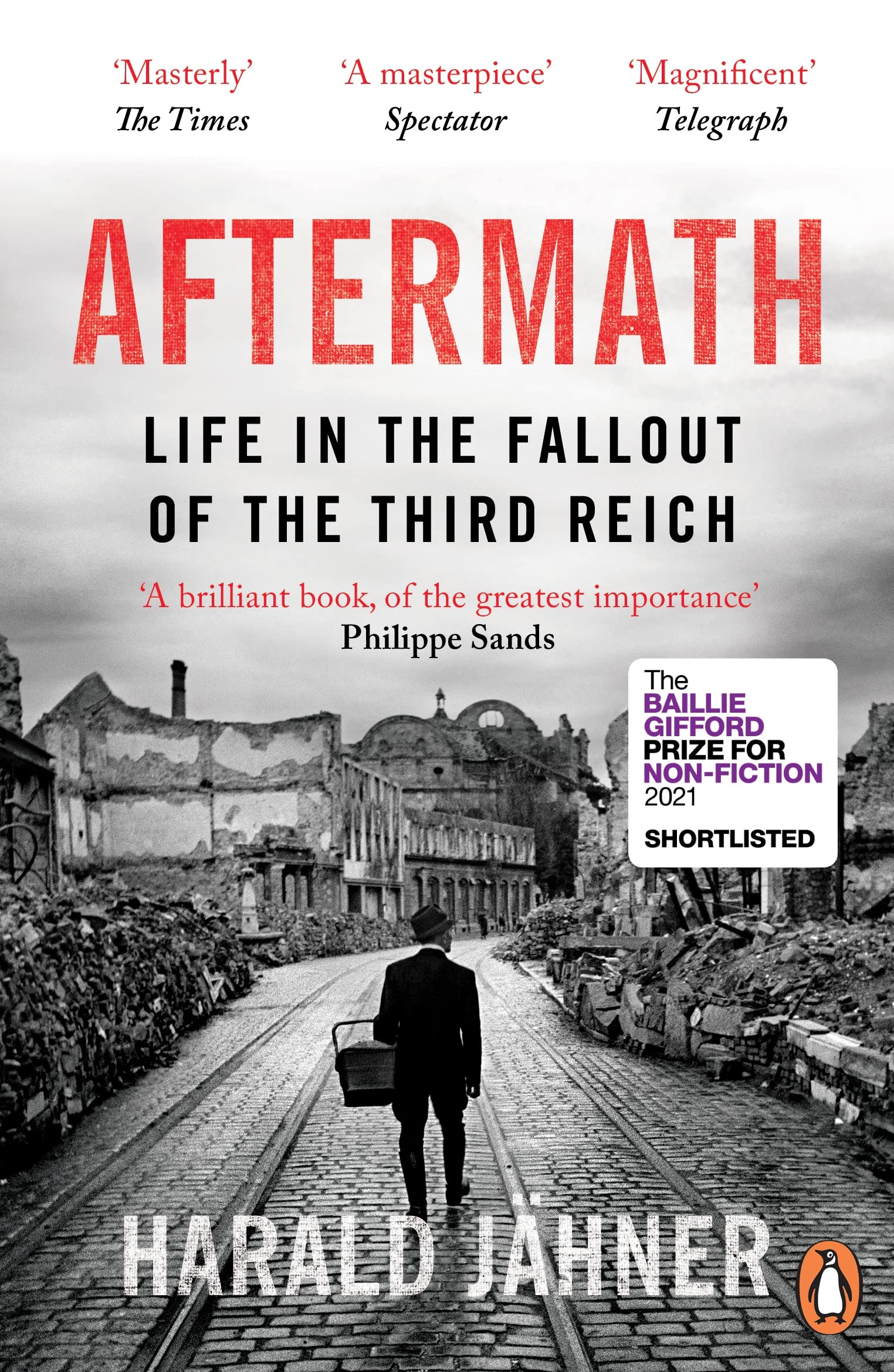
On a train journey earlier this year between Cologne and Berlin, I began to read Harald Jähner’s Aftermath, a fascinating account of the years when Germany emerged from the destruction and shame of the Third Reich.
The war ended 80 years ago today, and in the defeated nation the scenes were primeval and apocalyptic. In Berlin, journalist Ruth Andreas-Friedrich, along with a doctor, actor and musical conductor, discovered a white ox wandering through the streets and, after finding a Russian soldier to shoot it, found themselves suddenly surrounded by a ravenous mob. She recalled: “Suddenly, as if the underworld had been spying on them, a noisy crowd gathered around the dead ox. They crept from a hundred basements. Women, men, children. Were they lured by the smell of blood? Within minutes they were scrambling for meat.” The bourgeois of Middle Europe reduced to an animal state.
Germany was a pile of rubble; the ruins in the Reich‘s capital amounted to 55 million cubic metres, enough for a wall 30 metres wide and 5 metres high stretching all the way to Cologne. In West Berlin, for the next 22 years, up to 800 lorries a day unloaded so much rubble on the former Factory of Armaments Technology that it became known as Teufelsberg, or Devil’s Mountain. The last “rubble brigade” in Dresden only finished work in 1977.
Although Nazi party members were made to clear rubble as a punishment, the Germans hardly needed encouragement; on 23 April, the war not yet over, the municipal building of Mannheim had already declared WE ARE REBUILDING.
The communal process of clearing away seemed to serve a psychological function for a hungry, defeated people, and was encouraged by the new authorities — all the “heroic cinematic rhetoric” employed by the UFA film company of the Nazi regime now used to get the country clearing up. There was even a cinema genre called Trümmerfilm, rubble films, one — And The Heavens Above Us — ending with the Lord’s Prayer being recited among the ruins of Germany.
German POWs, “dispirited, disciplined and dutiful to the point of submissiveness”, made life easy for occupying soldiers while their former victims were far more troublesome. (Russian POWs in France caused such anarchy that they called in a Soviet liaison officer who selected ten at random and shot them, bringing the mob under control.) This led to a bizarre alliance between Allied and German law enforcement working hand-in-hand from the early days of the occupation, with joint raids and weapons searches on displaced persons from Poland and the Soviet Union, which the Poles and Russians “of course saw as an intolerable provocation”.
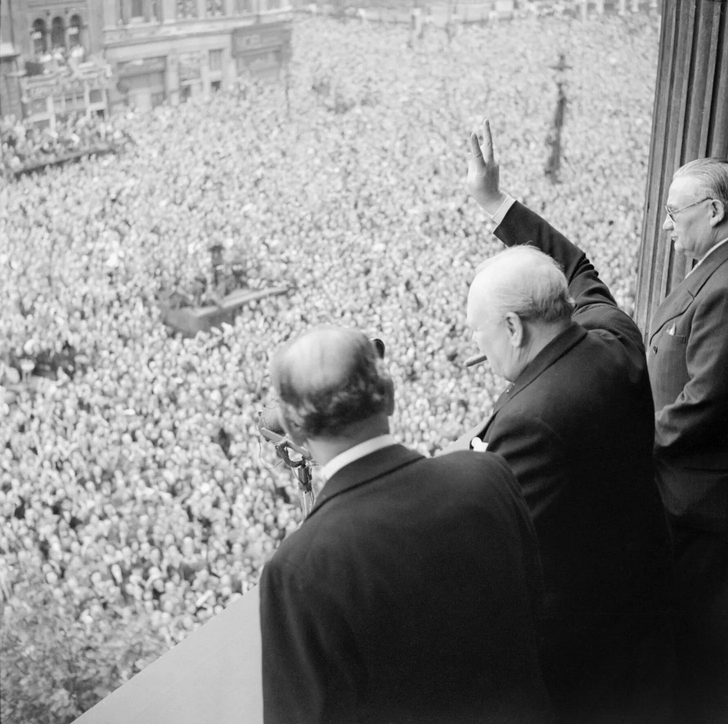
London cheered on May 8, 1945. In Berlin they searched for food and cleared rubble
In a strange irony, there was now a large-scale migration of Jews from Poland to Germany, fleeing fresh persecution despite the horror they had endured. Even here in a camp system under Allied control, there were anti-Semitic attacks from other survivors, so that Jews were eventually separated altogether following the conclusions of the Harrison Report. The Americans, in a likely first in European history, now made Jews an explicitly privileged group, with superior camp conditions.
The Polish Jews set up their own camp in the Munich district of Bogenhausen where locals were confused and disorientated by the new arrivals. These eastern Jews actually looked like the alien caricatures Nazi propaganda had bombarded them with, dressed in oriental clothes from the shtetl, totally unlike the assimilated German Jews they had grown up with. One local complained that “the Jews from the old days were really, how can I put it, very intelligent, polite and unusually friendly and elegant people. And of course the ones who turned up after the war included all sorts.” The Jews “from the old days” were “the good Jews”, he lamented.
Holocaust guilt was in the distant future for most, and newly re-established newspapers weren’t remotely shy about publishing anti-Semitic content. One printed a resident’s complaint about Polish Jews that “these were not people who had been persecuted” but “the sputum, the yeast and the scum of elements who were never deported but, to avoid regular work, came here from the eastern states, in many cases completely illegally, and are now spreading themselves raggedly about the place.”
May 6, 2025
1949: How the Arab-Israeli War Ended – W2W 27
TimeGhost History
Published 5 May 2025In early 1949, the Arab-Israeli War finally comes to an uneasy end. After brutal fighting, armistice talks in Rhodes redraw borders with a green pencil line, displacing hundreds of thousands and reshaping the Middle East. Egypt, Jordan, Syria, and Lebanon reluctantly sign ceasefires, leaving core issues — Jerusalem, refugees, and recognition — unresolved. But can forced armistices really bring lasting peace, or is Palestine fated to endless conflict?
(more…)
May 3, 2025
Development of the Uzi Family: Standard, Mini, and Micro
Forgotten Weapons
Published 4 Jan 2025The Uzi was originally designed in the 1950s, and it was on the technological cutting edge at the time. The stamped receiver, telescoping bolt, and compact magazine-in-grip layout made it an inexpensive and effective weapon. Its sedate 600 round/minute rate of fire helped as well, making it easy to shoot effectively. Uziel Gal experimented with a compact version at that time, but dropped the idea when he proved unable to make a smaller version with the same low rate of fire as the standard pattern.
Fast forward to the late 1970s, and the designers at IMI revisited the idea of a compact Uzi. They were willing to accept the increased rate of fire of a shorter receiver and lighter bolt, and their first prototypes were ready in 1978. full export sales began in 1980. The gun was advertised as having a 900 rpm rate of fire, but the reality was much higher.
The final step of classic Uzi development was the Micro Uzi, introduced in 1986. This was actually developed form the semiautomatic, closed-bolt Uzi Pistol made for American commercial sales. That pistol was given a select-fire trigger group and a folding stock, and it became a micro-compact submachine gun for only the most tactical of operators. It was advertised as having a 1200 rpm rate of fire, but this was again underestimated to improve sales.
In reality, the standard Uzi does fire at about 600 rpm. The Mini (in closed-bolt form) ran at 1300+ in my testing at S&B, and the Micro was over 1400 rpm. Where the original Uzi is best kept in fully automatic mode and can easily fire single shots when desired, the Mini and Micro Uzis are definitely best suited to semiautomatic use. Firing them in fully automatic is a much more difficult proposition if one wants to maintain any level of accuracy and situational awareness.
Thanks to Sellier & Bellot for giving me access to this set of Uzis to film for you!
(more…)
May 2, 2025
Monkey Rockets, beavers with Parachutes, and the Fall of Empires – 1948 Newscast – W2W 26
TimeGhost History
Published 1 May 2025In 1948, the Cold War intensifies as Stalin blockades Berlin, triggering a dramatic US-led Airlift to save West Berlin. Meanwhile, the British Empire continues to crumble as Burma, Ceylon, and Palestine gain independence — with Israel’s declaration igniting immediate war. America launches the Marshall Plan, the Soviets tighten their grip in Eastern Europe, and televised anticommunist hearings captivate the US public. The year ends with humanity pushing new frontiers — from launching monkeys into space to relocating beavers by parachute — showing just how rapidly the world is changing.
(more…)
April 30, 2025
The Korean War Week 45 – The Chinese Spring Offensive Begins! – April 29, 1951
The Korean War by Indy Neidell
Published 29 Apr 2025This is a week of nothing but battle action as the Chinese Spring Offensive crashes down on the UN forces like a tidal wave — literally hitting them along all of the front lines across the whole Korean Peninsula.
Chapters
00:00 Intro
00:46 Recap
01:59 The First Night
07:25 The Next Day
10:19 The Eastern Sector
13:56 The Kapyong Road
15:57 The Gloster Surrounded
19:48 Flight of the Glosters
(more…)
April 29, 2025
The US Cancels Tariffs and Saves the World – W2W 025
TimeGhost History
Published 28 Apr 2025After seeing the devastating effects of the trade war that ravaged the global economy between the world wars, in 1948 the US is determined to usher in an age of free trade and global cooperation that will last until the spring of 2025.
(more…)


