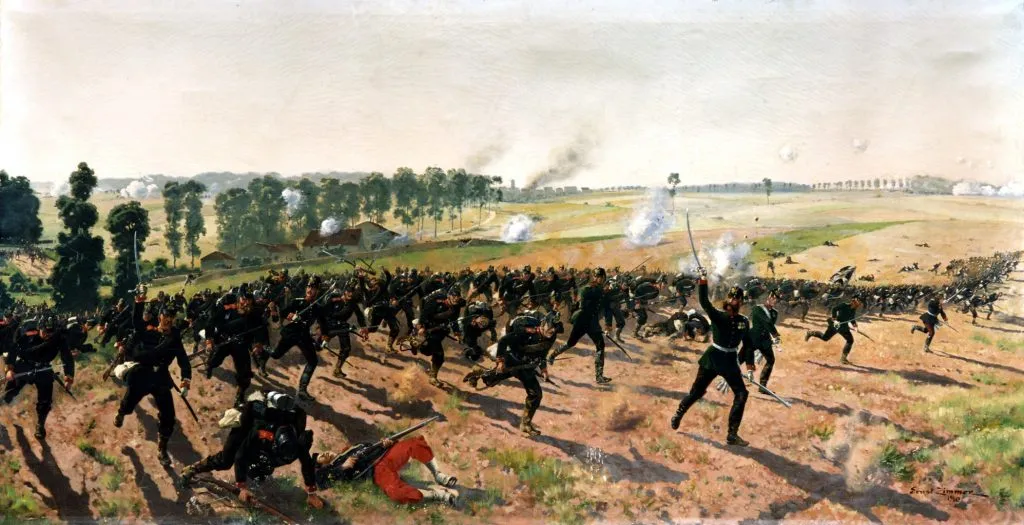
Pre-modern armies certainly do demand a considerable degree of coordination. In film and even sometimes in video games armies clash together in a confused melee with friends and foes all intermixed at random. Indeed, I have been asked by students more than once “What happens when X type of soldier ends up in a confused melee?” and had to explain that the answer is “they don’t”. Because no one fights that way, at least not intentionally.
In a fight, after all, a combatant is extremely vulnerable to attacks from behind or in their peripheral vision, especially if they are focused forward on the foe in front of them. A confused melee would thus produce extreme casualties and produce them extremely quickly. But fighters want to survive their combats and their leaders would like not only to win the battle but to have an army at the end of it. Remember: the purpose of the battle is to deliver a siege: if you win the battle but with only a pathetic handful of survivors, you haven’t really won much of anything.
The battle line is the obvious solution: each fighter is only responsible for a few feet of frontage directly in front of them, a small enough area that they can focus on it visually and direct whatever shield or armor or weapons they have towards it, giving them a greater margin of safety. Adding depth to the formation (that is, increasing the number of ranks, that is a row of fighters right to left) both secures each fighter against the possibility of being flanked due to the death of the fellows to their right or left (as now they’ll just be replaced by the next rank moving up) and adds a morale reinforcement which we’ll come back to […] But now you have a formation that consists essentially of a large number of files (that is, a single row of fighters front-to-back) which need to move together to create that unbroken, mutually supporting front line so that no one is being attacked from many sides at once. Again, all of this is before we start adding fighting styles like pike-formations or shield-walls that are designed to excel in this environment (and fare poorly out of it).
As an aside, this is one dynamic that I find games like Mount and Blade or the Total War series that simulate individual soldiers struggle to get quite right. In most games the line of formation either remains almost perfectly rigid (think units on “pike phalanx” in Rome: Total War) or units the moment they come into contact form rough blobs of models all pushing forward. But actually you are going to have men in the rear ranks trying to keep their relative position to the front ranks so the formation neither holds rigidly steady nor dissolves but is going to almost flex and bend (and if you are lucky, not tear or break). This is only an aside though because we’re not well informed about these sorts of dynamics, so it is hard to speak about them in-depth.
But to fight this way now means that all of your soldiers (really here we are talking about infantry; cavalry must also be coordinated but in different ways and because they are often composed of elites that coordination may be produced through different training methods) need to move in the same direction at the same speed in order to retain that front line where they can support each other. Again, we are not yet to something like a shield-wall or a sarisa-phalanx which demands tight coordination; even in a rough skirmish line you need to get everyone moving together just to maintain that unbroken front. A break in the front, after all, would be dangerous: enemies filtering into it uncontrolled could then flank and defeat individually the members of the broader line (two-on-one contests in melee combat typically end in seconds and are very lopsided), causing collapse.
Now the good news is that if all you need an army to do is form up in a rough line a few ranks deep and then move more or less forward, the coordination demands are not insurmountable. We’ve already discussed using marching formations to create the line of battle so all you need is a way to regulate speed (since forward is a fairly easy direction for everyone). It isn’t quite ideal for everyone to simply self-regulate their speed by looking around (at least not for a contact infantry line; for missile-skirmish troops moving in a “cloud” rather than a line they can absolutely do that) because that will produce a lot of stagger-start-stopping and accordioning which at best will slow you down and at worst will eventually turn your neat line into a rough crowd – one easily defeated if it is opposed by a line of infantry in good order. Keeping everyone in the same speed can be handled with music: the regular beat regulates the footsteps. That can be a marching song or it can be an instrument (ideally one easy to hear).
We’ve talked about armies – or components of armies – like this. I’ve described hoplite phalanxes through much of the classical periods, for instance, as essentially unguided missiles for this reason: the general hits “go” and the line moves forward. Likewise a shield-wall formation like the early English fyrd doesn’t need to do complex maneuvers. And for many armies, that was enough: a body of infantry which either held a position or moved forward in a single line, in some cases with a body of aristocratic cavalry which might be capable of more complex maneuvers (that the aristocrats had trained in since a young age). And you can see, if your culture has armies like this, why the general might be focused on either leading the cavalry in particular or else being the motivating “warrior-hero” general – such an army isn’t capable of much command once the advance starts in any event. They haven’t trained or prepared for it.
Bret Devereaux, “Collections: Total Generalship: Commanding Pre-Modern Armies, Part IIIa”, A Collection of Unmitigated Pedantry, 2022-06-17.
September 22, 2025
QotD: Tactical combat on the pre-modern battlefield
September 16, 2025
QotD: The Dictatorship in the late Roman Republic
… I’d also argue that the office [of Dictator as created by Sulla and then by Caesar] didn’t work for the goals of either of the men that recreated it.
For Sulla, the purpose of using the dictatorship was to offer his reforms to the Republic some degree of legitimacy (otherwise why not just force them through purely by violence without even the fig leaf of law). Sulla was a reactionary who quite clearly believed in the Republic and seems to have been honestly and sincerely attempting to fix it; he was also a brutal, cruel and inhuman man who solved all of his problems with a mix of violence and treachery. While we can’t read Sulla’s mind on why he chose this particular form, it seems likely the aim here was to wash his reforms in the patina of something traditional-sounding in order to give them legitimacy so that they’d be longer lasting, so that Sulla’s own memory might be a bit less tarnished and to make it harder for a crisis like this to occur again.
And it failed at all three potential goals.
When it comes to the legitimacy of Sulla’s reforms and the memory that congealed around Sulla himself, it is clear that he was politically toxic even among many more conservative Romans. A younger Cicero was already using Sulla’s memory to tarnish anyone associated with him in 80, casting Chrysogonus, Sulla’s freedman, as the villain of the Pro Roscio Amerino, delivered in that year. In the sources written in the following decades at best Sulla is a touchy subject best avoided; when he is discussed, it is as a villain. Our later sources on Sulla are uniform in seeing his dictatorship as lawless. Moreover, his own reforms were picked apart by his former lieutenants, with key provisions being repealed before he was even dead (in 78 BC so that’s not a long time).
Finally, of course, far from securing the Republic, Sulla’s dictatorship provided the example and opened the door for more mayhem. Crucially, Sulla had not fixed the army problem and in fact had made it worse. You may recall one benefit of the short dictatorship is that no dictator – indeed, no consul or praetor either – would be in office long enough to secure the loyalty of his army against the state. But in the second and early first century that system had broken down. Gaius Marius had been in continuous military command from 107 to 100. Moreover, the expansion of Rome’s territory demanded more military commands than there were offices and so the Romans had begun selecting proconsuls and propraetors (along with the consuls and praetors) to fill those posts. Thus Sulla was (as a result of the Social War in Italy) a legate in 90, a propraetor in 89, and consul in 88 and so had been in command for three consecutive years (albeit the first as a legate) when he decided to turn his army – which had just, under his command, besieged the rebel stronghold of Nola – against Rome in 88, precisely because his political enemies in Rome had revoked his proconsular command for 87 (by roughing up the voters, to be clear). And then Sulla has that same army under his command as a proconsul from 87 to 83, so by the time he marches on Rome the second time with the intent to mass slaughter his enemies, his soldiers have had more than half a decade under his command to develop that ironclad loyalty (and of course a confidence that if Sulla didn’t win, their service to him might suddenly look like a crime against the Republic).
Sulla actually made this problem worse, because one of the things he legislated by fiat as dictator was that the consuls were now to always stay in Italy (in theory to guard Rome, but guard it with what, Sulla never seems to have considered). That, along with Sulla having butchered quite a lot of the actual experienced and talented military men in the Senate, left a Senate increasingly reliant on special commands doled out to a handful of commanders for long periods, leading (through Pompey‘s unusual career, holding commands in more years than not between 76 and 62) to Julius Caesar being in unbroken command of a large army in Gaul from 58 to 50, by which point that army was sufficiently loyal that it could be turned against the Republic, which of course Caesar does in 49.
For Caesar, the dictatorship seems to have been purely a tool to try to legitimate his own permanent control over the Roman state. Caesar is, from 49 to 44, only in Rome for a few months at a time and so it isn’t surprising that at first he goes to the expedient of just having his appointment renewed. But it is remarkable that his move to dictator perpetuo comes immediately after the “trial balloon” of making Caesar a Hellenistic-style king (complete with a diadem, the clear visual marker of Hellenistic-style kingship) had failed badly and publicly (Plut. Caes. 61). Perhaps recognizing that so clearly foreign an institution would be a non-starter in Rome – unpopular even among the general populace who normally loved Caesar – he instead went for a more Roman-sounding institution, something with at least a pretense of tradition to it.
And if the goal was to provide himself with some legitimacy, the effort clearly catastrophically backfired. The optics of the dictatorship were, at this point, awful; as noted, the only real example anyone had to work with was Sulla, and everyone hated Sulla. Many of Caesar’s own senatorial supporters had probably been hoping, given Caesar’s repeatedly renewed dictatorship, that he would eventually at least resign out of the office (as Sulla had done), allowing the machinery of the Republic – the elections, office holding and the direction of the Senate – to return. Declaring that he was dictator forever, rather than cementing his legitimacy clearly galvanized the conspiracy to have him assassinated, which they did in just two months.
It is striking that no one after Caesar, even in the chaotic power-struggle that ensued, no one attempted to revive the dictatorship, or use it as a model to institutionalize their power, or employ its iconography or symbolism in any way. Instead, Antony, who had himself been Caesar’s magister equitum, proposed and passed a law in 44 – right after Caesar’s death – to abolish the dictatorship, make it illegal to nominate a dictator, or for any Roman to accept the office, on pain of death (App. BCiv, 3.25, Dio 44.51.2). By all accounts, the law was broadly popular. As a legitimacy-building tool, the dictatorship had been worse than useless.
So what might we offer as a final verdict on the dictatorship? As a short-term crisis office used during the early and middle republic, a tool appropriate to a small state that had highly fragmented power in its institutions to maintain internal stability, the dictatorship was very successful, though that very success made it increasingly less necessary and important as Rome’s power grew. The customary dictatorship withered away in part because of that success: a Mediterranean-spanning empire had no need of emergency officials, when its military crises occurred at great distance and could generally be resolved by just sending a new regular commander with a larger army. By contrast, the irregular dictatorship was a complete failure, both for the men that held it and for the republic it destroyed.
The real problem wasn’t the office of dictator, but the apparatus that surrounded it: the short duration of military commands, the effectiveness and depth of the Roman aristocracy (crucially undermined by Sulla and Marius) and – less discussed here but still crucial in understanding the collapse of the Republic – the willingness of the Roman elite to compromise in order to maintain social cohesion. Without those guardrails, the dictatorship became dangerous, but without them any office becomes dangerous. Sulla and Caesar, after all, both marched on Rome not as dictators, but as consuls and proconsuls. It is the guardrails, not the office, that matter.
Bret Devereaux, “Collections: The Roman Dictatorship: How Did It Work? Did It Work?”, A Collection of Unmitigated Pedantry, 2022-03-18.
September 12, 2025
QotD: Modern riot-control gear
What the well-dressed riot controller is wearing this year:
I’ve hinted already at my severe disenchantment with the riot control manual. Most of the following will tend to indicate some of why. Note that this is pretty military specific, but you all ought to know what’s happening, what should happen, and what isn’t happening with regards to riot control.
Head: Protection of the head involves also protection of the face, neck, and, especially, the eyes. The standard military issue Kevlar helmet is adequate for protecting the head from blunt force trauma and even some bullets . It does nothing for the face. There are shields that attach to the helmets to protect the face and which usually reach down enough for neck guard. However, after a cursory search or three for what’s on offer now, as with the old style ones I discussed previously, they can be blurred and ruined with solvents. Yes, this would seem to include polycarbonate as well; that’s how pieces of Lexan are glued together, actually. It’s a problem. Neither can I find a face shield that is glass over Lexan, though they may exist.
Moreover, while there are masks – nicely intimidating motorcycle rider masks, for example – that are black and which could have relatively cheap replaceable clear eyepieces made, they are close fitting, hence would interfere with donning the protective mask when it comes time to use RCA or when smoke from burning buildings gets to be a bit much. The only solution I can see is twofold: 1) Have a ready supply of extra face shields on hand, and 2) make the immediate penalty for attacking a mask with solvents a reasonably severe beating with some kicks and stomping.
Special Tip #1: If you’re using your issued helmets, troops and commanders, turn the camouflage band around so the rioters can’t see your name. This is for two reasons. One is to prevent personal retaliation against your men or their families. The other is to send a message the rioters will understand very clearly because they’re using anonymity for the same purpose, to stay out of court. In other words, the message you send is, “Get close enough to this soldier or policeman for him to hurt you and he will, all the more readily because you can’t identify him for civil suit or criminal complaint.
Chest: The current issue torso armor seems adequate for most threats it will encounter in riot control, but, at thirty-three pounds, strikes me as awfully heavy for an activity that is already about as physically intense as a battlefield, if not even more so. With an E-SAPI plate in front, that runs nearly to forty pounds, which is simply too damned much. There is room for some minor weight savings, as will be shown below, under “Protective Mask.”
There are lighter and quite likely better armor suites coming along or already on hand for the special operations folks, but if they are not available for a unit tasked for riot control, I’ll have to say, “Suck it up; wear the vests you have; keep about ten percent of your force in reserve, unarmored but ready and drilled to suit up in a hurry, to relieve people who become exhausted from the weight and heat retention.
Special Tip #2: You want the armor not only to protect your men, but also to protect them enough to keep them from losing their tempers and running wild. When they hurt somebody, it needs to be because the commander wants that somebody hurt, that the mission is advanced by that somebody being hurt, and not because of a breakdown in discipline.
Armament: For a number of reasons, I recommend against using bayoneted rifles. The downsides are numerous, so I’ll limit myself to a few. 1) They require both hands; this means that the riot controller cannot use a shield. 2) The act of fixing bayonets, all on its own, constitutes deadly force. Yeah, just fixing them. So you won’t be allowed to do it. 3) That means you end up with this bullshit:
https://en.wikipedia.org/wiki/Flower_Power_(photograph)
Instead, use batons. However, for that I have no less than two tips.
Special Tip #3: Grease the last eighteen inches or so of the batons with something non-water soluble, like Vaseline. No, this is not as an aid to anally raping the rioters with the batons, however tempting that may come to seem. Rather, it is to keep the rioters from snatching your batons away, which snatching encourages them to no end. If you don’t have petroleum jelly handy, thicker rifle lubricant, like LSA, can work, but spread it very thinly, so it doesn’t run.
Special Tip #4: Drive finishing nails into the ends of your batons and snip them off to leave about an inch sticking out. No need to sharpen the part sticking out; it’s sharp enough to penetrate and leave a painful puncture wound, whether directed at arms or torsos or thighs or groins (ouch!).
Shields: There are any number of makers of perfectly serviceable riot control shields, some of which are, although frightfully heavy, bullet proof. If you need bullet proof shields, I would suggest that you’re way past the point of suppressing a riot and already involved in a civil war. In that case, shoot back accordingly.
Assuming for discussion’s sake, however, that we aren’t quite at that point yet, the shields are extremely useful. They deflect rocks and bags of shit. They can cause a Molotov to go off somewhere other than on the riot controller or at his feet. They are, themselves, offensive weapons. As Suetonius said, just before kicking Boudicca’s Britannic ass: “Knock them down with your shields, then finish them off with your swords”.
The world being as it is, however, full of iniquity and injustice, when Battalion X of the YYth division gets alerted for riot control, the shields will probably not be available. A careful search by J4 will show that “They are either in Iraq or were left behind on Johnson Island, lest Greenpeace show up some day. Or maybe they were turned into a reef for some endangered fish. Who knows?” Hence, make your own. The example below was made by one of the handier troops of B-3/5 Infantry, Panama Canal Zone, in 1983. It’s just half inch plywood, 19 by 24 inches, though they can be cut larger to fit the larger troops, with arm straps cut from condemned nylon webbing and bolted on. The almost horizontal piece is one shoulder strap from the harness of nylon load bearing equipment, stapled on and serving as a shock pad for the arm. Yes, if you actually have to make something like these do not forget the shock pad. I’d recommend not painting them with unit insignia. We were, at the time, on testosterone overload and wanted people to know who was kicking their butts.
Note, a larger shield doesn’t necessarily protect more, it just moves more slowly to protect what needs protection. These shields are very light and, given the geometry of the matter, able to be moved very quickly indeed to protect any exposed part of the body, to include the thighs and crotch. Speaking of the …
Crotch: Move your/have the troops move their protective mask and carrier from the left hip to right in front of the family jewels. It won’t slow down donning the mask appreciably and it will save a little weight while providing adequate crotch coverage.
Tom Kratman, Twitter, 2025-06-09.
September 3, 2025
Dad’s Army caricatures capture life in Britain today
At The Daily Skeptic, Guy de la Bédoyère wonders why everything in modern Britain emulates an episode of the 70s sitcom Dad’s Army:

Dad’s Army, a BBC sitcom that ran from 1968 to 1977, starring Arthur Lowe as Captain Mainwaring, John Le Mesurier as Sergeant Wilson, and Clive Dunn as Lance Corporal Jones.
There are plenty of natural laws, but here’s one unique to Britain:
Every organisation, committee, scenario, initiative and government-backed and corporate project in Britain will inevitably degenerate into a scene from Dad’s Army.
That of course is the celebrated sitcom Dad’s Army, based on the world of Britain’s Home Guard in the Second World War, which ran for nine series in the 1970s. Every character is caricature, and sometimes not even as much as that.
Just think about it. Captain Mainwaring, the prickly bank manager and obsessed with status – the ultimate incompetent management figure, forever frustrated by his own paltry military service in the Great War and now strutting around like a dumpy cockerel as commanding officer of the platoon.
Sgt Wilson, a complacent, dozy and lazy member of the establishment, effortlessly imbued with a sense of privilege and world-weary detachment. Persistently given to undermining Mainwaring.
Lance-Corporal Jones, the panic-stricken jobsworth stifling initiative at every turn and floundering haplessly around to demolish every project with his matchless ability to overcomplicate anything and everything. He has a special skill for wasting inordinate amounts of time with ludicrously impenetrable explanations, usually based on fantasy.
Private Frazer, the miserable doom-laden pessimist and undertaker, forever raining down scorn and stirring up opposition and discontent in the ranks, his own ambitions in the platoon thwarted.
Private Walker, the skiving skimmer who dodged regular military service. Forever on the take but essentially harmless and even with some good characteristics.
Private Godfrey, the embodiment of the well-intentioned but largely hopeless pensioner whose presence relies usually on everyone else. Constantly called away to relieve himself.
Private Pike, the idiotic mummy’s body excused military service. Today he would have a certificate excusing him from any form of employment for anxiety, ADHD and anything else his mother or the system could come up with.
Then there’s the ARP Warden Hodges, whose sole purpose in life is feuding with Mainwaring, finding fault with the platoon’s men and triumphantly announcing their infractions. Hodges is the confrontational and dispute-loving trade union leader to Mainwaring’s shambolic management. His only mission in life is to create conflict and throw his weight about.
To these we can add various other characters, all comic figures (like the vicar and the verger) but essential props that amplify the authenticity.
The reason the sitcom lasted so long is very simple. Every single organisation in Britain is in home to some of or all these personality types, whether it’s the parish council, a local arts society, a corporation or the government.
Almost every problem the Home Guard platoon is confronted with results in bickering, chaos and wasted time, based mostly on posturing, obstinacy, incompetence, obsession with status and a lack of foresight, common sense and lateral thought. If the outcome is a good one, it’s invariably the result of chance.
Sounds familiar? It doesn’t matter what you think about the boats, climate change, the welfare state or the NHS. Every one of Britain’s current problems is being dealt with as if each was an episode of Dad’s Army.
Update, 5 September: Welcome, Instapundit readers! Please do have a look around at some of my other posts you may find of interest. I send out a daily summary of posts here through my Substack – https://substack.com/@nicholasrusson that you can subscribe to if you’d like to be informed of new posts in the future.
August 31, 2025
Military-Issue Colt Model 1839 Paterson Revolving Rifle
Forgotten Weapons
Published 23 Apr 2025The first rifle made in Sam Colt’s Paterson NJ factory was the 1837 “ring lever” rifle. These were rather fragile and underpowered and while they were used successfully in the First Seminole War, they needed improvement. Colt set about doing this with his 1839 pattern, which was more robust and more powerful. It had six chambers of .525″, with much greater powder capacity than the first Colt revolving rifles. A total of about 950 were made before the Paterson company failed in 1842, and nearly 700 of those were military sales. The US War Department bought 360 (including this example), the Republic of Texas bought 300, and the State of Rhode Island bought 46 — the rest were sold to private companies or individuals. Despite its improvements, though, the 1839 revolving rifle was still not a mature design and was not successful enough to keep Colt in business.
Colt 1837 Ring-Lever Rifle: Sam Colt’s Paterson No1 Model Carbine
Colt 1847 Walker Revolver: 1847 Walker Revolver: the Texas Behemoth
(more…)
August 28, 2025
History of Britain VII: Fall of Roman Britain
Thersites the Historian
Published 23 Feb 2025After its efflorescence during the 2nd Century, Roman Britain entered steep decline during the 3rd Century and the benefits of Roman civilization had all but vanished by the time that the Romans withdrew their forces and support.
QotD: The rise and fall of the chariot in combat
Horses had been domesticated long before the Scythians. Horses, along with dogs and reindeer, are the only animals domesticated by foragers, rather than farmers. The first significant use of horses in battle was to draw chariots. Chariot archers could shoot, and javelins could be thrown, further from a chariot than a horse.
The classic chariot was driver and archer or spearmen. A friend describes them as being like a pilot and a navigator (or bomb-aimer) on a bombing run. The pilot/charioteer concentrates on getting the pair of you where you need to be (or not to be). The archer/spearmen/navigator/bomb-aimer concentrates on killing the enemy.
The most famous driver/warrior pairing in myth and literature is Krishna and Prince Arjuna in the Mahabharata and, specifically, the Bhagavad Gita. (Normally, the driver serves the warrior, but if your driver is an incarnation of Vishnu, things work differently.) The warriors of the Iliad are also chariot-driving warriors — hence scenes such as Achilles dragging Hector‘s dead body behind his chariot. Chariots were a major element in Chinese warfare up to the Warring States period. New Kingdom Egypt was very much a chariot empire, as were their great rivals, the Hittites.
Once recurve bows able to match chariot archery from horseback arrived, chariots largely disappeared from combat in the major Eurasian civilisations. This began to occur around the time of the Assyrians — who were a transitional case using both chariots and cavalry — about a thousand years before the invention of the stirrup and even longer before the stirrup’s arrival in the Mediterranean world. Lancers — the heavily armoured version of which was the cataphract — then developed as a way of dealing with horse archers.
Lorenzo Warby, “Stirrups, a rant”, Lorenzo from Oz, 2025-02-28.
August 17, 2025
QotD: The benefits of using auxilia units to the Roman Empire
That frankly unusual structure for a multi-ethnic imperial army [the non-citizen auxilia numbering about half the total “Roman” army] brought three principal benefits for the Roman army and consequently for the Roman empire itself.
The most obvious of these is manpower. Especially with a long-service professional army, capable and qualified recruits are in limited supply. The size of the Roman army during the imperial period ranged from around 300,000 to around 500,000, but in 14 AD (the year of Augustus‘ death) there were only 4,937,000 Roman citizens (Res Gestae 8.11), a figure which probably (a word I am using to gloss over one of the most technical and complex arguments in the field) includes women and children. Needless to say, keeping something close to a fifth of the adult male citizen population under arms continually, forever was simply never going to be feasible. After his victory in 31 BC at Actium, Octavian (soon to be Augustus) had acted quickly to pare down the legions, disbanding some, merging others, until he reached a strength of just 28 (25 after the three legions lost in 9 AD were not replaced). It was a necessary move, as the massive armies that had been raised during the fever-pitch climax of the civil wars simply could not be kept under arms indefinitely, nor could a short-term service conscript army be expected to garrison the hundreds of miles of Roman limes (“frontier, border”) in perpetuity.
Harnessing the manpower of the provinces was simply the necessary solution – so necessary that almost every empire does it. By their very nature, empires consist of a core which rules over a much larger subject region, typically with far greater population; securing all of that territory almost always requires larger forces than the core’s population is able or willing to provide, leading to the recruitment of auxiliaries of all kinds. But whereas many imperial auxiliaries, as noted above, turn out to be potential dangers or weaknesses, Rome’s auxilia seem to have been fairly robustly “bought in” on the system, allowing Rome to access motivated, loyal, cohesive and highly effective manpower, quite literally doubling the amount of military force at their disposal. Which in turn mattered a great deal because the combat role of the auxilia was significant, in stark contrast to many other imperial armies which might use auxiliaries only in subsidiary roles.
The auxilia also served to supply many of the combat arms the Romans themselves weren’t particularly good at. The Romans had always performed very well as heavy infantry and combat engineers, but only passably as light infantry and truly poorly as shock cavalry; they generally hadn’t deployed meaningful numbers of their own missile cavalry or archers at all. We’ve already talked a lot about how social institutions and civilian culture can be important foundational elements for certain kinds of warfare, and this is no less true with the Romans. But by recruiting from subject peoples whose societies did value and practice the kinds of warfare the Romans were, frankly, bad at, the Roman skill-set could be diversified. And early on, this is exactly what we see the auxilia being used for (along with also providing supplemental heavy infantry), with sagitarii (archers), funditores (slingers), exploratores (scouts) and cavalry (light, heavy and missile), giving the Romans access to a combined arms fighting force with considerable flexibility. And the system clearly works – even accounting for exaggerated victories, it is clear that Roman armies, stretched over so long a frontier, were both routinely outnumbered but also routinely victorious anyway.
As Ian Haynes notes, the ethnic distinctiveness of various auxilia units does not seem to have lasted forever, though in some cases distinctive dress, equipment and fighting styles lasted longer. Most auxilia were posted far from their regions of origin and their units couldn’t rely on access to recruits from their “homeland” to sustain their numbers over the long haul (although some number of recruits would almost certainly come from the military families of veterans settled near the forts). But that didn’t mean the loss of the expertise and distinctive fighting styles of the auxilia. Rather skills, weapons and systems which worked tended to get diffused through the Roman army (particularly in the auxilia, but it is hard not to notice that eventually the spatha replaces the gladius as the sword of the legions). As Ovid quips, Fas est et ab hoste doceri, “It is right to learn, even from the enemy” (Met. 4.428); the Romans do that a lot. The long-service professional nature of these units presumably made a lot of this possible, with individual cohortes and alae becoming their own pockets of living tradition in the practice of various kinds of fighting and acclimating new recruits to it. Consequently, not only did the Roman army get access to these fighting-styles, because the auxilia were actually integrated into the military system rather than merely attached to it, they also got the opportunity to adopt or imitate the elements of the fighting styles that worked.
Finally, the auxilia system also minted new Romans. We’ve already mentioned that auxilia veterans received Roman citizenship on retirement, but that wasn’t the extent of it. We can see in inscriptions that the degree of cultural fluency that soldiers in the auxilia gained with Roman culture was high; they often adopted Roman or Romanized names and seem to have basically always learned Latin (presumably because their Roman officers wouldn’t have spoken their language). While some units of the auxilia kept distinctive national dress as a sort of uniform, most of the auxilia seem to have adopted a style of dress that, while distinct from the legions, was generally in keeping with the Roman tradition of military dress (which was not quite the same as Roman civilian dress). They also partook of the Roman military diet (Roman soldiers kept a similar diet all over the empire, even if that meant shipping thousands of amphora of olive-oil and sour wine to northern England) which would have given them a diet in common with many work-a-day Romans too. Once retired, auxilia soldiers tended to settle where they served (rather than returning to their “home” provinces), which meant settling in frontier provinces where their citizenship set them apart as distinctively Roman, wherever they may have come from.
Exactly how many auxilia would have retired like this requires a degree of number crunching. Given a 20-year tour of service and zero mortality, we might expect around 7,500 men to pass through the auxilia each year. But of course, mortality wasn’t zero and so we have to expect that of our c. 20-year-old recruits, some number are going to die before retirement. Using some model life tables (following B. Frier, “Demography” in CAH^2 XI (2000)), we should figure that very roughly one third of our recruits will have died before reaching discharge. We then we need to adjust our recruitment figures to retain the same total strength and we get something like 9,000 new recruits each year to keep a strength of c. 150,000 with mortality counted for and 20 year tours. That gives us roughly 6,000 auxilia living to retirement each year. That may seem a small number, but that gradual accretion matters when it runs for decades and centuries and the newly enfranchised family units (recall that the citizenship grant covers children and sort-of-kind-of his spouse1) tend to settle on the frontiers, which is a really handy place to have communities of citizens. If we assume that these new citizen families mostly reproduced themselves (or more correctly that they went extinct or split with multiple children at roughly the same rate with no natural population growth), then we’d expect this process to produce perhaps something like 1.5 million new citizen households up until the Constitutio Antoniniana. Being very back of the envelope then, we might – once we account for women and children descendants of those soldiers – assume that on the eve of the general grant of citizenship in 212, there were perhaps 4 million Romans whose citizenship status was a product of service in the auxilia somewhere in their history; perhaps representing something like 7% of the entire population (including non-free persons). Were we to assume larger households (which seems wise, given that retired auxiliaries are probably more likely than average to be in an economic position to have a larger family), that figure would be even higher.
That is a very meaningful number of new Romans. And those figures don’t account for some of the other ways Roman citizenship tended to expand through communities both through manumission but also the political networks citizenship created (your Latin-speaking former-auxiliary citizen neighbors are a lot more likely to be able to help intercede to get you citizenship or get your community recognized as a municipia with that attendant citizenship grant). And not only are those new Romans by legal status, but new Romans who have, by dint of military training and discipline, absorbed quite a lot of Roman culture. As best we can tell, they tended to view the Roman Empire as their polity, rather than as a foreign or oppressive entity. They were “bought in” as it were. Again, this does not seem to have been the Roman intent, but rather an opportunistic, self-serving response to the need to maintain the loyalty of these troops; citizenship was, after all, a free benefit the emperor might bestow at no cost to the treasury (since citizens who lived outside of Italy still owed taxes) or himself.
Of course that fits the auxilia in to a later pattern in the provinces which becomes perhaps most apparent as the Roman Empire begins to collapse …
Bret Devereaux, “Collections: The Queen’s Latin or Who Were the Romans, Part V: Saving and Losing and Empire”, A Collection of Unmitigated Pedantry, 2021-07-30.
- Note on the coverage of the spouse. The grant of citizenship covered any biological children of the discharged auxiliary but did not extend citizenship to his wife. It did however, give an auxiliary the right to contract a lawful marriage with effectively any free woman, including non-citizens and the children resulting from such a union would be citizens themselves. Consequently, it extended one of the core privileges of citizenship to the non-citizen wife of a discharged auxiliary: the right to bear citizen children. Since the wife would be part of the retired auxiliary’s household (and then later, if he predeceased her, potentially in the household of her male citizen children) she’d be legally covered in many cases because a legal action against her would generally be an action against her husband/child. Given that a number of the rights of citizens simply didn’t apply to women in the Roman world (e.g. office holding), this system left the wife of a retired auxiliary with many, but not all, of the privileges of citizenship, so long as her husband and her marriage survived. That said, the legal status remained vested in her husband or her children, which made it more than a little precarious. One of these days, we can talk more about the structure of the Roman familia.
August 14, 2025
D-Day’s Flat Pack Ports OR Lord HT Gets Cross with The Fat Electrician
HardThrasher
Published 13 Aug 2025In which we use the @the_fat_electrician as an excuse to talk about the Mulberry Harbours, make a specific threat to a building in the United States and get to oogle at giant bits of floating concrete.
Primary Source – Codename Mulberry – Guy Hartcup, Pen & Sword Military. Kindle Edition 2014 (org. 1977)
(more…)
August 10, 2025
QotD: The “generations” of warfare
Warfare is fundamentally about breaking the enemy’s will to fight. This can be done with violence, or without it – before the fight even starts, through raw intimidation. Working from this understanding, military theorists have divided the history of warfare into five generations.
First Generation Warfare, abbreviated 1GW, was war as it was waged from the dawn of civilization up through roughly the Civil War. This style of conflict involved massed line infantry, equipped with spears, pikes, swords, or line-of-sight ranged weapons such as longbows, crossbows, or muskets. The basic tactic was to draw up two large groups of armed men, bring them into close contact, and have them hack at one another until one side grew demoralized by the slaughter, at which point their line would break and the real slaughter could begin.
Industrial or Second Generation Warfare (2GW) brought rifled firearms, machine-guns, and indirect artillery. Men could now be killed at a great distance, without ever seeing the enemy. Camouflage, concealment, and cover became the keys to victory. Its heyday was roughly from the Civil War to the Great War.
Mechanized warfare or 3GW arrived with the internal combustion engine and powered flight. Tactics now depended on speed and manoeuvrability. It dawned with the Second World War and reached its apogee with the invasion of Iraq.
Mechanized warfare created an overwhelming advantage for large industrial states. Small states and non-state actors responded with 4GW, which can be thought of as televisual warfare – combat via propaganda. This is war as fought with cameras and media distribution networks. It is guerrilla warfare via weaponized morality: using the enemy’s own military actions against it by showing the consequences of war for one’s civilian population to the enemy civilian population. Bait the enemy into killing babies, then ask them how many more babies they’re willing to murder. Think Vietnam, Afghanistan, Iraq.
The response to 4GW is 5GW – warfare by psyop, utilizing misinformation and sentiment engineering. Its characteristic weapons platform is the social network. Where 4GW seeks to use the enemy’s own morality against it, 5GW seeks to change that morality, to transform the enemy’s inner nature, getting the enemy to attack themselves for you, to surrender with open arms and smiles on their faces … ideally, without the enemy even realizing that they’re under attack.
John Carter, “Political Conflict in the Age of Psychic Warfare”, Postcards From Barsoom, 2024-03-01.
August 5, 2025
QotD: Fighting a Middle Republic Legion
You’ve formed up in your fighting order and begun to advance and first a cloud of light enemies (the velites) move up against you. Behind them, you can vaguely see the main Roman body, but not in much detail yet. Instead, you are treated to shower of lighter javelins; these only mass around 250g or so, but some of them are bound to catch a face or an unarmored leg and bring someone down or get stuck in a shield. The damage is probably minimal, but what the velites are doing is already wearing you down: you are now, physically and mentally “in combat”, with weapons flying and adrenaline running (whereas the Roman heavy infantry are not!). The velites don’t need to inflict casualties at this stage to have an effect: they’re inflicting friction (in the Clausewitzian sense, drink!) and that is enough.
As you approach the velites, they scatter back to their lines and now the first real trial comes: when you are about twenty meters out from the enemy line, a storm of those heavy pila come in, thick and all at once. Each one masses around 1.3kg (just short of three pounds) so even if the tip doesn’t bite, one of these things clanging off of armor or a shield is going to hurt, the impacts stagger men near you as you struggle to keep formation (and for a Hellenistic army, get and keep those sarisa-points down). The impact of the massed volley, especially against close-order infantry with tight fighting-width, is going to be chaotic as some men are killed, others disabled, still more suddenly staggered. The volley is followed almost immediately by the on-rush of the hastati. These guys don’t have a long spear for keeping you at a distance, they’re all brandishing swords and aim to get in close, using their large body-shields to absorb any blows you might throw while they get right up in your face, where their swords can stab and slash viciously over or under your shield. These hastati are aggressive and they’re probably better armored than you are.
And of course an engagement in contact like this is unpredictable. Perhaps in some areas, your lines push forward, whereas in other places it bends back. For large maneuver units (like taxeis!) this can be a real problem, but Roman maniples are small, so one maniple can advance if it finds the opportunity while others hold position or are even forced back (we actually see a general give, essentially, an “advance at your own discretion” order at Pydna, Plut. Aem. 20.8).
After a short and terrifying experience – these moments of shock combat probably didn’t last all that long, perhaps as little as just a few minutes – the hastati fall back. The front of your line is already physically and mentally exhausted. Many men are wounded and certainly some have been killed or disabled. I don’t want to oversell the casualties aspect of this: armies don’t annihilate each other in stand-up engagements (instead more casualties happen in pursuit), but wounds and exhaustion matter. Latin has this phrase, of being confectus vulneribus, “exhausted by wounds” or perhaps “worn down by wounds” (Liv. 24.26.14, 31.17.11, Caes. BGall. 5.45) to describe how the accumulation of a lot of little wounds can sap soldiers of their ability to resist effectively, even if no one wound is lethal. And just as important, all of the emotional impetus of your initial attack is spent. And there’s a decent chance that, as you try to breath, you still have these light velites‘ javelins (the hasta velitaris) thudding into your line every few seconds, because – again – they carry seven of them. They’re not out.
And then, as you are getting your bearings, trying desperately to catch your breath, the principes come up. They’re not physically tired or emotionally exhausted, but eager (like you were a half an hour ago when you advanced), they’ve been waiting all this time. Worse yet, these are probably the most combat-effective soldiers the Romans have, in the prime of their life, with years of combat experience. Now the second volley of pila comes in, creating yet more chaos. And then more angry, heavily armored Romans, behind their big shields, stabbing and cutting with their deadly gladii.
Now the men at the back of your single line may be relatively fresh, but you have no real way to get them to the front, so the wrath of the principes falls on men who are already exhausted, already wounded, already tired and already out of fight. Your line isn’t advancing so stridently; the men in the back, if the formation is deep, don’t know why the advance is slowed, why the line seems to be wavering, only that it seems to be wavering. And meanwhile, everyone is hoping that, at any moment, the victorious cavalry on the flanks is going to show up and win the battle, but they can’t see it anywhere in the confusion. Maybe your cavalry has won and is moments away – or perhaps Antiochus III charged it off the field again and no help is coming. Or perhaps the enemy cavalry has tied it up or worse yet, the Romans’ highly skilled Numidian allies might have mastered the flanks. You have no idea, you only know that help isn’t here, you are tired and more Romans are upon you. And somewhere, the thin thread of human courage snaps, either from the exhausted men in front or the confused men behind and the formation begins to collapse.
As the collective defense of lapped shields or serried pikes gives way, the Romans are now truly in their element: their large shields function just fine in individual combat and their versatile swords do as well. Lead by their centurions, the principes, with practiced and experienced skill, are finding the gaps, cutting as they go. As the formation crumbles, the velites can pursue – lightly armored, but well enough armed, backed up by the equites if there are any left.
You can see thus how this is a formation designed to wear down an enemy’s main battle line. It isn’t that the Romans are set massively deeper than a Hellenistic army, either. Assuming a base-3 set of file-depths (which seems to me the most likely), the Roman ranks are probably six, six and three men deep (hastati, principes, triarii), for a total depth over each file of 15, one less than the normal Macedonian formation. And with the wider fighting intervals the Romans use, they won’t normally have much of a problem matching the fighting width of the enemy army, unless substantially outnumbered (as, for instance, at Magnesia).
It’s not the Roman formation is deeper, it’s that its successive battle lines avoid exposing the entire army to exhaustion, attrition and friction all at once. In effect, it uses the same principles as defense-in-depth, exploiting the effect of friction on the enemy line to wear it down, but does so on the offensive. I don’t think it is an accident that when the Romans do lose, it tends to be because this model battle was spoiled in some way, either because the army was ambushed, enveloped, something disrupted the triplex acies or because the enemy was able to carry the field with just the momentum of the first charge – the Roman lines essentially failing like a building undergoing controlled demolition, as each floor pancakes the next without slowing.
But an army that isn’t able to decisively win the battle either at the first onset or somewhere else on the line is going to find itself in quite a lot of trouble as the Romans almost inevitably sandpaper away the morale and stamina of the main line of resistance until it collapses.
Now many of you may already be realizing that this kind of force is going to present a Hellenistic army with a lot of problems, both because it is set up for a different kind of fight than they are, but also because it may end up matching much heavier troops against the lighter parts of a Hellenistic army. But before we jump into battles, we need to zoom up to the upper levels of military analysis – operations and strategy – and talk about the advantages the Romans have there.
Because if all the Romans had was an edge in their tactical system, we might expect them to win battles but sometimes lose wars. Instead, while the Romans sometimes lose battles, they seemingly always win the war.
Bret Devereaux, “Collections: Phalanx’s Twilight, Legion’s Triumph, Part IIa: How a Legion Fights”, A Collection of Unmitigated Pedantry, 2024-02-09.
July 30, 2025
History of Britain VI: Prime Roman Britain
Thersites the Historian
Published 13 Feb 2025Britain became a quietly productive part of the Roman Empire once the Celts of southern Britain were subjugated. This was the period when the Romans built cities, forts, and roads across the southern portion of the island. The good times corresponded with the Classical Optimum. However, after 150 or 200 CE, Britain was beginning to experience a decline in its material well-being.
July 26, 2025
The unaffordable luxury of a second-best army
At History Does You, Secretary of Defense Rock considers the downfall of Prussia’s vaunted army at the hands of Napoleon in a blink-of-the-eye campaign in 1806:

“Prussian wounded and stragglers leaving battle [after the battles of Jena and Auerstadt]. The mortally wounded Duke of Brunswick is the prominent figure in the painting.”
Painting by Richard Knötel (1857–1914) via Wikimedia Commons.
A vain, immoderate faith in these institutions made it possible to overlook the fact that their vitality was gone. The machine could still be heard clattering along, so no one asked if it was still doing its job.1
– Carl von Clausewitz on Prussia in 1806In the autumn of 1806, the Kingdom of Prussia, “The Iron Kingdom”, suffered one of the most rapid and humiliating military defeats in modern European history.2 The twin battles of Jena and Auerstedt shattered not only its army but the myth of invincibility that had surrounded the legacy of Frederick the Great. For the young Carl von Clausewitz, then a junior officer in the collapsing Prussian forces, this moment marked a personal and national catastrophe that would shape his life’s work. Clausewitz would come to see the defeat not simply as a failure of generalship or tactics, but as the exposure of a more profound institutional and societal crisis; one in which a state had grown complacent, a military rendered obsolete, and a society stripped of civic vitality falling apart during “the most decisive conflict in which they would ever have to fight”.3 In that collapse and Clausewitz’s later reflections, one finds an unsettling parallel to present-day America, a powerful nation outwardly strong, yet increasingly vulnerable to the same internal rot.
Prussia’s disaster in 1806 was the formative experience for the author of On War. How the armies of Frederick the Great and the state that he painstakingly built collapsed like a house of cards was a question that bothered Clausewitz for many years.4 It was a comprehensive disintegration of a system that had, since the mid-eighteenth century, claimed a position of prominence in European military affairs based on its discipline, linear tactics, and centralized command. Yet by the turn of the nineteenth century, these very strengths had calcified into weaknesses. Clausewitz foresaw disaster. Even as a young lieutenant, he was already warning of the Prussian army’s growing detachment from reality. In his early writings, he criticized military exercises as highly scripted performances, lacking genuine tactical challenge, unpredictability, and creativity.5 The number of steps marched in a minute of the cadence, what awards should be placed on a uniform, how a rifle should be cleaned for parade, all of this he feared, was cultivating a “lassitude of tradition and detail”.6 Clausewitz understood that rehearsing war under artificial constraints produced not readiness but ritual. Even though he later wrote, “no general can accustom an army to war”, he worried, presciently, that when confronted by a real enemy operating under real conditions, the army would collapse, and in 1806, it did.7
Whatever reservations he may have held, Clausewitz fulfilled his duty. He led a battalion of grenadiers at the battle of Auerstedt and managed to withdraw with most of his men intact in the chaotic aftermath of defeat. His escape was short-lived; however, he was captured on October 28, 1806, and subsequently marched into captivity in France, where he would spend the next year as a prisoner.8 Napoleon’s campaigns revealed that war had been transformed: faster, larger, and fundamentally political. Clausewitz wrote, “War was returned to the people, who to some extent had been separated from it by the professional standing armies; war cast off its shackles and crossed the bounds of what had once seemed possible”.9 The levée en masse and the corps system shattered the static paradigms of eighteenth-century warfare. Yet the Prussian high command, clinging to the geometries of the past, failed to respond with imagination or speed with any kind of seriousness.
Clausewitz’s later concept of friction — the unpredictable resistance that disrupts even the best plans — emerged directly from this experience.10 The Prussian army collapsed not for lack of courage, but because its institutional mindset could not withstand the volatility of an age that demanded adaptability, political intelligence, and creative command.
1. Carl von Clausewitz, Historical and Political Writings, ed. and trans. Peter Paret and Daniel Moran (Princeton, NJ: Princeton University Press, 1992), 32.
2. Christopher Clark, Iron Kingdom: The Rise and Downfall of Prussia, 1600–1947 (Cambridge: Belknap Press, 2006).
3. Clausewitz, Historical and Political Writings, 81.
4. Frederick the Great ruled from 1740-1786 and is usually credited as turning Prussia from a regional power to a continental power.
5. Peter Paret, Clausewitz and the State (Oxford: Oxford University Press, 1976), 92-93.
6. Clausewitz, Historical and Political Writings, 36.
7. Carl von Clausewitz, On War, trans. Michael Howard and Peter Paret (Princeton: Princeton University Press, 1984), 122.
8. Partet, 126.
9. Clausewitz, Historical and Political Writings, 287.
10. Clausewitz discusses this concept in Chapter 7 in On War, 119-121.
QotD: The accumulated friction of bureaucratic growth
Bureaucracies all succumb very quickly to some kind of “Malthusian progression”. I’m not sure what to call it, I suck at naming stuff (please take your shot in the comments), but you all know what I mean: A bureaucracy’s tasks increase arithmetically, but the amount of effort each task requires increases geometrically.
[…] In the early Republic, raising a legion was as simple as a patrician calling his clients to service, or the Senate issuing a conscription decree. One task: the summoning of free men, with their own equipment, and there you go — Legio I Hypothetica.
By the late Empire, though, all those freeholds had been turned into slave-worked Latifundia, so the effort of raising a legion increased enormously. Now the bureaucracy had to go out and hire freemen (if it could even find them), equip them at State expense, train them (again at State expense), and so on. In itself, the number of tasks isn’t that large — we’ve identified three — and they only increase at the rate of n+1.
But the effort each task requires increases to the power of n, such that if you could somehow express the effort expended in physical terms — joules or kilowatts or whatever — you’d see that the creation of Legio I Hypothetica under Scipio Africanus took 10 kilowatts, while raising the same legion under Diocletian took 10,000,000.
This isn’t (just) corruption. Sure, everyone at every level of the Imperial Bureaucracy was getting his beak wet, that goes without saying, but it’s the nature of bureaucracy itself that’s most to blame.
Severian, “Collapse II”, Founding Questions, 2021-12-09.
July 25, 2025
The ongoing conflict in Gaza
On his Substack, John Spencer responds to a New York Times op-ed that claims Israeli forces in Gaza are engaged in genocide:
In his New York Times op-ed titled “I’m a Genocide Scholar. I Know It When I See It“, Omer Bartov accused Israel of committing genocide in Gaza. As a professor of genocide studies, he should know better. Genocide is not defined by a few comments taken out of context, by estimates of casualties or destruction, or by how war looks in headlines or on social media. It is defined by specific intent to destroy a national, ethnic, racial, or religious group in whole or in part. That is a high legal bar. Bartov did not meet it. He did not even try.
I am not a lawyer or a political activist. I am a war expert. I have led soldiers in combat. I have trained military units in urban warfare for decades and studied and taught military history, strategy, and the laws of war for years. Since October 7, I have been to Gaza four times embedded with the Israel Defense Forces. I have interviewed the Prime Minister of Israel, the Defense Minister, the IDF Chief of Staff, Southern Command leadership, and dozens of commanders and soldiers on the front lines. I have reviewed their orders, watched their targeting process, and seen soldiers take real risks to avoid harming civilians. Nothing I have seen or studied resembles genocide or genocidal intent.
Bartov claims that five statements by Israeli leaders prove genocidal intent. He begins with Prime Minister Netanyahu’s comment on October 7 that Hamas would “pay a huge price”. That is not a call for genocide. It is what any leader would say after the worst terrorist attack in the nation’s history. He also cites Netanyahu’s statements that Hamas would be destroyed and that civilians should evacuate combat zones. That is not evidence of a desire to destroy a people. It is what professional militaries do when fighting an enemy that hides among civilians.
Bartov presents Netanyahu’s reference to “remember Amalek” as a smoking gun. But this is a phrase from Jewish history and tradition. It is engraved at Israel’s Holocaust memorial, Yad Vashem, and also appears on the Holocaust memorial in The Hague. In both places, it serves as a warning to remain vigilant against threats, not as a call for mass killing.
He also highlights Defense Minister Gallant’s use of the term “human animals” to describe Hamas fighters. That is not a war crime. After the slaughter, rape, and kidnapping of civilians on October 7, many would understand or even share that reaction.
Unable to find intent among those actually directing the war, Bartov turns to far-right politicians like Bezalel Smotrich and Nissim Vaturi. These individuals do not command troops, issue orders, or shape battlefield decisions. I have studied the actual orders. They focus on destroying Hamas, rescuing hostages, and protecting civilians whenever possible. Their rhetoric is irrelevant to the legal case.
Israel has taken extraordinary steps to limit civilian harm. It warns before attacks using text messages, phone calls, leaflets, and broadcasts. It opens safe corridors and pauses operations so civilians can leave combat areas. It tracks civilian presence down to the building level. I have seen missions delayed or canceled because children were nearby. I have seen Israeli troops come under fire and still be ordered not to shoot back because civilians might be harmed.
Israel has delivered more humanitarian aid to Gaza than any military in history has provided to an enemy population during wartime. More than 94,000 trucks carrying over 1.8 million tons of aid have entered the territory. Israel has supported hospitals, repaired water pipelines, increased access to clean water, and enabled over 36,000 patients to leave Gaza for treatment abroad.