
Let us assume, picking up our discussion of information last time, that our army is formed up into its battle array (pre-planned the night before, recall) and is advancing and our general has just now noticed something that demands a change in the plan. It could be a dangerous enemy attack (perhaps on the flank) or an opportunity to split the enemy line. Whatever it is, our general needs to make some alteration to the battle plan. It is almost certainly a fairly minor alteration, as with a battle line anywhere from a kilometer to several kilometers long, it would, for instance, take far too long to shuffle the right-to-left order of the line just due to the marching time involved. Nevertheless, the general needs to issue an unplanned, on-the-spot command; how does he do it?
The first option, of course, is shouting. The problem here is obvious: how is the commander’s command to be heard? Interestingly, there has been a fair bit of research by ancient historians looking at the question of how many people can possibly hear a short address unaided by modern loudspeakers and the like; figures vary but generally a few thousand if they are reasonably compact and quiet. That might work for a general’s pre-battle speech, delivered before the army advances, but it will not do for an army that is already in motion, much less once the chaos of battle has begun. Thousands of men marching (let alone fighting!) are noisy!
The modern solution to this problem is radio, but of course that’s hardly available to our pre-modern commander. Instead, to judge by films, the mind quickly jumps to signal flags. I am reminded of Braveheart (1995)’s rendition of the Battle of Falkirk, where Edward I uses signal flags to order his archers forward. HBO’s Rome also does this in its version of the Battle of Philippi, with flags being jostled and then pointed forward to signal the advance. Unfortunately, signal flags – as distinct from unit flags (which we’ll come back to in a moment) – have a few key problems, the most notable of which is that no one will be looking at them: after all the army is advancing, the soldiers are looking forward but signal flags (again, as opposed to unit flags) are going to be behind them, not placed out in the middle of No Man’s Land between the armies. As a result, signal flags are useful for sending information long distances (in a chain of stations or operators), for instance from one commander at distance to another, but not in battle; operational, rather than tactical tools. In practice, the use of signal flags like this is confined to the modern era; the first successful “optical telegraphs” (as iterations on things like smoke signals and fire relays) date to the late 18th century.
Unit flags – a banner or other big, obvious symbol (like a statue of an eagle on a stick) – are more useful. These can be positioned at the front of a unit, typically at its center. If it advances, then the soldiers in the unit also know to advance, following the standard they can see (because it is elevated, large and visible) even if they cannot hear the orders. There are two complications here though: first, the unit banner or flag is a relatively late innovation in antiquity, really only coming into its own with the Romans. The Achaemenids may have used some kinds of ensigns or standards, but the Greeks do not seem to have done. Instead our first really good documentation of something like a battle flag comes from the Romans: each legion had a signa (eventually standardized to the legionary eagle, the aquila), which was a shiny metal statue mounted on a pole so it could be easily seen. Units of the legion broken off to do other things might instead follow a less impressive cloth banner, a vexillum, by which such detachments became known as vexillationes. But the broader problem is that of course your general may not be particularly close to your flags (or other standards) which are generally at the front-center of each component unit of your army. The flags may allow a subordinate officer to “drive” the unit over the battlefield – and that’s good – but it doesn’t let the general tell that officer what to do.
A better option is music, but once again development seems to come fairly late in antiquity. Greek hoplites seem to have advanced to the music of the aulos, a double-reeded flute-like instrument; given the limitations of the instrument it is generally assumed it was used to keep time (so everyone marched in step) not transmit orders. Once again, a more complex system of musical signalling seems to come with the Romans, at least as detailed by Vegetius. Vegetius (2.22) notes three different kinds of horn instruments used by a legion: the tubicen was used to sound charge and retreat, the cornicen regulated the movement of the signa (so “advance” or “halt”), while the buccina was used mostly for camp signals: sounding watches or assemblies. It’s a system that is akin to later bugle calls, but note that the orders it can give are limited to a relative handful of prearranged signals: advance, halt, charge, retreat, assemble, change shift and so on.
The attentive reader here may have already noticed how developed Roman command and control is and may suspect that ties in with the Romans having a more “command” oriented culture of generalship; if so you are ahead of the game!
Of course if those instruments are sounding on a per-unit basis (and they are) that means you still have the problem of getting the order from the general to the instruments for the unit in question. And fundamentally here, the technology is – as I tell my students – man-on-horse. The particular fellow on the horse may be a dedicated messenger (if your military organization has those) or a subordinate officer or it may be the general himself.
But it is important to note now the limitations of this sort of system and we can use what we know of the Roman command and control system (as noted, one of the more developed of such systems prior to gunpowder) to get a sense of them. Let’s say the general realizes there is a problem on his flank and he needs a unit (probably here we’re talking a cohort or a maniple, not a legion) to change what it is doing. First off, the order needs to get within shouting range of the unit’s commander (in this case a senior centurion). The general can either go themselves or send a messenger; both options have their downsides. If the general goes himself he is essentially removing himself from observing or commanding the rest of the battle, but a common problem with sending a junior subordinate is that the unit commander may not respect or feel the need to obey that subordinate (written orders can help with this, but now we’re bringing in questions of literacy). Of course both a messenger or a general in transit may also well be killed, which will prevent the order from being received!
In either case, the message is going to move at galloping speed, which is around 40km/h, meaning that it may take several minutes for the general or messenger to navigate to the spot. That doesn’t sound so bad, but battles with contact weapons do not typically go for hours and hours; Pydna (168) was, as noted last week, decided in about an hour total! Of course a battle might be longer (or shorter!) than this, though much of that extra time is likely pre-battle skirmishing – the actual direct press of infantry formations in shock rarely lasts long because of the terror of it (and to a lesser extent its lethality; we’ll return to the balance of terror and lethality next time). Imagine if you were playing a Total War game and your input delay was, say, five minutes long in a battle that might only last an hour or two.
But of course galloping time isn’t the end of it. The message now has to be conveyed to the unit. In the Roman system, that means the messenger needs to find the appropriate centurion, explain the order to him and then ideally that fellow will then signal the instruments and signa to act accordingly – but even then, those instruments and signa only have a handful of prearranged signals available. Anything more complicated will need to be shouted down the line the old fashioned way (as we know, for instance, the Spartans did for lack of almost any of the rest of this apparatus of command, Xen. Lac. 13.9). Needless to say that means that giving any complex order to a unit already engaged or about to be engaged is going to mean starting by signalling retreat and then attempting to regroup the unit; regrouping an already retreating unit is one of the most difficult tasks on a battlefield and is rarely performed successfully in an unplanned fashion (even in a planned fashion it goes wrong as often as it goes right).
(This is, by the by, why reserves are so important. An unengaged unit hanging behind the lines can be given new orders far, far easier than a unit that is already engaged or about to be. And indeed, those familiar with the Roman system of fighting with its three lines of heavy infantry will note that it is a system heavy on reserves. Indeed, the manipular legion essentially assumes it will be necessary to retreat and regroup the first line of heavy infantry (the hastati) behind the second (the principes) and plans and drills for that. Note how the Roman command culture, the Roman fighting method and the actual apparatus of messengers, signa, instruments and junior officers all align here – that’s common because these sort of institutions tend to co-evolve.
By contrast we may compare a Greek hoplite army in the Classical Period. It has no battle flags or ensigns and the general is expected to fight on foot. In the past I’ve described the resulting phalanx as an “unguided missile” and this is a big reason why. That’s not to say hoplite generals never exerted command on the battlefield – better generals might keep a reserve to be rushed to important points (as Pagondas does at the Battle of Delium in 424 BC). But for the most part, once a hoplite general formed up the army and hit “go”, they had very little control over the army.
Bret Devereaux, “Collections: Total Generalship: Commanding Pre-Modern Armies, Part II: Commands”, A Collection of Unmitigated Pedantry, 2022-06-03.
July 5, 2026
QotD: Battlefield communication in the pre-modern world
July 4, 2026
In the “early Victorian period … drinking whisky was the modern-day equivalent of licking hallucinogenic toads”
Scotland was terra incognita to the English for far longer than one might think, even though the two kingdoms shared a monarch as early as 1603. On his Substack, Ed West shows how modern day Scotland has long since emerged from the mysterious shadows of the past:

“Scotch whiskies” by Chris huh is licensed under CC BY-SA 4.0 

 .
.
In his highly entertaining history of alcohol and the British, Empire of Booze, Henry Jeffreys observed how one effect of the Napoleonic Wars was to make Scotland a popular destination for English holiday makers. What with the continent being isolated and everything, there weren’t many more exotic places for the richer, more adventurous traveller to visit.
The country was until then largely unknown to many people south of the border, something also true of its trademark drink. “Highland and lowland whisky in the early 19th century would have been a mystery to the majority of Englishmen”, Jeffreys writes: “In the literature of the Georgian and early Victorian period it’s apparent that drinking whisky while in Scotland was the modern-day equivalent of licking hallucinogenic toads while in the Amazon or eating rancid whale in Iceland”.
The conflict with revolutionary France proved to be a great boost to Brand Scotland, and not just because of the limits it placed on rival destinations, but also for the dash that the Scots cut on the field. This culminated with a momentous scene in which “the Highland regiments dazzled the French when the Allied armies marched into Paris”.
Here they wowed both friends and enemies alike, and Sergeant Thomas Campbell of the Grenadier Company recalled how the Tsar even personally “examined my hose, gaiters, legs, and pinched my skin, thinking I wore something under my kilt, and had the curiosity to lift my kilt up to my navel, so that he might not be deceived”. Thanks to the likes of the Black Watch and Gordon Highlanders, the Scots had arrived on the global stage, and no one would ever forget Die Damen aus der Hölle (Ladies from Hell) as German troops would later call Highlanders.
This period of upheaval and war – the birth pangs of true modernity — was marked by a growing craze for Highlandism, “a peculiar phenomenon where lowland Scotland, a predominantly settled mercantile society, took on the trappings of the Highlander as a way of differentiating themselves from Englishmen who they were now yoked to in the Union”.
Previously viewed as menacing, the Highlanders had been tamed by the defeat of the Jacobites and the Clearances that followed, making this once-feared Gaelic culture now safe for English speakers to adopt as their own. Much of this was driven by the romantic imagination of Edinburgh’s Walter Scott, who helped shape both Scottish national identity and the 19th century resurgence of medievalism. Perhaps more than literature, however, Highlandism was boosted by the region’s most famous export — whisky. As Jeffreys writes: “The growth of Scotch coincided with the birth of Highlandism”.
The development of Brand Scotland was also helped by a man widely regarded as Britain’s greatest buffoon and waste of space, the former Prince Regent. Historian John Plumb described a hugely influential visit by the now George IV in 1822, where: “He paraded Edinburgh in the kilt, resplendent in the Royal Stuart tartan and flesh-coloured tights, and yet managed to keep his dignity. The Scots loved it! Quaintly enough, George IV had struck the future note of the monarchy … Be kilted! Be sporans! Be tartans! Riding up Princess Street … To the roaring cheers of loyal Scots, he was showing the way that the monarchy would have to go if it were to survive an industrial and democratic society.”
It was the start of a beautifully symbiotic relationship, with the Royal Family immersing themselves in Highlandism ever since, spending much of their summer holidays there and helping to project an ideal of a region famed for its dramatic countryside, castles, distilleries and golf courses. They’re not alone: Donald Trump, whose mother hailed from the Isle of Lewis, has a noted fondness for the old country, even if this is not always reciprocated, and no doubt many more of his compatriots will be making the pilgrimage in the coming year thanks to the country’s newest brand ambassadors. These are, of course, another occupying force of Scots, the fans of the national football team who followed their country’s brief recent appearance at World Cup.
The Scots in Boston marched as proudly as their ancestors. Their bagpipers serenaded the opposition. Some even turned up at a wedding. They came to watch the Boston Red Sox, which one local described as “the best thing that’s happened in years”. They attracted many neutrals, including a duck. Folk songs were written about them. Everyone loved them, even if some struggled to understand them.
The Boston Globe published a full-page letter thanking them. One local reported how Scotland fans leaving Boston was “almost like a day of mourning for the Americans“. After they left, Massachusetts State Senator Paul Feeney made an emotional farewell, thanking them for visiting children’s hospitals and donating money to local charities: “You’ve been great, courteous guests, you’ve been polite and you’ve been fun and I don’t want that to end”. He invited them to return next year, by which time Glasgow will be twinned with Boston. Indeed, Scottish fans so impressed the Bostonians that the city changed its zoning laws, not an easy task in America. They may even have solved the fertility crisis. Indeed, the Tartan Army charm offensive in Boston has been so overwhelming that I half suspect it’s some sort of devious RICU operation.

June 29, 2026
QotD: Roman Imperial frontiers and “defensive barbarism”
Here’s another one — why is Hadrian’s Wall where it is? There’s a much shorter and more defensible alternate location to the north, where the Firth of Forth and the Firth of Clyde create a natural bottleneck. In fact at one point the Romans did build a wall there and claimed all the intervening territory. On paper, the Antonine Wall looks better in every way than Hadrian’s Wall. [Image from original post] It’s shorter, so requires less military “output” to defend. And it encloses more area, so brings to the “inputs” of the machine of state both additional arable land and additional people who can be taxed and conscripted. But as it happened, the Antonine Wall was quickly abandoned, and the empire retreated to Hadrian’s Wall. Why?
It all had to do with the people living between the two walls. They were … hill people who had perfected the art of not being governed. They managed to be so thoroughly intractable, so impossible to control or corral, so very unpleasant to be around, that the Romans eventually threw up their hands in disgust and left them alone. It’s important to understand that this means they must have been true outliers, because the Roman Empire had “unit economics” like an enterprise SaaS business, where “customer acquisition costs” are financed on the assumption that they’ll be paid back in the distant future. Every Roman bureaucrat understood that newly conquered territories would be a drain on fiscal and military resources for a while, until a generations-long process of pacification and Romanization slowly made them net contributors in both departments. But in the case of the lands between the two walls, the payback timeline was so long, and the implied interest rates so high, that even a people as meticulous and relentless as the Romans decided there were better opportunities elsewhere. I count this as a serious victory for the theory of defensive barbarism.
John Psmith, “REVIEW: The Grand Strategy of the Roman Empire by Edward Luttwak”, Mr. and Mrs. Psmith’s Bookshelf, 2023-11-13.
June 28, 2026
How to Steal a Country Without a European War – Death of Democracy 21 – Q1 1938
World War Two and Spartacus Olsson
Published 27 Jun 2026In early 1938, Adolf Hitler turned a military scandal into personal control over the Wehrmacht — and within weeks used that power to pressure, invade, and annex Austria in the Anschluss. This episode follows the Blomberg-Fritsch crisis, Hitler’s February 4 command takeover, the Berchtesgaden ultimatum, Schuschnigg’s failed plebiscite gamble, the German invasion of March 12, and the terror that followed in Vienna.
This was not just a border crisis. It was the moment Nazi Germany moved from internal dictatorship to open territorial expansion. Britain and France did not intervene, Austria was erased as a sovereign state, and Hitler’s next target — Czechoslovakia — was already coming into view.
This historical documentary examines Nazi Germany, the Anschluss of Austria, the Wehrmacht, appeasement, antisemitic terror, propaganda, and the collapse of the post-1919 European order.
Educational documentary. Nazi symbols and imagery are shown only in a historical, critical, and anti-fascist context.
June 26, 2026
Sparta vs Athens 2(c): Spartan Childhood – The Agōgē, Infant Inspection, and State Brutality
seangabb
Published 8 Feb 2026Greece: A Brief History, c.700 BC – 500 AD
This segment goes straight to the ancient evidence. Using Plutarch’s Life of Lycurgus (with the passages shown on-screen), I explain how Sparta understood itself: infant inspection and exposure, the collective upbringing of boys in the agōgē, deliberate hunger and deprivation, enforced endurance, and the suppression of private loyalties in favour of loyalty to the state.
This is not presented as scandal. Plutarch often writes admiringly, which is precisely why the text is so revealing. The system is coherent. It is also terrifying. Sparta did not merely train soldiers. It manufactured them, beginning at birth.
June 24, 2026
Feeding A Roman Centurion – Pork & Puls
Tasting History with Max Miller
Published 30 Dec 2025Farro cooked in wine sauce topped with stewed pork, leeks, and dill
City/Region: Rome
Time Period: 1st CenturyWhile the common Roman foot soldier didn’t often have access to fresh meat, a Roman centurion did. A centurion was in charge of 80 fighting men and 20 servants, and holding such a rank meant that their meals were prepared for them and might include ingredients like garum, defrutum (reduced grape must), and fresh herbs and meat.
The dill and defrutum come through in the pork, and the wine isn’t overpowering. The puls, or wheat porridge, is wonderfully flavorful, and the whole dish is made up of lots of different textures (don’t skip the chopped leek garnish; it adds a wonderful crunch). If you like your puls to be thicker and more porridge-like in consistency, go ahead and crush the farro before cooking it.
… small pieces of meat and fine wheat flour or cooked groats you also season with [oenococti], and serve with small morsels of pork prepared with the same sauce.
Frontinian Piglet [oenococti sauce]:
You bone it, brown, and truss. Put into a pot garum and wine, and tie together a bundle of leek and dill. Halfway through the cooking, add defrutum. When it is cooked, wash it and dry. Sprinkle with pepper and serve.
— Apicius de re coquinaria, 1st century
June 22, 2026
QotD: When the US switched to the All-Volunteer Force in 1973
This was a huge change. For such a major change, I find that it draws surprisingly little attention. The 50th anniversary of the AVF passed with relatively little fanfare in 2023. I’ve mentioned For the Common Defense (1984, 1994, 2012) as the dominant textbook for introductory American military history: the shift to the All-Volunteer Force is dealt with in a single page (page 568, for the curious). The textbook I’ve seen most recently used for US Naval history (and which I used), J.C. Bradford and J. F. Bradford, America, Sea Power and the World (2016, 2023), doesn’t even give it that much: the shift is discussed in a single paragraph on page 351 (308 in the 2016 edition).1
The likely impacts of the shift to an AVF were studied prior to implementation in the Gates Commission, a report that had a preordained conclusion – it was convened to provide Nixon the cover to do the thing (end the draft) he had promised to do already in his campaign – and which honestly I find disappointing in its approach, which is mostly “happy talk” designed to justify what Nixon had already decided to do. It is striking to me, for instance, that the Gates Commission did not include a single historian to perhaps discuss how the shift towards fully professional militaries had gone for republics in the past. Instead, the focus is on the economics of the shift, with fairly blithe assertions that the civil-military relationship would remain unchanged despite the fairly obvious implausibility of that given the shift from “everyone serves” to “only a small portion of society serves”.2
As I’ve noted elsewhere, the Romans also seem to have thought that they could professionalize their army without reducing its ability to scale up in an emergency or altering the civil-military relationship and for quite a few decades that more or less worked, while the old norms held. But as those old norms decayed, the institution increasingly became what you’d expect from its institutional structure: a permanent political faction, advocating for its own interests, often with violence, to the point that the emperor Septimius Severus’ advice to his sons as he lay dying in 211 was, “Be harmonious, enrich the soldiers, and scorn all other men”,3 a fairly open admission that the soldiery was not just a political constituency, but the most important one. It took time for those norms to shift, but when one is building or rebuilding institutions, the long-term is the term that matters.
I do not think necessarily that this is the direction the All-Volunteer Force must go. It has two and a half centuries of strong norms pushing it away from this direction. But careful maintenance of the civ-mil bargain is made all the more necessary when the military is effectively fully professional. For my own part, all cards on the table, while I greatly value the service of the United States’ military personnel (there’s that third part of the bargain!) and think they serve honorably, I am quite skeptical of the long-term implications of the All-Volunteer Force. Its creators assumed that fully professionalizing the military would not impact the civil-military relationship and that it would always be possible to shift back to a mass-conscript army in the event of a major war, but historical examples suggest it is not so easy.
But the All-Volunteer Force is not the direction from which I see now the principal threat to the civ-mil bargain.
Bret Devereaux, “Collections: The American Civil-Military Relationship”, A Collection of Unmitigated Pedantry, 2025-07-04.
- In that book’s defense, the Navy has a really big set of reforms associated broadly with CNO Elmo Zumwalt that happen at basically the same time and are connected and it opts to focus on those. I will note that the position of the paragraph has changed because the updated 2023 version of the book has opted to grapple more extensively and more successfully with this period as one of increasing diversity in the navy, with a chapter by Kristy N. Kamarck on that specific topic. It is a marked improvement over the first edition, though I think both FtCD and the Bradford and Bradford remain too hagiographic, too willing to sweep the military’s problems under the rug and only comment on military diversity when they can tell the story as a happy tale of progress.
- Especially as that small portion tends to be concentrated, a thing the Commission essentially refuses to consider as a first principle of their analysis; they assume cheerfully that the AVF will naturally continue to reflect a cross-section of the United States. In some ways that is true, but in other ways it is very much not – there certainly are “military families”, where service tends to “run in the family” in the United States now – and the emergence of those patterns would have been a pretty obvious thing to expect, given that the same trend is extremely visible in the Roman army of the early empire.
- Dio 77.16
June 18, 2026
Ross 1912 Cadet: Straight Pull .22 Rimfire Training Rifle
Forgotten Weapons
Published 28 Jan 2026The Ross model 1912 Cadet rifle was introduced in 1912 as a diminutive rimfire companion to the 1905 and 1910 military Ross rifles. It was a single-shot straight pull rifle, with a somewhat unusual locking bolt system. Somewhere between 13,000 and 17,000 appear to have been made, for civilian commercial sale, Cadet Corps, and Militia use. Production ended in March 1917, when the Ross company collapsed. Today these are quite rare rifles.
(more…)
June 17, 2026
QotD: The artillery
Combat Boot, “So, ‘capbadges’, what’s that all about then?”, combatboot.co.uk, 2020-11-13.
June 16, 2026
The ever-declining (yet still effective) British military
Britain’s military needs have shifted a great deal since the United States took over the unofficial role of “world policeman” after the Second World War. As Imperial commitments overseas were reduced by former colonies achieving independence, the British armed forces have also diminished. In UnHerd, Edward Luttwak considers the current state of the British army, the Royal Air Force, and the Royal Navy in the wake of the sudden resignation of Defence Minister John Healey from Sir Keir Starmer’s cabinet:
Britain’s armed forces have undergone a very long recessional. In 1945, the Army alone had some three million men under arms, with millions more in the navy, air force and various colonial forces. At the start of this year, by contrast, the “trained strength” total of the Royal Navy, RAF, Marines, and Army came to just 126,440, a figure that has actually fallen since Putin’s invasion of Ukraine. But it was not just that very low figure that explains John Healey’s dramatic resignation last week.
Until relatively recently, British defence secretaries were much envied by their European counterparts — because they were allowed to conserve as much real combat strength as possible by cutting everything else to conserve money for training and realistic exercises, as well as the continuous maintenance it requires. Typical in that regard was Healey’s namesake Denis, a fiery socialist and decorated beachmaster at Anzio, who served as Labour’s defence secretary from 1964-70. No relation to his 21st-century successor, this elder Healey worked closely with his cabinet colleagues to cut costs on buying warships, aircraft, bases and the like, to focus instead on what really matters: training, munitions and maintenance.
That may seem like mere common sense. But since the post-Cold War drawdown that was underway by 1991, almost every European defence ministry has wasted increasing proportions of their diminishing defence spending to keep increasingly empty bases open — often just to preserve civilian janitors and ground-keepers in a job, and retired NCOs in their attached housing. Also bloated are the officer corps of most European forces, increasingly disproportionate to their shrinking personnel totals. The Spanish army is perhaps the leading champion here. Despite shrinking from 280,000 men in 1990 to just 75,000 today, it has preserved every formation command, and every regional headquarters and geographic command, including one for the Canary Islands, headed by a three-star army general and flanked by navy and air force counterparts.
Altogether, these commands absorb a remarkable percentage of the total armed force personnel: all just to keep up appearances, and jobs for generals and admirals. Nor is the Spanish army unique in this self-sabotage; Madrid’s wasted defence spending, which may even reflect the policy preferences of its pacifist government, is merely an exaggerated version of knowingly wasteful policies across Europe. By a remarkable coincidence, for instance, every branch of the Italian armed forces — as well as the civilian police, the customs police, and the carabinieri military police present in every town — buy almost all of their pistols, rifles and machine guns from privately owned Beretta. The French are arguably even worse offenders: all their combat aircraft are slated to come from the privately-owned Dassault Aviation, and for all the lobbying of British firms they are not allowed to become monopolies.
The root cause of John Healey’s complaint is that to preserve those envied British defence practices, to retain a disciplined focus in using taxpayers’ money to buy actually usable combat capabilities, there are minimum funding levels which must be respected. All concerned know perfectly well that spending on “combat readiness” is like buying cut flowers: which must be bought anew each day, at the expense of furniture that can last for decades or even centuries. In other words, doing defence for real is, much more than anything else a government does, like running a restaurant open 24 hours a day, 365 days a year. This is true even when compared with health care, in which the vast majority of patients do not require round-the-clock intensive care.
Luttwak pointedly differentiates the way the British armed services operate to most of the other NATO allies: “In sober strategic terms, there is nothing especially important about these examples. But think of the alternative: 3.5 million active NATO personnel, from Canada to Turkey, who eat breakfast, lunch and dinner in uniform every day — almost none of whom is ready to fight in earnest for any reason whatsoever.” The emphasis on the “soft” investment of skills and training has to be contrasted with the kinds of military organizations who boast vast numbers of tanks, artillery pieces, helicopters, fighter jets and bombers, but who lack the crews, maintenance technicians, and parts supply to keep them operational.
Update, 17 June: Welcome, Instapundit readers! Have a look around at some of my other posts you may find of interest. I send out a daily summary of posts here through my Substack – https://substack.com/@nicholasrusson that you can subscribe to if you’d like to be informed of new posts in the future.
June 12, 2026
How one German soldier survived WW1
The Great War
Published 12 Dec 2025Order Alexander’s Diary in The Other Trench in English and Der andere Graben in German: https://www.theothertrench.com
More than 13 million men served in the German army during the First World War. Most wrote letters home, some kept diaries, and some wrote memoirs if they survived. But over a century later, it’s rare to have a window into the everyday thoughts and feelings of one man, a time capsule of the experience of one of those 13 million.
(more…)
June 11, 2026
“That’s the fun thing about the fall of the West; everybody gets a swing of the sledgehammer”
Devon Eriksen responds to a fairly common boomer-ish post:
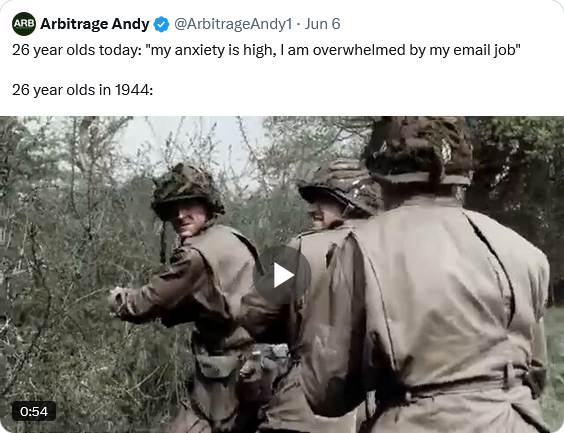
I don’t know if @ArbitrageAndy1 is a Boomer, but here he gives us a mashup of two classics from the Boomers’ greatest hits, “Younger Generations Suck”, and “The Television Never Lies to Me”.
It’s a jaunty little tune, and you can sing in it the shower, but the lyrics don’t actually make much sense.
Back in the real world, which younger generations actually have to live in, and where the television seldom tells the truth, WW2 was fought, on both sides, by guys even younger than 26.
And they were terrified.
The stress of combat against a peer adversary is overwhelming. It’s unendurable. But you endure anyway, because there you are, it’s happening to you, and you’re not getting out of it.
So you actually do have those little moments that Boomers would describe as stress meltdowns if they happened at work. You have them, and you do what you need to do anyway. Sometimes at the very same moment while you are melting down.
When you’re in this kind of war, there’s something terrible in front of you. In reality, that terrible thing is just as young and scared and overwhelmed as you are, but it sure doesn’t feel that way to you.
However, you also have something behind you, and something around you.
Behind you, you have a tribe that accepts and appreciates you. They know they sent you to hell, but they did it because hell was necessary, not because hell was fine. No one is gaslighting you pretending that everything is okay and that any problems you have are personal character flaws.
Around you, you have bros. They’re exactly where you are, doing exactly what you are doing, and they know how much it sucks. You’ve entrusted your lives to each other, and carried each other through things you don’t wanna talk about in your letters home.
Under intense stress and fear and exhaustion, your horizons shrink. You might have signed up for duty and patriotism and high ideals, but when you’re fighting, you fight to save the man next to you. And he fights to save you.
This is a very different experience than being isolated in a society that’s turned against young people, especially young men, especially young White men.
I won’t pretend it’s as difficult as fighting the Waffen SS. But young men fought the Waffen SS together.
They have to face the dissolution of the West alone.
That’s why they are anxious. Everything around them is not just going to shit.
It’s being systematically and deliberately turned into shit by powerful people who want them dead and replaced by someone else who will work cheaper and doesn’t expect to have a share of political power and a nice house and a retirement pension.
But I suppose Andy can still go ahead and dunk on them for clicks and a twenty-three dollar check from Twitter. That’s the fun thing about the fall of the West. Everybody gets a swing of the sledgehammer.
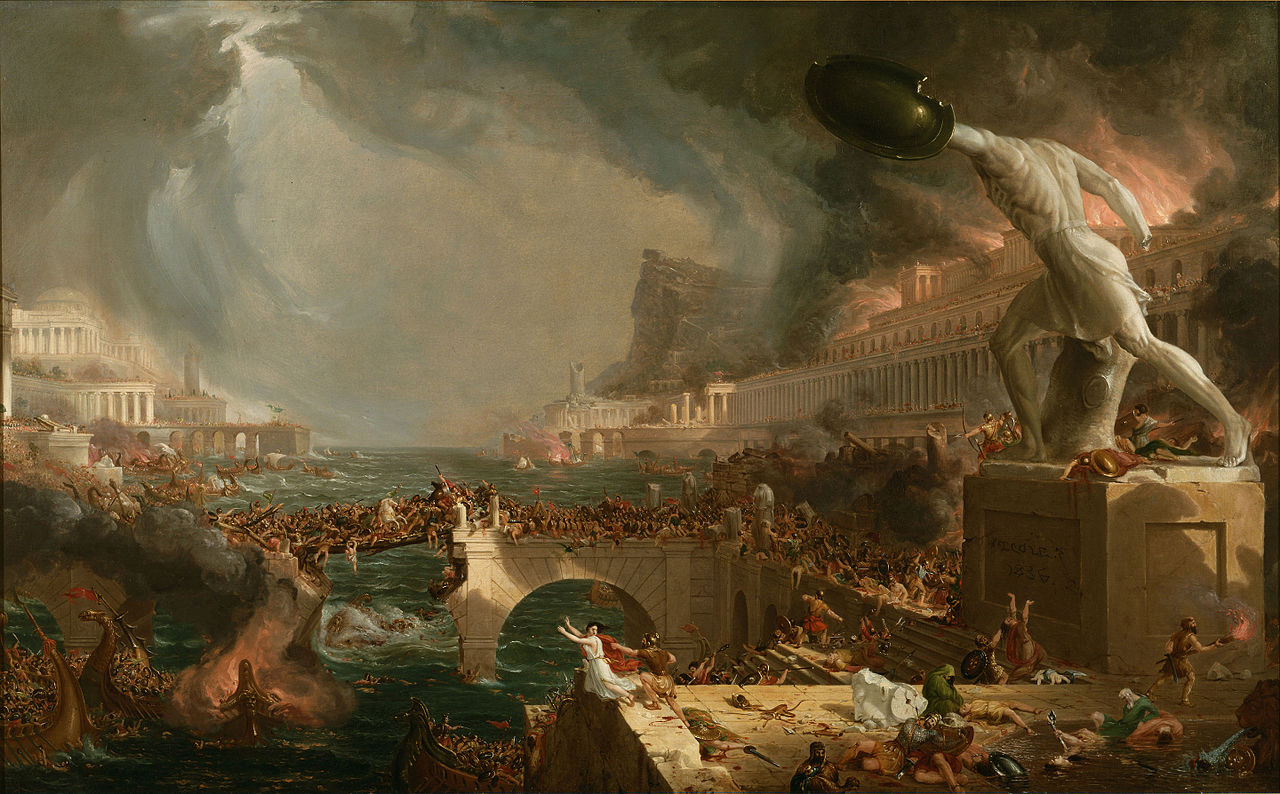
The Course of Empire – Destruction by Thomas Cole, 1836.
From the New York Historical Society collection via Wikimedia Commons.
June 10, 2026
World War 2 Mincemeat Pie for the Battle of the Bulge
Tasting History with Max Miller
Published 16 Dec 2025Raisin-forward army mincemeat pie made in a quarter sheet pan
City/Region: United States of America
Time Period: 1945During World War II, and really any war, soldiers far from home longed for a taste of home, especially during the holidays. Field kitchens would go to great lengths to break the monotonous menus and bring a little holiday cheer to the troops with things like turkey, stuffing, and pies.
This mincemeat pie is not bad, but it does lack the spices and citrus that really say “Christmas” to me. The corned beef and bouillon cubes add more of a savory note than a real meaty flavor, and raisins are the star of this pie.
No. 822. MINCEMEAT FORMULA NO. 1
Yield: 100 servings, 2 sheet pans, 16 1/2″ x 24″ x 1 1/2″.
Bouillon cubes……36 cubes
Water, boiling……9 quarts (9 No. 56 dippers)
Corned beef, canned……4 pounds
Fat……2 pounds (1 No. 56 dipper)
Apple nuggets, dehydrated……2 1/2 pounds (3 1/4 No. 56 dippers)
Sugar, granulated……3 pounds (1 1/2 No. 56 dippers)
Raisins……7 pounds (5 1/3 No. 56 dippers)
Cinnamon…… 3/4 ounce (3 mess kit spoons)
Pepper……(1/3 mess kit spoon)
Nutmeg……1/4 ounce (1 mess kit spoon)
Salt……(1/3 mess kit spoon)
Dissolve bouillon cubes in boiling water.
Add remaining ingredients. Simmer on a slow fire for approximately 45 minutes or until apples and raisins are tender. The addition of gravy coloring or caramelized sugar will improve the appearance. Remove from fire and cool. Pour into pastry-lined sheet pans.
Cover with a top crust and make in hot oven 40 to 45 minutes or until crust is golden brown.
Note. This mix should be prepared just prior to using.
— TM 10-412 US Army Technical Manual. Army Recipes by the U.S. War Department, 1945
May 29, 2026
QotD: What is volley fire and what is it for?
Volley fire can cover for the slow reload rate of guns or crossbows in two ways. The first are volley fire drills designed to ensure a continuous curtain of fire; the most famous of these is the “counter-march”, a drill where arquebuses or muskets are deployed several ranks deep (as many as six). The front rank fires a volley (that is, they all fire together) and then rush to the back of their file to begin reloading, allowing the next rank to fire, and so on. By the time the last rank has fired, the whole formation has moved backwards slightly (thus “counter” march) and the first rank has finished reloading and is ready to fire. The problem this is solving is the danger of an enemy, especially cavalry, crossing the entire effective range of the weapon in the long gap between shots. This, by the by, was the volley fire tactic that was being used in China with crossbows before gunpowder; I don’t know that anyone ever did volley-and-charge with crossbows, which lack the lethality of muskets.
The other classic use is volley-and-charge. Because firearms are very lethal but slow to reload, it could be very effective to march in close order right up to an enemy, dump a single volley by the entire unit into them to cause mass casualties and confusion and then immediately charge with pikes or bayonets to try to capitalize on the enemy being demoralized and confused. You can see variations on this tactic in things like the 17th century Highland Charge or the contemporary Swedish Gå–På (“go on”). By charging rather than waiting to reload, the attacker could take advantage of the high lethality of firearms without suffering the drawback of long reload times.
Crucially, note that volley-and-charge works because it compresses a lot of lethality into a very short time, which I suspect is why we don’t see it with bows or crossbows (but do see it with javelins, which may have shorter range and far fewer projectiles, but seem to have had higher lethality per projectile). As we’re going to see in a moment, the lethality of bows or crossbows against armored, shielded infantry – even in close order – was pretty low at any given moment and needed to add up over an extended period of shooting. By contrast, muskets were powerful enough to defeat most armor and thus to disable or kill basically anyone they hit, limited of course by reload time: with a reload time of as much as 30 seconds for earlier matchlocks, a line of musketeers might only be able to fire a few times at an advancing infantry unit (which might take two or three minutes to walk through effective range) and given the limited accuracy of smoothbore muskets, only the last shots would hit at a high level. By contrast, a unit doing volley-and-charge is compressing probably close to 50% of the lethality of sustained shooting, devastating moment and then immediately charging.
Putting that much lethality into a singular instant was valuable from a morale perspective and of course it enabled a unit to quick march through the enemy’s effective range, stopping only briefly to fire and charge, limiting losses from steady enemy fire. But as we’re going to see, the lethality of bows (and, to a significant extent, crossbows) was much lower and so couldn’t be effectively compressed into that single, devastating, confusing moment.2
Bret Devereaux, “Collections: Why Archers Didn’t Volley Fire”, A Collection of Unmitigated Pedantry, 2005-05-02.
- On drill and in particular, counter-march volley fire with crossbows, see Andrade, The Gunpowder Age (2016), 149-160.
- It also didn’t generate a smokescreen to help with the final rushing charge, whereas a musket-and-bayonet unit might benefit significantly from firing and then charging through and out of its own obscuring smoke into a terrified and confused enemy.
May 21, 2026
Enoch Powell, from would-be Viceroy to “Little Englander”
Niccolo Soldo discusses the early career of Enoch Powell and an earlier speech than the famous “Rivers of Blood” speech that took his own party to task for failings in the Imperial decline after World War 2:

AI-generated image from Fisted by Foucault
I’ve been on a bit of an Enoch Powell kick lately, and I’m not exactly sure as to why. Best known for his “Rivers of Blood” speech, in which he warned the UK about the dangers of mass migration, Powell was both an iconoclast and an eccentric, something that the British used to produce in spades.
Think about it; as a boy of the age of six, he would finish books and then collect his parents and give them a presentation on what he learned. His teen years were focused on the Classics, and translating(!) them into English. So adept was he at this that by the time he got to Trinity College at Cambridge, he entered into every Classics competition that existed at the time, and won each and every single one during his first year. When the University’s Dean and his wife invited him for a private supper, he had the temerity to politely refuse their offer, insisting that he had work to do (more translations). He became a Professor of Greek at the ripe old age of 25.
A devoted Nietzschean, Powell dreamed of becoming Viceroy of India, and he took the first opportunity to volunteer to serve his country in the war. His rise through the ranks was nothing short of incredible: Lieutenant-Colonel by 1942, and Brigadier (One-Star General) by the end of WW2. The man was the living embodiment of a 19th century German Romantic, albeit an English one at that. So thoroughly English was he that he could barely conceal his anti-Americanism, a trait that would surface from time to time over the course of decades. And yes, English, not British. Although today feted by immigration-restrictionists across the UK, his nationalism was what is known as “Little Englander”. Adding to the eccentricity, the turn away from Empire by the UK shortly after WW2 saw Powell do much the same: from golden dreams of being appointed Viceroy of India, to transforming into a Little Englander, adamant that it protect and retain all of what he felt were its best traits and characteristics, rejecting that which did not conform to this modus operandi.
It’s this overnight transformation that most piques my interest in his character because it is somewhat unique for a person of a very conservative nature to immediately accept such a dramatic shift in conditions and insist that the best must be made of it. “Empire is over. Let’s put it to bed, and let’s get on with it”, are words that are far, far beneath Powell’s level of erudition, but they do accurately describe his course correction.


