
Combined Arms is the use of different kinds of combat arms in concert; typically this is the combined use of some mix of infantry, artillery, armor (tanks and other armored fighting vehicles or AFVs) and airpower (when analyzing much older armies, we often talk about combined arms as mixing shock infantry, missile infantry and cavalry, so the “arms” being combined vary from era to era). This is important because effective use of these arms in modern warfare requires them to be used together: artillery and aircraft need infantry to help identify targets to strike (since both engage targets they typically cannot observe), while infantry needs them to provide supporting fires. AFVs of all kinds (but especially tanks) typically have poor situational awareness (there’s only so much you can see through even a good set of optics while buttoned up in a tank) and at close range are vulnerable to infantry-carried anti-tank weapons and so require infantry to screen them and be their eyes (while the superior firepower of AFVs enhance the infantry). Note that this can mean that good systems (e.g. an effective tank) can still be ineffective if not used appropriately with supporting arms (e.g. screening infantry with supporting fires). In the opening days of the invasion [of Ukraine in 2022], Russia struggled to use these arms in concert effectively, with the result that the Russian advantage in vehicles and fires, which was considerable, wasn’t realized. That in turn makes it difficult at this point to make clear assessments about the effectiveness of Russian equipment or the overall usefulness of certain kinds of equipment (e.g. tanks) when used properly in a combined arms framework.
Bret Devereaux, “Miscellanea: A Very Short Glossary of Military Terminology”, A Collection of Unmitigated Pedantry, 2022-03-25.
September 3, 2026
QotD: Combined arms
September 2, 2026
The Korean War Week 115 – What About Japan? – September 1, 1952
The Korean War by Indy Neidell
Published 1 Sep 2026The aftershocks of Typhoon Karen have dumped so much rain on Korea that it’s quiet in the field this week, so I turn my attention to Japan. Japan’s situation with regard to Korea is very important, but is in a state of flux after the occupation of Japan officially ended and the UN troops there went from occupiers to guests. It’s very interesting.
00:00 Hook
00:52 Recap
01:14 Typhoon Karen
02:42 National Police Reserve Japan
07:55 Expanding Forces
10:28 US Military Status
12:38 The Joint Committee
15:04 Summary
15:15 Mobilisation
August 28, 2026
“The Maple Mujaheddin Insurgency is not going to happen”
Of all the potential military conflicts facing the west, a US invasion of Canada has to be among the least likely — not just because it’s been attempted more than once in the past. For one thing, I don’t think even the best social media posting is going to bring ordinary Americans around to getting boots on the ground across the 49th parallel … there’s remarkably little passion about seizing our maple syrup and confiscating our strategic reserves of poutine among voters. Unlike places that Americans have strong feelings about, Canada just doesn’t move the needle.
The Operational Art of War has the first of a promised three-part series on Operation Maple Stomp, the biggest and best invasion of Canada — everyone says so:
In the latest round of “let’s do everything the dumbest way possible” the two nations in the world sharing the most in common keep taking to social media to fantasize going to war with each other.
It is deeply annoying, brings out the worst tendencies on both sides, and (to my mind worst of all) illustrates no one understands the Operational Art of War!
Americans take to social media and claim Canada doesn’t have a military, the military wouldn’t fight and be so outnumbered that resistance would collapse within hours.
Canadians usually agree the conventional war would be over in an afternoon, but then America would face a long and bloody insurgency (just wait till Uncle Sam meets the Maple Mujahedeen!).
Google AI’s idea of what a Canadian Insurgent looks like.
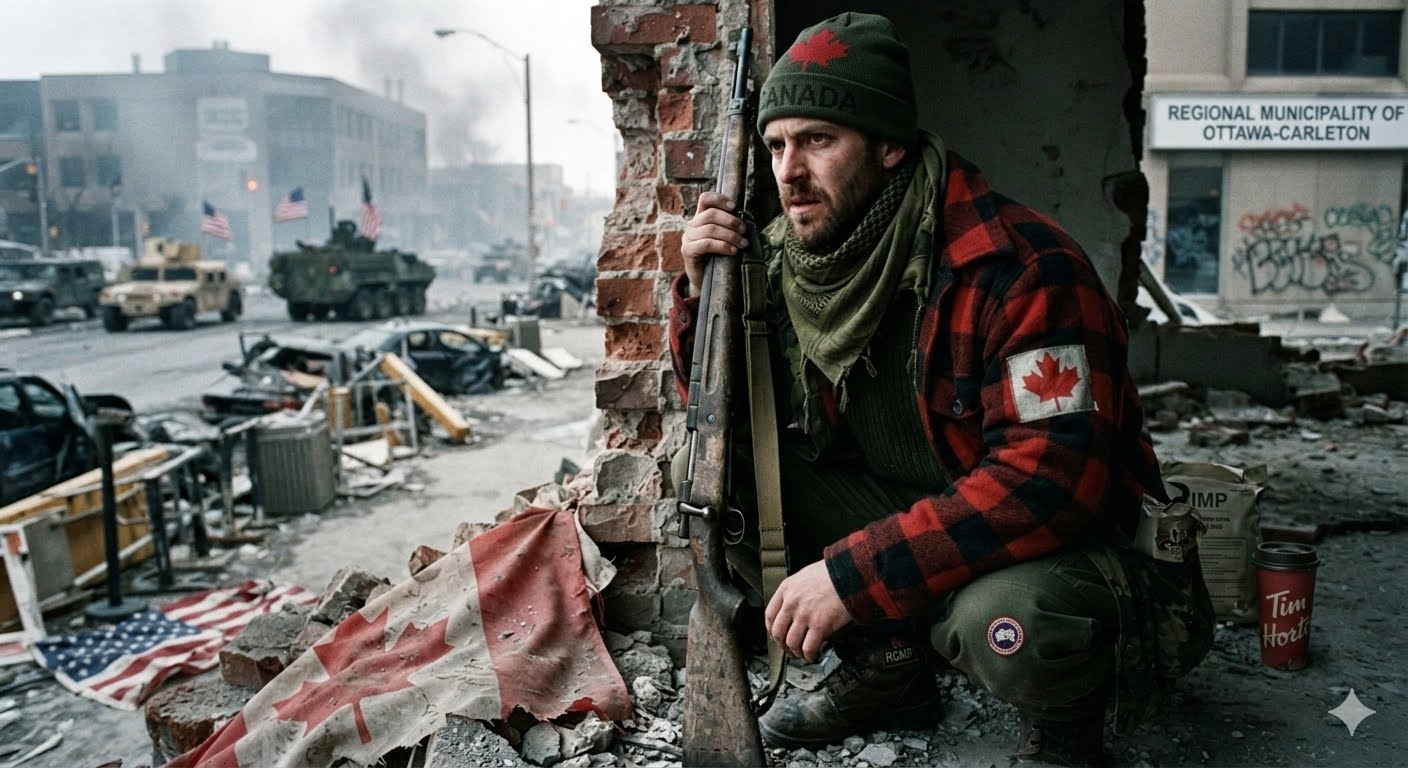
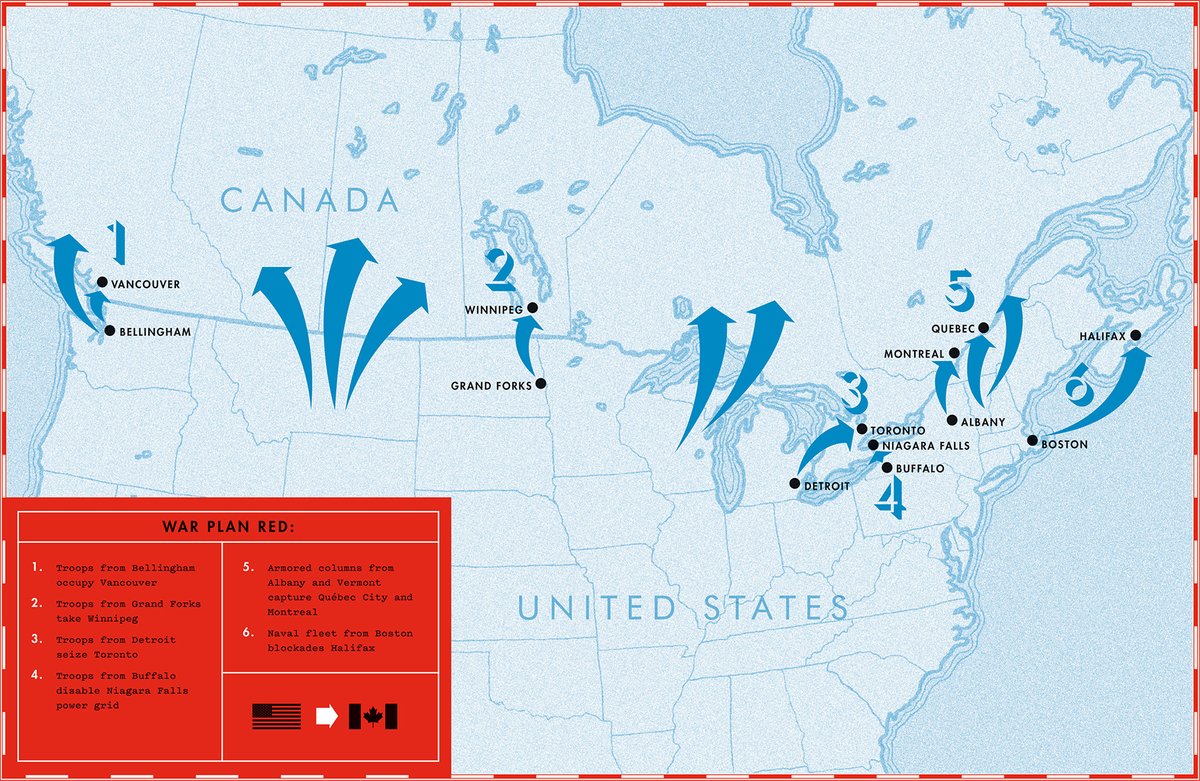
You can definitely count me as a member of Team Mere-matter-of-marching, at least as far as the tactical operations necessary to occupy the most populous parts of Soviet Canuckistan. Here’s a sketch map that Big Serge updated for the 2020s, based on the mid-1930s details for an attack on southern Ontario from War Plan Red:
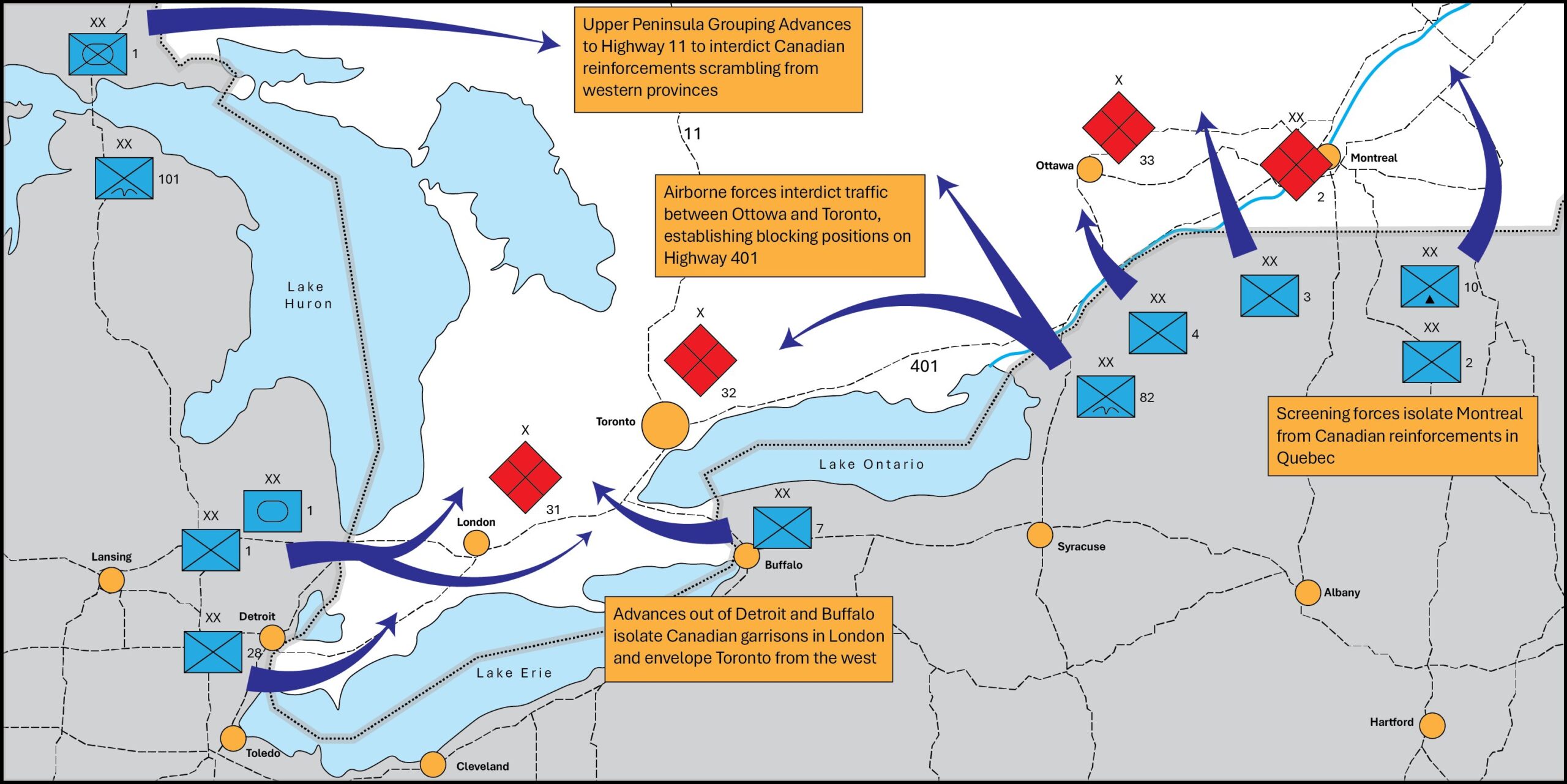
Manifest Destiny, 2025? Big Serge’s updated map for the old US War Plan Red for a military invasion of Canada.
The distances are short enough and the chances of significant military resistance low enough, that US Army vehicles would probably not need to refuel before reaching the initial stop-lines for their advance. Canadian infrastructure is not pre-wired for destruction, so unless local hotheads manage to temporarily block road bridges, volume of traffic will be a bigger friction factor than actual defensive fire.
Trump’s legions would reap the benefit of more than a century of demilitarized populations and the (small, but real) Canadian military being oriented to expeditionary operations rather than home defence. But taking the territory is only the first step. There are Canadians scattered throughout the continental United States, looking and sounding pretty much like any other American, and it wouldn’t take too many of them to decide that Trump’s fight was also their fight. Canada isn’t the only one enjoying the benefits of decades of lack-of-worry about homeland defence. Look how exposed the US has been to Islamic terrorists who, for the most part, don’t look or sound like Americans and still managed to pull off one of the greatest terror attacks of the modern age.
I mean, don’t misread what I’m saying here: the US would win. That’s not even remotely in doubt. There are at least ten of you for every one of us, and more of you have military training and access to personal weapons. (One wonders if the Canadian government’s fanatic devotion to civil disarmament is a kind of pre-surrender to this imagined US invasion we’re discussing …)
But the cost of winning might be more than even the most government-worshipping progressive might be willing to pay. We look like you. With a few exceptions (French-speaking Quebecers and Newfoundland-speaking Newfoundlanders, mostly), we fit in very well with you. We come from very, very similar cultures (some like Vancouver vlogger J.J. McCulloch argue it’s the same culture). Rather than a war of conquest, this would be much more like that “Second Civil War” that’s been so much a topic of conversation on far left and far right social media. The kind of civil war that takes far too long to settle back into peaceful co-existence.
You don’t like government surveillance? Too bad, bucky, because every level of government is going to be eager to ensure that you’re a good, loyal American … at all hours of the day and in everything you do. Cut down a Flock camera? That’s not going to be a mere vandalism issue … that’s tantamount to treason. What if that Flock camera was watching one of those undercover Canucki guerilla fighters?
Don’t like the feds watching every financial transaction? Too bad, bucky, ’cause you giving $5 to that sketchy Canuck for some bootleg maple syrup might be funding a terror attack on your nearest USAF base.
To fight the threat of Canuck infiltration, your every car trip will need to be logged, and your patterns of travel will need to be recorded and analyzed. Who you talk to will also need to be observed, in case one of your buddies is a covert maple-slurping spy!
Oh, wait, there’s more from the Operational Art of War:
There Won’t Be a Maple Mujahadeen
If the United States annexes Canada, there will not be a long-standing violent insurrection by a nation of hunters. The Maple Mujahadeen isn’t going to happen.
A successful insurgency has several requirements:
- A pre-existing structure to organize around;
- The structure having access to weapons;
- The insurgent group not having a future in the new regime; and
- The broader population being willing to shelter the insurgency.
Canada does have factions that meet all four of these factors, but spread across different factions. Like any complex modern society, Canada does have pre-existing structures of voluntary organizations. Virtually none of them are organized around any kind of collective defense or skills that easily translate to an insurgency.
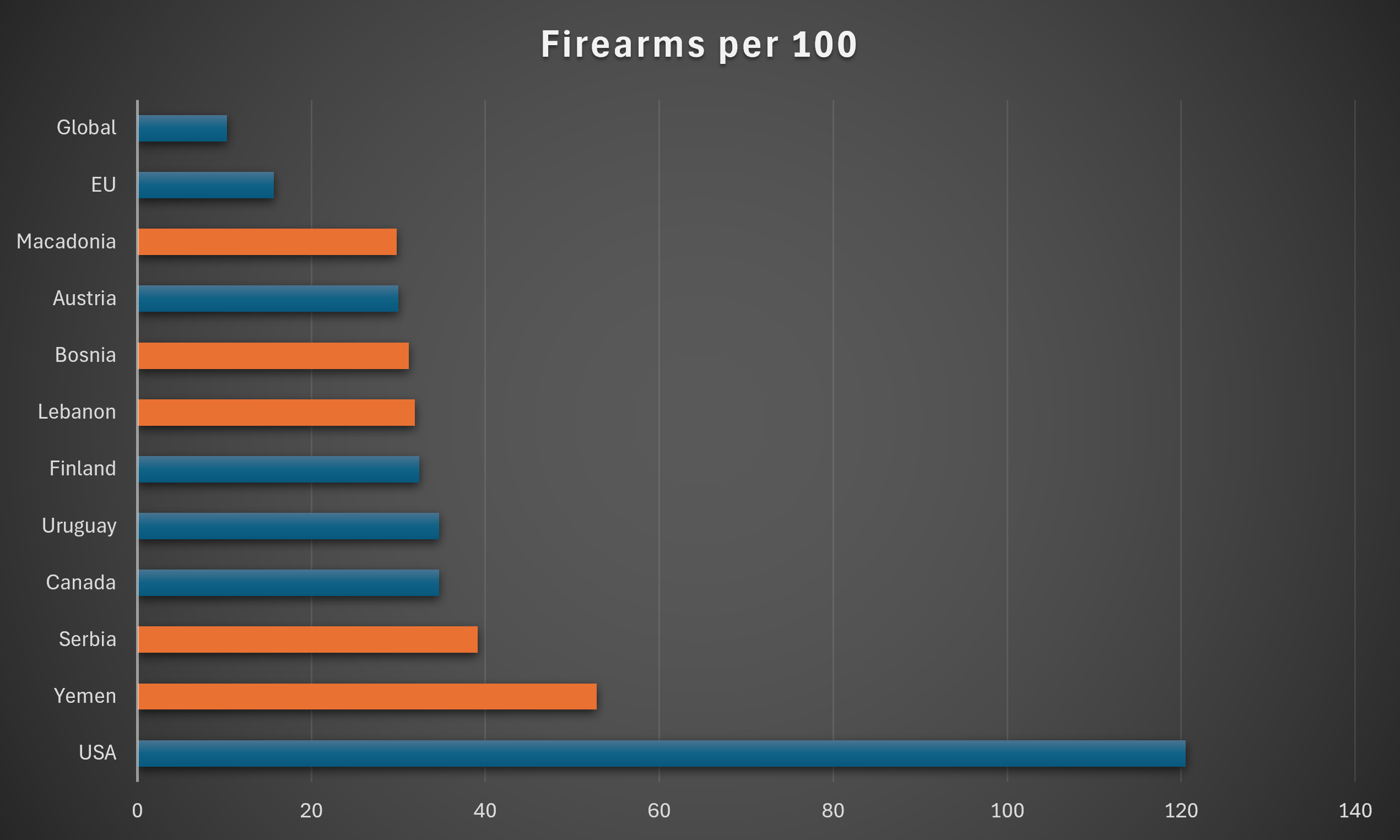
For #2 (access to weapons) you either need armed citizens, government weapons cashes or weapons brought in by a rival power supporting the insurgency. In Canada’s case, the only viable supply of weapons for an insurgency is its armed citizens. As with most statistics, Canada only looks like a gun free country because it’s beside America.
The graph below shows the top 10 countries for estimated firearms per 100 people, plus the EU and global average for comparison (excluding countries with a population under one million). Countries that were recently warzones are in orange, as their rate of firearm ownership is something of a special case.
The number for Canada is likely too low. This is based on a 2017 data set, and firearm ownership is growing faster than the population. It also assumes there are five unregistered firearms to every registered firearm in Canada. The last time Canada had hard data on unregistered firearms (2003 to 2012) the ratio was 10:1. Assuming a similar ratio today, firearms per 100 jumps to 1/2 that of America and nearly 4x the European average.
August 27, 2026
Britain’s Greatest Hero Never Existed!
The History Chap
Published 22 Apr 2026The most celebrated British hero of the First Anglo-Afghan War was brave, resourceful, and utterly magnificent under fire. He was also completely fictional – Harry Flashman.
Chris Green is The History Chap; telling stories that brings the past to life.
August 23, 2026
Why This “Foreign” Commonwealth Truck Was Built In 800,000 Units And Supplied Every Front
BritishWarLegends and BritishWarArmory
Published 31 Mar 2026The Canadian Military Pattern truck was built by two rival factories in Ontario for a nation of eleven million people. It ended up supplying the British Eighth Army across North Africa, Italy, Normandy, and Burma — and Canada built more of them than Germany, Italy, and Japan built trucks combined.
Almost nobody knows it existed.
When Rommel captured two thousand of them at Tobruk in 1942, he didn’t scrap them. The Afrika Korps pressed them straight into active German service. An enemy with his own purpose-built military trucks chose to keep using captured Canadian vehicles instead.
The full forgotten story.
Update: I generally try to avoid watching or re-posting clearly AI-generated slop, but this was the first video I’d encountered discussing the hundreds of thousands of CMP trucks that Canada built during WW2. At some point between me scheduling the video and today, the channel has been banned. You’ve undoubtedly seen CMP vehicles in WW2 stills or movie footage, as they’re pretty distinctive – https://en.wikipedia.org/wiki/Canadian_Military_Pattern_truck
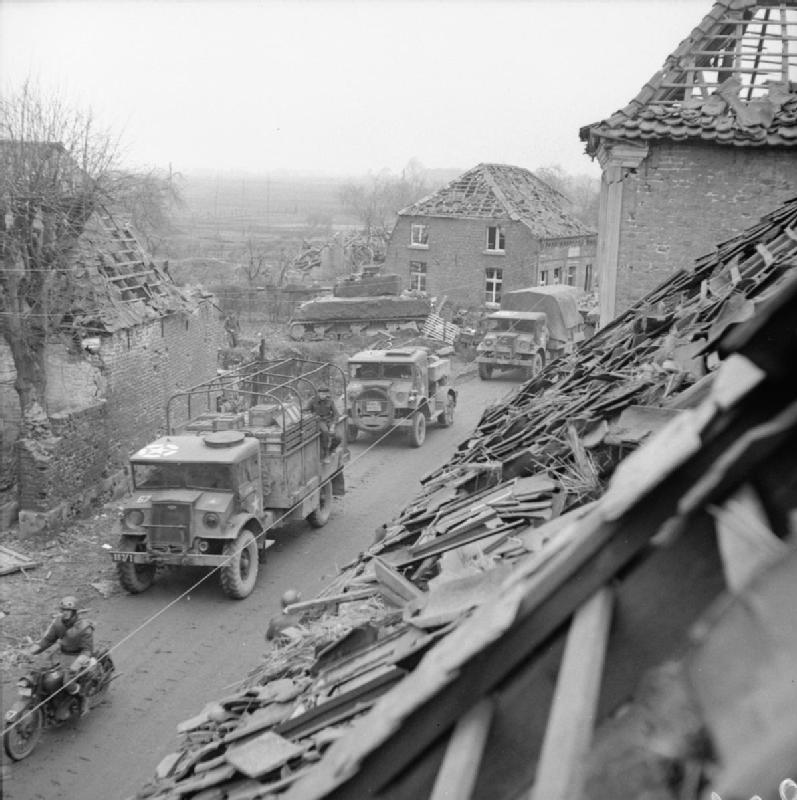
From The British Army in North-west Europe 1944-45,
CMP lorries passing through Uedem, 2 March 1945.
Photo by Carpenter (Sgt), No 5 Army Film & Photographic Unit, Photograph B 14966 from the Imperial War Museums via Wikimedia Commons.
August 16, 2026
The Ancient Greeks 04 – The Persian Invasion 2 – Logistics and Diplomacy
seangabb
Published 24 Mar 2026Greece: A Brief History, c.700 BC – 500 AD
How do you move an empire to war? This lecture examines the extraordinary logistical and diplomatic preparations behind Xerxes’ invasion of Greece. We explore how the Persian Empire assembled one of the largest armies in ancient history and the immense challenges of supplying and coordinating such a force.
At the same time, we examine the diplomatic pressure placed on the Greek states, including demands for submission and the divisions this created within the Greek world.
– The scale and organisation of the Persian army and navy
– Supply lines, engineering, and preparation
– The bridging (and scourging) of the Hellespont
– Persian diplomacy and the demand for “earth and water”
– Greek responses: submission, neutrality, and resistanceThis lecture shows that the invasion was not simply a military campaign, but a vast imperial operation combining force, intimidation, and political calculation.
QotD: The “Marian reforms” were not a thing
- Cohorts: Experimented with before Marius, especially in Spain. Marius uses cohorts, but there’s no evidence he systematized or standardized this or was particularly new or unusual in doing so. Probably the actual breakpoint here is the Social War.
- Poor Volunteers Instead of Conscripted Assidui: Marius does not represent a break in the normal function of the Roman dilectus but a continuation of the Roman tradition of taking volunteers or dipping into the capite censi in a crisis. The traditional Roman conscription system functions for decades after Marius and a full professional army doesn’t emerge until Augustus.
- Discharge bonuses or land as a regular feature of Roman service: Once again, this isn’t Marius but Imperator Caesar Augustus who does this. Rewarding soldiers with loot and using conquered lands to form colonies wasn’t new and Marius doesn’t standardize it, Augustus does.
- No More equites and velites: No reason in the source to suppose Marius does this and plenty of reasons to suppose he doesn’t. Both velites and equites seem to continue at least a little bit into the first century. Fully replacing these roles with auxilia is once again a job for our man, Imperator Caesar Augustus, divi filius, pater patriae, reformer of armies, gestae of res, and all the rest.
- State-Supplied Equipment: No evidence in the sources. This shift is happening but is not associated with Marius. In any event, the conformity of imperial pay records with Polybius’ system of deductions for the second century BC suggests no major, clean break in the system.
- A New Sort of Pilum: No evidence, probably didn’t exist, made up by Plutarch or his sources. Roman pilum design is shifting, but not in the ways Plutarch suggests. If a Marian pilum did exist, the idea didn’t stick.
- Aquila Standards: Eagle standards pre-date Marius and non-eagle standards post-date him, but this may be one thing he actually does do, amplifying the importance of the eagle as the primary standard of the legion.
- The sarcina and furca and making Roman soldiers carry things: By no means new to Marius. This is a topos of Roman commanders before and after Marius. There is no reason to suppose he was unusual in this regard.
So the Marian reforms … were not a thing. Functionally none of what is described as happening in them was new or unique to Marius. Indeed, the most substantial reforms are either things that were already changing (and which Marius seems to have had little role in) or things which had not yet changed but which would, under Augustus. Indeed, one of the problems with the assumption of a Marian reform is that it takes a whole lot of changes which were more likely a package of reforms under Augustus and pulls them forward in time to Marius, doing some damage to our understanding of both figures.
But Augustus makes much more sense as the figure doing many of those organizational changes. For one we have sources actually telling us he did them, from the standardization of military service (Dio 54.25.6), the creation of retirement bonuses and the aerarium militare to fund them (Dio 54.25.6 again, but also Res Gestae 17), and the radical expansion and formalization of the auxilia as part of the Roman army (Tac. Ann. 4.5). The one thing missing is citizenship-for-service, which we can see emerging under Tiberius, the next emperor immediately after Augustus. And it makes sense because Augustus is, by necessity, doing a bunch of other things with the legions too. He’s instituting a whole new command structure, with dedicated legionary commanders (the legatus legionis) serving under his own provincial commanders (legati Augusti) with imperial procuratores handling the former role of the quaestors. Also, the legions get their citizen cavalry (though a quite small detachment of it) back too.
So instead of thinking, “Marian reforms” – which were, I must stress, not a thing – you ought to be thinking about a period of tactical, organizational and institutional change beginning in the second century, accelerating in the first century and then finally being instituted as a comprehensive set of reforms and formalization by Augustus, not by Marius, which codified a lot of change that had already happened over that long period. A long process with a punctuation mark at the end rather than a singular moment of reform associated with a singular Roman general.
Alright. Now one of you go and fix the Wikipedia entry.
Bret Devereaux, “Collections: The Marian Reforms Weren’t a Thing”, A Collection of Unmitigated Pedantry, 2023-06-30.
August 12, 2026
US Army M68 Close Combat Optic aka Aimpoint CompM Series
Forgotten Weapons
Published 16 Mar 2026When Aimpoint entered the competition for a US Army standard-issue combat optic in the 1990s, they really didn’t expect to win. The other finalists were Trijicon and Meprolite, and it seems like a safe bet that the American firm — Trijicon — would get the contract. However, it ended up going to Aimpoint’s CompM on both price and technical capability. This meant an order for 100,000 of the optics, requiring Aimpoint to massively scale up. It also led to a series of improvements to the design, which became the CompM2, CompM3, and CompM4.
Today, we are looking at the history of this evolution. How the Aimpoint 3000 became the Comp[etition], how the Comp was ruggedized to the CompM[ilitary], and how the Swedish Army Aimpoint CS led to the current CompM4.
(more…)
August 7, 2026
QotD: A provisional taxonomy of “stupid smart guys”
If we assume this is a universal mental process, I suggest, then saying someone has a low-normal IQ does not mean he’s always going to do stupid things. He has those three-B flashes too. It might take a while for him to cotton to something that seems obvious, but cotton he will, in three-B fashion.
Moreover, Jaynes is good on the complexity of unconscious tasks. The mechanical parts of driving, once learned, are completely unconscious. Try teaching someone to drive and you’ll see it right away. You’ll find yourself literally side-seat driving — your foot pushing down on an imaginary brake, unconsciously. And you never really forget those unconscious patterns, either. You may not have ridden a bike in 30 years, but you could go out and do it right now. Same way with swimming, or the manual of arms — if you’ve been through Basic, a guy with the proper tone of voice can have you twirling around like a marionette, even if you got out of uniform decades ago.
The actual low IQ guys might be the most dangerous cogs in the machine.
The Dunning-Krugerrand. That’s Larry Correia’s phrase, and it’s great. This is the person who believes he’s way smarter and more competent than he actually is. Which on the one hand, they all do. But on the other hand, there are levels above D-K, so please hold fire for now.
The Artiste. It’s been my great … fortune, actually, to have been around a lot of Media people in my youth. I dated a gal who did production work for one of the big tv news programs in a fairly large city, so I saw the video side of it, at least, from close range. The on-camera bobbleheads are all Ron Burgundy, of course, but the production people are usually quite bright … but in a very odd way. They have what I came to think of as “the artist’s eye”. They naturally see everything in terms of camera angles and visual presentation, and training develops this to a very high degree.
This leads to wildly divergent takes on things. You or I see the police approaching a stopped car with their guns drawn, or firemen pulling up in front of a burning building, and we think something like “Damn, crime is out of control!” or “I hope everyone’s ok.” News people — video people, at least — think “What a shot!” They frame the visuals first, then start processing the propositional content … if they ever do. The longer they work in “news”, the more the propositional content — “the cops are arresting a bad guy”; “there are real people in real danger in that burning building” — drops away.
Same thing, I imagine, with the folks on the verbal end. They have a novelist’s sense of pace, structure, and so on. Is what they’re writing true? Of course not! At one point about 30 years ago they felt the need to justify this, and created a whole new category of writing: “creative nonfiction“, aka lies, aka “the news”. The “creative nonfiction” people will tell you, in Wiki’s words, that it “uses literary styles and techniques to create factually accurate narratives”. Emphasis mine, because like the cameraman who ends up exclusively focusing on the shot and never thinks about the life behind the shot, so the writer of “creative nonfiction” gets caught up in the creative part, and just kinda forgets the “nonfiction” part.
Medicalization. Not a category of people, but a technique. We say smart people tend to be spergy, and stupid smart people tend to be really spergy, but that’s mistaking effect for cause. They’re not very good at reading people, and have no social savvy, but that’s because they don’t practice — because they don’t need to practice. They medicalize their deficiencies. Instead of acknowledging a weakness in their game, they attribute it to a pathology.
Severian, “The Stupid Smart Guy”, Founding Questions, 2022-07-13.
August 4, 2026
QotD: Limits to tactical flexibility in Roman Republican armies
And therein lies the rub: just as the commander doesn’t have a multitude of points where he can intervene in the battle but rather a limited set of key decision points, so too he does not have an infinite set of potential orders he (or his subordinates) might give at any given moment. Instead, the commander (or his subordinates) has a McDonald’s menu worth of options he can employ. He can order anything on the menu and expect the unit to respond accordingly but he cannot order anything not on the menu, nor can he order an altered version of a menu item (no Big Mac without cheese; Sir, this is not a Wendy’s).
Now generals could and did use drilling in the early stages of the campaign to add one or two “menu items” to their drill so as to be prepared for this or that problem. Indeed the general preparing some sort of surprise of this sort and then deploying it against an enemy is a standard topos of effective ancient generalship (although in many cases we may doubt the purported gimmick was actually used (e.g. Dionysius 20.1.6, Dio 10.5)). But that is the thing: such extra “menu items” have to be prepared in advance and often well in advance of the battle. Caesar, for instance, anticipating war elephants drills his troops in anti-war-elephant tactics before the Battle of Thapsus (46 BC, Caes. Bel. Afr. 84). Alexander’s phalanx seems to have been drilled to respond to scythed chariots as well (Arr. Anab. 3.13.5-6).
That said the bulk of the menu was likely to remain constant. After all these “menu items”, while they have simple names are often actually fairly complex to do and train when you are dealing with units of dozens or hundreds. Turning back to our example of Company, Right Wheel! we can get a sense of the complexity of training that maneuver by the way they did it. The “right guide” (the man on the extreme right) adopts a set pace (nine inch steps) while the “left guide” moves at the normal regulated speed (note this requires training your soldiers not only to step in time but to step at standard lengths) and every soldier in the middle regulates his motion by maintaining elbow contact with the man to his side. That’s a good method to get the result, but it isn’t an obvious or simple method: the fellow training the company to do this needs to already know how to do this.
Now in the modern period with mass printing, you could print drill manuals that had all of the commands and instructions on how to do them, but in the pre-modern period that kind of mass printing isn’t an option (and our military texts almost never go into this kind of granular detail) so your officers have to learn to train the behavior by observing it and participating in it themselves. Which means in turn a great deal of your “package” is set before the army is even mustered at the beginning of the campaign season because you are relying on a package of culturally embedded knowledge about how armies ought to function. And if your culture doesn’t have that tradition, inventing it from scratch is going to be hard and take time; and by “time” I mean “decades”. Effective drill for volley fire (the “countermarch”), for instance, answered a need that had existed for most of the 16th century, but the embryonic ideas for it only started emerging in the 1570s, the actionable plan on how to do it in 1594 and it was only then finally deployed in a major battle in 1600 at Nieuwpoort.
However, the time available for that kind of training is limited. Remember that drill works by repeating the same set of actions over and over again until they become almost instinctive. That takes a lot of time and repetition! That both means it is going to be difficult to find space for new “menu items” (especially with green troops that still need to learn the basics) but also that synchronized discipline itself is expensive. Our ancient sources stress how Roman levels of synchronized discipline required diligent and continuous drilling to create and maintain.
Doing that in turn would demand keeping the soldiers in question under arms for training for long periods when they were not fighting. In the Middle Republic this seems to have been accomplished through rolling recruitment: Rome was essentially always at war and always raising armies so there were always a goodly number of veterans to train and “break in” the truly green new recruits in any given draft (though again – and I owe this notion to Michael Taylor – there are some signs that the less intense conflict of the mid-second-century leads to some dulling of the Roman edge). As we transition through the Late Republic into the Early Empire, that is replaced by the slow professionalization of the Roman army, culminating in the force of long-service professionals created by Augustus. Being mobilized in peacetime, professional soldiers could be drilled extensively (assuming their cultural values are going to let them drill you; also be wary here of assuming standing forces of “military settlers” are professional in this way).
But all of that is extraordinarily expensive. Keeping those soldiers under arms, after all, means that they need to be fed, clothed and paid. Even in a system like the Middle Roman Republic where soldiers provided their own kit out of their own wealth (because Roman soldiers in the Middle Republic were recruited from the modestly well-to-do smallholding class), by drafting those men you have removed them from that economic activity. The expense of doing this would have been in most cases enormous and of course those are resources that could be deployed to any number of other uses, including simply raising a larger army of less disciplined, well trained troops. For, say, a Greek polis given the choice between having 450 men under arms all year round and excellently trained or having 5,000 hoplites under arms only in the one month where there is a battle to fight the clear answer is the latter. A lot of things need to line up before producing armies with high levels of synchronized discipline makes sense: the state needs a lot of resources, year-round security challenges and a tactical system which is effective and demands this kind of investment. So while developing synchronized discipline offered an army a degree of greater control and flexibility, it was prohibitively expensive.
Bret Devereaux, “Collections: Total Generalship: Commanding Pre-Modern Armies, Part IIIa”, A Collection of Unmitigated Pedantry, 2022-06-17.
July 31, 2026
QotD: Cuisine on campaign
Supposing, for a moment, a bit of imagination on the part of quartermasters and cooks, and a semi-intelligent rationing authority, a war might be conducted with a bit of style. There could be rivalry between regimental kitchens, or between the galleys in Her Majesty’s fleet. Food could be made a powerful inducement in the recruitment drives.
There are some little sparks like this, in history. In the Crimean War, Florence Nightingale, that extraordinary lantern-bearing angel, procured the voluntary help of Alexis Soyer, the leading London hotel chef of the day, to advise her on the organization of field hospital kitchens. These quickly became the place to eat — almost worth getting wounded. M. Soyer applied his very broad mind to analyzing the limitations of field cookery, then turning each limitation into a strength. (I recommend his Culinary Campaign in the Crimea, 1857.)
Morale is not a small thing in the conduct of war. A hot meal served in defiance of logistics in the cold wet of a hideous trench, comes to remind us of victory, in the very face of the enemy.
David Warren, “Non-idlers”, Essays in Idleness, 2020-11-11.
July 29, 2026
1960s British Army Recruitment Film | Cold War Training & Life Inside the Army
Militaria Collectors Network
Published 23 Mar 2026Step back into the 1960s and experience how the British Army trained the soldiers of the Cold War era. This rare archival recruitment film offers a fascinating look at military life, basic training, and the wide range of technical and career opportunities available to new recruits during a time of global tension and rapid modernisation.
From infantry drills and weapons training to engineering, communications, and education programmes, this film highlights how the British Army prepared men for both combat and skilled professions. Whether you’re interested in Cold War history, military training, or vintage government films, this is a unique glimpse into a defining period of British military history.
📽️ In this film:
– 1960s British Army basic training
– Infantry tactics and weapons familiarisation
– Technical trades and career paths
– Cold War-era military strategy and preparation
– Life as a British Army recruit
(more…)
July 22, 2026
QotD: Burnside’s Army of the Potomac
This was the country of the boisterous forty-niner, the hell-roaring lumberjack, and the riverman who was half horse and half alligator. Without rancor (and also without the slightest hesitation) it annihilated Indian tribes so that it could people a wilderness, asserting that the only good Indian was a dead Indian and remarking casually of its own pioneers that the cowards never started and the weak died along the road. As it faced the cathedral aisles of endless virgin forests it shouted for immediate daylight in the swamp, even if whole generations must be brutalized for it. It was the country that invented the bucko mate and the Shanghai passage, and if the skysails of its incredible clippers gleamed on the farthest magic horizon they were taken there by men under the daily rule of clubs and brass knuckles. This nation accepted boiler explosions as the price of steamboat travel and it would boast presently of a dead gandy-dancer for every cross-tie on the transcontinental railroad. It wore seven-league boots and scorned to look where it planted them, and each of its immense strides was made at immense human cost. And the army of this country, buckling down to it at last in a fight which had to go to a finish, was going to be very rough on enemy civilians, not because it had anything against them but simply because they were there.
Of genuine hatred this army had practically none. The wild young men who ruined ancestral portraits and pranced in the smoky streets wearing the embroidered undergarments of gentlewomen were expressing nothing but plain hooliganism, which somehow was the obverse side of the medal that had laid nine hundred corpses in front of the stone wall west of town. Both sides of the medal bespoke raw youth which cheered and guffawed by turns, whose noble best forever went arm in arm with its ugly worst.
Bruce Catton, Army of the Potomac: Glory Road, 1952.
July 20, 2026
“Blame Canada”: evergreen. “Invade Canada”? It’s been done before
Upper Canadian Cavalier points out the obvious … that the United States absolutely could invade Canada and there’s not a lot the Canadian Armed Forces could do to stop them. But that would be the easy part:
“A mere matter of marching …”
The question of “could America ever invade Canada?” is wrong before it is even asked. Picture the MAGA politicos huddled in D.C. and the anon poasters spamming maps of how America could take Canada, as if it were even a question, as if the border were a wall and the wall the point. The whole conversation is midwits who never grasped what America already occupies.
Occupation is the crude instrument of the conqueror who arrives too late, who finds the ground already held by another and must break it by force, and that has never once been the American position in the north. The American position is that of the covert shareholder rather than the invader, and a shareholder does not knock down the door of a house whose deed already sits in his desk.
Empire in its highest form neither occupies nor marches, because it has learned to administer instead, and it does not plant a flag on the palace, since the flag is a confession that the palace was not yet yours. The genius of the modern Global American imperium has been to take without ever confessing, to hold Canada so completely that Canadians experience the holding as their own free choice. To reach for the army now would throw all of that away, trading a profitable and invisible dominion for a visible and bloody one, and teaching the empire at ruinous cost the difference between owning a country and holding it.
The republic was born reaching north with a bayonet, and it should remember how that went. In the winter of 1775 it sent Brigadier General Richard Montgomery and Colonel Benedict Arnold (yes, that Benedict Arnold) up through the snow to seize Quebec. The spirit of the country rose up in the snow to meet them, and Quebec killed Montgomery in a blizzard at the walls, the land itself passing sentence on the invasion before a single treaty could be signed.
That was first offensive act of the American project, it was a failed invasion of Canada that froze to death in the cold for its own arrogance. There is a symmetry waiting at the end of this essay that the reader should carry from the beginning, because a republic that opened its history reaching north may yet close its history the same way. America could invade Canada, but then it would not be able to conquer it, and in that attempt it would destroy the very thing that made its northern dominion worth having, because the soft empire cannot survive being seen and that invasion is nothing other than the act of trading quiet profits for overt pain and suffering.
July 7, 2026
QotD: “I was just following orders” — the Nuremberg Defence
JerryRigEverything @ZacksJerryRig
It is illegal to obey illegal orders.
It is illegal to obey illegal orders.
It is illegal to obey illegal orders.
It is illegal to obey illegal orders.
It is illegal to obey illegal orders.
It is illegal to obey illegal orders.
Congress has not declared War.
Pass it on.Hot Take: The “Nuremberg Defense” should be completely legally valid because it was for the entirety of human history until the Nuremberg Trials.
The idea that the average GI Joe has the knowledge and capability to parse the legality of orders in life-and-death situations is one of the best examples of how Liberalism simply does not comport with reality.
Every lawyer knows this to be true, too. Ask any number of attorneys a question on a matter of law and if the question is worth a damn you’ll get as many answers as participants. All good legal questions start with the same answer: “It depends.”
If you can’t even get a team of attorneys to always agree on whether something is legal, with hours to days to weeks of research put into the question, why/how do you expect a normal joe to figure that out?
You don’t. He can’t. You know that.
You just want to inspire doubt, raise mutiny, and have a way to punish people who did things you don’t like on the orders of someone out of your reach.
J.T. Alexander, The social media site formerly known as Twitter, 2026-04-06.


