Quotulatiousness

December 5, 2019

Tippman’s Half-Scale .22 Rimfire Browning 1917 Machine Gun

Filed under: History, USA, Weapons — Tags: , , , , — Nicholas @ 04:00

Forgotten Weapons
Published 4 Dec 2019

https://www.instagram.com/rockislanda…

https://www.youtube.com/user/RockIsla…

This is Lot 1578 in the upcoming RIA December 2019 Premier auction.

In 1983, Dennis Tippman formed a company to manufacture half-scale functional replicas of Browning machine guns — the 1919 and 1917 specifically. He built these as both fully automatic and semiautomatic (the semiauto design being approved by ATF in 1984) as new machine guns could still be registered in 1983. They were chambered for .22 LR rimfire ammunition, making then cheap and easy to shoot. In 1985, he added an M2HB replica, also in half scale, chambered for the .22 Magnum cartridge.

Tippman’s guns were excellent replicas of the originals, including accessories like tripods and even a few .22 caliber belt-loading machines. However, when the machine gun registry was closed in 1986, he left the business, selling it to FJ Vollmer. Tippman would move into paintball markers, and the company name is much better know for those today outside of a small community of machine gun enthusiasts.

Vollmer would eventually sell the company in 2001 to Eric Graetz and Lakeside Machine, who continued production of the semiauto versions, as well as offering post-sample automatics ones. This example is one of Graetz’ production, serial number 001 from when the company moved to New Haven Indiana.

http://www.patreon.com/ForgottenWeapons

Cool Forgotten Weapons merch! http://shop.bbtv.com/collections/forg…

Contact:
Forgotten Weapons
6281 N. Oracle #36270
Tucson, AZ 85704

Fallen flag – the Denver & Rio Grande Western

Filed under: History, Railways, USA — Tags: , , , , , , , — Nicholas @ 03:00

The origins of the Denver & Rio Grande Western by Mark Hemphill for Trains magazine:

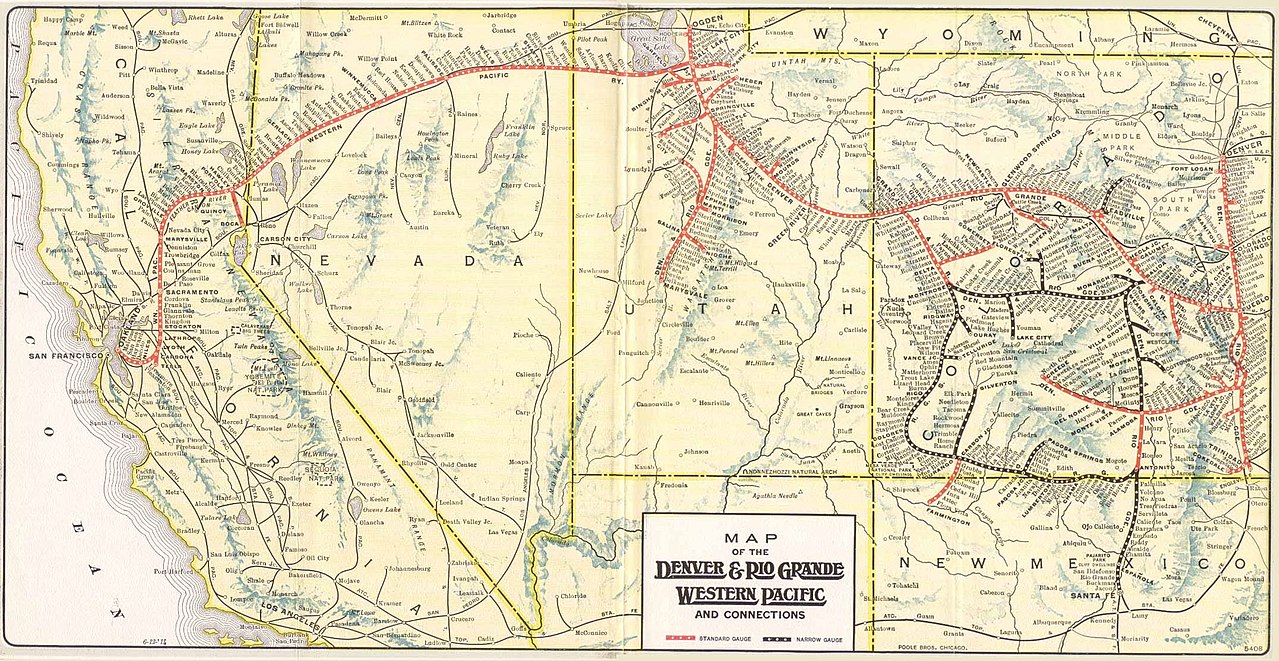
1914 route map of the Denver & Rio Grande Western and Western Pacific railroads.
Map via Wikimedia Commons

In the American tradition, a railroad is conceived by noble men for noble purposes: to develop a nation, or to connect small villages to the big city. The Denver & Rio Grande of 1870 was not that railroad. Much later, however, it came to serve an admirable public purpose, earn the appreciation of its shippers and passengers, and return a substantial profit.

The Rio Grande was conceived by former Union Brig. Gen. William Jackson Palmer. As surveyor of the Kansas Pacific (later in Union Pacific’s realm), Palmer saw the profit possibilities if you got there first and tied up the real estate. Palmer, apparently connecting dots on a map to appeal to British and Dutch investors, proposed the Denver & Rio Grande Railway to run south from Denver via El Paso, Texas, to Mexico City. There was no trade, nor prospect for such, between the two end points, but the proposal did attract sufficient capital to finish the first 75 miles to Colorado Springs in 1871.

William Jackson Palmer 1836-1909, founder of Colorado Springs, Colorado, builder of several railroads including the D&RGW.
Photograph circa 1870, photographer unknown, via Wikimedia Commons.

Narrow-gauge origins
Palmer chose 3-foot gauge to save money, assessing that the real value lay in the real estate, not in railroad operation. At each new terminal, Palmer’s men corralled the land, then located the depot, profiting through a side company on land sales. Construction continued fitfully to Trinidad, Colo., 210 miles from Denver, by 1878. Above Trinidad, on the ascent to Raton Pass, Palmer’s engineers collided with the Santa Fe’s, who were building toward California. Realizing that a roundabout narrow-gauge competing with a point-to-point standard-gauge would serve neither the fare box nor the next prospectus, Palmer changed course, making D&RG a supply line to the gold and silver bonanzas blossoming all over Colorado and Utah. Thus the Rio Grande would look west, not south, and would plumb so many canyons in search of mineral wealth that it was a surprise to find one without its rails.

Turning west at Pueblo, Colo., and outfighting the Santa Fe for the Royal Gorge of the Arkansas River — where there truly was room for only one track — D&RG entered Leadville, Colorado’s first world-class mining bonanza, in 1880. Three years later, it completed a Denver–Salt Lake City main line west from Salida, Colo., via Marshall Pass and the Black Canyon of the Gunnison River. The last-spike ceremony in the desert west of Green River, Utah, was low-key, lest anyone closely examine this rough, circuitous, and glacially slow “transcontinental.” Almost as an afterthought, D&RG added a third, standard-gauge rail from Denver to Pueblo, acknowledgment that once paralleled by a standard-gauge competitor, narrow-gauge was a death sentence.

New owners, new purpose
Palmer then began to exit. The company went bust, twice, in rapid succession. The new investors repurposed the railroad again. Instead of transient gold and silver, the new salvation would be coal. Thick bituminous seams in the Walsenburg-Trinidad field fed beehive coke ovens of a new steel mill near Pueblo and heated much of eastern Colorado and western Kansas and Nebraska.

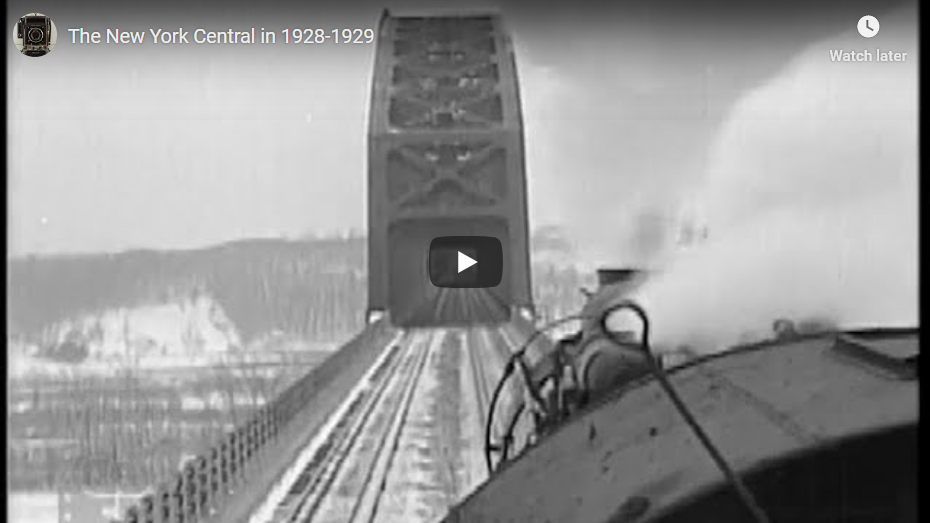
The New York Central in 1928-1929

Filed under: History, Railways, USA — Tags: , , — Nicholas @ 02:00

Speed Graphic Film and Video
Published 22 Dec 2017

More early sound film from the Fox Movietone News archives in the University of South Carolina’s Moving Image Resource Collection.

It shows New York Central trains in the Hudson River valley in 1928 and 1929. Scenes include:
0:10 K3 Pacifics passing through Peekskill station.
1:10 View from the tender as a fast freight crosses the bridge at Castleton.
2:30 Looking up at the bridge as a train passes over.
2:42 Another ride over the bridge at Castleton, this time seen from the caboose. There is a brief glimpse of NYC 0-6-6-0 No. 1300, the only locomotive with that wheel arrangement on the railroad.
4:54 View from a bluff above the Weehawken yards. (Thanks to Vincent Zablocki for the ID.)
5:30 Street operations on the West Side Line in Manhattan when it still ran at street level. Locomotives seen include No. 595 and dummy No. 1904.
7:33 A look at the drivers as a K3 Pacific passes by the camera.
8:21 Passenger trains on the main line, seen at a distance. These are editing “trims,” so the shot ends just as the train gets near the camera. These were probably taken at Breakneck Mountain.
11:19 Departing passenger train at a grade crossing. Again, this is a “trim,” so the beginning of the shot is missing.

QotD: [Literal] Health Nazis

Filed under: Germany, Health, History, Quotations — Tags: , , , , , — Nicholas @ 01:00

[T]he Nazis’ focus on the threats that risky habits pose to “public health” makes perfect sense in light of their collectivist ideology. “Brother national socialist,” said one bit of Nazi propaganda, “do you know that your Führer is against smoking and thinks that every German is responsible to the whole people for all his deeds and missions, and does not have the right to damage his body with drugs?”

Smith adds: “Clearly there were considerable links between the promotion of particular lifestyles and the racial hygiene movement. Tobacco and alcohol were seen as ‘genetic poisons,’ leading to degeneration of the German people.”

The point, I hasten to add, is not that today’s “public health” paternalists are Nazis. I am not suggesting that everyone who hates smoking is just like Hitler. But there is an unmistakable totalitarian logic to the notion that the government has a responsibility to promote “public health” by preventing us from engaging in activities that might lead to disease or injury. The implication is that we all have a duty to the collective to be as healthy as we can be, an idea the Nazis embraced but one that Americans ought to find troubling.

Jacob Sullum, “So What If Hitler Was an Anti-Smoker?”, Reason Hit and Run, 2004-12-17.

December 4, 2019

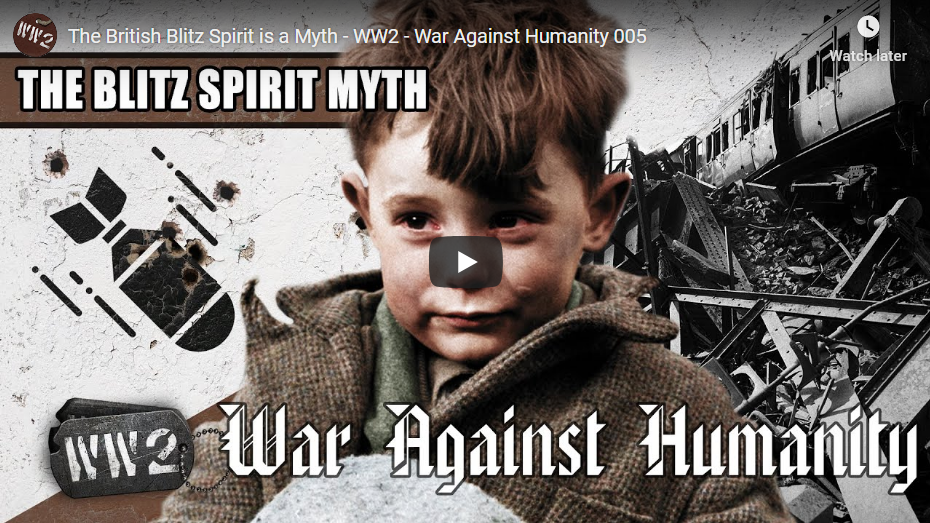
The British Blitz Spirit is a Myth – WW2 – War Against Humanity 005

World War Two
Published 3 Dec 2019

Strategic bombing was used to destroy the popular support for their governments war effort, and the British boosted that their resistance to bombing was an unique trait. But both are false, based on lies and propaganda.

Join us on Patreon: https://www.patreon.com/TimeGhostHistory
Or join The TimeGhost Army directly at: https://timeghost.tv

Follow WW2 day by day on Instagram @World_war_two_realtime https://www.instagram.com/world_war_t…
Join our Discord Server: https://discord.gg/D6D2aYN.
Between 2 Wars: https://www.youtube.com/playlist?list…
Source list: http://bit.ly/WW2sources

Hosted by: Spartacus Olsson
Written by: Joram Appel and Francis van Berkel
Produced and Directed by: Spartacus Olsson and Astrid Deinhard
Executive Producers: Bodo Rittenauer, Astrid Deinhard, Indy Neidell, Spartacus Olsson
Creative Producer: Joram Appel
Post-Production Director: Wieke Kapteijns
Research by: Francis van Berkel and Joram Appel
Edited by: Karolina Dołega

Thumbnail Colorization by:
– Julius Jääskeläinen – https://www.facebook.com/JJcolorization/

Colorizations by:
Dememorabilia – https://www.instagram.com/dememorabilia/

Sources:
– Imperial War Museum: D2168, D1623, D2956, 36206, D1587, D2154, D2157, HU36143, HU 36199
– Deutsche Fotothek, 0000436
– Noun Project: Natural Disasters 1674928 By Claudia Revalina, ID
noun_prisoner 63221 By carlotta zampini, IT, Bomb by P Thanga Vignesh
– Toni Frissell, Abandoned boy, London, 1945
– Battle of Britain, film from United States Holocaust Memorial Museum

Archive by Screenocean/Reuters https://www.screenocean.com.

A TimeGhost chronological documentary produced by OnLion Entertainment GmbH.

From the comments:

World War Two
7 hours ago (edited)
Having spoken to many British people while researching this episode, I realised that many in the United Kingdom still grow up with the idea that the perseverance in the face of constant bombing was something uniquely British, and that the so-called “Blitz Spirit” caused people to proudly face Hitlers bombs and transcend class-differences, and that bombing actually boosted their morale. However, research – half of which was done by Francis who is from Britain as well, shows that this idea is mainly based on propaganda. Furthermore, it is still considered controversial to doubt Churchill’s war cabinet’s policy of mass bombing German cities to force them out of the war. However, the effectiveness of this too has been proven to be based on falsehoods and lies. The true effectiveness of strategic bombing was already known to Churchill’s advisors during the war. Feel free to enter discussion about this in the comment section, but keep it civil and back up your arguments with examples and sources wherever possible.

Cheers,
Joram

Defund the BBC? Well, if you can’t just sack, burn, and salt the earth it stands on, defunding might help

Filed under: Britain, Government, Media, Politics — Tags: , , — Nicholas @ 05:00

Hector Drummond wonders if the Overton Window has moved far enough that the BBC might lose its sacred status:

In a notorious talk given to Conservative Future in 2009, Sean Gabb made the following radical recommendation:

    On the first day of your government, you should close down the BBC. You should take it off air. You should disclaim its copyrights. You should throw all its staff into the street … You must shut it down – and shut it down at once.

I have for many years been torn between thinking this a good idea, and thinking that it would result in such uproar that the government would immediately fall, and be replaced by a new government who would restore the BBC. But the question was purely abstract anyway, because no Conservative government would even contemplate doing such a thing. No Conservative government was even going to contemplate taking away the licence fee.

But finally, after three years of disgraceful conduct — well, extra disgraceful conduct — the future of the BBC is finally an issue that that can be broached. It’s finally an issue that can be talked about without people throwing up their hands in horror and demanding you be thrown out of wherever you are. People will listen sympathetically if you suggest that the BBC can’t go on like it has been. People will join in enthusiastically if you say that Channel 4 is a disgrace that should no longer be state-funded. Well, not if you’re in the common room. But in the ordinary pubs around the country they will. They will at the dinner parties that are being held outside the M25. And even some inside it.

So what should be done? The conventional conservative/libertarian idea is that the BBC should be moved to a subscription model. The more radical Gabb idea is not one that has ever been talked about much. In fact, it’s an idea that until recently would have shocked most people, even most conservatives. (If you read to the end of the Gabb article, you’ll see that the young conservatives were themselves outraged by Gabb’s idea). But actually it’s a very good idea. Because here’s the thing. If you privatise the BBC, it may do very well for itself, and then it would be free to spin the news far more outrageously than it currently does.

More recently than Dr. Gabb, Richard Delingpole made a suggestion that I stole for my headline:

So the idea is no longer so alien. Particularly amongst younger people, who just don’t watch the BBC any more. They generally don’t watch much TV at all, they prefer YouTube and TikTok (which are filled with rubbish, it has to be said, but that’s another story), but they especially don’t watch the BBC (or channel 4). So most young people won’t even notice if the BBC is closed down, although about thirty sociology undergraduates will eventually tweet about it once their lecturers tell them what’s happened, and then the Guardian will have a fit and try to make it a big story, but there’ll be no BBC to amplify that, so it won’t be that effective. And the other channels are unlikely to shed too many tears over the shutdown of a subsidised rival (although I expect that the news staff will as they’re all lefties now).

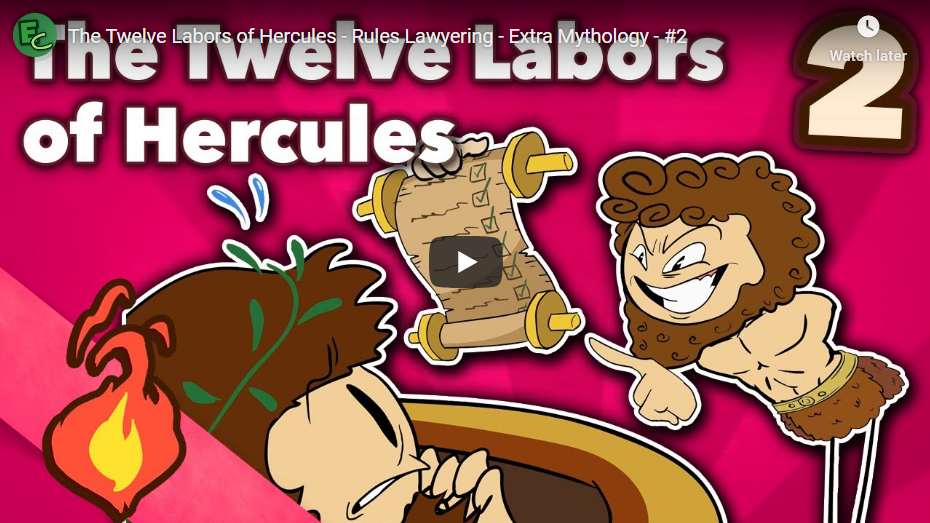
The Twelve Labors of Hercules – Rules Lawyering – Extra Mythology – #2

Filed under: Europe, Greece, History, Humour — Tags: — Nicholas @ 04:00

Extra Credits
Published 2 Dec 2019

Hercules (or Herakles in the Greek) needs to finish the last five tasks on the list before he will have properly atoned for murdering his family, but it isn’t going to be so easy. The king, seeing that Hercules has completed the tasks declares that two of them are invalid since Hercules got outside help. And I guess that’s technically cheating? More sidequests abound and we meet a familiar face from an older Extra Mythology!

The flesh-eating horses might be the worst monsters we’ve had on Extra Mythology. Something about those eyes. D:

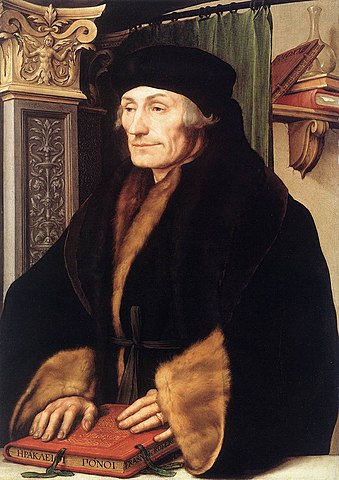
Desiderius Erasmus of Rotterdam

Filed under: Books, History, Religion — Tags: , , , — Nicholas @ 03:00

David Warren on discovering Erasmus as a teenager:

Erasmus makes an adequate hero for the adolescent boy. He was mine, for a time, even more than his friend Thomas More, who was forced on our consciousness in the late ‘sixties by Robert Bolt’s play-cum-movie (A Man for All Seasons). We were all herded from the High School to the Cinema, and rolled home in our yellow schoolbus full of something — youthful idealism — that could then be applied to various dubious causes. There was this Penguin with the title, Utopia. Without reading it, even in this pop translation, we became wise in our conceit, which is to say, conceited little wiseacres. I don’t “look back in anger,” however. That was for the ‘fifties. I look back through a fog of marijuana smoke, from the Age of Hippies.

Portrait of Desiderius Erasmus of Rotterdam (1466-1536) with Renaissance Pilaster
Hans Holbein (1497-1543) via Wikimedia Commons.

Drugs saved us. Had it not been for them, we might have accomplished worse horrors. By the ‘seventies, when a new nadir was being established for Western Civ, another, visibly duller generation was coming along. Ours was the first to be perpetually schooled (I would not say “educated”). I left high school, home and Canada, in the year of grace 1969, now half a century ago; and when I returned to settle in the 1980s, I found my old schoolmates still in college. To be fair, at least some were homemakers by then, or garage mechanics. It was so long ago that this word, “homemakers,” could still be used without feminist “irony,” if you came from a small town.

But the Erasmus who had appealed to me, as teenager, was the author of the Colloquies, and the Praise of Folly (a keepsake from his friendship with More). I imagined him gentle, humorous, wise, yet full of righteous fire. Too, apparently, a bit of a whiner. I was dazzled by his production of the first printed edition of the Greek Testament, and did not yet realize that it was a slapdash performance, rushed to beat the version of Cardinal Ximenes, already set in type but not yet bound — a proof that there is nothing new under the sun.

Erasmus’ obsessive struggle against the reputation of Saint Jerome, whose central rôle in the history of our Vulgate he tried to deny, and whom he presumptuously corrected on innumerable points — himself straying in and out of heresy — ended in repeated embarrassments for him. But to my adolescent mind, he must always be the hero, beating furiously against the hidebound.

What Life Was Like for the Home Guard During WW2

Filed under: Britain, History, Military, WW2 — Tags: , , — Nicholas @ 02:00

Forces TV
Published 8 May 2014

Scrapbooks revealing what the Home Guard was really like during World War Two have been published online.

The collection of maps, photographs and secret documents were compiled by Lieutenant Colonel Sir Morgan Crofton.

Now they are available for all to see thanks to work by the New Forest Park Authority.

The scrapbooks can be viewed online here – http://www.newforestww2.org

QotD: French anti-Americanism

Filed under: Books, France, Quotations, USA — Tags: — Nicholas @ 01:00

The list of French anti-American writers is long: it is its own unique genre, one found nowhere else in such abundance. Already, in 1793, Talleyrand, in exile before he would become French foreign minister, wrote in Philadelphia that Americans possessed “neither conversation nor cuisine.” He also famously observed, “These Americans, they have 32 religions but only one dish, roast beef with potatoes.” The genealogy of contemporary anti-Americanism is traceable to the beginning of the nineteenth century, to a Catholic France arrayed against a Protestant America, and then to the twentieth century, when a socialist France confronted a capitalist America; always just beneath the surface is the idea of a civilized France set against a supposedly uncivilized America. French anti-American literature, which Jean-François Revel analyzed perceptively in Anti-Americanism, is faithful to an eternal code: our civilization versus their lack of culture; our spirituality versus their brutality. Beneath these changing ideological masks, we might perhaps discern a rivalry between two nations that claim to be “universalist.” Americans have seized the torch of human rights from France, or at least the claim to embody them.

Guy Sorman, “French Anti-Americanism, Rebooted”, City Journal, 2017-11-27.

December 3, 2019

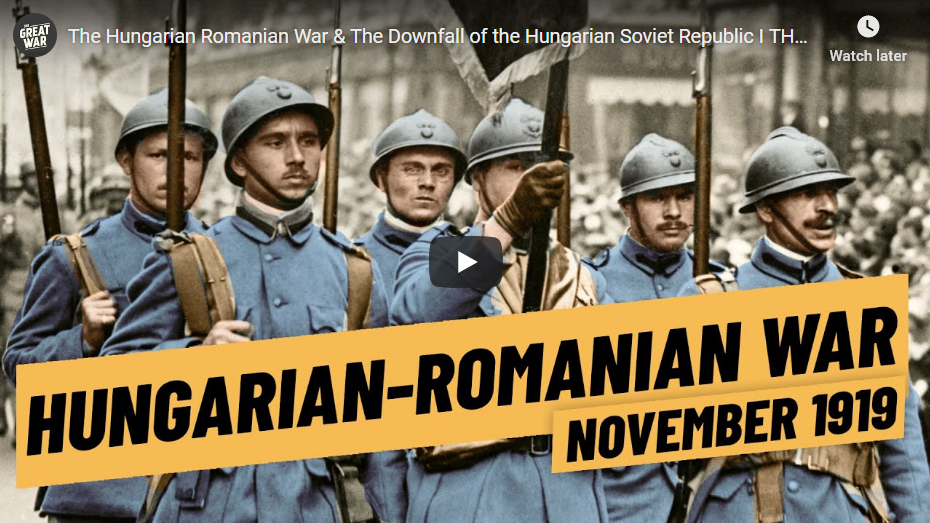
The Hungarian Romanian War & The Downfall of the Hungarian Soviet Republic I THE GREAT WAR 1919

Filed under: Europe, History, Military — Tags: , , , , — Nicholas @ 06:00

The Great War
Published 2 Dec 2019

SPONSOR: Get 20% off of your first order at Mack Wheldon. Go to https://mackwheldon.com and use promocode “greatwar” at checkout.

In early 1919 Hungary was one of the European territories that saw a communist revolution. Bela Kun and his supporters established the Hungarian Soviet Republic while the country was in great turmoil and fighting against the Romanians, the Czechoslovaks, the Serbs and within Hungary itself.

» SUPPORT THE CHANNEL
Patreon: https://www.patreon.com/thegreatwar
Merchandise: https://shop.spreadshirt.de/thegreatwar/

» SOURCES
Balogh, Eva S. “István Friedrich and the Hungarian Coup d’État of 1919: A Reevaluation” in Slavic Review, 1 June 1976, Vol.35(2): 269-286.

Borodziej, Wlodzimierz and Maciej Gorny. Der Vergessene Weltkrieg. Europas Osten 1912-1923. Band II – Nationen 1917-1923 (wbg Theiss, 2018).

Gosztony, Peter. “The Collapse of the Hungarian Red Army,” in Pastor, Peter, ed. Revolutions and Interventions in Hungary and its Neighbor States, 1918-1919 (New York: Columbia University Press, 1988): 69-80.

Hetes, Tibor. “The Northern Campaign of the Hungarian Red Army,” in Pastor, Peter, ed. Revolutions and Interventions in Hungary and its Neighbor States, 1918-1919 (New York: Columbia University Press, 1988): 55-60.

Horthy, Admiral Nicholas. Admiral Nicholas Horthy Memoirs. Simon Publications LLC, (2000).

Macmillan, Margaret. The Peacemakers: Six Months that Changed the World (London: John Murray, 2001).

Nouzille, Jean. “The July Campaign of the Hungarian Red Army as seen by France,” in Pastor, Peter, ed. Revolutions and Interventions in Hungary and its Neighbor States, 1918-1919 (New York: Columbia University Press, 1988): 81-88.

Révész, Tamás: “Post-war Turmoil and Violence (Hungary)”, in: 1914-1918-online. International Encyclopedia of the First World War, ed. by Ute Daniel, Peter Gatrell, Oliver Janz, Heather Jones, Jennifer Keene, Alan Kramer, and Bill Nasson, issued by Freie Universität Berlin, Berlin 2019-08-05.
https://encyclopedia.1914-1918-online…

Torrey, Glenn. “The Romanian Intervention in Hungary, 1919,” in Pastor, Peter, ed. Revolutions and Interventions in Hungary and its Neighbor States, 1918-1919 (New York: Columbia University Press, 1988): 301-320.

»CREDITS
Presented by: Jesse Alexander
Written by: Jesse Alexander
Director: Toni Steller & Florian Wittig
Director of Photography: Toni Steller
Sound: Toni Steller
Editing: Toni Steller
Mixing, Mastering & Sound Design: http://above-zero.com
Maps: Daniel Kogosov (https://www.patreon.com/Zalezsky)
Research by: Jesse Alexander
Fact checking: Florian Wittig

Channel Design: Alexander Clark
Original Logo: David van Stephold

A Mediakraft Networks Original Channel

Contains licensed material by getty images
All rights reserved – Real Time History GmbH 2019

Canada and China

Filed under: Cancon, China, Economics, Politics — Tags: , , , , — Nicholas @ 05:00

Ted Campbell discusses Canadian foreign policies — or perhaps more accurately Canada’s lack of policies — on China:

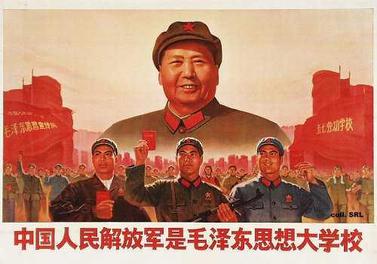
“The Chinese People’s Liberation Army is the great school of Mao Zedong Thought”, 1969.
A poster from the Cultural Revolution, featuring an image of Chairman Mao, published by the government of the People’s Republic of China.
Image via Wikimedia Commons.

There were many things that history might find regrettable about the Mulroney years but I doubt that it will fault him for having a principled and coherent foreign policy.

That all changed with Jean Chrétien, who was almost a neo-mercantilist, and for whom principle could never stand in the way of profit.

In the modern (Chrétien-Martin-Harper-Trudeau) era, Conservatives have been, broadly, anti-China, sometimes for reasons that are less than coherent or principled, and Liberals have been too prepared to “go along to get along” with China. This is because both parties reflect the incoherent views of the whole country. But political leaders shouldn’t (mustn’t) just reflect the views of their voters ~ that sort of populism is nonsensical ~ they must, as Edmund Burke said, bring his or her “unbiased opinion … mature judgment … [and] … enlightened conscience” to bear on each issue. But I’m afraid that too many (most?) modern Canadian political tacticians hold all those things in scant regard.

In the 2020s Canadians must listen to a few clear voices who will tell them that China is a competitor in many “markets” including in the marketplace of ideas, ideals, institutions and values. The current Chinese leadership is overtly hostile to Weterm liberal-democratic values and is not unwilling to punish any country with which it disagrees. It is protectionist, relatively rich and growing in military, political and economic power, but, still, somewhat cautious, and Xi Jinping’s China seems to be able to separate its own short-term political interests from its firm, long term, strategic goals. China, as Kevin Rudd reminded us just a few days agois contemptuous of weakness and prevarication,” which explains why it is so obviously contemptuous of Justin Trudeau’s Canadian government.

It is a fact that the Sino-Canadian relationship is “unbalanced:” China is a great power, Canada is not; China is an autocracy, Canada is a democracy; and so on but, as Kevin Rudd said (link just above) “China too has net strengths and weaknesses of which … [our] … strategists should be aware in framing our own strategy … [and we] … should be equally aware of our own strengths, weaknesses and vulnerabilities.” Canadian strategists need to educate Canadians about China so that a solid, informed majority will want a coherent and principled policy ~ one that puts our national vital interests first […]

Our policy towards China needs to be just one part of a coherent, principled foreign policy which Canadians understand and, broadly, support, and that, in turn, needs to be part of a Canadian grand strategy that aims to secure a place, as Paul Martin suggested, “of pride and influence in the world” ~ that, of course, was a place we enjoyed under St Laurent, Diefenbaker and Pearson, all of whom were acutely aware of the many and varied (and very divergent) views about Canada in the world that existed then and persist today in Canada’s many and varied communities.

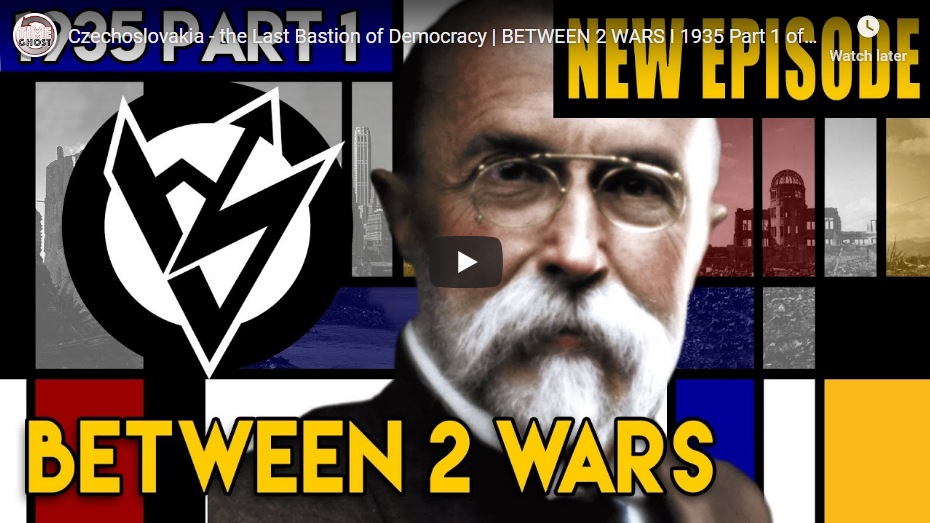
Czechoslovakia – the Last Bastion of Democracy | BETWEEN 2 WARS I 1935 Part 1 of 4

Filed under: Europe, Germany, History — Tags: , , , , , , — Nicholas @ 04:00

TimeGhost History
Published 2 Dec 2019

Czechoslovakia is holding on to democracy by a thread. It even looks like they might be able to integrate the German Czechoslovakians, but Hitler’s rise to power changes everything.

Join us on Patreon: https://www.patreon.com/TimeGhostHistory

Hosted by: Indy Neidell
Written by: Francis van Berkel
Directed by: Spartacus Olsson and Astrid Deinhard
Executive Producers: Bodo Rittenauer, Astrid Deinhard, Indy Neidell, Spartacus Olsson
Creative Producer: Joram Appel
Post-Production Director: Wieke Kapteijns
Research by: Francis van Berkel and Rune Væver Hartvig
Edited by: Daniel Weiss and Wieke Kapteijns
Sound design: Marek Kamiński

A TimeGhost chronological documentary produced by OnLion Entertainment GmbH.

From the comments:

TimeGhost History
2 days ago
The year is 1935 CE. Central Europe is entirely dominated by Authoritarians and Fascists. Well not entirely! One small country of indomitable Czechs and Slovaks still holds out for democracy. And life is not easy for the German Nazis who garrison the towns and villages in Bohemia and Moravia…

One thing in this episode might go unnoticed. It is how important it is to note that the term Sudeten German has only become widespread after WWI. It shows us how the delicate balance of ethnic groups had been upset after the Great War.

Before 1918, these same people felt comfortable called themselves Bohemian or Moravian. On the other side of the border that now divides Czechoslovakia from Germany, Austria, Poland and Hungary Czech and Slovak speakers felt comfortable calling themselves for instance Carpathian, Silesian, or Bavarian. In only 17 years this regional sense of unity has now been eradicated. It’s really easy to fall into the trap of the identity rhetoric of the time. To say that “Well, what did you expect? You forced people to be part of a country that wasn’t theirs” it’s an easy explanation for all of this conflict.

Well as we have often pointed out it wasn’t that simple. Fanned by identity politics on all sides, the borders have become fevering soars that are spreading infection into all of Europe. It is a disease that now threatens to develop into sepsis for the whole European continent. And think of this; borders are nothing but lines on maps, things invented arbitrarily in people’s minds… isn’t it remarkable how we as a species can invent our own demise?

“Useful idiots” during the Cold War

Robert Reilly reviews Judgement in Moscow: Soviet Crimes and Western Complicity by Vladimir Bukovsky, which has recently been republished in English:

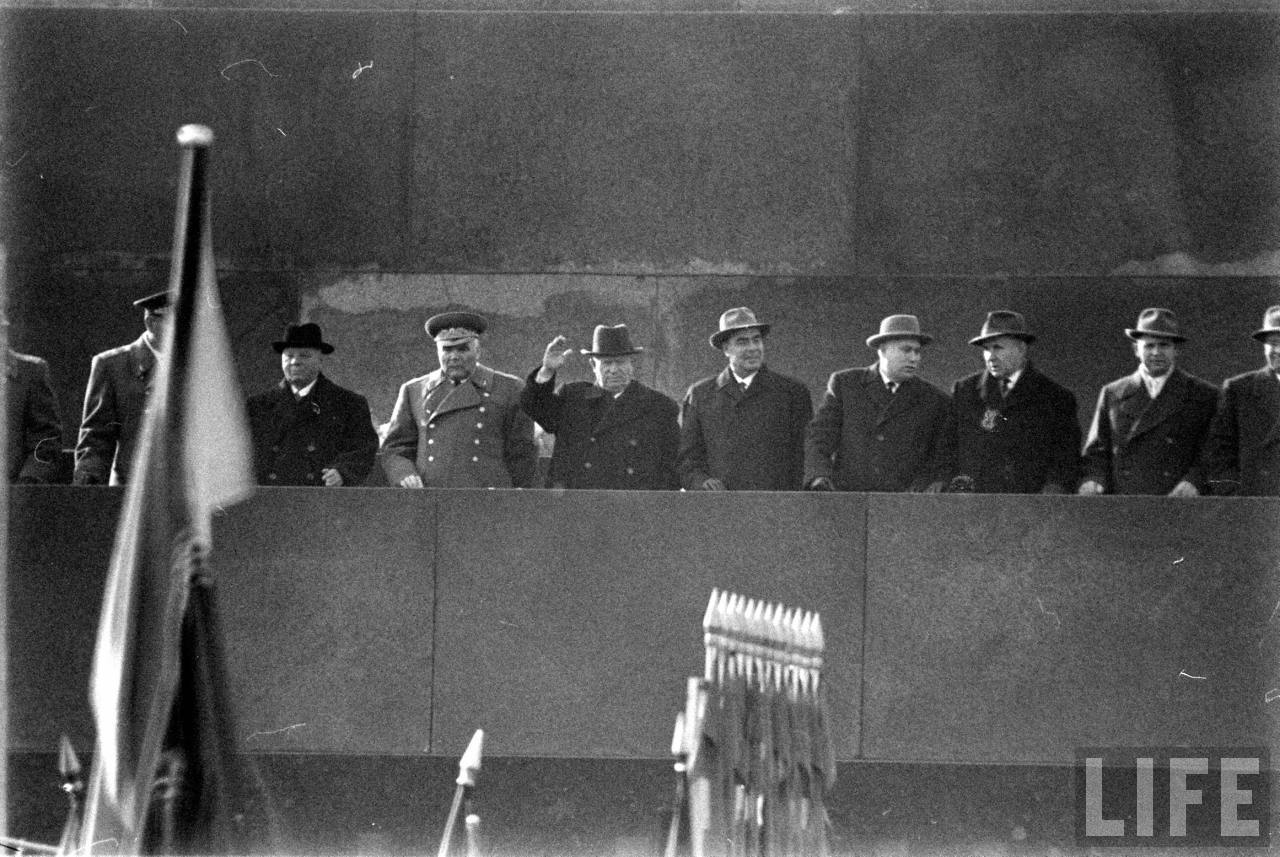
Krushchev, Brezhnev and other Soviet leaders review the Revolution parade in Red Square, 1962.
LIFE magazine photo by Stan Wayman.

Judgment In Moscow contains autobiographical elements but is principally concerned with providing and analyzing documentary evidence for what should have been the USSR equivalent of what the Nuremberg Trials had been for Nazi Germany. In 1991, Bukovsky returned to the Soviet Union to take part in the “trial of the communist party” that was held in 1992. In an audacious move the Communist Party had sued then-President Boris Yeltsin to get its property back. To prepare a defense, Yeltsin ordered that the secret Central Committee archives be opened to Bukovsky. The order was obeyed, but only partially and for a short time. The trial fizzled, but Bukovsky, with the aid of a hand-held scanner, was able to gather many thousands of pages of top-secret Central Committee and Politburo documents and get them out of Russia. Some of these key documents are what we have in this priceless book. They are eye-opening.

During the Cold War, we had to speculate as to why, for instance, the Soviet Union invaded Afghanistan and how the decision was made. Now we know for certain. Bukovsky provides the minutes of the Politburo meetings in which the invasion was decided. The Reagan administration was highly skeptical of détente and was therefore criticized for war-mongering. The skepticism was well-placed because, as the documents reveal, détente was simply a façade for advancing Soviet power and manipulating Western publics and governments against the Reagan plan to place Pershing IIs and cruise missiles in Europe to defend it against burgeoning Soviet power, including the SS-20s.

The revelations of the extent to which the Soviet Union manipulated the “peace” movement in the West should be an embarrassment to its participants, who may have been too naïve at the time to know how they were being used. Others, of course, acceded to being used, or even cravenly sought to be used. The names of some of these useful idiots are in the documents.

Another thing these documents disclose, much to the embarrassment of many American Sovietologists, is that there were no “hawks” and “doves” in the Kremlin — a premise on which they had banked their academic careers. The unanimity of the Politburo decisions reveals that the senior Soviet leaders were all of one stripe. It was to their advantage to create the impression that there were hawks and doves so that they could game the policies of Western governments and the opinions of its publics. For instance, providing Western credits to the USSR — it was thought by many so-called Russian experts in the West — would strengthen the doves in the Kremlin, whereas denying credits would empower the hawks. By buying this line of thought, the West was induced to keep the Soviet Union on life-support for more than a decade past what would have been its earlier collapse, according to Bukovsky.

No one was a greater master of this deception than Mikael Gorbachev. The minutes from many Politburo meetings chaired by Gorbachev show that glasnost and perestroika were façades constructed to ensure the continued existence of the Soviet Union through even more Western subsidies. And it worked to the extent that credits and subsidies ballooned under the Western illusion that Gorbachev had to be supported to ensure his success — ignorant of the fact that Gorbachev conceived of success in ways inimical to Western freedom.

H/T to Blazing Cat Fur for the link.

Turkish Conehammer “Broomhandle” C96 Mauser

Filed under: Europe, Germany, History, Military, Weapons — Tags: , , , — Nicholas @ 02:00

Forgotten Weapons
Published 13 Oct 2019

This is Lot 2493 in the upcoming October Morphy Extraordinary auction.

The “cone hammer” was the first commercial version of the Mauser C96, so named for the stepped conical sides of its hammer. The C96 did not sell particularly well in the first few years after its introduction, and the only major bulk sale was to Sultan Abdul Hamid II of the Ottoman Empire, who bought 1,000 of the guns for his palace guard. These guns were numbered in Farsi in their own range from 1 to 1000, and were all sold with matching shoulder stocks. The order was signed in December of 1897 and the guns were shipped a few months later, in May of 1898.

Under the Sultan’s rule, there was significant concern over potential military coups, and most arms were locked away in armories, including many of the C96 pistols. After the revolution in 1908/9, guns were more liberally distributed to the military and police, and these C96 pistols were issued out to both groups for service use. Some were used in combat in World War One, and after the war they were considered surplus, available for purchase inexpensively by Army or police officers. This meant that they saw a lot of use, and as a result few survive today, with many of them in rather rough condition.

http://www.patreon.com/ForgottenWeapons

Cool Forgotten Weapons merch! http://shop.bbtv.com/collections/forg…

Contact:
Forgotten Weapons
6281 N. Oracle #36270
Tucson, AZ 85704
« Newer PostsOlder Posts »

Powered by WordPress