
I don’t even have time to read a magisterial five-volume history of the Hundred Years War, let alone write one. But a little while ago I was in Albi and got more interested in the bloody and tragic history of that place, and learned that [Jonathan] Sumption had written a book about it that might or might not be magisterial, but had the distinct advantage of not being five volumes long. I read it, and I’m glad I did, because this short history of one of the nastiest little wars in the entire Middle Ages has many weird and unexpected echoes with our own era, not to mention a lot to tell about the creation of the modern nation-state.
An Albigensian is an inhabitant of Albi, in the South of France. Before we get to that, though, we need to talk about the Cathars. An important rule of thumb in the history of Christianity is that heresies generally originate in the East and gradually spread to the West. I think this is mostly because, at least for the first thousand years or so, the vast majority of the population, GDP, and theological disputation was happening in the East. If you have theological ferment, you will have heresies, as assuredly as modifying software produces bugs and copying a cell’s DNA produces cancer. There were just a lot more people arguing about the nature of God in the East for a long time, and so given a constant error rate we should expect that most of the bad ideas come from there as well as most of the good ones. Now, why it is that this rule of thumb still holds true, despite the bulk of population and GDP moving to the West, is a very interesting question. Perhaps the legalistic Latin mind is just not as given to flights of fancy.
Whatever the case, the East was doing its usual thing and spitting out heresies, and two in particular are important to our story here. The first is dualism, which is a very old solution to the Problem of Evil, and which states that the forces of good and the forces of evil are evenly matched in some ontological sense. Many religions (for instance Zoroastrianism) are officially dualist. Christian dualism, on the other hand, has always been severely frowned upon if not outright condemned. Yet it’s also always been there, almost from the very start. I theorize that the dualist temptation arises again and again in Christianity because it “humanizes” an otherwise quite otherworldly faith, making it more like the stories and situations that human beings hear and encounter elsewhere.1
The second heresy is gnosticism, the belief that the physical world we all experience is an illusion, or a deception, or at least very much worse than the world of pure spirit. Once again, this is an important official element of religions like Buddhism, and once again it’s a tendency that Christianity has had to battle from the very start, probably because of some common, cross-cultural psychological quirk about human beings. Many modern Christians don’t actually realize that gnosticism is, technically speaking, totally heretical, because much modern Christianity is quite gnostic-inflected. But in the early days, and still today in some more traditionalist corners, Christianity is an earthy religion of bodies and physical substances and matter that is capable of being sanctified. For much more on all of this, read our review of Origen’s Revenge.
Anyway, relatively early in the history of Christianity, these two great ur-heresies flowed into one, like Godzilla and Mothra becoming a single monster that both flies and is radioactive. According to this grand synthesis, the false, illusory world of our physical reality is the domain of the forces of evil. The “god” of this world, often called the demiurge, is a diabolical figure, an anti-god that has trapped us all in prisons of flesh and blood. The real God is somewhere above and outside this reality, and our mission is to use secret knowledge, gnosis, to transcend to the spirit world. The guy who codified and turbo-charged this combined doctrine was a rich shipowner named Marcion (from the East, naturally), so you may sometimes see this heresy referred to as “Marcionism”.
If the physical world is the creation of an evil demiurge, then all physicality and physical matter must be irredeemably corrupt. In fact a much later Marcionist theologian actually used this as an argument for his views: “God is perfect; nothing in the world is perfect; therefore nothing in the world was made by God”. Consequently, the Marcionists practiced unbelievably extreme forms of asceticism to try to disconnect themselves from this corrupted world. They meditated and wore rags and occasionally starved themselves to death. Needless to say, having children was severely frowned upon, because it meant trapping new souls in the prison of reality. Critics of Marcionism accused them of endorsing sodomy as an alternative to normal sexual intercourse. The Marcionists also rejected the entire Old Testament on the grounds that the God of the Old Testament was actually the Devil, because only an evil being would do something as terrible as create the world.
The Marcionists were persecuted by the Roman authorities just as much as the Christians were, and this kept their numbers under control until by chance they spread to an empire with different laws. A wild-man from Persia named Mani, claimed by his followers to be a prophet and a magician, became deeply influenced by Marcion, traveled to India, returned to Persia, and created his own spin on Marcionism that incorporated elements of Buddhism and of his native Zoroastrianism. This combined religion became known as “Manicheanism,” and his followers refused to work normal jobs, serve in the military, or marry. Mani was promptly killed, but his teachings jumped back into the Eastern Roman Empire, and started spreading like a wildfire.
In the 8th century, Manicheanism (via a quick detour through a dualist Armenian group called the Paulicians) jumped the firebreak separating Asia from Europe and took off amongst the Bulgarian Slavs. Here, their champion was a priest named Bogomil, and his followers became the “Bogomils“. The English slang-term “buggery” is actually derived from the word “Bulgaria,” because of the old knock against the Marcionists. Did Bogomil in fact endorse buggery? It’s a little hard to say, but the “radical” Bogomils really got quite wild.2 The most extreme of them preached that performing disgusting or blasphemous acts was actually good, because it was a way of debasing and disrespecting our corrupted physical reality. It was also in Bulgaria that the word “Cathari” meaning “the purified ones” began to appear as an alternative name for this church.3
John Psmith, “REVIEW: The Albigensian Crusade, by Jonathan Sumption”, Mr. and Mrs. Psmith’s Bookshelf, 2024-09-02.
- You can also see it as injecting some excitement and drama and narrative stakes into the religion. A critic of Christianity might call it boring because the forces of evil are always and everywhere ultimately powerless. I don’t agree with this characterization, because the drama is taking place on a different level, namely the struggle towards sanctification that every living being engages in. But that might be too abstract for some. A much more immediate kind of drama is angels and demons duking it out on roughly equal terms, which is why you see this in all kinds of popular media, movie, video games, etc. Again, this is not an anomaly, it’s been present in Christian folk culture forever.
- Thought not as wild as some even later Slavic adherents of Dualism/Gnosticism. The 18th century sect of the skoptsy interpreted the anti-physical, anti-reproduction message of Marcion as requiring castration for all true believers. Warning: the Wikipedia page has graphic pictures.
- Anything you read about the Dualists, Gnostics, Marcionists, Manicheans, Paulicians, Bogomils, and Cathars is made considerably more confusing by the fact that tons of authors use these terms completely interchangeably (including ancient authors, and including the Dualists/Gnostics/Marcionists/Manicheans/Paulicians/Bogomils/Cathars themselves). It’s not even entirely wrong to do so, because there really is a continuous tradition here that all these groups are manifestations of.
June 2, 2026
QotD: Christian heresies
May 15, 2025
QotD: The Donatist heresy
But like all things theological in the Christian Centuries, Donatism had important socio-political implications. Again, I’m about the furthest thing from a medievalist, but as I understand it, Jan Hus — a proto-Luther if anyone was — advanced a kind of Donatist argument against the Holy Roman Emperor (and / or the King of Bohemia, I forget which, or even if they were separate guys at that point). He was also, IIRC, echoing the English heretic John Wyclif, whose arguments had a similar political import in a similarly anarchic time. They held (again IIRC, which I might not) that since kings derive their authority from God, any king that is obviously on the outs with the Lord has lost his right to rule. A heretic or schismatic king, in other words, is no king at all.
You could call this a Christian version of the old Chinese idea of “The Mandate of Heaven”, and if you want to do that I’m not going to argue with you, but it’s considerably easier to identify a heretic. A Christian king’s most basic responsibility is to his own spiritual health; closely followed by his obligation to his realm’s spiritual health. It’s pretty easy to tell when a king’s not doing that.
Severian, “The New Donatism?”, Founding Questions, 2021-11-20.
July 22, 2024
“Dissident Christianity”
While I don’t have a god in this fight, I find much to agree with Fortissax here as he responds to another writer’s commentary on modern western Christianity in an essay he titles “Spiteful Mutant Christians“:

Dijon viewed from Saint-Bénigne Cathedral with the Palace of the States of Burgundy, the Notre-Dame and Saint-Michel churches, the Saint-Nicolas tower, the former Saint-Bénigne abbey palace (ENSA), The Lafayette galleries, the old department stores at Le Pauvre Diable and la Ménagère.
Photo by Twibo2 via Wikimedia Commons (caption translated by Google Translate).
Admittedly, I’m not a fan of the majority of Christians on the right, particularly traditionalists on Substack. Before I open a salvo on them, I will say many of them are educated, well-written, and well-spoken. Many of them are respectable, as far as I know, often fathers of many children, who aspire to virtue. This is certainly better than a great many. Many of them have been in this business far longer than I have. Many of them are intelligent and offhand I enjoy many of their general insights. Overall, I wish them no ill will.
However, I’m inclined to believe they’re mostly out-of-touch, often Generation X or elder Millennials who caught the last chopper out of Vietnam and fundamentally don’t understand the socioeconomic or cultural reality of younger Millennials or Generation Z. Who are colourblind by their narrow fraternal environment of American ruralite post-postmodern Christians who seldom interact with people outside of their pseudo-collapsitarian communities. I say “pseudo” because they’re not crazed Libertarian doomsday preppers building bunkers with a hand shovel in the backwoods of Montana, but I’ve observed that the Christian Traditionalist tendency is “Quietism”. From what I understand about Quietism, this is the Christian tendency to be pacifistic, avoid all confrontation, completely abandon North American cities, urban or civil life, and retreat to what is a romanticist fantasy of pastoral agrarian landscape of isolated God-fearing communities, have a pint, and wait for this to all blow over. They’re convinced of the moral, ethical and philosophical superiority of their rural life, an desperately wait for the day they can starve the city boys out.
On that note, the worst and most obnoxious of them are former city slickers or suburbanites who move to the countryside, but that’s an entirely different argument, and I’m getting sidetracked. Perhaps my biggest criticism of the Christians is that they are extremely presumptuous people in “this thing we call” the Dissident Right.
They piggyback off the remnant adherence and nominal identification to Christianity among the irreligious populace who, if they attend church at all, attend churches that are completely captured by the deistic DEI God of Equity. They pretend their super-ultra esoteric Pageau Hermetic Catholicism, Christ-is-King MAGA communist groyper Christian “nationalism”, or “based warrior priest” Eastern European war footage Orthodoxy is the norm. They pretend that the bumbling Christian faithful know or understand half of what they discuss on Telegram, X, or Substack, and this gives them a false sense of security and inevitability. They speak with a false confidence that, to outsiders, would appear that they’re truly in the know, that everyone is in fact Christian, and it’s only a matter of time before everyone else is. This is completely out of touch with reality. If you look at who is Christian and who isn’t, you start to see the brutal picture. For simplicity’s sake, we will focus on North America and Western Europe, with the dividing line being the old NATO boundaries. Let’s break down the facts:
In 2024, the following percentages of national populations identified as Christian
- Portugal: 84.8%
- Italy: 83.8%
- Denmark: 79%
- Norway: 76.7%
- United States: 65% (Pew Research Center)
- Belgium: 65%
- Canada: 53% (Pew Research Center)
- Spain: 67%
- Switzerland: 58.2%
- United Kingdom: 59%
- Germany: 57%
- Netherlands: 43%
- France: 63% (Pew Research Center)
On its face, you’d be inclined to believe that the majority of the Western world is Christian: God-fearing, church-going, has read and understands the Bible, and partakes in a community, correct? Wrong. The overwhelming majority of people who identify as Christian don’t go to church, and this is explained by baptisms at birth or early life inductions that never lead to anything. The real percentage of practising Christians is as follows, with Portugal hilariously being not even a quarter of what it claims, despite having the highest rate of identification.
In 2024, the following percentages of national populations regularly attending church.
- Portugal: 19% (Catholic News Agency)
- Austria: 14% (Catholic News Agency)
- Spain: 13.4% (Wikipedia)
- Italy: 20% (Catholic News Agency)
- Germany: 9% (Catholic News Agency)
- Netherlands: 7% (Catholic News Agency)
- Switzerland: 5% (Wikipedia) (BFS Administrations Website)
- France: 5% (Catholic News Agency)
- Belgium: 5% (Catholic News Agency)
- United Kingdom: 5% (Catholic News Agency)
- Canada: 5% (CareyNieuwhof.com)
- United States: 24% (weekly attendance) (ChurchTrac) (PRRI)
- Norway: 3% (Catholic News Agency)
- Sweden: 3% (Catholic News Agency)
- Denmark: 3% (Catholic News Agency)
I was technically baptized Catholic, specifically because it was believed that I’d have greater access to educational opportunities, and not out of any genuine piety. I was given a choice at 3 years old to go to my first communion or watch Power Rangers. I’ve never read the Bible, save for two versions of half the book of Romans before putting it down, incredibly unimpressed with Paul failing to sell me on Christianity. My family has been irreligious for four generations. My province of origin, Quebec, is the most secular part of North America, and I’m proud of it. I don’t believe we can sever the influence of Christianity completely, and I don’t think we should. It is an integral part of our heritage, and we need to respect it. You can’t claim to honour your ancestors, or even western history without honouring Christianity. I do however believe that secularism gave the West an opportunity for a clean enough slate to find the definitive, ongoing unraveling of Truth. I chose hero worship. No honest person would say this makes them a Christian.
The purpose of bringing up these statistics is to perform a reality check. Christians are not the majority. Not in the general population, and not in the Dissident Right. Christians do not have a monopoly on morality. Christians do not have a monopoly on Truth. Christians completely lack the social capital and popular consensus to instigate the social policies they want in accordance with their faith on a civilizational scale. I believe that part of the issue is that the discourse is civilization-wide, but most of the Christianity is coming from North America, specifically the United States of America, where it represents a small and dwindling political faction of a broader conservative movement. There is not going to be a Fifth Great Awakening — their latest awakening as Greene himself would admit, is Wokism. A deistic Christian heresy. The public is not going to kneel, convert to disparate, squabbling denominations of Christianity marching in lockstep with Regimevangelicalism.
Blue Checkmark Christianity™ has recently signaled a green light to the millions of Global South Catholic faithful that it’s okay to illegally migrate to and trespass in Europe. The Hierophant has ordered His faithful to abide.
The fact of the matter is that Dissident Christians are a minority of a minority — they’re the equivalent of Sikhs in India. One percent of the population, and yet one loud, obnoxious voice giving all the impression they’re a bigger majority than they are. Christians like Misanthrope are as barely relevant as the degenerate neopagans and their profligate made up religions with zero legitimacy or antiquity. Hiding their views from their pastors, priests and the rest who attend their churches. It is an absolute LARP to speak with the audacity and arrogance that they do to the great secular majority, and or other groups who are attempting to cultivate faith with sincerity. You’d think if their truth was so self-evident, they’d be winning a whole lot more people, and the West would be Christian, but no. They’re going out the same way Zoroastrianism did, and after that, Hellenism, the state religion of the Roman Empire. Weak men, wicked priests, irreligiosity, bureaucratization of the liturgy, heretical reinterpretation of the word. I could go on.
February 25, 2022
QotD: The lure of the forbidden knowledge
Forbidden ideas have an appeal that orthodoxy never does — just ask Martin Luther. In fact, the parallels between the rise of the alt-right and the Reformation are interesting. In Luther’s world the printing press had recently created new and difficult to control ways for people to share subversive ideas. Early forms of capitalism led to the rise of new social classes and fueled resentment against traditional elites and traditional forms of authority. There were even early forms of the meme. Long before Pepe the Frog was co-opted by the alt-right, drawing donkey ears on images of priests was a way of provoking the powerful.
It’s surely the case that some of the speech that activists and university administrators seek to suppress poses a much more direct threat to real people than does a debate about supply side economics or evolution, but it’s worth remembering that to the Church, the Lutheran heresy was a real threat too. It posed a mortal danger to the eternal souls of people who were deceived by its falsehoods and rejected orthodoxy. I doubt that the Inquisitors felt any more qualms about deplatforming Lutheran heretics than did the activists at Middlebury.
As the Church learned, simply suppressing heresy cannot guarantee that it will go away. If anything, meeting heretical speech with violence or disruption just adds to its allure, confirming in the minds of the already convinced that they are right and leading the fence sitters to take another, perhaps more sympathetic, look. Dismissing heretical speech because it falls into a category that is rejected by the orthodox is not that much more effective a strategy.
We can do a lot to keep things from getting to the sort of highly contentious encounters like the ones at Middlebury and Berkeley, just by addressing uncomfortable issues with evidence rather than just categorization in our courses. Next time you are tempted to sidestep contentious issues in your class or to dismiss a student’s question because it falls into a forbidden category, don’t.
In the long run we can’t win an argument by avoiding it.
Erik Gilbert, “Liberal Orthodoxy and the New Heresy”, Quillette, 2019-02-04.
January 26, 2022
Three generations of the OG Puritans
At Founding Questions, Severian considers the New England Puritans and the world they inhabited:
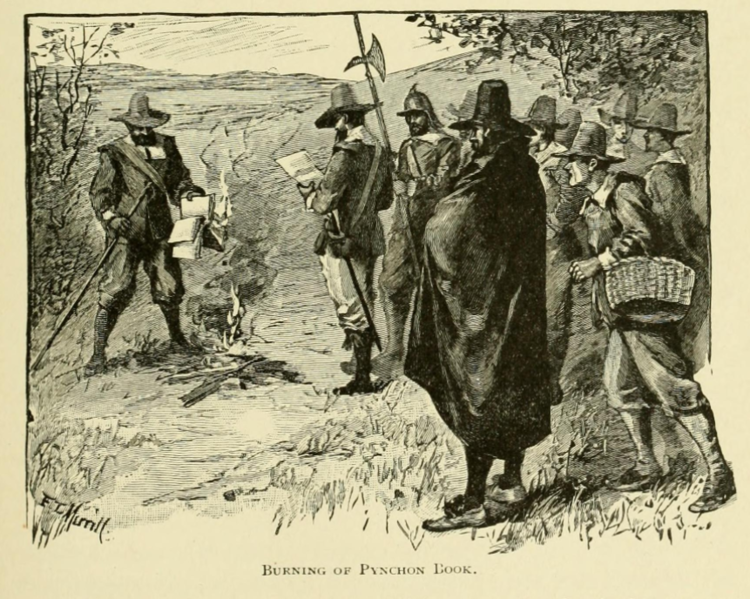
Portrayal of the burning of copies of William Pynchon’s book The Meritous Price of Our Redemption by early colonists of the Massachusetts Bay Colony, who saw his book as heresy; it was the first-ever banned book in the New World and only 4 original copies are known to survive today.
Engraving by F.T. Merrill in The History of Springfield for the Young by Charles Barrows, 1921.
Total cultural and intellectual uniformity, constantly reinforced. If those Puritans were going to go crazy, in other words, they’d do it within very carefully circumscribed boundaries. The only thing close to that level of mental control is Twitter … and I suppose I must put the disclaimer out front, so that you can factor it in if you disagree with me: I hate the Puritans. They’re just SJWs with balls and a slightly less tedious prose style. When they’re not obsessing over the tiniest motions of their pwecious widdle selves, they’re screwing you over for the hellbound heathen you are.
Credit where it’s due, though: If you need to go sodbusting in an unexplored continent, the Puritans are your guys. The original Plymouth Bay colony was thoroughly militarized, and they didn’t fuck around — when the local Indian tribes were beginning to wonder if they shouldn’t do something about these White devils they’d let loose, the Puritans attacked the fiercest tribe and wiped them out, as a show of force. Life was hard in the OG Plymouth Colony, but it was about as good as you were going to get in that era.
But the typical inheritance pattern soon took over. “Regression to the mean” is a behavioral phenomenon, too, not just an IQ one. Puritanism is an obsessive, paranoid creed; it can only flourish in times of high stress and dire insecurity. But by the 1690s, Plymouth Colony was arguably the healthiest, wealthiest, safest place per capita in Christendom (not a high bar, obviously, but still). The OG settlers were all gone by that time, of course — the original settlement, you’ll recall, was 1620 — and so were most of their almost as hardcore kids. The third generation was coming up fast …
… but finding their way blocked by the old men of the previous generation, who were as tediously, dogmatically Puritan as the OGs, but without the stones. This made them — the 2nd generation — enormous hypocrites, but even without the hypocrisy, imagine living in a world where the ultra-wealthy who control everything in society tell you that they deserve it all, because they’re God’s Elect, while you, sinner, deserve to live in a rented box and eat bugs and own nothing, because God hates you.
History’s full of weird stuff like that, and that was the situation circa 1690. One example will have to do: Since we probably all got to experience Nathaniel Hawthorne’s existential angst back in high school, consider that the ancestor who caused him so much grief, Judge John Hathorne, was born in 1641. He would’ve been 51, then, during his trial service – a ripe old age by 17th century standards.
Not only that, but the 2nd generation — the one that stubbornly refused to move on and let the kids take their place in the sun — had spent the previous twenty years grievously fucking things up. King Philip’s War nearly ruined the colony, there’d been widespread plague, and oh yeah, that whole Restoration thing back in England — the hardest of hardcore Puritan thinkers in the run-up to the Civil War had been colonials; guys like Col. Rainsborough were closely associated with Massachusetts, etc. Lots of bad blood on the other side of the water, and while the third generation was willing to let bygones by bygones, the 2nd generation wasn’t.
So: Hypocritical old throwbacks and cavemen, with a decades-long track record of dumbfuckery, who just wouldn’t get out of the way. As they got older, they got more insular and inward-looking, as old people tend to do … and “more inward looking” for a Puritan is a near-BCG level of narcissism. Meanwhile, the new generation is eager to take their place in the burgeoning Atlantic world, especially after the Glorious Revolution (1688) … but can’t.
July 16, 2020
The Witchfinder General Defends the Great State of Massachusetts
Atun-Shei Films
Published 14 Jul 2020The greate Common-Wealth of Massachusetts is oft unjustly slandered. The Ignorant shall saye that the inhabitants of this fair colonie drive Carriages like mad-men; that they are too much enamored with Crimson Stockings and Those Who Love Their Countrie; and that they are as sullen and cruel as a New-England winter. The Witchfinder General dis-proves this Slander, and denounces it for the Profession of Heresy that it is.
Support Atun-Shei Films on Patreon ► https://www.patreon.com/atunsheifilms
Leave a Tip via Paypal ► https://www.paypal.me/atunsheifilms (Between now and October, all donations made here will go toward the production of The Sudbury Devil, our historical feature film)
Original Music by Dillon DeRosa ► http://dillonderosa.com/
#Puritan #Witch #Boston
Watch our film ALIEN, BABY! free with Prime ► http://a.co/d/3QjqOWv
Reddit ► https://www.reddit.com/r/atunsheifilms
Twitter ► https://twitter.com/atun_shei
Instagram ► https://www.instagram.com/atunsheifilms
Merch ► https://atun-sheifilms.bandcamp.com
From the comments:
Atun-Shei Films
1 day ago
The awesome baroque song at the end of this video is the brand-new Witchfinder General theme composed by the insanely talented Dillon DeRosa, who’s currently hard at work putting together a new theme for Checkmate Lincolnites and a bunch of other incidental music for this channel. His music was also one of the best parts of my movie ALIEN, BABY! and he’s done a bunch of other film scores as well. Check out his website, and never forget that thou art a wretched sinner, utterly unworthy of God’s love: http://dillonderosa.com/
December 4, 2019
Desiderius Erasmus of Rotterdam
David Warren on discovering Erasmus as a teenager:
Erasmus makes an adequate hero for the adolescent boy. He was mine, for a time, even more than his friend Thomas More, who was forced on our consciousness in the late ‘sixties by Robert Bolt’s play-cum-movie (A Man for All Seasons). We were all herded from the High School to the Cinema, and rolled home in our yellow schoolbus full of something — youthful idealism — that could then be applied to various dubious causes. There was this Penguin with the title, Utopia. Without reading it, even in this pop translation, we became wise in our conceit, which is to say, conceited little wiseacres. I don’t “look back in anger,” however. That was for the ‘fifties. I look back through a fog of marijuana smoke, from the Age of Hippies.
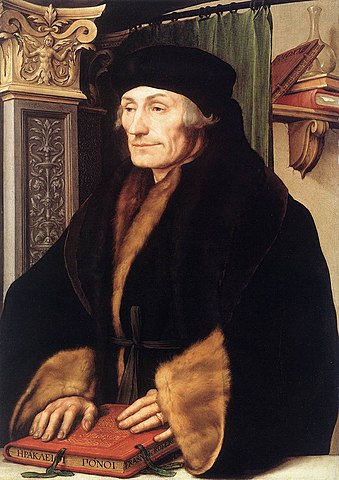
Portrait of Desiderius Erasmus of Rotterdam (1466-1536) with Renaissance Pilaster
Hans Holbein (1497-1543) via Wikimedia Commons.Drugs saved us. Had it not been for them, we might have accomplished worse horrors. By the ‘seventies, when a new nadir was being established for Western Civ, another, visibly duller generation was coming along. Ours was the first to be perpetually schooled (I would not say “educated”). I left high school, home and Canada, in the year of grace 1969, now half a century ago; and when I returned to settle in the 1980s, I found my old schoolmates still in college. To be fair, at least some were homemakers by then, or garage mechanics. It was so long ago that this word, “homemakers,” could still be used without feminist “irony,” if you came from a small town.
But the Erasmus who had appealed to me, as teenager, was the author of the Colloquies, and the Praise of Folly (a keepsake from his friendship with More). I imagined him gentle, humorous, wise, yet full of righteous fire. Too, apparently, a bit of a whiner. I was dazzled by his production of the first printed edition of the Greek Testament, and did not yet realize that it was a slapdash performance, rushed to beat the version of Cardinal Ximenes, already set in type but not yet bound — a proof that there is nothing new under the sun.
Erasmus’ obsessive struggle against the reputation of Saint Jerome, whose central rôle in the history of our Vulgate he tried to deny, and whom he presumptuously corrected on innumerable points — himself straying in and out of heresy — ended in repeated embarrassments for him. But to my adolescent mind, he must always be the hero, beating furiously against the hidebound.
October 11, 2019
QotD: Religious hysteria
It is with us now; there has been a sharp rise in strongly evangelical sects in this country in recent years, some of which hold beliefs theocratic in the extreme, anti-intellectual, anti-scientific, and anti-libertarian.
It is a truism that almost any sect, cult, or religion will legislate its creed into law if it acquires the political power to do so, and will follow it by suppressing opposition, subverting all education to seize early the minds of the young, and by killing, locking up, or driving underground all heretics. This is equally true whether the faith is Communism or Holy-Rollerism; indeed it is the bounden duty of the faithful to do so. The custodians of the True Faith cannot logically admit tolerance of heresy to be a virtue.
Nevertheless this business of legislating religious beliefs into law has never been more than sporadically successful in this country — Sunday closing laws here and there, birth control legislation in spots, the Prohibition experiment, temporary enclaves of theocracy such as Voliva’s Zion, Smith’s Nauvoo, and a few others. The country is split up into such a variety of faiths and sects that a degree of uneasy tolerance now exists from expedient compromise; the minorities constitute a majority of opposition against each other.
Could it be otherwise here? Could any one sect obtain a working majority at the polls and take over the country? Perhaps not — but a combination of a dynamic evangelist, television, enough money, and modern techniques of advertising and propaganda might make Billy Sunday’s efforts look like a corner store compared to Sears Roebuck.
Throw in a Depression for good measure, promise a material heaven here on earth, add a dash of anti-Semitism, anti-Catholicism, anti-Negrosim, and a good large dose of anti-“furriners” in general and anti-intellectuals here at home, and the result might be something quite frightening — particularly when one recalls that our voting system is such that a minority distributed as pluralities in enough states can constitute a working majority in Washington.
Robert A. Heinlein, “Concerning Stories Never Written”, Revolt in 2100, 1953.
March 6, 2019
QotD: Teaching evolution in the “Bible Belt”
I teach college in a small city in Arkansas, deep in the American Bible Belt. I am a historian of Africa and in my department that means that I also teach a world history survey. I always start with the expansion of modern humans out of Africa and their encounter with other types of humans: Neanderthals, Homo erectus, Denesovians and what seems like an ever-growing list of newly discovered human-like creatures. It’s less the case now, but when I started twenty years ago this part of the course was initially met with polite but firm resistance, which gradually gave way to a sort of furtive curiosity. I eventually realized that even my cleverest students knew very little about human evolution except that it was false and that they were supposed to reject it. They came to the university having been taught that evolution was part of a larger attack on their faith and values, but they had never really been exposed to anything but a sort of parody version of it. A small number of them accepted evolutionary theory, but being a Darwinian in rural Arkansas was usually more about youthful rebellion and non-conformity than it was about informed, rational consideration of evidence.
Once we got past the denunciation or acceptance of evolutionary theory as a form of tribal affiliation, I found students to be deeply curious about it. It was such a taboo subject that their high school teachers had only skimmed over it and often with some careful personal distancing from the material. So the opportunity to delve into the details of this forbidden knowledge was intellectually thrilling for them. Despite the excitement engendered by the topic only a few changed their minds; most did not.
My students had grown up in communities where evolutionary theory was so wrong, so contrary to the accepted worldview of all decent people, that the only acceptable way to talk about it was to denounce it or reject it. The result was that most of my students rejected evolution, but getting a chance to learn about it was profoundly exciting, even if most of them were too conformist (these were Honors students after all) to change their positions.
Erik Gilbert, “Liberal Orthodoxy and the New Heresy”, Quillette, 2019-02-04.
October 28, 2017
Loved by outsiders, hated by insiders … differing views of the Pope
In the Guardian, Andrew Brown reports on just how some insiders are eager for the Pope to be promoted out of office:
Pope Francis is one of the most hated men in the world today. Those who hate him most are not atheists, or protestants, or Muslims, but some of his own followers. Outside the church he is hugely popular as a figure of almost ostentatious modesty and humility. From the moment that Cardinal Jorge Bergoglio became pope in 2013, his gestures caught the world’s imagination: the new pope drove a Fiat, carried his own bags and settled his own bills in hotels; he asked, of gay people, “Who am I to judge?” and washed the feet of Muslim women refugees.
But within the church, Francis has provoked a ferocious backlash from conservatives who fear that this spirit will divide the church, and could even shatter it. This summer, one prominent English priest said to me: “We can’t wait for him to die. It’s unprintable what we say in private. Whenever two priests meet, they talk about how awful Bergoglio is … he’s like Caligula: if he had a horse, he’d make him cardinal.” Of course, after 10 minutes of fluent complaint, he added: “You mustn’t print any of this, or I’ll be sacked.”
This mixture of hatred and fear is common among the pope’s adversaries. Francis, the first non-European pope in modern times, and the first ever Jesuit pope, was elected as an outsider to the Vatican establishment, and expected to make enemies. But no one foresaw just how many he would make. From his swift renunciation of the pomp of the Vatican, which served notice to the church’s 3,000-strong civil service that he meant to be its master, to his support for migrants, his attacks on global capitalism and, most of all, his moves to re-examine the church’s teachings about sex, he has scandalised reactionaries and conservatives. To judge by the voting figures at the last worldwide meeting of bishops, almost a quarter of the college of Cardinals – the most senior clergy in the church – believe that the pope is flirting with heresy.
The crunch point has come in a fight over his views on divorce. Breaking with centuries, if not millennia, of Catholic theory, Pope Francis has tried to encourage Catholic priests to give communion to some divorced and remarried couples, or to families where unmarried parents are cohabiting. His enemies are trying to force him to abandon and renounce this effort.
Since he won’t, and has quietly persevered in the face of mounting discontent, they are now preparing for battle. Last year, one cardinal, backed by a few retired colleagues, raised the possibility of a formal declaration of heresy – the wilful rejection of an established doctrine of the church, a sin punishable by excommunication. Last month, 62 disaffected Catholics, including one retired bishop and a former head of the Vatican bank, published an open letter that accused Francis of seven specific counts of heretical teaching.
To accuse a sitting pope of heresy is the nuclear option in Catholic arguments. Doctrine holds that the pope cannot be wrong when he speaks on the central questions of the faith; so if he is wrong, he can’t be pope. On the other hand, if this pope is right, all his predecessors must have been wrong.
It might be worth noting that the doctrine of Papal Infallibility was only formally accepted in the late 19th century … long after the Pope was able to exercise secular power of any note.
H/T to Colby Cosh for the link.
March 20, 2017
“We call this pope’s persistent heresy ‘Marcionism'”
David Warren calls out the pope for his heterodox views:
The Left mildly disguise their anti-Semitism by substituting the term “Zionists” for Jews. Our pope does it by substituting “Pharisees” and like terms, in his daily homiletic attacks from Santa Marta — aimed chiefly against Catholic doctrinal precision. Our Saviour, who could hardly have been an anti-Semite, being Jewish himself, did make actual Scribes and Pharisees the butt of parables, and was very sharp on religious hypocrisy. But this was not to the purpose of disowning their religion; rather of showing how representative characters were disowning their own.
As many popes before him were at pains to explain, to Catholics and to others, we are Jews ourselves and our religion is not a contradiction of, but a continuation from, the Truth and truths going back to Moses and before. The Ten Commandments apply to us, too; the Great Commandment that Our Lord specified was itself paraphrased from Hebrew Scripture. He does not “invent” this, He shows it to be the structural and hermeneutic core of the Torah and the Prophets. Echoes of the ancient Scripture are everywhere in our Gospels.
Christ did not come to overthrow the Law, but to fulfil it. He said as much. He came as a scourge not to those who upheld the Law in their lives and hearts, but to those who twisted it. He preached Love, in all its mystery and toughness, not Climate Change.
We call this pope’s persistent heresy “Marcionism,” after Marcion of Sinope, who came to Rome about the year 140, after the Bar Kokhba revolt. Marcion taught that the revelations of Christ and the traditions from Paul were incompatible with what he thought the legalistic, bellicose, jealous and spiteful God of the Jews and their Torah. Gnostic not Christian, he may be found in the roots of the Eastern religion of Manichaeism, which spread through the declining Roman Empire in the fourth century, and flourished in competition with Catholic Christianity for many centuries thereafter.
While I don’t have a god in this fight, isn’t it a bit … presumptuous … to denounce the leader of your own religion as a heretic?
June 16, 2016
Early Christian Schisms – III: The Council of Nicaea – Extra History
Published on 14 May 2016
The Council of Nicaea convened to decide the guiding rules of the church – and to resolve the questions posed by Arian theology. A deacon named Athanasius set himself against Arius and succeeded in getting his teachings declared heresy.
____________Disclaimer: This series is intended for students, to give them a broad overview of a complicated subject that has driven world history for centuries. Our story begins and focuses on Rome.
Constantine called the Council of Nicaea not only to address the teachings of Arius, but also to decide basic matters for how the church would go forward. Yet it was the debate over Arian theology which quickly came to dominate the council’s time. The bishops effectively split into two factions, one backing Arius and the other led by a deacon named Athanasius. Athanasius vehemently opposed the Arian teachings and would not allow any compromise to be formed with the other group. Yet he played the politics very carefully, adopting in his own arguments the phrase “homoousian” (or “of the same substance”) to describe the relationship between the Father and the Son, knowing full well that Arius would never accept an agreement which included this idea. Even when others tried to compromise with the phrase “homoiousian” (or “of similar substance”), Arius would not agree. Athanasius used the extra time to make private deals and assemble a majority coalition, with which he successfully caused Arianism to be declared heresy and forced Arius himself into exile. Emperor Constantine was just happy a decision had been reached, but a bishop in his own court would not let matters rest so easily. This bishop, Eusebius, campaigned tirelessly for the restoration of Arius and managed to get Athanasius exiled instead. Constantine himself wound up being baptized by Eusebius, and his son Emperor Constantius II would be a die-hard Arian in his turn. Eusebius even ordained a Goth named Ulfilas to preach to the Gothic tribes, and his sucess meant that the tribes became Arian Christians who would never completely assimilate into the Roman Empire. Thus, despite the firm decree at the First Council of Nicaea, Arian Christianity continued to grow and thrive alongside orthodox teachings.
August 27, 2015
QotD: The real purpose of the Inquisition
In order to understand the Spanish Inquisition, which began in the late 15th century, we must look briefly at its predecessor, the medieval Inquisition. Before we do, though, it’s worth pointing out that the medieval world was not the modern world. For medieval people, religion was not something one just did at church. It was their science, their philosophy, their politics, their identity, and their hope for salvation. It was not a personal preference but an abiding and universal truth. Heresy, then, struck at the heart of that truth. It doomed the heretic, endangered those near him, and tore apart the fabric of community. Medieval Europeans were not alone in this view. It was shared by numerous cultures around the world. The modern practice of universal religious toleration is itself quite new and uniquely Western.
Secular and ecclesiastical leaders in medieval Europe approached heresy in different ways. Roman law equated heresy with treason. Why? Because kingship was God-given, thus making heresy an inherent challenge to royal authority. Heretics divided people, causing unrest and rebellion. No Christian doubted that God would punish a community that allowed heresy to take root and spread. Kings and commoners, therefore, had good reason to find and destroy heretics wherever they found them—and they did so with gusto.
One of the most enduring myths of the Inquisition is that it was a tool of oppression imposed on unwilling Europeans by a power-hungry Church. Nothing could be more wrong. In truth, the Inquisition brought order, justice, and compassion to combat rampant secular and popular persecutions of heretics. When the people of a village rounded up a suspected heretic and brought him before the local lord, how was he to be judged? How could an illiterate layman determine if the accused’s beliefs were heretical or not? And how were witnesses to be heard and examined?
The medieval Inquisition began in 1184 when Pope Lucius III sent a list of heresies to Europe’s bishops and commanded them to take an active role in determining whether those accused of heresy were, in fact, guilty. Rather than relying on secular courts, local lords, or just mobs, bishops were to see to it that accused heretics in their dioceses were examined by knowledgeable churchmen using Roman laws of evidence. In other words, they were to “inquire”—thus, the term “inquisition.”
From the perspective of secular authorities, heretics were traitors to God and king and therefore deserved death. From the perspective of the Church, however, heretics were lost sheep that had strayed from the flock. As shepherds, the pope and bishops had a duty to bring those sheep back into the fold, just as the Good Shepherd had commanded them. So, while medieval secular leaders were trying to safeguard their kingdoms, the Church was trying to save souls. The Inquisition provided a means for heretics to escape death and return to the community.
Most people accused of heresy by the medieval Inquisition were either acquitted or their sentence suspended. Those found guilty of grave error were allowed to confess their sin, do penance, and be restored to the Body of Christ. The underlying assumption of the Inquisition was that, like lost sheep, heretics had simply strayed. If, however, an inquisitor determined that a particular sheep had purposely departed out of hostility to the flock, there was nothing more that could be done. Unrepentant or obstinate heretics were excommunicated and given over to the secular authorities. Despite popular myth, the Church did not burn heretics. It was the secular authorities that held heresy to be a capital offense. The simple fact is that the medieval Inquisition saved uncounted thousands of innocent (and even not-so-innocent) people who would otherwise have been roasted by secular lords or mob rule.
As the power of medieval popes grew, so too did the extent and sophistication of the Inquisition. The introduction of the Franciscans and Dominicans in the early 13th century provided the papacy with a corps of dedicated religious willing to devote their lives to the salvation of the world. Because their order had been created to debate with heretics and preach the Catholic faith, the Dominicans became especially active in the Inquisition. Following the most progressive law codes of the day, the Church in the 13th century formed inquisitorial tribunals answerable to Rome rather than local bishops. To ensure fairness and uniformity, manuals were written for inquisitorial officials. Bernard Gui, best known today as the fanatical and evil inquisitor in The Name of the Rose, wrote a particularly influential manual. There is no reason to believe that Gui was anything like his fictional portrayal.
By the 14th century, the Inquisition represented the best legal practices available. Inquisition officials were university-trained specialists in law and theology. The procedures were similar to those used in secular inquisitions (we call them “inquests” today, but it’s the same word).
Thomas F. Madden, “The Truth About the Spanish Inquisition”, Crisis Magazine, 2003-10-01.
October 31, 2014
QotD: Nobody expects the Inquisition … to be a force for good
To understand the Inquisition we have to remember that the Middle Ages were, well, medieval. We should not expect people in the past to view the world and their place in it the way we do today. (You try living through the Black Death and see how it changes your attitude.) For people who lived during those times, religion was not something one did just at church. It was science, philosophy, politics, identity, and hope for salvation. It was not a personal preference but an abiding and universal truth. Heresy, then, struck at the heart of that truth. It doomed the heretic, endangered those near him, and tore apart the fabric of community.
The Inquisition was not born out of desire to crush diversity or oppress people; it was rather an attempt to stop unjust executions. Yes, you read that correctly. Heresy was a crime against the state. Roman law in the Code of Justinian made it a capital offense. Rulers, whose authority was believed to come from God, had no patience for heretics. Neither did common people, who saw them as dangerous outsiders who would bring down divine wrath. When someone was accused of heresy in the early Middle Ages, they were brought to the local lord for judgment, just as if they had stolen a pig or damaged shrubbery (really, it was a serious crime in England). Yet in contrast to those crimes, it was not so easy to discern whether the accused was really a heretic. For starters, one needed some basic theological training — something most medieval lords sorely lacked. The result is that uncounted thousands across Europe were executed by secular authorities without fair trials or a competent assessment of the validity of the charge.
The Catholic Church’s response to this problem was the Inquisition, first instituted by Pope Lucius III in 1184. It was born out of a need to provide fair trials for accused heretics using laws of evidence and presided over by knowledgeable judges. From the perspective of secular authorities, heretics were traitors to God and the king and therefore deserved death. From the perspective of the Church, however, heretics were lost sheep who had strayed from the flock. As shepherds, the pope and bishops had a duty to bring them back into the fold, just as the Good Shepherd had commanded them. So, while medieval secular leaders were trying to safeguard their kingdoms, the Church was trying to save souls. The Inquisition provided a means for heretics to escape death and return to the community.
Thomas Madden, quoted by Jonah Goldberg, “Nobody Expects a Defense of the Inquisition”, National Review, 2014-01-04.


