Leftist writers raised in affluent circumstances — as I think even they would admit, in honest moments — suffer from heroic self-image as an occupational disease. And perhaps this is equally true of the conservatives as well. But when you come from the actual working class — when your father is someone who actually helps assemble buildings, as opposed to designing them — you can never, as a professional intellectual, shake the suspicion that you are going to get caught and sent back to [earn] a proper living. I think it’s part of why relatively minor career crises have such a shattering effect on my nerves; as a columnist I’ve turned out to be much more of a cowardly beggar for editorial reassurance than I ever thought I’d be. It’s because I see my career subconsciously, and always will, as the product of some inchoate power’s inexplicable carelessness.
Colby Cosh “Who let him in?”, ColbyCosh.com, 2005-01-19.
January 24, 2020
QotD: Writing as a career
January 23, 2020
Vespasian: The Path To Power | Timeline
Timeline – World History Documentaries
Published 9 Jun 2017Check out our new website for more incredible history documentaries: HD and ad-free. http://bit.ly/2O6zUsK
Looks at the life of the Roman emperor Vespasian, from childhood to his death in 79 AD. Provides insight into the sophisticated workings of the Roman Empire.
Content licensed from Digital Rights Group (DRG).
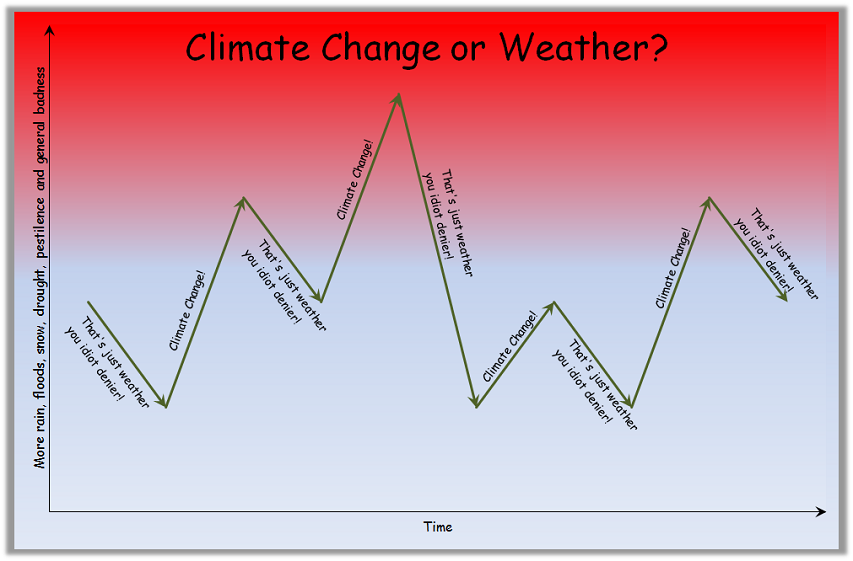
Pascal’s Wager, environmentalists’ version
Hector Drummond indulges in a proper “Fisking” of a recent column in the Telegraph:
We don’t have to buy into the apocalyptic angst of Greta Thunberg, on show again in Davos yesterday, to recognise that something has to be done.
He actually said “Something Has To Be Done”. How about we do a snow dance, Philip? That’s “something”.
Whether or not you are a sceptic about the impact of CO2 on the climate or question man’s involvement in producing the greenhouse gas, our energy future is a non-carbon one, like it or not.
Our energy future involves a lot of talk about non-carbon energy sources, while relying on “carbon” for a long time to come.
Virtually every government has committed to this as an overt aspect of public policy and those that haven’t, like China or the US, have a rapidly growing green energy sector poised to exploit the move to a carbon‑free future.
You mean the China that’s building coal-fired power plants at a rate of knots? That China?
Later on, the column invokes Pascal’s Wager, which Hector finds both amusing and irritating:
Seriously? Pascal’s Wager, which has been long ridiculed by most scientists and philosophers and thinkers, is now the basis for the largest and riskiest economic and political transformation in human history?
Pascal’s Wager justifies any proposed change in response to any possible threat. It’s possible that all the ducks in the world are really super-intelligent and they’re about to launch a takeover, so we need to kill them all. It’s possible that nylon stockings are eventually going to cause a nuclear explosion. Make your own ones up. The consequences of doing nothing, should these claims turns out to be true, are calamitous. In fact, they’re far more calamitous than most of the possible climate change scenarios.
Proper risk analysis, on the other hand, tells us to look at probabilities of the possible bad outcomes, not just how bad some possible bad outcome would be, were it true. The catastrophic climate change scenarios all have tiny probabilities. Even the IPCC admits that.
[…]
Then we have to look at the costs of the proposed action. The real costs, that is, not just vague claims like “Oh, moving everything to solar energy would be, like, you know, cool, my friend went to this talk once and she said that apparently solar works just as well as coal”. The costs – the real costs – are what needs be weighed against alternative courses of action.
The costs of abandoning fossil fuels are not zero. Not even remotely. Changing to renewables will be massively expensive, destroy jobs, and hinder prosperity, because they cannot provide anywhere near the energy we need. “Generate growth and prosperity” is nonsense, and Johnston should be ashamed of himself for falling for this.
Cut perfect grooves with this DIY tool!
Rex Krueger
Published 22 Jan 2020Make a plane for cutting perfect grooves in wood.
More video and exclusive content: http://www.patreon.com/rexkrueger
Get the Specialty Plane Bundle: https://www.rexkrueger.com/store/spec…
Get the Grooving Plane Plans: https://www.rexkrueger.com/store/plan…
(more…)
The EU apparently fears a “Singapore on the Thames”
In the Continental Telegraph, Tim Worstall explains why the EU negotiators are reportedly offering a much worse trade deal to the United Kingdom than they’ve already agreed with Canada, Japan, and other trading partners:

Take, for example, this idea of Singapore on Thames. It’s trivially easy to rally the peeps against one or other relaxation of regulation. Chlorine washed chicken for example. But what about lifting the entire burden? Singapore is, after all, about 50% richer than Britain on a per capita basis. The correct question therefore is would you like a 50% pay raise at the price of shooting all the bureaucrats? Given the manner in which the bureaucrats don’t want the question even asked we have a reasonable enough guide that the answer would be yes.
Which is why the terms on offer to a Britain which could do the SonT thing are so terrible. Because of SonT succeeded it would be a death blow to the entire idea of how Europe is regulated. Lille, Leipzig and Livorno will all put up with interfering bureaucracy because that’s just the way the world is. But if Les Rosbifs become richer by half again simply by that bonfire of the regulations then the auto da fes will light up all over Europe.
So, yes, of course the EU is offering shit trade terms. They can’t allow an independent and free Britain to succeed. That we will anyway is what will bring that freedom and liberty to the continent – once again. For as so often it will be us that saves Europe from itself.
Book Review – The Lee Enfield, by Ian Skennerton
Forgotten Weapons
Published 21 May 2017Available from Amazon: http://amzn.to/2qBntgB
Ian Skennerton is a leading authority on British rifles, having written extensively on Sniders, Martinis, Enfields, and more. This specific book, The Lee Enfield is the most recent iteration of his compendium of Lee-Enfield information, printed in 2007 (previous versions were The Lee Enfield Story of the 1980s and The British Service Lee of the 90s). It is an absolute wealth of information, including a large amount of original British military documents. Skennerton covers a huge array of developmental and experimental versions of the Enfield as well as the standard production models (including American, Canadian, Australian, and Indian production).
Strange WW1 modifications and accessories, grenade launchers, snipers, lightweight guns, carbines, long rifles, semiautomatic conversions, you name it — it’s all here. Unfortunately, the organization and editing leaves a lot to be desired, in my opinion. It is a book that looks magnificent when idly flipped through, but can be frustrating to use to understand the history of a gun or guns. The text often jumps from one subject to another, forcing the reader to piece together elements from different sections to figure out a coherent story.
That said, it remains an indispensable book for the Enfield enthusiast, as it has a ton of information not found elsewhere. I hope that if a new revision or edition is ever produced, Mr. Skennerton will employ the services of a ruthless editor to help him form the raw information into a more navigable history.
Cool Forgotten Weapons merchandise! http://shop.bbtv.com/collections/forg…
http://www.patreon.com/ForgottenWeapons
If you enjoy Forgotten Weapons, check out its sister channel, InRangeTV! http://www.youtube.com/InRangeTVShow

QotD: The “great” modern architects
Moreover, claiming respectable ancestors is somewhat at variance with equal claims to be starting from zero (as Gropius put it), but such a contradiction is hardly noticed by the grand narrative history of modernism that Professor Curl attacks and destroys.
He is not unable or unwilling to praise where it is due, though it is due rarely enough; and he is particularly effective in tracing the opportunistic ideological divagations of the modernists, whose one constant predilection was for absolute power over others. Mies, for example, was attracted to socialist totalitarianism, and his only objection to Nazism was that the Nazis eventually rejected his desire to have everything built according to his prescriptions. He left Nazi Germany because he feared his previous pro-leftism made him permanently suspect in its eyes, not because he was appalled by its brutality. If only they’d let him build! But contrary to apologists for Mies, and to a legend constantly repeated, it was not the Nazis who closed the Bauhaus but Mies himself, and he left Germany only four years after their assumption of power.
Finding refuge in America, Mies quickly perceived that the power of patronage of megalomaniac building lay with giant corporations rather than with fascists or communists and persuaded many of them to build his preternaturally inhuman and uninspired monstrosities. By a strange quirk of history, and because of mankind’s perpetual propensity to make logical errors, Mies was able to pose dishonestly as anti-totalitarian and even as a friend of freedom precisely because he had fled Nazi Germany where they hadn’t patronised him. He was fortunate that soon afterwards the United States had another totalitarian enemy, the Soviet Union. Mies and his allies were thus able to claim that his totalitarian modernism was actually a manifestation of western freedom. There are many such ironies pointed up in this book that would be delicious had they not had such appalling consequences.
Corbusier was a fascist in the most literal sense of the word, and early during the Occupation advocated the removal by force of the majority of Paris’ population because it had no business to be living there. Can one wonder that a man with thoughts like that built monstrosities?
Theodore Dalrymple, “Architectural Dystopia: A Book Review”, New English Review, 2018-10-04.
January 22, 2020
You – yes, you – and your “White Supremacy” issues
Antonia Senior is shocked, shocked to discover that she’s struggling with a whole bunch of internalized issues, according to a new book by Layla F. Saad:
I am a white supremacist. Who knew? I didn’t. I have, however, just read Me and White Supremacy by Layla F Saad, published next month by Quercus, which has made clear to me that I am white, therefore I am a racist. In fact, Ms Saad told me in the introduction to prepare to “become overwhelmed when you begin to discover the depths of your internalised white supremacy”.
On a similar note, a friend recently told me that my failure to recognise a vast malevolent patriarchy was as a result of “internalising your own oppression”. There seems to be a lot of internalised weirdness going on: gender victim battling it out with racist in my gut. I thought it was wind.
The publisher is pretty sure that the ranks of underpaid, bookish folk who work for them are also all white supremacists. It is distributing the tome to all the British employees of its parent company Hachette, and telling them to spend 28 days “reflecting on manifestations of white supremacy, including white privilege”.
The self-flagellation of all the white supremacists at Hachette is yet another example of how much the Woke borrow from the Church. Identity politics has become a secular religion, and “white privilege” is one of its shibboleths. Indeed Ms Saad makes the point clearly in her book, stating that “I strongly believe that anti-racism practice and social justice work are also spiritual work.”
To be woke demands faith in certain creeds, with the twins Equality and Diversity as unassailable deities. It demands a knowledge of the right language. You must believe in certain disprovable evils — like the existence of a malevolent patriarchy — and like many strict sects, it punishes its apostates most severely. The Twitter storms are fierce for those who express a non-woke view but should have known better than for those outside of the faith altogether.
Tom Holland, in his book Dominion, The making of the Western Mind, identifies the “trace elements” of Christianity in the woke world. The example he used was the intersectional feminists in the #MeToo movement offering white feminists the chance to “acknowledge their own entitlement, to confess their sins and to be granted absolution”.
Australian tourism, RIP
As we’ve all been inundated with the shocking images of almost the entire inhabited area of the Australian mainland burning, like this one, for example, claimed on social media to be a “satellite image”:
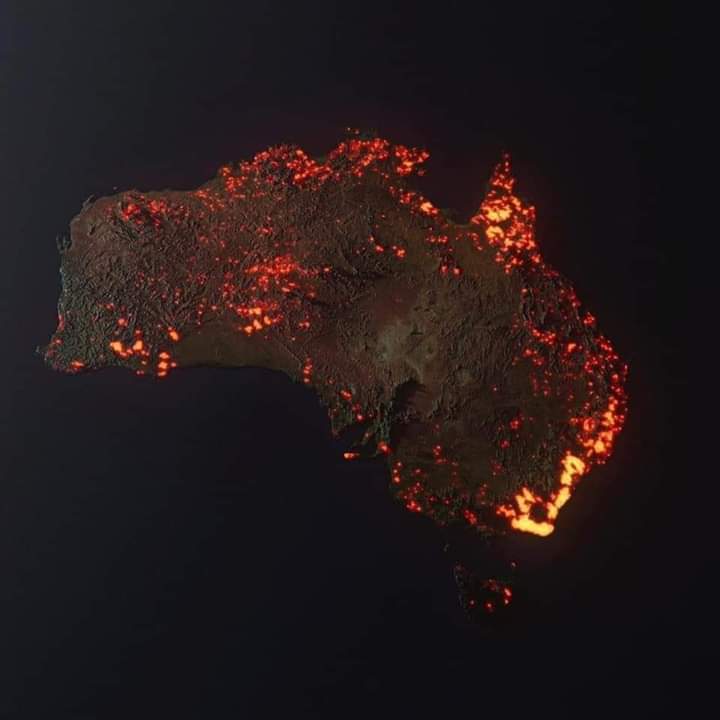
… it’s not surprising that anecdotal evidence of the decline in bookings from foreign tourists implies that there will be few visitors to the burned-out wasteland that used to be a thriving first-world nation. This, on top of the widely reported “death” of the Great Barrier Reef, means the few dozen dazed survivors will be reduced to cannibalism shortly. Or, as Arthur Chrenkoff suggests, we’ve been sold another bill of goods and things are not quite as desolate and post-apocalyptic as all that:
Just like many other people I know, I have been inundated by messages from family and friends overseas, inquiring about my safety, having been terrified by the media reports of what seemed like an environmental armageddon engulfing the entire country. I had to explain time after time that while the fires have been savage and extensive, they have largely burned through relatively sparsely populated areas (if it all, considering the vast extent of our national parks). No significant town has been threatened and destruction and loss of life, while tragic, have been pretty small in proportion to the area affected.
Yet, watching the hysterical and over-sensationalised coverage overseas has convinced many that the very existence of the nation is at stake. And the social media, if anything, has been even worse, with a number of completely misleading maps and photos exaggerating the extent of the affected areas by two-figure factors. As I pointed out, indeed the area the size of the state of Kentucky has been burned out, but unlike most other places on Earth, certainly in the developed world, Australia fits in nearly eighty Kentuckys, most of them pretty empty of human presence and activity.
Media sensationalises at the best of times in a never-ending quest for more eyeballs (“if it bleeds it leads”, or, in this case, “if it’s on fire, we’re on fire”) but the intersection of a large scale natural disaster with the “climate crisis” activism has generated a truly terrifying inferno of human passions where news becomes propaganda and the narrative trumps the objectivity. A significant proportion of the population — and the majority in the media — want to see the fires as Gaia’s wrath, with the disaster turning into green porn to terrify, titillate and agitate. Tourism has now become one of the casualties of this rhetorical excess, a collateral damage to the pursuit of a political agenda. This crisis is very much man-made and the economic pain unnecessarily inflicted on a whole industry because you wanted to make as terrible a point as possible will hang around your necks like a charred albatross, dear green activists on the streets and those masquerading as journalists.
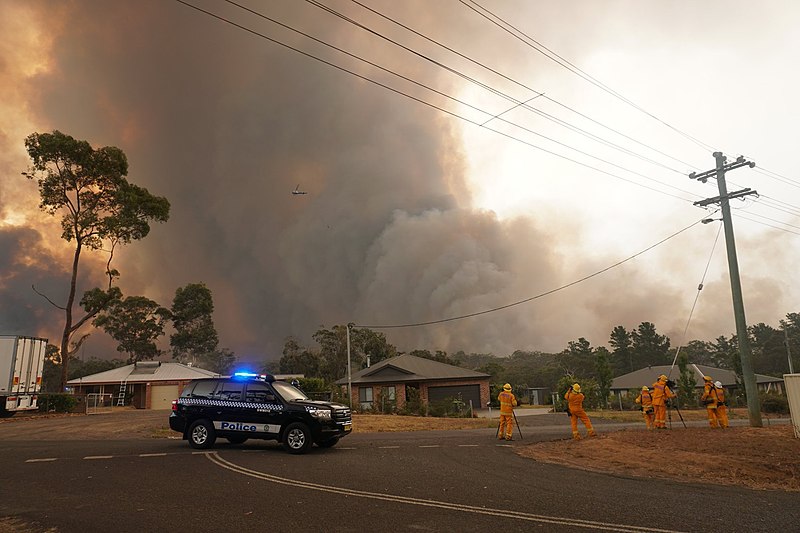
The Green Wattle Creek bushfire moves towards the Southern Highlands township of Yanderra as police evacuate residents from Yanderra Road, 21 December, 2019.
Photo by Helitak430 via Wikimedia Commons
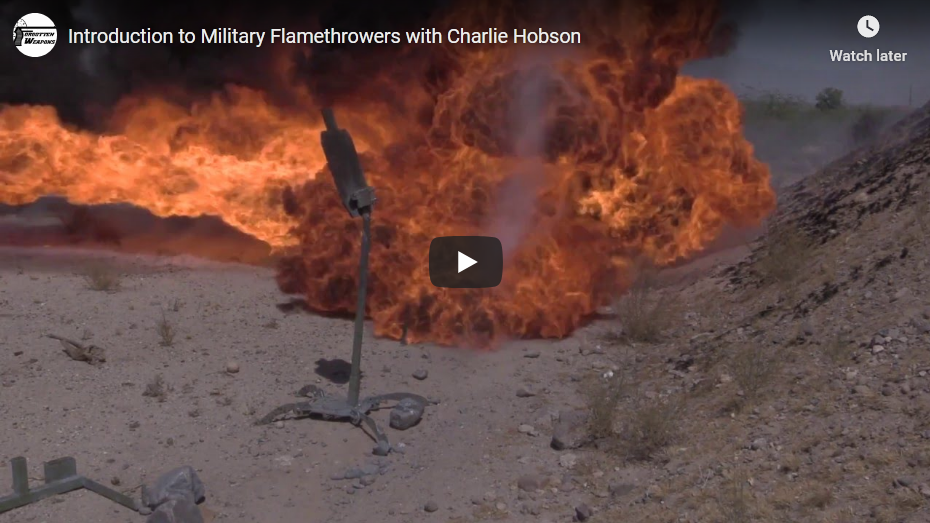
Introduction to Military Flamethrowers with Charlie Hobson
Forgotten Weapons
Published 5 May 2016http://www.flamethrowerexpert.com
You can find Charlie Hobson’s book, US Portable Flamethrowers here:
http://amzn.to/1SP9yc5Flamethrowers are a significant piece of military weapons history which are very widely misunderstood, as flamethrowers have never been the subject of nearly as much collector interest as other types of small arms. The US military removed its flamethrowers from inventory in 1985, and all other major national militaries have done the same. In the US, the lack of general interest led to most of the surplussed weapons being destroyed as scrap, and few survive in private collections. At the same time (and for the same reason) a great deal of the information on these weapons was also discarded and lost.
One of the people who has done a tremendous amount of work to recover practical information on historical military flamethrowers as well as restore, service, and operate them is Charlie Hobson. He has worked extensively with the US military museum system as well as the entertainment industry (if you have seen a movie of TV show using a real flamethrower, it was almost certainly done under his supervision).
Today I am discussing the basic of flamethrowers with Charlie. The goal is to provide a good baseline foundation so we can go on to look at a couple specific historical flamethrowers and understand them in context. So sit back, relax, and enjoy a chat with a man who is truly passionate about this underappreciated aspect of military history!
The general unpleasantness of life in the “groves of academe”
David Warren on the state of play on the intellectual and political battlefronts of academia:

University College, University of Toronto, 31 July, 2008.
Photo by “SurlyDuff” via Wikimedia Commons.
As the latest reports from our universities confirm, we live in an age of juvenile anachronism. So far as the past is acknowledged at all, it is to be judged, by the incredibly narrow standards of “social justice,” itself two words of a lie. Anyone who tries to resist this — even tenured professors — will be demoted, fired, or “placed on probation.” As in Soviet universities, this was enough to keep most dissenters secret. There is, after all, at least one mouth to feed, and not everyone is equipped to become a martyr. Among the better academics, some particles of truth can be snuck into lectures, past the inquiring minds of ignorant thugs.
But as technology has now blessed us with portable, and easily concealed recording devices, they must stay constantly on guard. A slight ideological slip could end the most promising career, apart from surrounding the speaker with shrieking Antifa who, if they manage to injure him, will not be prosecuted by campus or municipal sensitivity police.
It’s actually no better for (most of) the students than it is for the professors:
… after family breakdowns and the re-education of a generation of public school teachers, the crop of new students are so dull and docile that, unless they are radicalized, they will sit there aloof, like zombies. There are “conservative” students, whose complacency can serve any mission. Many have “common sense” enough to play along. They are only there to acquire the minimum credentials for paid work on the outside. It is a prison term. Once graduated, they will then adopt the customs and tone in their workplace environment which, except for “professions” like journalism, are unlikely to be radical. The feigned “social justice warrior” is transformed into a feigned enthusiast for capitalism, by self-interest, almost overnight.
Touring Nick Offerman’s Wood Shop | Ask This Old House
This Old House
Published 12 Feb 2017Ask This Old House host Kevin O’Connor visits Nick Offerman in Los Angeles to tour the comedian’s woodworking shop.
About Ask This Old House TV:
Homeowners have a virtual truckload of questions for us on smaller projects, and we’re ready to answer. Ask This Old House solves the steady stream of home improvement problems faced by our viewers — and we make house calls! Ask This Old House features some familiar faces from This Old House, including Kevin O’Connor, general contractor Tom Silva, plumbing and heating expert Richard Trethewey, and landscape contractor Roger Cook.For more on This Old House and Ask This Old House, visit us at: http://bit.ly/ThisOldHouseWebsite

QotD: National “wealth”
While working on my book, I read all these different accounts of where capitalism comes from. I was amazed by how many of them start from the assumption that wealth is … stuff. Depending on which Marxist you’re talking to, capitalism is the ill-gotten-booty of the Industrial Revolution, slavery, imperialism, and the rest. I don’t want to get into all of that here — there will be plenty of time when the book comes out.
But all of these assumptions are based on the idea that having stuff makes you rich. Now, in fairness, that’s true for individuals. But it doesn’t really work that way for societies. Writing about Venezuela earlier this week is what got this in my head. Venezuela is poor and getting poorer by the minute: Babies are dying from starvation.
Meanwhile, Venezuela has the largest proven oil reserves in the world. According to lots of people, not just Marxists, this should make no sense. Oil is valuable. If you have more of it than anyone else, you should be able to make money. For a decade, the American Left loved Hugo Chávez and then Nicolás Maduro because they allegedly redistributed all of the country’s wealth from the rich to the poor. These dictators were using The Peoples’ resources for the common good. Blah blah blah.
It turns out that the greatest resource a country has is its institutions. In economics, an institution is just a rule, which is why the rule of law in general and property rights in particular are the most important institutions there are, with the exception of the family. Take away the rule of law in any country, anywhere and that country will get very poor, very fast. Stop protecting the fruits of someone’s labor, enforcing legal contracts, guarding against theft from the state or the mob (a distinction without a difference in Venezuela’s case) and wealth starts to evaporate.
But even that is too complicated. Oil is worthless on its own. If you went back in time to the Arabian Peninsula before oil became a valuable commodity, you wouldn’t look at the squabbling nomads and call them rich, even though they were playing polo with a goat’s head above billions of barrels of oil. Go get lost in the Amazon by yourself. What would you rather have, a map or big-ass diamond? The diamond only has value once you get out of the jungle, but you can’t get out without the map.
Jonah Goldberg, “America and the ‘Original Position'”, National Review, 2017-12-22.
January 21, 2020
The Korean War – THE COLD WAR Turns Hot!
IT’S HISTORY
Published 23 May 2015Not so long after World War 2, the Cold War had its first very hot conflict. After the separation of Korea into a communist north and a pro-western south, the stage was set for war. A war that escalated quickly and brought new innovations to the front that were only in a testing phase a few years earlier. The conflict cooled down into an armistice and created the DMZ that we still know today.
» SOURCES
Videos: British Pathé (https://www.youtube.com/user/britishp…)
Pictures: mainly Picture Alliance
Content:
Mulholland, Andrew: The Korean War: History in an Hour, William Collins, 2013
Malkasian, Carter: The Korean War, Osprey Publishing, 2014
Hastings, Max: The Korean War, Pan, 1987» ABOUT US
IT’S HISTORY is a ride through history – Join us discovering the world’s most important eras in IN TIME, BIOGRAPHIES of the GREATEST MINDS and the most important INVENTIONS.» HOW CAN I SUPPORT YOUR CHANNEL?
You can support us by sharing our videos with your friends and spreading the word about our work.» CAN I EMBED YOUR VIDEOS ON MY WEBSITE?
Of course, you can embed our videos on your website. We are happy if you show our channel to your friends, fellow students, classmates, professors, teachers or neighbors. Or just share our videos on Twitter, Reddit etc. Subscribe to our channel and like our videos with a thumbs up.» CAN I SHOW YOUR VIDEOS IN CLASS?
Of course! Tell your teachers or professors about our channel and our videos. We’re happy if we can contribute with our videos.» CREDITS
Presented by: Indy Neidell
Based on the script by: Daniel Hungerford
Directed By: Daniel Czepelczauer
Director of Photography: Markus Kretzschmar
Music: Markus Kretzschmar and Daniel Czepelczauer
Sound Design: Bojan Novic
Editing: Franz JänichA Mediakraft Networks original channel
Based on a concept by Florian Wittig and Daniel Czepelczauer
Executive Producers: Astrid Deinhard-Olsson, Spartacus Olsson
Producer: Daniel Czepelczauer
Social Media Manager: Florian Wittig and Laura PaganContains material licensed from British Pathé
All rights reserved – © Mediakraft Networks GmbH, 2015

Those magical couple of weeks when politicians really pretend to care about Iowa
Colby Cosh discusses some of those puzzling-to-Canadians electoral oddities of our southern neighbours:
The actual, real, honest-to-God voting part of the U.S. presidential nominating process will begin with the Iowa state precinct caucuses on Feb. 3, two weeks from Monday. Every four years, at around this time, I rediscover the astonishing opacity of this process and marvel anew. The Iowa caucuses themselves, which have been the paramount preoccupation of American politics for months, serve as an excellent example.
You may have seen C-SPAN footage of the weird precinct caucus goings-on. These incorporate no balloting. Instead, you see small roomfuls of enthusiasts forming physical groupings, chatting about who they ought to support, and then merging smaller “non-viable” groups until the number of groups matches the number of delegates to be sent further on in the process.
“Further on to where?”, you may ask. To the Iowa Democratic Party county conventions, silly; but those don’t happen until March 21. These conventions send delegates to the party conventions for each congressional district (on the morning of April 25), and also to the state convention (June 13).
The actual makeup of the Iowa delegation to the national convention isn’t fully decided until that last date — yet an estimate of the statewide “result” will be provided magically on the evening of the 3rd. Even if no candidate drops out before the district and state conventions, this guess isn’t exactly set in stone. If there are dropouts, the final Iowa vote in the national roll call may look nothing at all like the estimates from the evening. Yet it’s these semi-fictitious, inferential estimates that will actually influence the course of the race in the other 49 states (and in the non-state delegations).
From a Canadian standpoint it all seems like a hell of a way to run a country.