Quotulatiousness

January 26, 2020

When Anti-Semites Infight, Jews Still Die – Pogroms in Romania – WW2 – 074 – January 25, 1941

Filed under: Africa, Britain, Europe, History, Italy, Military, WW2 — Tags: , , , , , , — Nicholas @ 04:00

World War Two
Published 25 Jan 2020

The British offensive in East-Africa takes off with some rapid advances. Meanwhile in Eastern-Europe, Romania is the stage of fierce anti-semitism, but also infighting between two of the groups causing the anti-semitism.

Join us on Patreon: https://www.patreon.com/TimeGhostHistory
Or join The TimeGhost Army directly at: https://timeghost.tv

Follow WW2 day by day on Instagram @World_war_two_realtime https://www.instagram.com/world_war_t…
Join our Discord Server: https://discord.gg/D6D2aYN.
Between 2 Wars: https://www.youtube.com/playlist?list…
Source list: http://bit.ly/WW2sources

Written and Hosted by: Indy Neidell
Produced and Directed by: Spartacus Olsson and Astrid Deinhard
Executive Producers: Bodo Rittenauer, Astrid Deinhard, Indy Neidell, Spartacus Olsson
Creative Producer: Joram Appel
Post-Production Director: Wieke Kapteijns
Research by: Indy Neidell
Edited by: Mikołaj Cackowski
Map animations: Eastory (https://www.youtube.com/c/eastory)
Additional animations: Ryan Weatherby

Colorizations by:
Adrien Fillon – https://www.instagram.com/adrien.colo…
Julius Jääskeläinen – https://www.facebook.com/JJcolorization/
Dememorabilia – https://www.instagram.com/dememorabilia/
Daniel Weiss

Sources:
IWM (B 10600)
Narodowe Archiwum Cyfrowe
freemason by Kyle Tezak from the Noun Project
Letter by Mochammad Kafi from the Noun Project
ETH-Bibliothek Zürich, Bildarchiv / Fotograf: Wehrli, Leo / Dia_247-08618
Private collection of Riggio family https://commons.wikimedia.org/wiki/Fi…

Soundtracks from the Epidemic Sound:
Philip Ayers – “The Unexplored”
Max Anson – “Ancient Saga”
Hakan Erikson – “Epic Adventure Theme 4”
Andreas Jamsheree – “Guilty Shadows 4”
Johannes Bornlof – “Last Man Standing 3”

Archive by Screenocean/Reuters https://www.screenocean.com.

A TimeGhost chronological documentary produced by OnLion Entertainment GmbH.

From the comments:

World War Two
2 days ago
Thank you all so much for reaching 400.000 subscribers! Thanks to all of your support and enthusiasm, more and more people get to see more and better content. In fact, from mid-February onwards, we are going to publish three WW2 videos a week, including Out of the Foxholes, Biographies, Special Episodes, War Against Humanity and a new series on the Homefronts. Not only that, we are also going to start a new series on the TimeGhost History Channel (http://www.youtube.com/c/timeghost). Our Patreons get to vote on what we’ll do next! So don’t miss out and change history here -> https://www.patreon.com/posts/what-timeghost-33300161
Cheers, Joram

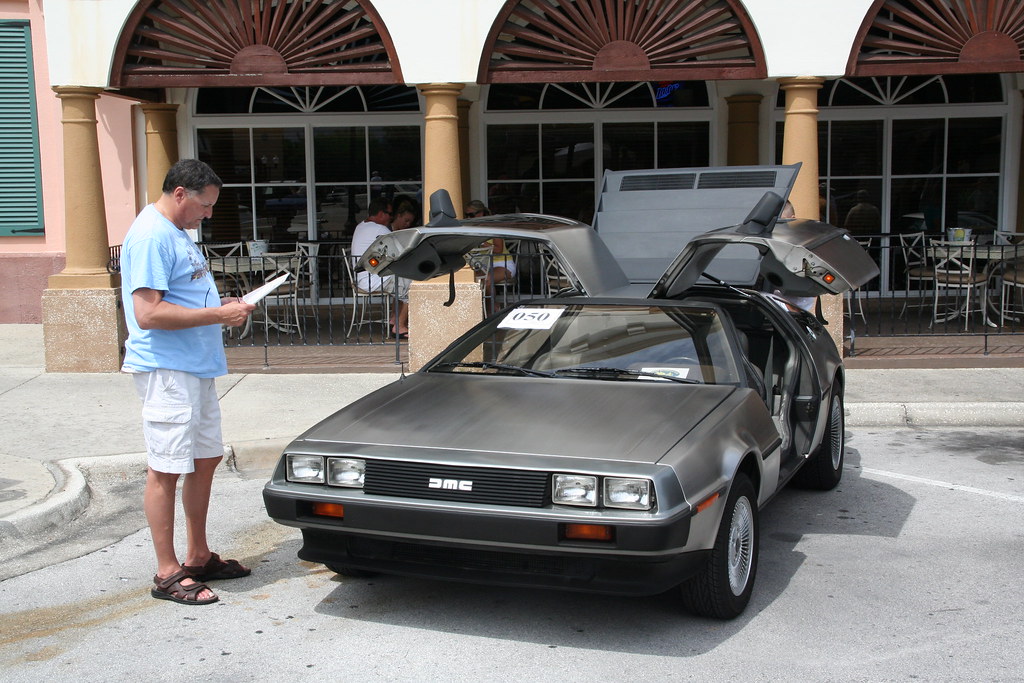
You, your new DeLorean, and the LVMVMA

Filed under: Bureaucracy, Business, Government, USA — Tags: , , , — Nicholas @ 03:00

Many people — not all of them rabid fans of the Back to the Future movies — would like to own a DeLorean and it is going to be possible … eventually:

Photo of a DeLorean by grayesun is licensed under CC BY-NC-SA 2.0

Basically, the legislation [the Low Volume Motor Vehicle Manufacturers Act of 2015], which was signed into law by President Barack Obama in 2015, would allow companies to produce limited-run replica vehicles without being bound by certain safety and emissions standards. But after that administration ended, the law stalled because the National Highway Traffic Safety Administration didn’t follow through with implementation.

“One problem, Espey explains, was that NHTSA hasn’t had a permanent administrator since the previous presidential election, and the acting administrator would not sign off on the regulations,” writes Hagerty. Thankfully, the Specialty Equipment Market Association (SEMA) took matters into their own hands and filed a lawsuit, and now it looks like the law could take effect soon.

That means DMC is once again gearing up to sell new turnkey DeLoreans, and this time around they’ll have modern conveniences like power steering and cruise control (imagine that!) and potentially features like heated seats and smartphone integration (the future!).

While they’re not available to order just yet, interested buyers can fill out a non-binding pre-order form. Just don’t expect to hit 88 miles per hour in 2020; as Espey said, “There will be no cars produced under this legislation for at least a year, and that’s presuming the feds do their job this time and don’t drag it out for four more years.”

H/T to Colby Cosh for the link.

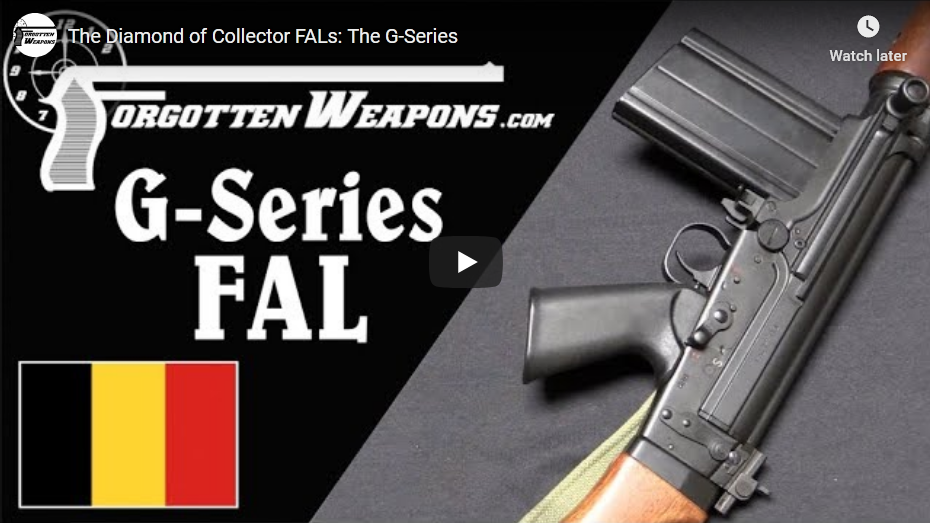
The Diamond of Collector FALs: The G-Series

Filed under: Europe, History, USA, Weapons — Tags: , , , , — Nicholas @ 02:00

Forgotten Weapons
Published 2 Apr 2018

Sold for $17,250.

When the Browning Arms Company first began importing semiautomatic FAL rifles from FN in 1959, the submitted an example for evaluation, and ATF determined that it was not a machine gun. The rifle was made with a selector that could not be moved to the fully automatic position, and did not have the automatic sear required for full auto firing. This was acceptable at the time, and Browning would import 1,836 of these rifles (mostly standard configuration, but some heavy barrel and paratrooper patterns) by January 10, 1963. On that date, ATF changed its standard, and ruled the FAL as currently being imported now would be considered a machine gun subject to the NFA. In order to be acceptable now, the rifle must not be able to accept an automatic sear at all, not merely be made without one. However, ATF ruled that the previously imported guns would be grandfathered in, and remain legally owned as semiautomatic rifles. They were listed by serial number (an additional 12 guns were added in 1974 which were imported by “administrative error”), and remain exempted from the NFA to this day. For the FAL collector, these G-series rifles are desirable because they are completely authentic and original early FN production guns, without any of the design changes that would be required later for importation.

Exempt serial number list: http://www.gseriesfal.com/docpages/91…

http://www.patreon.com/ForgottenWeapons

Cool Forgotten Weapons merch! http://shop.bbtv.com/collections/forg…

If you enjoy Forgotten Weapons, check out its sister channel, InRangeTV! http://www.youtube.com/InRangeTVShow

QotD: An Aboriginal woman’s view of Australia Day

Filed under: Australia, History, Quotations — Tags: , , , — Nicholas @ 01:00

We can project all sorts of fantasies onto our Aboriginal ancestors. There is scant record of their individual exploits or characters, and very few colonial Aborigines left behind a documented account of their experiences. I could, therefore, decide that my foremothers were courageous warriors of the resistance, or mysterious keepers of ancient feminine wisdoms, or I could envision them as victims and martyrs, enduring the humiliations of colonisation with grace and dignity. These romantic fantasies would be accepted as fact, and my “truth” would be applauded. My own (arguably more plausible) vision is that my Aboriginal foremothers had the good sense to form alliances with the settlers, and that they improved their own lives and their children’s prospects as a result.

I don’t begrudge any Aboriginal person a desire to fill in the blanks in their histories with romanticism, particularly given the rewards on offer. The story of white injustice and black tragedy has become the most acceptable Aboriginal tale to tell, and is now the only perspective on Aboriginal history — despite that dearth of documented accounts — that could possibly be accepted as authentic and true. To suggest that our story is not all about victimhood is bad enough; to suggest that modernity was in any way a blessing is double-plus ungood crimethink.

[…]

Those who mourn the demise of Aboriginal culture almost always regard things from the viewpoint of the men, who were indeed dispossessed of their land, and subsequently their traditions and status. Land wasn’t the only item of property they lost, however. They also lost or traded their women to the settlers, and this absorption — along with frontier warfare and disease — rapidly eroded tribal structures and doomed Aboriginal traditions to obsolescence. The settlers arrived with a wealth of goods and a shortage of females, and they were generally less enthusiastic about beating women than was customary in Aboriginal culture. In contrast, the Aboriginal men held no wealth, treated their women appallingly, and there were few taboos to prevent women from straying — and so stray they did. The men lost a lot in the invasion, while the women had little to lose and plenty to gain. Modern-day Aboriginal women who mourn the loss of traditional culture have rocks in their heads. (Metaphorically, that is. Back then, it would have been literally.)

Kerryn Pholi, “Something More: An Alternative Perspective on Australia Day”, Penthouse.au, 2018-01-22.

January 25, 2020

Miscellaneous Myths: Tantalus

Filed under: Europe, Greece, History, Humour — Tags: , — Nicholas @ 06:00

Overly Sarcastic Productions
Published 24 Jan 2020

Tantalus! The number one dude known for his eternal punishment in Hades, perhaps second only to Sisyphus

Our content is intended for teenage audiences and up.

PATREON: https://www.Patreon.com/OSP

MERCH LINKS: https://www.redbubble.com/people/OSPY…

DISCORD: https://discord.gg/hhAZA2z

OUR WEBSITE: https://www.OverlySarcasticProductions.com
Find us on Twitter https://www.Twitter.com/OSPYouTube
Find us on Reddit https://www.Reddit.com/r/OSP/

Petition against the Trudeau government’s proposed “military-style assault rifle” ban goes over 100,000 signatures

Filed under: Cancon, Law, Liberty, Politics, Weapons — Tags: , , , — Nicholas @ 05:00

There may be little point in protesting, as the Trudeau government has a track record of ignoring what Canadians want to do what it intends regardless, but you can still sign the petition here (if you do sign, remember to click the confirmation link in the email you’ll receive after signing the petition). In the Post Millennial, Sam McGriskin reports that the petition has enough confirmed signatures to be the second-largest in Canadian history:

E-petitions can be open for 30, 60, 90 or 120 days for signature based on what the petitioner prefers. The petitions get a government response within 45 days of their opening. Public Safety Minister Bill Blair is overseeing the “buyback program” which Blair estimates could cost anywhere from $400 to $600 million.

Blair’s office did not respond to request for comment from The Post Millennial. His office was asked what the minister’s response is to over 100,000 Canadians calling on the government to drop what many experts see as a completely ineffectual action to curb gun violence. Blair was also asked about fellow Liberal MP Marcus Powlowsk’s letter addressed to him that opposed the gun ban (Powlowsk has since retracted the letter) and Winnipeg Police constable calling the ban “nonsense”.

“When we seize handguns, the handguns are always almost 100% in the possession of people who have no legal right to possess them. They’re almost always stolen or illegally obtained,” said Const. Rob Carver. “I simply don’t see how as a 27-year-old veteran, how adding another layer of law will make any difference, anywhere in this country.”

In Powlowski’s letter to Blair he wrote, “Over the course of the past three months, I have heard a wide variety of views on this proposed ban. I believe it is my role to ensure that these views are brought to your attention for consideration.”

“Given that there is currently no legal definition for a ‘military-style assault rifle’ in Canada, some community members I have spoken with are skeptical that a ban based on this term would make sense as a coherent firearm policy,” the letter continued.

In a CBC interview in the summer of 2018, Blair said that most of the gun crime is committed by illegal handguns smuggled in from the U.S. and he was skeptical of a gun ban being effective in combating gun crime. His position changed drastically once he was appointed by Prime Minister Justin Trudeau as the public safety minister.

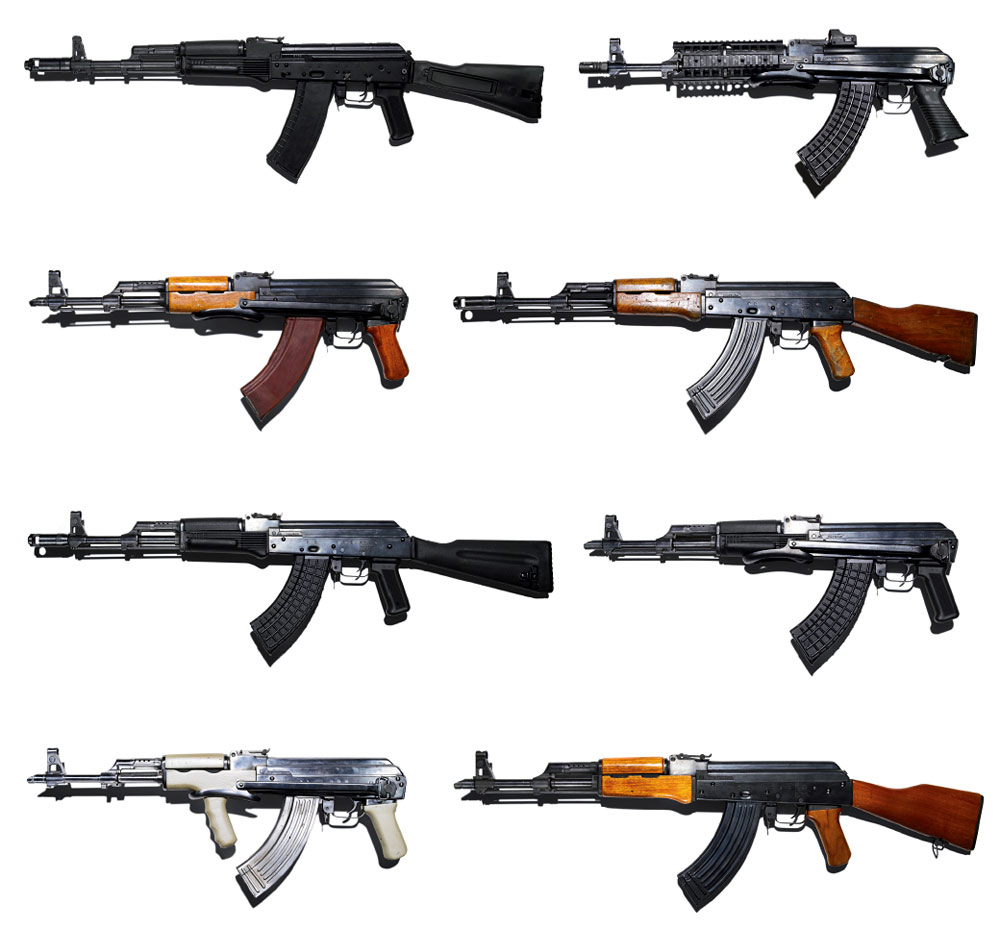
Variants of the AK-47

The Liberal voters in downtown Toronto and other major cities want the government to “do something” about gun crimes, but nothing the government can do is going to make much of a difference for people who are already violating multiple laws, so all they can do is make things worse for those who are already obeying the laws as they stand. In the real world, this makes no sense, but in the fantasy world of electoral politics, the government needs to be seen to be “doing something” … and this, stupid as it may be, counts as “something”.

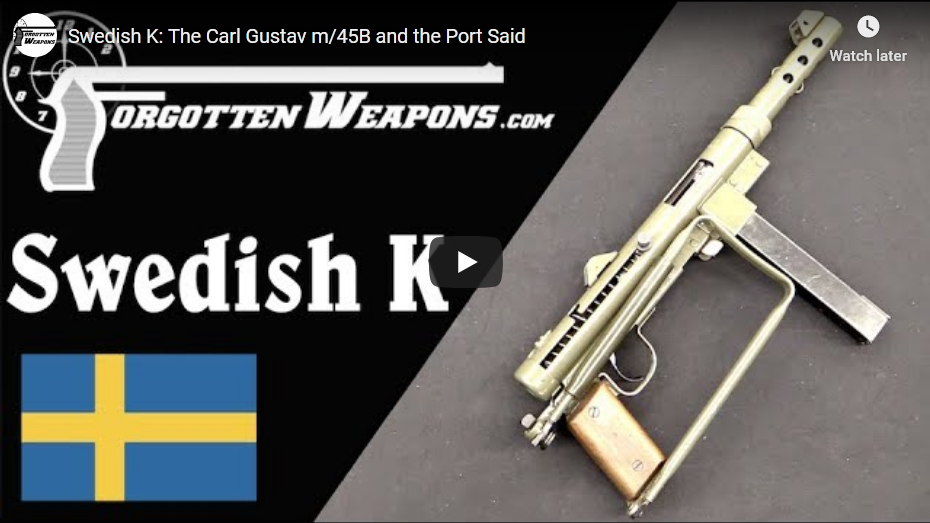
Swedish K: The Carl Gustav m/45B and the Port Said

Forgotten Weapons
Published 24 Jan 2020

http://www.patreon.com/ForgottenWeapons

https://www.floatplane.com/channel/Fo…

Cool Forgotten Weapons merch! http://shop.bbtv.com/collections/forg…

During the 1930s, Sweden acquired an assortment of different submachine guns, including Bergmanns, Thompsons, and Suomis. As World War Two progressed, they decided that they really needed to standardize on a single caliber and model of gun, and requested designs from both the Carl Gustav factory and Husqvarna. The Carl Gustav design won out, and was adopted as the m/45.

It was a very simple open-bolt, tube-receiver, fixed-firing-pin design chambered for 9x19mm Parabellum ammunition. The original guns were built around Finnish Suomi magazines, both 71-round drums and 50-round “coffin” mags. After the war these were replace by a new 36-round traditional box magazine, and magazine well adapters were fitted to the guns which precluded the use of the larger mags. The new magazines were much more convenient to carry, less expensive, and more reliable.

The name “Swedish K” comes form the full designation: Kulsprutepistol m/45. The guns were used by American special operations forces in Vietnam until the Swedish government stopped export sales to the US, at which point the Navy commissioned Smith & Wesson to produce the Model 76 submachine gun (essentially a copy of the m/45). The design was also licensed by Egypt, which also licensed the AG-42 Ljungman rifle at the same time. The Egyptian copy was called the Port Said, and shows the features fo the original Swedish m/45 pattern, where the guns in Swedish service were mostly updated to the m/45B pattern.

Photo of m/45C with bayonet from: http://www.gotavapen.se/index_eng2g.htm

Check them out for a ton of information on Swedish small arms!

Contact:
Forgotten Weapons
6281 N. Oracle #36270
Tucson, AZ 85740

Refuting the pessimism of Malthus

Filed under: Britain, Economics, Greece, History — Tags: , , , , — Nicholas @ 03:00

In the latest edition of Anton Howes’ Age of Invention newsletter, he looks at the predictions of that old gloomy Gus, Thomas Malthus:

The Malthusian trap. For Malthus, as population increases exponentially and food production only linearly, a point where food supply is inadequate will inevitably be reached.
Graph by Kravietz via Wikimedia Commons.

For economies before the Industrial Revolution, population growth was an important and ever-present brake on prosperity — an observation most famously articulated by the Reverend Thomas Malthus. Writing at the end of the eighteenth century, he warned against the promises of improvement. Whereas the optimists looked at the acceleration of innovation around them and claimed infinite horizons for increasing living standards, Malthus pessimistically argued that population would always catch up. Although a new agricultural technology might briefly increase the amount of available food, the inexorability of population growth meant that it would soon be eaten up by extra mouths to feed. The population would end up larger than it was before the new technology, but with that population eventually no richer than it had been to begin with. Economic historians call this the Malthusian regime, or the Malthusian Trap.

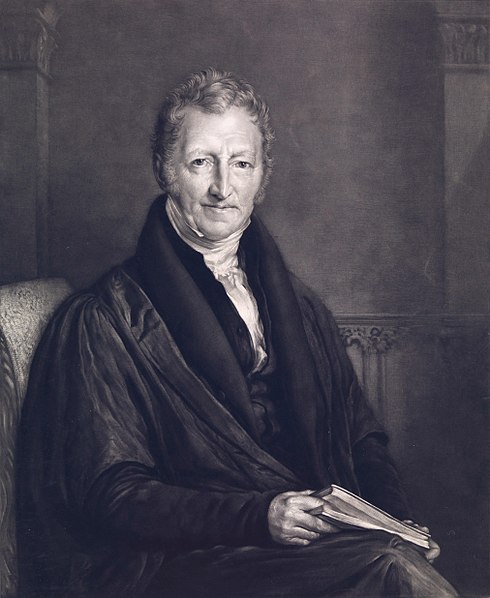
Thomas Malthus.
Portrait by John Linnell, 1834, via Wikimedia Commons

Fortunately, Malthus’s pessimism would prove unfounded. Economy after economy has managed to escape the trap. British output had already been outpacing its population for two centuries by the time he was writing — England’s agricultural output alone had increased 171% while its population had grown 113% (not even taking into account the fact that it also increasingly relied on imported food, paid for by its other industries). And in the decades and centuries that followed, England’s output continued to shoot ahead, widening the lead. Output per capita rose and rose, to the extent that Malthus’s worries about overpopulation are now usually applied to resources other than food.

But while Malthus is famous for the theory, he wasn’t its inventor. Well before Malthus, the people who actually lived in the trap seem to have recognised its effects. Concerns about overpopulation may have led to the Garland or Flower Wars of the Aztec Empire and its neighbours: after a series of famines in the 1450s, the local states reportedly began to engage in ritual battles, with the losers captured and sacrificed to the gods. Still earlier, in ancient Greece, the young men of a settlement might be formally conscripted to go forth and colonise other islands and coastlines. They were typically banned from returning home for several years, and in at least one case slingers were posted on the shore to kill any of the colonists who tried to make a break for home. In a whole host of pre-industrial societies, “surplus” infants were often simply exposed to the elements.

By the sixteenth century, with the rise of print culture, Malthusian rationales were being clearly articulated. Here’s Richard Hakluyt writing in 1584, over two hundred years before Malthus:

    Through our long peace and seldom sickness (two singular blessings of Almighty God) we are grown more populous than ever heretofore; so that now there are of every art and science so many, that they can hardly live one by another, nay rather they are ready to eat up one another.

It’s a direct statement of the Malthusian regime in action, expressed by one of England’s most influential Elizabethan intellectuals, and written specifically for the attention of the queen. Hakluyt thanked god for the recent and unusual lack of mass death, but now worried about overpopulation leading to low wages and unemployment. And he went on to list many other effects. Hakluyt argued that the misery would lead to unrest, thievery, begging, and “other lewdness”. The prisons filled up, where the poor either “pitifully pine away, or else at length are miserably hanged.”

Cursus honorum – Praetors

Filed under: Government, History, Law — Tags: , , , — Nicholas @ 02:00

Historia Civilis
Published 19 Feb 2015

Patreon: https://www.patreon.com/HistoriaCivilis
Website: https://www.historiacivilis.com
Twitter: https://twitter.com/HistoriaCivilis

Music is “Sea” by Jahzzar (http://betterwithmusic.com)

QotD: The post-oil-crisis evolution of modern cars

Filed under: Quotations, Technology, USA — Tags: , , , — Nicholas @ 01:00

Man I remember back in 1982, we all thought we’d be driving nothing but 3-cylinder diesels by the turn of the millennium. If you went back and told some gearhead in my high school class that in 2017 Dodge would be selling a “street legal” 10-second Hemi Challenger, he’d think you were talking about the 0-60 time of a 4-cyl car.

The computer changed everything. Not only in engine tuning and performance, but in design and modeling.

I had an example of a classic late Dark Ages car, an ’84 Trans Am with the LG4 305c.i. Rochester Quadrabog motor. A hunnert and fifty horsepower and nearly every engine function powered by enough dry-rotting vacuum tubing to reach to the moon and back…

Only a few years later and exotic computer-designed and controlled long-runner port fuel injection systems were common on domestic performance cars and HP numbers were on the right side of 200 for the first time in a decade.

It was coming out of an awful time. Like a friend wrote: When he went into seminary you could buy a Mustang with a nearly 400bhp engine option. When he left seminary, the Mustang was a Pinto.

Being a car enthusiast in America in the latter half of the 70s/first half of the ’80s was like being a dirt farmer in Fifth Century Britain, marveling at the weed-grown roads and disused aqueducts left by a race of giants and building your pig shed with stones looted from a burned library.

Tamara Keel, “Cars of the future from the past…”, View From The Porch, 2017-12-26.

January 24, 2020

How Left/Right Partisanship Starts a Civil War in Spain | BETWEEN 2 WARS I 1936 Part 2 of 4

Filed under: Europe, History, Military, Religion — Tags: , , , , , , , — Nicholas @ 06:00

TimeGhost History
Published 23 Jan 2020

Spain in the early 1930’s was practically Europe in Microcosm, with numerous political and ideological movements clashing in debate and open battles on the streets of Spain. All of this worsened in 1936 as Spain slowly descends into Civil War.

Join us on Patreon: https://www.patreon.com/TimeGhostHistory

Hosted by: Indy Neidell
Written by: Francis van Berkel
Directed by: Spartacus Olsson and Astrid Deinhard
Executive Producers: Bodo Rittenauer, Astrid Deinhard, Indy Neidell, Spartacus Olsson
Creative Producer: Joram Appel
Post-Production Director: Wieke Kapteijns
Research by: Francis van Berkel and Naman Habtom
Edited by: Daniel Weiss
Sound design: Marek Kaminski

Colorizations by:
– Dememorabilia – https://www.instagram.com/dememorabilia/
– Daniel Weiss

Sources:
– CNT_Emblem Source Heralder
– Kutxa Photograph Library
– photo from Gipuzkoako Foru Aldundiko Kultura eta Euskara Departamentua

Soundtracks from Epidemic Sound:
– “The Inspector 4” – Johannes Bornlöf
– “Dawn Of Civilization” – Jo Wandrini
– “Not Safe Yet” – Gunnar Johnsen
– “Easy Target” – Rannar Sillard
– “First Responders” – Skrya
– “Deflection” – Reynard Seidel
– “Death And Glory 2” – Johannes Bornlöf
– “The Charleston 3” – Håkan Eriksson

A TimeGhost chronological documentary produced by OnLion Entertainment GmbH.

From the comments:

TimeGhost History
1 day ago (edited)
Vote on what we’re doing after B2W! -> https://www.patreon.com/posts/33300161

We originally planned to just do one episode on the Spanish Civil War, but the more I researched it the more I realized how complicated everything was even before the real fighting even breaks out. To understand the battle-lines of the conflict you have to understand how they were drawn in the turbulent years of the Second Spanish Republic. In the space of just 5 years it sees numerous insurrections, revolutions, and a coup. In an era of political radicalism across the world, Spain really stands out as the most defined by it, and by 1936 is already in a state of quasi-civil war. This episode gives you a detailed insight into that. We’ll be covering the course of the war itself in a later episode.
Cheers, Francis.

From a Canadian perspective, “NORAD … is more important than NATO”

Filed under: Americas, Cancon, History, Military, Space, USA — Tags: , , , , , , — Nicholas @ 05:00

The American government has once again expressed a strong desire to update the 1957 North American Air Defence Commmand arrangement between the US and Canada for defence of the North American continent. It’s a Cold War relic to some (particularly some in the Prime Minister’s Office and cabinet), but it has a very real value to Canada, as Ted Campbell explains:

In 1957 Canada and the USA agreed to create the North American Air Defense Command. It is a “combined” command, American and Canadian people, civilian and military, work together, in combined headquarters, to conduct an active aerospace defence effort over the continent we share. Americans and Canadians work side-by-side managing the airspace, detecting intruders and identifying and intercepting them and so on.

NORAD, I would argue, is more important than NATO.

First, it is about defending our own homeland.

Second, it is about defending the US strategic deterrent, which has, arguably, done more to keep global peace than all the efforts of the United Nations, combined.

NORAD modernization and expansion should be at the top of Canada’s defence policy agenda. Specifically:

  • First, billions of dollars, likely tens of billions of dollars are going to be needed to upgrade the surveillance and warning system. We need new radars, terrestrial and space-based, and upgraded control systems to do the job properly;
  • Second, Canada needs to buy enough (85+ is just the very barest of bare minimums) of the right new fighter jet; and
  • Third, Canada needs to join the American ballistic missile defence system.

I believe that this issue: the shared defence of our, shared, continent and, therefore, the defence of the American heartland and of America’s strategic deterrent is a key, perhaps even the key element in our most important foreign relationship. […] The knowledge that Canada is doing a full and fair share of defending our shared continent, of defending America, is not lost on admirals and generals, diplomats and senior civil servants, representatives and senators in the US Congress, pundits and political leaders in waiting in the think-tanks and senior staff in the White House, even if Donald J Trump is not impressed … IF we are doing a full and fair share.

Right now, we are not.

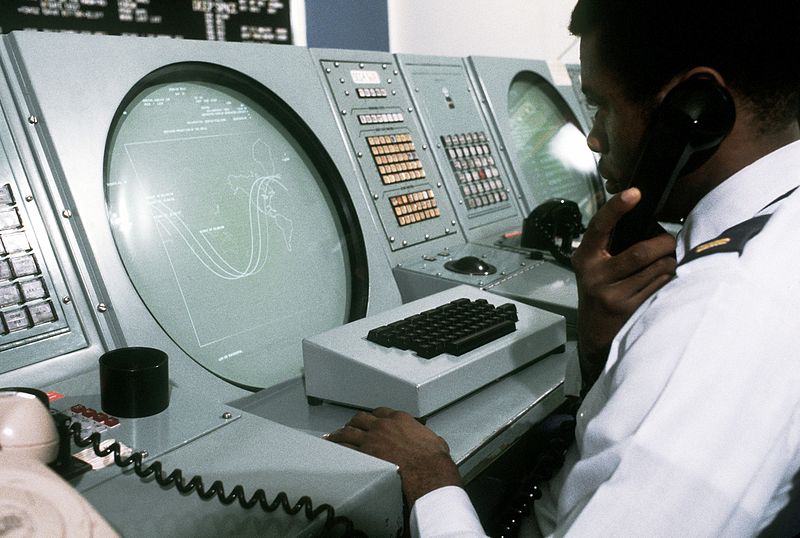
An orbital analyst tracks the Kosmos 1402 spy satellite in orbit in the Space Defense Operations Computation Center, North American Aerospace Defense Command (NORAD) on 18 February, 1983.
NORAD photo by Master Sergeant Hiyashi via Wikimedia Commons.

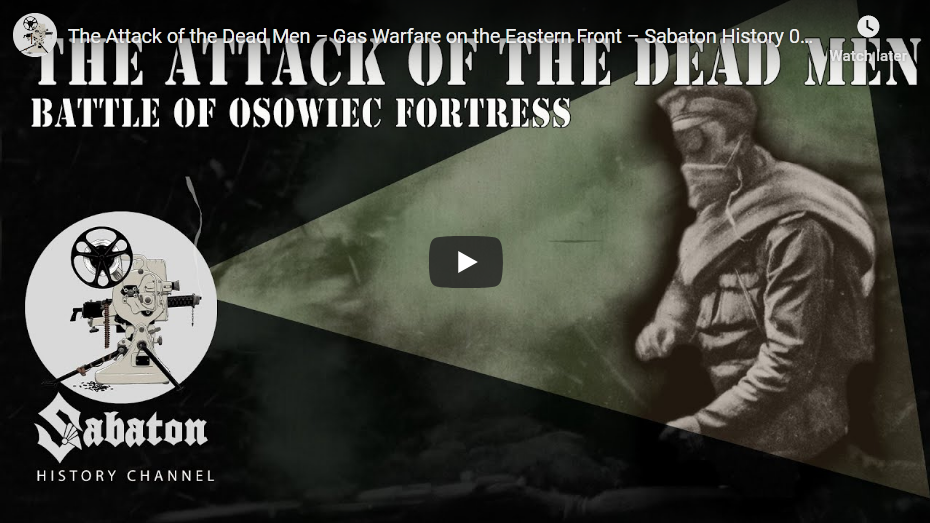
“The Attack of the Dead Men” – Gas Warfare on the Eastern Front – Sabaton History 051 [Official]

Filed under: Germany, History, Media, Military, Russia, WW1 — Tags: , , , — Nicholas @ 04:00

Sabaton History
Published 23 Jan 2020

This episode is about the “Attack of the Dead Men”. During the third battle for Osowiec Fortress in July 1915 during the Great War, German artillery was bombarding the defending Russian soldiers with a new deadly weapon: Poison Gas. The fatal mixture of chlorine and bromine descended like a green fog over the Russian trenches. Without adequate gas-masks to protect themselves, the defenders were believed to all have died in agony. However, as the German infantry advanced, they did not only march right into a Russian counterattack but also encountered the dead, seemingly rising from their graves.

Support Sabaton History on Patreon: https://www.patreon.com/sabatonhistory

Listen to The Great War (where “The Attack of the Dead Men” is featured):
CD: http://nblast.de/SabatonTheGreatWar
Spotify: https://sabat.one/TheGreatWarSpotify
Apple Music: https://sabat.one/TheGreatWarAppleMusic
iTunes: https://sabat.one/TheGreatWarItunes
Amazon: https://sabat.one/TheGreatWarAmazon
Google Play: https://sabat.one/TheGreatWarGooglePlay

Check out the trailer for Sabaton’s new album The Great War right here: https://www.youtube.com/watch?v=HCZP1…

Listen to Sabaton on Spotify: http://smarturl.it/SabatonSpotify
Official Sabaton Merchandise Shop: http://bit.ly/SabatonOfficialShop

Hosted by: Indy Neidell
Written by: Markus Linke and Indy Neidell
Directed by: Astrid Deinhard and Wieke Kapteijns
Produced by: Pär Sundström, Astrid Deinhard and Spartacus Olsson
Creative Producer: Joram Appel
Executive Producers: Pär Sundström, Joakim Broden, Tomas Sunmo, Indy Neidell, Astrid Deinhard, and Spartacus Olsson
Post-Production Director: Wieke Kapteijns
Edited by: Iryna Dulka
Sound Editing by: Marek Kaminski
Maps by: Eastory – https://www.youtube.com/c/eastory

Archive by: Reuters/Screenocean https://www.screenocean.com
Music by Sabaton.

Sources:
– IWM: Q 78100, Q 86635
– The New York Public Library
– Narodowe Archiwum Cyfrowe

An OnLion Entertainment GmbH and Raging Beaver Publishing AB co-Production.

© Raging Beaver Publishing AB, 2019 – all rights reserved.

“Sorry, Boomers. Just because you’ve been told your entire lives that you’re killing the planet, that doesn’t mean it’s true”

Filed under: History, Media, Politics — Tags: , , — Nicholas @ 03:00

Talk about a golden oldie! Does anyone else remember the portentious “Doomsday Clock”? It was devised shortly after WW2 as a handy visual and rhetorical prop for various unilateral disarmament, Soviet agitprop, and general anti-Western civilization groups to use. It’s apparently still being used to pretend we’re facing yet another potentially world-ending crisis:

Remember the Doomsday Clock? It’s a symbolic clock created by a group of scientists in the 1940s, supposedly indicating how close the human race is getting to Armageddon. Originally the clock was set to seven minutes to midnight, and when the clock strikes 12, we’re all dead. That’s the idea, anyway. This corny propaganda tool reached its pop-culture zenith in the ’80s, when everybody from Midnight Oil and Iron Maiden and Sting to DC Comics’ Watchmen were predicting catastrophe by referencing the Doomsday Clock. People love to be scared about the end of the world, and a lot of artists made a lot of money by exploiting that. Nobody ever lost a buck fearmongering.

But you’re reading this right now, which means we’re all still here. Doomsday hasn’t come. So of course, that must mean … it’s just that much closer!

[…]

And this means as much as it’s meant for the past 70-odd years: nothing. Real clocks are instruments of science; the Doomsday Clock is an instrument of the arbitrary whims of some scientists. It might as well be the Doomsday Dartboard. Do you really think we’re any closer to planetary doom than we were during the Cuban Missile Crisis, or the Chernobyl disaster, or the premiere of MTV’s The Real World? You’ve got all those brainiacs gathered in one place, and not one of them has read “The Boy Who Cried Wolf.”

We scoff at Jim Jones and Marshall Applewhite and other doomsday cult leaders, but at least they had the courage of their convictions. If these scientists really believe we’re all doomed, why are they sticking around? If Al Gore actually believes all hope is lost, why is he still living in huge mansions and jetting off to Davos? As the great Glenn Reynolds says: “I’ll believe it’s a crisis when the people who say it’s a crisis start acting like it’s a crisis.”

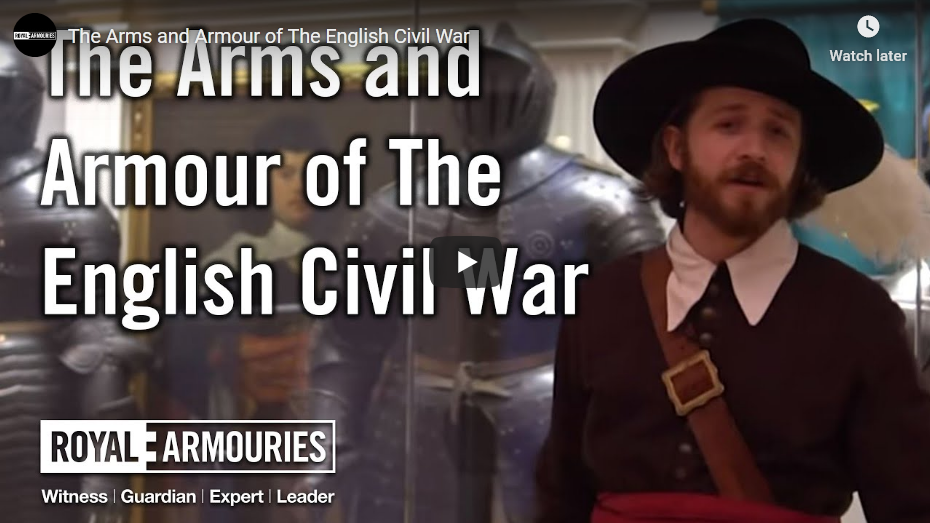
The Arms and Armour of The English Civil War

Filed under: Britain, History, Military, Weapons — Tags: , , , , , — Nicholas @ 02:00

Royal Armouries
Published 21 Dec 2017

The Royal Armouries’ English Civil War collection boasts an array of infantry and cavalry arms and armour from the 1640s. Delve into this turbulent historical period with a look at some cavalry arms and armour.

Where to find us:

⚔Website: https://royalarmouries.org/home
⚔Blog: https://blog.royalarmouries.org/
⚔Twitter: https://twitter.com/Royal_Armouries

The Royal Armouries is the United Kingdom’s national collection of arms and armour. On this channel, discover what goes on behind the scenes at the museum and to see our collection come to life. From combat demonstrations to jousting coverage to behind the scenes tours with our curators, we’ve got it covered.

Have a question about arms and armour? Feel free to leave us a comment and we’ll do our best to answer it.

« Newer PostsOlder Posts »

Powered by WordPress