Quotulatiousness

February 2, 2020

Israeli M1919 Brownings and the US Semiauto Market

Forgotten Weapons
Published 28 Mar 2018

Sold for $4,888.

In the world of converted semiautomatic “machine guns,” the Browning 1919 is a happy example of one of the most iconic and historically important US machine guns and also one of the cheapest semiautomatic belt fed guns available. This stems from two factors, primarily. One is that the Browning 1919, being developed from the water-cooled M1917 Browning, is a closed bolt system. Open bolt semiautomatic designs are not allowed by ATF, and so most semiauto machine gun conversions require substantial alteration to convert from open bolt to closed bolt — which the M1919 does not need. Second, the IDF used the Browning M1919 for many years and in large numbers, and surplussed many of them in the late 1990s. These guns came into the United States as parts kits in large numbers. This meant a glut of cheap guns, easily built as semi autos, and in an easily shootable caliber — 7.62mm NATO (as converted by Israel from their original .30-06 chambering).

Today, we are looking at an example of a semiautomatic converted M1919, and specifically at the various changes made by Israel to both improve the design and convert it successfully to the NATO cartridge.

http://www.patreon.com/ForgottenWeapons

Cool Forgotten Weapons merch! http://shop.bbtv.com/collections/forg…

If you enjoy Forgotten Weapons, check out its sister channel, InRangeTV! http://www.youtube.com/InRangeTVShow

QotD: The role of government, as seen by fans of government

Filed under: Government, History, Liberty, Politics, Quotations — Tags: , , — Nicholas @ 01:00

It seems to me that many people believe that we human beings left undirected by a sovereign power are either inert blobs, capable of achieving nothing, or unintelligent and brutal barbarians destined only to rob, rape, plunder, and kill each other until and unless a sovereign power restrains us and directs our energies onto more productive avenues. In the 16th and 17th centuries it was believed that the beneficent sovereign power must be monarchial; in the 19th, 20th, and (so far) 21st centuries it is believed that the beneficent sovereign power must be “the People,” usually in the form of democratic majorities. We moderns applaud ourselves for having discarded our ancestors’ unenlightened attachment to monarchy and for our having replaced that attachment with an attachment to majoritarian nationalist democracy. We moderns do not understand that our attachment to nationalist sovereignty itself is a far more dangerous superstition than is an attachment to a variety of sovereignty other than majoritarian nationalist democracy.

Don Boudreaux, “Bonus Quotation of the Day…”, Café Hayek, 2017-11-25.

February 1, 2020

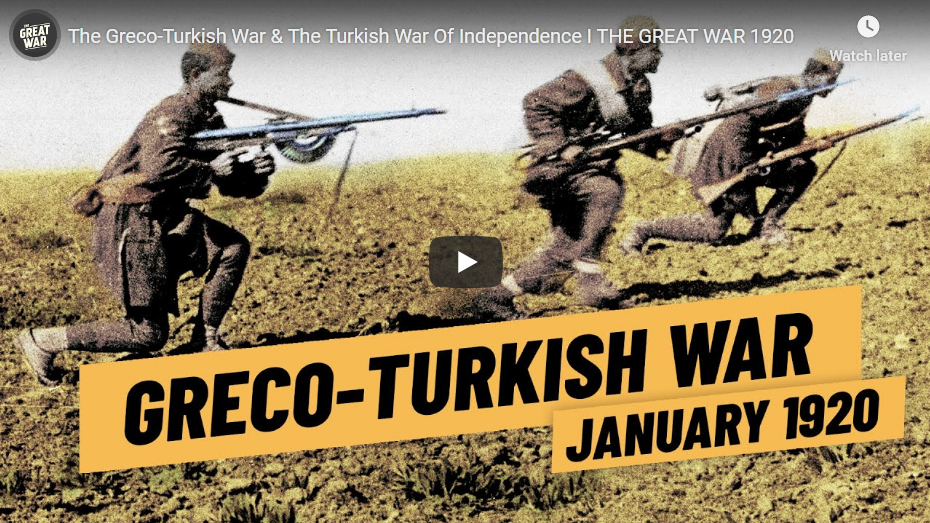
The Greco-Turkish War & The Turkish War Of Independence I THE GREAT WAR 1920

The Great War
Published 31 Jan 2020

Sign up for Curiosity Stream and Nebula: https://curiositystream.com/thegreatwar

The Ottoman Empire was among the losing powers of World War 1 and left a power vacuum after the armistice of Mudros. The Great Powers had already made plans for the territory beforehand and now Greece had ambitions to take over the parts of Turkey where Greeks lived.

» SUPPORT THE CHANNEL
Patreon: https://www.patreon.com/thegreatwar
Merchandise: https://shop.spreadshirt.de/thegreatwar/

» SOURCES
Criss, Nur Bilge: “Occupation during and after the War (Ottoman Empire)”, in: 1914-1918-online. International Encyclopedia of the First World War, ed. by Ute Daniel, Peter Gatrell, Oliver Janz, Heather Jones, Jennifer Keene, Alan Kramer, and Bill Nasson, issued by Freie Universität Berlin, Berlin 2015-08-05 https://encyclopedia.1914-1918-online…

Leonhard, Jörn. Der überforderte Frieden. Versailles und die Welt 1918-1923 (CH Beck, 2018).

Macmillan, Margaret. The Peacemakers: Six Months that Changed the World (London: John Murray, 2001).

Karsh, Efraim and Inari Karsh. Empires of the Sand (London: Harvard UP, 1999).

Llewllyn Smith, Michael. Ionian Vision: Greece in Asia Minor (London: Hurst, 2016 (1973))

Gerwarth, Robert. The Vanquished. Why the First World War Failed to End, 1917-1923 (Penguin, 2017).

Fromkin, David. A Peace to End All Peace (New York: Avon, 1989)

McMeekin, Sean. The Ottoman Endgame (Penguin, 2015)

» SOCIAL MEDIA
Instagram: https://instagram.com/the_great_war
Twitter: https://twitter.com/WW1_Series
Reddit: https://reddit.com/r/TheGreatWarChannel

»CREDITS
Presented by: Jesse Alexander
Written by: Jesse Alexander
Director: Toni Steller & Florian Wittig
Director of Photography: Toni Steller
Sound: Toni Steller Editing: Toni Steller
Mixing, Mastering & Sound Design: http://above-zero.com
Maps: Daniel Kogosov (https://www.patreon.com/Zalezsky)
Research by: Jesse Alexander
Fact checking: Florian Wittig Channel

Design: Alexander Clark

Original Logo: David van Stephold

A Mediakraft Networks Original Channel

Contains licensed material by getty images
All rights reserved – Real Time History GmbH 2019

Brexit Day

Filed under: Britain, Europe — Tags: , , , — Nicholas @ 05:00

Late Friday night, the United Kingdom left the European Union. Within minutes, the power failed all across the nation, people began to starve due to the lack of food, and the shattered remnants of civilization were hurled on the rubbish heap. London is now nothing but a smoking hole in the ground along the banks of the Thames occupied by filthy machete-wielding twitchy-eyed savages. Now that nobody in the UK can read or write, nobody knows how the machines used to work, and all the disgusting medieval diseases are back in full strength, the sun will literally never rise again over those once green and pleasant lands.

Yet, despite the ongoing disasters, a few brave souls still cling to their dim and pathetic hopes of a better world outside the European Union. Here, for example, someone claiming to be Brendan O’Neill smuggled out a story on the last helicopter to take off from the roof of the embassy building (at least, that’s how I assume it got posted to the web…):

Remainers, for their part, are furious about all the talk of parties. We’re rubbing their noses in it, they say. Everything from the Brexit Day gathering in Parliament Square this evening to Sajid Javid’s issuing of a commemorative 50p coin is being cited by the establishment’s bruised, Remoaning anti-democrats as proof of the vile populist streak in the Brexit movement. London mayor Sadiq Khan is even fretting that tonight’s Brexit bashes could give rise to xenophobic hate crimes.

Of course he is. That’s how they see us: as a pogrom-in-waiting. As a racist blob. As an unthinking mass driven almost entirely by hatred of the Other. They’ve been hurling these insults at us, at the millions of men and women who voted for Brexit, for three-and-a-half years now.

But all sides in the Brexit Day discussion are wrong. Baker and other timid Brexiteers are wrong to suggest we should play down the significance of this day lest we offend Remainers, and the Brexitphobic wing of the elite is wrong to say these celebrations are a screech of populist arrogance against the defeated side in the referendum. No, the reason this day must be marked — loudly, firmly and colourfully — is because it represents a glorious victory for democracy. What is being celebrated today is the defence of democracy against one of the greatest threats it has faced in modern times.

One of the peculiarities of the Brexit era, and of the contemporary era more broadly, is that very small and very unrepresentative sections of society are in control of the political and moral narrative. So even as 17.4million people, the largest electoral bloc in our history, voted for Brexit, and stood by their vote for Brexit in the face of the most extraordinary campaign of demonisation that I can remember, still the Remainer elites got to write the story of Brexit.

The powers-that-be — from the business elites to more than 70 per cent of MPs to virtually the entire academy and cultural sphere — were pro-Remain. And they used their influence in the worlds of commentary, letters and culture to paint a picture of Brexit as disastrous. As toxic. As fascistic. Or, at best, as very, very difficult to enact. The disjoint between public enthusiasm for Brexit and elite disgust with it was, at times, staggering.

As a consequence, it became incredibly difficult to draw out the historic significance, the magnificence, of Brexit. Even those in public life who supported Brexit, no doubt feeling the pressure of the often deranged establishment narrative around Brexit, became defensive. Brexit was manageable, they insisted. It would be okay. “Get Brexit Done”, as the Boris Johnson campaign said in December — a tellingly apologetic slogan which, thankfully, was enough to win the support of vast numbers of Leave voters, but which implicitly played into the denigration of Brexit, the reduction of it to a difficult, pesky task. Hardly anywhere was there an assertion of the historic, epoch-defining nature of Brexit.


History Summarized: Byzantine Empire — The Golden Age

Overly Sarcastic Productions
Published 31 Jan 2020

What do you do when life takes away half of your empire? Well, if you’re the Medieval Byzantines, you make comprehensive structural reforms to better manage a changing geopolitical landscape — And then you make an absolute crapload of mosaics.

Our content is intended for teenage audiences and up.

This video was edited in part by Sophia Ricciardi, AKA “Indigo”.

FURTHER SOURCES: A Short History of Byzantium by John Julius Norwich.

PATREON: https://www.Patreon.com/OSP

DISCORD: https://discord.gg/h3AqJPe

MERCH LINKS: https://www.redbubble.com/people/OSPY…

OUR WEBSITE: https://www.OverlySarcasticProductions.com
Find us on Twitter https://www.Twitter.com/OSPYouTube
Find us on Reddit https://www.Reddit.com/r/OSP/

Trudeau government’s unwillingness to define what they mean by “middle class”

Filed under: Bureaucracy, Cancon, Government — Tags: , , — Nicholas @ 03:00

The phrase has taken on almost an Alice in Wonderland quality for Justin Trudeau and his recently created “Minister of Middle Class Prosperity”:

    “When I use a word,” Humpty Dumpty said in rather a scornful tone, “it means just what I choose it to mean — neither more nor less.”

    “The question is,” said Alice, “whether you can make words mean so many different things.”

    “The question is,” said Humpty Dumpty, “which is to be master — that’s all.”

It could be addressed, says Chris Selley … and really should be:

In the meantime, the Liberals have another problem. It is far less important than Iran or China, but it’s also far more embarrassing than either, because it is entirely of their own making and so easily fixed. It is as follows: Trudeau has given Ottawa MP Mona Fortier the new cabinet title of “Minister of Middle Class Prosperity,” but no one in the government has yet bothered to define “middle class.” And everyone is laughing at them.

Mona Fortier, Minister of Middle Class Prosperity and Associate Minister of Finance.
© HOC-CDC. Photo by Christian Diotte, House of Commons Photo Services, November 2019.

Fortier has tried to explain herself. “We have to make sure we represent the realities in a rural, remote or even urban setting, (and) regional differences,” she told CTV upon her appointment. “The income required to attain a middle-class lifestyle can vary greatly based on Canadians’ specific situation,” she told the same network this week.

She’s right! Pack up your middle-class lifestyle in Small Town A, and you might well not recognize it when you unpack in Big City B. The thing is, though, statisticians — including scores of them in the federal government’s employ — are across this. They know very well that a Canadian dollar does not purchase the same quantity of goods and services in every part of the country, and they have all sorts of ingenious ways to compensate.

If it were true that “middle class” can’t be defined because it connotes different things in different places, then the same would go for “poverty.” But Canada has never had any problem defining poverty on a relative basis. And in 2018, this very Liberal government adopted an absolute measure of poverty as well: the Market Basket Measure, which estimates the cost of “a modest standard of living” in any given place, and calculates how many of us can’t afford it.

So the “poverty line” in Small Town A is not the same as it is in Big City B, and … sorry, this very simple concept doesn’t need to be explained to National Post readers any further. The point is, defining poverty was a good thing. Defining the middle class obviously doesn’t matter as much, but since this government seems utterly obsessed with it — and with evidence-based policy! — there is no good reason for it not to do likewise.

Cursus honorum – Consuls

Filed under: Government, History — Tags: , , , , — Nicholas @ 02:00

Historia Civilis
Published 18 May 2015

Patreon: https://www.patreon.com/HistoriaCivilis
Website: https://www.historiacivilis.com
Twitter: https://twitter.com/HistoriaCivilis

Music is “The Life and Death of a Certain K. Zabriskie, Patriarch” by Chris Zabriskie. (http://chriszabriskie.com/)

QotD: Justifying tyranny

Filed under: Government, Liberty, Quotations — Tags: , , , — Nicholas @ 01:00

In [Adam] Smith’s time, and now again in the regulatory state, few believed that a masterless society would be possible. The haunting fear by governing elites supported by worried citizens stirred up by an antitrade clerisy was then, and still is, that ordinary people will do bad things if left alone. Unless overawed by the threat of state violence in police or planning or regulation, ordinary people, especially the lower classes, will spurn priests, stop paying their rents and taxes, not save enough for old age, kill each other, not buy enough insurance, speak against the government, appear with hair uncovered, refuse military service, drink to excess, commit unnatural acts, use naughty words, chew gum, smoke marihuana – committing in sum, as Bill Murray put it in Ghostbusters, “human sacrifice, dogs and cats living together, mass hysteria.” A progressive or a conservative program of heavy regulation is a first-night-in-Ferguson-Missouri notion of keeping order. It is the justification of all tyranny, hard or soft.

Deirdre McCloskey, Bourgeois Equality, 2016.

January 31, 2020

How Hitler Won the Olympic Games – The Berlin Olympics | BETWEEN 2 WARS I 1936 Part 3 of 3

Filed under: Germany, History, Sports — Tags: , , , , — Nicholas @ 06:00

TimeGhost History
Published 30 Jan 2020

The Berlin Olympics in 1936 were a masterfully played piece of Nazi propaganda, where they framed their race as physically superior and their ideology as modern, organised and cultured while also ostensibly downplaying their anti-internationalism racism and anti-semitism. But the Germans didn’t embrace sports for friendly competition. They did so for something very different.

Join us on Patreon: https://www.patreon.com/TimeGhostHistory

Hosted by: Indy Neidell
Written by: Joram Appel
Directed by: Spartacus Olsson and Astrid Deinhard
Executive Producers: Bodo Rittenauer, Astrid Deinhard, Indy Neidell, Spartacus Olsson
Creative Producer: Joram Appel
Post-Production Director: Wieke Kapteijns
Research by: Joram Appel
Edited by: Daniel Weiss
Sound design: Marek Kaminski

Sources:
Bundesarchiv_Bild:
183-G00372, 102-08105, 145_Bild-P017100, 183-R96374, 146-
1998-020-00A, 146-1976-033, 183-G00978, 183-1992-0421-500,
146-2005-0017, 183-G00352, 146-1976-116-08A, 146-1988-106-
29, 146II-728, 8076_Bild-0008
Modern Olympic Photos:
Photo from illang https://www.flickr.com/photos/ilan_sr…,
Photo by Agência Brasil http://agenciabrasil.ebc.com.br/rio-2…

Colorizations by:
Daniel Weiss
Norman Stewart
Joram Appel

Soundtracks from Epidemic Sound:
– “First Responders” – Skrya
– “The Inspector 4” – Johannes Bornlöf
– “Heroes On Horses” – Gunnar Johnsén
– “Split Decision” – Rannar Sillard
– “Not Safe Yet” – Gunnar Johnsen
– “Thunder Storm 01” – Fredrik Ekstrom
– “Dawn Of Civilization” – Jo Wandrini (1)
– “March Of The Brave 4” – Rannar Sillard
– “Magnificent March 3” – Johannes Bornlöf
– “Imperious” – Bonnie Grace
– “The Charleston 3” – Håkan Eriksson

A TimeGhost chronological documentary produced by OnLion Entertainment GmbH.

From the comments:

TimeGhost History
2 days ago (edited)
The 1936 Berlin Summer Olympics and Garmisch-Partenkirchen Winter Olympics were the first true modern Olympic games. Many of the now staples of the Olympic games were introduced for the first time by the Nazis. But magnificent as they might have been, the intent of the Germans was not really to advance the vision of the internationalist and pacifist goals of the Olympic games. And while we do realise that many of the characteristics of the 1936 Olympics – how it was used to push a certain national image or to strengthen nationalism, could be said of more recent editions of the Olympics as well. And while sports and international institutions are still today being used to push alternate agendas, we’d rather not discuss them in the comment section here as this is a history channel – not a current affairs channel.
Cheers, Joram

“… the report envisions unprecedented government and regulatory intervention into the delivery of news services”

Filed under: Bureaucracy, Business, Cancon, Technology — Tags: , , , — Nicholas @ 05:00

Michael Geist heaps scorn on the recommendations of a panel that would empower the CRTC to regulate the internet in Canada to a very high degree:

The Broadcast and Telecommunications Legislative Review Panel released its much anticipated report yesterday with a vision of a highly regulated Internet in which an expanded CRTC (or a renamed Canadian Communications Commission) would aggressively assert its jurisdictional power over Internet sites and services worldwide with the power to levy massive penalties for failure to comply with its regulatory edicts. The recommendations should be rejected by Innovation, Science and Industry Minister Navdeep Bains and Canadian Heritage Minister Steven Guilbeault as both unnecessary to support a thriving cultural sector and inconsistent with a government committed to innovation and freedom of expression.

[…]

Yet the strengths of the telecommunications and consumer rights portions of the report are overshadowed by a stunning set of recommendations related to Internet content, some of which are unlikely to survive constitutional scrutiny, likely violate Canada’s emerging trade commitments, and rest of shaky policy grounds. If enacted, the Canadian Internet would be virtually unrecognizable with the CRTC empowered to licence or require registration from a myriad of Internet services, mandate what Canadians see on those services, and intervene in commercial negotiations. The 235 page report will require several posts to address all of its aspects and implications (including notable CBC and copyright reforms), but this post seeks to set out its broad-based content regulatory vision and make the case that the panel’s plan should be firmly rejected by the government.

The foundation of the content section of the report is the decision to regulate all media content, which includes audio, audiovisual, and news content delivered by telecom. In doing so, the report envisions unprecedented government and regulatory intervention into the delivery of news services. It argues that there are three types of services that provide this content that require regulation where they access the Canadian market:

  • Curators – services that disseminate media content with editorial control (broadcasters and streaming services such as Netflix, Spotify, and Amazon Prime)
  • Aggregators – cable companies, news aggregators such as Yahoo News
  • Platforms for Sharing – services that allow users to share amateur and professional content such as YouTube, Facebook and other platforms

The panel recommends that all of these kinds of companies be regulated (either by way of licence or registration), be required to contribute to Canadian content through spending percentages or levies, and comply with CRTC regulations on discoverability that would include regulatory rules on how prominently Canadian content is displayed within the service. The CRTC would be empowered to decide whether to exempt services from regulation with the power to levy huge penalties for failure to comply with its decisions (described as “high enough to create a deterrent foreign undertakings”).

Wehrmacht” – The German Army 1935-1945 – Sabaton History 052 [Official]

Filed under: Germany, History, Media, Military, WW2 — Tags: , , , , , — Nicholas @ 04:00

Sabaton History
Published 30 Jan 2020

From 1935 onwards, the German Wehrmacht was expanding rapidly. Millions of men joined the army, the Luftwaffe and the Kriegsmarine to fulfill Adolf Hitler’s visions for the 3rd Reich.

Highly motorized Panzergrenadiers, elite parachute- and resilient mountain-infantry troops were trained and and led with the utmost combat-efficiency in mind, supported by state of the art Panzers and aircraft. If it came to war, they would break the enemy and break them fast, achieving fast victories in a series of devastating hits. However, succumbing to the ideological influence of National-Socialism, the Wehrmacht found itself soon to be both culprit and accomplice to a self-reinforcing cycle of violence and atrocities.

Support Sabaton History on Patreon: https://www.patreon.com/sabatonhistory

Listen to “Wehrmacht” here:
CD: http://bit.ly/CoatOfArmsStore
Spotify: http://bit.ly/CoatOfArmsSpotify
Apple Music: http://bit.ly/CoatOfArmsAppleMusic
iTunes: http://bit.ly/CoatOfArmsiTunes
Amazon: http://bit.ly/CoatOfArmsAmzn
Google Play: http://bit.ly/CoatOfArmsGooglePlay

Check out the trailer for Sabaton’s new album The Great War right here: https://www.youtube.com/watch?v=HCZP1…

Listen to Sabaton on Spotify: http://smarturl.it/SabatonSpotify
Official Sabaton Merchandise Shop: http://bit.ly/SabatonOfficialShop

Hosted by: Indy Neidell
Written by: Markus Linke and Indy Neidell
Directed by: Astrid Deinhard and Wieke Kapteijns
Produced by: Pär Sundström, Astrid Deinhard and Spartacus Olsson
Creative Producer: Joram Appel
Executive Producers: Pär Sundström, Joakim Broden, Tomas Sunmo, Indy Neidell, Astrid Deinhard, and Spartacus Olsson
Post-Production Director: Wieke Kapteijns
Edited by: Iryna Dulka
Sound Editing by: Marek Kaminski
Maps by: Eastory – https://www.youtube.com/c/eastory

Archive by: Reuters/Screenocean https://www.screenocean.com
Music by Sabaton.

Sources:
– Bundesarchiv
– IWM: H 21907- Bundesarchiv
– IWM: H 21907

An OnLion Entertainment GmbH and Raging Beaver Publishing AB co-Production.

© Raging Beaver Publishing AB, 2019 – all rights reserved.

The little-known golden age of “The Xeriffe” in the 17th century

Filed under: Books, Economics, Europe, History — Tags: , , , — Nicholas @ 03:00

In the latest Age of Invention newsletter, Anton Howes discusses the economic snapshot of 17th century Europe (and parts of the wider world) provided in the work of Giovanni Botero:

… I’ve spent the past couple of days reading the work of an Italian geographer, Giovanni Botero. His 1590s treatise, on The Strength of all the Powers of Europe and Asia (translated into English in 1601 as The Traveller’s Breviat) tries to provide a comprehensive account of the relative strengths of all the world’s great powers. It can be a bit dry — at times it’s a bit like reading a table of statistics, but in paragraph form, as he goes through every country’s population, geography, and industries, as well as their manpower, the sizes and qualities of their armies and navies, their political systems, taxes, and geopolitical situations. Yet in all that information, we get a snapshot of what characteristics stood out internationally, at a point that was midway through England’s crucial century of change.

I thought I had a pretty good general grasp of the economic history of Europe and the west in the post-Middle Ages period, but Anton mentions something I didn’t know anything about:

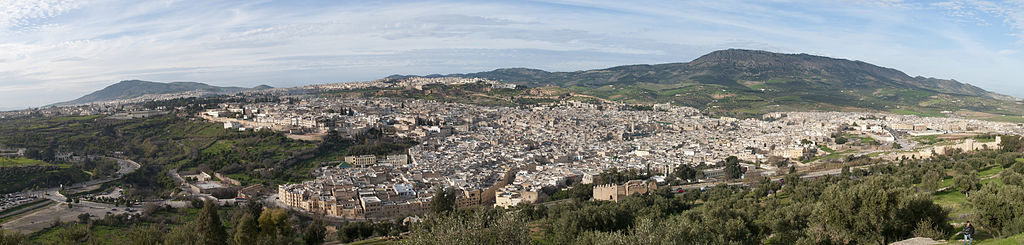
Panoramic view of the Old Medina in Fez, Morocco.
Photo by Michal Osmenda via Wikimedia Commons.

Yet there was another region that Botero singled out in terms of its technological and economic achievements, which I had never heard mentioned before: the land of “The Xeriffe”.

The term is usually rendered as sharif, denoting a descendant of the Prophet Muhammad via his grandson, Hasan ibn Ali. In 1600, the title was claimed by the rulers of the Saadi Empire, centred around Fez, in present-day Morocco. Botero claimed that its cities were of marble and alabaster, decorated with great lamps of brass. In Fez in particular were “200 schools of learning, 200 inns, and 400 water mills, every one driven with four or five wheels”, from which the ruler derived a substantial rent. The city also featured “600 conduits, from whence almost every house is served with water.” Indeed, he noted that “the inhabitants are very thrifty, given to traffic [commerce], and especially to the making of clothes of wool, silk, and cotton.”

So here was a remarkable city. One that was wealthy, populous, somewhat industrialised, and given to trade. It was a centre of learning for the entire region, especially under the long rule of one of its sultans, Ahmad al-Mansur “the Golden” and his immediate successors: the library they amassed forms one of the major surviving collections of Islamic manuscripts on literature and science (which was captured during a war in the seventeenth century, and has been in Spain ever since). The Saadi Empire even had some military might: during its rise it successfully contended with Portugal, and it had a large arsenal of gunpowder weapons, which it put to use in conquering parts of Sub-Saharan Africa. It maintained friendly commercial and diplomatic links with both England and the Dutch Republic, uniting with them in their opposition to Spain.

And yet, the Saadi Empire is never mentioned as an efflorescence [defined as “temporary bubblings up of innovation and economic growth, which ultimately resulted in stagnation or decline”]. It doesn’t even feature in debates about the causes of the Long Divergence — the centuries-long reversal of economic fortunes between northwestern Europe and the Islamic world. The latest major book on the reversal, by Jared Rubin (which is excellent, by the way), is entirely devoted to comparisons with the Ottoman Empire, not discussing Morocco even once. That may just be a product of which sources are most readily available in English, or because there are currently quite a few excellent Turkish economic historians, like Şevket Pamuk or Timur Kuran. It’s also possible that the descriptions of Fez’s wealth were exaggerated, or that there are straightforward explanations for its relative economic decline. But, if we’re to fully understand the causes of the Industrial Revolution in Britain, I think the rise and fall of the Saadi Empire is another efflorescence we need to seriously consider.

Why The US Military Made GPS Free-To-Use

Filed under: History, Military, Space, Technology, USA — Tags: , , — Nicholas @ 02:00

Real Engineering
Published 16 Jun 2017

Get your Real Engineering shirts at: https://store.dftba.com/collections/r…

Patreon:
https://www.patreon.com/user?u=282505…
Instagram:
https://www.instagram.com/brianjamesm…
Twitter:
https://twitter.com/Fiosracht
Website:
http://www.RealEngineering.net

Thank you to my patreon supporters: Adam Flohr, darth patron, Zoltan Gramantik, Henning Basma, Karl Andersson, Mark Govea, Mershal Alshammari, Hank Green, Tony Kuchta, Jason A. Diegmueller, Chris Plays Games, William Leu, Frejden Jarrett, Vincent Mooney, Ian Dundore, John & Becki Johnston. Nevin Spoljaric

Once again thank you to Maeson for his amazing music. Check out his soundcloud here: https://soundcloud.com/maeson-1/tracks

QotD: The heyday of blogging

Filed under: Humour, Media, Quotations — Tags: — Nicholas @ 01:00

This was a birthday party, not a blogger meeting. You could tell it wasn’t a blogger meeting because NO ONE WAS SPEAKING ELVISH OR KLINGON, and several of the people there weren’t virgins.

Steve H., “Cracking on Crackers”, Hog On Ice, 2005-01-21.

January 30, 2020

Upgrading NORAD’s capabilities with AN/SPY-7(V)1 radar (aka “Aegis Ashore”)

Filed under: Cancon, Military, Technology, USA — Tags: , , , , — Nicholas @ 05:00

Ted Campbell on the need to upgrade NORAD radar installations as part of a general refurbishment of the alliance’s capabilities:

Lockheed Martin’s Solid State Radar has been designated as AN/SPY-7(V)1 by the US government.
Image from Lockheed Martin/PRNewsfoto.

One of the elements which might be considered in modernizing and enhancing the North American Aerospace Defence Command (NORAD) surveillance, warning and control system is a new radar and some people have suggested that the AN/SPY-7(V)1 radar, sometimes called Aegis Ashore, might be a useful (and proven, it is in use, on land, in Japan, and will be fitted on Canada’s new Type 26 (destroyer-frigate) combat ships) solution. This radar is eminently suitable to be part of an enhanced (conventional) NORAD and of a CANUS continental ballistic missile defence system.

There are many technical (and logistical) advantages to using that radar on both our, Canadian, warships and in a land-based role, too.

The AN/SPY-7(V)1 radar produces a lot more information than do the current AN/FPS-117 and AN/FPS-124 radars which are used in the NORAD role, today, and were built in the 1980s using 1960s and ’70s technology.

(Please don’t worry about the AN/*** designations. They are part of a very sensible American system which was designed to make it simpler to identify both Army and Navy systems (hence the AN/ at the beginning). The three letters following the AN/ describe the system:

  • The first letter describes the installation. F means Fixed, on the ground (land) and S means on a ship;
  • The second letter means the type of equipment, and P means radar; and
  • The third letter means purpose. S means search (detection and locating) and Y surveillance and control.

Thus the SPY-7 is a shipborne surveillance radar and the FPS-117 is fixed (land-based) search radar. The numbers just differentiate one system from another.)

If Canada chooses an advanced radar, like the SPY-7, two engineering problems will need to be addressed:

  • First, these things use a lot more power than do the existing radars; and
  • Second, they produce much, much more information which needs to be “transported” instantly, to control centres in places like Canadian Forces Base North Bay, where all the data from all the radars is analyzed and used to effect NORAD’s mission. If the radar sites are located below (about) 72°N, as would be the case for coastal radars in BC, NS and NL, this is not a huge problem because the station is within the “footprint” of the big, high bandwidth satellites in geostationary orbit. But if the radar site is too far North then a terrestrial (possibly microwave, maybe tropospheric scatter) network (in which each station needs electrical power, too) will have to be installed to move the data to a satellite ground station. (Or a non-geostationary, high bandwidth, satellite system will have to be deployed.)
« Newer PostsOlder Posts »

Powered by WordPress