
Let me be clear that I think immigration and diversity are good things, overall. The economists seem to agree that immigration brings large economic benefits. The complete dominance of America in Nobel prizes, music, and the arts, and now the technology sector, would not have happened if we had not been open to immigrants. But as a social psychologist, I must point out that immigration and diversity have many sociological effects, some of which are negative. The main one is that they reduce social capital — the bonds of trust that exist between individuals. The political scientist Robert Putnam found this in a paper titled “E Pluribus Unum,” in which he followed his data to a conclusion he clearly did not relish: “In the short run, immigration and ethnic diversity tend to reduce social solidarity and social capital. New evidence from the US suggests that in ethnically diverse neighborhoods residents of all races tend to ‘hunker down.’ Trust (even of one’s own race) is lower, altruism and community cooperation rarer, friends fewer.”
In short, despite its other benefits, diversity is a centrifugal force, something the Founders were well aware of. In Federalist 2, John Jay wrote that we should count it as a blessing that America possessed “one united people — a people descended from the same ancestors, the same language, professing the same religion.” I repeat that diversity has many good effects too, and I am grateful that America took in my grandparents from Russia and Poland, and my wife’s parents from Korea. But Putnam’s findings make it clear that those who want more diversity should be even more attentive to strengthening centripetal forces.
Jonathan Haidt, “The Age of Outrage: What the current political climate is doing to our country and our universities”, City Journal, 2017-12-17.
February 16, 2020
QotD: Immigration and diversity
February 15, 2020
Paul Sellers’ Desktop Organiser | Episode 3
Paul Sellers
Published 14 Feb 2020Our Desktop Organiser series was originally released for free on Woodworking Masterclasses, to see Episode 4 straight away click here: https://woodworkingmasterclasses.com/…
Episode 4 will be released on YouTube on Friday 28th February.
Fitting the lid to the body of the box and marrying the surfaces results in a lid that fits properly in every way. But then there is the hinging, combined with the fielding that elevates the standard too.
All of that means that the main quality of the other features are equal in every way. For the inside divider, between the top bin and the drawer beneath, Paul takes you, step by step, through a very simple method for precise fitting.
For a free PDF of the drawing and cutting list, click here: https://paulsellers.com/desktop-organ…
——————–Want to learn more about woodworking?
Go to Woodworking Masterclasses for weekly project episodes: http://bit.ly/2JeH3a9
Go to Common Woodworking for step-by-step beginner guides and courses: http://bit.ly/35VQV2ohttp://bit.ly/2BXmuei for Paul’s latest ventures on his blog
——————–
Instagram: http://bit.ly/2oWpy7W
Twitter: http://bit.ly/33S7RFa
Pinterest: http://bit.ly/35X5uTf

Disrupting railways as an activist tactic appears to work really, really well
As Colby Cosh writes, for all the issues Alberta has with the government in Ottawa, nobody seriously suggested messing up the railways to get attention. Perhaps they should have:

“DSC02285” by Bengt 1955 is licensed under CC BY-NC 2.0


It never occurred to us to mess with the rail network in Eastern Canada — to inconvenience the precious commuters of the Golden Horseshoe — as a means of gaining negotiating leverage. Actually, I’m sure some people must have suggested it, but they would have been written off as selfish, dangerous idiots advocating counterproductive tactics.
The economic impact of the rail protests is big, but surely comparable, at the moment, to that of a big storm. Yet because a B.C. Aboriginal community is carrying its fight with the B.C. government to the guts of Canada, the clamour over whether large public works are now possible at all in Canada has instantly achieved new and unfamiliar volume levels.
The Coastal GasLink that is the source of the strife is a provincially regulated work running from Dawson Creek to the coast; unlike the vastly more expensive problems Alberta has encountered, this technically isn’t an issue for the wider federation at all. Except, whoops, it is! Because someone decided to make it one!
The levels of irony dazzle the imagination. The Canadian West was settled by means of passenger rail, which is supposedly one reason it was chosen as a target by the radicals supporting the Wet’suwet’en hereditary chiefs in their pipeline fight. But intercity commuter rail no longer really exists between the West Coast and Hamilton. The West is ultimately as dependent on rail freight as the East, and maybe more so, but it was that commuter inconvenience that gave rise to an immediate sense of national crisis, while Calgary and Saskatoon and Winnipeg snoozed.
And climate-change activists found themselves blocking rail lines in “solidarity” with the Wet’suwet’en, even though the chiefs’ fight is a question of territorial principle rather than carbon sins. This put the greenies in the position of opposing and thwarting actual rail travel. They admit this is anomalous; nobody likes to attach the word “hypocritical” to himself.
One of the protesters pointed out to the Star‘s Alex Boyd how dependence on rail — dependence of the sort that they spend 364 days a year advocating for intra-city commuters — facilitates unlawful, obstructive protest as a means for the self-anointed to “put pressure on decision-makers.” It is a little harder to block paved roads than railroads, and much harder to sabotage them, if it comes to that — which it might have if the police had used force to immediately disperse the protests. For some, this counts as a feature of rail, not a bug.
The Best Couples in History — Valentine’s Day Special
Overly Sarcastic Productions
Published 14 Feb 2020Happy Valentine’s Day! Celebrate the history of Love with a rundown of these outstanding couples — for better and for worse.
Our content is intended for teenage audiences and up.
This video was edited by Sophia Ricciardi, AKA “Indigo”.
PATREON: https://www.Patreon.com/OSP
DISCORD: https://discord.gg/h3AqJPe
MERCH LINKS: https://www.redbubble.com/people/OSPY…OUR WEBSITE: https://www.OverlySarcasticProductions.com
Find us on Twitter https://www.Twitter.com/OSPYouTube
Find us on Reddit https://www.Reddit.com/r/OSP/

Theodore Dalrymple on the death penalty
From the New English Review:
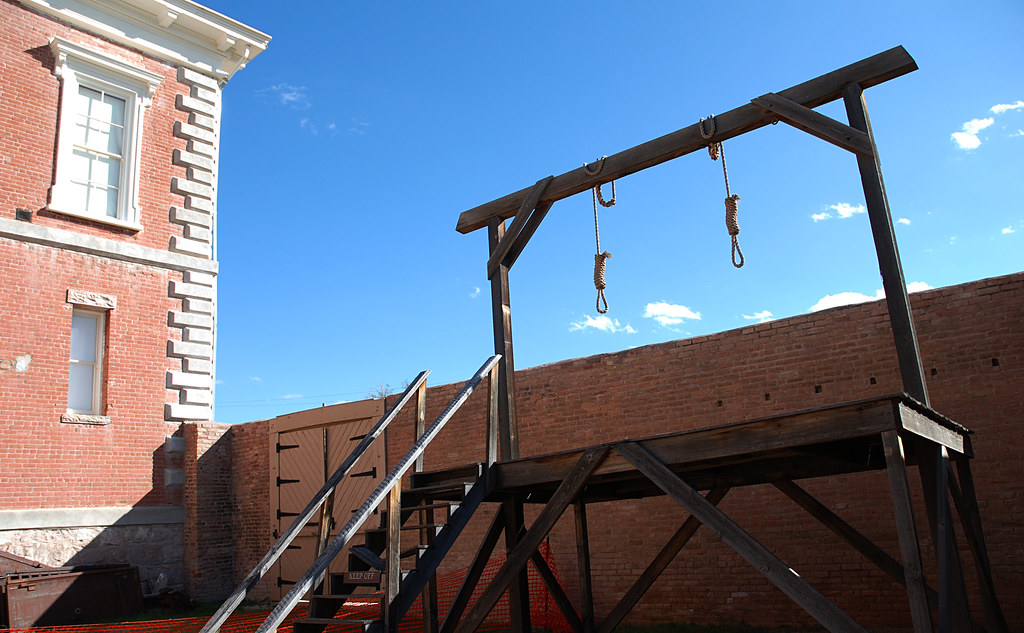
“Tombstone Courthouse State Historic Park” by August Rode is licensed under CC BY-NC-SA 2.0
I happened to read a book published in 1965, the year Britain legislated to end the death penalty, titled Murder Followed by Suicide, by the distinguished criminologist, D.J. West. For forty years up to that date, about a third of homicides had been followed by the suicide of those who committed them.
Most people who committed homicide followed by suicide were highly disturbed psychologically, if not outright mad. For example, in killing their families they imagined that they were saving them from a worse fate. They were not the kind of people who would be deterred by anything, including the death penalty.
Here was a natural experiment. I hypothesized that if the death penalty acted as a deterrent, the homicide rate would increase but the proportion of homicide followed by suicide, which in absolute numbers would remain more or less the same, would decrease. My friend, the criminologist David Fraser, looked at the actual figures and found that this was indeed the case. Some sane people who might otherwise be inclined to kill managed to control themselves knowing that they might be executed if they did.
For the death penalty to deter, it was not necessary for it to be applied in every case. Although the death penalty for murder was mandatory in Britain, it was commuted in nine cases out of ten. All that was necessary for it to deter was that execution was a real possibility. We shall never know whether the death penalty would have deterred even more if it had been applied more rigorously.
Does its deterrent effect, then, establish the case for the death penalty, at least in Britain? No, for two reasons. First, effectiveness of a punishment is not a sufficient justification for it. For example, it might well be that the death penalty would deter people from parking in the wrong place, but we would not therefore advocate it. Second, the fact is that in all jurisdictions, no matter how scrupulously fair they try to be, errors are sometime made, and innocent people have been put to death. This seems to me the strongest, and perhaps decisive, argument against the death penalty.
Against this might be urged the undoubted fact that some convicted murderers who have been spared death have gone on to kill again, and this will continue to be so. Victims of those who murder a second time are probably more numerous than those executed in error. Therefore, utilitarians might argue, even if mistakes are sometimes made, that the death penalty overall would save lives. (Let us disregard the fact that those murderers who go on to murder a second time would not necessarily have been executed after their first murder, for nowhere are all murderers executed.)
The argument holds only if utilitarianism is accepted as a true ground of ethics. But few of us would accept that it is. It might be that hanging the wrong person after the commission of a terrible crime would have a better social outcome than hanging no one at all, provided only that it was never publicly known that the wrong person had been hanged: but we would still be horrified at the prospect. Moreover, in practice, the execution of the innocent, once it is known, serves disproportionately to undermine faith in the justice system. And surely it is true that for the state to kill an innocent man is peculiarly horrific.
Lupercalia
Historia Civilis
Published 4 Sep 2014Patreon: https://www.patreon.com/HistoriaCivilis
Website: https://www.historiacivilis.com
Twitter: https://twitter.com/HistoriaCivilis
Plus a bonus video with a Julius Caesar connection:

QotD: Architecture’s lingering racism
In the 1920s, during the time he was a member of the French Fascist party, the seminal architect Le Corbusier said he was disgusted by the “zone of odours, [a] terrible and suffocating zone comparable to a field of gypsies crammed in their caravans amidst disorder and improvisation.” He also chimed in with Loos: “Decoration is of a sensorial and elementary order, as is color, and is suited to simple races, peasants, and savages … The peasant loves ornament and decorates his walls.”
More recently, indicative of architecture’s current race problem, in 2006 the aforementioned highly influential dean of Tulane’s architecture school, Reed Kroloff, wrote the embarrassingly tone-deaf, flat-footed essay “Black Like Me.” (As I discuss below, he collaborated with Betsky on a post-Katrina project.) Kroloff — the privileged, self-described gay white Jew from Waco, Texas — announced that he was now black, that the Hurricane Katrina disaster had made him feel first-hand the African-American predicament. His piece was subject to much ridicule. No wonder the Mods have chosen to insulate themselves from the un(brain)washed masses. Architecture has become a gated community.
Betsky, to his credit, doesn’t pretend that architects should even try to make outreach. Showing little sympathy for democracy, he says that appeals to the public are “mystical.” The people — the 99% — do not deserve a seat at the table. Yet Betsky would have us believe that he and the architecture he supports are “progressive.”
Justin Shubow, “Architecture Continues To Implode: More Insiders Admit The Profession Is Failing”, Forbes, 2015-01-06.
February 14, 2020
Innovation and the “low-hanging fruit”
In the latest Age of Invention newsletter, Anton Howes wonders about the “low-hanging fruit” theories on innovation and why some things that seem obvious in hindsight took so long to be noticed:

A flying shuttle with bobbin.
Photo by Audrius Meskauskas via Wikimedia Commons.
A theme I keep coming back to is that a lot of inventions could have been invented centuries, if not millennia, before they actually were. My favourite example is John Kay’s flying shuttle, one of the most famous inventions of the British Industrial Revolution. It radically increased the productivity of weaving in the 1730s, but involved simply attaching a little extra wood and string. It involved no new materials, was applied to the weaving of wool — England’s age-old industry — and required no special skill or science. Weaving had been “performed for upwards of five thousand years, by millions of skilled workmen, without any improvement being made to expedite the operation, until the year 1733”, was how Bennet Woodcroft — one of the nineteenth century’s most important historians of technology — put it. (Lest you doubt that description of Woodcroft, he was, in addition to being an inventor himself, the man who compiled and categorised England’s entire patent record up to 1852, and who collected the inventions that would later form the basis of London’s Science Museum, particularly some of the earliest steam engines — among the most important machines in human history — that grace its engine hall today. My hero!) Weavers had been around for millennia, as had shuttles: one is even mentioned in the Old Testament (“My days are swifter than a weaver’s shuttle, And are spent without hope”). As a labour-saving invention, Kay’s flying shuttle was even technically illegal.
I keep coming back to this example, because it goes against so many common notions about the causes of innovation. When it comes to skill, materials, science, institutions, or incentives, none of them quite seem to fit. But I keep seeing more and more such cases. There’s the classic example, of course, of suitcases with wheels — why so late? Was the bicycle another candidate?
It strikes me as odd, too, that there was an explosion of signalling systems like semaphore only towards the end of the eighteenth century. Although there were some seventeenth-century precursors, the main telegraphing systems in Europe seem to have been as crude as Gondor’s lighting of the beacons, capable only of communicating a single pre-agreed message. Ancient China at least had its smoke signals, as did many indigenous American societies, and apparently the ancient Greeks too. So what took semaphore so long to take off? Many of the eighteenth-century systems did not even need multicoloured flags, my favourite being Lieutenant James Spratt’s “homograph”, subtitled “every man a signal tower”, which involved just a long white handkerchief.
The economist Alex Tabarrok calls these cases “ideas behind their time“. I tend to just call them low-hanging fruit. Hanging so low, and for so long, that the fruit are fermenting on the ground. I now see them everywhere, not just in history, but today — probably at least one per week.
“Wolfpack” – German U-boat Tactics – Sabaton History 054 [Official]
Sabaton History
Published 13 Feb 2020The Battle of Britain had saved the United Kingdom from imminent invasion by the German Wehrmacht, however the war was far from over. To destroy Britain’s economic capabilities to wage war, the German Kriegsmarine had to win the tonnage war in the North Atlantic. The German submarines — the U-Boote, were sent out to hunt. As the British Royal Navy returned to the convoy system to protect its merchant fleet, the Germans as well began organizing their submarines in groups to attack in unison. These hunter-killer teams, the Wolfpacks, would soon haunt the depths of the North Atlantic.
Support Sabaton History on Patreon: https://www.patreon.com/sabatonhistory
Listen to “Wolfpack” on the album Primo Victoria:
CD: http://bit.ly/PrimoVictoriaStore
Spotify: http://bit.ly/PrimoVictoriaSpotify
Apple Music: http://bit.ly/PrimoVictoriaAppleMusic
iTunes: http://bit.ly/PrimoVictoriaiTunes
Amazon: http://bit.ly/PrimoVictoriaAmzn
Google Play: http://bit.ly/PrimoVictoriaGooglePlayCheck out the trailer for Sabaton’s new album The Great War right here: https://www.youtube.com/watch?v=HCZP1…
Listen to Sabaton on Spotify: http://smarturl.it/SabatonSpotify
Official Sabaton Merchandise Shop: http://bit.ly/SabatonOfficialShopHosted by: Indy Neidell
Written by: Markus Linke and Indy Neidell
Directed by: Astrid Deinhard and Wieke Kapteijns
Produced by: Pär Sundström, Astrid Deinhard and Spartacus Olsson
Creative Producer: Joram Appel
Executive Producers: Pär Sundström, Joakim Broden, Tomas Sunmo, Indy Neidell, Astrid Deinhard, and Spartacus Olsson
Post-Production Director: Wieke Kapteijns
Edited by: Iryna Dulka
Sound Editing by: Marek Kaminski
Maps by: Eastory – https://www.youtube.com/c/eastoryArchive by: Reuters/Screenocean https://www.screenocean.com
Music by Sabaton.Colorizations:
– Olga Shirnina, a.k.a. Klimbim – https://klimbim2014.wordpress.com/Sources:
– IWM: HU 16546, A 30292
– Bundesarchiv
– Otis Historical Archives, National Museum of Health and Medicine
– Narodowe Archiwum Cyfrowe
– Canadian ship being attacked, photo courtesy of the Government of Canada, https://www.canada.ca/en/navy/service…An OnLion Entertainment GmbH and Raging Beaver Publishing AB co-Production.
© Raging Beaver Publishing AB, 2019 – all rights reserved.

The reaction to the Mohawk blockade near Belleville shows that VIA Rail isn’t a serious company
Mohawk protesters began blocking the main CN and VIA line between Toronto and Montreal near Belleville nearly a week ago. The police, having learned so often that the government and the courts won’t back them up, did little to try to get the blockade lifted other than to prevent active confrontations with the First Nations activists. Canadian National announced that they were being forced to park trains all over Eastern Canada as a result of the blockade and that deliveries of goods would be snarled for quite some time even after service is allowed to resume. VIA rail, on the other hand, seems to care not a bit about the thousands of travellers who have been stranded mid-journey and made no apparent efforts to bring in buses or any other arrangements. Chris Selley says this proves that VIA is not an essential service even in their own minds:

“The 6424” by Stephen Downes is licensed under CC BY-NC-SA 2.0
Of all the bad news to befall VIA Rail this week, with the cancellation of all its trains between Toronto and Ottawa and Toronto and Montreal — that’s roughly 50 per cent of its ridership and 60 per cent of its revenues — the worst news might be just how little news it has made. Mostly, the Mohawk blockade of the CN main line near Belleville, Ont., has been treated as a side story to the anti-pipeline protests and arrests in the British Columbia interior.
That’s what it is in the grand scheme of things: The battle between Wet’suwet’en members and chiefs and the federal government speaks to much larger, existential questions about the future of the Canadian economy, about the Liberal government’s reconciliation agenda, about the very nature of the Canadian federation and the rule of law. This blockade, launched in the name of solidarity with the Wet’suwet’en, just means people have to take the bus, or fly, instead of the train.
But that’s no small inconvenience, no small expense. Canadians in general are not quick to anger, but very few of the VIA refugees interviewed by various news outlets sounded even slightly furious, which they had every right to be. When protesters from the same First Nation blockaded the same set of tracks six years ago, VIA properly exhibited some concern with getting their customers to their destinations and put on replacement buses.
This time around, no buses. No suggestions. No response to media inquiries asking why there are no buses. Just a cancellation notice on the website and a fare-thee-well. At a time when VIA is seeking untold billions from the federal government to build a new Toronto-Ottawa-Montreal route and run vastly more trains, this does not bespeak a company that takes itself very seriously.
[…]
And never mind VIA, what sort of country lets a few people close down a key piece of national infrastructure, in violation of a court injunction — not for an hour or a day, but literally indefinitely? For a time it wasn’t even clear whose job it was to enforce the injunction: On Sunday an Ontario Provincial Police spokesperson told Global News it was up to the CN Police Service. On Tuesday, a CN spokesperson told the National Post it was up to the OPP, and indeed, late Tuesday OPP officers warned protesters to leave or they would be forced out. Perhaps the threat of massive economic disruption finally lit a fire under them: earlier in the day, CN had said it was considering shutting down huge parts of its freight network across the country. Had it just been rail passengers, though, the idea of this side-protest dragging on for weeks or even months seems absurdly plausible.
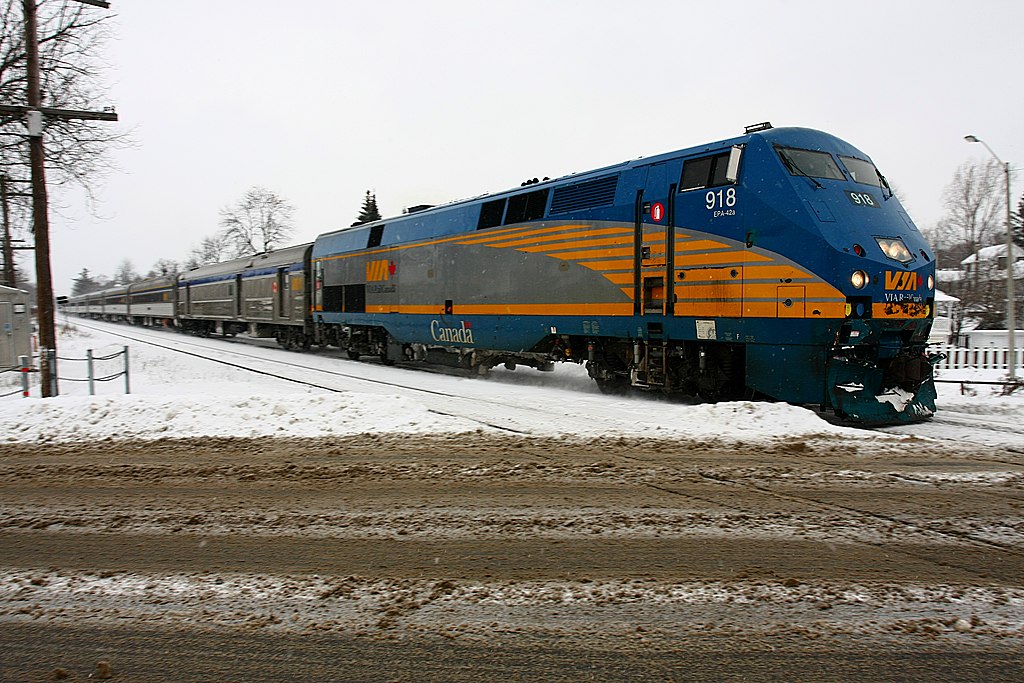
VIA Rail 918, a General Electric model P42DC locomotive, at Belleville, Ontario on 23 December 2008.
Photo by Martin Cathrae via Wikimedia Commons.
While VIA may not be serious, others are extremely serious:
Left-wing blogs have been offering instructions and maps during the #ShutDownCanada protests on how to blockade and destroy train tracks and other pieces of Canada’s infrastructure, according to True North.
Two websites in particular, these being North Shore and Warrior Up, have instructed demonstrators how to damage Canada’s pipelines, roads and railways.
In some of North Shore’s posts, for instance, they told their readers to stand in solidarity with the Wet’suwet’en tribe by destroying train tracks. In this article, the author makes it perfectly clear that he wants to damage Canada’s economy at large.
More absurdly, however, the article then went on to instruct the reader on how to compose a chemical mixture that destroys steel rail tracks — taking particular care to describe how not to leaving fingerprint or DNA evidence.
Thursday evening, VIA Rail announced their whole passenger network would be shut down until further notice: Service cancellation notice.

Silent But Deadly: Welrod Mk IIA
Forgotten Weapons
Published 27 Dec 2016http://www.patreon.com/ForgottenWeapons
Cool Forgotten Weapons merch! http://shop.bbtv.com/collections/forg…
If you enjoy Forgotten Weapons, check out its sister channel, InRangeTV! http://www.youtube.com/InRangeTVShow
The Welrod is a nearly completely silent bolt action pistol designed by SOE Section 9 for covert operation and assassination use during WW2. Chambered for the .32ACP cartridge (which is subsonic to begin with), the Welrod uses a ventilated barrel and large-volume suppressor with several solid rubber wipes to bring its firing report down to the minimum possible level. This noise reduction only lasts for about a dozen shots, after which time the rubber wipes have more or less bore-sized permanent holes in them, reducing the suppressor’s effectiveness to pretty much on par with other typical designs.
The Welrod is a manually operated pistol, to avoid action noise. It feeds from a Colt 1903 Pocket Hammerless magazine, which also serves as its grip. A grip safety is the only safety device, and it fires using a striker mechanism. The Welrod was first introduced in 1943, with a larger 9x19mm version added later in the war. They appear to have been manufactured by BSA, with a total of about 14,000 made. Welrods were in service as recently as Desert Storm, and are most likely still in use for those times when a very efficient silent pistol is necessary.
Thanks to the Institute of Military Technology for allowing me to have access to this very cool pistol and bring it to you! Check them out at:

QotD: Canadian youth
More pernicious, and ultimately, in my view, far more dangerous — should my generation ever locate their polling stations — is a poisonous, systemic anti-Americanism. The young people I know hate the United States, and hate Americans. Many people have seen the infamous poll released last June which indicated that 40% of Canadian teens viewed America as “evil.” Many people were surprised by the results. So was I.
I thought the number was low.
The average youth voter, in my personal experience, has, at most, three political principles:
- Equality is good. (Usually interpreted as equality of results… equality of opportunity is probably ‘racist’ and ‘greedy.’)
- Everything is relative. “Good” and “Evil” are anachronistic terms devoid of meaning … they’re just, like, your opinion, man.
- George Bush is the living embodiment of all that is Evil. He is, literally, the anti-Christ, and he feeds on the blood of puppies and minorities. Plus, he thought our Prime Minister’s name was Poutine.
Joel Fleming, “The Youth Vote”, Joel Fleming, 2005-01-06
February 13, 2020
“Titania McGrath thinks you’re scum. That is because of how tolerant she is.”
Spencer Klavan interviews the mind behind the Twitter legend that is Titania McGrath:
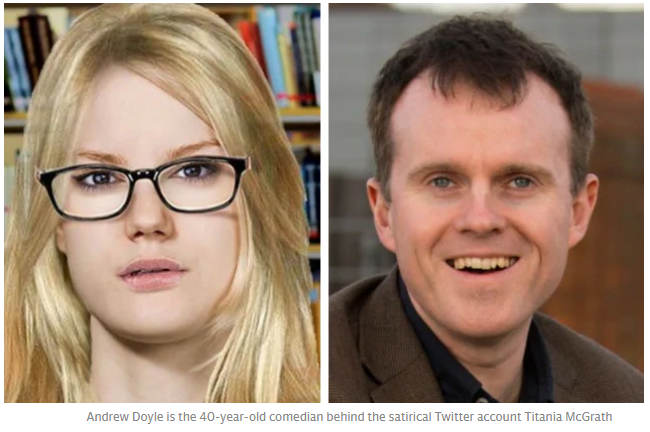
In April 2018, Oxford-educated comedian and journalist Andrew Doyle created a satirical Twitter persona, an “activist,” “healer,” and “radical intersectionalist poet” who self-identifies as “selfless and brave.” Titania, an imaginary amalgam of all the worst excesses in the modern social justice movement, fancies herself a voice for minorities of all kinds (whether they know they agree with her or not). What she lacks in self-awareness, she makes up for in conviction.
There are other parody accounts in a vein similar to Titania’s: Jarvis Dupont of the Spectator USA, for example, or Wrightly Willowleaf (who moved to Williamsburg before it was cool). But none of them has achieved Titania’s notoriety, or her reach (418.4K followers). Doyle attributes some of this success to a much-publicized Twitter ban. But that’s perhaps too modest: Titania is a note-perfect creation, as frighteningly accurate as she is screamingly funny. “[Y]ou need to understand that which you are critiquing,” Doyle told me: more than anything, his tweets as Titania demonstrate an incisive grasp of how radical progressivism functions and why woke politics commands such hypnotic power over the 21st-century Western psyche.
Doyle is among a growing number of classical liberals who have simply had enough: witty, thoughtful, and profoundly humane, he is the kind of eloquent sophisticate who would have been quite uncontroversial as a cultural critic and public intellectual in a less turbulent era. But that wasn’t his fate. Comedy and culture have been so strangled by political correctness that he is “at that point where I feel that it would be morally wrong to be silent” about the crisis of free public discourse in the West. Still, there is much more to Doyle than politics and polemic. I spoke to him at some length about his philosophical outlook, his academic interests, and his career beyond Titania.
[…]
S.K. Yes, something you capture really well with Titania is the complete lack of self-awareness, the oblivion of people to their own racism even as they criticize racism in others.
Let’s talk about that moment when Titania got banned: you’ve written elsewhere that “those in power cannot tolerate being ridiculed.” That was a theme when we interviewed Kyle Mann of the Babylon Bee as well: why do you think ridicule gets woke people so angry?
A.D. Because it’s an effective way to expose their folly. There’s something very instinctive that we all have as human beings: we don’t like being laughed at. And that makes sense: it feels like a form of humiliation. But I also think that’s why it’s a good way to puncture and deflate those kinds of pretensions. And they absolutely don’t like it — I mean, tyrants throughout history have locked up and killed satirists. We had the Bishop’s Ban on any satirical work in Great Britain, and that was in 1599. You’ve got president Erdogan in Turkey who will lock up satirists and call for their arrest — so it’s a pretty standard feature of history.
Of course, with Titania, the misinterpretation of what she’s doing is that she’s punching down, she’s attacking minorities. That’s not the point at all: it’s attacking the social justice movement, which is very very powerful but doesn’t perceive itself to be powerful. That’s why they claim victimhood: so that they can say mocking social justice is mocking the weak. It’s not, of course. It’s mocking those who are in power.
S.K. You’re absolutely right that persecution of satire by the powerful is as old as satire itself — goes back to the court of Ptolemy II, probably further. So let’s talk about power.
Based on what you’ve written it seems as if you feel that wokeness wields a kind of soft power — a cultural power more than a legal or a political power. I’m reminded a bit of Shelley’s argument that poets are the “unacknowledged legislators of the world.” How is it that you think the woke and the social justice movement came to acquire the overwhelming degree of cultural power they now have?
A.D. I think it’s because the woke movement is largely driven by people who are independently wealthy and privately educated. Just to give you an example from the U.K.: 7% of our country is educated privately. So those are the richest people, but those 7% dominate the arts, and the media, and journalism, and the law, and education, and the government. So what you have is a very small coterie of very powerful people who disproportionately control the direction of culture.
The BBC is a good example of an institution that is overly dominated by privately educated people, and it’s very very woke. So there seems to be a correlation. And similarly, the universities where they have the most woke students, and the most people wanting to de-platform and censor — which comes hand-in-hand, obviously, with woke culture — there is a clear correlation between the economic privilege of students and how woke they are. So the worst examples you’ll find are in places like Oxford University, Cambridge University, Yale, and Harvard. Those will be the ones where you get the most egregious examples of censorial wokeness. And of course those are the kids who come from the most privileged backgrounds.
It is no surprise to me that those with the most would like to claim to have the least and to be the most oppressed. There was a survey in the Atlantic about political correctness, and by a long way, the people who resent political correctness the most are the ones whom it purports to defend: the ethnic minorities and the sexual minorities and so on. And the people who support political correctness the most tend to be rich white liberals, by a long way. I think there’s something quite strategic about holding on to power by claiming to be oppressed or claiming to stand up for the oppressed. It’s something which I think is unprecedented in history: those who claim to be the victims also seize the power. It’s very unusual.
You don’t need a vise on the Joiner’s Bench
Rex Krueger
Published 12 Feb 2020Vises are useful for woodwork, but you can do EVERY woodworking operation without a vise.
More video and exclusive content: http://www.patreon.com/rexkrueger
Get the Viseless Workholding Plans: https://www.rexkrueger.com/store/plan…
(more…)
Here’s a deceptive factoid … time for you to get angry to suit someone’s political agenda
Did you know that “Three Billionaires Have More Wealth Than Half of America”!!!???!!! Are you angry now? You’re supposed to be, because this factoid was concocted specifically to make people irrationally angry. Daniel C. Jensen explains how this sound bite was created:

Amazon’s Jeff Bezos, Microsoft’s Bill Gates, and Berkshire Hathaway’s Warren Buffet.
Fox Business.
People between 0 and 24 years of age account for about 32 percent of the United States population of 320 million. Almost all of them are going to be in the bottom half of the wealth distribution for reasons including diaper rash and puberty. That means they account for about 63 percent of the “bottom half of the wealth distribution.” Should it surprise us that some kid fresh out of college does not “hold any stocks or bonds”? Or a kid fresh out of the womb?
Then we must consider people with mental and physical disabilities. They will also tend to be in the bottom half of the wealth distribution because they face greater challenges to building wealth. “About 56.7 million people — 19 percent of the population — had a disability” at last count, according to the United States Census Bureau. But there is overlap between the disabled 19 percent and the young 32 percent of the population. If we assume disabilities are evenly distributed in the population, then young people and non-young disabled people account for 45 percent of the population. So we have now accounted for 90 percent of the “160 million Americans in the bottom half of the wealth distribution.”
Next, we must think about other groups who have had limited wealth-building opportunities. What about the 2.2 million people in jail and prison? What about people in their late twenties who pursued PhDs, law degrees, medical residencies, etc., and are just beginning their careers? Now we are close to accounting for 100 percent of the “bottom half of the wealth distribution.” But this wealth distribution is not what any sensible person would expect it to be.
Maybe the factoid is true. Maybe Jeff Bezos, Bill Gates, and Warren Buffet have more wealth than all of the infants, children, students, handicapped, prisoners, and postgrads combined. But you don’t need a PhD to figure out that’s not useful knowledge. Even if the factoid is true, it’s deceitful. Whoever created it was obviously trying to manipulate people. And we uncovered this deception with nothing but some simple knowledge of the US population.
Next time you encounter an economic factoid, remember that it might be pitting a bunch of newborns against Jeff Bezos, and that hardly seems fair. Thankfully, you can save those babies from certain defeat simply by knowing some basic statistics about your country.


