Suibhne
Published 23 Apr 2018The Armchair Historian Collab: https://youtu.be/vGM54x0LsII
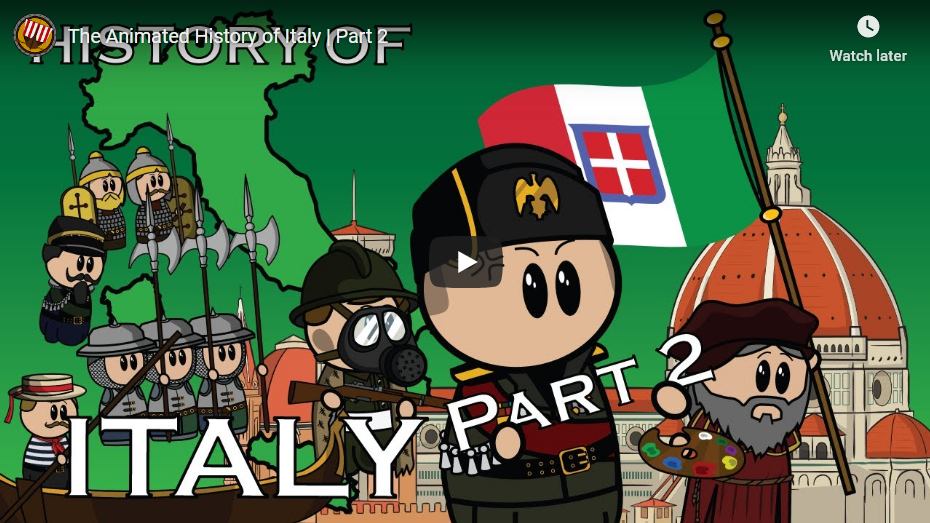
Beginning part two, Italy has been recaptured by the Byzantines thanks to the tenacious ambitions of Emperor Justinian. But throughout the Middle Ages, the land became a battleground for more powerful empires. The 19th Century Italian revolution would see the peninsula swept up in the waves of nationalism that was taking the continent by storm.
February 13, 2020
The Animated History of Italy | Part 2
QotD: Libertarianism
I make here the case for a modern and humane version of what is often called “libertarianism.” It is not right wing, reactionary, or some very scary creature out of dark money. It stands in the middle of the road – recently a dangerous place to stand – being tolerant and optimistic and respectful. It’s true liberal, that is, anti-statist, opposing the impulse of people to push other people around. It’s not “I’ve got mine,” or “Let’s be cruel.” Nor is it “I’m from the government and I’m here to help you, by force of arms if necessary.” It’s “I respect your dignity and am willing to listen, really listen, helping you when you wish, on your own terms.” When people grasp it, most like it. Give it a try.
Dierdre Nansen McCloskey, Why Liberalism Works: How true Liberal values produce a freer, more equal, properous world for all, 2019.
February 12, 2020
Guderian – Myth & Reality
Military History Visualized
Published 24 Apr 2018Heinz Guderian, the father of the German Panzerwaffe, is one of the best known German generals from the Second World War. He is also known for his opposition to the Battle of Kursk (Operation Zitadelle) and the early deployment of the Panzerkampfwagen V Panther, yet some historians noted recently that many of Heinz Guderian’s claims are not backed up by archives. Well, time to take a closer look.
»» SUPPORT MHV ««
» patreon – https://www.patreon.com/join/mhv
» paypal donation – https://www.paypal.com/cgi-bin/webscr…»» MERCHANDISE – SPOILS OF WAR ««
» shop – https://www.redbubble.com/people/mhvi…»» SOCIAL MEDIA ««
» twitter – https://twitter.com/MilHiVisualized
» twitch – https://www.twitch.tv/militaryhistory…
» minds.com – https://www.minds.com/militaryhistory…» SOURCES «
Pöhlmann, Markus: Der Panzer und die Mechanisierung des Krieges: Eine deutsche Geschichte 1890 bis 1945 (Zeitalter der Weltkriege)
Corum, James S.: The Roots of Blitzkrieg. Hans von Seeckt and German Military Reform
Macksey, Kenneth: “Generaloberst Heinz Guderian”; in: Ueberschär (Hrsg.) Gerd R.: Hitlers militärische Elite – 68 Lebensläufe (3. Auflage), S. 351-358
Guderian, Heinz: Panzer Leader (English Version of Erinnerungen eines Soldaten)
Guderian, Heinz: Erinnerungen eines Soldaten
Munzel, Oskar: Die deutschen gepanzerten Truppen bis 1945
Schacter, Daniel L.: The Seven Sins of Memory: How the Mind Forgets and Remembers
Citino, Robert M.: The German Way of War. From the Thirty Years’ War to the Third Reich
Citino, Robert M.: The Wehrmacht Retreats: Fighting a Lost War, 1943
» CREDITS & SPECIAL THX «
Song: Ethan Meixsell – “Demilitarized Zone”#ww2 #panzergeneral #Guderian
Rebecca Black, nine years after the release of “Friday”
CNN‘s Scottie Andrew talked to Rebecca Black about her experiences and the reactions to her debut video:
Partyin’, partyin’, YEAH! “Friday,” the accidental anthem of 2011 and an ode to the best day of the week, is officially nine years old.
It became something of a national joke when it debuted. But to a then-13-year-old Rebecca Black, the single’s star, the jokes made at her expense were immensely damaging.
Black, now 22 but still a pop singer, is remarkably well-adjusted for someone whose life was upended by a music video. She marked the 9th anniversary of the song that started it all with a note to her younger self — and advice for her followers to love themselves a little better.
[…]
Black was only in middle school when she filmed the infamous video. She paid a company called Ark Music Factory to write her a song and film a music video for it, starring her and her friends.
It’s not an artistic achievement, but it’s fitting for the young star at its center. In it, Black sways and sings her way through a Friday — she wakes up, she eats cereal, she can’t decide which seat in a convertible to take. Typical teen stuff.
The negative comments rolled in almost immediately, and nearly all of them lambasted Black.
At the time, I linked to a couple of deconstructions of the video that amused me. One was from The Awl:
She offers the camera a hostage’s smile, forced, false. Her smoky eyes suggest chaos witnessed: tear gas, rock missiles and gasoline flames. They paint her as a refugee of a teen culture whose capacity for real subversion was bludgeoned away somewhere between the atrocities of Kent State and those of the 1968 Democratic Convention, the start of a creeping zombification that would see youthful dissent packaged and sold alongside Pez and Doritos.
“Look and listen deeply,” she challenges. An onanistic recursion, at once Siren and Cassandra, she heralds a new chapter in the Homeric tradition. With a slight grin, she calls out to us: “I sing of the death of the individual, the dire plight of free will and the awful barricades daily built inside the minds of all who endure what lately passes for American life. And here I shall tell you of what I have done in order to feel alive again.”
***Ms. Black first appears as her own computer-generated outline: wobbly, marginal, a dislocated erasure. The days of the week flip by accompanied by dull obligations — “essay due” — and tired clichés — “Just another manic Monday …” Her non-being threatens to be consumed by this virtual litany of nothing at all until, at long last — Friday.
[…]
Yet here the discerning viewer notes that something is wrong. Because it is a simple matter of fact that in this car all the good seats have already been taken. For Rebecca Black (her name here would seem to evoke Rosa Parks, a mirroring that will only gain in significance) there is no actual choice, only the illusion of choice.
The viewer knows that she’ll take the only seat that’s offered to her, a position so very undesirable as to be known by a derisive — the “Bitch” seat.
She might well have been better off on the school bus, among the have-nots. But Rebecca Black’s world is so advanced in the craft of evisceration that this was never a consideration. John Hughes died while out jogging, these are the progeny of his great materialist teen-villain, James Spader, a name that would come to be synonymous with desperate sex and high-speed collision. And as she gets in the car Ms. Black’s joy is as patently empty as her liberation.
“Partying, Partying,” she sings, in hollow mantra.
“Yeah!” an unseen mass replies, a Pavlovian affirmation.
The other was from Jeffrey Tucker in the Christian Science Monitor:
Far more significant is the underlying celebration of liberation that the day Friday represents. The kids featured in the video are of junior-high age, a time when adulthood is beginning to dawn and, with it, the realization of the captive state that the public school represents.
From the time that children are first institutionalized in these tax-funded cement structures, they are told the rules. Show up, obey the rules, accept the grades you are given, and never even think of escaping until you hear the bell. If you do escape, even peacefully of your own choice, you will be declared “truant,” which is the intentional and unauthorized absence from compulsory school.
This prison-like environment runs from Monday through Friday, from 8 a.m. to late afternoon, for at least ten years of every child’s life. It’s been called the “twelve-year sentence” for good reason. At some point, every kid in public school gains consciousness of the strange reality. You can acquiesce as the civic order demands, or you can protest and be declared a bum and a loser by society.
“Friday” beautifully illustrates the sheer banality of a life spent in this prison-like system, and the prospect of liberation that the weekend means. Partying, in this case, is just another word for freedom from state authority.
The largest segment of the video then deals with what this window of liberty, the weekend, means in the life of someone otherwise ensnared in a thicket of statism. Keep in mind here that the celebration of Friday in this context means more than it would for a worker in a factory, for example: for the worker is free to come and go, to apply for a job or quit, to negotiate terms of a contract, or whatever. All of this is denied to the kid in public school.

Jeeves & Windsor (Prince Andrew Edition) – Will Franken
Comedy Unleashed
Published 8 Feb 2020An imagined Prince Andrew receives advice from Jeeves about Jeffrey Epstein.
Live at London’s little home of free-thinking comedy.
Gigs every month https://comedyunleashed.co.uk/whatson
H/T to Hector Drummond for the link.
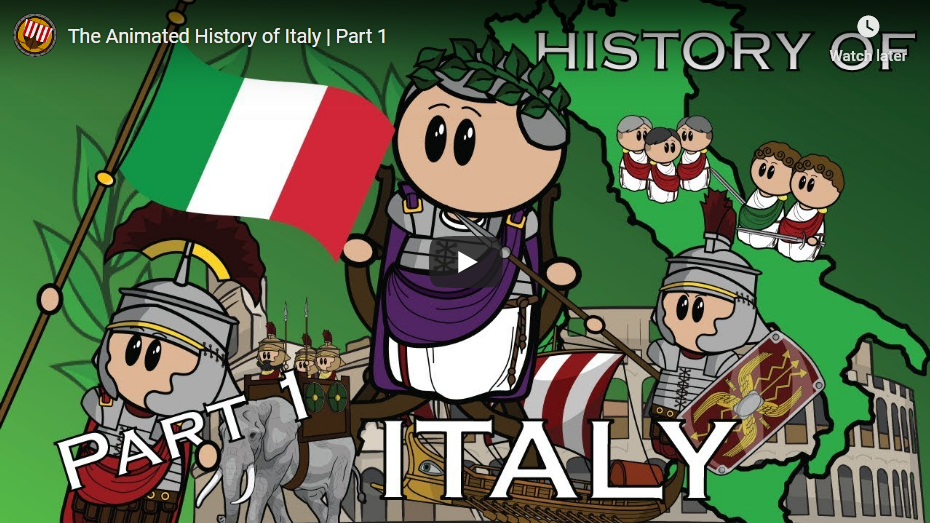
The Animated History of Italy | Part 1
Suibhne
Published 19 Mar 2018Signup for your FREE trial to The Great Courses Plus here: http://ow.ly/tsMf30iqEeT
The exciting first video in the History of Italy series. Find out how the Italian peninsula was perfectly positioned at the heart of the Mediterranean to both dominate trade, and then rise to defeat its rivals, becoming the most powerful empire Europe, and perhaps the world has ever known
QotD: Experienced political operators after an unexpected paradigm shift
I think this is causing some confusion, blindness and otherwise inexplicably stupid behavior in people who never seemed stupid before. This is what I call The Years the Masks Fell off.
Look, take a just-now thing: the DNC says that all precincts in Iowa WERE counted. The app recorded every vote, they say. They just need to tally them.
Turns out that’s probably not precisely true.
As a friend noticed, that’s not precisely a lie, that’s just “making sh*t up.”
We’re seeing that a lot from the other side of the aisle suddenly. Unbelievably stupid behavior like the sham wow impeachment.
They keep telling us “Who you gonna believe, me or your lying eyes?” and being shocked and appalled when we choose our lying eyes.
[…]
And then they’re shocked, nay astonished, when these tactics don’t work. While we who are standing outside this look at them and go “Who would think that would work? Some two year old?”
I mean half of the bizarre behavior of our government and its agencies falls under that heading too. “Who could think that would work/wouldn’t be found out/made any sense?”
But the thing you have to understand is that you’re not dealing with stupid people. Not by half. You’re dealing with people who were very competent and comfortable in — for lack of a better term — the previous paradigm of politics, or publishing or whatever.
The more comfortable they were; the easier it was for them, the harder it is to accept that it’s gone and it’s not coming back
For instance, the dems could trust the media would cover for them absolutely and completely, and that their pettiness, idiocy or outright corruption would never be revealed.
They got used to it, they got comfortable. They got to believing it was their natural right. It was just the way things were. They were the good people. Their hearts were pure. No one would ever look into their behavior outside the limelight.
If some psychological tests are correct, they grew to believe they were entitled to corruption and unethical behavior for all the “good” they did, such as Clinton thinking he was entitled to all the women he wanted for “fighting for women’s rights” (Which for men like him always mean abortion, but never mind.)
They can’t adapt. They can’t believe things have changed.
Sarah Hoyt, “How Things Have Always Been”, Libertarian Enterprise, 2020-02-09.
February 11, 2020
Hydrogen – the Fuel of the Future?
Real Engineering
Published 20 Apr 2018Thank you to Shell for sponsoring this video. Listen to the Intelligence Squared Podcast for more: https://www.intelligencesquared.com/i…
Instagram:
https://www.instagram.com/brianjamesm…Additional Reading: https://go.shell.com/2qLmhWv
Get your Real Engineering merch at: https://standard.tv/collections/real-…
Patreon:
https://www.patreon.com/user?u=282505…
Instagram:
https://www.instagram.com/brianjamesm…
Twitter:
https://twitter.com/FiosrachtMy Patreon Expense Report:
https://goo.gl/ZB7kvKThank you to my patreon supporters: Adam Flohr, darth patron, Zoltan Gramantik, Henning Basma, Karl Andersson, Mark Govea, Mershal Alshammari, Hank Green, Tony Kuchta, Jason A. Diegmueller, Chris Plays Games, William Leu, Frejden Jarrett, Vincent Mooney, Ian Dundore, John & Becki Johnston. Nevin Spoljaric, Kedar Deshpande
Music:
“Sydney Sleeps Alone Tonight” by eleven.five & Dan Sieg [Silk Music]
“Hydra” by Huma-Huma, and “Dawn” by Andrew Odd [Silk Music]
Silk Music: http://bit.ly/MoreSilkMusic
“… loveable Nickelodeon show Paw Patrol is an insidious tool of capitalism”
I’ve only heard of the show because my grand-niece is a huge fan, so I can’t say anything one way or another about these heresy allegations:
Six adorable, daring puppies and their whiz kid leader, ten-year-old Ryder, rescue people in the community of Adventure Bay. You would have to be a fool to not love Paw Patrol. And that’s where the Canadian state broadcaster CBC comes in!
A new article by Rebecca Zandbergen explores the groundbreaking new theory by Canadian university professor Liam Kennedy that loveable Nickelodeon show Paw Patrol is an insidious tool of capitalism. Kennedy, from King’s University College, has penned a vital new piece of research called “Whenever there’s trouble. Just yelp for help”: Crime, Conservation and Corporatization in Paw Patrol” in the peer-reviewed journal Crime Media Culture. His child isn’t allowed to watch the show, but Kennedy spent countless hours watching it in his office.
In the show, Ryder is the ring-leader of the pups, each of whom has a job to do as part of their team. There’s Chase, the police dog, Marshall, the fire chief dog who can never quite get control of his hose, Rubble, the builder, Skye, who flies a plane for some reason and is the girl pup, Everest, the extreme outdoor adventuring pup, Rocky, the rescue dog, and Zuma, the pup who drives a boat.
Together, they are the Paw Patrol, and they even have a headquarters, because all kids love a home base. Inexplicably, the grown-ups in town depend on Ryder and the pups to help them when they’re in a jam. Probably because it’s a show for kids, so it’s kid-centric. Kids like that.
Kennedy posits that “Paw Patrol, as a private corporation, is used to help provide basic social services in the Adventure Bay community. That’s problematic in that the Paw Patrol creators are sending this message that we can’t depend on the state to provide these services.”
Kennedy was angry that elected officials are not portrayed as heroes: “Mayor Humdinger and Mayor Goodway — kind of the representatives of the state or the government — are portrayed negatively,” Kennedy argued.
Kennedy also pointed out that, at the age of ten, Ryder should be in school, not saving the world. CBC did not bother to ask Kennedy how he feels about real-life school-skipper and saviour Greta Thunberg. We guess some do-gooders are more equal than others.
Leaving the Left – Part 9: PJ O’Rourke
Economics in the Media
Published 18 Aug 2016“When I got my first paycheck I found that I netted $82.27 after federal income tax, state income tax, city income tax, Social Security, union dues, and pension fund contribution. I was a communist. I had protested for communism. I had rioted for communism. Then I got a capitalist job and found out we had communism already.”
– The Baby Boom, PJ O’RourkeParliament of Whores: A Lone Humorist Attempts to Explain the Entire U.S. Government
Full Interview with Peter Robinson
https://youtu.be/keJYIkxbieg
Animal “rights”
In the latest Libertarian Enterprise, L. Neil Smith republished a short essay he wrote for the March 1996 edition which is still fully relevant today:

An olive ridley sea turtle, a species of the sea turtle superfamily.
NASA image via Wikimedia Commons.
Last Friday I watched an episode of X-Files in which innocent zoo animals were being abducted — apparently by benign, superior UFOsies (the ones who mutilate cattle and stick needles in women’s bellies) — to save them from a despicable mankind responsible for the erasure of thousands of species every year.
Or every week, I forget which.
I was reminded of a debate I’d found myself involved in about sea turtles; I’d suggested that laws prohibiting international trade in certain animal products be repealed so the turtles might be privately farmed and thereby kept from extinction. After all, who ever heard of chickens being an endangered species? From the hysteria I provoked — by breathing the sacred phrase “animal rights” and the vile epithet “profit” in one sentence — you’d have thought I’d demanded that the Virgin be depicted henceforth in mesh stockings and a merry widow like Frank N. Furter in The Rocky Horror Picture Show.
That debate convinced me of two things. First: I wasn’t dealing with politics, here, or even philosophy, but with a religion, one that would irrationally sacrifice its highest value — the survival of a species — if the only way to assure it was to let the moneylenders back into the temple. Its adherents abominate free enterprise more than they adore sea turtles.
Second (on evidence indirect but undeniable): those who cynically constructed this religion have no interest in the true believers at its gullible grassroots, but see it simply as a new way to pursue the same old sinister objective. A friend of mine used to refer to “watermelons” — green on the outside, red on the inside — who use environmental advocacy to abuse individualism and capitalism. Even the impenetrable Rush Limbaugh understands that animal rights and related issues are just another way socialism pursues its obsolete, discredited agenda.
In my experience, those who profess to believe in animal rights usually don’t believe in human rights. That’s the point, after all.
Maxim Pom-Pom 37mm Machine Gun
Forgotten Weapons
Published 13 Sep 2016Failed to sell at auction.
“Pom-Pom” was the name given to the 37mm Maxim gun by the Boers of South Africa, based on the gun’s sound. It was a Maxim machine gun scaled up to the quite impressive 37mm caliber, intended primarily for naval use defending large vessels against small torpedo boats. This particular example is serial number 2024, made in 1889 and then sold three times before being ultimately purchased by the United States Coast Guard and installed on the USS Manning (along with a second gun, number 2026). The Manning was promptly put into military service by the Navy and steamed down to Cuba, where it participated in the first bombardment of Cuba during the Spanish-American War.
These 37mm guns could fire a wide variety of projectiles, including solid rounds which could pierce an inch (25mm) of iron armor at 100 yards and hollow rounds filled with black powder and fused to explode on impact. During World War One, they would be pushed into anti-aircraft service, with the explosive rounds being extremely effective on early aircraft (when you could get a hit, anyway).
Related:
Bethlehem Steel 37mm Gun: https://www.youtube.com/watch?v=abEq7…
Vickers 2.95″ Mountain Gun: https://www.youtube.com/watch?v=-b53i…
Maxim lMG08/15: https://www.youtube.com/watch?v=Gbt1_…
QotD: Agriculture and the rise of the state
Why should cereal grains play such a massive role in the earliest states? After all, other crops, in particular legumes such as lentils, chickpeas, and peas, had been domesticated in the Middle East and, in China, taro and soybean. Why were they not the basis of state formation? More broadly, why have no “lentil states,” chickpea states, taro states, sago states, breadfruit states, yam states, cassava states, potato states, peanut states, or banana states appeared in the historical record? Many of these cultivars provide more calories per unit of land than wheat and barley, some require less labor, and singly or in combination they would provide comparable basic nutrition. Many of them meet, in other words, the agro-demographic conditions of population density and food value as well as cereal grains. Only irrigated rice outclasses them in terms of sheer concentration of caloric value per unit of land.
The key to the nexus between grains and states lies, I believe, in the fact that only the cereal grains can serve as a basis for taxation: visible, divisible, assessable, storable, transportable, and “rationable.” Other crops — legumes, tubers, and starch plants — have some of these desirable state-adapted qualities, but none has all of these advantages. To appreciate the unique advantages of the cereal grains, it helps to place yourself in the sandals of an ancient tax-collection official interested, above all, in the ease and efficiency of appropriation.
The fact that cereal grains grow above ground and ripen at roughly the same time makes the job of any would-be taxman that much easier. If the army or the tax officials arrive at the right time, they can cut, thresh, and confiscate the entire harvest in one operation. For a hostile army, cereal grains make a scorched-earth policy that much simpler; they can burn the harvest-ready grain fields and reduce the cultivators to flight or starvation. Better yet, a tax collector or enemy can simply wait until the crop has been threshed and stored and confiscate the entire contents of the granary.
Compare this situation with, say, that of farmers whose staple crops are tubers such as potatoes or cassava/manioc. Such crops ripen in a year but may be safely left in the ground for an additional year or two. They can be dug up as needed and the reaminder stored where they grew, underground. If an army or tax collectors want your tubers, they will have to dig them up tuber by tuber, as the farmer does, and then they will have a cartload of potatoes which is far less valuable (either calorically or at the market) than a cartload of wheat, and is also more likely to spoil quickly. Frederick the Great of Prussia, when he ordered his subjects to plant potatoes, understood that, as planters of tubers, they could not be so easily dispersed by invading armies.
The “aboveground” simultaneous ripening of cereal grains has the inestimable advantage of being legible and assessable by the state tax collectors. These characteristics are what make wheat, barley, rice, millet, and maize the premier political crops. A tax assessor typically classifies fields in terms of soil quality and, knowing the average yield of a particular grain from such soil, is able to estimate a tax. If a year-to-year adjustment is required, fields can be surveyed and crop cuttings taken from a representative patch just before harvest to arrive at an estimated yield for that particular crop year. As we shall see, state officials tried to raise crop yields and taxes in kind by mandating techniques of cultivation; in Mesopotamia this included insisting on repeated ploughing to break up the large clods of earth and repeated harrowing for better rooting and nutrient delivery. The point is that with cereal grains and soil preparation, the planting, the condition of the crop, and the ultimate yield were more visible and assessable.
James Scott, Against The Grain: A deep history of the earliest states, 2017.
February 10, 2020
Why wood warps/cups, and how to stop it!
Stumpy Nubs
Published 17 Sep 2018SUBSCRIBE (FREE) TO STUMPY NUBS WOODWORKING JOURNAL► http://www.stumpynubs.com
HELP KEEP OUR VIDEOS FREE! Please support those who support us by visiting their websites and having a quick look around-
Fisch Tools: https://affinitytool.com/brands/fisch
Clear Vue Cyclones (Use coupon codeNUBS5):
iGaging Digital Tools: http://www.chipsfly.com/category/L.html