Quotulatiousness

March 27, 2020

The Best SMLE: The No1 MkV Trials Rifle

Filed under: Britain, History, Military, Weapons — Tags: , , , , — Nicholas @ 02:00

Forgotten Weapons
Published 18 Nov 2019

After World War One, the British looked at how to apply the lessons of the war to development of a new infantry rifle. Even before the war, a decision had been made to move to an aperture type rear sight — which would have been used on the Pattern 1913 Enfield, had the war no interrupted adoption of that model. So after the war, trials were made on some MkIII SMLE rifles refitted with rear aperture sights. These trials were successful enough to justify production of a substantial number of rifles for troop trials. This would be designated the No1 MkV rifle, and 20,000 of them were made between 1922 and 1924.

The magazine cutoff was retained in the MkV rifles, as were the volley sights in the initial production — along with an aperture rear sight marked out to 1500 yards. Following concerns about the durability of the sight and its adjustment latch, it was redesigned slightly, and the new version only went out to 1400 yards. On this second variation, the volley sights were omitted.

The new rifles was taken to Bisley and input was sought from both military units and civilian marksmen from the British NRA. The feedback that was received was that the sight was too fragile, its adjustments were too coarse, and the barrel was too light. These changes were implemented in the No1 MkVI rifle which would ultimately be adopted as the N4 MkI; the classic World War 2 version oft he Lee Enfield.

http://www.patreon.com/ForgottenWeapons

Cool Forgotten Weapons merch! http://shop.bbtv.com/collections/forg…

Contact:
Forgotten Weapons
6281 N. Oracle #36270
Tucson, AZ 85704

QotD: “Jesus was a socialist”

Filed under: Government, Politics, Quotations, Religion — Tags: , , , , — Nicholas @ 01:00

Christ taught giving. Giving means taking ones own property and passing it on to someone in need. Nowhere did he advocate taking from others by force and “redistributing” it. He certainly did not advocate taking from others, using what’s taken to fund a huge government bureaucracy, and pass out a pittance of the remainder to the poor (have to justify that bureaucracy somehow).

Nowhere in the Bible is there a passage similar to this:

    And I say unto you, take up your sword and shew it to the rich man and say unto him “give to me your wealth that it might care for the poor, lest I smite you to the Earth.”

    And when the wealthy man has given up his wealth, take it and pay for a multitude of scribes and pharisees and learned doctors of the law and say unto them, “use this wealth to provide for your hire, but only this, save a pittance thereof and give it unto the poor so that we may noise about this good work and stand in the marketplace speaking loudly of these alms we give.”

    And when this is done, say unto the people “Behold, we have cared for the poor. Now give us more of your wealth that we may continue to do so and to do other things.”

    And if any dare to resist you, lay your hands upon him and chain him and cast him into a dungeon.

    And in all this way shall you show unto the people your mercy and kindness.

When people advocate socialism enforced by government, they are advocating using force to take from some to give to others. Nowhere in his teachings did Christ advocate that. Nowhere.

This is where some people say “but Christ said Render unto Caesar.” Yes. He did. In response to a question intended to trap him. Context matters. Christ had rising popularity among the masses which concerned the Jewish leadership greatly. So they planted the question of whether they should give tribute to Caesar. If Christ had simply said “yes” he would have lost his popular audience and his ministry would have died right there. If he had said “no”, he would likely have been arrested (“we caught him forbidding tribute to Caesar” was one of the charges the Sanhedrin laid against him when handing him over to the Romans for execution). And his ministry would have died right there. Instead, he asked for an example of the tribute money, asked whose picture was on it, and gave his famous answer. And if people followed him in that, the Roman reprisal, destruction of Jerusalem, and diaspora would have occurred before much of Christ’s mission was fairly begun. If you accept his divinity, you have to accept that he knew this and gave the answer that allowed him to complete his mission.

But did “render unto Caesar” mean an endorsement of everything that tax funds were used for? Did he endorse gladiatorial games? Wars of conquest? The capture and importation of slaves? The use of government troops to put down slave revolts? Let’s not be absurd. Just because the Roman government did something with tax monies, or modern governments do something with it, “Render unto Caesar” is not an endorsement of that use.

Government is force, pure and simple. That’s essentially a definition of government: the legitimizing of the use of force. Socialism imposed by government has nothing to do with Christian charity. It is, in fact, very nearly the exact opposite, wearing a mask to confuse the unwary.

David L. Burkhead, “The “Christian Left”, The Writer in Black, 2018-01-08.

March 26, 2020

The Deadly Dry Run for WW2 – The Spanish Civil War | BETWEEN 2 WARS I 1939 Part 1 of 3

TimeGhost History
Published 25 Mar 2020

After years of political violence and strife, a military coup in 1936 finally brings Spain into all-out civil war. Mass executions and revolutionary upheaval, as the eyes of the world focus on the Iberian Peninsula.

Join us on Patreon: https://www.patreon.com/TimeGhostHistory

Watch part one of the Spanish Civil War (1936) here: https://youtu.be/ncUkPavahCU

Hosted by: Indy Neidell
Written by: Francis van Berkel
Directed by: Spartacus Olsson and Astrid Deinhard
Executive Producers: Bodo Rittenauer, Astrid Deinhard, Indy Neidell, Spartacus Olsson
Creative Producer: Joram Appel
Post-Production Director: Wieke Kapteijns
Research by: Francis van Berkel
Edited by: Daniel Weiss
Sound design: Marek Kamiński

Sources:
(Kutxa Photograph Library) – Brigadas de Navarra Photos,
EBNZ; HansenBCN – Emblem of Spanish Legion,
Foto Kutxateka – Eibar in Ruins,
Herbert Behrens / Anefo – Guernica Painting,
Dorieo – Battle of Brunete,

From the Noun Project:
noun_Death by Icon Island,
noun_soldier by Wonmo Kang,
noun_Arm Sling by Sergey Demushkin,
noun_Government by Adrien Coquet,

Photos from Color by Klimbim

Colorizations by:
– Daniel Weiss
– Julius Jääskeläinen
– Adrien Fillon – https://www.instagram.com/adrien.colo…
– Dememorabilia – https://www.instagram.com/dememorabilia/

Soundtracks from Epidemic Sound:
– “Not Safe Yet” – Gunnar Johnsen
– “The Inspector 4” – Johannes Bornlöf
– “Watchman” – Yi Nantiro
– “Split Decision” – Rannar Sillard
– “Guilty Shadows 4” – Andreas Jamsheree
– “Disciples of Sun Tzu” – Christian Andersen
– “Last Point of Safe Return” – Fabien Tell
– “First Responders” – Skrya
– “One More Thought” – Johan Hynynen
– “Dark Beginning” – Johan Hynynen
– “Easy Target” – Rannar Sillard
– “The Charleston 3” – Håkan Eriksson

A TimeGhost chronological documentary produced by OnLion Entertainment GmbH.

From the comments:

TimeGhost History
1 hour ago
Just in terms of the complexity of things, researching and writing this episode has been my biggest challenge so far. So much happens and at such a fast pace that it’s difficult to understand everything as it is, let alone get it into a chronological video that actually makes sense! The amount of actors both nationally and internationally gives you a feeling that you are writing about a continental, or even global, war rather than one in a relatively small country. It is this way for several reasons, a lot of which you’ll know if you watched our last episode on the Second Spanish Republic. But we’d be interested to see what you guys think about the Spanish Civil War? Why was it so complicated? Why does it hold so much significance beyond Spain’s borders? Why did it get so violent so quickly? Let us know what you think, we want to hear your opinions.

Cheers, Francis.

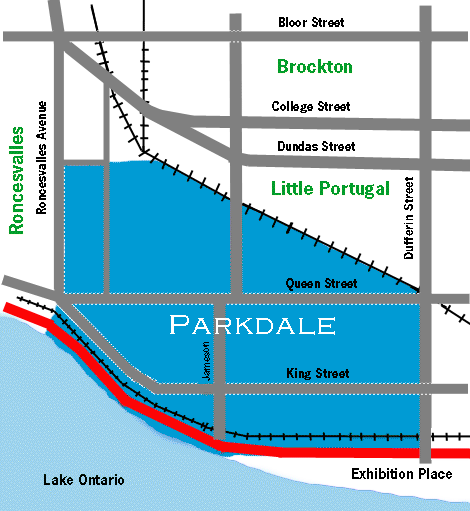
David Warren on the situation in Parkdale

Filed under: Cancon — Tags: , , , , — Nicholas @ 03:00

David Warren provides a glimpse of what life is like in the Toronto neighbourhood of Parkdale during the Wuhan Coronavirus epidemic:

Is gentle reader bored with pathogens yet? At some point in the proximate future, death will lose its sting. While there are plausible economic reasons for people to return to work, there is also a dark secret. The most restless society since the invention of restlessness cannot cope with “downtime.” This is what gives me my monopoly on Idleness. Without the “events” which help to distinguish one day from another, we will need to start a war.

The Parkdale neighbourhood of Toronto.
Map by Alaney2k via Wikimedia Commons.

Had we books, and to have developed the habit of using them, we might read history instead; and even a bit of poetry on the side. But now, at loose ends, we are inspired to do something. Also, please note, the doctrine of original sin. I’m a big fan.

My political dogma has surely been established by now. I am against “doing” anything. Fight for a world in which nothing exciting happens, other than the pursuit of beauty, goodness, and truth. Fight relentlessly — by example.

Here in Parkdale, Toronto’s go-to centre for the criminally insane, there is always entertainment. From my balconata I can spy several half-way houses, and for variety, a Tibetan temple. The streets get quieter every day, especially the throb of the superhighways. It has been softening, as the economy bleeds away; and there are clear days with no contrails in the sky.

The “Green Nude Eel” is being accomplished. Superficially, this might seem like a good thing.

But because Parkdale has been unable to start a war with our bourgeois neighbour — Liberty Village, where the childless young professionals live in sterilized apartment blocks — we have had to look for excitement elsewhere. By calling 9-1-1 frequently, the Vallishortensians (demonym for “Parkdale”) are able to keep the sirens blaring, and little knots of emergency vehicles collecting, to no definable purpose here and there. Due to my Scottish genetic endowment, I follow these skits as I would a taxi-meter: How much have we cost the taxpayers today?

The Boxer Rebellion l HISTORY OF CHINA

Filed under: Britain, China, France, Germany, History, Japan, Military, Religion, Russia — Tags: , , — Nicholas @ 02:00

IT’S HISTORY
Published 26 Aug 2015

The Boxer Rebellion was one of China’s biggest uprisings against the unwanted European, US-American and Japanese imperialism. Distrust and tensions marked all contacts with foreigners. Secret societies were formed to propagate against the enemy. The Yihequan, also known as Boxers, quickly rose to one of the biggest organisations in Northern China. Masters of close combat, they mainly targeted converted Chinese Christians and attacks increased wildly in the 1880s. From 1900 Empress Dowager Cixi was less and less opposed to the Rebellion, as she hoped to fight back foreign influence. Shortly after, even the Chinese Army started helping the rebels and foreigners were fought, killed or driven out. Consequently, an alliance of the imperial powers sent in 50,000 soldiers to end the massacre. Tough reprisals and treaties followed. Learn all about the Boxer Rebellion on IT’S HISTORY.

» JOIN OUR COMMUNITY FOR MORE HISTORY KNOWLEDGE!
Follow us on Twitter: http://twitter.com/thehistoryshow
Your photos on Instagram: https://instagram.com/itshistorychannel

» SOURCES
Videos: British Pathé (https://www.youtube.com/user/britishp…)
Pictures: mainly Picture Alliance
Content:
Harrington, Peter: Peking 1900: The Boxer Rebellion, Osprey Campaign
Bodin, Lynn: The Boxer Rebellion, Men-at-Arms
http://www.historyofwar.org/articles/…
http://www.chinafolio.com/chinas-last…

» ABOUT US
IT’S HISTORY is a ride through history – Join us discovering the world’s most important eras in IN TIME, BIOGRAPHIES of the GREATEST MINDS and the most important INVENTIONS.

» HOW CAN I SUPPORT YOUR CHANNEL?
You can support us by sharing our videos with your friends and spreading the word about our work.

» CAN I EMBED YOUR VIDEOS ON MY WEBSITE?
Of course, you can embed our videos on your website. We are happy if you show our channel to your friends, fellow students, classmates, professors, teachers or neighbors. Or just share our videos on Facebook, Twitter, Reddit etc. Subscribe to our channel and like our videos with a thumbs up.

» CAN I SHOW YOUR VIDEOS IN CLASS?
Of course! Tell your teachers or professors about our channel and our videos. We’re happy if we can contribute with our videos.

» CREDITS
Presented by: Indy Neidell
Script by: Dan Hungerford
Directed by: Daniel Czepelczauer
Director of Photography: Markus Kretzschmar
Music: Markus Kretzschmar
Sound Design: Bojan Novic
Editing: Markus Kretzschmar

A Mediakraft Networks original channel
Based on a concept by Florian Wittig and Daniel Czepelczauer
Executive Producers: Astrid Deinhard-Olsson, Spartacus Olsson
Head of Production: Michael Wendt
Producer: Daniel Czepelczauer
Social Media Manager: Laura Pagan

Contains material licensed from British Pathé
All rights reserved – © Mediakraft Networks GmbH, 2015

QotD: “Gammon”

Filed under: Britain, Politics, Quotations — Tags: , , , , , — Nicholas @ 01:00

I think it’s important to look beyond personalities and current political issues. Yes, Jeremy Corbyn was a repulsive figure, and that played a significant role in Labor’s defeat; yes, Brexit upended British politics. But if we look at the demographics of who voted Labor, it is not difficult to discern larger and longer-term forces in play.

Who voted Labor? Recent immigrants. University students. Urban professionals. The wealthy and the near wealthy. People who make their living by slinging words and images, not wrenches or hammers. Other than recent immigrants, the Labor voting base is now predominantly elite.

This is the Great Inversion – in Great Britain, Marxist-derived Left politics has become the signature of the overclass even as the working class has abandoned it. Indeed, an increasingly important feature of Left politics in Britain is a visceral and loudly expressed loathing of the working class.

To today’s British leftist, the worst thing you can be is a “gammon”. The word literally means “ham”, but is metaphorically an older white male with a choleric complexion. A working-class white male, vulgar and uneducated – the term is never used to refer to men in upper socio-economic strata. And, of course, all gammons are presumed to be reactionary bigots; that’s the payload of the insult.

Catch any Labor talking head on video in the first days after the election and what you’d see is either tearful, disbelieving shock or a venomous rant about gammons and how racist, sexist, homophobic, and fascist they are. They haven’t recovered yet as I write, eleven days later.

Observe what has occurred: the working class are now reactionaries. New Labor is entirely composed of what an old Leninist would have called “the revolutionary vanguard” and their immigrant clients. Is it any wonder that some Laborites now speak openly of demographic replacement, of swamping the gammons with brown immigrants?

It would be entertaining to talk about the obvious parallels in American politics – British “gammons” map straight to American “deplorables”, of course, and I’m not even close to first in noticing how alike Donald Trump and Boris Johnson are – but I think it is more interesting to take a longer-term view and examine the causes of the Great Inversion in both countries.

Eric S. Raymond, “The Great Inversion”, Armed and Dangerous, 2019-12-23.

March 25, 2020

Hans Oster – A German Against Nazism – WW2 Biography Special

Filed under: Germany, History, Military, WW2 — Tags: , , , , , , — Nicholas @ 04:00

World War Two
Published 24 Mar 2020

Hans Oster opposed the Nazis and tried to oppose them from early on. As a member of the Abwehr, he tried to do whatever he could. During the war, his efforts increased with a dramatic outcome.

Join us on Patreon: https://www.patreon.com/TimeGhostHistory
Or join The TimeGhost Army directly at: https://timeghost.tv

Follow WW2 day by day on Instagram @World_war_two_realtime https://www.instagram.com/world_war_t…
Between 2 Wars: https://www.youtube.com/playlist?list…
Source list: http://bit.ly/WW2sources

Hosted by: Spartacus Olsson
Written by: Isabel Wilson, Joram Appel and Spartacus Olsson
Produced and Directed by: Spartacus Olsson and Astrid Deinhard
Executive Producers: Bodo Rittenauer, Astrid Deinhard, Indy Neidell, Spartacus Olsson
Creative Producer: Joram Appel
Post-Production Director: Wieke Kapteijns
Research by: Arnaldo Teodorani and Isabel Wilson
Edited by: Iryna Dulka
Map animations: Eastory (https://www.youtube.com/c/eastory)

Colorizations by:
Dememorabilia – https://www.instagram.com/dememorabilia/

Sources:
Picture of Dresden, courtesy Wikimedia Commons https://commons.wikimedia.org/wiki/Fi…
Collection of Auckland War Memorial Museum Tamaki Paenga Hira, N2658
Narodowe Archiwum Cyfrowe
Picture of Gijsbertus Jacobus Sas, courtesy ANP Historisch Archief https://www.anp-archief.nl/page/21998…
Picture of Hans Bernd Gisevius, courtesy Gedenkstätte Deutscher Widerstand https://www.gdw-berlin.de/en/recess/b…
id by Flatart from the Noun Project
people by ProSymbols from the Noun Project
documents by Srinivas Agra from the Noun Project

Soundtracks from the Epidemic Sound:
Johannes Bornlof – “Deviation in Time”
Andreas Jamsheree – “Guilty Shadows 4”
Fabien Tell – “Last Point of Safe Return”
Reynard Seidel – “Deflection”
Jo Wandrini – “Puzzle of Complexity”
Gunnar Johnsen – “Not Safe Yet”

Archive by Screenocean/Reuters https://www.screenocean.com.

A TimeGhost chronological documentary produced by OnLion Entertainment GmbH.

Bonus QotD: Cognitive dissonance and the very, very woke

Like everyone, I’m tired of the Wuhan Flu freakout. But I owe a debt to future historians to leave them a primary source, so I’m going to do this last brief post on it, then move on. Unless something major happens, this is my final word on the subject […]

We’ve written a lot here on the West’s “crisis of legitimacy.” Well … this is it. Let’s break down some of the big factors in play:

The first, biggest, and in some ways only factor that matters, legitimacy-wise, is cognitive dissonance. We spent a lot of time here back in the days arguing about whether or not it’s a real thing […] I finally took the position that it’s real, but only for stuff that rises to level of actual cognition … which you just don’t see too much of anymore. Indeed, the whole point of Postmodern Leftism, when you come right down to it, is not having to think. Identity politics gives you The One Right Answer for most every situation; it’s just a matter of filling in the Social Justice Mad Lib. Any apparent conflict between One Right Answers is dealt with by ad hominem.

An example will probably help: Trannies vs. Feminists. Feminists, of course, are all in on The One Right Answer that “gender is just a social construction.” But Trannies actually believe this — if you feel you’re really a woman, then you are, your twelve-inch wang be damned. How, then, can impeccably #woke lesbians refuse to have sex with the aforesaid twelve-inch wang, since gender is just a social construction and Thundercock identifies as a lesbian? Easy: ad hominem. Oh, gender’s just a social construction all right … it’s just that any be-penised individual who “constructs” himself as a lesbian is lying for personal gain (#wokeness, as everyone knows, gives one the ability to read minds).

This isn’t a problem for the Left as a whole, much less for our entire society, because of the tiny numbers involved. Despite showing up pretty much everywhere in popular culture, gays are a small fraction of the population. Trannies are a fraction of a fraction, and since militant lesbianism is almost entirely political anyway (lesbian bed death is very real), about the only place this could possibly be a live issue is on the loonier college campuses.

Severian, “The Real Crisis”, Rotten Chestnuts, 2020-03-17.

Armchair History: The Borgia

Filed under: Europe, History, Italy, Politics, Religion — Tags: , , , — Nicholas @ 02:00

Overly Sarcastic Productions
Published 30 Jun 2015

CONTENT DISCLAIMER: This video no longer meets my standards of quality for historical research and presentation. I made this one in the days long past, when the question of “How do I make an entertaining and historically interesting video” was answered by “IDK, memes I guess?”. This video in particular was an experiment with a shorter format, and is by no means definitive history. Take the video above with a grain of salt and enjoy the jokes.

In what could be a landmark in terms of progress, Overly Sarcastic Productions has decided to start making SHORT videos as well as rather long ones.

The Borgias were one messed up family, I tell you what.

QotD: The broken feedback mechanism that brought down the chain bookstores

Filed under: Books, Business, Quotations — Tags: , , , , — Nicholas @ 01:00

… the push-model of book sales. Long before there was an Amazon, chain bookstores had cozy deals with publishers that sent most indie bookstores (now beloved in effigy by the left) out of business.

And then the left dominated publishing establishment had a brilliant idea. For decades they’d been trying to forecast failure and success, and failings. Books they pushed out the wazzoo (A river in Sundon’tshine) died on the vine when bookstores refused to stock them because the owners had read them. The books they had designated as to be ignored caught someone’s fancy, and suddenly were all over.

This was inefficient. It caused way too much printing that never got distributed, and much last minute rushed reprinting. (Even leaving aside how often people chose to read the WRONG things, something that started to matter more and more in the last two decades.)

So they came up with the push model. It was, from a certain perspective, brilliant.

That perspective is the one where the real world doesn’t really exist, so you don’t need to hear from it.

Because the managers of the big corporate bookstores ALSO didn’t read, they took instruction beautifully. So the publishers could say “you’ll take 100 of x and 2 of y” and they DID.

For a little while it worked beautifully, in the sense that there were no surprise bestsellers, (and publishing houses hated those. I know someone who unexpectedly sold out her print run in a week. The publishing house took the book out of print. No, seriously.) and the books that got seen and talked about were picked by the publisher. (BTW this wasn’t even always or primarily political. Sure, that existed too sometimes, but mostly it was the crazy fads that publishing convinced itself of. For instance, sometime in the mid two thousands they convinced themselves no one wanted historical mysteries — they weren’t selling, true, probably because they were on NO shelves — but everyone wanted “chick-lit mysteries” that had covers with lots of shoes and dresses and whose plots were “Sex in the City with murder.” I remember trying to find something to read, giving up and going to the used bookstore (then a hundred miles away in Denver) for my mystery fix.)

Of course, they sold less. In fact, as time went on and people got out of the habit of going to the bookstore, because there was never anything they could find to read. I mean, I remember being chased from Science Fiction to Mystery to finally History, to at last the sort of “utility” book you find in the discount bins you know “a chart of history” type of thing just to find something to buy on our bookstore night.

Then we gave up.

Eventually the broken feedback mechanism gave us the demise of Borders — and B & N is not feeling so good itself — and a yawning, desperate chasm in customers’ need for books that meant the way was wide open for Indie and Amazon. Even the early badly proofed indie books were like a breath of fresh air because for the first time I could read outside the trends being pushed.

Sarah Hoyt, “Breaking the Gears”, According to Hoyt, 2018-01-03.

March 24, 2020

Thompson 1921: The Original Chicago Typewriter

Filed under: History, Military, USA, Weapons — Tags: , , , , — Nicholas @ 02:00

Forgotten Weapons
Published 6 Oct 2018

https://www.forgottenweapons.com/thom…

http://www.patreon.com/ForgottenWeapons

Cool Forgotten Weapons merch! http://shop.bbtv.com/collections/forg…

The first prototype Thompsons submachine guns (and it was Thompson who coined that term, by the way) were produced in 1919 and dubbed the “Annihilators”. The gun was intended to be a military weapon to equip American soldiers in World War One, but by the time the gun was developed the war had ended. Still, Thompson and his Auto-Ordnance company contracted with Colt to manufacture 15,000 of the guns. These were the Model of 1921, and they were marketed to both the US military and as many European armies as Thompson and his salesmen could reach. They found few takers in the climate of the early 1920s, however, and sales were slow.

This is the first in a 5-part series about the development of the Thompson, concluding with a trip to the range to fire three different patterns side by side…

Contact:
Forgotten Weapons
PO Box 87647
Tucson, AZ 85754

If you enjoy Forgotten Weapons, check out its sister channel, InRangeTV! http://www.youtube.com/InRangeTVShow

QotD: “Desacralizing the State”

Filed under: Government, History, Politics, Quotations — Tags: , , , , — Nicholas @ 01:00

Winston Churchill famously proclaimed democracy to be the least-worst government. Alas, quotability is not the same thing as wisdom. Worst at what, Sir Winston?

Speaking of quotable-yet-loony folks, Aristotle defined Man as “the political animal,” and as such had an answer to our question: The State’s purpose, Aristotle said, is to promote virtue.

Let’s leave the contentious topic of “virtue” aside, and step back to the definition of “Man.” Man isn’t a political animal. Man is a purpose-finding animal, an explaining animal. We simply can’t resist the siren song of teleology. We all live under some kind of State; therefore, we assume that “The State” must have a purpose. It’s in our DNA; we can’t do otherwise, but … we might be wrong. Perhaps “self-organization into some kind of government” is just one of Humanity’s givens, like “sexual dimorphism*” or “requires oxygen.” Maybe “government” just IS.

A dangerous thought, that. If it’s true, it desacralizes the State — the worship of which, I think we all agree, has driven all the major political events in the West since at least 1789. Historian Herbert Butterfield called the 20th century’s great mass movements “giant organized forms of self-righteousness,” but he could’ve taken that a step further — “popular” government of any sort invariably becomes a giant organized form of self-righteousness. People being people — that is, teleology-addled monkeys — it can’t be any other way. The State, since it exists, must exist to do something. What better something to do than to promote virtue?

So we’re back to Aristotle. But it looks like Aristotle stole a base. As a rule, people aren’t virtuous. Why else would they need the State to promote virtue? And yet, the State is made up of nothing but people. Aristotle also said that a cause can’t give something to an effect that it, the cause, doesn’t already have. So how, then, can the State — which, like Soylent Green, is made of people — itself make people virtuous?

See what I mean about this teleology stuff? The mind rebels. The State is a human thing. Humans made it, and every human act, we’re hardwired to believe, has a purpose behind it. That hardwiring may lead us into incoherence in under three steps, but so far as I know, I’m the only guy in the history of Political Science ever to suggest that government just … kinda … IS. That it evolved with us, and thus all our airy-fairy noodling about Divine Right and We the People and the Vanguard of the Proletariat and whatnot are just foolish blather about what’s basically still a monkey troop.

[…]

All this would be just philosophy-wank, better suited to a dorm room bull session after a few bong rips, if not for the fact that “desacralizing the State” has to be the #1 project of any viable Dissident movement. The State, as a human production, has only such “goals” as we give it … and, being made up of nothing but humans, is going to be as good at achieving those goals as we humans generally are at achieving any of our goals …

Severian, “The Least-Worst Government?”, Rotten Chestnuts, 2019-12-21.

March 23, 2020

Naval strategy versus naval tactics in the Battle of the Atlantic

Ted Campbell outlines how the Battle of the Atlantic was fought between the Kriegsmarine and the Royal Navy (and the Royal Canadian Navy and, eventually, the United States Navy) in World War 2:

U-2513 in US Navy control off Key West, Florida – 30 October 1946

… there is a rather thick, and quite blurry line between naval strategy and naval tactics. One Army.ca member used the Battle of the Atlantic to distinguish between two doctrines:

  • Sea control ~ which was practised by the 2nd World War allies ~ mostly British Admirals Percy Noble and Max Horton in Britain and Canadian Rear Admiral Leonard Murray in St John’s and Halifax; and
  • Sea denial ~ which was practised by German Admiral Karl Dönitz.

The difference between the two tactical doctrines was very clear. The strategic aims were equally clear:

  • Admiral Dönitz wanted to knock Britain out of the war ~ something that he (and Churchill) understood could be done by starving Britain into submission by preventing food, fuel and ammunition from reaching Britain from North America. (We can be eternally grateful that Adolph Hitler did not share Dönitz’ strategic vision and listened, instead, to lesser men and his own, inept, instincts); and
  • Prime Minister Churchill, who really did say that “the only thing that ever really frightened me during the war was the U-boat peril“, who wanted to keep Britain fighting, at the very least resisting, until the Americans could, finally, be persuaded to come to the rescue.
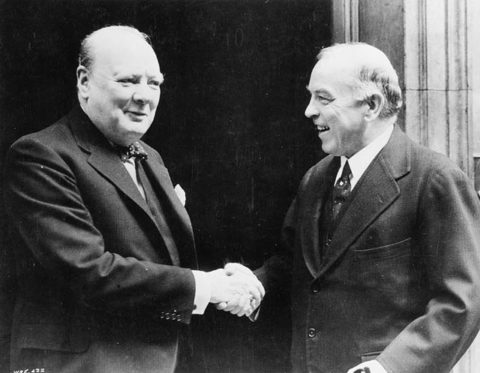
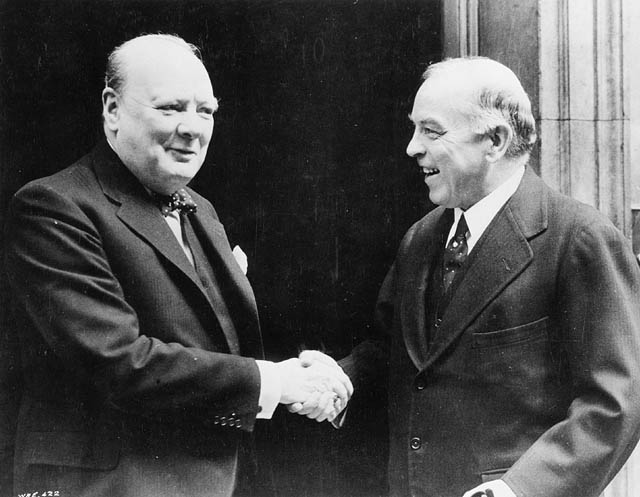
Prime Minister Winston Churchill greets Canadian PM William Lyon Mackenzie King, 1941.
Photo from Library and Archives Canada (reference number C-047565) via Wikimedia Commons.

Canada’s Prime Minister Mackenzie King did have a grand strategy of his own. It was to do as much as possible while operating with the lowest possible risk of casualties ~ the conscription crisis of 1917 was, always, uppermost in his mind and he was, therefore, terrified of casualties. He mightily approved of the Navy doing a HUGE share in the Battle of the Atlantic ~ especially by building ships in Canadian yards and escorting convoys which he hoped would be a low-risk affair.

Churchill’s grand strategy was based on Britain surviving … there was, I believe, a “worst case” scenario in which the British Isles were occupied and the King and his government went to Canada or even India. But that has always seemed to me to be a sort of fantasy. The United Kingdom, without the British Isles, made no sense.

    (While I believe that Rudolph Hess was, as they say, a few fries short of a happy meal, I think that he and several people in Germany believed that it might be possible to negotiate a peace with Britain which many felt was a necessary precursor to a successful campaign against Russia. The Battle of Britain (die Luftschlacht um England, September 1940 to June 1941) was, clearly, not going in Germany’s favour. Late in 1940, the Nazi high command had been forced to send a German Army formation to Libya to prevent a complete rout of the Italians. Malta still held out, meaning that Britain had air cover throughout the Mediterranean. In short, Britain was not going to go down unless it could be starved into submission ~ and in the spring of 1941, the Battle of the Atlantic was going in Germany’s favour. There was, in other words, some reason for Germans to believe that an armistice might be possible ~ freeing up all of Germany’s power to be used against the USSR.)

    (But things were changing for the Allies, too. At just about the same time as Hess was flying to Scotland, then Commodore Leonard Murray of the Royal Canadian Navy, who had been in England on other duties, had met with and persuaded Admiral Sir Percy Noble, who liked Murray and had been his commander in earlier years, that a new convoy escort force should be established in Newfoundland and that it should be a largely Canadian force (with British, Dutch, Norwegian and Polish ships under command, too) and that it should be commanded by a Canadian officer. Admiral Noble insisted, to Canada, that Murray, who he liked, personally, and who had written, extensively, on convoy operations in the 1920s and ’30s, must be that commander. The establishment of the Newfoundland Escort Force, which would be more appropriately renamed the Mid Ocean Escort Force in 1942, was a key decision at the much-debated operational level of war which put an expert tactician (Murray) in command of a major force and allowed him (and Noble) to move closer to achieving Churchill’s strategic aim. The Battle of the Atlantic was not won in 1941, but it seemed to Churchill, Noble and Murray that they were a lot less likely to lose it, even without the Americans.)
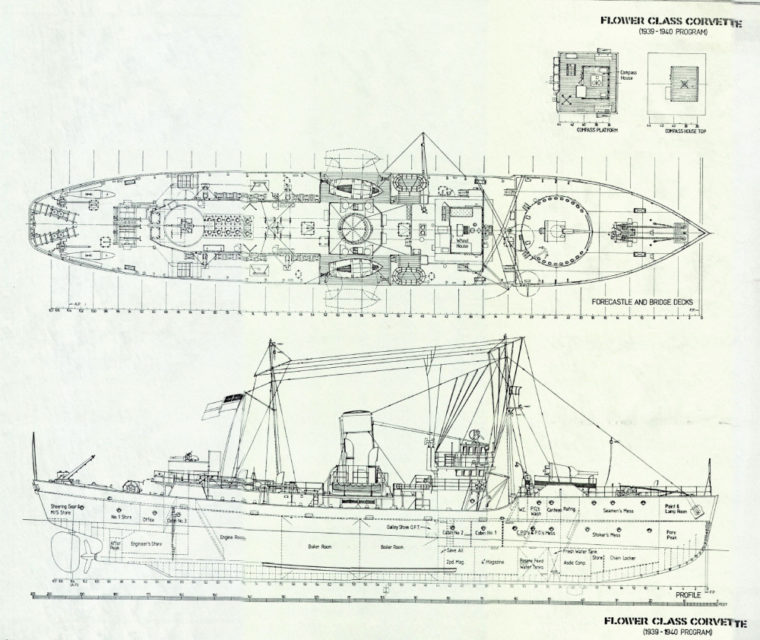
Diagram of the early Flower-class corvettes, via Lt. Mike Dunbar (https://visualfix.wordpress.com/2017/04/12/dreadful-wale-4/)

Anyway, the boundaries of strategy vs. the operational art vs. tactics were as thick and blurry in 1941 as they are today. The decision, taken in 1939, for example, to build little corvettes in the many British and Canadian yards that could not build a real warship was, in retrospect, a key strategic choice, but it was, at the time, totally materialist: just a commonsense, engineer solution to an operational problem ~ lack of ships. Ditto for the eventual decision, which had to be made by Churchill, himself, to reassign some of the big, long-range, Lancaster heavy bombers to Coastal Command. It was, once again, with the benefit of hindsight, a key strategic move, but at the time it would likely have seemed, to Capt(N) Hugues Canuel, the author of that Canadian Naval Review essay, to be materialistic, more concerned with how to use the resources available than with deciding what is needed.

I agree with Capt(N) Canuel that, by and large, Canadians have left strategic and even operational level thinking to first, the British and more recently the American admirals ~ Rear Admiral Murray being known, in the 1930s and early 1940s as a notable exception.


Making The Drawer Runners | The Cabinet Project #5 | Free Online Woodworking School

Filed under: Tools, Woodworking — Tags: , , — Nicholas @ 04:00

Matt Estlea
Published 19 Mar 2020

In this video, I show you how to create the drawer runners that will be fitted into the bottom of the cabinet. These are constructed using tiny mortice and tenon joints and is also a great introduction into the world of wood movement.

View the full lesson here:
https://mattestlea.com/free-online-wo…

Plans for this project:
https://mattestlea.com/product/cabine…

Buy Pre-Planed Material Packs for this Project Here:
www.mattestlea.com/projectpacks
_________________________________________________________________
Supporting Resources:

Wood Movement
https://mattestlea.com/school/school-…

How To Cut a Mortice and Tenon
https://mattestlea.com/tutorials/how-…

Hand Tool Basics:
https://mattestlea.com/school/woodwor…
_________________________________________________________________

Support what I do by becoming a Patron! This will help fund new tools, equipment and cover my overheads. Meaning I can continue to bring you regular, high quality, free content. Thank you so much for your support! https://www.patreon.com/mattestlea

Don’t want to commit to a monthly direct debit but still want to help out? That’s fine!
You can make a one time donation here: www.mattestlea.com/donate
You can donate us biscuits here: www.mattestlea.com/wishlist
_________________________________________________________________
BUY THE WOODWORKING BIBLE HERE:
www.mattestlea.com/the-woodworkers-manual
_________________________________________________________________

SOCIAL MEDIA
Instagram: www.instagram.com/mattestlea
Twitter: www.twitter.com/mattestlea
Patreon: www.patreon.com/mattestlea
Pinterest: www.pinterest.com/mattestlea
LinkedIn: www.linkedin.com/in/matt-estlea-b6414b11a/
_________________________________________________________________
See what tools I use here: www.mattestlea.com/equipment
My Website: www.mattestlea.com
_________________________________________________________________

My name is Matt Estlea, I’m a 24 year old Woodworker from Basingstoke in England and my aim is to make your woodworking less s***.

I come from 5 years tuition at Rycotewood Furniture Centre with a further 1 year working as an Artist in Residence at the Sylva Foundation. I now teach City and Guilds Furniture Making at Rycotewood as of September 2018.

If you’re interested in studying at Rycotewood, view their courses here:
www.mattestlea.com/rycotewood

I also had 5 years of experience working at Axminster Tools and Machinery where I helped customers with purchasing tools, demonstrated in stores and events, and gained extensive knowledge about a variety of tools and brands. I discontinued this at the start of 2019 to focus solely on video creation and teaching.

During the week, I film woodworking projects, tutorials, reviews and a viewer favourite ‘Tool Duel’ where I compare two competitive manufacturers tools against one another to find out which is best. I also have a Free Online Woodworking School which you should definitely check out!

www.mattestlea.com/school

I like to have a laugh and my videos are quite fast paced BUT you will learn a lot, I assure you.

Lets go make a mess.

The world of woke crossword-puzzlers – a place of horrible, unintentional microaggressions

Filed under: Media, Politics — Tags: , , , — Nicholas @ 03:00

David Thompson takes us on a scary trip to the heart of the woke crossword world:

The world of woke crossword-puzzlers — because that’s a thing that exists — is one in which enthusiasts, via social media, grumble about white men, bemoan the insufficient prominence of “queer or POC colloquialisms,” share “off-colour jokes about hypothetical titles for a Melania Trump memoir,” and fret about the exact ratio of male and female names used as clues. Because a lack of “gender parity” in crossword puzzle clues constitutes one of “the systemic forces that threaten women.”

Crossword puzzles can do that, apparently.

The list of possible crossword-puzzle wrongdoings is, of course, extensive, ever-growing and not entirely straightforward.

Transgressions include clues for ILLEGAL (“One caught by border patrol”); MEN (“Exasperated comment from a feminist”); and HOOD (“Place with homies”).

I’ll give you a moment to steady yourselves, to recover from all that gasping.

A New York Times puzzle triggered agitation with the clue “Pitch to the head, informally,” the solution to which was “beaner.” Given sufficient effort, said word could also, it seems, be construed as a mild and antiquated racial slur, albeit one that had escaped me and which I had to look up. Inevitably, apologies and public prostration ensued, despite both the puzzler-writer and editor confessing their own ignorance and intending no harm. Needless to say, the apology immediately resulted in further hissing and rending of garments by people whose Twitter bios include preferred pronouns and the words liberal and feminist.

Unlike almost every other site on the web, I do encourage you to read the comments at David’s blog … he has a great group of regular commenters (commentators? commentistas? Whatevs…)

« Newer PostsOlder Posts »

Powered by WordPress