Forgotten Weapons
Published 4 Jan 2020http://www.patreon.com/ForgottenWeapons
Cool Forgotten Weapons merch! http://shop.bbtv.com/collections/forg…
The D30 is a Soviet 122mm multi-role gun introduced in the 1960s and still in use around the world today. It has a somewhat unusual 3-leg mount that is slower to set up than a standard trail, but allows for complete 360-degree rotation of the gun. The piece was designed for both indirect fire (maximum range 15.4km; more with rocket-assisted munitions) or direct anti-tank fire. Note that it came with an armor shield for the crew, which was left off the gun for this trip to the range.
Thanks to Battlefield Vegas for the chance to film this awesome cannon firing! It belongs to them, and will be set up at their facility for a pretty awesome rental firing experience if you are into that…
http://www.battlefieldvegas.com
Contact:
Forgotten Weapons
6281 N. Oracle #36270
Tucson, AZ 85704
April 21, 2020
Soviet 122mm D30 Cannon (Firing)
QotD: Admiral Jackie Fisher’s five keys to “lock up the world”
Geography plays an important part in all of this. While the sea surface itself is without geography, naval forces are dependent on shore facilities for support. In the age of sail, this was mostly for supply and repair, while coaling stations defined naval geography during the early age of steam, giving the British a huge advantage over all opponents. The US, lacking such facilities, built bigger, longer-ranged ships. Today, we’ve created forward bases in Europe and Japan, to allow our ships to spend more time on station, and replenishment ships to allow ships to spend more time at sea.
Moreover, a huge fraction of global trade flows through a few key choke points. A century ago, Jackie Fisher described “Five keys [that] lock up the world! Singapore. The Cape. Alexandria [Suez]. Gibraltar. Dover.” Today, we’d have to add the Strait of Hormuz, but the basic truth remains the same. Control of trade through these critical areas gives immense power, and it is in the interest of a maritime power to have that control, or at least to have great influence over how it is used.
“bean”, “Basics of Naval Strategy”, Naval Gazing, 2018-01-22.
April 20, 2020
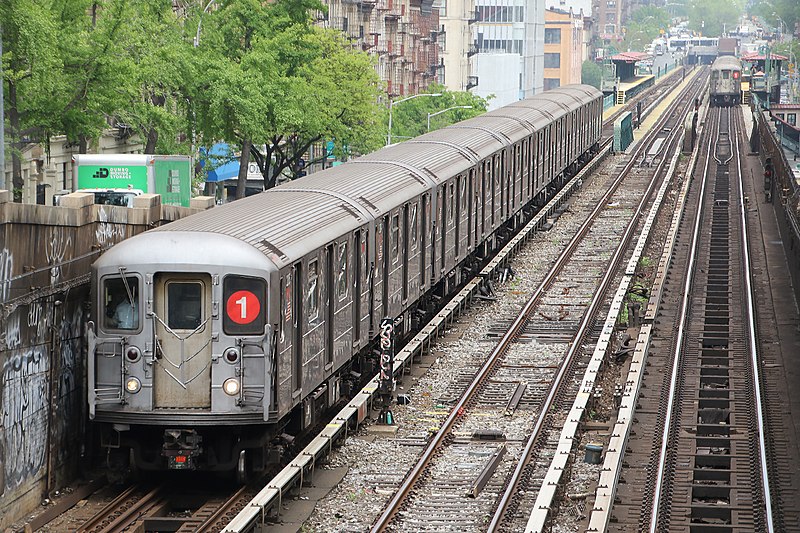
“New York City subways were ‘a major disseminator — if not the principal transmission vehicle — of coronavirus infection'”
Randal O’Toole wonders why the lone sacred cow of mass transit is still running, despite its potential role in spreading disease:
Sit‐down restaurants and bars have been shut down. Public officials are discouraging or even forbidding people from doing “unnecessary travel,” even if it is to visit a second home where they might be able to socially distance themselves better than in their first, more urban home. All sorts of other rules are being passed, all supposedly for our own good.
So why are urban transit systems still running? A 2018 study found that “mass transportation systems offer an effective way of accelerating the spread of infectious diseases.” A 2011 study found that people who use mass transit were nearly six times more likely to have acute respiratory infections than those who don’t. Not surprisingly, a study published a few days ago found that New York City subways were “a major disseminator — if not the principal transmission vehicle — of coronavirus infection.”
Transit agencies say they are helping “essential workers” go about their business. But if they are so essential, isn’t it important to find them a safe way of getting to work? If we truly cared about people’s safety, then transit services should have shut down at the same time we closed other non‐essential businesses and asked people to stay at home.
[…]
Unfortunately, the transit lobby has successfully turned government‐subsidized transit into a sacred cow. Transit is supposedly greener than driving when in fact it’s an energy hog. Transit is supposedly needed to help poor people get to work when in fact the people most likely to commute by transit are those earning more than $75,000 a year.
When the pandemic took away most of transit’s customers, instead of shutting down, which would have been the responsible thing to do, transit agencies demanded that Congress give them $25 billion, tripling federal support to transit this year. Thanks to transit’s sacred cow status, Congress agreed without any serious debate.
Effectively, Congress rewarded the agencies for spreading disease. It would have been better to use that money to help transit‐dependent essential workers buy a car so they could have a safe way of getting to work.
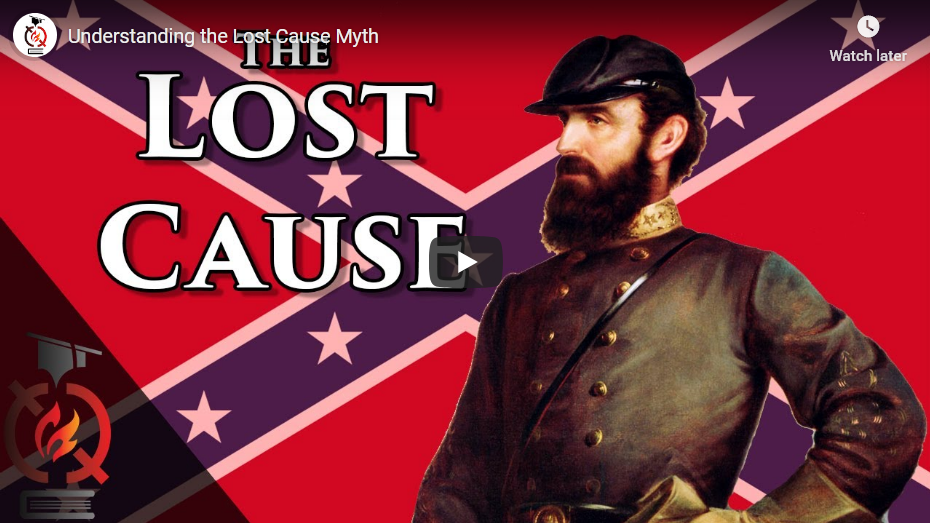
Understanding the Lost Cause Myth
The Cynical Historian
Published 16 Apr 2020The Lost Cause Myth has changed American history. Though it is a hateful ideology today, to ignore it is to give it power. We must understand the myth in order to defeat it.
————————————————————
Connected videos [see YouTube description for linked videos to parts of this discussion]
————————————————————
See pinned comment and its replies for references, notes, responses, and errata
————————————————————
Support the channel through PATREON:
https://www.patreon.com/CynicalHistorianLET’S CONNECT:
Discord: https://discord.gg/Ukthk4U
Twitter: https://twitter.com/Cynical_History
Subreddit: https://www.reddit.com/r/CynicalHistory/
————————————————————
Wiki: The Lost Cause of the Confederacy, or simply the Lost Cause, is an American pseudo-historical, negationist ideology which holds the view that the cause of the Confederacy during the American Civil War was a just and heroic one. The ideology endorses the supposed virtues of the antebellum South, viewing the war as a struggle which was primarily waged in order to save the Southern way of life, or to defend “states’ rights”, in the face of overwhelming “Northern aggression.” At the same time, the Lost Cause minimizes or completely denies the central role of slavery in the buildup to and outbreak of the war.Particularly intense periods of Lost Cause activity occurred around the time of World War I, as the last Confederate veterans began to die out and a push was made to preserve their memories, and they also occurred during the Civil Rights Movement of the 1950s and 1960s, in reaction to growing public support for racial equality. Through activities such as building prominent Confederate monuments and writing school history textbooks, they sought to ensure that future generations of Southern whites would know about the South’s “true” reasons for fighting the war, and support white supremacist policies, such as Jim Crow laws. In this manner, white supremacy is a characteristic of the Lost Cause narrative.
The Lost Cause narratives typically portray the Confederacy’s cause as a noble one and they also portray its leaders as exemplars of old-fashioned chivalry, who were defeated by the Union armies through numerical and industrial force that overwhelmed the South’s superior military skill and courage. Proponents of the Lost Cause movement also condemned the Reconstruction that followed the Civil War, claiming that it had been a deliberate attempt by Northern politicians and speculators to keep the South down. The Lost Cause theme has also evolved into a major element in defining gender roles in the white South, in terms of preserving family honor and chivalrous traditions. The Lost Cause has inspired numerous Southern memorials and religious attitudes.
————————————————————
Hashtags: #history #LostCause #Mythology
The four distinct phases of the Great Depression in the United States
An older post from Lawrence W. Reed at the Foundation for Economic Education outlines the low points of the Great Depression and debunks a few widely held myths about that cataclysmic economic era:
Phase 1, the Federal Reserve and the end of the Roaring 20’s:
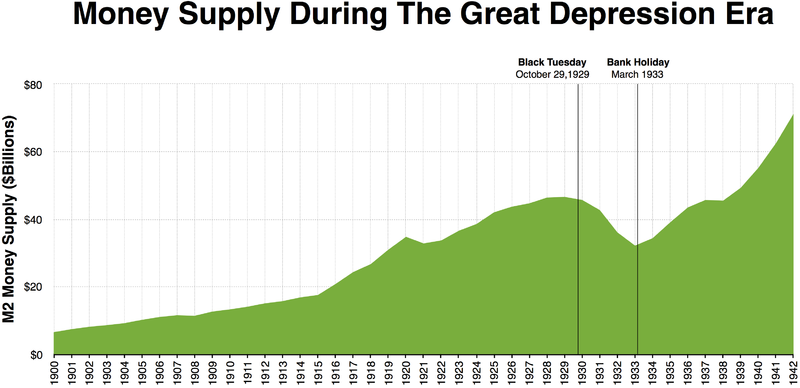
One of the most thorough and meticulously documented accounts of the Fed’s inflationary actions prior to 1929 is America’s Great Depression by the late Murray Rothbard. Using a broad measure that includes currency, demand and time deposits, and other ingredients, Rothbard estimated that the Federal Reserve expanded the money supply by more than 60 percent from mid-1921 to mid-1929. The flood of easy money drove interest rates down, pushed the stock market to dizzy heights, and gave birth to the “Roaring Twenties.”
By early 1929, the Federal Reserve was taking the punch away from the party. It choked off the money supply, raised interest rates, and for the next three years presided over a money supply that shrank by 30 percent. This deflation following the inflation wrenched the economy from tremendous boom to colossal bust.
The “smart” money — the Bernard Baruchs and the Joseph Kennedys who watched things like money supply — saw that the party was coming to an end before most other Americans did. Baruch actually began selling stocks and buying bonds and gold as early as 1928; Kennedy did likewise, commenting, “only a fool holds out for the top dollar.”
Phase 2, Hoover’s interventions and the disaster of Smoot-Hawley:
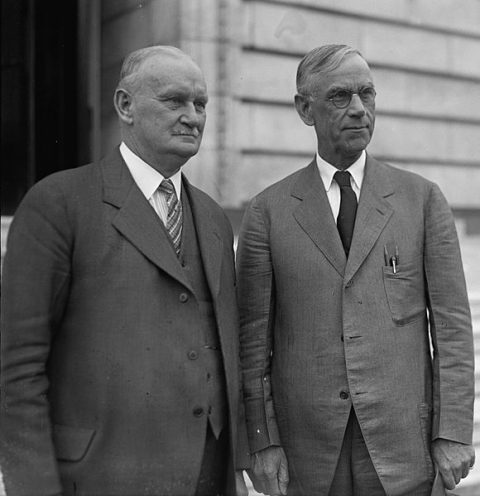
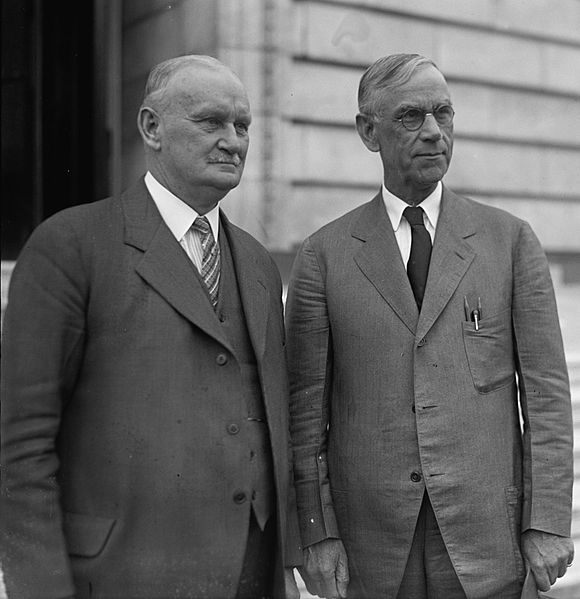
Willis C. Hawley (left) and Reed Smoot in April 1929, shortly before the Smoot–Hawley Tariff Act passed the House of Representatives.
Library of Congress photo via Wikimedia Commons.
Unemployment in 1930 averaged a mildly recessionary 8.9 percent, up from 3.2 percent in 1929. It shot up rapidly until peaking out at more than 25 percent in 1933. Until March 1933, these were the years of President Herbert Hoover — the man that anti-capitalists depict as a champion of noninterventionist, laissez-faire economics.
Did Hoover really subscribe to a “hands off the economy,” free-market philosophy? His opponent in the 1932 election, Franklin Roosevelt, didn’t think so. During the campaign, Roosevelt blasted Hoover for spending and taxing too much, boosting the national debt, choking off trade, and putting millions of people on the dole. He accused the president of “reckless and extravagant” spending, of thinking “that we ought to center control of everything in Washington as rapidly as possible,” and of presiding over “the greatest spending administration in peacetime in all of history.” Roosevelt’s running mate, John Nance Garner, charged that Hoover was “leading the country down the path of socialism.” Contrary to the modern myth about Hoover, Roosevelt and Garner were absolutely right.
The crowning folly of the Hoover administration was the Smoot-Hawley Tariff, passed in June 1930. It came on top of the Fordney-McCumber Tariff of 1922, which had already put American agriculture in a tailspin during the preceding decade. The most protectionist legislation in U.S. history, Smoot-Hawley virtually closed the borders to foreign goods and ignited a vicious international trade war. Professor Barry Poulson notes that not only were 887 tariffs sharply increased, but the act broadened the list of dutiable commodities to 3,218 items as well.
Officials in the administration and in Congress believed that raising trade barriers would force Americans to buy more goods made at home, which would solve the nagging unemployment problem. They ignored an important principle of international commerce: trade is ultimately a two-way street; if foreigners cannot sell their goods here, then they cannot earn the dollars they need to buy here.
Phase 3, FDR and the New Deal:
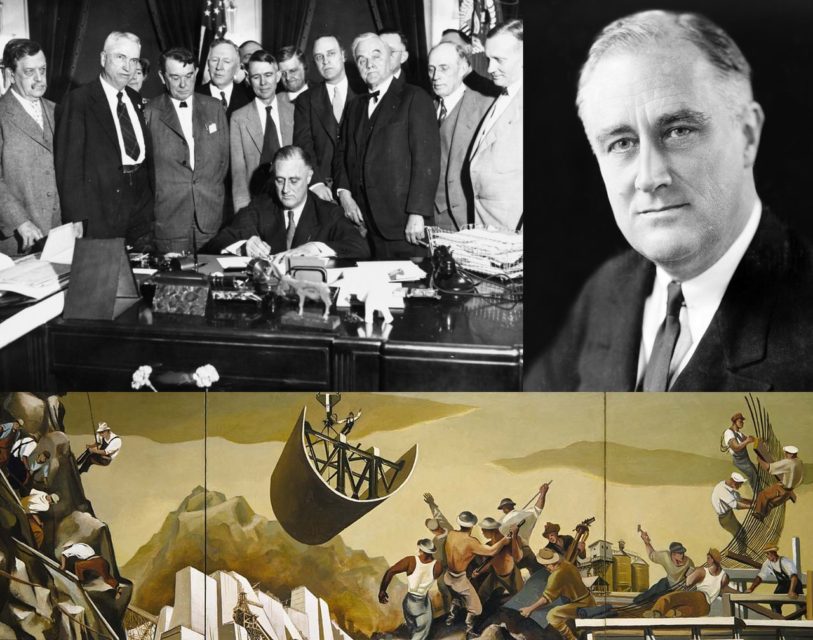
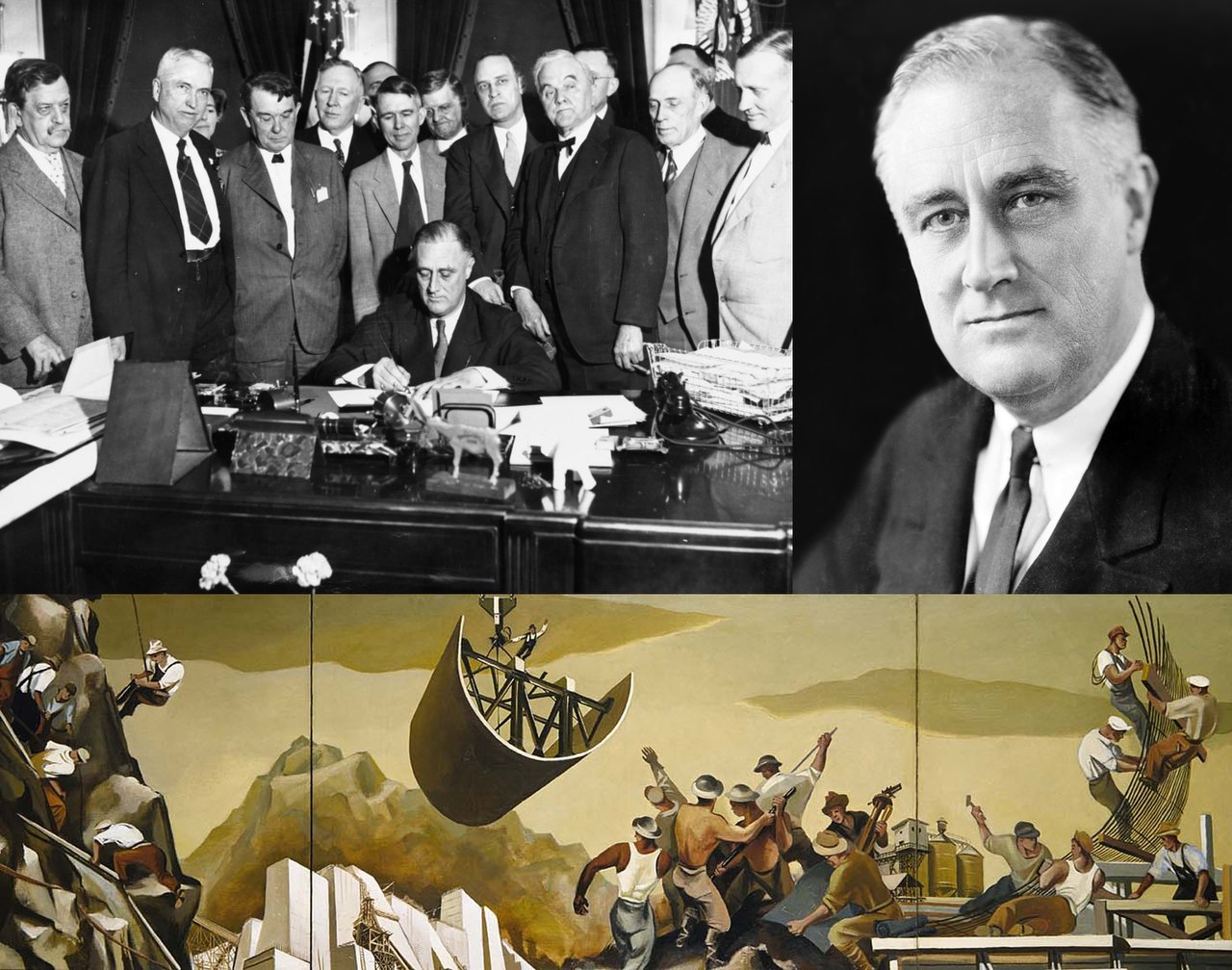
Top left: The Tennessee Valley Authority, part of the New Deal, being signed into law in 1933.
Top right: FDR (President Franklin Delano Roosevelt) was responsible for the New Deal.
Bottom: A public mural from one of the artists employed by the New Deal’s WPA program.
Wikimedia Commons.
Franklin Delano Roosevelt won the 1932 presidential election in a landslide, collecting 472 electoral votes to just 59 for the incumbent Herbert Hoover. The platform of the Democratic Party whose ticket Roosevelt headed declared, “We believe that a party platform is a covenant with the people to be faithfully kept by the party entrusted with power.” It called for a 25 percent reduction in federal spending, a balanced federal budget, a sound gold currency “to be preserved at all hazards,” the removal of government from areas that belonged more appropriately to private enterprise, and an end to the “extravagance” of Hoover’s farm programs. This is what candidate Roosevelt promised, but it bears no resemblance to what President Roosevelt actually delivered.
In the first year of the New Deal, Roosevelt proposed spending $10 billion while revenues were only $3 billion. Between 1933 and 1936, government expenditures rose by more than 83 percent. Federal debt skyrocketed by 73 percent.
[…] in 1935 the Works Progress Administration came along. It is known today as the very government program that gave rise to the new term, “boondoggle,” because it “produced” a lot more than the 77,000 bridges and 116,000 buildings to which its advocates loved to point as evidence of its efficacy. The stupefying roster of wasteful spending generated by these jobs programs represented a diversion of valuable resources to politically motivated and economically counterproductive purposes.
The American economy was soon relieved of the burden of some of the New Deal’s excesses when the Supreme Court outlawed the NRA in 1935 and the AAA in 1936, earning Roosevelt’s eternal wrath and derision. Recognizing much of what Roosevelt did as unconstitutional, the “nine old men” of the Court also threw out other, more minor acts and programs which hindered recovery.
Phase 4, the Wagner Act:
The stage was set for the 1937–38 collapse with the passage of the National Labor Relations Act in 1935 — better known as the Wagner Act and organized labor’s “Magna Carta.” […] Armed with these sweeping new powers, labor unions went on a militant organizing frenzy. Threats, boycotts, strikes, seizures of plants, and widespread violence pushed productivity down sharply and unemployment up dramatically. Membership in the nation’s labor unions soared; by 1941 there were two and a half times as many Americans in unions as in 1935.
[…]
Higgs draws a close connection between the level of private investment and the course of the American economy in the 1930s. The relentless assaults of the Roosevelt administration — in both word and deed — against business, property, and free enterprise guaranteed that the capital needed to jumpstart the economy was either taxed away or forced into hiding. When Roosevelt took America to war in 1941, he eased up on his antibusiness agenda, but a great deal of the nation’s capital was diverted into the war effort instead of into plant expansion or consumer goods. Not until both Roosevelt and the war were gone did investors feel confident enough to “set in motion the postwar investment boom that powered the economy’s return to sustained prosperity.”

Prehistory Summarized: Early Life
Overly Sarcastic Productions
Published 1 Dec 2015Blue’s back with more sweet, sweet prehistory! Today, Bruce explores the wonders of life.
QotD: The Columbus myth
My conclusion was that the Rabbi’s view of the history of the ketubah fitted a pattern I have seen in other contexts — moderns believing in bogus history that supports their self image of superiority to those ignorant and unreasonable people in the past.
My favorite example is the Columbus myth, the idea that the people who argued against Columbus were ignorant flat-earthers who thought his ships would sail off the edge. That is almost the precise opposite of the truth. By the time Columbus set off, a spherical Earth had been the accepted scientific view for well over a thousand years. Columbus’s contemporaries not only knew that the Earth was round, they knew how big around it was, that having been correctly calculated by Eratosthenes in the third century B.C.
By the fifteenth century they also had a reasonably accurate estimate of the width of Asia. Subtracting the one number from the other they could calculate the distance from where Columbus was starting to where Columbus claimed to be going and correctly conclude that it was much farther than his ships could go before running out of food and water. The scientific ignorance was on the side of Columbus and those who believed him; he was claiming a much smaller circumference for the Earth and a much larger width of Asia, hence a much shorter distance from Spain to the far end of Asia. We will probably never know whether he believed his own numbers or was deliberately misrepresenting the geographical facts in order to get funding for his trip in the hope that he would find land somewhere between Spain and Japan, as in fact he did.
David D. Friedman, “Slandering the Past”, Ideas, 2018-02-14.
April 19, 2020
Yugoslavia Crushed – Battle for Greece Continues – WW2 – 086 – April 18, 1941
World War Two
Published 18 Apr 2020The Battles for Yugoslavia and Greece continue as the Soviet-Union and Japan sign a non-aggression pact.
Join us on Patreon: https://www.patreon.com/TimeGhostHistory
Or join The TimeGhost Army directly at: https://timeghost.tvFollow WW2 day by day on Instagram @World_war_two_realtime https://www.instagram.com/world_war_t…
Between 2 Wars: https://www.youtube.com/playlist?list…
Source list: http://bit.ly/WW2sourcesWritten and Hosted by: Indy Neidell
Director: Astrid Deinhard
Producers: Astrid Deinhard and Spartacus Olsson
Executive Producers: Astrid Deinhard, Indy Neidell, Spartacus Olsson, Bodo Rittenauer
Creative Producer: Joram Appel
Post-Production Director: Wieke Kapteijns
Research by: NN
Edited by: Iryna Dulka
Sound design: Marek Kamiński
Map animations: Eastory (https://www.youtube.com/c/eastory)Colorizations by:
– Norman Stewart – https://oldtimesincolor.blogspot.com/
– Adrien Fillon – https://www.instagram.com/adrien.colo…
– Julius Jääskeläinen – https://www.facebook.com/JJcolorization/
– Carlos Ortega Pereira, https://www.instagram.com/blaucoloriz…Sources:
– Bundesarchiv, CC-BY-SA 3.0: Bild 101III-Weyer-024-05A/Weyer, Bild 146-1975-036-24/Gofferjé, Leander, Bild 101I-161-0317-26/Bauer, Bild 101I-158-0094-35/Kisselbach, Bild 102-17311
– Narodowe Archiwum Cyfrowe
– fractured arm icon by ProSymbols from the Noun Project
– Imperial War Museum: D 4311Archive by Screenocean/Reuters https://www.screenocean.com.
A TimeGhost chronological documentary produced by OnLion Entertainment GmbH.
In healthcare matters, Confederation is working as intended
Chris Selley on the viewing-with-alarm concerns that we don’t have a single nation-wide standard of care, and why the Swedish approach to the Wuhan Coronavirus epidemic is worth observing closely:

Front view of Toronto General Hospital in 2005. The new wing, as shown in the photograph, was completed in 2002.
Photo via Wikimedia Commons.
Last week, Maclean’s reported on a group of University of Ottawa researchers who had found, to their consternation, that each province offers different advice to people who think they might be showing coronavirus symptoms. “Even in a cross-Canada pandemic as devastating as this, there is not a single, evidence-based Canadian standard of care simply for self-assessment,” the researchers wrote.
It’s strange how many Canadians seem uncomfortable with the most basic design of their country, which is that of a federation. What the U of O researchers find alarming is not just a matter of Canada operating as it was intended to operate, but also a good example of the benefits. Provinces and territories can shape their responses to the needs of their populations. They can learn from each other what works. It’s a living laboratory.
In the same vein, assuming things don’t go catastrophically wrong, we should be thankful that Sweden is sticking to its guns in avoiding a total lockdown. That, too, will provide very useful data in preparation for COVID-the-next.
It is important to realize that lockdowns take a human toll, sometimes fatal, just like coronaviruses (though probably not on the same scale). Emergency room doctors are worried about their lack of business nowadays, the National Post‘s Richard Warnica reported Friday. “Doctors believe … patients who are afraid of contracting COVID-19 are just waiting (to seek treatment) and getting sicker,” Warnica reported. The head of a Vancouver ER department noted that opioid overdose deaths are up, even as his hospital treats far fewer. Are they overdosing alone, whereas before they might have been saved? When we postmortem this pandemic, we will hear about sexual and domestic assaults, suicides and other isolation-related harms. They will need to be weighed against the risks inherent in a less draconian approach.
Sweden’s strategy has been somewhat caricatured. High schools and universities closed; people aged 70 or older were advised to self-isolate; large gatherings ceased. Easter travel was down a reported 90 per cent. More Swedes have reportedly filed for unemployment benefits than during 2008 crash. Restaurants, pubs and cafés remain open, which seems unfathomable to a Canadian. But “it’s a myth that it’s business as usual,” as Sweden’s deputy prime minister Isabella Lovin told the Financial Times this week.
French Foreign Legion | Stuff That I Find Interesting
Jabzy
Published 14 Oct 2017
QotD: Early Greek philosophers
The greatest name in this succession of first researchers was that of Democritus, who became known as the laughing philosopher. In his ethical teaching great store was set by cheerfulness.
Democritus was still living when the new scientific movement suffered a violent reverse. It was in Athens, a center of conservatism, that the opposition arose and it was brilliantly headed. The leader was no other than Socrates, who despaired of the possibility of scientific knowledge. Even Aristotle, who pioneered in some branches of science, rejected the atomic theory. Between these two great names came that of Plato, who believed the ultimate realities to be not atoms but triangles, cubes, spheres and the like. By a kind of analogy he extended this doctrine to the realm of abstract thought. If, for example, perfect spheres exist, why should not perfect justice exist also? Convinced that such perfect justice did exist, he sought in his own way to find it. The ten books of his Republic record only part of his searchings of the mind. At the core of all this thinking lies the doctrine that the eternal, unchangeable things are forms, shapes, models, patterns, or, what means the same thing in Greek, “ideas.” All visible things are but changing copies of unchanging forms.
The Epicurean Revival
After the great triumvirate of Socrates, Plato and Aristotle had passed away the scientific tradition was revived with timely amendments by Epicurus. In his time it was the prevalent teaching that the qualities of compound bodies must be explained by the qualities of the ingredients. If the compound body was cold, then it must contain the cold element air, if moist, water, if dry, earth, and if hot, fire. Even Aristotle sanctioned this belief in the four elements. Epicurus, on the contrary, maintained that colorless atoms could produce a compound of any color according to the circumstances of their combination. This was the first definite recognition of what we now know as chemical change.
The Stoic Reaction
Epicurus was still a young man when Athenian conservatism bred a second reaction to the new science. This was headed by Zeno, the founder of Stoicism. His followers welcomed a regression more extreme than that of Aristotle in respect to the prime elements. For the source of their physical theories they went back to Heracleitus, who believed that the sole element was fire. This was not a return to the Stone Age but it was a longish way in that direction.
This Heracleitus had been a doleful and eccentric individual and became known, in contrast to the cheerful Democritus, as the weeping philosopher. His gloom was perpetuated in Stoicism, a cheerless creed, of which the founder is described as “the sour and scowling Zeno.” Epicurus, on the contrary, urged his disciples to “wear a smile while they practiced their philosophy.”
Running parallel to these contrasting attitudes toward life and physical theories was an equally unbroken social divergence. Platonism as a creed was always aristocratic and in favor in royal courts. “I prefer to agree with Plato and be wrong than to agree with those Epicureans and be right,” wrote Cicero, and this snobbish attitude was not peculiar to him. Close to Platonism in point of social ranking stood Stoicism, which steadily extolled virtue, logic, and divine providence. This specious front was no less acceptable to hypocrites than to saints. Aptly the poet Horace, describing a pair of high-born hypocrites, mentions “Stoic tracts strewn among the silken cushions.” Epicureanism, on the contrary, offered no bait to the silk-cushion trade. It eschewed all social distinction. The advice of the founder was to have only so much regard for public opinion as to avoid unfriendly criticism for either sordidness or luxury. This was no fit creed for the socially or politically ambitious.
Norman W. DeWitt, “Epicurus: Philosophy for the Millions”, The Classical Journal, 1947-01.
April 18, 2020
Miscellaneous Myths: Typhon
Overly Sarcastic Productions
Published 17 Apr 2020Are you getting sick of Zeus? Are his constant antics getting you down? Do you wanna hear about the time he got his ass kicked by Godzilla?
Our content is intended for teenage audiences and up.
PATREON: https://www.Patreon.com/OSP
MERCH LINKS: https://www.redbubble.com/people/OSPY…
OUR WEBSITE: https://www.OverlySarcasticProductions.com
Find us on Twitter https://www.Twitter.com/OSPYouTube
Find us on Reddit https://www.Reddit.com/r/OSP/
Discord: https://discord.gg/h3AqJPe
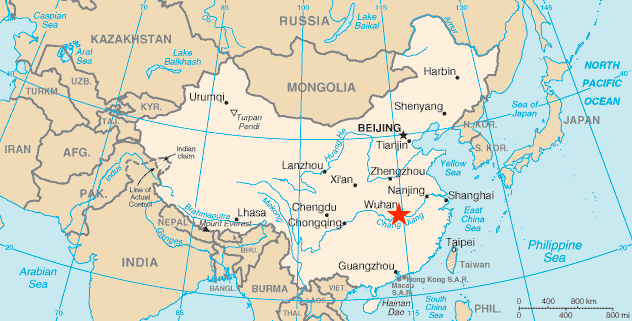
Chairman Xi, the Wuhan Coronavirus, and the “Mandate of Heaven”
It is a little-known fact that no government can do anything, without the cooperation of its victims. Of course that cooperation may be obtained by force and falsehood, but there will always be a few people who won’t play along. This creates a “technical problem” for the tyrant, which can also be solved by violence and deceit, but in the heart of every dictatorship there must be calculations. At what point do so many people want us dead, that they will actually kill us?
This is a political calculation, and it can turn even a genocidal maniac into a thoughtful politician. A monstrously evil country, such as Red China, can be moderated in this way. Superficially, it may sometimes come to resemble a bourgeois, Westernized, rule-of-law state, like Japan, Taiwan, South Korea. It may, indeed must in its own interest, pretend to be benign. But under sufficient pressure it has only two choices. One is to be openly monstrous, with all the risks that entails; and the other is to disintegrate.
My interest has been piqued as a China-watcher. Recent events have been bringing that kettle back to the boil. That the Peking politburo has been making serious mistakes, we may observe. It could not possibly have intended the Batflu crisis, which its own malign incompetence brought about. But as it tries to manage the crisis, for its own purposes, the mistakes multiply. Even the people it had diligently bought — such as our progressive journalists, politicians, and businessmen — are turning against it.
Within China itself, the unthinking default loyalty of the masses, has been disturbed. “Narratives” which conflict with the official ones are circulating, along with the virus — and even among those who “test negative,” as it were. These are people who would never rebel, but they become sympathetic to rebels. Moreover, the state’s image of invincibility — the Mao/Xi portrait, a hundred feet tall — is cracking. Imagined lines of contempt appear in the plaster. Chairman Mao, of course, is dead, but Chairman Xi must be sensing his mortality.
As the Soviet Union was collapsing from within, progressive Westerners tried to ignore it. This wasn’t something they wanted to look at, which is why they were all taken by surprise. The fall of the Berlin Wall inwardly distressed everyone on the Left. For a few years their confidence was shaken, slowing their efforts to regroup around “environmentalism,” or some alternative leftwing cause, that wasn’t in shambles like socialism. But eventually their smugness recovered, and those revealed to have been absolutely wrong about everything they had ever told us, were able to resume their status as “experts.”
From Wikipedia‘s entry on the Mandate of Heaven:
The Mandate of Heaven (Chinese: 天命; pinyin: Tiānmìng; Wade–Giles: T’ien-ming, literally “Heaven’s will”) is a Chinese political and religious teaching used since ancient times to justify the rule of the King or Emperor of China. According to this belief, Heaven (天, Tian) — which embodies the natural order and will of the universe — bestows the mandate on a just ruler of China, the “Son of Heaven” of the “Celestial Empire”. If a ruler was overthrown, this was interpreted as an indication that the ruler was unworthy, and had lost the mandate. It was also a common belief that natural disasters such as famine and flood were divine retributions bearing signs of Heaven’s displeasure with the ruler, so there would often be revolts following major disasters as the people saw these calamities as signs that the Mandate of Heaven had been withdrawn.
[…] The Mandate of Heaven was often invoked by philosophers and scholars in China as a way to curtail the abuse of power by the ruler, in a system that had few other checks. Chinese historians interpreted a successful revolt as evidence that Heaven had withdrawn its mandate from the ruler. Throughout Chinese history, times of poverty and natural disasters were often taken as signs that heaven considered the incumbent ruler unjust and thus in need of replacement.
What makes a handplane good or bad?
Rex Krueger
Published 13 Mar 2019More video and exclusive content: http://www.patreon.com/rexkrueger
Get the FREE Tip Sheet: https://www.rexkrueger.com/articles/2…
Tools and Materials in this Video (affiliate; scroll for more) || Stanley 12-404 plane : https://amzn.to/2Ty8Dq8
(more…)
QotD: Distorting the history of science
The most frequently assigned book on science in universities (aside from a popular biology textbook) is Thomas Kuhn’s The Structure of Scientific Revolutions. That 1962 classic is commonly interpreted as showing that science does not converge on the truth but merely busies itself with solving puzzles before lurching to some new paradigm that renders its previous theories obsolete; indeed, unintelligible. Though Kuhn himself disavowed that nihilist interpretation, it has become the conventional wisdom among many intellectuals. A critic from a major magazine once explained to me that the art world no longer considers whether works of art are “beautiful” for the same reason that scientists no longer consider whether theories are “true.” He seemed genuinely surprised when I corrected him.
The historian of science David Wootton has remarked on the mores of his own field: “In the years since Snow’s lecture the two-cultures problem has deepened; history of science, far from serving as a bridge between the arts and sciences, nowadays offers the scientists a picture of themselves that most of them cannot recognize.” That is because many historians of science consider it naïve to treat science as the pursuit of true explanations of the world. The result is like a report of a basketball game by a dance critic who is not allowed to say that the players are trying to throw the ball through the hoop.
Many scholars in “science studies” devote their careers to recondite analyses of how the whole institution is just a pretext for oppression. An example is a 2016 article on the world’s most pressing challenge, titled “Glaciers, Gender, and Science: A Feminist Glaciology Framework for Global Environmental Change Research,” which sought to generate a “robust analysis of gender, power, and epistemologies in dynamic social-ecological systems, thereby leading to more just and equitable science and human-ice interactions.”
More insidious than the ferreting out of ever more cryptic forms of racism and sexism is a demonization campaign that impugns science (together with the rest of the Enlightenment) for crimes that are as old as civilization, including racism, slavery, conquest, and genocide.
This was a major theme of the Critical Theory of the Frankfurt School, the quasi-Marxist movement originated by Theodor Adorno and Max Horkheimer, who proclaimed that “the fully enlightened earth radiates disaster triumphant.” It also figures in the works of postmodernist theorists such as Michel Foucault, who argued that the Holocaust was the inevitable culmination of a “bio-politics” that began with the Enlightenment, when science and rational governance exerted increasing power over people’s lives. In a similar vein, the sociologist Zygmunt Bauman blamed the Holocaust on the Enlightenment ideal to “remake the society, force it to conform to an overall, scientifically conceived plan.”
In this twisted narrative, the Nazis themselves are somehow let off the hook (“It’s modernity’s fault!”). Though Critical Theory and postmodernism avoid “scientistic” methods such as quantification and systematic chronology, the facts suggest that they have the history backwards. Genocide and autocracy were ubiquitous in premodern times, and they decreased, not increased, as science and liberal Enlightenment values became increasingly influential after World War II.
Steven Pinker, “The Intellectual War on Science”, Chronicle of Higher Education, 2018-02-13.