World War Two
Published 16 Apr 2020Charles De Gaulle is a towering figure in history, and not just because of his height. Becoming increasingly political in the interwar years due to his unorthodox views on military strategy, The Fall of France will thrust him into the limelight.
Join us on Patreon: https://www.patreon.com/TimeGhostHistory
Or join The TimeGhost Army directly at: https://timeghost.tvFollow WW2 day by day on Instagram @World_war_two_realtime https://www.instagram.com/world_war_t…
Between 2 Wars: https://www.youtube.com/playlist?list…
Source list: http://bit.ly/WW2sourcesHosted by: Indy Neidell
Written by: Francis van Berkel
Director: Astrid Deinhard
Producers: Astrid Deinhard and Spartacus Olsson
Executive Producers: Astrid Deinhard, Indy Neidell, Spartacus Olsson, Bodo Rittenauer
Creative Producer: Joram Appel
Post-Production Director: Wieke Kapteijns
Research by: Catherine Burton
Edited by: Mikołaj Cackowski
Sound design: Marek Kamiński
Map animations: Eastory (https://www.youtube.com/c/eastory)Colorizations by:
Carlos Ortega Pereira, BlauColorizations, https://www.instagram.com/blaucoloriz…
Dememorabilia – https://www.instagram.com/dememorabilia/
Norman Stewart – https://oldtimesincolor.blogspot.com/
Adrien Fillon – https://www.instagram.com/adrien.colo…
Sources:
Outdoor family portrait, with lurkers (c.1920), courtesy pellethepoet https://flic.kr/p/ompxgf
IWM A 1464, E 2324, D 1966
Frederick Milthorp collectionSoundtracks from the Epidemic Sound:
Max Anson – “Ancient Saga”
Farell Wooten – “Blunt Object”
Johannes Bornlof – “Deviation in Time”
Reynard Seidel – “Deflection”
Johannes Bornlof – “The Inspector 4”
Phoenix Tail – “At the Front”Archive by Screenocean/Reuters https://www.screenocean.com.
A TimeGhost chronological documentary produced by OnLion Entertainment GmbH.
April 17, 2020
Charles De Gaulle – The Flame of French Resistance? – WW2 Biography Special
“Diary Of An Unknown Soldier” – Lost in the Great War – Sabaton History 063 [Official]
Sabaton History
Published 16 Apr 2020The bells rang on Armistice Day 1920 in the 11th hour, and two minutes of silence followed. One minute for the soldiers that had fought in the Great War and had come back. The second for those who did not. Those unfortunate souls that had been left behind. They had died like so many others, but had been denied a final resting place due to the violence of war. They had vanished, without a trace, without an identity. Those men where the Unknown Soldiers.
Support Sabaton History on Patreon: https://www.patreon.com/sabatonhistory
Listen to “Diary of an Unknown Soldier” on the album The Last Stand:
CD: http://bit.ly/TheLastStandStore
Spotify: http://bit.ly/TheLastStandSpotify
Apple Music: http://bit.ly/TheLastStandItunes
iTunes: http://bit.ly/TheLastStandItunes
Amazon: http://bit.ly/TheLastStandAmz
Google Play: http://bit.ly/TheLastStandGooglePlayWatch the official lyric video of “Diary Of An Unknown Soldier” here:
https://www.youtube.com/watch?v=Jhkz5…Check out the trailer for Sabaton’s new album The Great War right here: https://www.youtube.com/watch?v=HCZP1…
Listen to Sabaton on Spotify: http://smarturl.it/SabatonSpotify
Official Sabaton Merchandise Shop: http://bit.ly/SabatonOfficialShopHosted by: Indy Neidell
Written by: Markus Linke and Indy Neidell
Directed by: Astrid Deinhard and Wieke Kapteijns
Produced by: Pär Sundström, Astrid Deinhard and Spartacus Olsson
Creative Producer: Joram Appel
Executive Producers: Pär Sundström, Joakim Broden, Tomas Sunmo, Indy Neidell, Astrid Deinhard, and Spartacus Olsson
Post-Production Director: Wieke Kapteijns
Edited by: Iryna Dulka
Sound Editing by: Marek Kaminski
Maps by: Eastory – https://www.youtube.com/c/eastoryArchive by: Reuters/Screenocean https://www.screenocean.com
Music by Sabaton.Sources:
– National Library of Scotland
– National Library of France
– Imperial War Museum: Q 10378, Q 100373, Q 57227, Q 100624, Q 53727, Q 29155, ART 3991 a, Q 109517, Q 100928, Q 100699, Q 100913, Q 45814, Q 23706, Q 14963, Q 31518, Q 31494, RAF-T 3129, Q 31514, Q 909, Q 87441, Documents.5323, Q 100486, Q 48929A, Q 78614An OnLion Entertainment GmbH and Raging Beaver Publishing AB co-Production.
© Raging Beaver Publishing AB, 2019 – all rights reserved.
From the comments:
Sabaton History
2 days ago
Something different this time. Since we already have two episodes about the fighting in the Argonne, we thought this time we’d talk about the sacrifice and the legacy of the “Unknown Soldier”. Of those who fought and died but were not fortunate enough to have a last known resting place. We hope you still enjoy the episode!
Chris Selley – “… if John Q. Bylaw is hassling you just for taking a walk, for heaven’s sake get your smart phone out and make a righteous stink”
Our proto-surveillance society is moving rapidly toward all-surveillance, all the time and the current justification is to fight the Wuhan Coronavirus epidemic:
For civil libertarians, these are alarming times — but less alarming than they might be. During a pandemic, when everyone agrees life cannot go on as normal, people who place maximum value on individual freedom are liable to look rather selfish. “Trust our leaders” types get a big boost.
But if Canadian officialdom has not botched its response to this crisis, neither has it excelled. Theresa Tam’s defenders are right that official advice will naturally change over the course of a pandemic — but nothing justifies her proactive downplaying of the COVID-19 risk at a time when several Canadian governments were, we now know, woefully unprepared. The pandemic doesn’t care that Prime Minister Justin Trudeau went to Harrington Lake, against advice from three governments including his own to stay away from any second homes — but it would have been so bloody easy for him not to go, to set an example. It’s equally inconsequential that Andrew Scheer added six more human beings than necessary to a government charter flight from Regina to Ottawa — and it would have been equally easy for him not to bring his family along.
Meanwhile, certain big Canadian cities have so obviously overstepped the mark, by cracking down on perfectly safe behaviours — walking in parks, notably — as to highlight the value of some don’t-tread-on-me pushback. An unscientific survey of social media suggests not a single real human being supports the City of Ottawa’s latest ridiculousness: Days after its bylaw officers threatened a father and son for kicking a ball around [noted here], fined a man $880 for walking his dog, and allegedly assaulted a man questioning his eviction from a park — none of which seems to be supported by the provincial emergency act they were ostensibly enforcing — a public health official now advises against exchanging properly distanced outdoor pleasantries with one’s neighbours lest it “turn into a parking lot or backyard party.” (Don’t laugh: Studio 54 was a cozy little jazz bar before Mick Jagger and Debbie Harry showed up one night with some records and a pound of blow.)
For civil libertarians who remember life before smart phones, meanwhile, the plan Google and Apple are working on to help governments control COVID-19 might as well be custom-designed to induce heebie-jeebies. The basic idea is that your phone’s operating system would reach out to other phones via Bluetooth and record the date, time, duration and location of the meeting. No personal information need be attached to those data points, just the identity of the device. When someone reports a COVID-19 diagnosis on an app, using a code provided by their public health department, devices that had been nearby would receive a warning that their owners might have been exposed, and should take such measures as local authorities advise.
It could be the stuff of dystopian sci-fi. You can just see the guy with the giant translucent computer screen shouting “magnify! Enhance!” Really, though, this comes down to a simple question: Whom do you least distrust? A co-production between Google, which is not at all known for respecting users’ privacy, and Apple, which at least seems to make an effort? Or governments?
Prototype Mauser 1917 Trench Carbine
Forgotten Weapons
Published 20 Dec 2019http://www.patreon.com/ForgottenWeapons
Cool Forgotten Weapons merch! http://shop.bbtv.com/collections/forg…
In the latter stages of World War One, the German military was looking for new arms for its Sturmtruppen. Without a reliable self-loading rifle design to use, they instead focused on pistol-caliber arms. The first to be used was the existing P08 artillery Luger, fitted with a drum magazine. At the very end of the war, these were being replaced by Bergmann MP-18,I submachine guns. But there was another gun that was tested but not adopted — the 1917 trench carbine variation of Mauser’s C96 “Broomhandle” pistol. Only about 40 of these guns were made as prototypes and trials models, and they were not adopted for reasons that are not entirely clear (but cost is probably a significant element). Only a few examples survive, and they vary substantially in their details. In addition, they are substantially different from both standard C96 pistols and also the sporting carbines made before the war.
All the 1917 trench carbines used a magazine developed from the 1906/08 pistol; an excellent double-stack, double-feed type. Magazines of 10, 20, and 40-round capacity were made, although all known examples were only semiautomatic (the full-auto Schnellfeuer Mausers would not come until the early 1930s).
Contact:
Forgotten Weapons
6281 N. Oracle #36270
Tucson, AZ 85704
QotD: Rommel arrives in North Africa
Rommel arrived in February 1941 with fairly mundane orders to act as a Sperrband, a “blocker” to bolster the Italians after their mauling at Beda Fomm. The force he led was appropriately tiny: the reconnaissance battalion and an antitank detachment of the 5th Light Division (soon renamed the 21st Panzer Division). The rest of the division was still en route to Africa, and a second division, the 15th Panzer, would not arrive completely until the end of May.
Rommel had his orders, but he had ignored orders in the past and been decorated for it. With British forces stripped to fight an exceedingly ill-advised campaign in Greece, he carried out a quick personal reconnaissance in his trusty little Fieseler Storch airplane, then launched an offensive in concert with his Italian partners (Ariete armored division and the infantry divisions of X Corps, Bologna and Pavia). He penetrated British defenses at El Agheila on March 24th, then drove on to Mersa el Brega on March 31st, pausing only long enough to take (and ignore) a number of radio messages from Berlin and Rome warning him not to do anything rash. Finally, he smashed the British defenders at Agedabia (elements of the green 2nd Armoured Division, equipped partially with captured Italian M13/40 tanks), pinning them in front with the infantry of 5th Light Division while dispatching his Panzers on a ride around the open desert flank to the south, the first use of a tactic that would become his signature move.
These three tiny encounters, none of them exceeding regimental strength, were enough to unhinge the entire British defensive position in Cyrenaica. Rommel now expanded his “reconnaissance in force” into a general offensive, although the forces involved were still minuscule. One column headed up the coast road towards Benghazi, while two more sliced across the Cyrenaican bulge, scooping up a mountain of British supplies at Msus and Mechili. The British rear was in chaos. On April 6th, a German motorcycle patrol actually captured the British commander in Cyrenaica, General Philip Neame, as well as General Richard O’Connor, the victor of Beda Fomm. By April 11th, the Germans had surrounded the coastal fortress of Tobruk while smaller formations pressed on to the east, taking Bardia and reaching the Egyptian border at Sollum and Ft. Capuzzo.
This was top speed maneuver, and the distances were vast, with the Afrika Korps covering over 600 miles in less than two weeks. An amazing feat, to be sure, but may we not legitimately ask, Six-hundred miles to where? Rommel had lunged from central Libya to the Egyptian border in a great bound, but now he had an unconquered fortress sitting in his rear, a serious threat to his lines of communication and supply. Two hastily marshaled attempts to storm Tobruk went badly wrong. In the “Easter battle” (April 10th-14th) and the “battle of the Salient” (April 30th-May 4th), the defenders of the 9th Australian Division hung tough. Minefields channeled the German attacks, while direct fire from artillery, antitank guns, and supporting tanks shot up the assault forces quite badly and killed General Heinrich von Prittwitz, commander of 15th Panzer Division.
The very presence of an unconquered Tobruk rendered the drive across the desert pointless. Indeed, for all the fame it had brought Rommel in the world press, this first campaign won him few friends among command echelons in Berlin. General Halder was especially unimpressed. Rommel, he wrote, “storms around all day long with formations strewn all over the place.” The man had apparently “gone insane.” There was some justice to the complaint. A German division-plus had overrun territory — a vast wasteland, to be precise — but it hadn’t really won anything. There had been no battle of annihilation, no Kesselschlacht, nor could there have been. The Afrika Korps had come a long way, but now sat precariously on the edge of nowhere. Although Rommel and his command had shown a satisfying level of aggression, something the entire officer corps understood, most of them saw his drive to the Egyptian border as a misfire.
Robert Citino, “Drive to Nowhere: The Myth of the Afrika Korps, 1941-43″, The National WWII Museum, 2012. (Originally published in MHQ, Summer 2012).

April 16, 2020
Make a cabinet with hand-tools and no clamps
Rex Krueger
Published 15 Apr 2020Make sturdy cabinets with limited tools and inexpensive wood. No clamps needed!
More video and exclusive content: http://www.patreon.com/rexkrueger
(more…)
The (temporary) return of “dazzle” paint schemes for the Royal Canadian Navy
Well, two RCN ships, if not the entire fleet … Joseph Trevithick reports for The Drive:

HMCS Regina in her dazzle camouflage paint taking part in Task Group Exercise 20-1 in April, 2020.
Canadian Forces photo via The Drive.
Air forces around the world will often give their aircraft specialized paint jobs to commemorate anniversaries and other notable occasions, but it’s far less common to see navies do the same thing with their ships. Recently, however, the Royal Canadian Navy’s Halifax class frigate HMCS Regina recently took part in a training exercise wearing an iconic blue, black, and gray paint job, commonly known as a “dazzle” scheme, a kind of warship camouflage that first appeared during World War I.
At the end of March 2020, Regina, and her unique paint job, had joined HMCS Calgary, another Halifax-class frigate, along with the Kingston-class coastal defense vessel HMCS Brandon and two Orca-class Patrol Craft Training (PCT) vessels, Cougar* and Wolf*, for Task Group Exercise 20-1 (TGEX 20-1) off the coast of Vancouver Island in the northeastern Pacific Ocean. The training continued into the first week of April. TGEX 20-1 was part of Calgary‘s Directed Sea Readiness Training (DSRT) in preparation for that particular ship’s upcoming deployment.
Regina had first emerged in the dazzle scheme in October 2019 ahead of the U.S. Navy-led Rim of the Pacific (RIMPAC) exercise, a massive naval training event that takes place every two years and includes U.S. allies and partners from around the Pacific region. It reportedly took 272 gallons of paint and cost the Royal Canadian Navy $20,000 to give Regina the dazzle treatment.
The frigate will wear the camouflage pattern until the end of 2020. The Royal Canadian Navy also painted up the Kingston-class HMCS Moncton, which is homeported in Halifax on the other side of the country, in a similar scheme. The paint job on both ships is in commemoration of the 75th anniversary of the end of the Battle of the Atlantic. This refers to the Allied fight to both enforce a naval blockade of Germany during World War II and secure critical maritime supply routes from North America to Europe. The battle officially ended with the surrender of the Nazi regime in May 1945.
* Wikipedia points out that the Orca-class are not formally commissioned ships in the RCN and therefore do not carry the designation “Her Majesty’s Canadian Ship” (HMCS).
Prologue: The Dutch Colonial Whip | The Indonesian War Of Independence
TimeGhost History
Published 15 Apr 2020This is the prologue to our five-part Indonesian War of Independence Miniseries. It sets the stage of brutal colonial repression, a growing sense of Indonesian Nationalism and ultimately the desire to be free.
Join us on Patreon: https://www.patreon.com/TimeGhostHistory
Hosted by: Indy Neidell
Written by:
Spartacus Olsson and Joram Appel
Directed by: Astrid Deinhard
Produced by: Astrid Deinhard and Spartacus Olsson
Executive Producers: Astrid Deinhard, Indy Neidell, Spartacus Olsson, Bodo Rittenauer
Creative Producer: Joram Appel
Post-Production Director: Wieke Kapteijns
Research by: Joram Appel and Isabel Wilson
Edited by: Wieke Kapteijns, Guido Becker
Sound design: Marek KamińskiColorizations by: Dememorabilia – https://www.instagram.com/dememorabilia/
Research Sources: https://bit.ly/IndoSources
Visual Sources:
Tropenmuseum, part of the National Museum of World Cultures
Wellcome ImagesIcons retrieved via The Nounproject: gold by Phạm Thanh Lộc, slaves by Salaidinovich, silver by Marie Van den Broeck, spice by ahmad, Opium Poppies by Matt Wasser.
Music:
“Disciples of Sun Tzu” – Christian Andersen
“Weapon of Choice” – Fabien Tell
“Guilty Shadows 4” – Andreas Jamsheree
“Road To Tibet 5” – Rannar Sillard
“Sailing for Gold” – Howard Harper-Barnes
“The Inspector 4” – Johannes Bornlöf
“The Dominion” – Bonnie Grace
“Heroes On Horses” – Gunnar Johnsén
“Not Safe Yet” – Gunnar JohnsenA TimeGhost chronological documentary produced by OnLion Entertainment GmbH.
From the comments:
TimeGhost History
2 days ago (edited)
This is the prologue to our new ‘Indonesian War of Independence’ mini-series. Now, we initially only wanted to do five episodes, but episode one became double as long as we imagined, so we decided to cut the historical context out and put it in a prologue. These series are mainly written by Joram and Isabel, two historians from the Netherlands and the United Kingdom. Now, you might say that we are not in the best position to talk about European Imperialism because of that. However, as we’re both academically trained historians, we believe that we’re able to overcome any bias through the use of academic methods and peer-reviewed academic sources. If anyone is interested to take a look at our source-list, you can find it right here: https://bit.ly/IndoSourcesThese mini-series have been chosen out of a bigger selection by our TimeGhost Army. They fund almost our entire production – this would not exist without them. Become one of them to choose future series and to support the creation of content just like this! You can do that at patreon.com/timeghosthistory or https://timeghost.tv.
Cheers,
Joram
Canada’s temporary foreign workers
Chris Selley points out some of the weirdness of Canada’s claimed dependence on temporary foreign workers because “Canadians still need to eat.”:

Temporary foreign workers picking fruit in a Canadian orchard.
Image from http://www.yorkfeed.com/apple-picking-urgently-canada/
If all goes as it should at Canada’s airports, temporary foreign workers will be informed of their responsibilities. They should be made aware of their employers’ responsibilities as well. And there’s no particular epidemiological reason to worry about them more than anyone else landing on a Canadian runway from abroad — or domestically, for that matter. The vast majority of temporary foreign workers are from Mexico, Jamaica or Guatemala, which have reported 39, 25 and nine COVID-19 cases per million residents. Canada’s tally works out to 713 per million.
But the official advice to employers provides little comfort. It doesn’t prohibit putting people up in shared accommodations; it merely says residents must be able to keep two metres from each other at all times. We know the limitations of such measures from experience in seniors’ homes and homeless shelters. It’s not necessarily “the state’s duty” to quarantine arriving temporary foreign workers, as Bloc Québécois leader Yves-François Blanchet argued this week. But the state could certainly do far more than it is.
For one thing, the cities in which workers typically first arrive are much better suited to proper self-isolation — i.e., in a hotel or motel room — compared to the farm country they are eventually headed for. Sourcing 45,000 hotel rooms is a huge job even in cities — that’s roughly how many rooms there are in the entire Greater Toronto Area — but it will never be easier than right now. It would prevent any bad-actor employers from breaking the rules. It would be much more reassuring than a government cheque for what works out to less than $80 per worker per day of isolation.
The whole situation is completely bizarre, though — one of several longstanding, bizarre and sometimes embarrassing Canadian situations that COVID-19 has highlighted. Economically speaking, the idea of temporary foreign workers essentially amounts to cheating. It reaches peak absurdity when businesses like Tim Hortons outlets claim to need them — that is, when they’re being brought in to do work that Canadians are demonstrably willing to do. It’s just a skeevy way to artificially depress wages and the price of fast food. People seemed to sense that back in 2014, when the government tightened the rules.
In agriculture, however, the idea seems thoroughly entrenched. Perhaps it’s a case of out of sight, out of mind. But it’s the same absurdity: If you can identify a group of 45,000 people without whose labour we literally wouldn’t be able to feed ourselves — or so we are told — then on what possible grounds are we denying them a path to Canadian citizenship? In 2017, the Toronto Star profiled a 66-year-old Saint Lucian man who had busted his hump on Canadian farms for 37 years in a row, with his paycheques deducted for income tax, EI and CPP, but who had no claim to stay. The highly skilled and educated immigrants we compete to attract bring many important things to Canada’s table; they don’t bring anything more important than food. And food is something COVID-19 has very much taught us not to take for granted. Who would have thought supermarket checkout clerks would achieve hero status?
Was the Afrika Korps worth it?
Military History not Visualized
Published 20 Apr 2018Was it worth it to send the Afrika Korps at all? In this video we look at the Mediterranean Campaign in World War 2, which is usually overshadowed by the “Desert Warfare” between Rommel and Montgomery.
»» SUPPORT MHV ««
» patreon – https://www.patreon.com/mhv
» paypal donation – https://www.paypal.com/cgi-bin/webscr…»» MERCHANDISE – SPOILS OF WAR ««
» shop – https://www.redbubble.com/people/mhvi…»» SOCIAL MEDIA ««
» twitter – https://twitter.com/MilHiVisualizedMilitary History Vlogs is a support channel to Military History Visualized with a focus personal accounts, answering questions that arose on the main channel and showcasing events like visiting museums, using equipment or military hardware.
» SOURCES «
Ball, Simon: “The Mediterranean and North Africa, 1940-1944”, in: Cambridge History of the Second World War – Volume I, p. 358-388
Preston, Paul: “Spain: betting on a Nazi victory”; in: Cambridge History of the Second World War: Volume II: Politics & Ideology, p. 324-349
Das Deutsche Reich und der Zweite Weltkrieg, Band 3: Der Mittelmeerraum und Südosteuropa 1940-1941 (English Version below)
ENGLISH VERSION: Germany and the Second World War, Volume 3, The Mediterranean, South-east Europe, and North Africa, 1939-1941Das Deutsche Reich und der Zweite Weltkrieg – Band 6 – Der Globale Krieg
ENGLISH VERSION: Germany and the Second World War – Volume 6 – The Global WarDas Deutsche Reich und der Zweite Weltkrieg – Band 8
ENGLISH VERSION: Germany and the Second World War – Volume 8 – The Eastern Front 1943-1944: The War in the East and on the Neighbouring Fronts» CREDITS & SPECIAL THX «
Song: Ethan Meixsell – “Demilitarized Zone”#AfrikaKorps #AfricaCorps #WW2
QotD: Nietzsche’s ideas
… an accurate and intelligent account of Nietzsche’s ideas, by one who has studied them and understands them, is, as Mawruss Perlmutter would say, yet another thing again. Seek in What Nietzsche Taught, by Willard H. Wright, and you will find it. Here in the midst of the current obfuscation, are the plain facts, set down by one who knows them. Wright has simply taken the eighteen volumes of the Nietzsche canon and reduced each of them to a chapter. All of the steps in Nietzsche’s arguments are jumped; there is no report of his frequent disputing with himself; one gets only his conclusions. But Wright has arranged these conclusions so artfully and with so keen a comprehension of all that stands behind them that they fall into logical and ordered chains, and are thus easily intelligible, not only in themselves, but also in their interrelations. The book is incomparably more useful than any other Nietzsche summary that I know. It does not, of course, exhaust Nietzsche, for some of the philosopher’s most interesting work appears in his arguments rather than in his conclusions, but it at least gives a straightforward and coherent account of his principal ideas, and the reader who has gone through it carefully will be quite ready for the Nietzsche books themselves.
These principal ideas all go back to two, the which may be stated as follows:
- Every system of morality has its origin in an experience of utility. A race, finding that a certain action works for its security and betterment, calls that action good; and, finding that a certain other action works to its peril, it calls that other action bad. Once it has arrived at these valuations it seeks to make them permanent and inviolable by crediting them to its gods.
- The menace of every moral system lies in the fact that, by reason of the supernatural authority thus put behind it, it tends to remain substantially unchanged long after the conditions which gave rise to it have been supplanted by different, and often diametrically antagonistic conditions.
In other words, systems of morality almost always outlive their usefulness, simply because the gods upon whose authority they are grounded are hard to get rid of. Among gods, as among office-holders, few die and none resign. Thus it happens that the Jews of today, if they remain true to the faith of their fathers, are oppressed by a code of dietary and other sumptuary laws — i.e., a system of domestic morality — which has long since ceased to be of any appreciable value, or even of any appreciable meaning, to them. It was, perhaps, an actual as well as a statutory immorality for a Jew of ancient Palestine to eat shell-fish, for the shell-fish of the region he lived in were scarecly fit for human food, and so he endangered his own life and worked damage to the community of which he was a part when he ate them. But these considerations do not appear in the United Sates of today. It is no more imprudent for an American Jew to eat shell-fish than it is for him to eat süaut;ss-und-sauer. His law, however, remains unchanged, and his immemorial God of Hosts stands behind it, and so, if he would be counted a faithful Jew, he must obey it. It is not until he definitely abandons his old god for some modern and intelligible god that he ventures upon disobedience. Find me a Jew eating oyster fritters and I will show you a Jew who has begun to doubt very seriously that the Creator actually held the conversation with Moses described in the ninteenth and subsequent chapters of the Book of Exodus.
H.L. Mencken, “Transvaluation of Morals”, The Smart Set, 1915-03.
April 15, 2020
Roy Underhill’s Bench Hooks
Lie-Nielsen Toolworks
Published 19 Sep 2012Bench hooks are indispensable jigs for all kinds of hand tool woodworking tasks. Roy Underhill shows us how to make a pair of them using a number of different hand tools and techniques — and offers his secrets to flawless woodworking.
The Industrial Revolution and the Society for the Encouragement of Arts, Manufactures and Commerce
In the latest from Anton Howes’ Age of Invention newsletter, we are introduced to the Society for the Encouragement of Arts, Manufactures and Commerce:

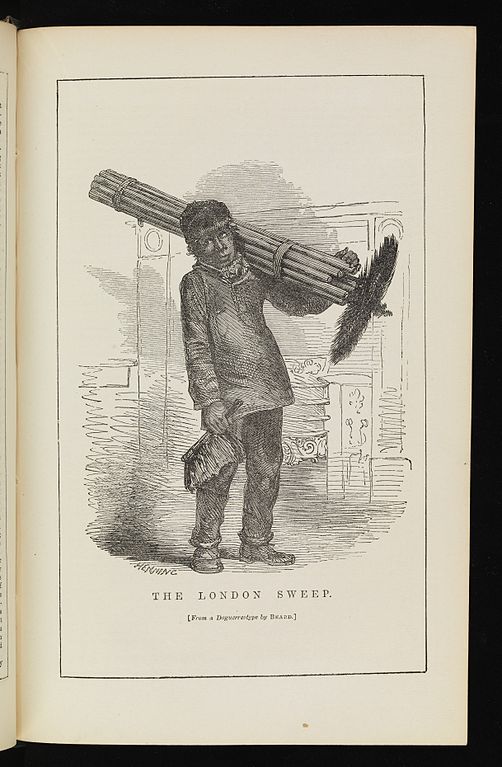
The London Sweep (from a Daguerreotype by BEARD).
Image from London labour and the London poor : a cyclopaedia of the condition and earnings of those that will work, those that cannot work, and those that will not work, 1851, via the Wellcome Collection.
When we think of the British Industrial Revolution, the image that springs to mind tends to be of soot-belching factories and foundries, of child labour and squalid cities. The inventors who spring to mind tend to be James Watt and his steam engines, or Richard Arkwright and his cotton-spinning machines. But what people tend to forget is that the Industrial Revolution was unleashed by a much broader tide of accelerating innovation — as I never tire of repeating, it touched everything from agriculture to watchmaking, and everything inbetween. Just as some inventors pioneered the use of factories, other inventors sought solutions to industrialisation’s social ills.
Last time, I mentioned the Society for the Encouragement of Arts, Manufactures and Commerce, set up in 1754 in a London coffee house (the Society of Arts for short). What’s so fascinating about the organisation — which still exists today, now called “Royal” — is that it was closely involved with many of the more socially-oriented innovations of the period. By this, I mean the kinds of inventions that were rarely immediately profitable, but which aimed to save lives, to alleviate suffering, or to remedy some other social ill. The Society advertised premiums — cash prizes or honorary medals — for solutions to the problems that its members identified. And it offered similar rewards, which they called bounties, for unsolicited inventions.
It awarded a bounty of fifty guineas and a gold medal to Henry Greathead, for example, one of the claimants for the invention of the lifeboat. It gave another fifty guineas to a sergeant of the Royal Artillery, John Bell, for a method of firing a rope and grapple by mortar from a ship to the shore, to save people on board from shipwreck during storms. (Some years later, it even gave a gold medal to another inventor for a device that did the opposite, firing from shore to ship.) The Society awarded a medal to a Sheffield schoolmaster, John Hessey Abraham, for a magnetic apparatus that would prevent metal dust getting into the eyes and lungs of workers employed in grinding the points of needles. And in 1767 it awarded a bounty to a clockmaker, Christopher Pinchbeck, for a safer crane — cranes at the time were like gigantic hamster wheels, but for humans. When lines snapped, the results could be fatal, so Pinchbeck added a pneumatic braking mechanism.
The list goes on — in all, over the course of about a century, the Society of Arts awarded over two thousand premiums and bounties for inventions. But there is one that really stands out: a premium for the invention of a mechanical means of cleaning chimneys. With such an invention, the Society hoped to abolish the employment of children, sometimes as young as 4, who were forced to climb up inside chimneys in order to clean them. These children were sometimes abducted by the master chimney sweeps, and frequently perished in horrific accidents or of soot-induced cancers. Strikingly, the use of climbing boys was thought to be unique to Britain — the “peculiar disgrace of England” as the campaigners put it (though I don’t think this was quite true). The Society’s idea was that if a technological replacement could be found, then the case for outright abolition could be made — they wanted to create a machine to take the children’s jobs.
The Society of Arts played its role with the offer of a premium, but it acted alongside another campaign run by a few of its members, who ran the snappily titled “Society for Superseding the Necessity of Climbing Boys, by Encouraging a New Method of Sweeping Chimnies, and for Improving the Condition of Children and Others Employed by Chimney Sweepers”, founded in 1803 at the London Coffee-House on Ludgate Hill. Let’s call it the SSNCB for short. There had been earlier campaigns to abolish the use of climbing boys, one of the most prominent being run by Jonas Hanway (a prominent philanthropist, also a member of the Society of Arts, whose various claims to fame include being the first man in London to sport an umbrella). But the 1803 campaign was to prove the most successful, drawing on wider political support. The SSNCB’s key members included William Wilberforce, who later became famous for his zeal in abolishing the slave trade.
Girls Armed With Pitchforks – The Women’s Land Army – On the Homefront 002
World War Two
Published 14 Apr 2020Now that the labour-needs and the availability of manpower has changed due to the outbreak of World War Two, Women are required to join the workforce. They’re put to work in the Women’s Land Army.
Join us on Patreon: https://www.patreon.com/TimeGhostHistory
Or join The TimeGhost Army directly at: https://timeghost.tvFollow WW2 day by day on Instagram @World_war_two_realtime https://www.instagram.com/world_war_t…
Between 2 Wars: https://www.youtube.com/playlist?list…
Source list: http://bit.ly/WW2sourcesHosted by: Anna Deinhard
Written by: Spartacus Olsson and Francis van Berkel
Produced and Directed by: Spartacus Olsson and Astrid Deinhard
Executive Producers: Bodo Rittenauer, Astrid Deinhard, Indy Neidell, Spartacus Olsson
Creative Producer: Joram Appel
Post-Production Director: Wieke Kapteijns
Research by: Tom Meaden
Edited by: Mikołaj Cackowski
Map animations: Eastory (https://www.youtube.com/c/eastory)Colorizations by:
Dememorabilia – https://www.instagram.com/dememorabilia/
Julius Jääskeläinen – https://www.facebook.com/JJcolorization/Sources:
IWM A 19891, Q 54607, Q 54601, Q 54602, D 8793, D 204, D 199, D 18050, D 8463, D 18062, D 20722, D 8833, D 2973, D 14123, D 115, D 11256, D 14090, D 8806, TR 911, D 21057, D 128, CH 4119, D 3324, TR 912, D 18057, IWM TR 1568, D 21958, D 8794, TR 913
Picture of Women’s Land Army memorial in Scotland, courtesy of IWM, Martin Briscoe (WMR-69248)
Library of Congress
Portrait of Hilda Gibson, taken 2008 at 10 Downing Street, courtesy BBC PM blog http://www.bbc.co.uk/blogs/pm/2008/07…Soundtracks from the Epidemic Sound:
Johannes Bornlof – “Deviation In Time”
Wendel Scherer – “Defeated”
Johannes Bornlof – “Magnificent March 3”
Reynard Seidel – “Deflection”
Max Anson – “Ancient Saga”
Johannes Bornlof – “The Inspector 4”
Christian Andersen – “Quiet Contemplation”Archive by Screenocean/Reuters https://www.screenocean.com.
A TimeGhost chronological documentary produced by OnLion Entertainment GmbH.
From the comments:
World War Two
22 minutes ago (edited)
This is the second instalment of our monthly ‘On the Homefront’ series and it’s about the Women’s Land Army. Now, with these series we’re planning to cover the events and cultural and social changes that occurred during World War Two, as well as the organisations and individuals that lived through them. As with the other specials, we want to cover all the homefronts, from all nations all across the world. If you have any good ideas for future episodes, please let us know in the comments!
Cheers and stay safe!
Joram
“Experts” and their “models”
In the latest Libertarian Enterprise, after offering us his current favourite mixed drink recipe, L. Neil Smith gets around to discussing our modern dependence on “experts” wielding their intricate and convoluted computer models to guide our lives:
Start with a tall glass of Mott’s Clamato over ice. Many people can’t stand the idea of tomato juice enhanced with sweet clam juice (and some spices), and I won’t try to sell you on it, here. But if you relish it the way I do (I used to buy it by the gallon), then bon appetit! Throw in a healthy shot of tequila — mine is Cuervo Gold, but your mileage may vary. Add a fat slice of lime on the edge of the glass, a slice of lemon, and a slice of orange. The citrus really dresses it up. These are all ingredients I like very much, and together, they take the edge off a day I spent writing 1000 or 2000 words (my record so far is 3200) and let me relax.
At the end of that day, when my lovely and talented wife quits work and comes home — from the dining room, these days — we have a nice, comfortable cocktail hour (she drinks Cuba Libras) and watch Tucker Carlson. Ordinarily, three giant cans of the Budweiser concoction (which is also made with Clamato) will make me the tiniest bit silly. This drink, the Bloody Mermaid (ick) is surprisingly gentle and I have had two and a half so far without embarrassing myself. I love the taste of tequila neat (many don’t), and I would still be doing shooters, except that my loving bride of 36 years won’t let me eat that much salt.
Please enjoy this silly little drink if you can until we’re all free again.
Oh yeah — I couldn’t resist after all. There’s something I need to get off my chest. I’m sure you remember the way “experts” with computer models warned us all about Y2K, and the way it meant the end of Civilization-As-We-Knew-It. Then there was Global Warming — more experts, more computer models — there are still gullible morons out there who believe it’s not an obvious hoax. Now experts and their — increasingly failing — computer models are all telling us we are in the middle of the worst health crisis since the Black Death.
I happen to be, as you know, a lifelong libertarian and the most fervid advocate of the First Amendment that you will ever read. Therefore, I cannot endorse the suggestion I’ve heard that whenever an “expert” testifies about anything before any legislative body anywhere, and the words “computer model” come out of his mouth, the Sergeant-at-Arms should smash his face in, drag him out into the street, and shoot him him the back of the head. Perhaps millions of lives could be saved that way, but, as a lifelong libertarian and the most fervid advocate of the First Amendment you will ever read, I cannot endorse that position.
So drink up, my dear friends and readers and have the best time — under house arrest — that you possibly can!