
Victimhood bestows upon its legions a certain cloak of inviolability. One must remember that those who wear their victimhood like a badge of honor (and their liberal enablers) only want “one” thing: to be treated the same as everyone else is treated and to be treated special. This profound cognitive dissonance pervades their lives and defines them. They are allowed to say or believe things that would cause outrage if one of the oppressor groups said or thought the same thing. The best, most famous instance of this is Muhammed Ali’s virulent opposition to mixing the races. Ali, a man of great athletic and intellectual skills and one who had enormous courage in standing up for his principles regarding the Vietnam War, was also an appalling racist for much of his adult life. But he was insulated by his victimhood and so his odious views on miscegenation were rarely ever mentioned, let alone condemned. A more recent example was Kanye West’s infamous interruption of Taylor Swift’s award during the 2009 MTV awards. Rude and inexcusable, but no one dared to chastise him for his actions even though everyone knew that no white singer could ever interrupt a ceremony giving an award to a black singer and ever hope for continuing his career.
The irony of all this, of course, is the reluctance to hold everyone to the same standard of conduct and the same rules of discourse proves that racism is still alive and well in America. We still, as a society, refuse to treat everyone equally. It is, in fact, an insult to Ali and West that no one thought them equal enough to be chastised and condemned. In our society’s own peculiarly paternalistic and condescending way, we are saying that some people must be handled differently because they are not yet quite equal.
Joseph Mussomeli, “Victim Privilege, Cultural Appropriation, & the New Enslavement”, The Imaginative Conservative, 2018-02-09.
June 22, 2020
QotD: Victimhood
June 21, 2020
A Tale of Two Swords
Atun-Shei Films
Published 19 Jun 2020Myles Standish and Benjamin Church were military commanders in 17th century colonial Massachusetts who lived a generation apart. Standish came over on the Mayflower, and commanded the militia of the Plymouth Pilgrims in the 1620s; Church lived his whole life in the New World, and led the crack troops that tracked down Metacomet, sachem of the Pokanoket Wampanoag, during King Philip’s War in the 1670s. Standish carried an elegant German rapier, while Church used a simple naval cutlass. What changed? And what story can these two swords tell about the men who wielded them?
Support Atun-Shei Films on Patreon ► https://www.patreon.com/atunsheifilms
Leave a Tip via Paypal ► https://www.paypal.me/atunsheifilms (Between now and October, all donations made here will go toward the production of The Sudbury Devil, our historical feature film)
#PlymouthPilgrims #KingPhilipsWar #AmericanHistory
Watch our film ALIEN, BABY! free with Prime ► http://a.co/d/3QjqOWv
Reddit ► https://www.reddit.com/r/atunsheifilms
Twitter ► https://twitter.com/atun_shei
Instagram ► https://www.instagram.com/atunsheifilms
Merch ► https://atun-sheifilms.bandcamp.com~REFERENCES~
[1] Jeremy Dupertuis Bangs: “Myles Standish, Born Where? (2010).” Sail 1620 https://web.archive.org/web/201011301…
[2] Nathaniel Philbrick: Mayflower (2006). Penguin Books, Page 59-60
[3] “Short Men ‘Not More Aggressive'” (2007). BBC News http://news.bbc.co.uk/2/hi/uk_news/65…
[4] Charles Francis Adams: The New English Canaan of Thomas Morton (1883). The Prince Society, Page 284 https://archive.org/details/newenglis…
[5] Philbrick, Page 164
[6] Philbrick, Page 151-152
[7] Benjamin Church: Entertaining Passages Relating to King Philip’s War, Tercentenary Edition (1975). Pequot Press, Page 67-73
[8] Church, Page 75
[9] Church, Page 105-106
[10] Church, Page 108
[11] Church, Page 140
[12] Lisa Brooks: Our Beloved Kin (2018). Yale University Press, Page 322
[13] Church, Page 142
[14] Douglas Edward Leach: Flintlock and Tomahawk (1958). Parnassus Imprints, Page 231
[15] Philbrick, Page 338
[16] Church, Page 170
[17] Leach, Page 237
[18] Brooks, Page 337
Paul Wells – “Everyone agrees!” [on the need to fully investigate the Nova Scotia massacre] … “But so far there is no inquiry”
Paul Wells in Maclean’s:

We are faced, perhaps only temporarily, with a familiar Canadian paradox: everyone says they want something to happen, but it isn’t happening.
The “something” is a rigorous public inquiry into a horrible shooting spree that spanned two days and killed 22 people in Nova Scotia in mid-April. It was the worst mass murder in Canadian history. It was lurid in its weirdness. The gunman, Gabriel Wortman, spent two days driving around in a convincing replica RCMP vehicle, shooting at whim, while the force he was imitating and dodging failed to send out a more comprehensive emergency alert than their Twitter warnings, one that might have saved more lives. In the midst of the carnage, two actual RCMP officers apparently fired their weapons into the walls of a firehall in Onslow for reasons that remain unknown.
New reporting for Maclean’s by Shannon Gormley, Stephen Maher and Paul Palango raises troubling new questions about Wortman’s possible ties to organized crime and, especially, to the RCMP itself. This reporting is attracting a lot of attention and, here and there, vigorous online debate. This Twitter thread, for instance, asks hard questions about our latest story.
The questions raised by our investigative team including Paul Palango, author of three best-selling books (here, here and here) about the troubling history of the RCMP, are backed by a solid and growing network of well-informed sources. But past a certain point, even superb reporting can’t provide authoritative answers. That work is properly left to duly mandated public authorities, usually wearing judges’ robes. Some people, reading the most recent Maclean’s reporting, have said the RCMP has a lot of questions to answer. Unfortunately there is no reason to take any answer from the RCMP on faith. It’s time for a full judicial inquiry.
Everyone agrees! From Nova Scotia premier Stephen McNeil to the latest embattled RCMP commissioner to three Trudeau-appointed Nova Scotia senators to anguished families of the murdered to, I mean sort of, the Prime Minister. But so far there is no inquiry.
French Killing French in Syria – WW2 – 095 – June 20, 1941
World War Two
Published 20 Jun 2020The Allies continue advancing into Vichy French Syria, but they are halted and pushed back by Erwin Rommel at the Halfaya Pass in Libya. Meanwhile, the last preparations are being made for Operation Barbarossa. It will begin in two days.
Join us on Patreon: https://www.patreon.com/TimeGhostHistory
Or join The TimeGhost Army directly at: https://timeghost.tvCheck out our TimeGhost History YouTube Channel: https://www.youtube.com/c/timeghost?s…
Follow WW2 day by day on Instagram @World_war_two_realtime https://www.instagram.com/world_war_two_realtime
Between 2 Wars: https://www.youtube.com/playlist?list…
Source list: http://bit.ly/WW2sourcesWritten and Hosted by: Indy Neidell
Director: Astrid Deinhard
Producers: Astrid Deinhard and Spartacus Olsson
Executive Producers: Astrid Deinhard, Indy Neidell, Spartacus Olsson, Bodo Rittenauer
Creative Producer: Joram Appel
Post-Production Director: Wieke Kapteijns
Edited by: Iryna Dulka
Sound design: Marek Kamiński
Map animations: Eastory (https://www.youtube.com/c/eastory)Colorizations by:
– Julius Jääskeläinen – https://www.facebook.com/JJcolorization/
– Olga Shirnina, a.k.a. Klimbim – https://klimbim2014.wordpress.com/
– Norman Stewart – https://oldtimesincolor.blogspot.com/
– Adrien Fillon – https://www.instagram.com/adrien.colo…Sources:
– Imperial War Museum: E 6022, CM 923
– Bundesarchiv, CC-BY-SA 3.0: Bild_101I-443-1599-20
– Hawker Hurricane shape by Martin Čížek from Wikimedia
– Narodowe Archiwum Cyfrowe
– SA-Kuva
– Bundesarchiv, CC-BY-SA 3.0: Bild 101III-Wiegand-119-12 / WiegandArchive by Screenocean/Reuters https://www.screenocean.com.
A TimeGhost chronological documentary produced by OnLion Entertainment GmbH.
Jagmeet Singh’s social media moment in the sun
Most Canadians seem to have forgotten about federal NDP leader Jagmeet Singh, so this parliamentary kerfuffle — perfectly timed for maximum social media attention — is a great boost to his political visibility.
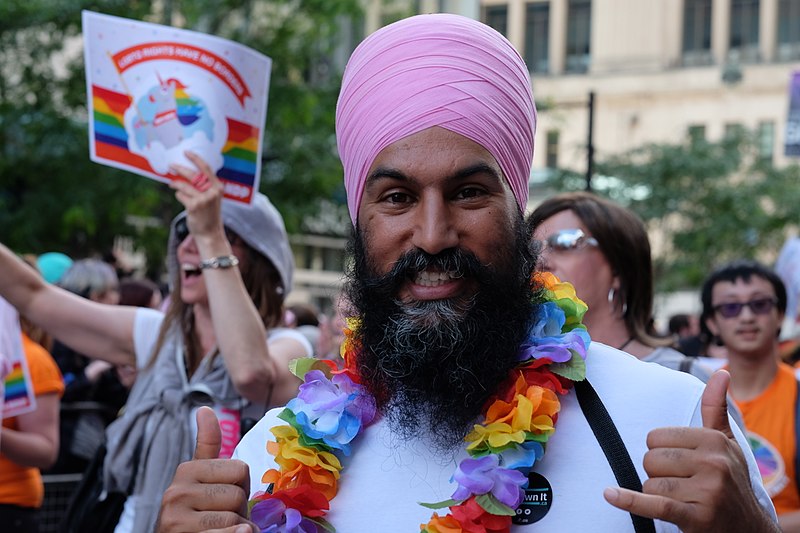
Federal NDP leader Jagmeet Singh taking part in a Pride Parade in June 2017 (during the leadership campaign).
Photo via Wikimedia.
In this woebegotten year of 2020, blessed is the politician who can stumble into a scandal perfectly tailored to the tyranny of Twitter.
As protests, riots, and rage make their mark across the world in the wake of the murder of George Floyd, NDP leader Jagmeet Singh got himself ejected from the House of Commons for calling Bloc MP Alain Therrien a “racist.”
It was an act of civil disobedience, well suited to the passions of the moment, that generated overwhelming support for Singh.
“Only in a racist country does a brown man get ejected from parliament for insisting that the denial of systemic racism is racist,” was a fairly typical, and popular, example on Twitter.
I’m not interested in disputing the point, but rather deconstructing it. So let’s start, for a moment, with the prim prohibitions on unparliamentary language.
In keeping with the long-standing “tradition of respect for the integrity of all Members,” elected officials are barred from using personal attacks, obscenities and insults while in the House of Commons.
And, yes, I’m mentioning this point mostly for the joy of listing off some of the language that has been deemed “unparliamentary” in the past, including, my favourite; “Honourable only by courtesy” (ruled against in 1880), “Coming into the world by accident,” (1886) and “The political sewer pipe from Carleton County” (1917).
Whatever else we can say about the state of our political culture, the quality of our insults has declined alarmingly.
There are a few examples in the parliamentary record of the term “racist” being used in the House. In several instances, the record can’t identify who said it. Or the subject of the insult failed to call a point of order on the matter.
Burma Victory (1945)
PeriscopeFilm
Published 31 May 2016Support Our Channel: https://www.patreon.com/PeriscopeFilm
Made in 1945, BURMA VICTORY is a British documentary about the Burma Campaign during World War Two. It was directed by Roy Boulting. The introduction to the film outlines the geography and climate of Burma, and the extent of the Japanese conquests. The film then describes the establishment of the South East Asian Command (SEAC) under Mountbatten, “a born innovator and firm believer in the unorthodox”, and gives a comparatively detailed account of subsequent military events, including the Battle of Imphal-Kohima and Slim’s drive on Mandalay, Arakan landings, the northern offensive of the Americans and Chinese under Stilwell, and the roles played by Chindits and Merrill’s Marauders. The film ends with the capture of Rangoon and the Japanese surrender. The film focuses on the difficulties of climate, terrain, the endemic diseases of dysentery, malaria, etc., the vital role of air supplies, the shattering of the myth of Japanese invincibility and the secondary role of the Burma campaign in overall Allied strategy.
This film represents a British look at the campaign and was the pet project of Admiral Lord Louis Mountbatten, Supreme Allied Commander, South-East Asia, and he planned it as a joint Anglo-American production. But this scheme foundered over the inability of the U.S. leadership and British to agree on the main theme of the film. The British wanted it to concentrate on the drive southwards to liberate Burma. The Americans, anxious not to be seen to be participating in the restoration of the British Empire, wanted to emphasize the heroic building of the Ledo Road and the drive northwards to relieve the Chinese. In the end the two sides went their separate ways. The Americans produced the Ronald Reagan narrated film The Stilwell Road and the British made Burma Victory. It was the final production of the Army Film and Photographic Unit (AFPU) and was directed, like Desert Victory (1943), by Roy Boulting. Not released until after the war was over, it was hailed and promoted as “the real Burma film”.
The Burma Campaign in the South-East Asian theatre of World War II was fought primarily between the forces of the British Empire and China, with support from the United States, against the forces of the Empire of Japan, Thailand, and the Indian National Army. British Empire forces peaked at around 1,000,000 land, naval and air forces, and were drawn primarily from British India, with British Army forces (equivalent to 8 regular infantry divisions and 6 tank regiments), 100,000 East and West African colonial troops, and smaller numbers of land and air forces from several other Dominions and Colonies. The Burmese Independence Army was trained by the Japanese and spearheaded the initial attacks against British Empire forces.
The campaign had a number of notable features. The geographical characteristics of the region meant that factors like weather, disease and terrain had a major effect on operations. The lack of transport infrastructure placed an emphasis on military engineering and air transport to move and supply troops, and evacuate wounded. The campaign was also politically complex, with the British, the United States and the Chinese all having different strategic priorities.
South East Asia Command (SEAC) was the body set up to be in overall charge of Allied operations in the South-East Asian Theatre during World War II. Admiral Lord Louis Mountbatten served as Supreme Allied Commander of the South East Asia Command from October 1943 through the disbandment of SEAC in 1946.
This film is part of the Periscope Film LLC archive, one of the largest historic military, transportation, and aviation stock footage collections in the USA. Entirely film backed, this material is available for licensing in 24p HD and 2k. For more information visit http://www.PeriscopeFilm.com
QotD: “[T]he fascinating modern science of high-tech grave robbing”
As Fitzgerald’s friend Hemingway ended The Sun Also Rises, “Isn’t it pretty to think so?”
But now the brilliant Harvard geneticist David Reich has published a bombshell scientific book, Who We Are and How We Got Here: Ancient DNA and the New Science of the Human Past, whose revelations would have been found congenial by a smarter version of Buchanan (such as Fitzgerald himself).
Despite Reich’s occasional need to stop his otherwise lucid narrative to spew irrational rage against his fellow race-science heretics such as James D. Watson, the genome expert conclusively demolishes the post-Boasian anthropologists’ conventional wisdom.
[…]
Reich learned the fascinating modern science of high-tech grave robbing from Svante Pääbo. This Swedish biologist invented the techniques for extracting from ancient skeletons their DNA. (Interestingly, the 1990 Native American Graves Protection and Repatriation Act makes it hard to get hold of ancient American Indian skeletons, but other races’ ancestors appear to be fair game.)
Reich applied to Pääbo’s breakthrough the traditional American knack for vast industrial scale. Assisted by English code-cracker Nick Patterson’s innovations in extracting meaning from bits and pieces of ancient genomes, Reich’s factory-like lab at the Broad Institute has been churning out a tsunami of papers on fascinating questions of prehistory.
Steve Sailer, “Reich’s Laboratory”, Taki’s Magazine, 2018-03-28.
June 20, 2020
History-Makers: Confucius
Overly Sarcastic Productions
Published 19 Jun 2020Welcome to the challenge run of History-Makers, where I attempt to give insightful historical context to someone whose backstory is almost entirely blank.
SOURCES & Further Reading: Confucius: A Very Short Introduction by Gardner, China: A History by Keay, The Analects of Confucius, The Mencius.
This video was edited by Sophia Ricciardi AKA “Indigo”. https://www.sophiakricci.com/
Our content is intended for teenage audiences and up.PATREON: https://www.Patreon.com/OSP
MERCH LINKS: https://www.redbubble.com/people/OSPY…
OUR WEBSITE: https://www.OverlySarcasticProductions.com
Find us on Twitter https://www.Twitter.com/OSPYouTube
Find us on Reddit https://www.Reddit.com/r/OSP/
“What did you do in the Wuhan Coronavirus war, Daddy?”
Chris Selley metaphorically dons the garb of a war correspondent to report on how the Canadian government systematically mishandled the epidemic “war”:

Toronto General Hospital.
Photo via Wikimedia Commons.
At first, comparisons to wartime seemed a bit silly. All we were being asked to do, after all, was stay indoors. As the World Health Organization was declaring a pandemic 100 days ago, the commanders had everything under control: the borders, the epidemiology, the strategy, support for shuttered businesses and their employees. Traditionally, wartime puts those of us left on the home front to work whether we like it or not. This was entirely the opposite: the worst we would have to put up with — in theory, assuming government aid was as advertised — was the indignity of idleness. Collective inaction would flatten the curve, the forces of COVID-19 would be beaten back, and summer would be saved. Peace in our time.
And then it instantly turned to quagmire. Canadians watched slack-jawed as COVID-19 breached our most fundamental defences. You don’t need Sun Tzu’s perspicacity to inform people arriving in Canada of their responsibility to self-isolate, and exactly what self-isolation means — go directly home, do not stop for groceries, do not receive visitors. I just did it, right there, in half a sentence. But we couldn’t manage it: Where information was distributed at all, it was excessively complex even as it failed to deliver the central message. Provincial forces threatened mutiny. Alberta Commander-in-Chief Jason Kenney stormed into the Edmonton airport demanding answers. It took weeks to sort out.
[…]
If it didn’t seem like a war before, it sure did once the real live army was drafted in to bail out long-term care homes in Ontario and Quebec that had descended into horrifying squalor. We learned the appalling details from leaked military reports. And now, in an almost poetic act of military pigheadedness, the Ottawa Citizen reports the Armed Forces are trying to hunt down and punish the leakers.
The war must go on. But sitting here in still-locked-down Toronto, stewing in my own bile, I cannot say this is filling me with patriotic fervour. I find myself simultaneously envious of other provinces that are in the process of reopening, and sympathetic to their residents: If it weren’t for the two sick men of the federation [Ontario and Quebec] dominating the narrative, they would likely have reopened much earlier.
Indeed, jealousies have bloomed as weeks turned to months. Apartment dwellers envy other apartment dwellers who have balconies. All apartment dwellers envy homeowners. Everyone envies cottage-owners. Some cottage-country mayors have told cottage-owners to stay put and keep their infestations to themselves. People cooped up with their kids sometimes envy those with time to themselves; singletons who have had enough alone time to last a decade occasionally envy those trying to juggle kids with working from home. The pleasant novelty of Zoom-based socializing faded ages ago, as everyone realized that Zoom-based socializing sucks.
More than 8,200 Canadians are dead, most having lived long lives but many having died in grim and lonely circumstances. In future, considerably more deaths and distress will be associated with the lockdown itself. The psychological effects of this will be studied for decades. If war isn’t quite the right analogy, it’s certainly closer to a war than anything that has been contested on Canadian soil in my or my parents’ lifetime, and it will come at a greater cost to the whole of society than any actual war that Canadian forces have fought over that time. It’s a terrible shame that as a nation, we didn’t win.
Soviet Gender Equality Was a Scam – WW2 – On the Homefront 004
World War Two
Published 19 Jun 2020The future looks bright for soviet women in the 1910s, they have the right to vote and they’re on track for social emancipation. Yet this doesn’t last long. Soon, the demands of the nation will rob them of these promises.
Join us on Patreon: https://www.patreon.com/TimeGhostHistory
Or join The TimeGhost Army directly at: https://timeghost.tvFollow WW2 day by day on Instagram @World_war_two_realtime https://www.instagram.com/world_war_two_realtime
Between 2 Wars: https://www.youtube.com/playlist?list…
Source list: http://bit.ly/WW2sourcesHosted by: Anna Deinhard
Written by: Isabel Wilson
Director: Astrid Deinhard
Producers: Astrid Deinhard and Spartacus Olsson
Executive Producers: Astrid Deinhard, Indy Neidell, Spartacus Olsson, Bodo Rittenauer
Creative Producer: Joram Appel
Post-Production Director: Wieke Kapteijns
Research by: Isabel Wilson
Edited by: Karolina Dołęga
Sound design: Marek KamińskiColorizations by:
Klimbim
Carlos Ortega Pereira, BlauColorizations, https://www.instagram.com/blaucoloriz…Visual Sources:
Library of Congress
Adam Jones from Flickr: https://www.flickr.com/photos/adam_jo…Icons from The Noun Project: Sandhi Priyasmoro, Sarah Rudkin, Andrew Doane, Vectors Market, Adrien Coquet, ProSymbols, Luke Anthony Firth, Russia Woman & Gan Khoon Lay
Music:
“March Of The Brave 10” – Rannar Sillard
“Disciples of Sun Tzu” – Christian Andersen
“Deviation In Time” – Johannes Bornlof
“Other Sides of Glory” – Fabien Tell
“The Inspector 4” – Johannes Bornlöf
“Sailing for Gold” – Howard Harper-Barnes
“London” – Howard Harper-Barnes
“Split Decision” – Rannar SillarResearch sources:
– Lenin On the Emancipation of Women (1965), pp. 63–4. First Published July 1919, as a pamphlet
– Selected Writings of Alexandra Kollontai, Allison & Busby, 1977, First Published 1921, as a pamphlet, trans Alix Holt.
– Wendy Goldman, “Recasting the vision: The resurrection of the family”. In Women, the State and Revolution: Soviet Family Policy and Social Life, 1917–1936, (Cambridge Russian, Soviet, and Post-Soviet Studies, (1993) pp. 296-336), p.310Archive by Screenocean/Reuters https://www.screenocean.com.
A TimeGhost chronological documentary produced by OnLion Entertainment GmbH.
Opposition to home schooling is merely a side-issue for those who want government to control everything
Kerry McDonald recently took part in a debate with a Harvard academic who has called upon governments to ban homeschooling. She’s written up some of the things she took away from the discussion and from the many questions submitted before the event:
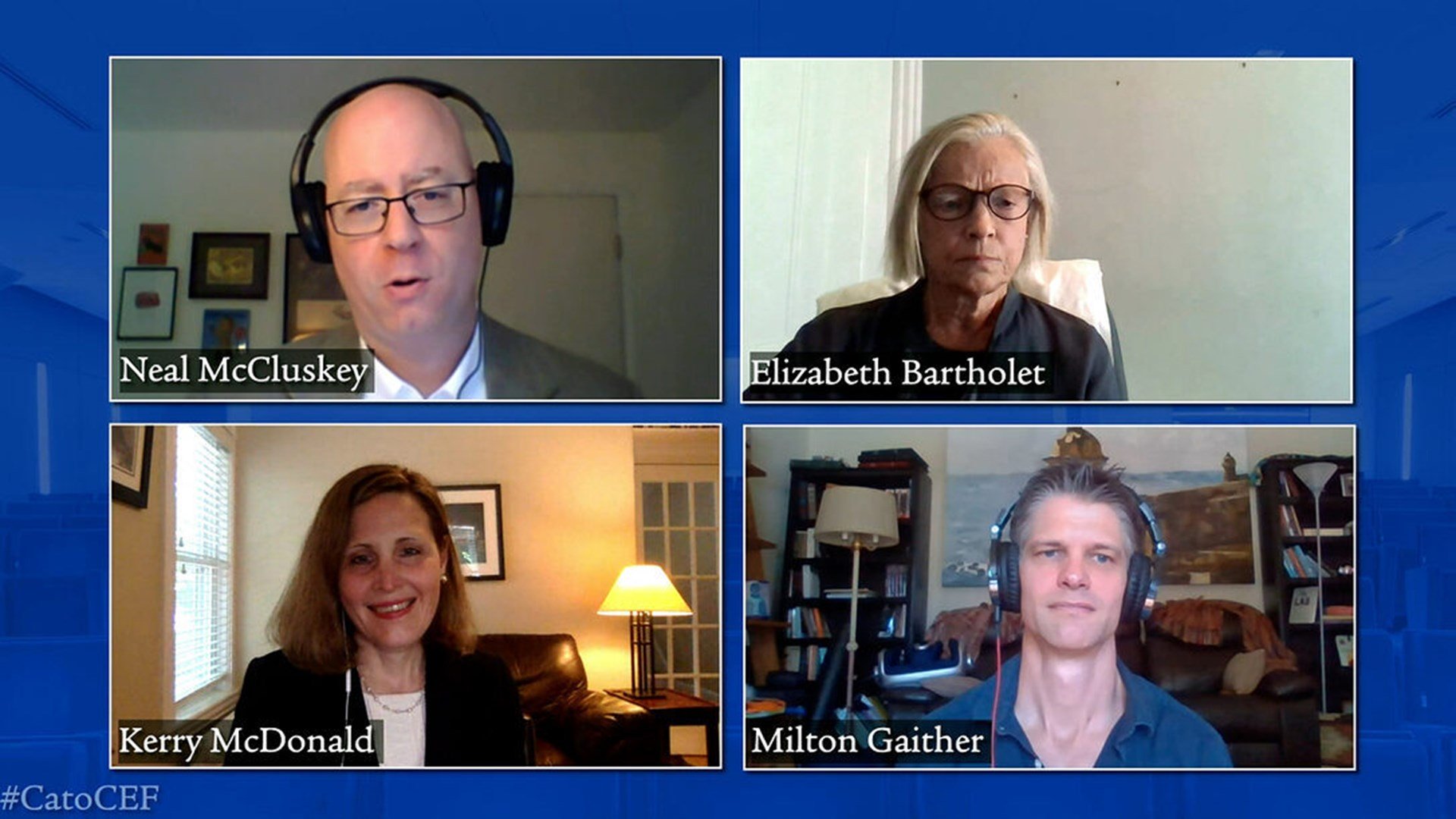
While this event was framed as a discussion about homeschooling, including whether and how to regulate the practice, it is clear that homeschooling is just a strawman. The real issue focuses on the role of government in people’s lives, and in particular in the lives of families and children. In her 80-page Arizona Law Review article that sparked this controversy, Professor Bartholet makes it clear that she is seeking a reinterpretation of the US Constitution, which she calls “outdated and inadequate,” to move from its existing focus on negative rights, or individuals being free from state intervention, to positive rights where the state takes a much more active role in citizens’ lives.
During Monday’s discussion, Professor Bartholet explained that “some parents can’t be trusted to not abuse and neglect their children,” and that is why “kids are going to be way better off if both parent and state are involved.” She said her argument focuses on “the state having the right to assert the rights of the child to both education and protection.” Finally, Professor Bartholet said that it’s important to “have the state have some say in protecting children and in trying to raise them so that the children have a decent chance at a future and also are likely to participate in some positive, meaningful ways in the larger society.”
It’s true that the state has a role in protecting children from harm, but does it really have a role in “trying to raise them”? And if the state does have a role in raising children to be competent adults, then the fact that two-thirds of US schoolchildren are not reading proficiently, and more than three-quarters are not proficient in civics, should cause us to be skeptical about the state’s ability to ensure competence.
I made the point on Monday that we already have an established government system to protect children from abuse and neglect. The mission of Child Protective Services (CPS) is to investigate suspected child abuse and punish perpetrators. CPS is plagued with problems and must be dramatically reformed, but the key is to improve the current government system meant to protect children rather than singling out homeschoolers for additional regulation and government oversight. This is particularly true when there is no compelling evidence that homeschooling parents are more likely to abuse their children than non-homeschooling parents, and some research to suggest that homeschooling parents are actually less likely to abuse their children.
Additionally, and perhaps most disturbingly, this argument for more state involvement in the lives of homeschoolers ignores the fact that children are routinely abused in government schools by government educators, as well as by school peers. If the government can’t even protect children enrolled in its own heavily regulated and surveilled schools, then how can it possibly argue for the right to regulate and monitor those families who opt out?
Two books on WW2 – which is the memoir and which the novel?
Lindybeige
Published 4 Mar 2018Two books I have read recently. When is a book a memoir and when is it a novel? WW2 from two different perspectives.
Support me on Patreon: https://www.patreon.com/Lindybeige
The books:
From the City, From the Plough by Alexander Baron (Bernstein)
The Last Panther by Wolfgang Faust (Chris Ziedler)Buy the music – the music played at the end of my videos is now available here: https://lindybeige.bandcamp.com/track…
Lindybeige: a channel of archaeology, ancient and medieval warfare, rants, swing dance, travelogues, evolution, and whatever else occurs to me to make.
▼ Follow me…
Twitter: https://twitter.com/Lindybeige I may have some drivel to contribute to the Twittersphere, plus you get notice of uploads.
website: http://www.LloydianAspects.co.uk

QotD: Morality and the government
Gaze upon the members of Congress, the president and his lieutenants, the justices of the Supreme Court, and the leading figures of the government bureaucracies. As I do so, I cannot help but wonder: Who are these people? I am not personally acquainted with a single one of them; they are complete strangers to me. I have not contracted with them for the provision of any services, nor have I agreed to support them financially. Why then do these strangers presume to dictate to me what I must do and not do, and to threaten me with violence if I do not obey? They might as well be alien invaders from outer space.
Robert Higgs, “A Straightforward View of Morality and the Government”, The Beacon, 2018-03-06.
June 19, 2020
What Actually Is Blitzkrieg? – WW2 Special
World War Two
Published 18 Jun 2020When the Nazi war machines tears through Poland, France, and the Soviet Union, people will call it Blitzkrieg. But what is Blitzkrieg and is it anything that unique?
Join us on Patreon: https://www.patreon.com/TimeGhostHistory
Or join The TimeGhost Army directly at: https://timeghost.tvFollow WW2 day by day on Instagram @World_war_two_realtime https://www.instagram.com/world_war_two_realtime
Between 2 Wars: https://www.youtube.com/playlist?list…
Source list: http://bit.ly/WW2sourcesHosted by: Indy Neidell
Written by: Francis van Berkel
Director: Astrid Deinhard
Producers: Astrid Deinhard and Spartacus Olsson
Executive Producers: Astrid Deinhard, Indy Neidell, Spartacus Olsson, Bodo Rittenauer
Creative Producer: Joram Appel
Post-Production Director: Wieke Kapteijns
Research by: Adam Adkins
Edited by: Mikołaj Cackowski
Sound design: Marek Kamiński
Map animations: Eastory (https://www.youtube.com/c/eastory)Colorizations by:
Jaris Almazani (Artistic Man) – https://instagram.com/artistic.man?ig… (edited)
Carlos Ortega Pereira, BlauColorizations – https://www.instagram.com/blaucoloriz…
Julius Jääskeläinen – https://www.facebook.com/JJcolorization/
Dememorabilia – https://www.instagram.com/dememorabilia/
Musvage https://commons.wikimedia.org/wiki/Fi…
Klimbim https://www.flickr.com/photos/2215569…Sources:
Portrait of Basil Liddell-Hart, courtesy National Portrait Gallery
Portrait of Douglas McGarel Hogg, courtesy National Portrait Gallery
IWM H 20697, Q 6337, D 1966
Bundesarchiv
from the Noun Project: Target by RITASYA, documents by DinosoftLab, Tank by mbok sumirna, Armored Car by Martin, Plane by Graphic Enginer, transceiver by Eucalyp
Breaking A Wall Down (With A Hammer) by scampsie https://freesound.org/people/scampsie…Soundtracks from the Epidemic Sound:
Johannes Bornlof – “Last Man Standing 3”
Reynard Seidel – “Deflection”
Fabien Tell – “Last Point of Safe Return”
Hakan Eriksson – “Epic Adventure Theme 4”
Johannes Bornlof – “The Inspector 4”
Johannes Bornlof – “Death And Glory”
Bonnie Grace – “The Dominion”
Bonnie Grace – “Imperious”Archive by Screenocean/Reuters https://www.screenocean.com.
A TimeGhost chronological documentary produced by OnLion Entertainment GmbH.

National Defence Headquarters needs to go on a crash diet
Ted Campbell knows how Canada’s NDHQ got into the state it is in, and has some suggestions for getting it out of its critical state of administrative morbid obesity:
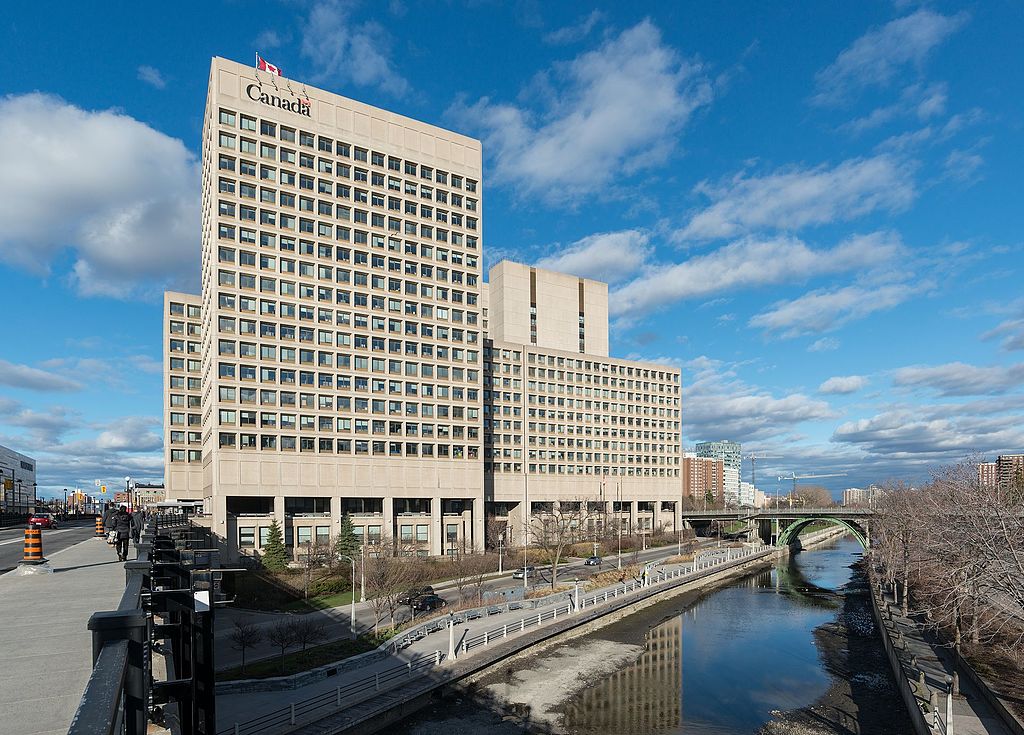
Major General George R. Pearkes Building in Ottawa, home of National Defence Headquarters on Colonel By Drive.
Photo by DXR via Wikimedia Commons.
National Defence Headquarters is a HUGE place with diverse functions. First: it is, simultaneously, the management centre of the Department of National Defence, which is a very large (and complex) department of government that includes the Canadian Armed Forces (but the CAF is just one of DND’s “arms”), and it is the national command centre for the Canadian Armed Forces. Second: it is one of the biggest budget departments in Canada. Defence spending supports many hundreds of thousands of jobs in the military, in the civil service and all across the spectrum of Canadian industry from the highest of high-tech enterprises through to janitorial services. It is never surprising when things fall through the cracks in any large, complex organization, is it?
But there are two other problems:
As defence spending has declined, year-after-year, always in terms of GDP and often in terms of its share of the public accounts and sometimes in real, dollar terms, too, the headquarters, especially the military’s command and control (C²) superstructure, has grown. A bit of growth is not surprising when one must “do more with less” as I well remember being told during the rounds of budget and staff cuts in the 1990s. Although to their credit, defence ministers in the Chrétien-Martin era imposed a series of staff cuts on the HQs in Ottawa, there was a bit of growth in the (largely civil service) policy and financial management areas. But in the Harper era that all changed. Budget pursestrings were loosened by governments after 2001 and, under e.g. Conservative Defence Minister Gordon O’Connor the Canadian Forces began to receive some much needed new equipment including the big CC-177 Globemaster III transport planes, new CH-147F Chinook transport helicopters and Leopard tanks ~ all procured on sole-source contracts, over the objections of many. But then O’Connor was replaced by Peter MacKay and, it appeared to me, the generals and admirals took over and the HQ went from lean to overweight and then to downright fat. Then, in the Trudeau era, the HQ went from simply being fat to being morbidly obese. There are, now, hundreds of admirals and generals, managing a military force that numbers in the (too few) thousands. Even serving flag and general officers have told me that cutting the highest ranks by ⅓ would do no harm and some retired officers and civil servants (with intimate knowledge of the inner workings of the HQ at the highest levels) say that a 50% cut would be healthy. The simple fact is that the Canadian Forces have too many very smart, very able senior officers with too little real work to do. They, not surprisingly, fill the time available with “work” of their own devising which, often, involves creating new and more complex command structures which require more and more general officers. The process seems unconstrained from the top.
Why? What happened?
Well, it started with the very best of intentions. I recall being told by one very, very fine general that we, the Canadian Forces, must, above all else, be “interoperable” with our American allies and that, he explained, meant adapting to their command and control system, poor as he thought it was. He said, and he meant, adapting, not adopting. But he retired and a new generation of officers entered the most senior ranks and some of them seemed, to me, to be more interested in adopting than in just adapting to. We seemed, in the 2000s, to be seized by a giant case of military penis envy and we seemed to want to have a local version of whatever the Americans had. The result was a proliferation of new command and control organizations, all put in place as the combat elements were actually shrinking. The end result was an unconscionable GOFO [General Officer/Flag Officer] to combat sailor and solder ratio and a bloated and, in my opinion, weak and inefficient command and control superstructure.


