Quotulatiousness

June 27, 2020

Andrew Sullivan on revolution in the current year

Filed under: History, Politics, USA — Tags: , , , , , , — Nicholas @ 05:00

The people involved in the protests — some of them would-be revolutionaries — may not know about prior revolutionary movements, and if they succeed then they’ll ensure that nobody will be able to remember what life was like before their longed-for Year Zero moment:
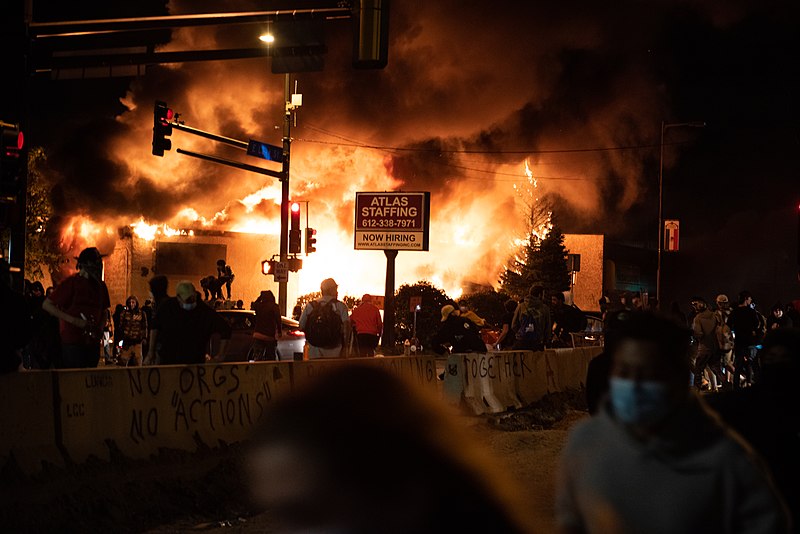
A building burning in Minneapolis following the death of George Floyd.
Photo by Hungryogrephotos via Wikipedia.

Revolutions also encourage individuals to take matters in their own hands. The distinguished liberal philosopher Michael Walzer recently noted how mutual social policing has a long and not-so-lovely history — particularly in post–Reformation Europe, in what he has called “the revolution of the saints.” “The ‘saints’ were very strong on the work of neighborhood committees. In Calvin’s Geneva, law and order were maintained through ‘mutual surveillance.’ Church members (ideally all Genevans were church members) ‘watched, investigated, and chastised’ each other.” Imagine what these Puritans could have done with cell phones and Twitter histories.

Revolutionaries also create new forms of language to dismantle the existing order. Under Mao, “linguistic engineering” was integral to identifying counterrevolutionaries, and so it is today. The use of the term “white supremacy” to mean not the KKK or the antebellum South but American society as a whole in the 21st century has become routine on the left, as if it were now beyond dispute. The word “women,” J.K. Rowling had the temerity to point out, is now being replaced by “people who menstruate.” The word “oppression” now includes not only being herded into Uighur reeducation camps but also feeling awkward as a sophomore in an Ivy League school. The word “racist,” which was widely understood quite recently to be prejudicial treatment of an individual based on the color of their skin, now requires no intent to be racist in the former sense, just acquiescence in something called “structural racism,” which can mean any difference in outcomes among racial groupings. Being color-blind is therefore now being racist.

And there is no escaping this. The woke shift their language all the time, so that words that were one day fine are now utterly reprehensible. You can’t keep up — which is the point. (A good resource for understanding this new constantly changing language of ideology is Translations From the Wokish.) The result is an exercise of cultural power through linguistic distortion.

So, yes, this is an Orwellian moment. It’s not a moment of reform but of a revolutionary break, sustained in part by much of the liberal Establishment. Even good and important causes, like exposing and stopping police brutality, can morph very easily from an exercise in overdue reform into a revolutionary spasm. There has been much good done by the demonstrations forcing us all to understand better how our fellow citizens are mistreated by the agents of the state or worn down by the residue of past and present inequality. But the zeal and certainty of its more revolutionary features threaten to undo a great deal of that goodwill.

The movement’s destruction of even abolitionist statues, its vandalism of monuments to even George Washington, its crude demonization of figures like Jefferson, its coerced public confessions, its pitiless wreckage of people’s lives and livelihoods, its crude ideological Manichaeanism, its struggle sessions and mandated anti-racism courses, its purging of cultural institutions of dissidents, its abandonment of objective tests in higher education (replacing them with quotas and a commitment to ideology), and its desire to upend a country’s sustained meaning and practices are deeply reminiscent of some very ugly predecessors.

But the erasure of the past means a tyranny of the present. In the words of Orwell, a truly successful ideological revolution means that “every record has been destroyed or falsified, every book rewritten, every picture has been repainted, every statue and street building has been renamed, every date has been altered. And the process is continuing day by day and minute by minute. History has stopped. Nothing exists except an endless present in which the Party is always right.” We are not there yet. But unless we recognize the illiberal malignancy of some of what we face, and stand up to it with courage and candor, we soon will be.


Creating a JAPANESE Inspired PICNIC BENCH from Scratch | The Picnic Bench Project – Part #2

Filed under: Tools, Woodworking — Tags: , , , , — Nicholas @ 04:00

Matt Estlea
Published 25 Jun 2020

_________________________________________________________________

Support what I do by becoming a Patron! This will help fund new tools, equipment and cover my overheads. Meaning I can continue to bring you regular, high quality, free content. Thank you so much for your support! https://www.patreon.com/mattestlea

Don’t want to commit to a monthly direct debit but still want to help out? That’s fine!
You can make a one time donation here: www.mattestlea.com/donate
You can donate us biscuits here: www.mattestlea.com/wishlist
_________________________________________________________________
BUY THE WOODWORKING BIBLE HERE:
www.mattestlea.com/the-woodworkers-manual
_________________________________________________________________

SOCIAL MEDIA
Instagram: www.instagram.com/mattestlea
Twitter: www.twitter.com/mattestlea
Patreon: www.patreon.com/mattestlea
Pinterest: www.pinterest.com/mattestlea
LinkedIn: www.linkedin.com/in/matt-estlea-b6414b11a/
_________________________________________________________________
See what tools I use here: www.mattestlea.com/equipment
My Website: www.mattestlea.com
_________________________________________________________________

My name is Matt Estlea, I’m a 24 year old Woodworker from Basingstoke in England and my aim is to make your woodworking less s***.

I come from 5 years tuition at Rycotewood Furniture Centre with a further 1 year working as an Artist in Residence at the Sylva Foundation. I now teach City and Guilds Furniture Making at Rycotewood as of September 2018.

If you’re interested in studying at Rycotewood, view their courses here:
www.mattestlea.com/rycotewood

I also had 5 years of experience working at Axminster Tools and Machinery where I helped customers with purchasing tools, demonstrated in stores and events, and gained extensive knowledge about a variety of tools and brands. I discontinued this at the start of 2019 to focus solely on video creation and teaching.

During the week, I film woodworking projects, tutorials, reviews and a viewer favourite ‘Tool Duel’ where I compare two competitive manufacturers tools against one another to find out which is best. I also have a Free Online Woodworking School which you should definitely check out!

www.mattestlea.com/school

I like to have a laugh and my videos are quite fast paced BUT you will learn a lot, I assure you.

Lets go make a mess.

Canada’s “Gang of 19” urges abject surrender and hostage exchange with China

Filed under: Cancon, China, Government, Law, Politics — Tags: , , , , — Nicholas @ 03:00

As Canadian political life continues to revolve more and more around the Chinese model, we now have our very own political “gang”, just like China did!

“The Chinese People’s Liberation Army is the great school of Mao Zedong Thought”, 1969.
A poster from the Cultural Revolution, featuring an image of Chairman Mao.
Image via Wikimedia Commons.

A former leader of the New Democratic Party of Canada. A former Conservative foreign minister. Two former Liberal foreign ministers. Four former Canadian ambassadors to the United Nations, under Liberal and Tory governments. Two former Canadian ambassadors to the United States, under Liberal and Tory governments. A former Supreme Court justice. A former Liberal justice minister. A former Conservative senator. A flock of name-brand diplomats. Former CBC host Don Newman, for some reason.

This is the panoply of 19 elite opinion-makers that gathered in the Laurentian Boardroom at an online hotel and drafted a letter, released Wednesday, calling on Prime Minister Justin Trudeau to intervene in the extradition process, set Huawei CFO Meng Wangzhou free, and thereby secure the release of Canadians Michael Kovrig and Michael Spavor.

China, last seen denying the two men’s detention had anything to do with Meng, had changed its tune just hours earlier on Wednesday: Freeing her might “open up space for resolution to the situation of the two Canadians,” foreign ministry spokesman Zhao Lijian said.

And who stands in the way? A prime minister who was perfectly happy to stick his thumb on the scales of justice to save a cherished member of Quebec Inc. from the indignity of prosecution for rather flamboyant alleged corporate malfeasance in and concerning Gaddafi-era Libya (or to “save jobs,” if you prefer, although it emerged no one in Justin Trudeau’s government had bothered to inquire how many jobs might actually be lost if SNC-Lavalin were convicted).

You can hardly blame China for noting the precedent. And it’s sorely fitting that the Gang of 19 addressed their letter to Trudeau rather than to the fellow who would actually have to give the order: Justice Minister David Lametti. We all know who calls the shots in that particular relationship. Perhaps it’s best we just admit it.

Colby Cosh also finds the advice proffered to the Prime Minister to be … less than admirable:

Screen capture of a BBC News report on Canadians Michael Kovrig and Michael Spavor facing espionage charges in China.

I wanted to discuss the letter written by the 19 geriatric Canadian worthies who encouraged the Prime Minister to trade Huawei executive Meng Wanzhou, in Canadian custody fighting extradition to the U.S., for the “two (Canadian) Michaels” detained on ill-defined espionage charges in China. Colleague Chris Selley has gone over the ground, but that’s show biz for you. Selley concluded his overview by pointing out that the letter argues perversely for “surrender, then victory.” With the Meng-Michaels standoff out of the way, the various ex-diplomats and superannuated politicians argued, Canada could use the opportunity for a fresh foreign-policy start, deciding what “tough steps” ought to be taken against China. If any.

The letter, part of a campaign on the two Michaels’ behalf led by ex-Supreme Court Justice Louise Arbour and ex-justice minister Allan Rock, is self-refuting in parts. Yielding “to bullying or blackmail” is “repugnant,” the authors admit, while advising just that. But “resisting China’s pressure is no guarantee that it will never be applied again in the future … China might well decide that next time it will need to escalate by detaining more than two Canadians.”

The implication, if this argument is to have any force, is that actively rewarding China’s abduction of our citizens is a jim-dandy way of making sure it never happens again. The problem with this reasoning is obvious, but the authors are also careful not to define victory too precisely. They say that letting Meng go and getting Michael Kovrig and Michael Spavor back would permit Canada to “declare its position on Huawei’s involvement in the deployment of 5G technology in Canada,” a decision “that has been postponed time and again.”

Sooo … the authors think we should slam the door on Huawei, whose CEO is Meng’s father? They don’t say so! They only say that settling this quarrel would make it easier for us to decide. And they are only slightly clearer on issues of human rights in China and Hong Kong, which our current government and foreign service are allegedly being shy about “so as not to make the situation worse for the Canadian prisoners.”

Tank Chats #74 Panzer I | The Tank Museum

Filed under: Germany, History, Military, Weapons, WW2 — Tags: , , , — Nicholas @ 02:00

The Tank Museum
Published 10 May 2019

Panzer I was the first tank mass produced by Germany, as part of their drive to re-arm in the 1930’s before the Second World War.

The Tank Museum’s Panzer IB tank is the only known commander’s model of the Panzer I.
Cradit @10:25 Panzer I from The Arsenalen Museum, Sweden.

Support the work of The Tank Museum on Patreon: ► https://www.patreon.com/tankmuseum

Visit The Tank Museum SHOP: ► https://tankmuseumshop.org/
Twitter: ► https://twitter.com/TankMuseum
Tiger Tank Blog: ► http://blog.tiger-tank.com/
Tank 100 First World War Centenary Blog: ► http://tank100.com/ #tankmuseum #tanks #tankchats

QotD: The cost of military equipment

Major military hardware is produced in only limited quantities and involves a massive amount of research, development, and engineering before the first unit goes into service. Because of this, the companies that build it are rarely willing to take the risk of paying for the development themselves and recovering the cost from the units that they sell. What if the customer suddenly decides to cut their buy in half? To avoid this problem, development is paid for by the customer separately from procurement of each item. Well, more or less. The actual answer varies with each particular system, accounting method, and time of the month. But in general, costs break down that way.

So why does this cause so much confusion? Well, it all has to do with what gets reported. Someone who is trying to make the case that some program is outrageously expensive and should be cancelled is going to lump together development and procurement, divide by the number of systems involved, and then publish the resulting number. But, particularly when we’re discussing the cost of a system about to enter production, that’s very different from the actual numbers. To give a well-known example, the B-2 is generally reputed to have cost about $2 billion/plane in the 90s. However, this is the total program cost divided by the 21 airframes. If we’d decided to buy 22 B-2s instead of the 21 we did buy, the extra plane would have cost only $700 million or so. Admittedly, the B-2 is a rather extreme case, and usually the share of R&D cost is less than the procurement (flyaway) cost, but it’s illustrative of the power of this kind of framing.

“bean”, “Military Procurement – Pricing”, Naval Gazing, 2018-03-09.

June 26, 2020

The Holocaust Begins in Lithuania – War Against Humanity 013 – June 1941 Part 01

Filed under: Europe, Germany, History, Military, Russia, WW2 — Tags: , , , , , , — Nicholas @ 06:00

World War Two
Published 25 Jun 2020

The German Fallschirmjäger target the Cretan civilian population as they take the island with big losses. But the War Against Humanity intensifies dramatically as Operation Barbarossa is launched on 22nd June, 1941.

Join us on Patreon: https://www.patreon.com/TimeGhostHistory
Or join The TimeGhost Army directly at: https://timeghost.tv

Follow WW2 day by day on Instagram @World_war_two_realtime https://www.instagram.com/world_war_two_realtime
Between 2 Wars: https://www.youtube.com/playlist?list…
Source list: http://bit.ly/WW2sources

Hosted by: Spartacus Olsson
Written by: Spartacus Olsson and Joram Appel
Director: Astrid Deinhard
Producers: Astrid Deinhard and Spartacus Olsson
Executive Producers: Astrid Deinhard, Indy Neidell, Spartacus Olsson, Bodo Rittenauer
Creative Producer: Joram Appel
Post-Production Director: Wieke Kapteijns
Research by: Joram Appel and Valantis Athanasiou
Edited by: Mikołaj Cackowski
Sound design: Marek Kamiński
Map animations: Eastory (https://www.youtube.com/c/eastory)

Colorizations by:
Dememorabilia – https://www.instagram.com/dememorabilia/
Carlos Ortega Pereira, BlauColorizations – https://www.instagram.com/blaucoloriz…
Julius Jääskeläinen – https://www.facebook.com/JJcolorization/
https://www.flickr.com/photos/2215569…
Norman Stewart – https://oldtimesincolor.blogspot.com/

Sources:
Detail of Mural Depicting 1919 Amritsar Massacre – Jallianwala Bagh – Amritsar – Punjab – India, courtesy Adam Jones https://flic.kr/p/kj6riR
RIA Novosti archive, image #965
Bundesarchiv
Narodowe Archiwum Cyfrowe
IWM E 3064E
Vilna Gaon State Jewish Museum
from the Noun Project: Policeman by karina, suit by Gabriel Ciccariello, manufacturer by priyanka, land investment by Gan Khoon Lay, soldier by Andi Nur Abdillah, classroom by Gan Khoon Lay, prisoner by carlotta zampini, interrogation by Gan Khoon Lay, Tortured Man by Gan Khoon Lay, sitting at desk by IYIKON

Bibliography:
“NKVD and Central Committee of the Soviet communication” as documented in: The great west Ukrainian prison massacre of 1941, a sourcebook – Ksenya Kiebuzinski, Alexander Motyl
Alexander Statiev, The Soviet Counterinsurgency in the Western Borderlands 167-168
“Lithuania in March 1941: An American Diplomat’s Report”, In: Journal of Baltic Studies 26:2 (1995) 161-158.
Herman Kruk, The Last Days of the Jerusalem of Lithuania: Chronicles from the Vilna Ghetto and the Camps, 1939-1944 (2002)
Stephan D. Yada-Mc Neal, Places of Shame – German and Bulgarian war crimes in Greece 1941-1945, Books on Demand, 2018
Antony Beevor, Crete 1941: The Battle and the Resistance, Greek edition, Athens, 2004.
Fleischer, Hagen, “Battle of Crete”, in Crete, History and Civilization, vol. 2 (Greek), Cretan TEDK, Heraklion, 1988.
Sanoudaki-Sanoudou Antonis, May 2011, German reprisals in the Battle of Crete (Greek), 70 Years from the Battle of Crete, pp. 89-112

Soundtracks from the Epidemic Sound:
Skrya – “First Responders”
Flouw – “Endlessness”
Jon Bjork – “For the Many”
Johannes Bornlof – “Deviation In Time”
Andreas Jamsheree – “Guilty Shadows 4”
Cobby Costa – “From the Past”
Farell Wooten – “Blunt Object”
Philip Ayers – “Trapped In A Maze”
Johannes Bornlof – “The Inspector 4”
Gunnar Johnsen – “Not Safe Yet”

Archive by Screenocean/Reuters https://www.screenocean.com.

A TimeGhost chronological documentary produced by OnLion Entertainment GmbH.

From the comments:

World War Two
2 hours ago (edited)
We apologize deeply for the mess up with the listing of countries at the opening – somehow the errors in the list of invaders slipped through the fact check. To be clear: neither Bulgaria, nor Slovenia (obviously) invaded the USSR in June 1941. We’re working on fixing it in some way with YouTube’s help.

At the end of June 1941 the civilian population in what is today Poland, Romania, Ukraine, Belarus, Latvia, Lithuania, and Estonia are facing two lethal enemies. The political police of the USSR – the NKVD, and the invading German Army accompanied by the Nazi killing squads of the SS. That’s simply how it is. That it will get even worse than it is during the last week of June, especially through horrors committed by one of these sides does not change that fact. Because of the importance of these events to humanity, and the difficulty we all face to not equivocate who did what, we would like to remind you that we use a chronological format, that we do not make analytical commentary that looks to what will happen, but let you discover the events as they evolve.

The rise of the Karenfinder General

Filed under: Media, Politics, USA — Tags: , , , , — Nicholas @ 05:00

Brendan O’Neill on the recent phenomena of the Karens and the anti-Karens:

The most important thing here is the question of where the Karenfinder Generals derive their power from. It comes from the insatiable appetite among identitarian reactionaries for mis-speakers or wrongthinkers they can ritualistically denounce and destroy. It is this warped social-media appetite for spectacles of shaming, for being part of a virtual mob that takes to task an allegedly evil person, that bolsters and empowers people like Karlos Dillard. It is reported that he has a strange obsession with Karens and he is even selling anti-Karen t-shirts through his Instagram page. This speaks to the extent to which Karen-shaming has become a kind of industry. There are memes, there is branded clothing, and there are of course the videos of exposed and shattered Karens which are watched and shared millions of times. Dillard was able to reduce Leah to a weeping wreck desperately trying to remain anonymous because of this broader, entrenched and increasingly misogynistic culture of seeking out white women to revile and tear down.

One of the great ironies of the witch-hunting of Karens is that the people doing the filming and public shaming are far more Karen-like than the women they humiliate. The Karen prejudice is built on a view of certain middle-class, often middle-aged, white women as uncouth and arrogant and given to complaining. They always want to “speak with the manager”. But no one wants to “speak with the manager” as gleefully as the Karenfinder Generals. Their entire mission is to report on “problematic” people to the managers of acceptable thought, to the bosses of correct-think: the new PC elites. Their thirst for tearing people down for doing or saying something wrong utterly overshadows the instinct to complain that any middle-class white woman might have.

Consider the recent Central Park incident in which a woman called Amy Cooper called the cops on a black man called Christian Cooper (no relation) and claimed that he was harassing her when in truth he was reprimanding her for letting her dog off its leash in a part of the park where you’re not meant to do that. Amy behaved badly in this incident. But as Robert A George argued in the New York Daily News: “[Christian] is the ‘Karen’ in this encounter, deciding to enforce park rules unilaterally and to punish ‘intransigence’ ruthlessly.” Amy Cooper’s life has been shattered by this Karen-shaming incident: she lost her job and her dog.

Or consider the case of Lisa Alexander, the CEO of a San Francisco-based cosmetics company who was recently filmed by a Filipino man after she asked him why he was writing “Black Lives Matter” on the wall outside a private residential property. Alexander may have been wrong to presume that this Filipino man couldn’t possibly live in one of these plush private residences, but she is polite, patient and not remotely racist during their encounter. At one point the man even suggests that she call the police and she looks shocked and says: “I don’t want to call the police.” And yet she was put online, shamed across the world, lost business as a result, and then issued a self-denouncing confession in which she accepts, essentially, that she is a witch. “I did not realise at the time that my actions were racist”, she said. “I am taking a hard look at the meaning behind white privilege and am committed to growing from this experience.”

It all gets more Salem-like by the day. Just as accused witches of old could never deny the accusations against them – denial often carried a greater penalty than confession – so Karens today must immediately confess to the sin of racism if they want any hope of at least partially saving their reputations and their futures. As in earlier outbreaks of witch-hunting, Karen-hunting puts women into a bind. If they deny the charge of racism, that is held up as proof of just how racist they are. If they confess to the charge of racism, that is of course also proof of their foul, evil minds, of their possession by the demon of race-hatred. Lisa Alexander’s confession of wickedness and promise to re-educate herself on the evils of white privilege sums up how religious the identitarian outlook has become. She is in essence on her knees begging for salvation, pleading for redemption, offering to do the intellectual penance of learning the horrible truth about her “white privilege” – that is, her sinful state, her fallen nature.

“Ghost Division” – Rommel’s 7th Panzer Division – Sabaton History 073 [Official]

Filed under: France, Germany, History, Media, Military, WW2 — Tags: , , , , , — Nicholas @ 04:00

Sabaton History
Published 25 Jun 2020

In the night of 17 May 1940, confusing reports were reaching French High Command. They spoke of what was thought impossible: The German Army had broken through the Maginot Line in the north. Scattered and panicked soldiers spoke of a “Division Fantôme” – a Ghost Division! It was Generalmajor Erwin Rommel’s 7th Panzer Division that was wreaking havoc in the French rear. In an unauthorized push, Rommel had seized the opportunity to rush the French fortress garrisons by a surprise armor attack straight from the move. Now in open space and with the night sky illuminated by burning French tanks and trucks, it was crucial for the Ghost Division to exploit its tactical victory. Alone and cut off like an island in a sea of enemies, this was easier said than done.

Support Sabaton History on Patreon: https://www.patreon.com/sabatonhistory

Listen to “Ghost Division” on the album The Art of War:
CD: http://bit.ly/TheArtOfWarStore
Spotify: http://bit.ly/TheArtOfWarSpotify
Apple Music: http://bit.ly/TheArtOfWarAppleMusic
iTunes: http://bit.ly/TheArtOfWariTunes
Amazon: http://bit.ly/TheArtOfWarAmz
Google Play: http://bit.ly/TheArtOfWarGooglePlay

Watch the Official Lyric Video of “Ghost Division” here:
https://www.youtube.com/watch?v=9FkYx…

Listen to Sabaton on Spotify: http://smarturl.it/SabatonSpotify
Official Sabaton Merchandise Shop: http://bit.ly/SabatonOfficialShop

Hosted by: Indy Neidell
Written by: Markus Linke and Indy Neidell
Directed by: Astrid Deinhard and Wieke Kapteijns
Produced by: Pär Sundström, Astrid Deinhard and Spartacus Olsson
Creative Producer: Joram Appel
Community Manager: Maria Kyhle
Executive Producers: Pär Sundström, Joakim Broden, Tomas Sunmo, Indy Neidell, Astrid Deinhard, and Spartacus Olsson
Post-Production Director: Wieke Kapteijns
Edited by: Iryna Dulka
Sound Editing by: Marek Kaminski
Maps by: Eastory – https://www.youtube.com/c/eastory

Archive by: Reuters/Screenocean https://www.screenocean.com
Music by Sabaton.

Colorizations:
– Dememorabilia – https://www.instagram.com/dememorabilia/

Sources:
– Bundesarchiv, CC-BY-SA 3.0: Bild 146-1977-018-13A/Otto, Bild 101I-124-0219-20/Hinz, Bild 146-1972-045-02
– Narodowe Archiwum Cyfrowe
– chieftanruncrush from Freesound.org
– Food vector created by freepik – www.freepik.com

An OnLion Entertainment GmbH and Raging Beaver Publishing AB co-Production.

© Raging Beaver Publishing AB, 2019 – all rights reserved.

Progressive hate for nuclear power

In Quillette, Michael Shellenberger discusses the demands of some climate activists who also reject the best solutions to the problems they foresee:

For the last decade I have been obsessed with a question: Why are the people who are the most alarmist about environmental issues also opposed to all of the obvious solutions?

Those who raise the alarm about food shortages oppose expanding the use of chemical fertilizers, tractors, and GMOs. Those who raise the alarm about Amazon deforestation promote policies that fragment the forest. And those who raise the alarm about climate change oppose nuclear energy, the largest source of zero-emissions energy in developed nations. Why is that?

It is not an academic question for me. I have been a climate activist for 20 years and an energy expert for 10 of them. I was adamantly against nuclear energy until about a decade ago when it became clear renewables couldn’t replace fossil fuels. After educating myself about the facts, I came to support the technology.

Over the last five years, I have campaigned, as founder and president of my small and independent nonprofit research organization, Environmental Progress, to expand the use of nuclear energy. During that time our main opponents have not been climate skeptics or even the fossil fuel industry but rather other climate activists.

This is the case around the world. It is climate alarmist Democrats and Greens who are seeking to shut down nuclear plants in the US and Europe. Greta Thunberg last year condemned the technology as “extremely dangerous, expensive, & time-consuming,” which is false. And Green New Deal architect Rep. Alexandria Ocasio-Cortez (AOC) has advocated closing the Indian Point nuclear plant in New York, which is now being replaced with natural gas.

In nearly every situation around the world, support for nuclear energy from climate activists like Thunberg and AOC would make the difference between nuclear plants staying open or closing, and being built or not being built. Had Thunberg spoken out in defense of nuclear power she likely could have prevented two reactors in her home nation of Sweden from being closed. Had AOC advocated for Indian Point rather than condemned it as dangerous, it could likely keep operating, for at least 40 years longer.

That’s because the main problem facing nuclear energy is that it’s unpopular — and far more among progressives than conservatives, and far more among women than men. There are no good technical or economic reasons that nations from the US and Japan to Sweden and Germany are closing their nuclear plants. Center-left governments are closing them early in response to the demands of progressives and Greens — the very same people who are claiming climate change will kill billions of people.

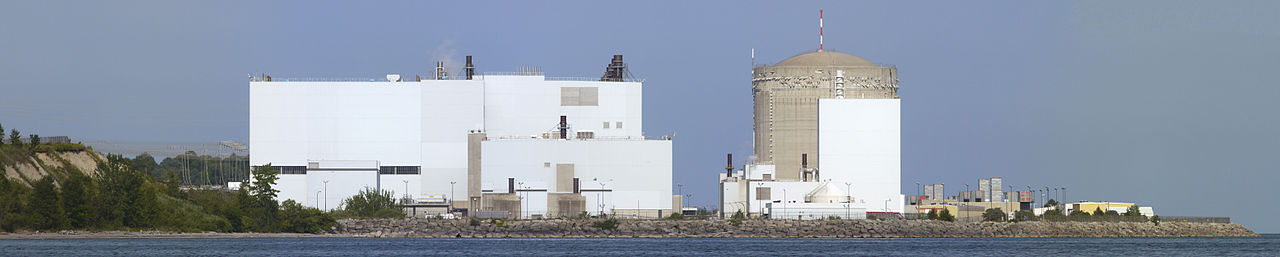
Darlington Nuclear Generating Station in Clarington, Ontario.
Photo by Óðinn via Wikimedia Commons.

Some prominent environmental groups have a pecuniary interest in replacing existing nuclear generating stations with natural gas and “renewable” energy sources, but money isn’t the only reason for the widespread opposition to nuclear power:

Sierra Club, NRDC, and EDF have worked to shut down nuclear plants and replace them with fossil fuels and a smattering of renewables since the 1970s. They have created detailed reports for policymakers, journalists, and the public purporting to show that neither nuclear plants nor fossil fuels are needed to meet electricity demand, thanks to energy efficiency and renewables. And yet, as we have seen, almost everywhere nuclear plants are closed, or not built, fossil fuels are burned instead.

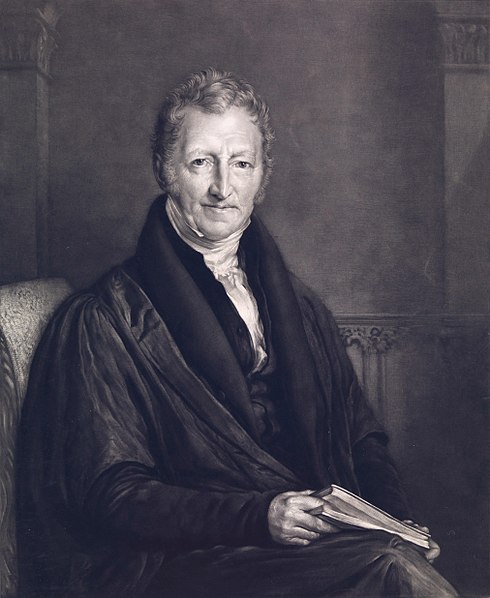
Thomas Malthus.
Portrait by John Linnell, 1834, via Wikimedia Commons

But it’s not just about money. It’s also about ideology. Anti-nuclear groups have long had a deeply ideological motivation to kill off nuclear energy.

Policymakers, journalists, conservationists, and other educated elites in the ’50s and ’60s knew that nuclear was unlimited energy and that unlimited energy meant unlimited food and water.

We could use desalination to convert ocean water into freshwater. We could create fertilizer without fossil fuels, by harvesting nitrogen from the air, and hydrogen from water, and combining them. We could create transportation fuels without fossil fuels, by taking carbon dioxide out of the atmosphere to make artificial hydrocarbons, or by splitting water to make pure hydrogen gas.

Nuclear energy thus created a serious problem for Malthusians — followers of widely-debunked 18th-century economist, Thomas Robert Malthus — who argued that the world was on the brink of ecological collapse and resource scarcity. Nuclear energy not only meant infinite fertilizer, freshwater, and food but also zero pollution and a radically reduced environmental footprint.

In reaction, Malthusians attacked nuclear energy as dangerous, mostly by suggesting that it would lead to nuclear war, but also by spreading misinformation about nuclear “waste” — the tiny quantity of used fuel rods — and the rapidly decaying radiation that escapes from nuclear plants during their worst accidents.

There is a pattern: Malthusians raise the alarm about resource depletion or environmental problems and then attack the obvious technical solutions. In the late 1700s, Thomas Malthus had to reject birth control to predict overpopulation. In the 1960s, Malthusians had to claim fossil fuels were scarce to oppose the extension of fertilizers and industrial agriculture to poor nations and to raise the alarm over famine. And today, climate activists reject nuclear energy in order to declare a coming climate apocalypse.

The Italian Tank Meme

Filed under: Africa, Europe, History, Italy, Military, Weapons, WW2 — Tags: , — Nicholas @ 02:00

Potential History
Published 27 Jul 2018

Italian tanks and why they were what they were.

Tank illustrations: http://www.tanks-encyclopedia.com/

P.O.Box:
Potential History
P.O. Box
524 Beech Grove, IN,
46107

Patreon: https://www.patreon.com/potentialhistory

QotD: “The freedom to tell lies is one of the most basic freedoms of all”

It was clear to me from the questions that followed that the children had very little notion of what freedom actually was or what it entailed. For example, could it be right to allow climate-deniers to spread their falsehood and lies? The question begs many questions, of course: it assumes that it is beyond reasonable doubt that the globe is warming, that the warming is caused by man’s activities, that the warming is a wholly harmful phenomenon and that there is only one possible solution to it. I am insufficiently knowledgeable to pronounce on these questions and have heard eminent people whom I respect and whose integrity I have no grounds for doubting argue for very different conclusions.

But even if there were answers to these questions that were a good deal more certainly true than any answers that we possess today, it still would not be right to silence doubters and deniers: for error and even malice are the price of freedom. In the realm of intellectual freedom it is not truth that sets you free, but error, or rather the permissibility of error. And the freedom to tell lies is one of the most basic freedoms of all. There can be no freedom without it.

Well, the audience was only young and perhaps this was strong meat for their immature digestions rendered sensitive by a constant diet of modern pieties, as the young these days are said to be more likely to develop allergies because of the sterility and cleanliness of modern homes and ways of life (what they need is more dirt and early contact with potential pathogens). But soon they would be going off to university, where it was likely that they would encounter an even narrower and powerfully self-reinforcing view of the world. The pressure to conform would add to the natural self-righteousness of youth, which is often mistaken for idealism, and their impulse to censor in the name of their own irreproachable virtue would be strengthened and entrenched.

The long-term prospects for freedom of speech, then, are not altogether rosy. Those who value it are less vehement in their defence of it than are the self-righteous in their assault on it.

Anthony Daniels, “Free Speech’s Emboldened Enemies”, Quadrant, 2018-03-10.

June 25, 2020

Designing a JAPANESE Inspired PICNIC BENCH from Scratch | The Picnic Bench Project – Part #1

Filed under: Woodworking — Tags: , , — Nicholas @ 06:00

Matt Estlea
Published 24 Jun 2020

This isn’t going to be your basic, run-of-the-mill picnic bench. This picnic bench is going to be a one-of-a-kind, Japanese influenced picnic bench with all the traditional hand-cut joints you could ask for.

This is going to be a great project, don’t miss out on it!
#designingapicnicbench #buildingapicnicbench #thedesignprocess
_________________________________________________________________
3 YEAR ANNIVERSARY BERTHA MERCHANDISE!!
https://mattestlea.com/product-tag/be…

Use the code ‘ThirdBirthday’ for 50% off plans for my Roubo Workbench!
https://mattestlea.com/product/roubo-…
_________________________________________________________________

Support what I do by becoming a Patron! This will help fund new tools, equipment and cover my overheads. Meaning I can continue to bring you regular, high quality, free content. Thank you so much for your support! https://www.patreon.com/mattestlea

Don’t want to commit to a monthly direct debit but still want to help out? That’s fine!
You can make a one time donation here: www.mattestlea.com/donate
You can donate us biscuits here: www.mattestlea.com/wishlist
_________________________________________________________________
BUY THE WOODWORKING BIBLE HERE:
www.mattestlea.com/the-woodworkers-manual
_________________________________________________________________

SOCIAL MEDIA
Instagram: www.instagram.com/mattestlea
Twitter: www.twitter.com/mattestlea
Patreon: www.patreon.com/mattestlea
Pinterest: www.pinterest.com/mattestlea
LinkedIn: www.linkedin.com/in/matt-estlea-b6414b11a/
_________________________________________________________________
See what tools I use here: www.mattestlea.com/equipment
My Website: www.mattestlea.com
_________________________________________________________________

My name is Matt Estlea, I’m a 24 year old Woodworker from Basingstoke in England and my aim is to make your woodworking less s***.

I come from 5 years tuition at Rycotewood Furniture Centre with a further 1 year working as an Artist in Residence at the Sylva Foundation. I now teach City and Guilds Furniture Making at Rycotewood as of September 2018.

If you’re interested in studying at Rycotewood, view their courses here:
www.mattestlea.com/rycotewood

I also had 5 years of experience working at Axminster Tools and Machinery where I helped customers with purchasing tools, demonstrated in stores and events, and gained extensive knowledge about a variety of tools and brands. I discontinued this at the start of 2019 to focus solely on video creation and teaching.

During the week, I film woodworking projects, tutorials, reviews and a viewer favourite ‘Tool Duel’ where I compare two competitive manufacturers tools against one another to find out which is best. I also have a Free Online Woodworking School which you should definitely check out!

www.mattestlea.com/school

I like to have a laugh and my videos are quite fast paced BUT you will learn a lot, I assure you.

Lets go make a mess.

Capitalism and slavery

Filed under: Books, Britain, Economics, History, Liberty, USA — Tags: , , — Nicholas @ 05:00

In Quillette, Matthew Lesh explains why glib claims that slavery was somehow “essential” to early capitalism or that slavery was the cause of western wealth just don’t hold up to any historical scrutiny:

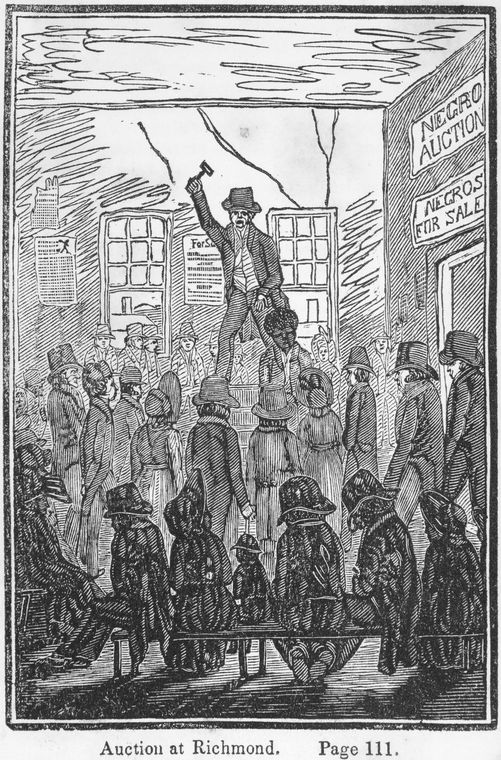
Auction at Richmond. (1834)
“Five hundred thousand strokes for freedom; a series of anti-slavery tracts, of which half a million are now first issued by the friends of the Negro” by Wilson Armistead and “Picture of slavery in the United States of America” by George Bourne.
New York Public Library via Wikimedia Commons.

It has become a common trope that slavery and the slave trade is responsible for the industrial revolution, if not our entire modern prosperity. Slavery is often called capitalism’s “dark side.” A recent column in the Guardian claimed the slave trade “heralded the age of capitalism” and Guardian columnist George Monbiot said on Twitter: “The more we discover about our own history, the less the ‘trade’ on which Britain built its wealth looks like exchange, and the more it looks like looting. It meant extracting stolen resources and the products of slavery, debt bondage and land theft from other nations.” The same line has been taken by London Mayor Sadiq Khan, who tweeted: “It’s a sad truth that much of our wealth was derived from the slave trade.”

But what did the “father of modern economics,” Adam Smith, actually think about slavery? And is it responsible for our modern prosperity?

Adam Smith argued not only that slavery was morally reprehensible, but that it causes economic self-harm. He provided economic and moral ammunition for the abolitionist movement that came to fruition after his death in 1790. Smith was pessimistic about the potential for full abolition, but he was on the side of the angels.

Smith’s The Wealth of Nations, published in 1776, contains perhaps the best known economic critique of slavery. Smith argued that free individuals work harder and invest in the improvement of land, motivated by their interest in earning a higher income, than slaves. Smith refers to ancient Italy, where the cultivation of corn degraded under slavery. The cost of slavery is “in the end the dearest of any,” Smith writes.

His thinking about slavery can be traced further back. In the Lectures on Justice, Police, Revenue and Arms, delivered in 1763 long before Britain’s abolitionist movement was formalised, Smith writes:

    Slaves cultivate only for themselves; the surplus goes to the master, and therefore they are careless about cultivating the ground to the best advantage. A free man keeps as his own whatever is above his rent, and therefore has a motive to industry.

Smith describes how serfs in Western Europe — in feudal relationships with lords — were progressively transformed into free tenants as they acquired cattle and tools. Harvests were more evenly divided between landlord and tenant to encourage better use of land, and tenants eventually progressed to simply giving the landlord a sum for lease. As government became more established, the influence of lords over the lives of tenants was also loosened.

Capitalism was, as Marx described, the next stage in human development after feudal slave relations. Smith’s commercial society is in direct opposition to a slave society. Smith, at his core, is an advocate for individuals being free to specialize and trade, including to trade their labor. Everyone acting with regard to their “own interest,” not because of coercion, creates general prosperity.

Smith’s case against slavery is proven by history: The huge uptick in human prosperity came largely after the end of feudal relations and the abolition of slavery and the slave trade. We are many magnitudes richer than when lords held slaves, or even chattel slavery proliferated in the Americas. The setting free of humanity led to extraordinary innovation and entrepreneurialism. This is only possible, as Smith argued, when individuals can benefit from the fruits of their own labor (slaves cannot hold property in their own name, and hence cannot trade or choose to specialise).

We didn’t become rich because a few hundred years ago people toiled on farms in awful conditions. In fact, the opposite. “It was precisely the replacement of human muscle power with that of steam and machines which did away with the vileness of chattel slavery and forced labor,” Tim Worstall has explained.

USA Starts the Atomic Arms Race | The Cuban Missile Crisis I Prelude 1

TimeGhost History
Published 24 Jun 2020

When WW2 ends the former Allies find themselves at odds with each other over ideological and economic world domination. In an atmosphere of increasing escalation, the US pulls ahead in the nuclear arms race. While the Soviet Union tries to catch up, they are far behind, and yet humanity soon faces potential destruction many times over.

Join us on Patreon: https://www.patreon.com/TimeGhostHistory

Hosted by: Indy Neidell
Written by: Spartacus Olsson
Director: Astrid Deinhard
Producers: Astrid Deinhard and Spartacus Olsson
Executive Producers: Astrid Deinhard, Indy Neidell, Spartacus Olsson, Bodo Rittenauer
Creative Producer: Joram Appel
Post-Production Director: Wieke Kapteijns
Research by: Spartacus Olsson
Edited by: Daniel Weiss
Sound design: Marek Kaminski

Colorizations:
– Daniel Weiss

Sources:
– Bundesarchiv_Bild_183-30562-0001,
– Color by Klimbim

Soundtracks from Epidemic Sound:
– “Cold Eyes” – Elliot Holmes
– “Juvenile Delinquent” – Elliot Holmes
– “Nightclub Standoff” – Elliot Holmes
– “Scope” – Got Happy
– “Zoot Suit” – Elliot Holmes
– “Car Chase in Virginia” – White Bones
– “When They Fell” – Wendel Scherer
– “Kissed by Thunder” – Elliot Holmes

Archive by Screenocean/Reuters https://www.screenocean.com.

A TimeGhost chronological documentary produced by OnLion Entertainment GmbH.

From the comments:

TimeGhost History
1 day ago
This is the first of two preludes before we will cover the Cuban Missile Crisis day-by-day in 13 episodes. Our hardcore fans might recognise this series, as these are a remake of the very first series that we ever did on this YouTube channel. Not only did we improve the set and the audio and video quality, also did we gain access to a lot more unique archive material. These episodes were also edited by dedicated editors (back then Spartacus had to edit them) and we have the help of Ryan who makes graphics and our coloriziation squad who bring history to life. We have come a long way since the old version of this was first published. We thank everyone for sticking around but especially those who joined the TimeGhost Army at www.patreon.com/timeghosthistory or https://timeghost.tv. We wouldn’t be here without them!
Cheers,
Joram

What is the purpose of public art?

Filed under: History, Media, Politics — Tags: , , , — Nicholas @ 03:00

In his latest Age of Invention newsletter, Anton Howes engages with a topic that is in the headlines today as we find ourselves in the midst of an unexpected outbreak of iconoclasm:

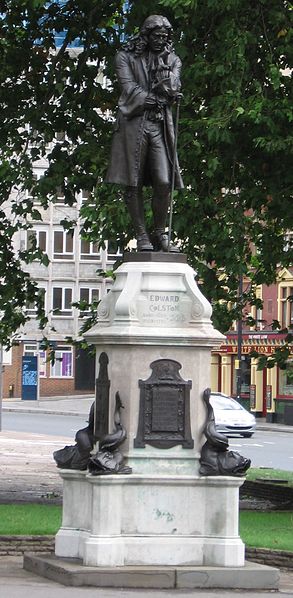
The John Cassidy (1860-1939) statue of Edward Colston, which stood in Bristol from 1895-2020 before being taken down and thrown into Bristol harbour during the protests after the death of George Floyd.
Photo by William Avery via Wikimedia Commons.

… public art in the eighteenth and nineteenth centuries used to be about inculcating virtue, which is something we seem to have forgotten. Public art was explicitly moralising, and not in the subversive way so often seen today, which leads us to question ourselves but rarely gives us answers. Back then, public art was instead meant to inspire. In painting, for example, the most prestigious and public-facing genre was history painting. History painting showed allegorical, mythological, and religious scenes, as well as those from actual history, in order to illustrate the exploits of the great and good, setting an example to us of integrity and public-spiritedness.

Importantly, the subjects of history paintings were taken from classical Greek or Roman history, or from mythology or religion, because such figures were generally uncontroversial — they could be upheld as paragons of virtue in a way that more recent and local historical figures could not. And the same went for statues, which became the main mediums of public art because the spaces available for history paintings were lacking. (The great room of the Society of Arts, by the way, has some of the few major history paintings in the country, all executed by the troubled self-proclaimed genius James Barry — the fastest riser in the Royal Academy’s history, and also, as far as I know, the only person to ever be expelled from it)

So, if some public statues have become controversial, that’s a clear sign of their failure. To the Victorians who put up the statue of slave trader Edward Colston in 1895, he must have seemed a distant and uncontroversial paragon of philanthropy. But today, he is mostly remembered for his murderous avarice. As such, he doesn’t deserve space on our streets or squares, for much the same reason that people in the eighteenth century avoided putting up statues of Oliver Cromwell — depending on your politics, he was either an ambitious and fanatical tyrant, or a selfless promoter of parliamentary liberties. Either way, it was the controversy itself that made him unsuitable: controversy got in the way of moral education. (Funnily enough, Cromwell seems to have got his public statues in the 1890s, too, just like Colston — maybe it was a low-point for the quality of history-teaching?)

I’m worried, however, that we’ve lost the self-confidence to replace them with statues that uncontroversially inculcate virtue (and in more than just a subversive or critical way). I suspect it take the delusions of grandeur of a James Barry to pull it off — someone who thought the history painter akin to a poet, like Shakespeare. But, as Tim Almond pointed out to me on twitter, perhaps we already do have such forms of virtue-promoting public art, and that all that has changed is the medium. Thus, rather than gazing upon statues or history paintings, we instead watch blockbuster superhero movies.

« Newer PostsOlder Posts »

Powered by WordPress