Quotulatiousness

June 30, 2020

“The Squadrons Are Coming” – HMS Ark Royal aviation operations

Filed under: Britain, History, Military — Tags: , , , , , — Nicholas @ 02:00

Aircraft Games Movies
Published 1 Jul 2010

In the Western Approaches, Ark Royal welcomes her air group back aboard, with the occasional hairy approach for newly qualified aviators.

This appears to be footage from episode 3 of Sailor, a BBC television series from 1976 about life aboard HMS Ark Royal.

The Wikipedia entry for HMS Ark Royal (R09) begins:

HMS Ark Royal (R09) was an Audacious-class aircraft carrier of the Royal Navy and, when she was decommissioned in 1979, was the Royal Navy’s last remaining conventional catapult and arrested-landing aircraft carrier. She was the first aircraft carrier to be equipped with angled flight deck at its commissioning; her sister ship, HMS Eagle, was the Royal Navy’s first angle-decked aircraft carrier after modification in 1954. Ark Royal was the only non-United States vessel to operate the McDonnell Douglas Phantom at sea.

[…]

While Ark Royal‘s career spanned 24 years from the time of her commissioning (her name was a household word), she spent as much time in refit; repair and reserve and modernisation as in commissioned service (12 years). It required a lot of effort from her engineers to keep her serviceable between yard periods. Ark Royal had been poorly preserved during its lengthy construction from 1942 to 1955, and much of its machinery was obsolete by its completion, including its dated DC electrics, supplemented later by some AC systems, resulting in a ship which experienced regular defects and mechanical failure. Eagle was a more reliable and well-built ship, and spent far more time at sea than her sister. The scrapping of Ark Royal in 1980, two years after Eagle, marked the end of conventional fixed-wing aircraft operations aboard Royal Navy carriers. She had borne so many innovations, yet her replacement was not equipped with any of these. There was some discussion about preserving her as a museum ship, and some private funds were raised; the MOD would not sanction these efforts.

QotD: Ideologies and belief systems

Filed under: Health, History, Quotations, Religion — Tags: , , , , — Nicholas @ 01:00

It’s really not a good thing because it manifests itself not only in individual psychopathologies, but also in social psychopathologies. That’s this proclivity of people to get tangled up in ideologies, and I really do think of them as crippled religions. That’s the right way to think about them. They’re like religion that’s missing an arm and a leg but can still hobble along. It provides a certain amount of security and group identity, but it’s warped and twisted and demented and bent, and it’s a parasite on something underlying that’s rich and true. That’s how it looks to me, anyways. I think it’s very important that we sort out this problem. I think that there isn’t anything more important that needs to be done than that. I’ve thought that for a long, long time, probably since the early ’80s when I started looking at the role that belief systems played in regulating psychological and social health. You can tell that they do that because of how upset people get if you challenge their belief systems. Why the hell do they care, exactly? What difference does it make if all of your ideological axioms are 100 percent correct?

People get unbelievable upset when you poke them in the axioms, so to speak, and it is not by any stretch of the imagination obvious why. There’s a fundamental truth that they’re standing on. It’s like they’re on a raft in the middle of the ocean. You’re starting to pull out the logs, and they’re afraid they’re going to fall in and drown. Drown in what? What are the logs protecting them from? Why are they so afraid to move beyond the confines of the ideological system? These are not obvious things. I’ve been trying to puzzle that out for a very long time. […]

Nietzsche’s idea was that human beings were going to have to create their own values. He understood that we had bodies and that we had motivations and emotions. He was a romantic thinker, in some sense, but way ahead of his time. He knew that our capacity to think wasn’t some free-floating soul but was embedded in our physiology, constrained by our emotions, shaped by our motivations, shaped by our body. He understood that. But he still believed that the only possible way out of the problem would be for human beings themselves to become something akin to God and to create their own values. He talked about the person who created their own values as the overman, or the superman. That was one part of the Nietzschean philosophy that the Nazis took out of context and used to fuel their superior man ideology. We know what happened with that. That didn’t seem to turn out very well, that’s for sure.

Jordan B. Peterson, “Biblical Series I: Introduction to the Idea of God” {transcript], jordanbpeterson.com, 2018-03-12.

June 29, 2020

The End of the Line

Filed under: Cancon, History, Railways, Technology — Tags: , , , — Nicholas @ 06:00

NFB
Published 2 Sep 2015

This documentary short offers a nostalgic look at the steam locomotive as it passes from reality to history. In its heyday, the big smoke-belching steam engine seemed immortal. Now, powerful and efficient diesels are pushing the old coal-burning locomotives to the sidelines, and the lonely echo of their whistles may soon be a thing of the past.

Directed by Terence Macartney-Filgate – 1959.

Today on NeoNaziHuntingExpeditions, we track down Neo Nazi Bronies

Filed under: Media, Politics, USA — Tags: , , , , , , , — Nicholas @ 05:00

In Quillette, Daniel Friedman examines the claims made in a recent Atlantic investigation into Nazis in the My Little Pony community (that is, adult fans of the show, not little girls … I think):

Image found by searching for “Neo Nazi Bronies”, listed URL – http://www.democraticunderground.com/1014960111

The evidence of this Nazi problem in the My Little Pony fandom is that, on a My Little Pony imageboard called Derpibooru, over 900 images were tagged as “racist,” and images mocking Black Lives Matter were upvoted by users while images supporting the movement were downvoted, even as the site’s administrators made a statement of support for the protests. After much controversy, the imageboard banned uploading images “created for no reason other than to incite controversy” and removed the 926 images tagged “racism” or “racist.” This move was extremely controversial within the Derpibooru community, many members of which oppose any moderation.

Atlantic reporter Kaitlyn Tiffany suggests that the strong free-speech norms of the Derpibooru boards stem from its origins on 4Chan, which Tiffany describes as “the largest den of chaos and toxic beliefs available on the Internet.” She describes the Brony community as being divided between those who “genuinely enjoy My Little Pony and the wholesome escapism it provides” and trolls who think it is “edgy and provocative to be an adult obsessed with cartoon ponies.” This frames the Derpibooru imageboard as a place where innocent cartoon fans are unknowingly subjected to subversive, racist memes and images that may send people down a rabbit hole of far-right content.

However, claims that a significant portion of the Brony community are Nazis, or that a significant amount of the content on Brony imageboards is right-wing propaganda or racist memes has to be put in the proper context. First of all, the 926 images tagged “racist” exist on a board that hosts over two million images. If you order all the site’s various tags by how many images fall within their categories, there are 12 full pages of other, more popular tags you have to scroll through to find the “racism” tag. One thousand two hundred and seventy-five images are tagged “politics” and include images both supporting and opposing Black Lives Matter. Discussion of these issues is a tiny fraction of one percent of the content on the My Little Pony imageboard.

By contrast, 315,867 images on the Derpibooru forum are tagged as sexually explicit, a further 127,414 images are tagged as sexually suggestive and 105,521 images are tagged as containing “questionable” sexual content. The truth is that Derpibooru’s lax moderation norms and anti-censorship culture don’t exist to protect objectionable political content; this imageboard is unmoderated because it is an enormous repository of fan-made My Little Pony pornography.

The Atlantic article fails to place the 926 racist images in the context of the larger scope of the two million images hosted by the Derpibooru board, because less than one-quarter of one percent of the site’s content is of a political nature. And the Atlantic article avoids mentioning the half-million pornographic images the site hosts, because doing so reveals that the community’s widespread opposition to content moderation on their imageboard is about protecting sexually explicit content rather than creating a space for hateful politics to flourish, and it further reveals that the Bronies are 500 times more interested in having sex with My Little Pony characters than they are in spreading racist pony memes.

The article creates an impression that the alt-Right is using seemingly-innocent cartoon fandoms as a Trojan horse to conceal and spread a sinister ideology, but the truth is that the only thing these guys are interested in hiding inside a horse is their dicks.

Creating a JAPANESE Inspired PICNIC BENCH from Scratch | The Picnic Bench Project – Part #3

Filed under: Tools, Woodworking — Tags: , , , — Nicholas @ 04:00

Matt Estlea
Published 28 Jun 2020

[Note: To skip the in-video ad for Raid, you can go directly to 3:00]

Install Raid for Free ✅ IOS: https://clcr.me/bGSf3q ✅ ANDROID: https://clcr.me/gFa8bI ✅ PC: https://clcr.me/pHXO39 and get a special starter pack 💥Available only for the next 30 days

In this video, we go and visit Tyler Hardwoods to grab some cedar. Then get it resawn, cut to size, and ready for the next video!

Get the Incra Protractor Here:
https://kit.co/MattEstlea/measuring-a…
_________________________________________________________________

Support what I do by becoming a Patron! This will help fund new tools, equipment and cover my overheads. Meaning I can continue to bring you regular, high quality, free content. Thank you so much for your support! https://www.patreon.com/mattestlea

Don’t want to commit to a monthly direct debit but still want to help out? That’s fine!
You can make a one time donation here: www.mattestlea.com/donate
You can donate us biscuits here: www.mattestlea.com/wishlist
_________________________________________________________________
BUY THE WOODWORKING BIBLE HERE:
www.mattestlea.com/the-woodworkers-manual
_________________________________________________________________

SOCIAL MEDIA
Instagram: www.instagram.com/mattestlea
Twitter: www.twitter.com/mattestlea
Patreon: www.patreon.com/mattestlea
Pinterest: www.pinterest.com/mattestlea
LinkedIn: www.linkedin.com/in/matt-estlea-b6414b11a/
_________________________________________________________________
See what tools I use here: www.mattestlea.com/equipment
My Website: www.mattestlea.com
_________________________________________________________________

My name is Matt Estlea, I’m a 24 year old Woodworker from Basingstoke in England and my aim is to make your woodworking less s***.

I come from 5 years tuition at Rycotewood Furniture Centre with a further 1 year working as an Artist in Residence at the Sylva Foundation. I now teach City and Guilds Furniture Making at Rycotewood as of September 2018.

If you’re interested in studying at Rycotewood, view their courses here:
www.mattestlea.com/rycotewood

I also had 5 years of experience working at Axminster Tools and Machinery where I helped customers with purchasing tools, demonstrated in stores and events, and gained extensive knowledge about a variety of tools and brands. I discontinued this at the start of 2019 to focus solely on video creation and teaching.

During the week, I film woodworking projects, tutorials, reviews and a viewer favourite ‘Tool Duel’ where I compare two competitive manufacturers tools against one another to find out which is best. I also have a Free Online Woodworking School which you should definitely check out!

www.mattestlea.com/school

I like to have a laugh and my videos are quite fast paced BUT you will learn a lot, I assure you.

Lets go make a mess.

The Canadian Armed Forces Primary Reserve

Filed under: Cancon, Military — Tags: , , — Nicholas @ 03:00

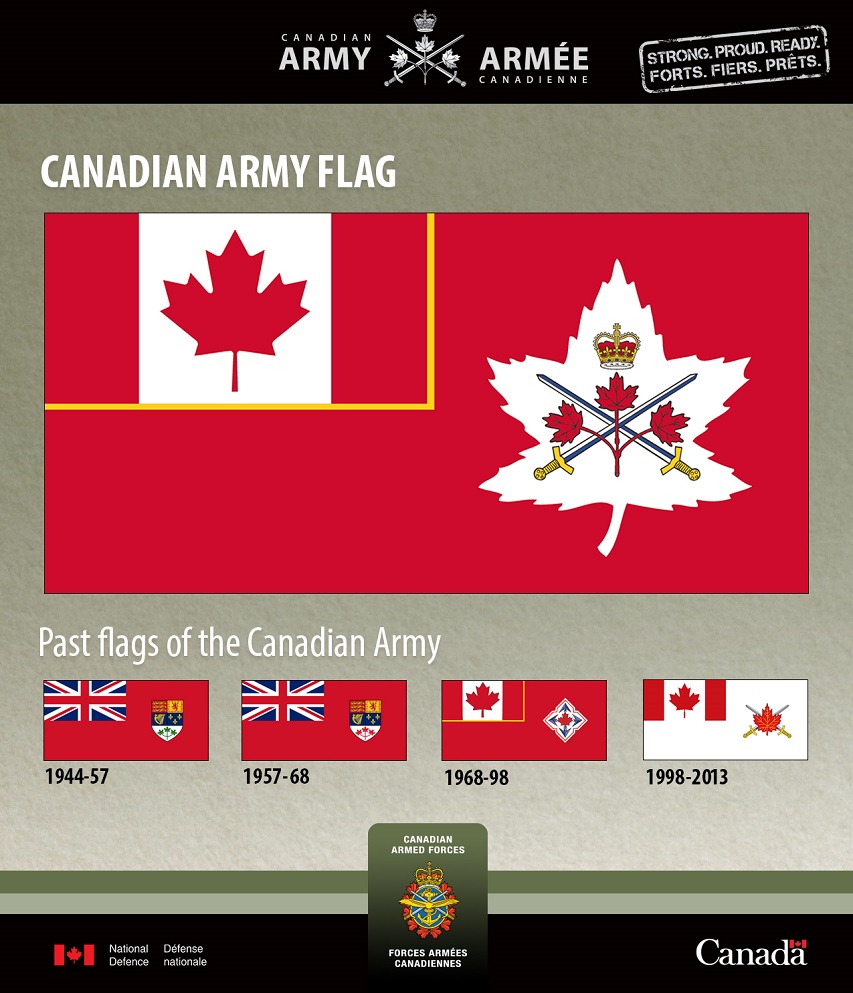
Ted Campbell looks at the state of the reserves, specifically the Army Reserve:

For those interested, and every thinking Canadian should have some, albeit limited interest in the subject, there is an interesting thread over on Army.ca which deals with the problems (there are a lot of them) in making Canada’s reserve Army (the militia if you’re old enough) into an effective force.

I’m going to go with what I think is the majority opinion and say that our Army reserve, in particular, is ineffective. That does not mean that it does not do yeoman service: Canada’s tiny regular Army could not have conducted sustained combat operations in Afghanistan from 2002 to 2014 unless thousands and thousands of reserve force soldiers had stepped up. They were mostly young men, many looking for some combination of a full-time job, some adventure, a faster route into the regular Army, or even a sort of “gap year” experience, but some, like Canada’s current Defence Minister Harjit Sajjan, were middle-aged senior officers when they took a year off from their civilian careers to serve. Today, as I write many reserve force soldiers are serving in a new sort of front-line: long term care facilities that have been ravaged by the COVID-19 virus. The one problem that Canada does NOT have in its Army (regular or reserve) is the quality of the people who serve ~ they are, by and large, amongst the best soldiers in the world and, equally, especially the reservists, Canada’s finest citizens.

But too many people seem to be content with the notion that reserve Army is doing enough by providing a pool of individuals to fill up or augment regular Army units in an emergency. If that’s all the country wants, if that’s the level of capability for which we are willing to settle, then I think we, as a nation, do not deserve the service of the men and women in our reserve Army units.

Operation Gunnerside: The Mission to Stop Germany’s Atomic Bomb

Filed under: Europe, Germany, History, Military, WW2 — Tags: , , — Nicholas @ 02:00

Historigraph
Published 21 Mar 2020

Buy Historigraph Posters here! https://teespring.com/stores/historig…
Support the channel on Patreon: https://www.patreon.com/historigraph

#OperationGunnerside #Historigraph #Historigraph #CuriosityStream

►Twitter: https://twitter.com/historigraph
►Instagram: https://www.instagram.com/historigraph
►Patreon: https://www.patreon.com/historigraph
►Follow me on Twitch: https://www.twitch.tv/historigraph

Sources:

Richard Petrow, The Bitter Years

David Greentree, Heroes of Telemark: Sabotaging Hitler’s Atomic Bomb

Clips:

1948 film Kampen om tungtvannet

Clips from contemporary documentary; https://www.youtube.com/watch?v=c3jSW…

Music:

“Crypto” by Kevin MacLeod
Link: https://incompetech.filmmusic.io/song…
License: http://creativecommons.org/licenses/b…

“Rynos Theme”, Incompetech https://incompetech.com

“Hitman” by Kevin MacLeod
Link: https://incompetech.filmmusic.io/song…
License: http://creativecommons.org/licenses/b…

QotD: Gandhi’s religious views

Filed under: History, India, Quotations, Religion — Tags: , , — Nicholas @ 01:00

I am sure that almost everyone who sees the movie Gandhi is aware that, from a religious point of view, the Mahatma was something called a “Hindu” — but I do not think one in a thousand has the dimmest notion of the fundamental beliefs of the Hindu religion. The simplest example is Gandhi’s use of the word “God,” which, for members of the great Western religions — Christianity, Judaism, and Islam, all interrelated — means a personal god, a godhead. But when Gandhi said “God” in speaking English, he was merely translating from Gujarati or Hindi, and from the Hindu culture. Gandhi, in fact, simply did not believe in a personal God, and wrote in so many words, “God is not a person … but a force; the undefinable mysterious Power that pervades everything; a living Power that is Love …” And Gandhi’s very favorite definition of God, repeated many thousands of times, was, “God is Truth,” which reduces God to some kind of abstract principle.

Like all Hindus, Gandhi also believed in the “Great Oneness,” according to which everything is part of God, meaning not just you and me and everyone else, but every living creature, every dead creature, every plant, the pitcher of milk, the milk in the pitcher, the tumbler into which the milk is poured … After all of which, he could suddenly pop up with a declaration that God is “the Maker, the Law-Giver, a jealous Lord,” phrases he had probably picked up in the Bible and, with Hindu fluidity, felt he could throw in so as to embrace even more of the Great Oneness. So when Gandhi said, “I am a Hindu and a Muslim and a Christian and a Jew,” it was (from a Western standpoint) Hindu double-talk. Hindu holy men, some of them reformers like Gandhi, have actually even “converted” to Islam, then Christianity, or whatever, to worship different “aspects” of the Great Oneness, before reconverting to Hinduism. Now for Christians, fastidious in matters of doctrine, a man who converts to Islam is an apostate (or vice versa), but a Hindu is a Hindu is a Hindu. The better to experience the Great Oneness, many Hindu holy men feel they should be women as well as men, and one quite famous one even claimed he could menstruate (I will spare the reader the details).

In this ecumenical age, it is extremely hard to shake Westerners loose from the notion that the devout of all religions, after all, worship “the one God.” But Gandhi did not worship the one God. He did not worship the God of mercy. He did not worship the God of forgiveness. And this for the simple reason that the concepts of mercy and forgiveness are absent from Hinduism. In Hinduism, men do not pray to God for forgiveness, and a man’s sins are never forgiven — indeed, there is no one out there to do the forgiving. In your next life you may be born someone higher up the caste scale, but in this life there is no hope. For Gandhi, a true Hindu, did not believe in man’s immortal soul. He believed with every ounce of his being in karma, a series, perhaps a long series, of reincarnations, and at the end, with great good fortune: mukti, liberation from suffering and the necessity of rebirth, nothingness. Gandhi once wrote to Tolstoy (of all people) that reincarnation explained “reasonably the many mysteries of life.” So if Hindus today still treat an Untouchable as barely human, this is thought to be perfectly right and fitting because of his actions in earlier lives. As can be seen, Hinduism, by its very theology, with its sacred triad of karma, reincarnation, and caste (with caste an absolutely indispensable part of the system) offers the most complacent justification of inhumanity of any of the world’s great religious faiths.

Gandhi, needless to say, was a Hindu reformer, one of many. Until well into his fifties, however, he accepted the caste system in toto as the “natural order of society,” promoting control and discipline and sanctioned by his religion. Later, in bursts of zeal, he favored moderating it in a number of ways. But he stuck by the basic varna system (the four main caste groupings plus the Untouchables) until the end of his days, insisting that a man’s position and occupation should be determined essentially by birth. Gandhi favored milder treatment of Untouchables, renaming them Harijans, “children of God,” but a Harijan was still a Harijan. Perhaps because his frenzies of compassion were so extreme (no, no, he would clean the Harijan’s latrine), Hindu reverence for him as a holy man became immense, but his prescriptions were rarely followed. Industrialization and modernization have introduced new occupations and sizable social and political changes in India, but the caste system has dexterously adapted and remains largely intact today. The Sudras still labor. The sweepers still sweep. Max Weber, in his The Religion of India, after quoting the last line of the Communist Manifesto, suggests somewhat sardonically that low-caste Hindus, too, have “nothing to lose but their chains,” that they, too, have “a world to win” — the only problem being that they have to die first and get born again, higher, it is to be hoped, in the immutable system of caste. Hinduism in general, wrote Weber, “is characterized by a dread of the magical evil of innovation.” Its very essence is to guarantee stasis.

In addition to its literally thousands of castes and sub-castes, Hinduism has countless sects, with discordant rites and beliefs. It has no clear ecclesiastical organization and no universal body of doctrine. What I have described above is your standard, no-frills Hindu, of which in many ways Gandhi was an excellent example. With the reader’s permission I will skip over the Upanishads, Vedanta, Yoga, the Puranas, Tantra, Bhakti, the Bhagavad-Gita (which contains theistic elements), Brahma, Vishnu, Shiva, and the terrible Kali or Durga, to concentrate on those central beliefs that most motivated Gandhi’s behavior as a public figure.

Richard Grenier, “The Gandhi Nobody Knows”, Commentary, 1983-03-01.

June 28, 2020

The Peasants Rise Up Against The Bolsheviks – The Russian Civil War(s) 1920 I THE GREAT WAR 1920

Filed under: History, Military, Russia — Tags: , , , , — Nicholas @ 09:30

The Great War
Published 27 Jun 2020

Sign up for Curiosity Stream and get Nebula bundled in: https://curiositystream.com/thegreatwar

Freeing peasants and workers from oppression was one of the main messages of the Bolsheviks. The peasants in the countryside were happy to get rid of the landowning class and supported socialist ideas of land reform but once the Bolsheviks turned to “War Communism” to maintain their power against the Whites and other forces, the reluctant support of the peasants dropped — and in 1920 they turned to open revolt.

» SUPPORT THE CHANNEL
Patreon: https://www.patreon.com/thegreatwar
Merchandise: https://shop.spreadshirt.de/thegreatwar/

» SOURCES
Figes, Orlando. A People’s Tragedy. The Russian Revolution (London: The Bodley Head, 2017 [1996]).
Mawdsley, Evan. The Russian Civil War (New York: Pegasus Books, 2005).
Smele, Jonathan. The “Russian” Civil Wars 1916-1926 (London: Hurst, 2015).
Sumpf, Alexandre. “Russian Civil War,” in 1914-1918 online. International Encyclopedia of the First World War. https://encyclopedia.1914-1918-online.
Engelstein, Laura. Russia in Flames (Oxford University Press, 2017).
Wolf, Eric R. Peasant Wars of the Twentieth Century (New York: Harper, 1969)

» SOCIAL MEDIA
Instagram: https://instagram.com/the_great_war
Twitter: https://twitter.com/WW1_Series
Reddit: https://reddit.com/r/TheGreatWarChannel

»CREDITS
Presented by: Jesse Alexander
Written by: Jesse Alexander
Director: Toni Steller & Florian Wittig
Director of Photography: Toni Steller
Sound: Toni Steller
Editing: Toni Steller
Mixing, Mastering & Sound Design: http://above-zero.com
Maps: Daniel Kogosov (https://www.patreon.com/Zalezsky)
Research by: Jesse Alexander
Fact checking: Florian Wittig

Channel Design: Alexander Clark
Original Logo: David van Stephold

Contains licensed material by getty images
All rights reserved – Real Time History GmbH 2020

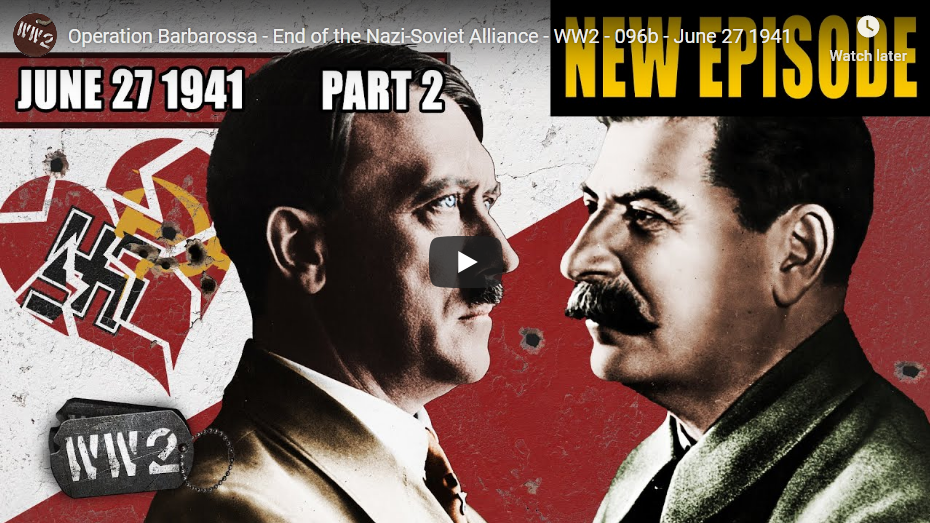
Operation Barbarossa – End of the Nazi-Soviet Alliance – WW2 – 096b – June 27 1941

World War Two
Published 27 Jun 2020

Operation Barbarossa kicks off this week with action all along the front as German panzers pierce deep into the Soviet Union. Meanwhile, Claude Auchinleck becomes Commander of the Allied forces in the Middle East that capture Damascus.

Join us on Patreon: https://www.patreon.com/TimeGhostHistory
Or join The TimeGhost Army directly at: https://timeghost.tv

Follow WW2 day by day on Instagram @World_war_two_realtime https://www.instagram.com/world_war_two_realtime
Between 2 Wars: https://www.youtube.com/playlist?list…
Source list: http://bit.ly/WW2sources

Written and Hosted by: Indy Neidell
Director: Astrid Deinhard
Producers: Astrid Deinhard and Spartacus Olsson
Executive Producers: Astrid Deinhard, Indy Neidell, Spartacus Olsson, Bodo Rittenauer
Creative Producer: Joram Appel
Post-Production Director: Wieke Kapteijns
Research by: Indy Neidell
Edited by: Iryna Dulka
Sound design: Marek Kamiński
Map animations: Eastory (https://www.youtube.com/c/eastory)
Map consultants: Rabih Rached and Patrick Adaimy

Colorizations by:
– Adrien Fillon – https://www.instagram.com/adrien.colo…
– Olga Shirnina, a.k.a. Klimbim – https://klimbim2014.wordpress.com/
– Cassowary Colorizations
– Dememorabilia – https://www.instagram.com/dememorabilia/
– Daniel Weiss
– Norman Stewart – https://oldtimesincolor.blogspot.com/

Sources:
– Imperial War Museum: E 3833, TR 841, E 1549, E 5448
– Bundesarchiv, CC-BY-SA 3.0: Bild 146-1990-044-13, Bild_183-B24575, Bild_101I-265-0048A-03, Bild_101I-208-0031-03, Bild_169-0443, Bild_101I-020-1262-35, Bild_101I-020-1272-21, Bundesarchiv_Bild_101I-209-0056-06
– Narodowe Archiwum Cyfrowe
– FDR Presidential Library & Museum

Archive by Screenocean/Reuters https://www.screenocean.com.

A TimeGhost chronological documentary produced by OnLion Entertainment GmbH.

“Viking” was the word for “Incel” in the early Middle Ages

Filed under: Books, China, Europe, Health, History, India, Military — Tags: , , , , , , — Nicholas @ 05:00

At least, that’s one interpretation offered by Mary Harrington at UnHerd:

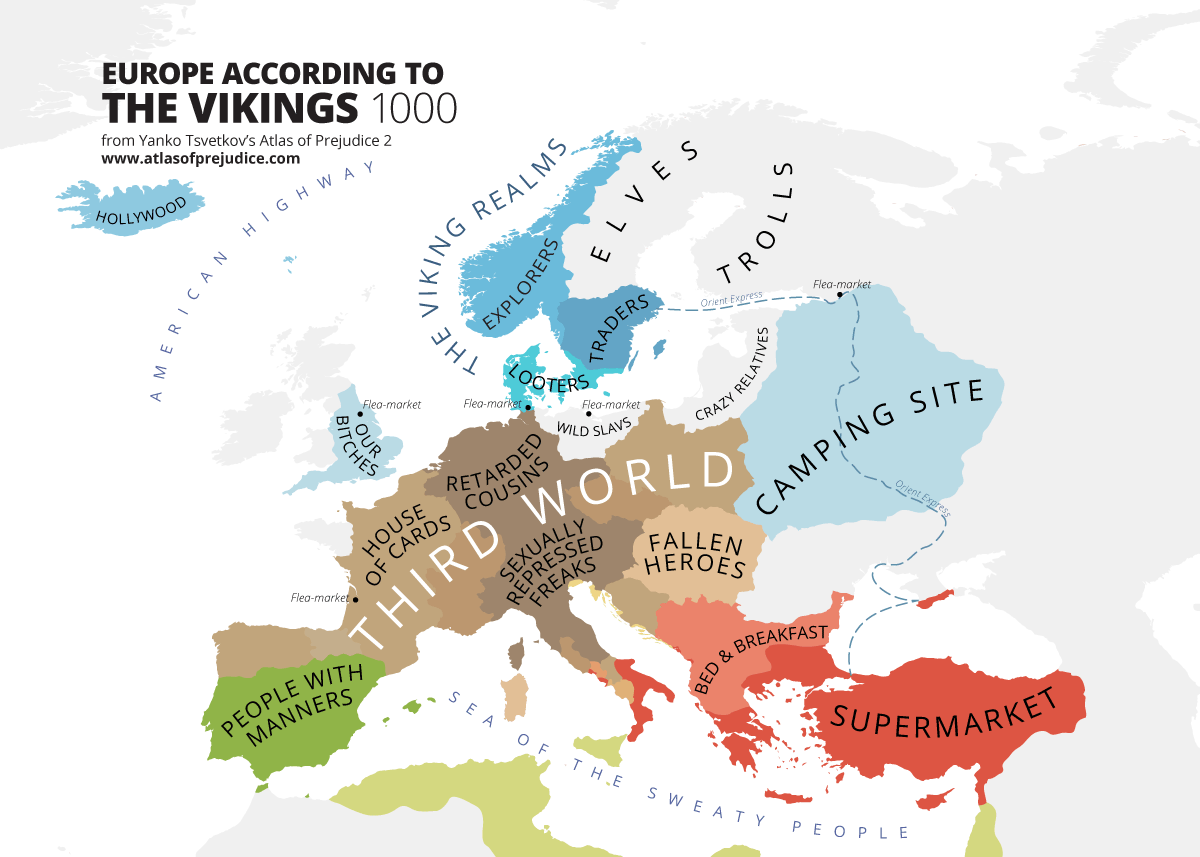
Europe According to the Vikings (1000) from Atlas of Prejudice 2 by Yanko Tsvetkov.

Last week, World War 3 nearly started in Ladakh. A dry, high-altitude region of Indian Kashmir on the Himalayan border with China, it’s been the site of escalating tensions and military buildup for some time. On June 15, the first physical confrontation between the Indian and Chinese militaries for 45 years erupted, killing at least 20 Indian and 45 Chinese soldiers.

There are all sorts of geopolitical reasons cited for the escalating tension between the world’s two most populous countries, but there is one more central and timeless problem that is going to drive both countries towards violence and instability — women. Or a lack of them.

In his History of the Normans, written circa 1015, Dudo of St Quentin argued that the reason the Vikings went raiding was because they couldn’t find wives, an idea echoed by the Tudor antiquarian William Camden in his 1610 book Britannia. “Wikings”, Camden suggested, were what you got when there weren’t enough women to go round, resulting in an excess of young men hanging around full of machismo but without any prospect of finding a nice girl and settling down. (Viking literally means raider.)

So, whenever these spare males “multiply’d themselves to a burdensom community”, Camden reports that an area would draw lots. Those of the young troublemakers chosen in the lottery would be sent off on a ship to make a nuisance of themselves overseas. Which they did.

In evolutionary biology, the “operational sex ratio” is a term used to count the proportion of males and females in a given species that are seeking a reproductive mate. As soon as the ratio tilts away from 50:50, the sex that’s over-represented will have to compete to secure a mate from among the less-plentiful potential partners of the opposite sex.

Though they wouldn’t have used that phrase, both Dudo of St Quentin and William Camden were both describing this phenomenon in human males. Where potential wives are scarce and the “burdensom community” of spare men multiplies, the result is more violence and crime. One 2019 study showed that where polygyny — that is, multiple wives — is a social norm for higher-status men, attacks on neighbouring ethnic groups skyrocket. With a few men monopolising eligible women, the rest are forced to seek status and resources by attacking other tribes.

India and China both have an extremely “burdensom community” of spare males. The normal ratio of newborn boys to girls is around 105:100. But as Mara Hvistendahl documents in Unnatural Selection, thanks to prenatal ultrasound and sex-selective abortion the ratio in China is around 118:100, and 108:100 in India. In some regions of India, the ratio rises as high as 150 males to 100 females. Though sex-selective technology is now banned in India, it’s still widespread, and the country now has some 37 million more men than women. Studies estimate that China has around 30 million excess men.

Why is the British government buying part of OneWeb?

Filed under: Britain, Business, Economics, Europe, Space — Tags: , — Nicholas @ 03:00

As Tim Worstall points out, the British government’s decision to buy 20% of the satellite company OneWeb doesn’t actually make any economic sense:

… OneWeb – in which the UK will own a 20% stake following the investment – currently operates a completely different type of satellite network from that typically used to run such navigation systems.

“The fundamental starting point is, yes, we’ve bought the wrong satellites,” said Dr Bleddyn Bowen, a space policy expert at the University of Leicester. “OneWeb is working on basically the same idea as Elon Musk’s Starlink: a mega-constellation of satellites in low Earth orbit, which are used to connect people on the ground to the internet.

The actual answer is that we don’t need to buy into anyone’s system at all. Just as we shouldn’t have into [EU satellite system] Galileo in the first place.

For, d’ye see, GPS is a public good. The US allows anyone to use the signals. Not that they can really stop people doing so either. Not unless they take the whole system down.

So, there’s the US system, free for all to use. A global public good – this means it doesn’t matter who provides it, it is there. It also means we don’t need our own. Which, in turn, means we don’t and didn’t need the Galileo system, let alone another one after we’ve left that.

As I said, politics not even asking the right question. They’re asking “which new system should we have?” when the correct questions is “why do we need a new system?” and given that the answer to the second is we don’t therefore the first is entirely moot.

Even setting aside the question of what the satellite system will be capable of, as the market is already in the process of developing and deploying the equipment, why does the British government think its investment is necessary?

British 1942 Prototype Simplified…Enfield?

Filed under: Britain, History, Military, Weapons, WW2 — Tags: , , , — Nicholas @ 02:00

Forgotten Weapons
Published 18 Nov 2018

https://www.forgottenweapons.com/brit…

http://www.patreon.com/ForgottenWeapons

Cool Forgotten Weapons merch! http://shop.bbtv.com/collections/forg…

In 1942, the British government instituted a development program to design a new simplified rifle to replace the No4 MkI Lee Enfield. The CSAD (Central Small Arms Department) came up with a design using a quite simple receiver machined form a small steel billet. It was a rifle wholly distinct form the Enfield, although both were chambered for the .303 British cartridge. The simplified rifle used a front-locking bolt, a simplified cocking piece, and had a magazine holding just 6 rounds. The sights were a simple 300/600 yard rear aperture, and a crude spike bayonet could be fitted either forward for use or rearward for storage.

The project never got as far as serial production, or even field trials as far as I can tell, and only a handful of prototypes were made.

Contact:
Forgotten Weapons
PO Box 87647
Tucson, AZ 85754

QotD: Nietzsche’s views on Christianity

Filed under: History, Quotations, Religion — Tags: , , , — Nicholas @ 01:00

Nietzsche was a devastating critic of dogmatic Christianity — Christianity as it was instantiated in institutions. Although, he is a very paradoxical thinker. One of the things Nietzsche said was that he didn’t believe the scientific revolution would have ever got off the ground if it hadn’t been for Christianity and, more specifically, for Catholicism. He believed that, over the course of a thousand years, the European mind had to train itself to interpret everything that was known within a single coherent framework — coherent if you accept the initial axioms. Nietzsche believed that the Catholicization of the phenomena of life and history produced the kind of mind that was then capable of transcending its dogmatic foundations and concentrating on something else. In this particular case it happened to be the natural world.

Nietzsche believed that Christianity died of its own hand, and that it spent a very long time trying to attune people to the necessity of the truth, absent the corruption and all that — that’s always part of any human endeavour. The truth, the spirit of truth, that was developed by Christianity turned on the roots of Christianity. Everyone woke up and said, or thought, something like, how is it that we came to believe any of this? It’s like waking up one day and noting that you really don’t know why you put a Christmas tree up, but you’ve been doing it for a long time and that’s what people do. There are reasons Christmas trees came about. The ritual lasts long after the reasons have been forgotten.

Nietzsche was a critic of Christianity and also a champion of its disciplinary capacity. The other thing that Nietzsche believed was that it was not possible to be free unless you had been a slave. By that he meant that you don’t go from childhood to full-fledged adult individuality; you go from child to a state of discipline, which you might think is akin to self-imposed slavery. That would be the best scenario, where you have to discipline yourself to become something specific before you might be able to reattain the generality you had as a child. He believed that Christianity had played that role for Western civilization. But, in the late 1800s, he announced that God was dead. You often hear of that as something triumphant but for Nietzsche it wasn’t. He was too nuanced a thinker to be that simpleminded. Nietzsche understood — and this is something I’m going to try to make clear — that there’s a very large amount that we don’t know about the structure of experience, that we don’t know about reality, and we have our articulated representations of the world. Outside of that there are things we know absolutely nothing about. There’s a buffer between them, and those are things we sort of know something about. But we don’t know them in an articulated way.

Jordan B. Peterson, “Biblical Series I: Introduction to the Idea of God” {transcript], jordanbpeterson.com, 2018-03-12.

June 27, 2020

Maximilien Robespierre: The Reign of Terror

Filed under: France, Government, History — Tags: , , , , , — Nicholas @ 06:00

Biographics
Published 5 Jul 2018

Maximilien Robespierre promised to usher a fairer, more representative form of government to the French people. What they got was a reign of terror that saw thousands facing the horror of the guillotine.

Visit our companion website for more: http://biographics.org

Credits:
Host – Simon Whistler
Author – Steve Theunissen
Producer – Jack Cole
Executive Producer – Shell Harris

Business inquiries to biographics.email@gmail.com

« Newer PostsOlder Posts »

Powered by WordPress