
Unpopular ideas can be silenced, and inconvenient facts kept dark, without the need for any official ban. Anyone who has lived long in a foreign country will know of instances of sensational items of news — things which on their own merits would get the big headlines — being kept right out of the British press, not because the Government intervened but because of a general tacit agreement that “it wouldn’t do” to mention that particular fact. So far as the daily newspapers go, this is easy to understand. The British press is extremely centralised, and most of it is owned by wealthy men who have every motive to be dishonest on certain important topics. But the same kind of veiled censorship also operates in books and periodicals, as well as in plays, films and radio. At any given moment there is an orthodoxy, a body of ideas which it is assumed that all right-thinking people will accept without question. It is not exactly forbidden to say this, that or the other, but it is “not done” to say it, just as in mid-Victorian times it was “not done” to mention trousers in the presence of a lady. Anyone who challenges the prevailing orthodoxy finds himself silenced with surprising effectiveness. A genuinely unfashionable opinion is almost never given a fair hearing, either in the popular press or in the highbrow periodicals.
At this moment what is demanded by the prevailing orthodoxy is an uncritical admiration of Soviet Russia. Everyone knows this, nearly everyone acts on it. Any serious criticism of the Soviet régime, any disclosure of facts which the Soviet government would prefer to keep hidden, is next door to unprintable. And this nation-wide conspiracy to flatter our ally takes place, curiously enough, against a background of genuine intellectual tolerance. For though you are not allowed to criticise the Soviet government, at least you are reasonably free to criticise our own. Hardly anyone will print an attack on Stalin, but it is quite safe to attack Churchill, at any rate in books and periodicals. And throughout five years of war, during two or three of which we were fighting for national survival, countless books, pamphlets and articles advocating a compromise peace have been published without interference. More, they have been published without exciting much disapproval. So long as the prestige of the USSR is not involved, the principle of free speech has been reasonably well upheld. There are other forbidden topics, and I shall mention some of them presently, but the prevailing attitude towards the USSR is much the most serious symptom. It is, as it were, spontaneous, and is not due to the action of any pressure group.
George Orwell, Unpublished Preface to Animal Farm, 1945.
June 5, 2021
QotD: British wartime censorship
June 4, 2021
“I’m talking about the Pride flag. That omnipresent rainbow eyesore. A virtue-signal made cloth.”
Brendan O’Neill seems to have had it up to here with the rainbow flag being used everywhere at all times, the unbearable annoyingness of Pride:
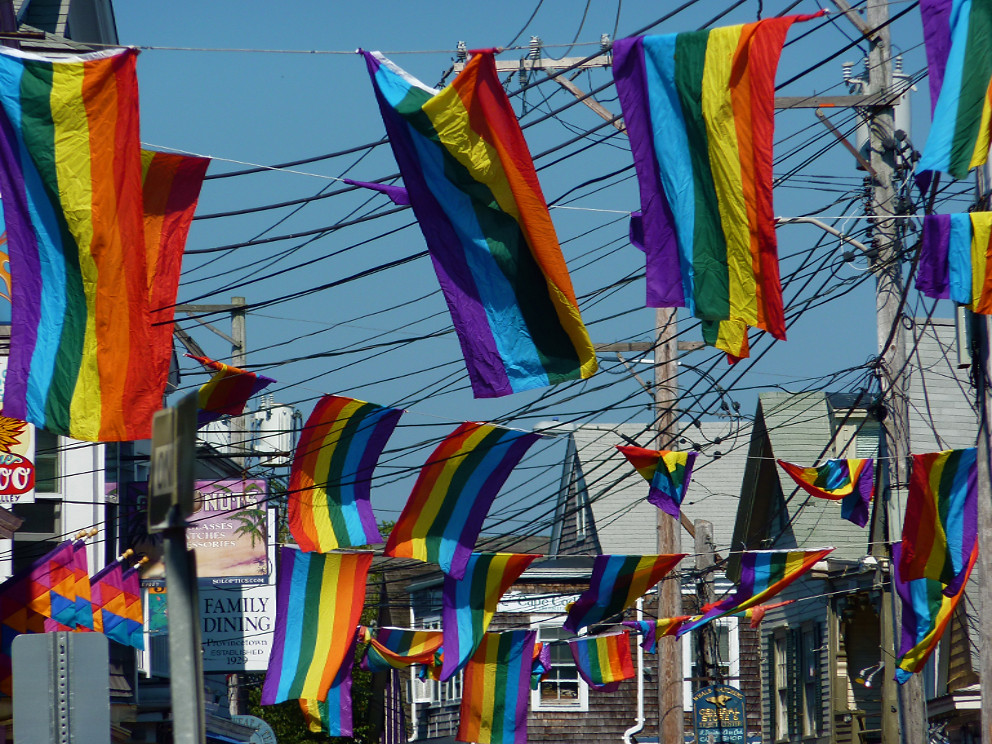
“Pride Flags, Commercial Street, Provincetown, Credit: Tim Grafft/MOTT” by Massachusetts Office of Travel & Tourism is licensed under CC BY-ND 2.0


I see the flag-shaggers are out in force. No, not working-class people who hang the Union flag from their living-room window as an expression of pride in their nation. I’m talking about the Pride flag. That omnipresent rainbow eyesore. A virtue-signal made cloth. The flag no one can escape. Yep, it’s Pride Month, which means that everywhere you go for the next four weeks – the bank, the supermarket, Maccy D’s – you’ll have this flag waved in your face to remind you not to be such a horrible, homophobic piece of shit. Happy Pride Month!
God, Pride has become annoying. It’s so gratingly ubiquitous. I haven’t seen this much smug flag-waving since 100,000 Guardian readers wrapped in the EU colours, tears streaking their blue-painted faces, descended on Whitehall to demand the cancellation of stupid northern people’s votes. And yet the people who cry “flag-shagger!” every time Keir Starmer stands stiffly next to the Union flag, or when Robert Jenrick goes on TV with a backdrop of showy British memorabilia, are curiously silent about the adorning of every building in the land with the bloody Pride flag.
You can’t move for rainbows right now. The Pride flag will flutter from town halls across the country. Some schools in Scotland will fly the flag for the whole month. I can’t be the only person who found the photo of school pupils wearing Pride face masks beneath a vast Pride flag somewhat chilling. It’s borderline cultish. Go to a cashpoint machine and you’ll be told about Pride. Coutts Bank on The Strand in London once painted its entire facade in the Pride colours. That was a very expensive way of saying: “We’re nice, I swear.”
Cops will wear Pride-coloured badges. They’ll do dad-dancing at Pride marches and everyone will go wild for it (except the Daily Mail probably). The army is getting in on the act. It is using Pride Month to showcase its British Army LGBT+ Network. If this doesn’t become a meme featuring someone in the Middle East saying “They say the next bombs will be dropped by people who believe in gay rights! Don’t you love progress!”, I will lose all faith in the internet. Even the Beano is flag-shagging. It posted a comic strip featuring Dennis the Menace in a Pride-coloured jumper. I preferred him when he was bullying Walter the Softy.
Snacks are propaganda now, too. Who can forget M&S’s Pride sandwich, which was basically a club sandwich with added guacamole (“Gays like guacamole, right?”). McDonald’s has created Rainbow-coloured boxes for its French fries, which was definitely one of the key demands of the radicals who took part in the Stonewall riot of 1969 that Pride is meant to commemorate. Skittles surely caused even Pride aficionados’ eyes to roll when they released limited-edition white versions of their sweets, because “we are giving up our rainbow to show support for the LGBTQ+ community”. (It is testament to the insanity of intersectionalism that the only complaint about this conceited act of corporate virtue-signalling was that the sweets were white.)
The Peloponnesian War
Epimetheus
Published 21 Oct 2018The Peloponnesian War (extended Video)
Support new videos from Epimetheus on Patreon! 😀
https://www.patreon.com/Epimetheus1776
From the comments:
Epimetheus
2 years ago (edited)
On Spartan society I left out the council of five ephors who were elected annually and shared power with the two kings. This video is a little less edited and recorded partially earlier this year and this evening — sorry if the audio sounds a little all over the place — but I thought some of you may enjoy a finished video rather than one that does not get released — let me know what you think of this longer less polished style of video in contrast to the shorter version of this videoI have increasingly committed to using most of my time on this channel writing researching editing drawing and narrating these videos by myself, I love doing it and would not like to go back to working full time in a cubicle (doing boring stuff) if you want to help me out with upgrading my software and equipment (I use a slow old computer and a tablet) you can do so on Patreon https://www.patreon.com/Epimetheus1776
Even if it is just a single dollar I greatly appreciate you taking the time and your generosity

Fallen Flag — the Central Railroad of New Jersey
 This month’s Classic Trains fallen flag feature is the Central Railroad of New Jersey (CNJ) by Peter Brill. The first of the two original lines that merged to become the CNJ was granted a charter as the Elizabethtown and Somerville Railroad to create a connection from Elizabeth, New Jersey to Somerville, including a ferry into New York City. The charter was dated 9 February, 1831 and the line was completed in 1842. The Somerville and Easton received a charter in 1847 to connect the existing Elizabethtown line to Easton, Pennsylvania and the new connecting line was leased by the Elizabethtown and Somerville in 1848 and then purchased outright in 1849. The combined railroads merged as the Central Railroad of New Jersey in February of that year.
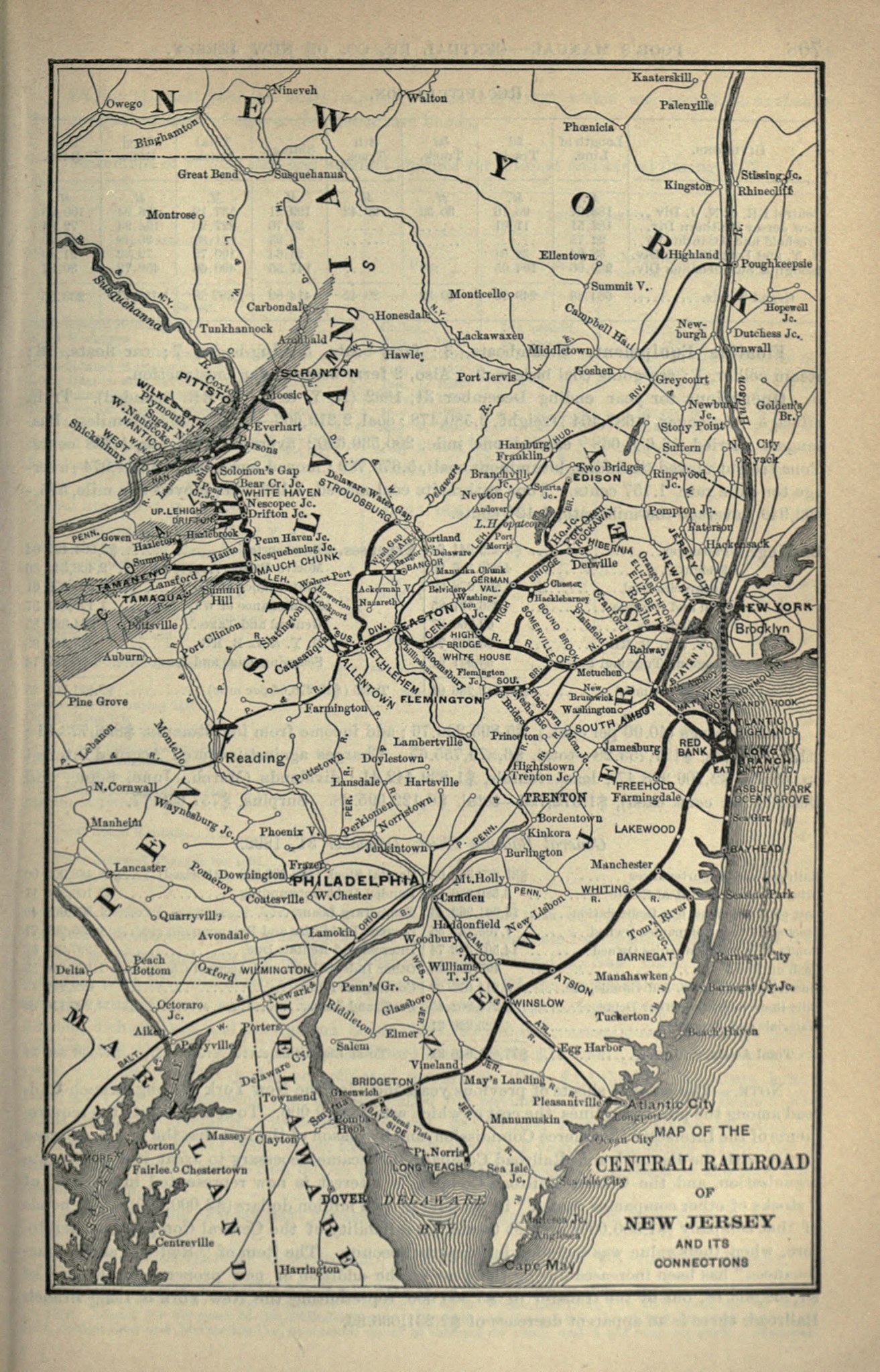
Map of the extent and connections of the Centrail Railroad of New Jersey in 1893.
Poor’s Manual of the Railroads of the United States via Wikimedia Commons.
Click to see full-size image.At its peak, the Central Railroad of New Jersey, the self-proclaimed “Big Little Railroad”, operated only about 700 route-miles, but in keeping with its densely populated region, totaled over 1,900 miles of track, two-thirds in New Jersey. CNJ’s Central Division extended from Jersey City to Phillipsburg, on the Delaware River. The Lehigh & Susquehanna Division (later Central Railroad of Pennsylvania, then the Penn Division) went west from Easton, Pa., to Allentown, then north to Wilkes-Barre and Scranton. The Southern Division, from Red Bank to Bridgeton/Bayside, was reached from Elizabethport via CNJ’s Perth Amboy Branch and the New York & Long Branch.
Although “little” in geographic span — it’s just 191 miles from Jersey City to Scranton — CNJ was “big” in traffic density. Between Jersey City and Raritan, 35 miles of commuter territory, four to six main tracks handled 300 daily commuter trains carrying 35,000 riders plus local freights, longer-distance passenger and freight trains, and, east of Bound Brook Junction, through Baltimore & Ohio/Reading traffic from Philadelphia and beyond.
[…]
CNJ’s evolution from tidewater connection to competing anthracite road coincided with LV [Lehigh Valley] and DL&W [Delaware, Lackawanna & Western] developing their own routes to New York Harbor. CNJ originally based its Pennsylvania operations in Mauch Chunk (now called Jim Thorpe). Narrow-gauge “lokies” worked the Wanamie Colliery on the Nanticoke Branch until 1967, and CNJ hauled the anthracite to Ashley’s Huber Breaker. In 1892, Central States Dispatch, a fast freight route on B&O, Western Maryland, RDG [Reading], CNJ, Lehigh & Hudson River, and New Haven, commenced via Allentown Yard.
In 1893, America’s first automatic, motor-operated semaphore signal was installed on CNJ at Black Dan’s Cut east of Phillipsburg. Installation of twin McMyler car dumpers at Pier 18 in Jersey City in 1919 created CNJ’s foremost destination for anthracite and bituminous coal into the 1960s. In 1925, what is regarded as America’s first successful commercial diesel locomotive, CNJ 1000, a 300 h.p. box-cab, began a 27-year assignment at Bronx Terminal. The bridge over Newark Bay was replaced in 1926 by a 1.4-mile, 4-track, 2-span, lift-type drawbridge. In the 1930s, one of the country’s most modern traffic control towers was installed at Elizabethport to control the convergence of the multi-track Central Division main with the Newark and Perth Amboy branches. E’port also hosted CNJ’s main shops.
Two Blue Comet consists, Packard blue with gold lettering and window bands of Jersey cream, in 1929 introduced luxury coach service at no extra charge between Jersey City and Atlantic City. Later that year, The Bullet debuted similar service between Jersey City and Wilkes-Barre. Specially painted Pacifics handled both: royal and Packard blue with gold striping and lettering for the Comet and dark olive with gold striping and chromium trim for The Bullet. The latter ran only two years, but the Comet lasted until 1941.
CNJ entered a 10-year bankruptcy in 1939 while controlled by the Reading, which in turn was controlled by B&O. During World War II, the German submarine menace diverted eastbound oil products from tanker to tank car, and CNJ delivered up to 1,000 loads a day, half the New York area’s requirement, until pipelines were built. In 1944 CNJ became “Jersey Central Lines” and adopted the Statue of Liberty emblem.
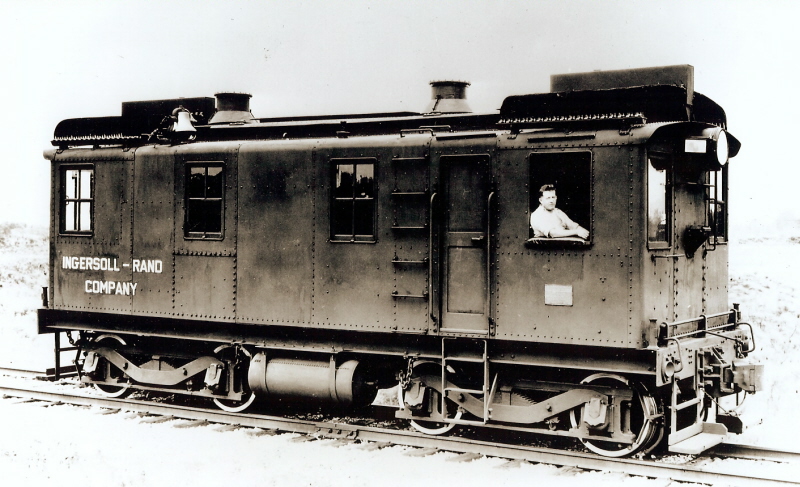
Builder’s photo of CNJ 1000, the first diesel-electric switch engine built by ALCO in conjunction with Westinghouse for the electrical equipment and Ingersoll-Rand for the prime mover. Built 1924 and sold to CNJ in 1928. This unit was retired from active service in 1957.
Wikimedia Commons.
Tank Chats #109 | Scorpion & TV15000 | The Tank Museum
The Tank Museum
Published 30 Oct 2020Join The Tank Museum’s Historian David Fletcher as he discusses the TV15000, the unique prototype of the FV101 Scorpion armoured reconnaissance vehicle. David examines its development and how it came to be the production Scorpion we know today.
(more…)
QotD: Handguns in the “Wild West”
In mid-late 19th Century America, walking around a town or city setting with a full-size horse pistol stuffed in your belt would be seen as eccentric as it would in similar surroundings today. Perhaps more so, since 19th Century Americans didn’t grow up watching old John Wayne and Clint Eastwood movies on cable. On the other hand, guns were everywhere.
“But wait, Tam!” you say, “I thought you just said people mostly didn’t walk around with the big iron on their hip!”
Well, generally they didn’t. First, a Colt’s M1873, the Peacemaker of Hollywood lore, went for around twenty bucks over most of the time period of the Old West. They made about 175,000 of them, including military contract guns, over that period. (Smith & Wesson, by comparison, made almost twice that many of the big No.3 top-breaks, for what it’s worth.)
Twenty bucks was a lot of dough, relatively speaking. About a tenth the cost of a good saddle horse and the equivalent of a pretty nice AR-15 these days. Since cowboys and miners around the various cowtowns and mining boomtowns were overwhelmingly young, single men with fairly low-overhead lifestyles, it wouldn’t be amiss to think of the Colt Peacemaker and well-saddled Quarter Horse in 1870s Dodge City as the equivalent of a Daniel Defense carbine and Ford Raptor in 2010s Midland-Odessa. I have no idea what the 19th Century equivalent of truck nuts was, and considering that male working horses are almost uniformly geldings, I’m not sure I want to.
Meanwhile, there were literal millions of .22, .32, .38, and .41 pocket guns, rimfires and centerfires, sold over the same period. Human nature hasn’t changed much over the years, and I didn’t see no metal detectors at that saloon in Tombstone. Most every person had a gun for pocket, purse, or nightstand and, probably like most gun owners today, carried it if they felt like they were “going someplace they might need it.”
Tamara Keel, “Mouseguns, Then and Now”, View From The Porch, 2021-02-21.
June 3, 2021
The Supernatural Adventures of Arthur Conan Doyle | B2W:ZEITGEIST! I E.19 Spring – 1923
TimeGhost History
Published 2 Jun 2021Being the creator of the legendary Sherlock Holmes has made Arthur Conan Doyle famous for his scientific rationality. But Doyle also has a deeply held belief in the existence of the spirit universe. In a world still reeling from the shock of the Great War, he is not alone.
(more…)
John McWhorter on Affirmative Action
In the latest post at It Bears Mentioning, John McWhorter outlines the history of Affirmative Action in American schooling and explains why it’s no longer doing anything useful and should be re-oriented to actually help disadvantaged students of all races:

John McWhorter’s Twitter thumbnail image
I do not oppose Affirmative Action. I simply think it should be based on disadvantage, not melanin. It made sense – logical as well as moral – to adjust standards in the wake of the implacable oppression of black people until the mid-1960s.
When Affirmative Action began in the 1960s, largely with black people in mind, the overlap between blackness and disadvantage was so large that the racialized intent of the policy made sense. Most black people lived at or below the poverty line. Being black and middle class was, as one used to term it, “fortunate”. Plus, black people suffered open discrimination regardless of socioeconomic status, in ways for more concrete than microaggressions and things only identifiable via Implicit Association Testing and the like. In a sense, black people were all in the same boat.
Luckily, Affirmative Action worked. By the 1980s, it was no longer unusual or “fortunate” to be black and middle class. I would argue that by that time, it was time to reevaluate the idea that anyone black should be admitted to schools with lowered standards. I think Affirmative Action today should be robustly practiced — but on the basis of socioeconomics.
A common objection is that this would help too many poor whites (as if that’s a bad thing?). But actually, brilliant and non-partisan persons have argued that basing preferences on socioeconomics would actually bring numbers of black people into the net that almost anyone would be satisfied with.
I’m no odd duck on my sense that Affirmative Action being about race had passed its sell-by date after about a generation. At this very time, it had become clear, to anyone really looking, that the black people benefitting from Affirmative Action were no longer mostly poor – as well as that simply plopping truly poor black people into college who had gone to awful schools had tended not to work out anyway. It was no accident that in 1978 came the Bakke decision, where Justice Lewis Powell inaugurated the new idea that Affirmative Action would serve to foster “diversity”, the idea being that diversity in the classroom made for better learning.
I highly suspect that most people have always had to make a slight mental adjustment to get comfortable with this idea, as standard as it now is in enlightened discussion. Do students in classes with a certain mixture of races learn better? Really? Not that there might not be benefits to students of different races being together for other reasons. But does diversity make for better learning? Has that been proven?
As you might expect, it has not – and in fact the idea has been disproven, again and again. No one will tell you this when the next round of opining on racial preferences comes about. But this doesn’t mean it isn’t true.
Should you hate sapwood?
Stumpy Nubs
Published 2 Mar 2021Hoity-toity woodworkers say don’t use sapwood. Do they have a point?
When you use this link to visit our sponsor, you support us►
Trend diamond stones: https://amzn.to/2XomWMi
(We may get a small commission if you use one of the above affiliate links.)Subscribe (free) to Stumpy Nubs Woodworking Journal e-Magazine► http://www.stumpynubs.com/
Follow us on social media►
Instagram: https://www.instagram.com/stumpynubs/
Twitter: https://twitter.com/StumpyNubs

QotD: Simon de Montfort
Simon de Montfort’s Good Idea
Simon de Montfort’s Idea was to make the Parliament more Representative by inviting one or two vergers, or vergesses, to come from every parish, thus causing the only Good Parliament in History. Simon de Montfort, though only a Frenchman, was thus a Good Thing, and is very notable as being the only good Baron in history. The other Barons were, of course, all wicked Barons. They had, however, many important duties under the Banorial system. These were:
- To be armed to the teeth.
- To extract from the Villein(*) Saccage and Soccage, tollage and tallage, pillage and ullage, and, in extreme cases, all other banorial amenities such as umbrage and porrage. (These may be collectively defined as the banorial rites of carnage and wreckage).
- To hasten the King’s death, deposition, insanity, etc., and make quite sure that there were always at least three false claimants to the throne.
- To resent the Attitude of the Church. (The Barons were secretly jealous of the Church, which they accused of encroaching on their rites — see p. 30, Age of Piety.)
- To keep up the Middle Ages.
(*) Villein: medieval term for agricultural labourer, usually suffering from scurvy, Black Death, etc.
W.C. Sellar & R.J. Yeatman, 1066 And All That, 1930.
June 2, 2021
How Hitler Manipulated Germany into Committing Genocide – WW2 Special
World War Two
Published 1 Jun 2021In the wrong hands, propaganda is a powerful tool that can trick whole countries into supporting a dictator, go to war, or even commit genocide.
(more…)
Media Fearmongering
Laura Dodsworth on how the BBC and other British media outlets turned all the dials to 11 to ramp up fear over the spread of the Wuhan Coronavirus:
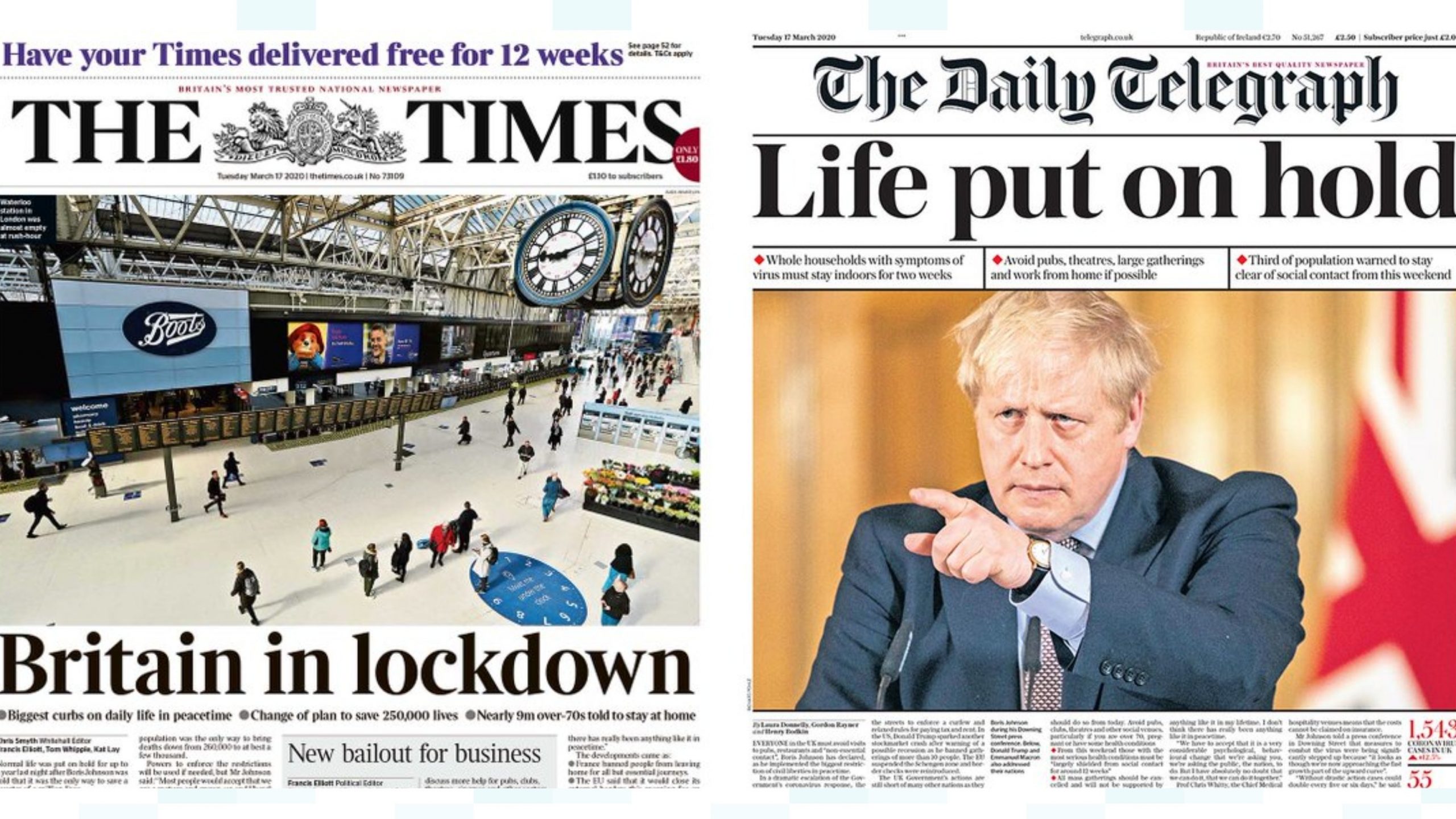
The media have served us a cornucopia of frightening articles and news items about Covid-19 in 2020 and 2021. While writing my new book, A State of Fear: How the UK Government Weaponised Fear During the Covid-19 Pandemic, I encountered a panoply of doom-mongering headlines. These were an indication of the significant role the media have played in creating our state of fear.
Of course, news media should not shy away from reporting frightening news during a pandemic. They should make us aware of the numbers of deaths, the policies being implemented to tackle the pandemic and the latest scientific developments. But during Covid, the media went beyond reporting on the pandemic. Instead, they appeared beholden to the old commercial imperatives, “If it scares, it airs”, and “If it bleeds, it leads”. It seems fear does sell.
The anxious, frightened climate this has helped to create has been suffocating. Death tolls were constantly brandished without the context of how many people die every day in the UK, and hospital admissions were reported while recoveries were not. As a result, Covid often appeared as a death sentence, an illness you did not recover from – even though it was known from the outset that Covid was a mild illness for the majority of people.
Given the wall-to-wall doom, it is therefore no surprise that the British were one of the most frightened populations in the world. Various studies showed that we were more concerned than other countries about the spread of Covid and less confident in the ability of our government to deal with it. One survey in July 2020 showed that the British public thought between six and seven per cent of the population had died from Covid – which was around 100 times the actual death rate at the time. Indeed, if six or seven per cent of Brits had died from Covid, that would have amounted to about 4,500,000 bodies – we’d have noticed, don’t you think?
While researching A State of Fear, I interviewed members of the general public about how they were impacted by the “campaign of fear” during the epidemic. Many talked of how the media had elevated their alarm.
“There wasn’t much to do”, Darren told me, “so we’d watch TV and we saw programmes about disinfecting your shopping when it arrives, and having a safezone in the kitchen. The nightly bulletins on the TV about death tolls, the big graphs with huge spikes on them, came at us ‘boom, boom, boom!’. It was a constant barrage of doom and gloom. My fear of the virus went through the roof.”
Sarah told me she had to stop watching the BBC. As her daughter put it, “If you just watched or listened to the BBC every day, what hope would you have had?”. Jane, meanwhile, described the “gruesome headlines” that came at her “thick and fast”.
The fearmongering about Covid began even before the pandemic hit the UK. We were primed by videos from Wuhan in China, which were then widely circulated by UK-based media outlets. These painted an apocalyptic picture, featuring collapsed citizens, medics in Hazmat suits, concerned bystanders and a city grinding to a halt. In one memorable video, which went viral, so to speak, a woman fell, stiff as a board, flat on her face, on a pavement. The split second where she falters is a giveaway – this was a set-up. If the rest of the world had Covid, China had “Stunt Covid”.
Prototype Ross “H5” from 1909
Forgotten Weapons
Published 22 Feb 2021http://www.patreon.com/ForgottenWeapons
https://www.floatplane.com/channel/Fo…
Cool Forgotten Weapons merch! http://shop.bbtv.com/collections/forg…
The Ross MkII (aka Ross 1905) was a reasonably successful rifle design, but it lacked a few elements that the Canadian military would have preferred. Most significantly, it was not compatible with the charger clip that was introduced for the Lee Enfield rifles in 1907. The rifle we have today is a toolroom prototype Ross from about 1909 that was an experiment in adding clip compatibility. The receiver is a 1905/MkII type, but with a combination stripper clip guide and rear sight screwed onto the rear of the action. It has a 5-round staggered Mauser-type magazine box, a Lee Enfield style buttstock, a 1903 Springfield type bolt stop, and a thinner profile barrel than either the MkII or eventual MkII Ross patterns. The only marking on the rifle is the designation “H5” on the receiver and bolt. Ultimately, virtually none of this rifle’s unique features were included in the finalized MkIII Ross.
Contact:
Forgotten Weapons
6281 N. Oracle #36270
Tucson, AZ 85740

QotD: The evolution of theory-of-mind
All this seems so obvious to most people that it sounds like common sense rather than theory. It isn’t; it has to be learned. Very young children don’t start out with theory of mind. They can’t separate themselves from their emotions; it’s not natural for them to say “I’m really angry now, but that’s just a thing I’m feeling, I don’t actually hate you”. It’s not even clear to them that people’s minds contain different things; children are famously unable to figure out that a playmate who has different evidence than they do may draw different conclusions.
And the learning isn’t just a process of passively sitting back observing your own mind until you figure out how it works. You learn it from your parents. Parents are always telling their kids that “I think this” and “What do you think?” and “You look sad” and “It makes me feel sad when you do that”. Eventually it all sinks in. Kids learn their parent’s theory-of-mind the same way they learn their parents’ language or religion.
When in human history did theory-of-mind first arise? It couldn’t have been a single invention – more like a gradual process of refinement. “The unconscious” only really entered our theory-of-mind with Freud. Statements like “my abuse gave me a lot of baggage that I’m still working through” involves a theory-of-mind that would have been incomprehensible a few centuries ago. It’s like “I’m clicking on an icon with my mouse” – every individual word would have made sense, but the gestalt would be nonsensical.
Still, everyone always assumes that the absolute basics – mind as a metaphorical space containing beliefs and emotions, people having thoughts and making decisions – must go back so far that their origins are lost in the mists of time, attributable only to nameless ape-men.
Scott Alexander, “Book Review: Origin Of Consciousness In The Breakdown Of The Bicameral Mind”, Slate Star Codex, 2020-06-01.
June 1, 2021
What Orwell wrote about in The Road to Wigan Pier applies just as well to the modern Labour Party
David Starkey points out that while the best contemporary analysis of the collapse of the Labour vote may come from Rod Liddle, he is in many ways just echoing the words of George Orwell in The Road To Wigan Pier:
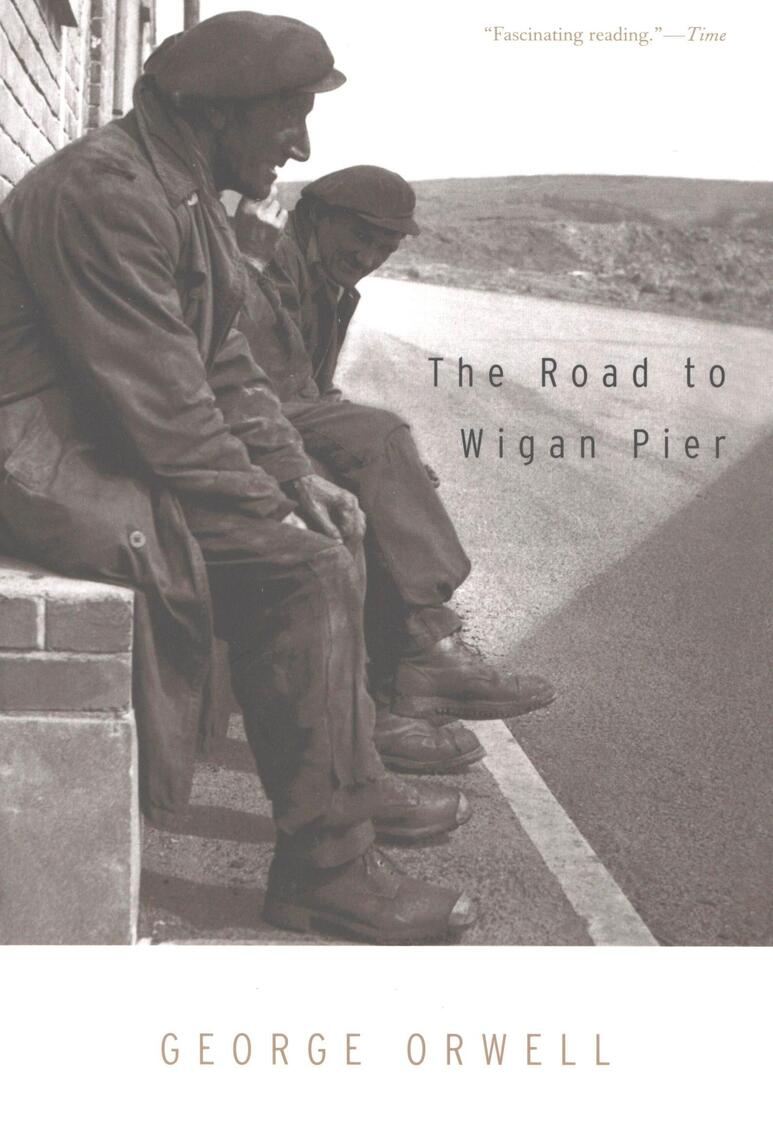
“The first thing that must strike any outside observer,” Orwell’s analysis begins, “is that Socialism in its developed form is a theory confined entirely to the middle classes.” “The typical Socialist is not”, he explains, “a ferocious-looking working man with greasy overalls and a raucous voice. He is either a youthful snob-Bolshevik … or, still more typically, a prim little man with a white-collar job … [and] a social position which he has no intention of forfeiting.”
He — and even more it must be said she — is also likely to be odd. Here Orwell is unsparing. And spot on. “There is,” Orwell declares, “the horrible — the really disquieting — prevalence of cranks wherever Socialists are gathered together.” “One sometimes get the impression,” he continues, “that the mere words ‘Socialism’ and ‘Communism’ draw towards them with magnetic force every fruit-juice drinker, nudist, sandal-wearer, sex-maniac, Quaker, ‘Nature Cure’ quack, pacifist, and feminist in England.”
Oh and vegetarians. And beards. And “high-minded women”. And homosexuals, like the two “dreadful-looking old men”, clad “in pistachio-coloured shirts and khaki shorts into which their huge bottoms were crammed so tightly that you could study every dimple”, whom Orwell encountered on a bus in Letchworth. And so — effortlessly out-Liddling Liddle — on.
Above all, Orwell identified the same disdain for the working class. “Are these mingy little beasts,” he reflected after attending one Socialist conventicle, “the champions of the working class?”
“For every person there”, he recalled, “bore the worst stigmata of snobbish middle-class superiority. If a real working man, a miner dirty from the pit, for instance, had suddenly walked into their midst, they would have been embarrassed, angry and disgusted; some, I should think, would have fled holding their noses”.
“The truth is,” Orwell concludes, “that to many people calling themselves Socialists, revolution does not mean a movement of the masses with which they hope to associate themselves; it means a set of reforms which ‘we’, the clever ones, are going to impose upon ‘them’, the Lower Orders.”
But Orwell was writing in 1937. Not 2021. So how on earth did the Labour party, with even then such a freakish, repellent cadre at its core, survive and thrive as the great mass movement that, for a time, it became and whose passing Liddle laments?


