
Theory-of-mind is our intuitive model of how the mind works. It has no relation to intellectual theories about how the mind is made of cognitive algorithms or instantiated on neurons in the brain. Every schoolchild has a theory-of-mind. It usually goes like this: the mind is an imaginary space containing things like thoughts, emotions, and desires. I have mine and you have yours. I can see what’s inside my mind, but not what’s inside your mind, and vice versa. I mostly choose the things that are in my mind at any given time: I will thoughts to happen, and they happen; I will myself to make a decision, and it gets made. This needs a resource called willpower; if I don’t have enough willpower, sometimes the things that happen in my mind aren’t the ones I want. When important things happen, sometimes my mind gets strong emotions; this is natural, but I need to use lots of willpower to make sure I don’t get overwhelmed by them and make bad decisions.
All this seems so obvious to most people that it sounds like common sense rather than theory. It isn’t; it has to be learned. Very young children don’t start out with theory of mind. They can’t separate themselves from their emotions; it’s not natural for them to say “I’m really angry now, but that’s just a thing I’m feeling, I don’t actually hate you”. It’s not even clear to them that people’s minds contain different things; children are famously unable to figure out that a playmate who has different evidence than they do may draw different conclusions.
And the learning isn’t just a process of passively sitting back observing your own mind until you figure out how it works. You learn it from your parents. Parents are always telling their kids that “I think this” and “What do you think?” and “You look sad” and “It makes me feel sad when you do that”. Eventually it all sinks in. Kids learn their parent’s theory-of-mind the same way they learn their parents’ language or religion.
When in human history did theory-of-mind first arise? It couldn’t have been a single invention – more like a gradual process of refinement. “The unconscious” only really entered our theory-of-mind with Freud. Statements like “my abuse gave me a lot of baggage that I’m still working through” involves a theory-of-mind that would have been incomprehensible a few centuries ago. It’s like “I’m clicking on an icon with my mouse” – every individual word would have made sense, but the gestalt would be nonsensical.
Still, everyone always assumes that the absolute basics – mind as a metaphorical space containing beliefs and emotions, people having thoughts and making decisions – must go back so far that their origins are lost in the mists of time, attributable only to nameless ape-men.
Scott Alexander, “Book Review: Origin Of Consciousness In The Breakdown Of The Bicameral Mind”, Slate Star Codex, 2020-06-01.
June 2, 2021
QotD: The evolution of theory-of-mind
June 1, 2021
What Orwell wrote about in The Road to Wigan Pier applies just as well to the modern Labour Party
David Starkey points out that while the best contemporary analysis of the collapse of the Labour vote may come from Rod Liddle, he is in many ways just echoing the words of George Orwell in The Road To Wigan Pier:
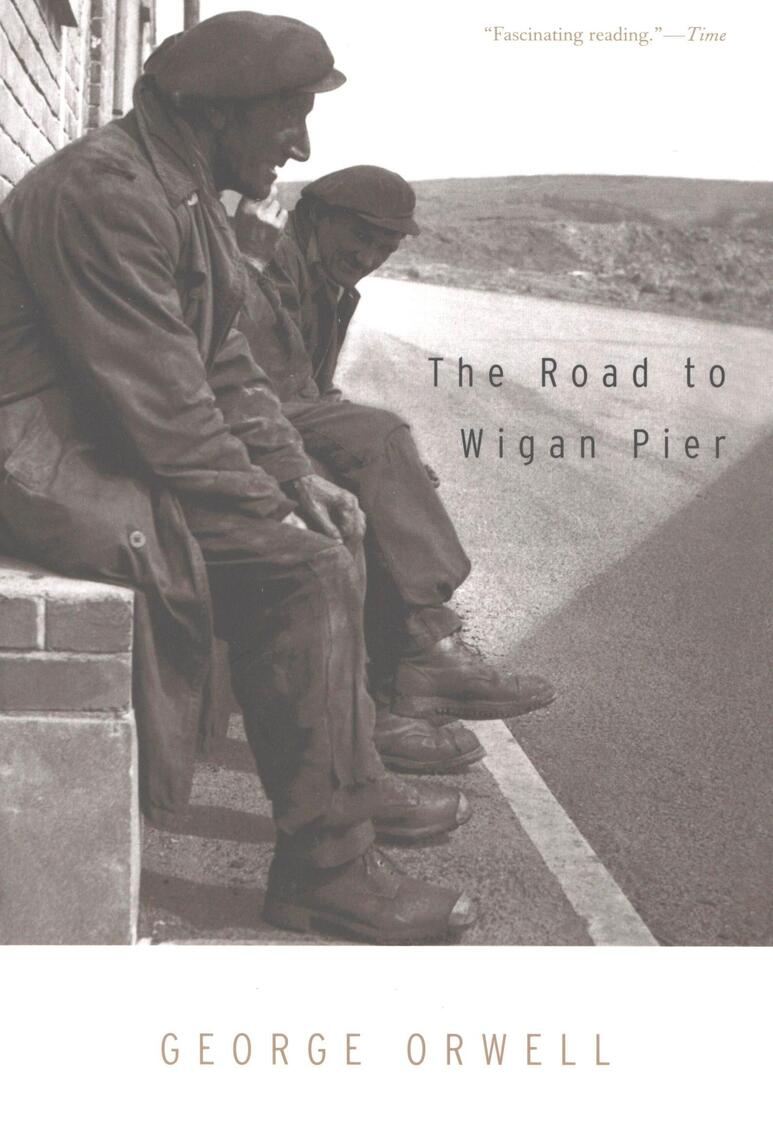
“The first thing that must strike any outside observer,” Orwell’s analysis begins, “is that Socialism in its developed form is a theory confined entirely to the middle classes.” “The typical Socialist is not”, he explains, “a ferocious-looking working man with greasy overalls and a raucous voice. He is either a youthful snob-Bolshevik … or, still more typically, a prim little man with a white-collar job … [and] a social position which he has no intention of forfeiting.”
He — and even more it must be said she — is also likely to be odd. Here Orwell is unsparing. And spot on. “There is,” Orwell declares, “the horrible — the really disquieting — prevalence of cranks wherever Socialists are gathered together.” “One sometimes get the impression,” he continues, “that the mere words ‘Socialism’ and ‘Communism’ draw towards them with magnetic force every fruit-juice drinker, nudist, sandal-wearer, sex-maniac, Quaker, ‘Nature Cure’ quack, pacifist, and feminist in England.”
Oh and vegetarians. And beards. And “high-minded women”. And homosexuals, like the two “dreadful-looking old men”, clad “in pistachio-coloured shirts and khaki shorts into which their huge bottoms were crammed so tightly that you could study every dimple”, whom Orwell encountered on a bus in Letchworth. And so — effortlessly out-Liddling Liddle — on.
Above all, Orwell identified the same disdain for the working class. “Are these mingy little beasts,” he reflected after attending one Socialist conventicle, “the champions of the working class?”
“For every person there”, he recalled, “bore the worst stigmata of snobbish middle-class superiority. If a real working man, a miner dirty from the pit, for instance, had suddenly walked into their midst, they would have been embarrassed, angry and disgusted; some, I should think, would have fled holding their noses”.
“The truth is,” Orwell concludes, “that to many people calling themselves Socialists, revolution does not mean a movement of the masses with which they hope to associate themselves; it means a set of reforms which ‘we’, the clever ones, are going to impose upon ‘them’, the Lower Orders.”
But Orwell was writing in 1937. Not 2021. So how on earth did the Labour party, with even then such a freakish, repellent cadre at its core, survive and thrive as the great mass movement that, for a time, it became and whose passing Liddle laments?
Rise and Fall of the Sikh Empire explained in less than 7 minutes
Epimetheus
Published 8 Oct 2019Rise and Fall of the Sikh Empire explained in less than 7 minutes Sikh history documentary
This video covers Sikh history from the Guru Nanak till the fall of the Sikh Empire.
This video and others like it are sponsored by my Patrons over on patreon.
https://www.patreon.com/Epimetheus1776
Undoing Dr. Beeching’s cuts
In The Critic, Brice Stratford looks at the British government’s “nationalization if necessary, but not necessarily nationalization” scheme to once again reform Britain’s passenger railway network:
Astonishing scenes this week, whereby the Tory government announces a White Paper to re-nationalise the railways. The union bosses and Guardianistas who have called for such policy for decades immediately decided that actually it’s a terrible idea, or that this doesn’t count as re-nationalising because it’s the Conservatives doing it, or that calling the new entity “Great British Railways” just because it will run Great Britain’s railways is so offensive that the entire project should be called off. It’s all very tribal, and very silly, and very 2021, alas.
Of course, the Department for Transport (DfT) is still afraid of admitting that this is in fact renationalisation, as to do so would be to rile up certain elements of the Right, and to admit what we all know: that their generations-long experiment in railway privatisation has been a failure. Today we have a service which is overpriced, unreliable, and generally an unpleasant and ineffective experience from start to finish.
The postwar Labour government included railway nationalization in its many, many reforms to the economic life of Britain and in 1948 the remaining railway systems were unified as British Railways. By the 1960s, the system was losing money at a high rate of speed, so Dr. Beeching was called upon to recommend how to put the railway if not into profit then at least into a much more acceptable rate of loss:
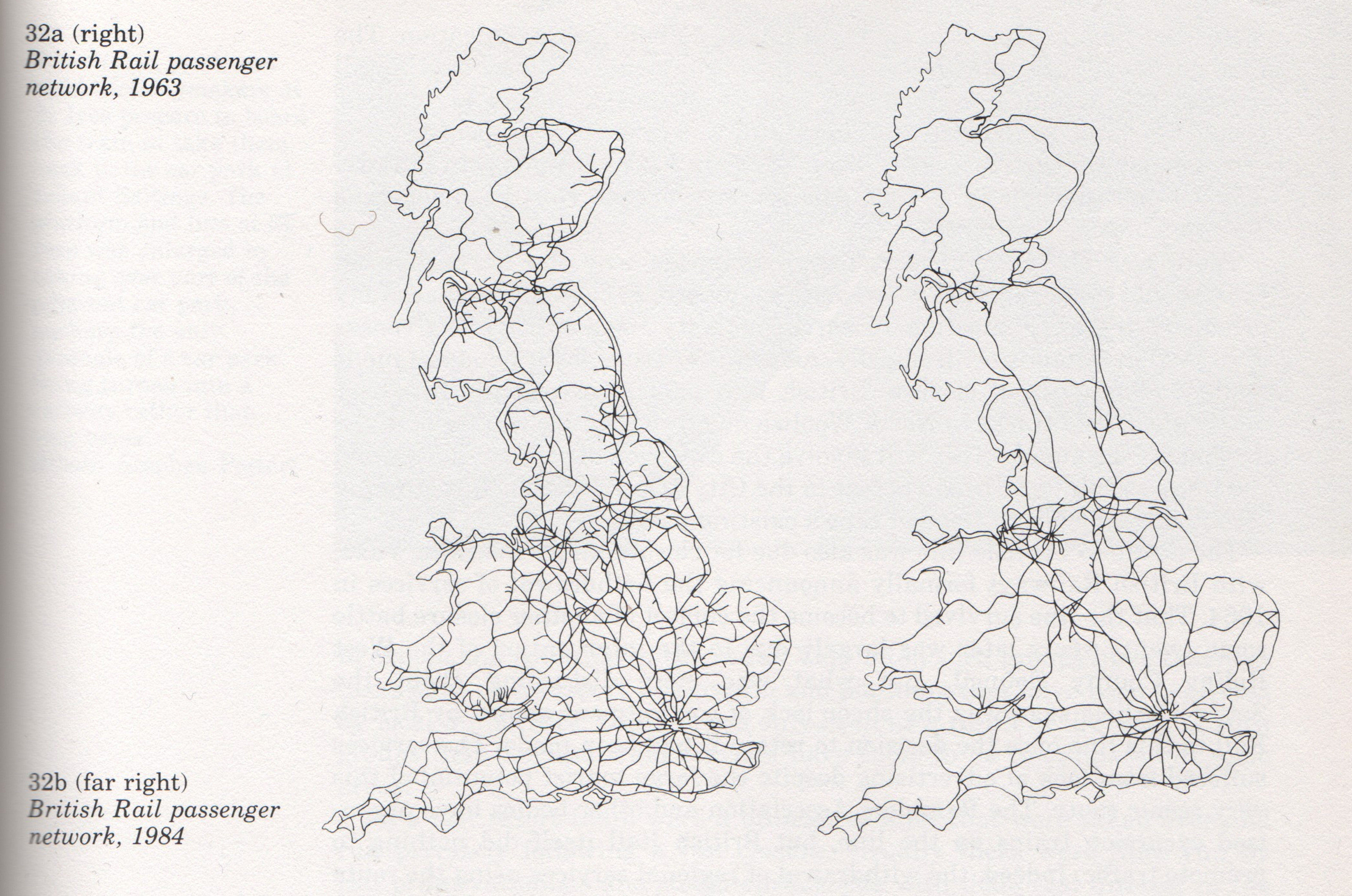
Maps originally from Losing Track by Kerry Hamilton and Stephen Potter (1985), by way of Is Your Journey Really Necessary?, 2012-12-31.
https://isyourjourneyreallynecessary.wordpress.com/2012/12/31/nice-work-if-you-can-get-there/
Click map to enlarge.
The aim of the Beeching cuts, which followed on from a pair of reports written by Dr Richard Beeching in 1963 and 1965 for the British Railway Board (of which he was Chair), was to turn the loss-making British railways network into a profitable enterprise. Prioritising this profitability over all else, he proposed axing about a third of Britain’s then 7000 railway stations, removing passenger service from around 5000 route miles, and cutting 70,000 jobs over three years. The moves were highly controversial, and though they certainly saved money, the social consequences were extensive and the scars remain visible today.
As a consequence of the cuts, Britain became over-reliant on car travel, and over the 1970s and 80s town planners gutted the experientially human-scale city centres in service of this newly favoured road transport. We still very much feel the consequences of the Beeching axe today, whereby a rail journey between neighbouring cities is often only possible by zigzagging up to London and back down again, and public transport between rural communities is limited to one bus service every hour or two in the morning and mid-afternoon, which crawls along at a testudinian pace, further isolating and atrophying the scattered settlements that once were happy, thriving homes.
The Avengers – Must See TV
Billy Rees
Published 19 Aug 2015ITV programme from 2005 presented by Joan Collins.
QotD: The evolutionary origin of male aggressiveness
Were we humans the entirely separate creations, quite unlike mere animals, that old-school Christians used to say we were, then for our minds to be entirely different from those of animals might make more sense. As it is, given that we are products of the same evolutionary process that made all the others animals, the “blank slate” notion of the human mind makes no sense at all.
One thing I did — not “learn” exactly — but hear for the first time from a scientist of human evolution, concerned the aggressiveness of the human male. Many human masculine characteristics have evolved not so much because human females like them, but more because other human males are intimidated by them. Males who defeat other males in competition achieve high status, and high status and the resources that accompany it are what human females especially like, rather than necessarily liking the particular characteristics that achieve that high status. Male aggressive characteristics are, metaphorically speaking, deer antlers more than they are peacock tails. They are at least as much for making human males into top dogs, so to speak, as they are for directly impressing the ladies. I can’t help noticing that some human females are impressed, directly, by male aggression. They like to watch men fighting, for instance. But others are very put off by such behaviour, and especially, of course, if it is ever directed against them.
Brian Micklethwait, “What Steve Stewart-Williams said”, Brian Micklethwait’s New Blog, 2021-02-26.
May 31, 2021
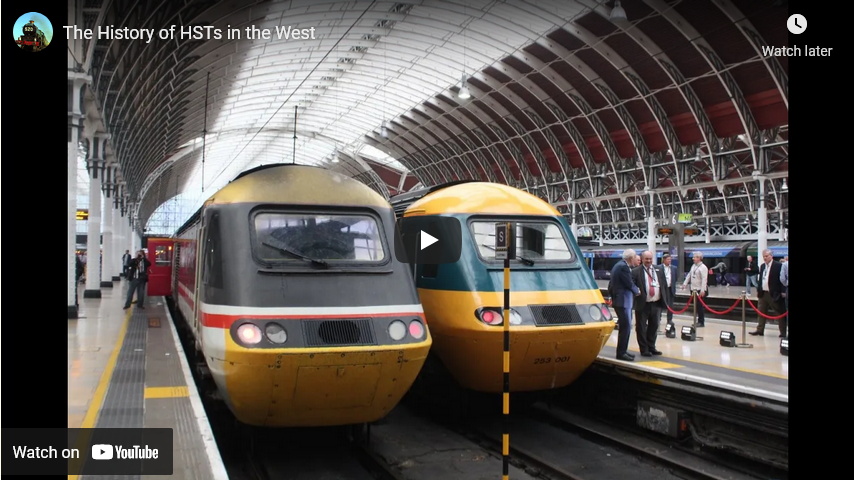
The History of HSTs in the West
Ruairidh MacVeigh
Published 29 May 2021Hello again! 😀
With the recent withdrawal of the last HST operations into London, I wanted to make a series of videos chronicling the history of these mighty trains in terms of their years of each region they were assigned to, the Great Western, East Coast, Midland, West Coast and Cross Country Routes.
With that in mind, we start with the first of the BR Regions to employ the venerable HST, but also the first to withdraw them from long distance services, the Great Western, a line that, since its inception under the auspices of Brunel, has played host to many different types of trains, but none have had greater impact that the superb HSTs.
All video content and images in this production have been provided with permission wherever possible. While I endeavour to ensure that all accreditations properly name the original creator, some of my sources do not list them as they are usually provided by other, unrelated YouTubers. Therefore, if I have mistakenly put the accreditation of “Unknown”, and you are aware of the original creator, please send me a personal message at my Gmail (this is more effective than comments as I am often unable to read all of them): rorymacveigh@gmail.com
The views and opinions expressed in this video are my personal appraisal and are not the views and opinions of any of these individuals or bodies who have kindly supplied me with footage and images.
If you enjoyed this video, why not leave a like, and consider subscribing for more great content coming soon.
Thanks again, everyone, and enjoy! 😀
References:
– 125Group (and their respective sources)
– Wikipedia (and its respective references)
“For four generations our culture and education has been in the hands of an unholy hybrid of Marxism and Rousseau’s Romanticism”
In the most recent edition of the Libertarian Enterprise, Sarah Hoyt regrets not learning some traditional — manual — skills when she was younger, and how children today are even worse served by the education system:

… there are are other things. I mean, husband and I to an extent were thrown in to the world with no clue how to do the most basic things, like home maintenance or how to clean with proper products, how to take care of clothes, how to do anything with our savings other than let it sit in the bank, how to organize and sort files and records. It goes on. (I do still tend to use bleach for most things. It’s cheap. I have at least learned what it will damage.) Our first ten years of marriage would make a good sitcom, as they had a repeating pattern: figure out we need to do something; extrapolate how it can be done; invest untold amount of time and effort into doing thing; find out after that it can be done in a simpler and cheaper way. And then people wonder why I curse.
And so many times, we just come up on something that must be done — even now — and have no clue how to get to the place where we can even think about how to do it. Teaching the kids what we never learned has been fun, too.
Heck, even in my religion — and I taught it was a young woman — I keep coming across these massive gaps where no one ever taught me what to do or why. As for the education my kids got: pfui.
In the same way, I’ve spent most of my adult life learning history, grammar, natural science and the basics of things that I supposedly learned the advanced form for with my degree, but without anyone ever teaching me the fundamentals.
Kind of like part of my degree is the study of literature but until I read Dwight Swain’s Techniques of the Selling Writer I’d never realized that books are composed of conflict and reaction units. (No, not physical conflict, though heck, you could sell that.) Instead I tried to fit them into the structure of plays and wondered why it wasn’t working.
Because no one had ever taught me the basics. I mean, I knew how to do a lot of advanced things, even as a beginning writer. I just had no clue how to do the basic things. And it showed.
For four generations our culture and education has been in the hands of an unholy hybrid of Marxism and Rousseau’s Romanticism. (The two are related in that both believe that natural man left to his own devices creates paradise.)
I can understand how those scarred by the long war of the 20th century would decide that they were going to ditch all the evil bad things in civilization and let the children grow up “naturally” so they would be sweet and innocent angels. (Spit.) I understand but I don’t forgive. If they thought what they saw in the war was the result of Western Civilization, they’d never studied other civilizations or for that matter hid in a playground and watched the children be “natural”.
Then the cascade started. People who only half learned could only half teach. On top of which the doubts instilled in them about the purpose of civilization made them teach less than half. And the next generation knew less. And then less.
More than once, as an inquisitive student, I’d go to my teacher and ask why something worked the way it did or didn’t work the way they said, only to be given a glib explanation I knew was wrong. I must have been 11 the first time I realized the teacher had no more clue than I did. (This was a good thing. It set me on a path of researching and investigating on my own.)
By the time my kids were in school it had become more so, partly because to justify themselves, and abate the feeling they were incompetent, people derived entire theories on why they shouldn’t learn the basics, learning the basics was bad, and you could be so much better by learning naturally.
I don’t have enough words to revile the “immersion” method of language learning, particularly was applied in our schools. Yes, sure “but the military used it” – yeah, but the military could enforce LIVING in the language. It also — which seems to elude most people — does teach people grammar and vocabulary in formal classroom settings.
[…]
Part of the unlearning are people who never learned enough to realize what works and what doesn’t trying to do things in ways that only work for a very few highly gifted individuals. That’s how we got whole word, new math, total immersion, whateverthehelltheyretryingnow all of which involved “less work for teachers” and the vague hope that unschooled children, or children who learned “naturally” were just somehow “better”.
Kind of like what would happen if I decided my digit dyslexic, half-baked way with wood meant my making, say, a table that was lopsided and wobbly made the table better and more authentic.
When to use Bevel up or Bevel Down with a Chisel | Paul Sellers
Paul Sellers
Published 23 Feb 2021Bevel up or bevel down chisel work? This question comes up often because for some reason, mainly from school woodworking, kids are taught to remove waste from a housing dado, recess, or other using only the bevel down. In reality, however, we need to be ready to use both or one or the other at different times. I hope that this video will help to show alternative ways and also show just how very versatile the chisel is for various applications.
——————–
Want to learn more about woodworking?
Go to Woodworking Masterclasses for weekly project episodes: http://bit.ly/2JeH3a9
Go to Common Woodworking for step-by-step beginner guides and courses: http://bit.ly/35VQV2o
http://bit.ly/2BXmuei for Paul’s latest ventures on his blog
——————–
Instagram: http://bit.ly/2oWpy7W
Twitter: http://bit.ly/33S7RFa
Pinterest: http://bit.ly/35X5uTf

QotD: Contemporary architecture hates you
Another thing you will often hear from design-school types is that contemporary architecture is honest. It doesn’t rely on the forms and usages of the past, and it is not interested in coddling you and your dumb feelings. Wake up, sheeple! Your boss hates you, and your bloodsucking landlord too, and your government fully intends to grind you between its gears. That’s the world we live in! Get used to it! Fans of Brutalism — the blocky-industrial-concrete school of architecture — are quick to emphasize that these buildings tell it like it is, as if this somehow excused the fact that they look, at best, dreary, and, at worst, like the headquarters of some kind of post-apocalyptic totalitarian dictatorship.
Brianna Rennix and Nathan J. Robinson, “Why You Hate Contemporary Architecture”, Current Affairs, 2017-10-31.
May 30, 2021
New frontiers in cultural appropriation
John McWhorter considers the notion that white people shouldn’t be allowed to use “black” words and phrases because it’s a form of cultural appropriation and therefore another aspect of white supremacy:

Screencap from NBC’s Saturday Night Live highlights for “Gen-Z Hospital” skit.
A little while ago, a Saturday Night Live skit depicted a multiracial group of teens communicating in what was depicted as “Gen Z slang”, with the doctor they were talking with having to “translate” his thoughts into it to communicate with them.
A lot of people didn’t like it, because the slang in question was mostly of Black English origin. The complaint is that the skit was denying the black roots of these terms, and instead ascribing them to Americans in general – i.e. (shudder) white persons. As in, yes – the problem was cultural appropriation.
As I write, there are still people grousing on social media in the wake of that skit about whites “stealing” black language, with a leitmotif being that we should apply our N-word taboo more widely. To wit, many propose that whites should not be allowed to use Black English terms because they are “ours”. Many who haven’t outright proposed this give the notion Likes, which suggests that a considerable group of people – and from what I can see, quite a few of them are white – concur with this line of reasoning.
Let’s break this down. To do so we must understand the sorts of terms in question. The SNL skit included, among others, yo, bestie, vibes, feels for feelings, salty for irritated, bro / bruh and no cap for “I’m not kidding” (as in, these are actual whole gold teeth, not golden caps on teeth).
Is there a case that you should only use these terms if you’re black, or that if you use them as a white person you should “do the work” of thinking hard about whether or not it is problematic (blasphemous)?
Rommel’s Desert Dash – The Whole Bloody Afrika Korps! – Gazala – WW2 – 144 – May 30, 1942
World War Two
Published 29 May 2021Erwin Rommel begins his surprise new offensive with “Rommel’s Moonlight Ride”, bringing all of his mighty mobile units to the fray in North Africa, while in the Pacific, dozens of warships and tens of thousands of men set sail from Japan — their mission? Attack the Aleutian Islands and Midway Island, but above all, destroy the US Pacific Fleet!
(more…)
The Stanford Prison “Experiment”
In another of the anonymous book reviews at Scott Alexander’s Astral Codex Ten, a look at the infamous Stanford Prison Experiment:
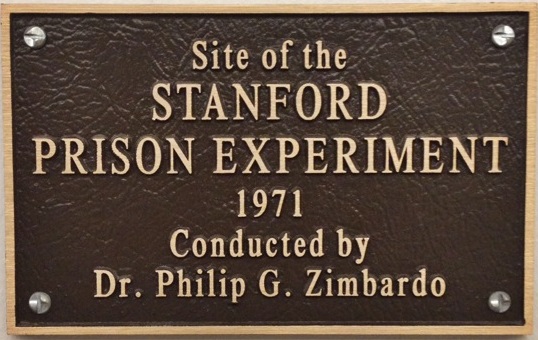
The second most famous psychology experiment in history is the Stanford Prison experiment. Philip Zimbardo split a group of undergrads at random into prisoners and guards. The guards were left free to choose how they would manage the prisoners, and within days the whole thing had to be called off as it had descended into a sadistic torture camp. At least that’s how Zimbardo has described it for the last 50 years. In fact, everything I just said is completely false. The undergrads were not split at random — the scheme had actually been dreamt up by an undergrad called David Jaffe who had run a previous experiment himself on abusing prisoners in a fake jail. He was carefully placed into the guards group. Nor were the guards left to choose their methods, instead they were briefed by Zimbardo and Jaffe that the purpose of the experiment (for which they were being well renumerated) was to see how people cracked under pressure. The experiment would be a failure unless they could put the prisoners under terrible stress. Even Douglas Korpi’s prisoner breakdown on day two, which, captured on camera, became the cinematic face of the experiment, was a fake he put on after discovering he wouldn’t be able to spend the time in jail revising, and being told he would only be allowed to quit if he suffered some sort of serious mental or physical breakdown.
Despite the pressure from Zimbardo and Jaffe, two thirds of the guards refused to take part in sadistic games, and much to their frustration a third continued to treat the prisoners with kindness. Nonetheless when Zimbardo came to write up the experiment about the effects on the prisoners, he realised it would be a much more compelling story if he turned it on its head, and made it about the guards instead. The truth of guards carefully drilled to be sadistic was swept away with a lie of ordinary people spontaneously becoming cruel when dressed in a uniform and given a position of power.
For years no one replicated the experiment — given the results first time round it was thought unethical, but in 2001 the BBC in search of new reality television commissioned a repeat (turns out reality television runs to different ethics than the average psychology department). Now unlike normal reality TV they didn’t bother manipulating the participants to be at each other’s throats — there was no need, in days it was going to be a bloodbath.
The result is the four most boring hours of television ever recorded. Nothing happens. The guards sit around chatting. When tensions arise with the prisoners, they defuse them by talking to them nicely. On day 6 some prisoners escaped. They headed over to the guards’ canteen and all had a smoke together. On day 7 they voted in favour of turning the whole thing into a commune.
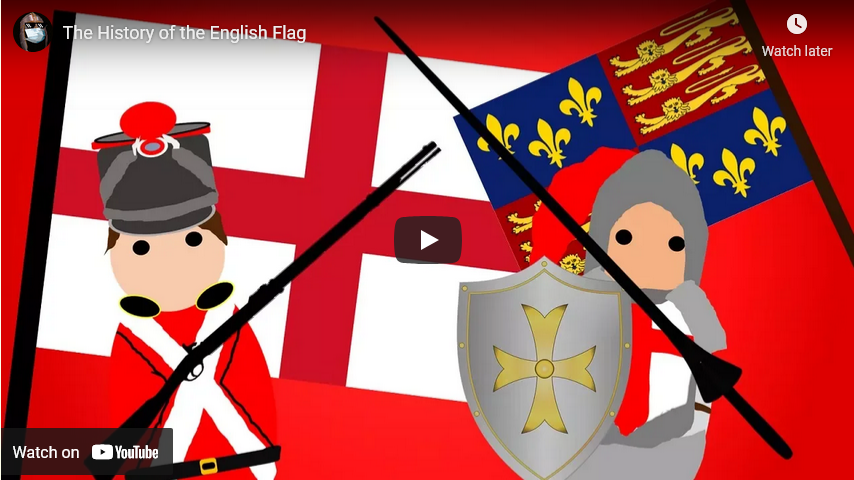
The History of the English Flag
History With Hilbert
Published 13 Apr 2018Most people know that the Union Flag (sometimes incorrectly called the Union Jack by normies) is made up of the various flags of the United Kingdom combining things like the Scottish Saltire and the English Saint George’s Cross. But what is the history behind these symbols and why were they adopted by these nations, and what is more, why these flags, and what about the competitors who if history had been different might have come to symbolise these nations. In today’s episode, I’m going to explore the history and symbolism behind England’s flag, the Saint George’s Cross, as well as the other banners that were once seen as being representative of the English people.
Music Used:
“Sneaky Snitch” – Kevin MacLeod
“Pippin the Hunchback” – Kevin MacLeod
“Angevin” – Kevin MacLeod
“Gregorian Chant” – Kevin MacLeod
“Ever Mindful” – Kevin MacLeod
“Ever Mindful” – Kevin MacLeod (incompetech.com)
Licensed under Creative Commons: By Attribution 3.0 LicenseAll images are from the Public Domain of Wikimedia Commons and Pixabay.
QotD: Pornography
Jesse Walker, “Guess Who’s Coming: Progress at the cineplex”, Reason, 2005-03-28.


