The Great War
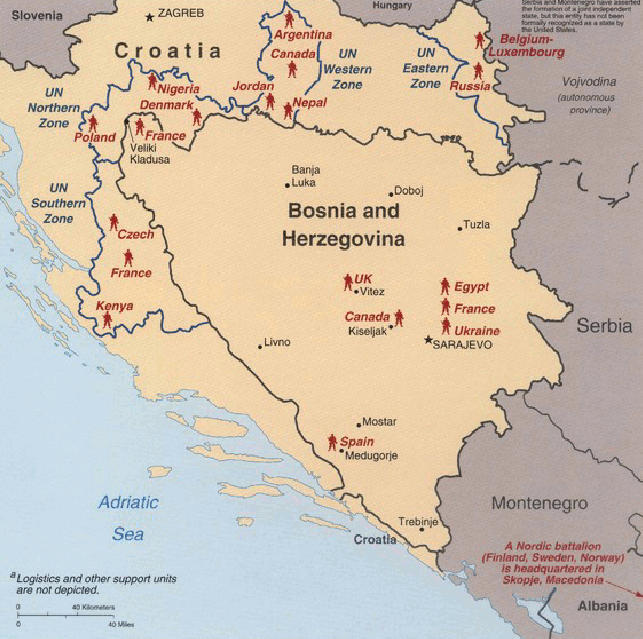
Published 7 Oct 2022The Balkan Wars marked the end of Ottoman rule in Southeastern Europe, and they involved several countries that would join the First World War just a few years later. A complicated alliance between Serbia, Montenegro, Bulgaria and Greece imploded over disagreement of the war spoils after defeating the Ottomans. This led to the 2nd Balkan War and also created much resentment that would play a role between 1914 and 1918 too.
(more…)
October 8, 2022
Prelude to WW1 – The Balkan Wars 1912-1913
Faint glimmers of hope for Canadians’ “right to repair”?
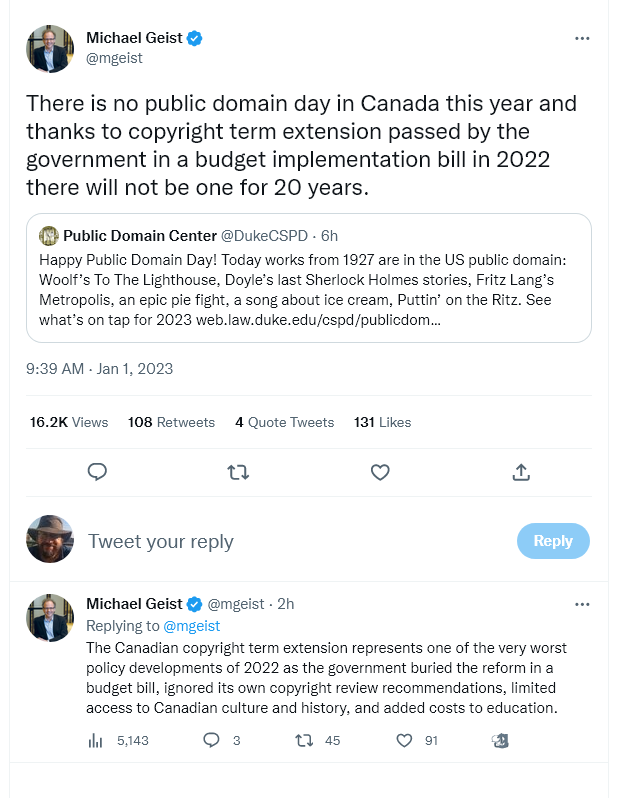
Michael Geist on the state of play in modifying Canada’s digital lock rules to allow consumers a tiny bit more flexibility in how they can get their electronic devices repaired:

“The Self-Repair Manifesto from ifixit.com ‘If you can’t fix it, you don’t own it’. Hear, hear!” by dullhunk is licensed under CC BY 2.0 .
Canadian anti-circumvention laws (also known as digital lock rules) are among the strictest in the world, creating unnecessary barriers to innovation and consumer rights. The rules are required under the World Intellectual Property Organization’s Internet Treaties, but those treaties leave considerable flexibility in how they should be implemented. This is reflected in the countless examples around the world of countries adopting flexible anti-circumvention rules that seek to maintain the copyright balance. Canada was pressured into following the restrictive U.S. approach in 2012, establishing a framework is not only more restrictive than required under the WIPO treaties, but even more restrictive than the U.S. system.
One of the biggest differences between Canada and the U.S. is that the U.S. conducts a review every three years to determine whether new exceptions to a general prohibition on circumventing a digital locks are needed. This has led to the adoption of several exceptions to TPMs for innovative activities such as automotive security research, repairs and maintenance, archiving and preserving video games, and for remixing from DVDs and Blu-Ray sources. Canada has no such system as the government instead provided assurances that it could address new exceptions through a regulation-making power. In the decade since the law has been in effect, successive Canadian governments have never done so. This is particularly problematic where the rules restrict basic property rights by limiting the ability to repair products or ensure full interoperability between systems.
The best policy would be to clarify that the anti-circumvention rules do not apply to non-infringing uses. This would enable the anti-circumvention rules to work alongside the user rights in the Copyright Act (also known as limitations and exceptions) without restricting their lawful exercise. This approach was endorsed by the 2019 Canadian copyright review, which unanimously concluded:
it agrees that the circumvention of TPMs should be allowed for non-infringing purposes, especially given the fact that the Nintendo case provided such a broad interpretation of TPMs. In other words, while anti-circumvention rules should support the use of TPMs to enable the remuneration of rights-holders and prevent copyright infringement, they should generally not prevent someone from committing an act otherwise authorized under the Act.
The government has not acted on this recommendation, but two private members bills are working their way through the House of Commons that provide some hope of change. First, Bill S-244 on the right of repair. Introduced by Liberal MP Wilson Miao in February, the bill this week passed second reading unanimously and has been referred to the Industry committee for further study. The lack of a right of repair exception in Canadian digital lock rules has hindered both consumers and Canadian innovation significantly, leaving consumers unable to repair their electronic devices and farmers often locked out of their farm equipment. After farmers protested against similar copyright restrictions, the U.S. established specific exceptions permitting digital locks to be circumvented to allow repair of software-enabled devices.
Given the impact on consumers, the agricultural sector, and the environment, a provision that explicitly permits circumvention for purposes of the right of repair in Canada is long overdue. Indeed, such an approach is consistent with the 2019 copyright review recommendation:
Recommendation 19
That the Government of Canada examine measures to modernize copyright policy with digital technologies affecting Canadians and Canadian institutions, including the relevance of technological protection measures within copyright law, notably to facilitate the maintenance, repair or adaptation of a lawfully-acquired device for non-infringing purposes.
Tank Chat #155 | Warthog | The Tank Museum
The Tank Museum
Published 3 Jun 2022David Willey is back with another Tank Chat. This week join David as he chats about the armoured vehicle Warthog — the Viking successor.
(more…)
QotD: Does homework, well, work? ¯\_(ツ)_/¯
Yesterday I wrote about bottlenecks to learning. I wanted to discuss the effectiveness of homework. If it works well, that would suggest students are bottlenecked on examples and repetition. If it works poorly, it would have to be something else.
Unfortunately, all the research on this (showcased in eg Cooper 2006) is terrible.
Most studies cited by both sides use “time spent doing homework” as the independent variable, then correlate it with test scores or grades. If students who do more time on homework get better test scores, they conclude homework works; otherwise, that it doesn’t.
One minor complaint about this methodology is that we don’t really know if anyone is reporting time spent on homework accurately. Cooper cites some studies showing that student-reported time-spent-on-homework correlates with test scores at a respectable r = 0.25. But in the same sample, parent-reported time-spent-on-homework correlates at close to zero. Cooper speculates that the students’ estimates are better than the parents’, and I think this makes sense — it’s easier to reduce a correlation by adding noise than to increase it — but in the end we don’t know. According to a Washington Post article, students in two very similar datasets reported very different amounts of time spent on homework — maybe because of the way they asked the question? I don’t know, self-report from schoolchildren seems fraught.
But this is the least of our problems. This methodology assumes that time spent on homework is a safe proxy for amount of homework. It isn’t. Students may spend less time on homework because they’re smart, find it easy, and can finish it very quickly. Or they might spend more time on homework because they love learning and care about the subject matter a lot. Or they might spend more time because they’re second-generation Asian immigrants with taskmaster parents who insist on it being perfect. Or they might spend less time because they’re in some kind of horrible living environment not conducive to sitting at a desk quietly. All of these make “time spent doing homework” a poor proxy for “amount of homework that teacher assigned” in a way that directly confounds a homework-test scores correlation. Most studies don’t bother to adjust for these factors. The ones that do choose a few of them haphazardly, make wild guesses about what model to use, and then come up with basically random results.
Both homework proponents (Harris Cooper) and opponents (Alfie Kohn) briefly nod to this problem, then take these studies seriously anyway. If you do that, you find that probably homework isn’t helpful in elementary school, but might be helpful during high school (though some people disagree with either half of that statement). But why would you take these seriously?
Scott Alexander, “Nobody Knows How Well Homework Works”, Astral Codex Ten, 2022-07-07.
October 7, 2022
The “two movies on the same screen” effect: most Canadians see impending collapse but our “elites” think everything’s peachy
Tara Henley contrasts the reality many Canadians are facing day-to-day with the out-of-touch “laptop elites” who, as a class, did great through the last two and a half years and who have no clue at all why anyone would see the state of the country as anything like a collapse:

Pierre and Ana Poilievre at a Conservative leadership rally, 21 April, 2022.
Photo by Wikipageedittor099 via Wikimedia Commons.
There has been much discussion lately about the state of our nation — and whether or not we, as a society, are in decline.
Former journalist and Justin Trudeau speechwriter (and current Substacker) Colin Horgan published a provocative essay at The Line last month, arguing that our country is vulnerable to extremists who believe that “the current system of liberal democracy is inherently corrupt and corrupted, verging on collapse, and that, in the extreme, its downfall can and should be hastened by acts of violence”.
Horgan worries that Conservative leader Pierre Poilievre — who’s been actively speaking to this ambient vibe of distress and dissatisfaction — could accelerate such destabilization.
Poilievre does not say extreme things, Horgan concedes, but Poilievre’s message is “still poison” because “what he telegraphs is the vision of a social order at a tipping point, with the suggestion that it can be easily pushed over”.
In short, Poilievre has tapped into “an Internet language of decline”.
There’s a thriving cottage industry in the Canadian legacy media doing everything they can to tar Poilievre as a Canadian Hitler and to continue the re-typing and re-phrasing of government talking points for the mass market. The government subsidies to “approved” media outlets will help keep the lights on a bit longer as they continue to lose audience share — and trust.
Our quality of life has been eroded for some time now. Wages have been stagnant for decades. Precarious work is the order of the day, both for the working class and professionals. Rents and property prices are through the roof; according to the Globe and Mail, since 2000, domestic home prices have increased by 420 percent. Inflation is high. Gas is expensive. Food costs are up. We are coping with a crisis of social isolation. Our opioid epidemic rages on.
Meanwhile, pandemic policy has benefited the laptop class and harmed the most vulnerable among us. (See lockdowns and school closures, for starters.)
Indeed, there has been extreme winners and losers during the COVID era, which saw a massive transfer of wealth upwards. Billionaires in this country, in fact, saw their wealth increase 68 percent during the pandemic.
Should we be surprised that those on the losing end are expressing their frustration?
[…]
Things have only gotten worse as the pandemic has dragged on and citizens have been hit with high inflation and rising interest rates (while also staring down other looming financial catastrophes).
According to an Angus Reid poll out this week, nine out of ten Canadians have cut their household budgets due to inflation and high prices. And 46 percent of Canadians say their personal finances are worse off now than they were at this time last year.
But if the material conditions in this country are dire, so too is the national mood.
In fact, there is a gaping wound at the centre of our national psyche.
Essential workers have laboured throughout the COVID crisis, endangering their health and that of their families, in order to keep society running. In return for their heroic efforts, the unvaccinated among them — many of whom previously contracted COVID and have natural immunity — have seen themselves ostracized and smeared as racists and misogynists. Their fundamental values have been mocked in the public square, and their basic rights and freedoms, including freedom of expression, have been compromised. Some have lost jobs, social lives and more for declining vaccination.
To comprehend the human toll this has taken, one need only look to the grassroots #TrudeauMustGo campaign on Twitter.
The consequences of vaccine mandates should have been covered in great depth by our national press. But instead, the Canadian media largely fell down on this story, often generating coverage that uncritically reproduced the Liberal party line.
Trust in the Canadian news media is now at its lowest point in seven years.
And judging from the reader mail I get, the Liberals’ decision to turn vaccine mandates into a wedge issue has had significant social consequences — tearing apart families, communities, and workplaces in ways that may take years to recover from.
All told, what we are witnessing is not merely a state of decline. It is a form of collapse. A collapse of the social contract. A collapse of the expectations we grew up with — that if you worked hard and respected the law, you could have a home, a family if you chose, and, crucially, a say in our democracy.
What we are living through is a collapse of life as we knew it in Canada.
What was once a stable, prosperous, diverse democracy is now a nation divided, rife with fear and anger, and financial and social instability.
Not only has our Prime Minister failed to grasp this, but he’s actively stoked tensions.
The Combat Dogs of World War Two – WW2 Special
World War Two
Published 6 Oct 2022Where man goes, so does man’s best friend. Across the globe, tens of thousands of dogs are called up. They play their part in tales of heroism and joy. But without any agency over their own lives, they also experience fear, death, and cruelty.
Churchill and the Queen
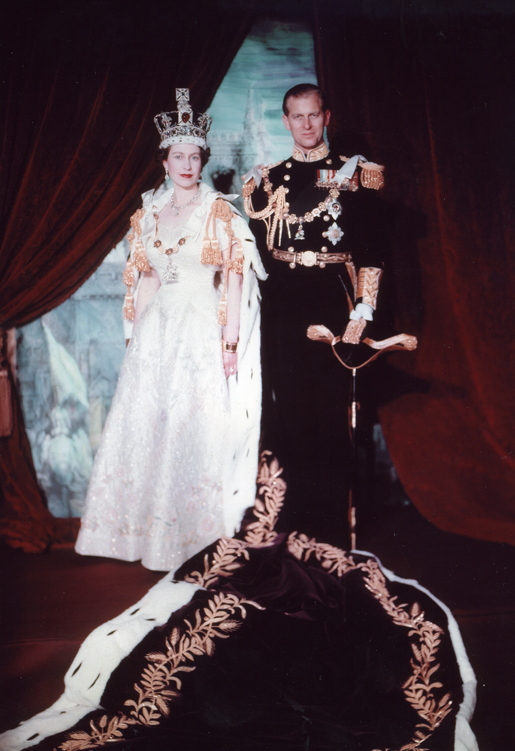
In The Critic, Andrew Roberts outlines the relationship between Prime Minister Winston Churchill and Queen Elizabeth II:

Queen Elizabeth II and Sir Winston Churchill, with Prince Charles and Princess Anne in the foreground, 10 Februrary 1953.
Official photograph via Wikimedia Commons.
Winston Churchill was besotted with Queen Elizabeth II: the word is precise. He worshipped and adored her. His relations with some other members of the royal family were, on occasion, complicated — not least when King Edward VII was sleeping with his mother. But for the late Queen he had nothing but an almost puppy-dog love.
[…]
When King George VI died unexpectedly on 6 February 1952, aged only 56, Churchill was devastated, weeping copiously both on hearing the news and at the funeral. Of the new monarch he told his private secretary, Jock Colville, that “he did not know her and that she was only a child”.
Nonetheless he saw an opportunity of romanticising the country’s situation. “Famous have been the reigns of our queens,” he said in his BBC broadcast on the King’s death. “Some of the greatest periods in our history have unfolded under their sceptre. Now that we have the second Queen Elizabeth, also ascending the Throne in her twenty-sixth year, our thoughts are carried back nearly 400 years to the magnificent figure who presided over and, in many ways, embodied and inspired the grandeur and genius of the Elizabethan Age.”
Although she was his sixth sovereign, Churchill was the new Queen’s first prime minister and old enough to be her grandfather. For all the 51-year age difference — or perhaps because of it — Churchill quickly grew devoted to her. “There was one lady by whom, from 1952 onward, Churchill was dazzled,” noted Colville. “That was the new Queen. Here was a woman whom he respected and admired more than any man.”
[…]
On 24 January 1965, 70 years to the day after the death of his father Lord Randolph Churchill, Sir Winston died. The Queen waived all custom and precedent to attend his funeral at St Paul’s Cathedral. She added a message in her own handwriting to the wreath of white flowers that was placed upon his coffin: “From the Nation and the Commonwealth. In grateful remembrance, Elizabeth R.” It echoed that which Churchill had placed on her father’s coffin, simply saying “For Valour”, the motto of the Victoria Cross, and a reference to the late king’s moral and physical courage during the Second World War, and perhaps also at the battle of Jutland in 1916.
[…]
The Queen decided Churchill should have a State funeral following his stroke in 1953. Once he had recovered, she told him so. The plans had to be rewritten several times over the next 12 years because, as Lord Mountbatten joked, Churchill kept on living but the pallbearers kept on dying.
There is a powerful symmetry to the friendship of monarch and premier that the next State funeral after Churchill’s was to be the Queen’s own, a full 57 years later.
Pease Pudding – Weird Stuff In A Can #74
Atomic Shrimp
Published 28 May 2018This is Pease Pudding — A sort of spreadable paste made from yellow split peas, and with a very long history as a staple food in England.
Here’s the link to the article on Atomic Shrimp (includes a recipe, of sorts): http://atomicshrimp.com/post/2007/01/…
QotD: King Agis IV’s and King Cleomenes III’s failed reform attempts in Sparta after 371BC
In order to serve in the army as a hoplite” rel=”noopener” target=”_blank”>hoplite (the Greek heavy infantryman who was the basic unit of every polis army) – the key concern around the declining Spartiate citizen body – a man had to have enough wealth to afford the arms and armor. In a state where – because of the oft-praised Spartan austerity – functionally all wealth was tied to the land, that meant that any new Hoplites needed to be given land in order to be able to serve. But all the best land in Sparta was tied up in an ever-shrinking number of kleroi.
Thus the Spartan state might grant marginal, borderland to small groups of freed helots – the neodamodes and the Brasidioi – but actually bringing up the military strength of the polis in full could only be achieved by de-consolidating the kleroi – the best, most productive land (because you can only support so many hoplites on disputed, marginal land). This is one thing, of course, that the wealthy Spartiates who dominated the state were unwilling to do. The mothakes and hypomeiones, pushed to the edges of Spartan society, might be brought in to make up the difference, but unless they were made equals – homoioi – this was a recipe for instability, as seen with Lysander and Cinadon. This is the other thing the Spartiates were unwilling to do – if I had my guess, because for the poor Spartiates who still clung to their status (and might still use the Apella to block reform, even if they couldn’t use it to propose reform), that status differential was just about the only thing they had (apart from all of the slave labor they enjoyed the benefits of, of course).
(A different polis might have tried to make up this difference by either hiring large numbers of mercenaries, or arming its own people at state expense, as a way of using the fortunes of the rich to fund military activity without expanding the citizenry. But, as Aristotle notes – (we’ll come back to this when we talk about Spartan war performance) the public finances of Sparta were pitiful even by ancient standards – for precisely the same reason that deconsolidating the kleroi was politically impossible: the state was dominated by the wealthy (Arist. Pol. 2.1271b). With no real source of wealth outside of landholding and all of the good land held by the Spartiates, it seems that Sparta – despite being by far the largest polis in Greece and holding some of the best farmland outside of Thessaly, was never able to raise significant revenue.)
Instead, the clique of wealthy Spartiates arrayed about the kings did nothing, decade on decade, as the Spartiate citizen body – and the military power of Sparta – slowly shrank, until at least, in 371 it broke for good. But what is perhaps most illustrative of the dysfunction in the Spartan political system is the sad epilogue of efforts in the second half of the third century (in the 240s and 220s) to finally reform the system by two Spartan kings.
The first effort was by Agis IV (r. 245-241; Plut. Agis). By the time Agis came to power, there were only a few hundred Spartiate households. Agis tried to reform through the system by redividing all of the kleruchal land into 4,500 plots for Spartiates and another 15,000 for the Perioikoi (who might also fight as Hoplites). Agis gets the Apella to support his motion – his offer to put his own royal estates into the redistribution first earns him a lot of respect – but the Gerousia, by a narrow margin, rejects it. Agis is eventually politically isolated and finally executed by the Ephors (along with his mother and grandmother, who had backed his idea) – the first Spartan king ever executed (I have left out some of the twists and turns here. If you want to know Plutarch has you covered).
Cleomenes III (r. 235-222) recognizes what Agis seemingly did not – reform to the Spartan system could not happen within the system. Instead, he stages a coup, having four of the five Ephors murdered, exiled eighty citizens – one assumes these are wealthy and prominent opponents – and possibly had the other king assassinated (Plut. Cleom. 8, 10.1; Plb. 5.37). Cleomenes then redistributed the kleroi into 4,000 plots and made his own brother his co-king (Plut. Cleom. 11), essentially making him a tyrant in the typical Greek mold. He then set about continuing his war with the neighboring Achaean League in an effort to re-establish Spartan hegemony in the Peloponnese and presumably retake Messenia (which by that point was free and part of the Achaean league).
It was far, far too late. Had this been done in the 380s or even the 350s, Sparta might well have resumed its position of prominence. But this was the 220s – Macedon had dominated Greek affairs now for a century and the Antigonids – the dynasty then ruling in Macedon – had no intention of humoring a resurgent Sparta. In 224, a Macedonian army marched into the Peloponnese in support of Sparta’s enemies and in 222 it smashed the Spartan army flat at Sellasia, almost entirely wiping out the Spartiate citizen body – new and old – in the process (Plutarch claims only 200 adult Spartiate males survived, Plut. Cleom. 28.5). The victorious Macedonian – Antigonis III Doson – for his part re-crippled Sparta: he occupied it, restored its constitution to what it had been before Cleomenes and then left, presumably content that it would not threaten him again (Plut. Cleom. 30.1). The time when a state with a citizen body in the few thousands could be a major player had been over for a century and the great empires of the third century were in no mood to humor self-important poleis who hadn’t gotten the message.
Bret Devereaux, “Collections: This. Isn’t. Sparta. Part V: Spartan Government”, A Collection of Unmitigated Pedantry, 2019-08-29.
October 6, 2022
This vehicle belongs in a museum. Why is it still being used in Ukraine?
Imperial War Museums
Published 5 Oct 2022The BMP-1 is a Soviet infantry fighting vehicle from the 1960s. Ours was captured during Operation Desert Storm in 1991 and has been on display at IWM Duxford for over 30 years. Yet vehicles just like It are still being used by both sides in the ongoing Russo-Ukrainian War, with heavy losses. So why are museum pieces being fielded in a 21st century war? And how are they performing?
(more…)
The pendulum swings back toward institutionalization
During the 1950s and 60s, many mental institutions were shut down due to concerns about the way the patients in those institutions were being treated. Those suffering from mental health issues were, to a large degree, just discharged into the larger community with few supports to help them re-integrate. Today, the concerns about severely mentally ill peoples’ actions may be pushing the system back toward some form of formal re-institutionalization, as Michael Shellenberger reports for Common Sense:

William Norris, shackled sitting upright on his bed at Bedlam, 1838.
Engraving by Ambroise Tardieu, Des maladies mentales Esquirol via Wikimedia Commons.
Though it is difficult to get an exact estimate, a large body of research makes clear that people like Zisopoulos, Mesa, and Simon are just three among hundreds of cases of people in New York alone — to say nothing of cities like Los Angeles, Seattle, San Francisco and others — in which mentally ill people off their medication have assaulted or killed people. And if you think the problem is getting worse, you are right.
In 2021, felony assaults in New York’s subway were almost 25 percent higher compared to 2019, despite a lower ridership because of the pandemic. The number of people pushed onto tracks rose from 9 in 2017 to 20 in 2019 to 30 in 2021. Psychiatrists and emergency department workers in San Francisco and Los Angeles tell me that they have seen a significant increase in homeless patients in psychotic states over the last few years.
How have we arrived at the point where we leave people with psychosis to their demons, and leave the public to take their chances? How have we allowed so many of our cities to have no decent plans or places for the burgeoning number of the violent mentally ill on the streets?
There are two major forces at work. The first is that the U.S. never created a functioning mental health care system. The second is that powerful groups have effectively prevented dangerously mentally ill people from getting treatment.
Starting in the late 19th century, the U.S. created large psychiatric hospitals, often in the countryside, known as asylums, for the mentally ill. Asylums were a major progressive achievement because they delivered, for many decades, significantly more humane, evidence-based care to people who, until then, had often been neglected, abused, or even killed.
But by the middle of the 20th century, the reputation of psychiatric hospitals was in tatters — and deservedly so. Conditions in many of them were appalling, even barbaric. People who were not severely mentally ill were sometimes subjected to years of involuntary hospitalization.
Many reformers just wanted better funding and oversight, but other reformers were more radical, and proposed shutting the hospitals down entirely and replacing them with community-based clinics. Some reformers claimed that serious mental illnesses were the result of poverty and inequality, not biology, and argued that they could be cured through radical social change.
The reformers largely won. State hospitals were shut down in droves before sufficient community centers could be built to treat the suffering. Over the next two decades, as state mental hospitals emptied out, many released patients ended up on the street, or incarcerated. Those community clinics that did start operating tended to treat “the worried well” — those suffering from comparatively low-level anxiety and depression, rather than psychosis.
Decades later, governments were still cutting funding for the treatment of the mentally ill. New York State in 2010 reduced Medicaid reimbursement for inpatient stays of the mentally ill in hospitals beyond 12 days. As a result, New York hospitals released the mentally ill earlier than they should have. From 2012 to 2019, the number of mentally ill adults in inpatient psychiatric care in hospitals and mental institutions in New York City declined from 4,100 to just 3,000. Meanwhile, the number of seriously mentally ill homeless people rose from 11,500 to 13,200.
The story is similar in California. Between 2012 and 2019, more than one-third of the group homes in San Francisco that served mentally ill and disabled people under the age of sixty closed their doors. Why? The measly Medi-Cal and Medicare reimbursement of $1,058 per person per month, and rising estate prices, made it more valuable for the private owners of group homes to sell than to keep operating them.
At the national level, the same dynamic was in play. The U.S. as a whole lost 15,000 board and care beds for the mentally ill and disabled between 2010 and 2016. Today, approximately 121,000 mentally ill people are conservatively estimated to be living on America’s streets.
Carl Gustav m/42: A 20mm Recoilless Antitank Rifle
Forgotten Weapons
Published 21 Apr 2017The Swedish Pansarvärnsgevär fm/42 made by the Carl Gustav company was an interesting early hybrid antitank weapon — a recoilless rifle firing solid armor-piercing projectiles. It used a 20x180mm case, propelling the 108g (1650gr) bullet at 950 m/s (3150 fps). This was capable of perforating 40mm of perpendicular armor plate at 100m (a high explosive projectile was also made). This was on the high end of armor penetration for anti-tank rifles, and the m/42 was able to do this with a weapon weighing just 11.7kg (25 lb) — less than a quarter of a comparable 20mm conventional rifle.
This was possible because of its recoilless design — upon firing, the rear end of the cartridge case would blow out and vent out the back of the weapon, instead of being firmly sealed like a conventional rifle. This created a counter balancing recoil impulse which prevented the gun and shooter from having to absorb the full recoil energy produced by a heavy bullet launching off at high velocity. The tradeoff was that much of the potential energy of firing was wasted venting out the back instead of pushing the bullet forward, which is why the cartridge case was so oversized.
About a thousand of the guns were made by the end of World War 2, at which time even it had been made quite thoroughly obsolete by the rapidly increasing thickness of tank armor. It would, however, be the stepping-stone to the m/48 Carl Gustav 84mm recoilless rifle, which used a shaped charge warhead to perforate armor with a stream of molten metal instead of relying on velocity of a hardened projectile.
(more…)
QotD: Life in grad school
Grad students spend most of their time in the library, and because of the peculiar ecology of college towns, even their non-library hours are spent almost exclusively with other academics. You have to work very, very hard to have any kind of “normal” life in a college town, in other words, so even if you’re not a goofball when you arrive, pretty soon Stockholm Syndrome kicks in and you find yourself, if not liking, then at least tolerating, experimental theater and milk made from plants.
After a few years of this, you forget what normal life is even like. You come to understand the deep and longstanding grievances the Poststructuralist Feminist Marxists have with the Marxist Feminist Poststructuralists. Oh, there’s scads of “diversity” on campus — all those recruiting brochures they mail to dumb parents in the ‘burbs aren’t lying — but there’s one thing you’ll never, ever find: The thought that maybe politics doesn’t matter all that much.
That’s the answer, right there. Academic “humanities” work is mostly bullshit because most people just don’t care about politics. To normals, if they think about “politics” at all, it’s in Schoolhouse Rock terms — some guys in Washington vote on some stuff, and that’s how a bill becomes a law. They certainly don’t mean ideology, which is pretty much the only thing academics mean. That a normal person could walk into the voting booth without really knowing if he’s going to pull the lever for Trump or Hillary fries an egghead’s circuits…
… and yet, as we all know, the majority of American voters do this, every single time. There’s something profound about normal person behavior that academics just can’t — or won’t — grasp.
Severian, “Ignoring the Human Factor”, Rotten Chestnuts, 2019-08-14.
October 5, 2022
Are the protests in Iran about to tip over into actual revolution?
In The Line, Kaveh Shahrooz reports on the still-ongoing public protests after the death of a young woman at the hands of the morality police:

Aftermath of anti-government protests in Bojnord, North Khorasan Province, Iran, 22 September, 2022.
Photo from Tasnim News Agency Bojnord Desk via Wikimedia Commons.
Revolutions are funny things. They sometimes appear impossible until, in one single moment, they become inevitable. In Iran, that moment came on September 13th with the murder of a young woman.
Mahsa Amini, a 22-year-old who was also known by her Kurdish name “Gina”, had come from Iran’s Kurdistan region to visit her brother in Tehran. It was during that trip that she faced a particular humiliation that has become a fact of life for tens of millions of women in that country: a run-in with the country’s gasht-e ershad (“Guidance Patrol”). The role of this roving gang, seemingly imported from Atwood’s Gilead and called Iran’s “morality police”, is to monitor the streets to find and punish violations of the regime’s seventh-century moral and dress codes.
Having determined that Mahsa’s hijab exposed a little too much hair — a few strands of a woman’s hair and men will simply be incapable of controlling their sexual urges, the logic goes — they detained and beat her severely. The story for most women who deal with the morality police typically ends there, after which they are released to seethe at having endured another round of state-imposed gender apartheid. For Mahsa, the story ended differently: with a skull fracture that caused her to be brought, brain dead, to a local clinic. She died there on September 16th.
The murder of Mahsa Amini was the spark that set off a revolution. The killing reminded women of their daily misery at the hands of a regime that, both de facto and de jure, treats them as second-class citizens. And it reminded everyone of the million other senseless cruelties, large and small, that they must endure daily at the hands of a barbaric theocracy. Outraged by the death of an innocent young woman, the people took to the streets in protests that continue to this day.
There have been mass protests in Iran before. In 2009, in response to a widespread belief that Mahmoud Ahmadinejad had illegally stolen the presidential election — to the extent the word “election” means anything in a country where candidates must first be approved by a clerical body loyal to the regime — citizens protested by the millions. Their slogan, “Where’s my vote?” rested on the premise that a fair, albeit controlled, election was something that could change the system for the better. The protesters typically avoided confrontation with security forces. Even when they happened to corner a regime thug periodically, they ensured that no harm was done to him.
Ancient Roman Jellyfish for the Black Banquet
Tasting History with Max Miller
Published 4 Oct 2022
(more…)