
Forgotten Weapons
Published 30 Aug 2022During my visit to Slovenia, I had a chance to tour the AREX Defense factory in Šentjernej. I came away really impressed by the quality and the breadth of operations that the factory performs in-house. They have only been making their own handgun designs for about 5 years, but they have been a subcontractor making parts for other big-name companies (like FN) for decades.
(more…)
December 31, 2022
Tour of the AREX Defense Factory in Slovenia
Comments Off on Tour of the AREX Defense Factory in Slovenia
QotD: Casual (aka slobby) clothing at the airport
I’m back to my old gripe about people who dress like slobs. Theodore Dalrymple takes up the cause:
Indeed, if there is one thing that unites mankind today it is casual slobbery in dress. This is rather odd, considering that so many people seem to spend a lot of their spare time shopping for clothes. The fact is, though, that however much time they spend on shopping, they will always look just as much a mess as ever. They choose, but they do not discriminate. Our unwillingness, and increasing inability, to dress elegantly represents the triumph of self-esteem over self-respect. We dress to please ourselves, not others, and not looking like a slob takes effort, especially keeping it up through the day. Convenience is all, and it is easier to throw on a few casual clothes than to dress well.
What sparked Dalrymple’s ire was his experience at a couple of airports:
Sitting in two airports last week, in Paris and Riga, it suddenly occurred to me that I had not seen a single person who was smartly, let alone elegantly, dressed.
Now I seldom disagree with Teddy about much, but I do on this occasion. Imagine this scenario:
You get dressed to go to an important business meeting, so you do it properly: ironed shirt, tie, decent navy-blue suit, leather belt and shiny black lace-up Oxfords. You check yourself in a mirror and damn, you look good.
But did I mention that the important business meeting was out of town, and you’d need to catch a flight there?
Now go back and reflect how difficult it’s going to be when you’re confronted by the surly TSA apparatchiks at the airport. Belt? Take it off. Shoes? Unlace them, and take ’em off. Jacket? Run it through the X-ray. And that gold tie-clip? We’re going to pat you down and run you through our Magical Cancer-Generating Full-Body Scanner, bub.
All of a sudden, a tee shirt, sweatpants and slip-on moccasins make a lot more sense, don’t they? And the net result is that you look like a slob, because it’s a big enough chore to dress properly in the first place without having to do it all over again at the airport in front of hundreds of people.
Kim du Toit, “Slobbery”, Splendid Isolation, 2018-09-06.
Comments Off on QotD: Casual (aka slobby) clothing at the airport
December 30, 2022
Barnes & Noble used to be like an even more boring Indigo … but they’ve been turned around
Back when my job required more travel, one of the things I used to look forward to was visiting US bookstores, as they always had a wider and more interesting stock than our staid Canadian equivalents. Over time, the interesting local bookstores got harder and harder to find as the big box stores like Borders and Barnes & Noble took over much of their customer base. Of the two, I much preferred going into a Borders store, as they had better stock than B&N and the staff seemed friendlier and (generally) more helpful to clueless foreigners like me. Borders went under around the same time my business travels to the US tapered off and it looked like it was only a matter of time for B&N to follow it into bankruptcy. Even if it struggled on, surely the pandemic killed off what Amazon left behind? Ted Gioia says not so fast:

“Barnes & Noble Book Store” by JeepersMedia is licensed under CC BY 2.0 
 .
.
But Barnes & Noble is flourishing. After a long decline, the company is profitable and growing again — and last week announced plans to open 30 new stores. In some instances, they are taking over locations where Amazon tried (and failed) to operate bookstores.
Amazon seems invincible. So the idea that Barnes & Noble can succeed where its much larger competitor failed is hard to believe. But the turnaround at B&N is real. In many instances they have already re-opened in locations where they previously shut down.
Barnes & Noble tried exactly the same sort of “re-imagining” of their stores that Canada’s Indigo chain is currently floundering with: cutting back on the floorspace devoted to books in favour of throw cushions, candles, decorations, bath salts, scarfs and towels. It worked just as badly for B&N as it is working for Indigo: it chases out the primary customer base (book-buyers) in favour of bored people looking to waste away an hour or two just browsing tchotchkes. (And if you can find an Indigo staff member to ask about a particular book, they almost always assure you that you can find it on their website, which I’m sure helps bring more people into the store …) In desperation, B&N looked to expand into a very different market:
… in a bizarre strategic move, the company decided to launch freestanding restaurants under the name Barnes & Noble Kitchen — no books, just meals. But this was another disaster.
The company chairman Leonard Riggio eventually admitted, in September 2018, that running a restaurant is “a lot harder than you think it is … The bottom line is awful.”
Given the incredibly short and profitless life of most start-up restaurants, that really does qualify as a “No shit, Sherlock” moment. So how did Barnes & Noble turn things around?
It’s amazing how much difference a new boss can make.
I’ve seen that firsthand so many times. I now have a rule of thumb: “There is no substitute for good decisions at the top — and no remedy for stupid ones.”
It’s really that simple. When the CEO makes foolish blunders, all the wisdom and hard work of everyone else in the company is insufficient to compensate. You only fix these problems by starting at the top.
In the case of Barnes & Noble, the new boss was named James Daunt. And he had already turned around Waterstones, a struggling book retailing chain in Britain.
Bringing in fresh blood can be a life-saver for a business, but we also have that expression about deck chairs on the Titanic in common business parlance, so just being “new” isn’t enough … new leaders must also bring new approaches and fresh ideas:
But the most amazing thing Daunt did at Waterstones was this: He refused to take any promotional money from publishers.
This seemed stark raving mad. But Daunt had a reason. Publishers give you promotional money in exchange for purchase commitments and prominent placement — but once you take the cash, you’ve made your deal with the devil. You now must put stacks of the promoted books in the most visible parts of the store, and sell them like they’re the holy script of some new cure-all creed.
Those promoted books are the first things you see when you walk by the window. They welcome you when you step inside the front door. They wink at you again next to the checkout counter.
Leaked emails show ridiculous deals. Publishers give discounts and thousands of dollars in marketing support, but the store must buy a boatload of copies — even if the book sucks and demand is weak — and push them as aggressively as possible.
Publishers do this in order to force-feed a book on to the bestseller list, using the brute force of marketing money to drive sales. If you flog that bad boy ruthlessly enough, it might compensate for the inferiority of the book itself. Booksellers, for their part, sweep up the promo cash, and maybe even get a discount that allows them to under-price Amazon.
Everybody wins. Except maybe the reader.
Daunt refused to play this game. He wanted to put the best books in the window. He wanted to display the most exciting books by the front door. Even more amazing, he let the people working in the stores make these decisions.
This is James Daunt’s super power: He loves books.
“Staff are now in control of their own shops”, he explained. “Hopefully they’re enjoying their work more. They’re creating something very different in each store.”
This crazy strategy proved so successful at Waterstones, that returns fell almost to zero — 97% of the books placed on the shelves were purchased by customers. That’s an amazing figure in the book business.
On the basis of this success, Daunt was put in charge of Barnes & Noble in August 2019. But could he really bring that dinosaur, on the brink of extinction, back to life?
Comments Off on Barnes & Noble used to be like an even more boring Indigo … but they’ve been turned around
Stalin Deports An Entire Ethnicity – War Against Humanity 093
World War Two
Published 29 Dec 2022The last week of 1943 is a busy one. Stalin deports the Kalmyk minority from Kalmykia, the escapees from Fort IX get away, and the US President moves to found the post-war UN.
(more…)
Comments Off on Stalin Deports An Entire Ethnicity – War Against Humanity 093
The continued relevance of Orwell’s “Politics and the English Language”
In Quillette, George Case praises Orwell’s 1946 essay “Politics and the English Language” (which was one of the first essays that convinced me that Orwell was one of the greatest writers of the 20th century), and shows how it still has relevance today:
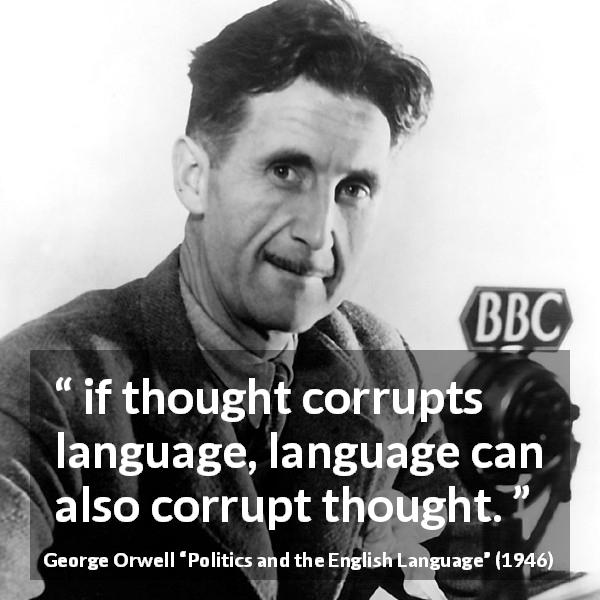
George Orwell’s “Politics and the English Language” is widely considered one of the greatest and most influential essays ever written. First published in Britain’s Horizon in 1946, it has since been widely anthologized and is always included in any collection of the writer’s essential nonfiction. In the decades since its appearance, the article has been quoted by many commentators who invoke Orwell’s literary and moral stature in support of its continued relevance. But perhaps the language of today’s politics warrants some fresh criticisms that even the author of Nineteen Eighty-Four and Animal Farm could not have conceived.
“Politics and the English Language” addressed the jargon, double-talk, and what we would now call “spin” that had already distorted the discourse of the mid-20th century. “In our time,” Orwell argued, “political speech and writing are largely the defence of the indefensible. … Thus political language has to consist largely of euphemism, question-begging and sheer cloudy vagueness. … Political language — and with variations this is true of all political parties, from Conservatives to Anarchists — is designed to make lies sound truthful and murder respectable, and to give an appearance of solidity to pure wind.” Those are the sentences most cited whenever a modern leader or talking head hides behind terms like “restructuring” (for layoffs), “visiting a site” (for bombing), or “alternative facts” (for falsehoods). In his essay, Orwell also cut through the careless, mechanical prose of academics and journalists who fall back on clichés — “all prefabricated phrases, needless repetitions, and humbug and vagueness generally”.
These objections still hold up almost 80 years later, but historic changes in taste and technology mean that they apply to a new set of unexamined truisms and slogans regularly invoked less in oratory or print than through televised soundbites, online memes, and social media: the errors of reason and rhetoric identified in “Politics and the English Language” can be seen in familiar examples of empty platitudes, stretched metaphors, and meaningless cant which few who post, share, like, and retweet have seriously parsed. Consider how the following lexicon from 2023 is distinguished by the same question-begging, humbug, and sheer cloudy vagueness exposed by George Orwell in 1946.
[…]
Climate, [mis- and dis-]information, popular knowledge, genocide, land claims, sexual assault, and racism are all serious topics, but politicizing them with hyperbole turns them into trite catchphrases. The language cited here is largely employed as a stylistic template by the outlets who relay it — in the same way that individual publications will adhere to uniform guidelines of punctuation and capitalization, so too must they now follow directives to always write rape culture, stolen land, misinformation, or climate emergency in place of anything more neutral or accurate. Sometimes, as with cultural genocide or systemic racism, the purpose appears to be in how the diction of a few extra syllables imparts gravity to the premise being conveyed, as if a gigantic whale is a bigger animal than a whale, or a horrific murder is a worse crime than a murder.
Elsewhere, the words strive to alter the parameters of an issue so that its actual or perceived significance is amplified a little longer. “Drunk driving” will always be a danger if the legal limits of motorists’ alcohol levels are periodically lowered; likewise, relations between the sexes and a chaotic range of public opinion will always be problematic if they can be recast as rape culture, hate, or disinformation. This lingo typifies the parroted lines and reflexive responses of political communication in the 21st century.
In “Politics and the English Language”, George Orwell’s concluding lesson was not just that parroted lines and reflexive responses were aesthetically bad, or that they revealed professional incompetence in whoever crafted them, but that they served to suppress thinking. “The invasion of one’s mind by ready-made phrases … can only be prevented if one is constantly on guard against them, and every such phrase anaesthetizes a portion of one’s brain”, he wrote. He is still right: glib, shallow expression reflects, and will only perpetuate, glib, shallow thought, achieving no more than to give an appearance of solidity to pure wind.
Comments Off on The continued relevance of Orwell’s “Politics and the English Language”
My Top 10 Favorite Avalon Hill Games
Legendary Tactics
Published 1 Apr 2021Avalon Hill has such a rich history as a board game company, and has contributed so much to our hobby, our sense of history, and our lives. I sat down to reminisce about my top 10 favorite Avalon Hill games of all time. Are these the best games of all time? What games would make your list? Let us know in the comment section below.
(more…)
Comments Off on My Top 10 Favorite Avalon Hill Games
QotD: If AT&T had used the Google model
Guess what? That still may happen. The only reason Apple hasn’t already started force-feeding ads on your iPhone is a fear that competitors may not do the same — and they might lose a few market share points. But all it takes is one backroom meeting of dubious legality between smartphone providers, and you will soon start hearing a pitch from the GEICO gecko before you even say hello.
Ted Gioia, “YouTube May Force You to Watch 10 (or More) Unskippable Ads in a Row”, The Honest Broker, 2022-09-19.
Comments Off on QotD: If AT&T had used the Google model
December 29, 2022
Brewing Mesopotamian Beer – 4,000 Years Old
Tasting History with Max Miller
Published 27 Dec 2022
(more…)
Comments Off on Brewing Mesopotamian Beer – 4,000 Years Old
Selection bias in polling
At Astral Codex Ten, Scott Alexander points out that it’s impossible to do any kind of poll without some selection bias, so you can’t automatically dismiss any given poll on that basis. The kind of selection bias, however, may indicate whether the results will have any relationship to reality:
The real studies by professional scientists usually use Psych 101 students at the professional scientists’ university. Or sometimes they will put up a flyer on a bulletin board in town, saying “Earn $10 By Participating In A Study!” in which case their population will be selected for people who want $10 (poor people, bored people, etc). Sometimes the scientists will get really into cross-cultural research, and retest their hypothesis on various primitive tribes — in which case their population will be selected for the primitive tribes that don’t murder scientists who try to study them. As far as I know, nobody in history has ever done a psychology study on a truly representative sample of the world population.
This is fine. Why?
Selection bias is disastrous if you’re trying to do something like a poll or census. That is, if you want to know “What percent of Americans own smartphones?” then any selection at all limits your result. The percent of Psych 101 undergrads who own smartphones is different from the percent of poor people who want $10 who own smartphones, and both are different from the percent of Americans who own smartphones. The same is potentially true about “how many people oppose abortion?” or “what percent of people are color blind?” or anything else trying to find out how common something is in the population. The only good ways to do this are a) use a giant government dataset that literally includes everyone, b) hire a polling company like Gallup which has tried really hard to get a panel that includes the exact right number of Hispanic people and elderly people and homeless people and every other demographic, c) do a lot of statistical adjustments and pray.
Selection bias is fine-ish if you’re trying to do something like test a correlation. Does eating bananas make people smarter because something something potassium? Get a bunch of Psych 101 undergrads, test their IQs, and ask them how many bananas they eat per day (obviously there are many other problems with this study, like establishing causation — let’s ignore those for now). If you find that people who eat more bananas have higher IQ, then fine, that’s a finding. If you’re right about the mechanism (something something potassium), then probably it should generalize to groups other than Psych 101 undergrads. It might not! But it’s okay to publish a paper saying “Study Finds Eating Bananas Raises IQ” with a little asterisk at the bottom saying “like every study ever done, we only tested this in a specific population rather than everyone in the world, and for all we know maybe it isn’t true in other populations, whatever.” If there’s some reason why Psych 101 undergrads are a particularly bad population to test this in, and any other population is better, then you should use a different population. Otherwise, choose your poison.
Comments Off on Selection bias in polling
Anti-Tank Chats #5 | PIAT | The Tank Museum
The Tank Museum
Published 26 Aug 2022Bring up the PIAT! Join Stuart Wheeler as he takes a look at the iconic WW2 British anti-tank weapon — the PIAT. With thanks to @The Armourer’s Bench and @History in Firearms
(more…)
Comments Off on Anti-Tank Chats #5 | PIAT | The Tank Museum
QotD: That foolish optimism of the early days of the internet
Those we call the left were sure that the internet would help democratize American society by opening the floor to marginalized voices. The people we call the right were sure this new medium would follow the pattern of talk radio. Free of progressive control, normal people could challenge the opinions of the liberal media. The internet was going to be an open debating society that worked on democratic principles.
Thirty years on and people old enough to remember the before times think that maybe the internet was a mistake. Giving a platform to millions of talking meat sticks, banging away at their phones, has just made life noisy. Worse yet, the range of allowable opinion has become much narrower. We now live in an age of censorship that was unimaginable before the internet.
The Z Man, “Coercion and Consensus”, Taki’s Magazine, 2022-09-25.
Comments Off on QotD: That foolish optimism of the early days of the internet
December 28, 2022
The Twitter Files – “How does anyone run a business under these conditions?”
Chris Bray on the sheer magnitude of government(s) meddling in Twitter’s business (even though, yes, Twitter’s management was totally on-board politically with most or all of this meddling):
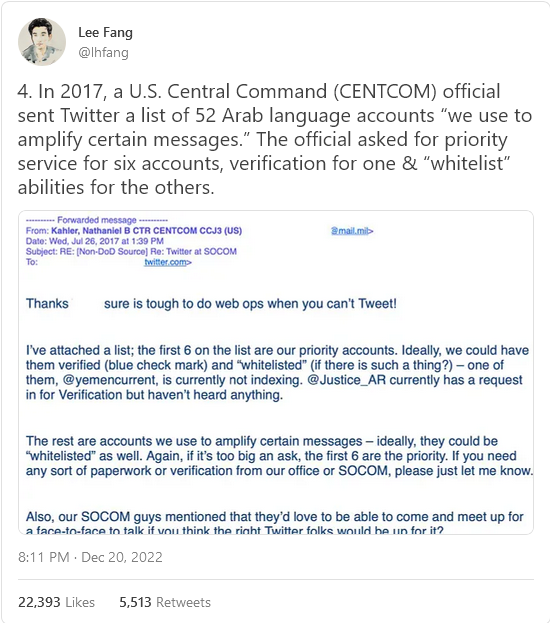
[…] Twitter has been constantly flooded with requests from at least dozens of separate federal entities, all of them needy and pushy and consuming the company’s time and energy: CENTCOM wants a meeting this week and CDC wants a meeting this week and NIH wants a meeting this week and the FBI wants a meeting this week and the White House wants a meeting this week and DHS wants a meeting this week and DOD wants a meeting this week even though CENTCOM already has one, and several members of Congress have some concerns they want the senior team to address this week, and …
Now: Twitter is a global platform. I would bet a kidney that there’s a Twitter Files equivalent for the Ottawa Police Department during the Freedom Convoy, and an RCMP file, and a Trudeau government file, and that Chrystia Freeland had some thoughts to share about some tweets she didn’t like. I would bet the other kidney that Twitter has equivalent files, in dozens of languages, from multiple government agencies in Iran and New Zealand and Australia and the Netherlands and the UK and Brazil and on and on an on.
As for my third kidney — just go with it, and we’ll clean up the biological metaphors later — state and local governments also expect Twitter to act on their content concerns and complaints about disinformation, which means fifty governors and attorneys general and state directors of public health and state police commanders picking up the phone, and 3,243 sheriffs and district attorneys and public health directors expecting to be able to reach out to their partners at Twitter, and close to 20,000 mayors and police chiefs, and thousands of state legislators and tens of thousands of city councilmembers, and on and on and on. “You tell this Jack Dorsey that I’m the damn mayor pro tem here in Glendale, and I want my concerns to be dealt with.”
And so, if we accept the premise that governments have special rights to demand content moderation, if the staff director of a legislative committee in the Arkansas state legislature and a sheriff in Maryland and the flag officers at all the MACOMS and Jen Psaki’s deputy assistant and a member of a county board of supervisors in Oregon and the chief of staff to the governor of Rhode Island, being Very Important People, all expect to by God get a direct meeting with Twitter executives because @buttchug623 is saying some things that they do not like at all, and oh by the way the prime minister of the Democratic Republic of the Congo is holding on line 6 and he’s pissed and when can you pencil in a half-hour with Turkmenistan’s finance minister, then how much does it cost to manage all of those relationships?
The regulatory affairs staffing buries the business — you can’t pay for that much face time with that many self-important officials. We need to schedule the senior management team for a meeting with the White House this week, ’cause they don’t like Alex Berenson. How does anyone run a business under these conditions? “Before you cook that cheeseburger for order number seven, the deputy assistant secretary for sustainable agriculture would like to share some thoughts on the environmental trajectory of industrial protein cultivation. And about that milkshake …”
In addition to the free speech problem and the pathologies of gleichschaltung, the Twitter files are about the way government without boundaries consumes resources from every entity it touches.
Twitter’s path to bankruptcy runs through the premise that every government official who doesn’t like a tweet deserves a meeting.
Comments Off on The Twitter Files – “How does anyone run a business under these conditions?”
The Myth of the Nazi Police State – WW2 Documentary Special
World War Two
Published 27 Dec 2022The popular image of the Gestapo is as black leather-jacketed fiends whose spies keep the nation under constant surveillance. They are so powerful that the terrified population has no choice but to sell out its family and friends. But how true is this? Are all Germans living in fear of the Gestapo all the time?
(more…)
Comments Off on The Myth of the Nazi Police State – WW2 Documentary Special
What we still don’t know about historical European swordfighting
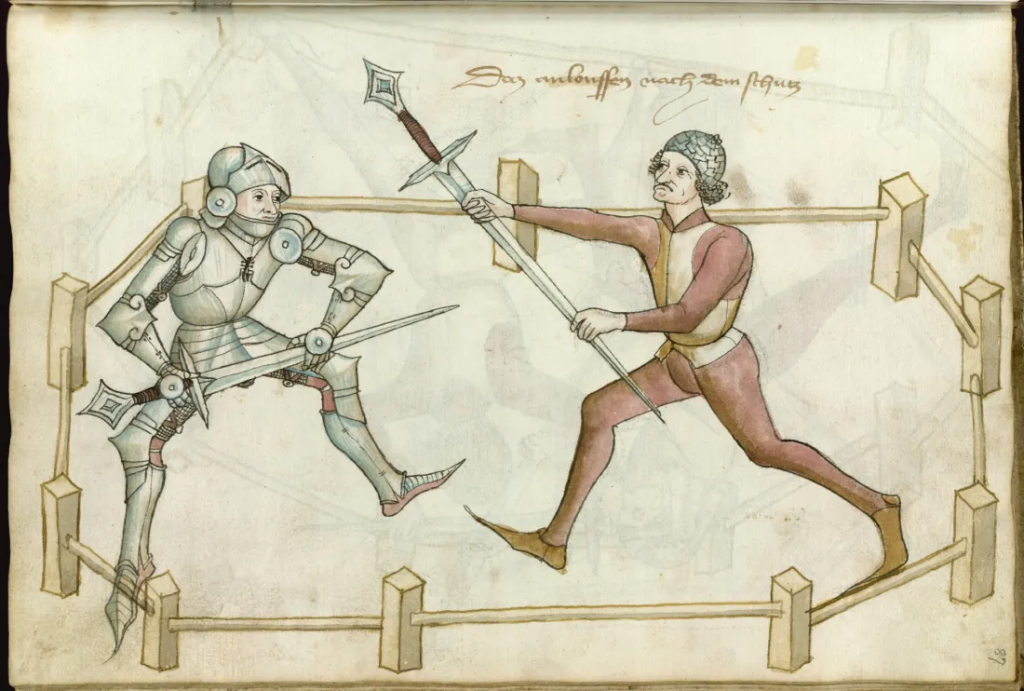
I was for many years a member of the SCA partly for the attraction of the historical period and partly for the swordfighting. The Society developed a (mostly) safe simulation of (some) medieval combat styles and later introduced (some) renaissance rapier combat as well (initially borrowing equipment standards from modern sport fencing). Around the time the SCA began to consider expanding from high medieval sword-and-shield styles, separate organizations in Europe and the United States sprang up to be more consciously historical in how they recreated historical blade combat, these groups are often collectively referred to as Historical European Martial Arts (HEMA) or Western Martial Arts (WMA). The foundation documents for HEMA and other historical combat enthusiasts are the various surviving manuals of swordmasters and fencing school owners which cover a kaleidoscope of weapons, techniques, advice, and how-to illustrations … some of which appear to be physically impossible for ordinary human beings:
MS Thott.290.2º f.87r.
The ultimate experts in medieval sword fighting were the “fight masters” – elite athletes who trained their disciples in the subtle arts of close combat. The most highly renowned were almost as famous as the knights they trained, and many of the techniques they used were ancient, dating back hundreds of years in a continuous tradition.
Little is known about these rare talents, but the scraps of information that have survived are full of intrigue. Hans Talhoffer, a German fencing master with curly hair, impressive sideburns and a penchant for tight body suits, had a particularly chequered past. In 1434, he was accused of murdering a man and admitted abducting him in the Austrian city of Salzburg.
Fight masters worked with a grisly assortment of deadly weapons. The majority of training was dedicated to fencing with the longsword, or the sword and buckler (a style of combat involving holding a sword in one hand, and a small shield in the other). However, they also taught how to wield daggers, poleaxes, shields, and even how to fight with nothing at all, or just a bag of rocks (more on this later).
It’s thought that some fight masters were organised into brotherhoods, such as the Fellowship of Liechtenauer – a society of around 18 men who trained under the shadowy grandmaster Johannes Lichtenauer in the 15th Century. Though details about the almost-legendary figure himself have remained elusive, it’s thought he led an itinerant life, travelling across borders to train a handful of select proteges and learn new fencing secrets.
Other fight masters stayed closer to home – hired by dukes, archbishops and other assorted nobles to train themselves and their guards. A number even set up their own “fight schools”, where they gathered less wealthy students for regular weekly sessions.
[…]
For all their beauty, the hand-drawn works could also be decidedly bloodthirsty. In Talhoffer’s 1467 manual, neat sequences of moves that look almost like dancing end abruptly with swords through eye-sockets, violent impalings, and casual instructions to beat the opponent to death. Some signature techniques even have names – chilling titles like the “wrath-hew”, “crumpler”, “twain hangings”, “skuller” and “four openings”.
Despite passing through countless generations of owners, and – in some cases – centuries of graffiti, burns, theft, and mysterious periods of vanishment from the historical record, a surprising number survive today. This includes at least 80 codexes from German-speaking regions alone.
Impossible moves and missing clues
But there’s a problem. Many of the techniques in combat manuals, also known as “fechtbücher“, are convoluted, vague, and cryptic. Despite the large corpus of remaining books, they often offer surprisingly little insight into what the fight master is trying to convey.
“It’s famously difficult to take these static unmoving woodcut images, and determine the dynamic action of combat,” says Scott Nokes, “This has been a topic of debate, research and experimentation for generations.”
On some occasions these manuals seem to depict contortions of the body that are physically impossible, while those that attempt to convey moves in three dimensions sometimes give combatants extra arms and legs that were added in by accident. Others contain instructions that are frustratingly opaque – sometimes depicting actions that don’t seem to work, or building upon enigmatic moves that have long-since been lost.
Oddly, the text is often written as poetry, rather than prose – and a few authors even made it hard to interpret their works on purpose.
Lichtenauer recorded his instructions in obscure verses which remain almost incomprehensible today – one expert has gone so far as to call them “gibberish”. According to a contemporary fight master he trained, the grandmaster wrote in “secret words” to prevent them from being intelligible to anyone who didn’t value his art highly enough.
Even when it is possible to decipher what a combat manual is describing or demonstrating, some experts suspect that crucial contextual information is always missing.
Comments Off on What we still don’t know about historical European swordfighting
Useful Beer Reviews: Newcastle Brown Ale
Jago Hazzard
Published 12 Jun 2019Today, an old favourite – Newcastle Brown Ale.
DISCLAIMER: Contains rambling that may bear no resemblance to reality.
Comments Off on Useful Beer Reviews: Newcastle Brown Ale


