Quotulatiousness

October 26, 2025

Biggs and the “End of History”

Feral Historian
Published 30 May 2025

The “Biggs Edit” isn’t just a contentious question of Star Wars arcana, but an example of some of the problems historians face trying to reconstruct the past. Problems that are only going to get worse in the age of AI.

00:00 Intro
01:12 Not So Easy
05:02 A Slim Hope
05:50 Not Equal Claims
06:46 Memory and AI

🔹 Patreon | patreon.com/FeralHistorian
🔹 Ko-Fi | ko-fi.com/feralhistorian

October 20, 2025

From Hitler’s Rockets to America’s Arsenal – W2W 049

TimeGhost History
Published 19 Oct 2025

From the ashes of Nazi Germany to the launch pads of the American desert, the story of the nation’s first ballistic missile is one filled with contradiction. A man who once served the SS soon became a celebrated figure in the United States, and his weapon of war was transformed into a symbol of progress. Here, we will explore how this unlikely journey unfolded and what it reveals about science, power, and morality in the modern age.
(more…)

October 18, 2025

Remembering GamerGate

We’ve lived through such a tumultuous decade that it’s sometimes difficult to remember what things were like in the “before times”. On Substack chat, John Carter linked to this essay by Billionaire Psycho which helps refresh memories about one of the seminal events that kicked off the political and social chaos of the last decade:

GamerGate is maybe the most important event of the past 20 years which never receives mainstream media coverage. Lomez will be publishing an in-depth history of GamerGate, to serve as an official record going forward, and that’s crucial as part of building a foundation for a new culture — fighting the narrative war over how history is remembered, how history is interpreted, what events are recognized as significant and influential moments in culture, and how Western identity is defined.

GamerGate was only possible because a generation of incompetent Leftists inherited an empire built on propaganda that came without a legible instruction manual. Leftists forgot how to run their imperial machine. Video games sedated young white men, funneling their energy into a simulation of achievement, an illusory power fantasy of digital significance. Leftists forgot that porn, video games, movies, junk food, and other passive consumption activities primarily existed to prevent young white men from doing anything useful with their lives. And this zone of sedation was viewed as another industry to conquer so that DEI activists could bully the video game industry into providing overproduced elites with fake jobs.

This event was important for several reasons.

GamerGate exposed American Sharia laws. It unveiled the shibboleths, religious taboos, and blasphemy codes which were considered more important than Constitutional protections on “free speech”. A gulf emerged between written laws, and selective enforcement.

GamerGate was maybe the first time in 50 years that Leftists suffered a real, measurable defeat.

It functioned as a generational awakening: a catalyst that activated a decentralized army of shytpoasters, bloggers, podcasters, streamers, journalists, and RW activists.

It mapped out in real-time the architecture and OODA loop of the Leftist hivemind, providing empirical data on how the swarm intelligence perceives, coordinates, reacts, propagates … and suffers damage.

It educated critics of the hegemonic monoculture that rules the Global American Empire.

But I think the most important aspect of GamerGate was that it disproved the narrative illusion that everyone more or less accepted as conventional wisdom, the bedrock of the uniparty worldview. Before GamerGate, it was taken as a self-evident fact that America was a capitalist country, and that all of the evil in the world was caused by Wall Street corporations chasing “shareholder value” and advancing “the profit-motive”. Capitalism and racism were the invisible demons which could be used as scapegoats for anything bad that ever happened at any point and at any place in American society.

Leftism could do anything it wanted, no matter how dumb, destructive, intrusive, or evil — and then blame capitalism and racism for the consequences.

This illusion was shattered by GamerGate.

[…]

There’s one important thing that’s been lost since GamerGate (GG) and the Meme War of 2016, which is the adolescent fun, transgressive irreverence, and juvenile sense of humor which once characterized the RW youth. There was a brief window when video game enthusiasts believed they could meme their way to victory (they did), win a landslide election (they did), and reverse imperial decline (they didn’t). Ten years have passed since then. Countless accounts have been banned, doxxed, deplatformed, debanked. Dissidents have been prosecuted and imprisoned. The presidency of 2016 was stalled out and subverted, the election of 2020 was stolen, the election of 2024 almost ended in an assassination on live television. Covid lockdowns crashed the economy and trapped everyone in their homes, while Antifa and Black Lives Matter rioted outside in the name of George Floyd.

At some point, it stopped being fun, and the contest turned into a forever war.

Comedy turned serious.

But it should be remembered that in the aftermath of GamerGate, humor and a playful, childish energy fueled the engine of RW victories. That’s the secret ingredient.

Samizdat is the key to winning.

Always remember to keep having fun, and keep laughing, because our enemies are ridiculous.

October 14, 2025

Carthaginian or Roman America?

Filed under: Africa, Americas, History, Technology — Tags: , , , , , — Nicholas @ 03:00

On the social media site formerly known as Twitter:

    Alaric The Barbarian @0xAlaric

    There’s a handful of evidence for this. Most of it’s a little fringe or circumstantial, but it exists.

    – 500s BC Carthaginian navigator Himilco described the Sargasso Sea; the original work is now lost but it was quoted in Ora Maritima a century later. If you can make it there and back, you know trade winds well enough to take Columbus’ route.

    – There’s quite a lot of copper “missing” from the Great Lakes area, and there was more bronze in the Old World than could have possibly been supported by the known copper mining infrastructure there … despite 7,000-year-old copper mines in that region, the local natives didn’t seem to really use copper for much aside from odd pictographic disks.

    – The Tecaxic-Calixtlahuaca head, discovered in 1933, was a bearded terracotta head made before European contact with modern-day Mexico. Its features and style don’t match local populations or material cultures, and it’s been dated to centuries prior. Roman experts ID it as 200s AD Roman art. Even the archaeological community isn’t sure what to make of this one; their best (non-)explanation is “it was a prank”.

    – Numerous odd discoveries were made of Old World artifacts in the American West throughout the 19th century. Alleged Roman coins, weapons, tools, etc. Some of these were hoaxes; others have been lost to time; others seem almost covered up. The wildest example is Kincaid’s alleged 1909 discovery of an ancient Egyptian-style tunnel annex hidden in the walls of the Grand Canyon, full of artifacts; and, a similar alleged discovery around Death Valley. The former was reported to have been investigated (maybe covered up?) by the Smithsonian, though they deny this; the latter is on government land now.

    – Various Old World artifacts seem to show New World goods or maps; there is a depiction of a pineapple at Pompeii, for example, and c. 350 BC Carthaginian coins show a map of the Mediterranean including the Americas to the west. Certain of Ptolemy’s odd geographic ideas are “corrected” (such as his earth-size estimate) by placing the Antilles as the Fortunate Isles. The Piri Reis Map, compiled in 1513 but surely copied from much older sources, shows a fairly accurate east coast of the Americas, as well as Antarctica. Diodorus Siculus may have even described the Americas as found by the Phoenicians, then kept secret …

    – This of course predates Rome and Carthage, but a wide swathe of native cultures had extraordinarily similar oral histories of being visited by ethnically distinct people from the east who taught them aspects of civilization … “But that’s probably nothing, right?”

    The field awaits its smoking gun, its Rosetta Stone. But I believe something is out there, just waiting for an enterprising follower of Schliemann to discover it. There’s *something* there.

And in response:

    John Ringo SF Author @Jringo1508

    The part that does it for me (that there was pre-Viking contact) is just studying the development of pottery and metallurgy in the Old World vs New.

    Old World: Burnt bits of clay with markings on them. Poorly formed “pottery” charms. Better made pottery charms. Pottery dishes. Metal ore based glazes. Simple, low temperature, metals.

    New World: POTTERY FULLY FORMED AND GOLD AND SILVER EXTRACTION BECAUSE NATIVE AMERICANS ARE AWESOME!

    The Carthaginians had a process of going to less advanced areas, teaching them some simple “advanced” technologies that in some way helped out the Carthaginians then trading with them for “stuff”. They’d teach pottery or better pottery techniques so that they (the Carthaginians) didn’t have to load themselves down with empty pots to pick up “stuff”.

    They’d then trade stuff like bronze daggers for gold, silver and spices.

    So, it entirely makes sense (if you understand the currents) that a Carthaginian/Phoenician (they’re the same) trading/exploring fleet would make it across the Atlantic in one direction (probably in winter), set up a trading center somewhere and start trading wares. They’d leave a few behind to build up a store then sail back.

    If they went over in winter and sailed back in summer, good chance they were wiped out by hurricanes.

    It could have happened multiple times with a small group of colonists left behind. Their genes would disappear in the wash.

    But going from zero to FULLY FORMED POTTERY has always been my reason to know that there was early contact.

October 13, 2025

Speculation that J.D. Vance “maintains a Twitter alt, that he is in fact an anon poaster”

Filed under: Media, Politics, Technology, USA — Tags: , , — Nicholas @ 05:00

The latest post from John Carter at Postcards from Barsoom includes some interesting speculation about how well J.D. Vance has handled his engagement with social media trolling and why that might be:

Gigachads on the official DHS X account only provide evidence of one poaster in the administration, but this is a poaster in a very prominent, public-facing role, who has been allowed to do this for quite some time now, obviously without rebuke. That strongly suggests that the administration smiles upon the memelord, and it also makes it more likely that the chud running the DHS X account is far from alone. An obvious question is why the DHS would be so tolerant of its social media manager posting right wing memes, when this is guaranteed to draw the ire of the left. One possible explanation is that the administration wants its anon army to understand that they have guys on the inside. Memes are a tool for informal coordination; by posting these memes, the administration is winking at the base, telling them “We’re listening to you, and as for CNN … we don’t think about them at all. Now follow our lead …”

The young men powering the new administration were acculturated within the free-wheeling environment of loosely connected online networks, in which irony and ambiguity is simply the water in which they swim, and the only hierarchy is the one established by informal influence and demonstrated ability. They are not accustomed to subordinating their activities to directives pushed down from the summits of rigid org charts. Their basic assumptions are individual initiative, freedom of action, and a magpie willingness to grab good ideas wherever they can be found and put them to immediate use without waiting for permission.

And it is not only the junior staffers and federal agents who have this mindset.

Importantly, at 41, Vance is a young man by political standards. His cultural assumptions are not those of network news, but of digital networks. When the Vance memes making fun of his weight, or riffing off of his remark to Zelensky that he never even said “Thank you”, started circulating, he didn’t get mad about them. He laughed, and rolled with it, because he understood that – coming from the online right – these memes were an expression of affection, the way you rib your friend by calling him a faggot and he pokes you back by calling you a fat retard. Naturally the feminized left does not understand this at all. They think that these memes are humiliating to Vance and so spread the memes themselves, while interpreting the popularity of the memes amongst the online right as an indication that the base loathes him. As always, the left lacks theory of mind for their opponents. Imprisoned within the iron bars of their own ideological-managerial cage, the left has completely failed to learn the lessons of participatory media, and like a general staff doggedly trying to break the trench lines with cavalry charges, continues to try to fight the current war with the weapons they used to win the last one.

There is widespread speculation that Vance’s comfortable navigation of meme culture comes from direct experience, that he maintains a Twitter alt, that he is in fact an anon poaster. There is of course even speculation as to which account is his, although naturally, no one knows for sure, and Vance sure isn’t telling.

If there are poasters in the administration, we might expect them to treat policy the way they learned to handle memes. Any random small-account anon might come up with an absolute banger of post … so why shouldn’t they be able to come up with banger policies, too? Why limit themselves to adopting policies developed inside the long, tedious processes of bureaucratic committees and comfortable think tanks? If rapisthitler1488 has a good idea, well, why not use it? You can just do things. This attitude is at the heart of what Dudley Newright calls the “up-the-chain phenomenon”.

We’d also expect an administration laced with poasters to pay careful attention to the online right, using it to gauge the public mood in order to correct course. At its worst this could turn into audience capture, but at its best this enables a much more responsive reaction to public sentiment than that afforded by polling data since it is both immediate and disintermediated. Rather than waiting for the polling agency to carefully word a question to get the answer it wants, and then painstakingly call up and interview a statistically representative and unbiased sample so that it can provide rigorous Poisson errors for the answers to its biased questions, public sentiment can be analyzed as soon as people start tweeting, and evaluated in terms of the public’s own words. In essence, the poastocratic administration becomes akin to a livestreamer monitoring the chat.

Finally, we might expect to see the administration deliberately trolling the base. Experienced influencers know that outrage bait drives engagement. If you want to move in a certain policy direction but are being pressured behind the scenes not to do that, or conversely if you are being pressured to do something you know will be unpopular, an excellent way of assembling the political capital necessary to do what you want is to announce that you’re going to do the opposite. The howls of outrage from the base then provide you with the excuse you need to do what you wanted to do in the first place. “Let me check with the boss … Well, sorry, I’d really love to help you, but the boss won’t let me do that.”

OK, you say, this is all very interesting, an emergent feedback loop of cybernetic governance linking the networked hive mind to the traditional institutions of government, but is there any actual evidence beyond some meme-slop posted by the DHS in an effort to assure the base that they are getting the Got What They Voted For Award? Well, let’s get into that.

Update, 14 October: Welcome, Instapundit readers! Please do have a look around at some of my other posts you may find of interest. I send out a daily summary of posts here through my Substackhttps://substack.com/@nicholasrusson that you can subscribe to if you’d like to be informed of new posts in the future.

October 8, 2025

QotD: Porn is always in the vanguard of new technologies

Filed under: Books, History, Humour, Quotations, Technology — Tags: , , — Nicholas @ 01:00

    I remember seeing something years ago that commented on how soon after the development of photography we got pictures of naked women.

5 Florins says after Gutenberg invented the printing press and mass printed the Bible, guys were buying presses and cranking out copies of Thee Hornee Shepard and Thee Shye But Readye Milkmaide. 😍

(“T’would say it be a bodice ripper, but we’ve not invented bodices yet” – Johannes of Cologne, Ye Cologne Courier Newspapere)

mmack, commenting on “Why the Internet Stinks Now”, Founding Questions, 2025-07-03.

Update, 9 October: Welcome, Instapundit readers! Please do have a look around at some of my other posts you may find of interest. I send out a daily summary of posts here through my Substackhttps://substack.com/@nicholasrusson that you can subscribe to if you’d like to be informed of new posts in the future.

October 3, 2025

Adding digital ID to the pocket moloch … what could possibly go wrong?

Filed under: Britain, Bureaucracy, Government, Liberty, Technology — Tags: , , , , — Nicholas @ 03:00

On Substack, Andrew Doyle explains why it’s a terrible idea to trust the government — any government — in forcing digital ID on everyone:

An illustration of Jeremy Bentham’s Panopticon prison.
Drawing by Willey Reveley, 1791.

During a trip to Russia in 1785, the philosopher Jeremy Bentham sketched an outline for a new prison design. The cells were arranged around the circular perimeter and, at the centre, he placed his “panopticon”: a watchtower which afforded a view of any of the cells at all times. The prisoners might not always be being observed, but they could never be sure that they weren’t.

Bentham’s design was never directly used, but the idea took hold as a symbol of state overreach and control, most famously in Michel Foucault’s Discipline and Punish (1975). Foucault was alert to the political ramifications of such a concept, and how surveillance might become an internalised experience. With Keir Starmer now pledging to introduce a digital ID system as a mandatory condition for the right to work, are we seeing the first step towards the realisation of Bentham’s vision?

I suppose we are already there. I have seen friends switch off their phones before discussing politically sensitive issues, genuinely convinced that digital eavesdropping is the norm. Many people are mistrustful of the “Alexa” voice assistant, which they are persuaded is recording their every word. While this all seems terribly conspiratorial, I’m sure most of us remember those reports a few years ago about the Pegasus spyware which had been covertly installed on the phones of journalists and government figures, turning the devices into pocket spies.

[…]

Few will be surprised to hear that public trust in political institutions has plummeted. The increasingly authoritarian tendencies of successive governments, our two-tier policing system, public manipulation as embodied in the “nudge unit”, and the corrupt prioritisation of the interests of the political class over the people they serve – perhaps best demonstrated by parliament’s flagrant efforts to overturn the Brexit vote – have all contributed to this climate of mistrust. The bizarre overreach of police during the lockdowns – in which dog walkers were publicly shamed with drone footage, and shopping trolleys were probed for “non-essential items” – has hardly helped matters.

To many of us, it is baffling that anyone at all would support the prospect of the government keeping track of our movements and holding our private details in a database. Starmer claims that the scheme will curb illegal immigration, but we are talking about criminals who already work outside the system and will doubtless continue to do so. Besides, identity cards have been a reality on the continent for years, and have done precisely nothing to resolve the problem. Employers in the UK are already legally obliged to insist on proof of immigration status from workers.

Labour’s digital ID scheme seems more about control than anything else. The possibility of fraud is also a major concern. It’s not as though the government has an unblemished track record of preventing data breaches. We all recall the massive leak of official MOD data regarding Afghans who had worked with the British government during the UK’s military campaigns. And who could forget the senior civil servant who, in 2008, left top-secret documents concerning al-Qaeda and Iraq’s security forces on a train from London Waterloo? Are we really to suppose that the creation of an all-encompassing centralised database will not leave the public open to risk from hackers and hostile foreign powers?

Tim Worstall adds that “they c’n fuck off ‘n’ all”:

So we’ve that wet dream of Tony Blair raising its ugly head again. There should be a national ID system. Actually, it’s not just Blair, T — the bureaucracy has been right pissed at the erasure of the wartime system since the 50s when it was abolished.

For there are two ways of looking at, thinking about, the whole governance thing. One is — the Blair, bureaucrats’, version — that the population are cattle, kine, to be managed. For the benefit of the bureaucracy of course — or at very least to be forced into doing what the bureaucracy thinks they — we — should be doing.

Then there’s that stout Englishman, the Anglo Saxon, version, which is that government are just the slaves we communally hire to make sure the bins get emptied. Well, OK, maybe raise a bit of tax for a Royal Navy to sink the Frenchies. But even then, not too much of that — the Civil War was, after all, triggered by Ship Money. Did the people who would not be slaughtered by the first wave of invading Frenchies — because they had the silly excuse of living 25 miles inland — have to pay the tax to run the Royal Navy to keep the Frenchies at bay or not? The King said yes — the King was right — and not for the first nor last time in British political history the guy who was right had his head cut off for being so.

Digital ID, so which version should we have? That one beloved of Froggie-type bureaucrats who view La Profonde as kine to be corralled? Or the Anglo Saxon version where we just devolve the scut work to a few slaves?

[…]

The reason this never will be proposed is that it doesn’t fit the reasons why our rulers wish to have an ID system. They’re insistent that we be their kine rather than they our. So, the Hell w’ ’em.

But it could be done. Government simply publishes an interface — an API — which says that proof of identity needs to be presented in this format. We’re done as far as whose kine is whose.

Update 4 October: From Samizdata, another illustration of just how toxic Two Tier Keir has become to British voters:

The Guardian reports:

    “Reverse Midas touch”: Starmer plan prompts collapse in support for digital IDs

    Public support for digital IDs has collapsed after Keir Starmer announced plans for their introduction, in what has been described as a symptom of the prime minister’s “reverse Midas touch”.

    Net support for digital ID cards fell from 35% in the early summer to -14% at the weekend after Starmer’s announcement, according to polling by More in Common.

    The findings suggest that the proposal has suffered considerably from its association with an unpopular government. In June, 53% of voters surveyed said they were in favour of digital ID cards for all Britons, while 19% were opposed.

October 2, 2025

UNshittifying the internet

Filed under: Business, Media, Technology — Tags: , , — Nicholas @ 04:00

In The Line, Matt Gurney asks if we can go back to when the internet (and by extension, all the other tech toys and gadgets we see everywhere) was … good?

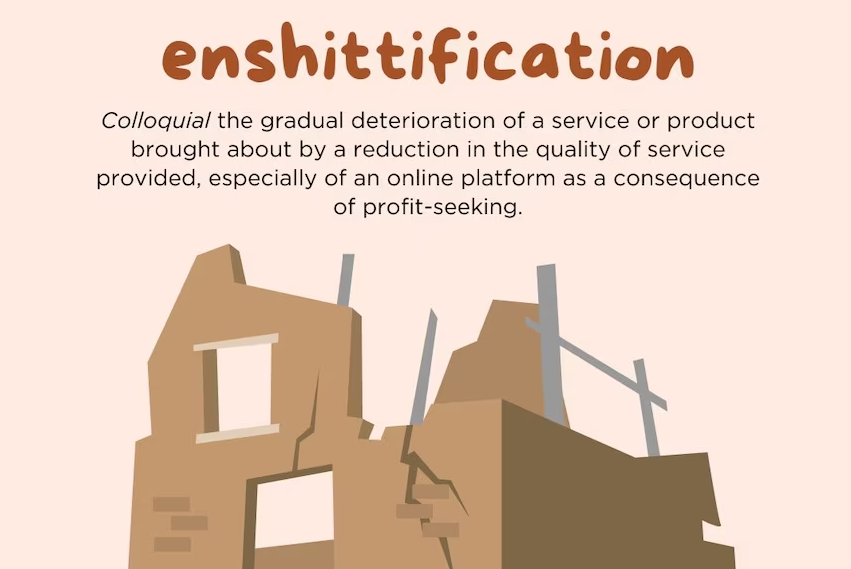
Have you heard about enshittification? It’s not just a potty word. It’s actually a pretty fascinating concept, and you read about it mostly in tech circles. Enshittification is the process by which something becomes worse over time, instead of better, normally as people try to squeeze more efficiency and revenue value out of it. Through that process of squeezing, the thing becomes enshittified.

If you want a proper definition

    Enshittification: The gradual deterioration of a service or product brought about by a reduction in the quality of service provided, especially of an online platform, and as a consequence of profit-seeking.

There are lots of examples. My favourite example? My video doorbell has an annual service fee. Another great example? Cars that now require payments to access certain features, like heated seats. You own the device. But you need to pay a recurring fee to use it. That’s enshittification.

It’s everywhere. And it’s getting worse, especially online. And, perversely, maybe this is a good thing. Maybe it’s going to force us to stop, rethink how we use the digital realm, and, basically, try again. Start over. And get it right this time.

Noah Smith is an American economics writer whose work I enjoy. Smith noted on Twitter recently that we are rapidly getting to the point where we should declare social media a failure. It’s passé to criticize social media on social media, but Smith wasn’t making the usual warmed-over moral argument. He wasn’t saying that it was bad because people are mean there or that they fall down dark rabbit holes and end up believing insane things. Those are problems! But Smith’s concern was the extent to which AI-generated content and bots have simply flooded all the social media channels. Even a responsible user trying to use these platforms for the good is going to find it increasingly difficult to derive any value from them. They’re being rapidly enshittified.

I share his view of the trajectory. I don’t really know anyone who doesn’t. But Smith’s comment led me to ponder what value I actually derive from them — what I would miss if they were gone. I came up with four broad use cases.

How “Roman” is Times New Roman?

Filed under: Books, Europe, History, Technology — Tags: , , — Nicholas @ 02:00

toldinstone
Published 24 May 2025

Today’s video explores the long history of “Roman” fonts.

Chapters
0:00 Introduction
0:42 The Latin Alphabet
1:53 Rustic capitals
2:21 Uncial
2:50 Carolingian miniscule
3:32 Gothic
4:24 The Book
5:26 The first fonts
6:05 Littera Antiqua
6:46 Aldus Manutius and his successors
7:40 Times New Roman
8:07 How Roman?

September 29, 2025

Screen addiction – “No drug cartel makes as much money as the screen-and-app companies”

Filed under: Health, Media, Technology — Tags: , , , , , , — Nicholas @ 03:00

Ted Gioia on the eight things about screen addiction that David Foster Wallace tried to warn us about before he took his own life in 2008:

Those same youngsters are now showing up on college campuses, and we can begin to gauge the societal impact of a screen-driven life. It ain’t pretty.

So this is a good time to revisit what Wallace tried to warn us about thirty years ago. He was ahead of his time in the worst possible way, experiencing firsthand all the debilitating symptoms that now plague millions.

That’s why his writings feel so eerily contemporary. They read like commentaries on what’s happening right now.

Of course, Wallace knew very little about the Internet — he deliberately avoided it. He also refused to own a television. He understood how susceptible he was to screen addiction, and took drastic steps to reduce his exposure to all screens.

But he wrote about it — most tellingly in his huge novel Infinite Jest. The title refers to a film that is so addictive that people who watch it can’t stop. They literally watch it to death. It’s an infinite diversion, much like the endless scrolls on today’s social media apps.

He returned to the topic in his final book The Pale King, and also discussed it in interviews and essays. I’ve read through all of these including more than thirty interviews with the author. These allow me to put together a point-by-point summary of what Wallace tried to tell us.

We ignore his warnings at great risk.

(1) Screen technology will cause a crisis of loneliness, especially among young people.
In almost every interview, Wallace eventually talks about loneliness. It was a looming crisis, he insisted. But he was one of the first to link this to the ways we divert ourselves via screens. […]

(2) This will lead to widespread depression.
Wallace also knew this firsthand. He suffered intensely from depression. His inability to find a suitable treatment led to his suicide in 2008. […]

(3) This will also happen at a larger scale. Society will grow more fragmented and disconnected.
As each person falls into an isolated relationship with a screen, larger communities begin to fray. Wallace anticipated a “new vision of the U.S.A. as an atomized mass of watchers and appearers”. […]

(4) Screen technology promises to liberate us, but the reality is that it controls us for the benefit of others.
The most dangerous part of the screen entertainment is the illusion that it serves us. But the reality is that we actually serve tech platforms and their advertisers. […]

(5) The people who control the technology work to hide their purposes and goals.
“They’re trying to lock us tighter into certain conventions, in this case habits of consumption,” Wallace told Larry McCaffery in 1993. “This is McLuhan right? ‘The medium is the message’ and all that? But notice that TV’s mediated message is never that the medium is the message.” […]

(6) Our survival will depend on our ability to remain independent of these forces.
If we abandon ourselves completely to the tech (as many now do), we become pawns in the corporate agenda to monetize us — at a tremendous cost in loneliness, depression, and social disconnection. […]

(7) We don’t have many tools, but kindness and compassion will be the starting point.
We need to replace irony, sarcasm, and cynicism — which have contributed to our self-debasement — with softer, gentler attitudes. Cynicism is useful in criticizing, but is impotent when we need to build something better. Irony only destroys, never builds. […]

(8) Art can help us heal.
He wrote his big books with the hope that they would help us find a way back to a more caring and connected world — but connected via people, not screens. […]

September 25, 2025

An unanticipated danger of AI – “classified” videos for decision-makers

Until fairly recently, even the least tech-savvy among us could distinguish AI-generated videos from the real thing … but most of the leaders and decision-makers in western governments aren’t very tech-savvy and put into high-pressure environments may be uniquely susceptible to AI manipulation:

What If I Told You … One of the biggest applications of AI for misinformation hasn’t been online but in the halls of power.

Aging boomer politicians, generals, and major figures are manipulated by showing them AI videos they can’t tell, can’t pause to look at, and certainly can’t digitally examine or geolocate …

“And as you saw Mr President.”

Pay attention. All of them reference seeing “videos” that you aren’t allowed to see, of events which they claim are public record, but appear no-where and no reporting supports …

Sean Hannity was interviewing a world leader and even said “You should show the public the video you showed me it’d really change everyone’s opinion. it changed mine” LIVE ON AIR. And the world leader said some non-committal maybe, then released nothing.

These aging politicians, media figures, corporate personalities, etc. all casually reference seeing insane videos that would CHANGE EVERYTHING and would have been immediately released to sway public opinion if they existed or would have been leaked if it would have been in poor taste to be seen directly releasing them (like gore films)

But of course they aren’t released because they’re faked and the internet would immediately piece together that they’re faked with AI, video game, and archival footage from old conflicts … But the aging 60- and 80-year-olds who run the world can’t tell.

There was a case where they challenged Greta Thunberg “Would you watch this video it’d change your mind” and she refused telling them to just release it … Then they didn’t and attacked her for not being willing to view evidence contrary to her views … in a controlled environment where she couldn’t scrutinize it or check its authenticity against anything else …

It sounds insane! But if you pay attention all of these politicians, media figures, and even influencers … People who often have ZERO security clearance or any official attachment of real trust or allegiance to the governments showing them this “classified” or “controlled” footage … Regularly reference seeing footage which does not exist in the public domain, for events which are viciously contested in which any of the footage they claim to have seen would be WORLD CHANGING news … Yet all these figures are just left out in the wind repeating “Trust me bro”s for some of the most important occurrences of the past decade.

September 19, 2025

QotD: The sub-generations of Generation X

Filed under: Media, Quotations, Technology, USA — Tags: , , , , , , — Nicholas @ 01:00

… “Gen X” is actually a misnomer, as there are at least three distinct subgroups. There’s the very earliest Xers, the guys who were in high school in the late 1970s. They often get lumped in with the Baby Boomers, too, though they’re as different from the Boomers as they are from us, the “mid” Xers. Think Wooderson from Dazed and Confused. Brian Niemeier calls them “Generation Jones”, and while I don’t like that tag I don’t know what else to call them (except maybe “Woodersons”), so roll with it.

Then there’s the group that was in high school in the late 1980s. I squeak into this group (barely). We’re the mid-Xers. The real “grunge” generation. If Dazed and Confused is a pretty decent late-90s approximation of late-70s high school kids, then the best description I can give you of a “grunge” kid is the movie Deadpool. Made in 2016, by guys who were born in the mid-1970s. That’s grunge, in a way Kurt Cobain couldn’t even imagine. Fourth wall breaks! Sarcastic asides about the fourth wall breaks! Profanity! Masturbation jokes! And snark, snark, snark — unrelenting snark, about everything, all the time. Every second of that movie screams “I can’t believe you fags are amused by this, but since you obviously do, here’s lots more! Choke on it!!!”

The writers obviously wanted to work on Buffy the Vampire Slayer, but Joss Whedon was too cool for them — imagine the twisted psyche of a person who thinks Joss Whedon is cool — and Sarah Michelle Gellar just laughed at them, so they made Deadpool out of spite.

Then there’s the late Xers. They were in high school in the late 1990s, which is why us oldsters call them “Millennials” (as the term is now used, it seems to mean “those born around 2000”, i.e. the generation just now getting out of college. We took it to mean “those who were just getting out of college around the turn of the century”). Obviously I use the Internet. I’m using it now, but I’m not on the internet, and I’m certainly not an Internet Person. The very late Xers are Internet People. The very first Internet People; they invented the concept of Internet People. Mark Zuckerberg (born 1984) is a late Xer. The people behind Twitter (Jack Dorsey born 1976; Biz Stone 1974; Evan Williams 1972) are mid-Xers; they were ahead of the curve.

Severian, “Addendum to Previous”, Founding Questions, 2022-02-24.

September 4, 2025

They can’t catch actual criminals, but they are quite capable of arresting social media users

Filed under: Britain, Government, Law, Liberty, Media, Politics, Technology — Tags: , , , — Nicholas @ 04:00

Andrew Doyle hopes that the farcical performance by British police in sending five armed officers to arrest Graham Linehan as he stepped off the plane will be a tipping point:

How many more controversies will it take? The arrest of comedy writer Graham Linehan by five armed police officers as he landed at Heathrow Airport has become an international news story because it so self-evidently tyrannical. The stress of the ordeal raised his blood pressure to an alarming degree and he was rushed to hospital. With the help of the Free Speech Union, Graham is now suing the Metropolitan Police. You can donate to his crowdfunder here.

It is reassuring to see that some action is being taken against such chilling state overreach, but when will our politicians follow suit? Many of us have been warning about this ongoing assault on liberty for many years, and at every watershed moment we’ve been led to believe that something will be done. Then, inevitably, the “blob” is activated and swallows up any potential for progress in its viscous and undulating folds.

So when Sir Mark Rowley, head of the Metropolitan Police, complains that the police are acting on unclear laws, and that the responsibility for the maltreatment of the likes of Graham lies with those in power, he’s overlooking the impact of the activist middlemen. Let’s not forget that the Home Office has twice instructed the College of Policing to stop the recording of “non-crime hate incidents” (NCHIs) and has been ignored. Or that the chairman of the College of Policing, Lord Herbert, said the solution to the complaints about NCHIs might be to rename them. As though the public’s concerns about this brazen authoritarianism might be assuaged with a touch of rebranding.

Rowley’s buck-passing is likewise inadequate. He claimed that Graham’s arrest was necessary because officers “had reasonable grounds to believe an offence had been committed”, which is palpably untrue. He said: “I don’t believe we should be policing toxic culture wars debates and officers are currently in an impossible position”. He also made clear that police would continue to behave in this way “unless the law and guidance is changed or clarified”.

But this is precisely the problem. At present, a quango called the College of Policing trains officers in England and Wales. In my article for UnHerd about Graham’s arrest (which you can read here) I make the case that the College of Policing has become woefully unfit for purpose due to activist capture. For a long time, agitators within the system have reinterpreted and fudged the actual law in favour of what they would like it to be. This has led to some police acting in potentially criminal ways. Most egregiously, there is clear evidence of systemic bias against gender-critical individuals within the police force, and a reluctance to apply identical standards to trans activists who routinely post threats of death and rape and are rarely investigated for it.

In the wake of the Linehan arrest, Tom Knighton wonders why the US isn’t treating the UK as it would any other tyranny where free speech and other civil liberties are denied to the people on a whim or a suspicion:

The United States has a history of dealing with tyrannical governments, who oppose tyrannical governments we like even less. We worked with Saddam Hussein, for example, because he was at war with Iran.

But we never stopped pretending these weren’t tyrants.

So, it’s time we start treating the UK just the same.

The latest incident was a well-known comedian from the UK being arrested over a couple of jokes.

    Something odd happened before I even boarded the flight in Arizona. When I handed over my passport at the gate, the official told me I didn’t have a seat and had to be re-ticketed. At the time, I thought it was just the sort of innocent snafu that makes air travel such a joy. But in hindsight, it was clear I’d been flagged. Someone, somewhere, probably wearing unconvincing make-up and his sister/wife’s/mum’s underwear, had made a phone call.

    The moment I stepped off the plane at Heathrow, five armed police officers were waiting. Not one, not two—five. They escorted me to a private area and told me I was under arrest for three tweets. In a country where paedophiles escape sentencing, where knife crime is out of control, where women are assaulted and harassed every time they gather to speak, the state had mobilised five armed officers to arrest a comedy writer for this tweet (and no, I promise you, I am not making this up.

    … and then, a follow up to that one.

    When I first saw the cops, I actually laughed. I couldn’t help myself. “Don’t tell me! You’ve been sent by trans activists” The officers gave no reaction and this was the theme throughout most of the day. Among the rank-and-file, there was a sort of polite bafflement. Entirely professional and even kind, but most had absolutely no idea what any of this was about.

While the officers were kind, they still arrested him. They arrested him because he made some jokes. He spent time in a jail cell, was interviewed by detectives, and was treated like a criminal because he made some jokes.

They waited for him at the airport with five officers, something that would be a clear indication to others that he was truly dangerous, over some jokes.

The first one wasn’t a great joke, really, but that wasn’t the issue. This wasn’t that it wasn’t as funny as it should have been, but that it was made at all.

September 1, 2025

“… these two [books] are ‘perfect bound’, which is a misleading name for a crappy technique”

Filed under: Books, Business, Media, Technology, Woodworking — Tags: , , — Nicholas @ 03:00

Chris Schwarz on the frustrations of a (physical) book reader with far too many modern printed books:

Dammit, Norton!

I don’t read much for pleasure these days. I spend about three hours a day reading manuscripts, draft blog entries, old woodworking texts, academic papers and contracts. When the workday is done, the last thing I want is someone else’s voice chattering in my head.

But I love books and have always been a voracious reader. So I keep a stack of books that I probe and pick at, like a 5-year-old forking through chop suey, looking for something to consume.

This month has been great. I’m in the middle of “The Overstory” by Richard Powers and “A Swim in a Pond in the Rain” by George Saunders. Both books were written with an exquisite pen, and I lose track of time when I’m reading them.

But both books also make me want to burn down the headquarters of Norton and Random House publishing. Because both books are made like dogshit.

Like most books these days, these two are “perfect bound”, which is a misleading name for a crappy technique. Like if we called a “butt joint” the “excellent end-grain joint,” or if we called miters the “super slanty joint”.

What’s perfect binding? Take a stack of individual sheets of paper, like the stack of pages you put in your printer. Slather some glue on one edge and press the goo into the pages. While the glue is still wet, slap the book’s cover to the glue on the spine. Trim the pages, sell the book and make an obscene amount of money.

I don’t know a binding technique that is crappier than perfect binding. Even loose-leaf pages in a Trapper Keeper are better because they can be repaired.

Perfect-bound books are – like a Ryobi drill – a product that has an expiration date. After two or three readings, the pages will start to fall out of the glue. You don’t even have to mistreat the binding for this to happen. The glue gets brittle, then you turn a page like a normal person and the leaves fall like it’s autumn.

Do not fool yourself and think that book publishers are suffering and need to cut corners in the manufacturing department. They aren’t. Book publishing is still one of the most profitable businesses, as far as margin is concerned. It’s not unusual for a publisher to have margins of 30 to 35 percent. (Note: Lost Art Press keeps a margin of about 15 percent – much lower because we pay more in royalties and pay a lot more for manufacturing.)

My paperback copy of “The Overstory” is the 23rd printing of the title since it was released in 2018. Norton is literally printing money at this point with the book. The book’s retail is $18.95. Manufacturing cost (at a plant in the United States): I’d guess is about $3.80.

Norton can do better. But it doesn’t have to. Customers are happy to pay $18.95 for an impermanent book.

August 30, 2025

QotD: SaaS – software as an “intolerable swarm of blood-sucking leeches”

Filed under: Business, Quotations, Technology — Tags: , , , , — Nicholas @ 01:00

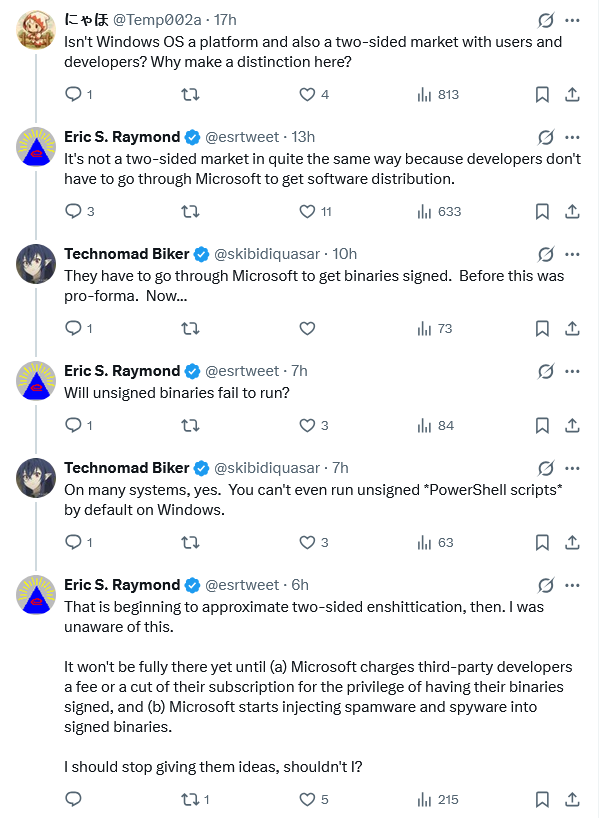
Commercial desktop software is getting worse, not better. I’ve been generally aware of this for a while — the relentless pull away from “you pay for it once and own it” to monthly subscription models that extract money from you forever has been a leading indicator.

But my friend @DrInsensitive reports that the enshittification is accelerating. He says that in addition to a lot of tediously stupid UI changes, his most recent upgrade of CorelDraw now spams ads at him even when CorelDraw itself is not running! Furthermore the plague of microtransactions that has afflicted AA games for years is spreading — the set of free fill patterns for rectangles that his old version had is gone, instead when he tries to fill a rectangle he gets a pop-up invitation to buy an extra-cost feature pack of them.

When one asshole vendor thinks they’ve successfully numbed their user base into accepting this kind of crap, others immediately follow. We’ve seen this movie before, we know how it ends — with applications, like games, designed to be deliberately frustrating and low-level awful, intended to give you itches that you can only scratch by buying their endless parade of “enhancements”.

I’m sure a surcharge to suppress the spammy CorelDraw ads won’t be long in coming. And soon after that it will be everywhere.

If this goes on, open-source software will finally win the desktop not because it’s gotten enough better but because closed-source desktop applications have reached final form as an intolerable swarm of blood-sucking leeches.

This is not the way I was looking forward to winning.

ESR, Twitter, 2025-03-22.

« Newer PostsOlder Posts »

Powered by WordPress