
Tom Scott
Published 5 Sep 2022The @Royal Albert Hall is 150 years old; the roof is 600 tonnes of glass and steel. And it turns out that there’s a terrifying technicians’ trampoline, acoustic-dampening mushrooms, and a complete lack of connections.
(more…)
January 6, 2023
This is the most interesting roof in London
Comments Off on This is the most interesting roof in London
QotD: The weird economics of “Onlyfans”
… I’ll be the first to admit that I not only don’t understand the business side of it, but the whole concept leaves me cold. Yes, of course, like any young man from the latter half of the 20th century I’ve seen a few pornos, gone to a few strip clubs, and so forth. Both were bachelor party rites of passage in my day; lord knows what they do now, and maybe that’s part of the OnlyFans sales model — since guys can’t go out to seedy strip clubs or get together as a bachelor party and watch a porno (too much Toxic Male Gaze, #MeToo) they have to do it virtually. And I don’t get that, either. Looking at sex strikes me as pointless — either put me in, coach, or I’m going to find some other, more productive use of my time — and looking but not touching at a strip club seems even dumber.
Given that I am not in the target audience for OnlyFans, then, perhaps all my speculations are hilariously wrong. And obviously there’s a robust market for porn, so it stands to reason that a la carte porn would have, if anything, an even bigger market …
… but do we trust those numbers? Everything in Clown World is fake and gay, and everything to do with the Internet has always been … how shall we put this? Factually dubious. This was true even when the Internet was a Libertarian paradise (for the young guys out there: Back in the build-your-own-modem days, I’m told, the Internet was hardcore Libertarian. By the time I got there, it was still very, very Right. Which stands to reason — you needed patience, discipline, and a little savvy to be online back then, and those are not Leftist qualities). OnlyFans claims a subscriber base of X, with revenues of Y. Do we have any reason to believe those are even within shouting distance of reality?
Money laundering seems like a live option.
My other guess was kompromat. I understand that Chinese Intelligence has all but openly admitted that TikTok is part of a targeted program to spread deviance, and if it has some intel benefit that’s a bonus. I figure OnlyFans had some sort of similar function. We all know that the classic “honey pot” is alive and well — Eric Swalwell and of course Hunter Biden say hi — but why bother running a real agent at somebody when he’s perfectly willing to put all his deviant desires in writing, backed by his credit card number?
I checked out OnlyFans — on Wikipedia; for research — and hey, whaddaya know, they got in on The Current Thing in Ukraine. Given what we know about Vladimir Putin, I’m sure he’s real broken up about that. It probably works pretty well as “open source” domestic intelligence, too — just as your enemies are busy uploading their own blackmail photos, so your domestic deviants are busy outing themselves on the other side of the transaction. Indeed, the only thing that surprises me is that the usual (((retards))) aren’t blaming it on the Mossad …
… actually I’m sure they are, and I do NOT want to know about it, but the point is, the whole thing seems really sketchy. So what are your thoughts? Money laundering scheme? PsyOp? Really obvious intelligence ploy? Or is it exactly what it seems like, desperately horny betas doing their thing?
(Based on what I saw on Facebook etc., I’m almost willing to believe the latter. All a recognizably human female has to do is post a cleavage shot on Facebook and she’ll get a hundred thirsty simps complimenting her. It’s the money thing that gets me, though. Being a simp in the Facebook comments is free).
Severian, “The E-Thot Economy”, Founding Questions, 2022-10-05.
Comments Off on QotD: The weird economics of “Onlyfans”
January 1, 2023
Full Cabin Build – 4K Full Length – Townsends Wilderness Homestead
Townsends
Published 29 Aug 20220:00 – Laying the Foundation
4:39 – The Walls Begin
8:22 – Prepping the Fireplace
9:52 – Finishing the Walls
15:58 – The Roof Design
17:04 – Adding the Purlins
20:29 – The Doorframe
21:32 – The Final Purlins
24:00 – Roofing Materials
25:47 – Adding the Bark Shingles
27:37 – Roof Wrap-Up
29:03 – Door Jams
29:47 – Opening the Fireplace
30:58 – Building the Fireplace
36:06 – Adding the Door
37:54 – The First Fire
39:02 – A Winter Safe Haven
(more…)
Comments Off on Full Cabin Build – 4K Full Length – Townsends Wilderness Homestead
QotD: The amazing economic impact of mobile phones in the developing world
We also know why too. Being able to contact people means that markets complete, contracts and transactions are possible. It’s no longer necessary to near randomly meet someone physically in order to be able to organise a transaction. Thus more transactions happen – the value added in voluntary transactions being that GDP which is increasing.
Tim Worstall, “Mobile Phones Cut The Murder Rate – For the Same Reason They Grow The Economy”, Continental Telegraph, 2019-05-30.
Comments Off on QotD: The amazing economic impact of mobile phones in the developing world
December 31, 2022
The Twitter Files – “Let’s at least try to stop lying for a while, see what happens. How bad can it be?”
Matt Taibbi on the continuing revelations about Twitter’s deep entanglements with agencies of the US (and probably many other) government:
In the coming days you’ll find a new thread on Twitter, along with a two-part article here at TK explaining the latest #TwitterFiles findings. Even as someone in the middle of it, naturally jazzed by everything I’m reading, I feel the necessity of explaining why it’s important to keep hammering at this.
Any lawyer who’s ever sifted though a large discovery file will report the task is like archaeology. You dig a little, find a bit of a claw, dust some more and find a tooth, then hours later it’s the outline of a pelvis bone, and so on. After a while you think you’re looking at something that was alive once, but what?
Who knows? At the moment, all we can do is show a few pieces of what we think might be a larger story. I believe the broader picture will eventually describe a company that was directly or indirectly blamed for allowing Donald Trump to get elected, and whose subjugation and takeover by a furious combination of politicians, enforcement officials, and media then became a priority as soon as Trump took office.
These next few pieces are the result of looking at two discrete data sets, one ranging from mid-2017 to early 2018, and the other spanning from roughly March 2020 through the present. In the first piece focused on that late 2017 period, you see how Washington politicians learned that Twitter could be trained quickly to cooperate and cede control over its moderation process through a combination of threatened legislation and bad press.
In the second, you see how the cycle of threats and bad media that first emerged in 2017 became institutionalized, to the point where a long list of government enforcement agencies essentially got to operate Twitter as an involuntary contractor, heading into the 2020 election. Requests for moderation were funneled mainly through the FBI, the self-described “belly button” of the federal government (not a joke, an agent really calls it that).
The company leadership knew as far back as 2017 that giving in to even one request to suspend this or that set of accused “hostile foreign accounts” would lead to an endless cycle of such demands. “Will work to contain that”, offered one comms official, without much enthusiasm, after the company caved for the first time that year. By 2020, Twitter was living the hell its leaders created for themselves.
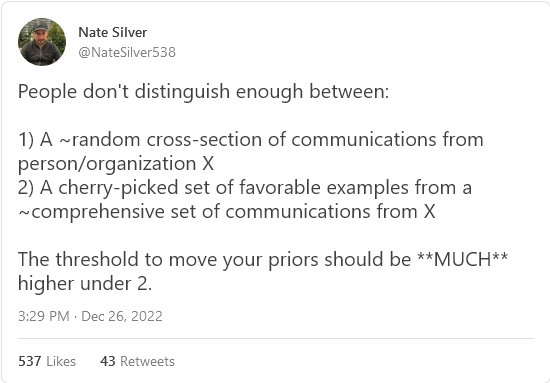
What does it all mean? I haven’t really had time to think it over. Surely, though, it means something. I’ve been amused by the accusation that these stories are “cherry-picked”. As opposed to what, the perfectly representative sample of the human experience you normally read in news? Former baseball analytics whiz Nate Silver chimed in on this front:
Comments Off on The Twitter Files – “Let’s at least try to stop lying for a while, see what happens. How bad can it be?”
Tour of the AREX Defense Factory in Slovenia
Forgotten Weapons
Published 30 Aug 2022During my visit to Slovenia, I had a chance to tour the AREX Defense factory in Šentjernej. I came away really impressed by the quality and the breadth of operations that the factory performs in-house. They have only been making their own handgun designs for about 5 years, but they have been a subcontractor making parts for other big-name companies (like FN) for decades.
(more…)
Comments Off on Tour of the AREX Defense Factory in Slovenia
December 30, 2022
QotD: If AT&T had used the Google model
Guess what? That still may happen. The only reason Apple hasn’t already started force-feeding ads on your iPhone is a fear that competitors may not do the same — and they might lose a few market share points. But all it takes is one backroom meeting of dubious legality between smartphone providers, and you will soon start hearing a pitch from the GEICO gecko before you even say hello.
Ted Gioia, “YouTube May Force You to Watch 10 (or More) Unskippable Ads in a Row”, The Honest Broker, 2022-09-19.
Comments Off on QotD: If AT&T had used the Google model
December 29, 2022
QotD: That foolish optimism of the early days of the internet
Those we call the left were sure that the internet would help democratize American society by opening the floor to marginalized voices. The people we call the right were sure this new medium would follow the pattern of talk radio. Free of progressive control, normal people could challenge the opinions of the liberal media. The internet was going to be an open debating society that worked on democratic principles.
Thirty years on and people old enough to remember the before times think that maybe the internet was a mistake. Giving a platform to millions of talking meat sticks, banging away at their phones, has just made life noisy. Worse yet, the range of allowable opinion has become much narrower. We now live in an age of censorship that was unimaginable before the internet.
The Z Man, “Coercion and Consensus”, Taki’s Magazine, 2022-09-25.
Comments Off on QotD: That foolish optimism of the early days of the internet
December 28, 2022
The Twitter Files – “How does anyone run a business under these conditions?”
Chris Bray on the sheer magnitude of government(s) meddling in Twitter’s business (even though, yes, Twitter’s management was totally on-board politically with most or all of this meddling):
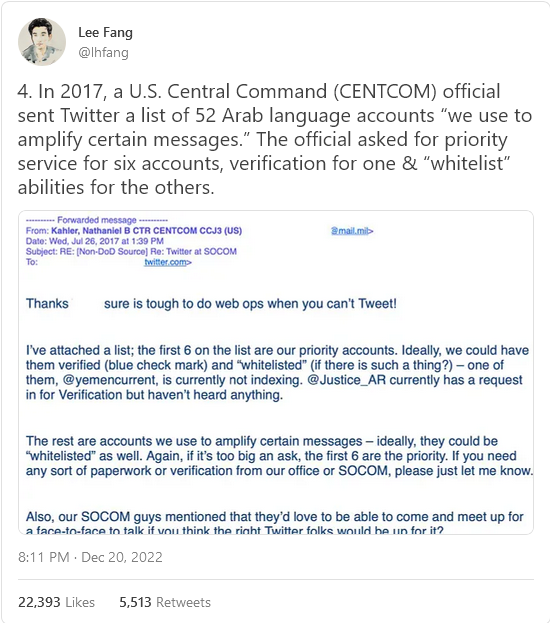
[…] Twitter has been constantly flooded with requests from at least dozens of separate federal entities, all of them needy and pushy and consuming the company’s time and energy: CENTCOM wants a meeting this week and CDC wants a meeting this week and NIH wants a meeting this week and the FBI wants a meeting this week and the White House wants a meeting this week and DHS wants a meeting this week and DOD wants a meeting this week even though CENTCOM already has one, and several members of Congress have some concerns they want the senior team to address this week, and …
Now: Twitter is a global platform. I would bet a kidney that there’s a Twitter Files equivalent for the Ottawa Police Department during the Freedom Convoy, and an RCMP file, and a Trudeau government file, and that Chrystia Freeland had some thoughts to share about some tweets she didn’t like. I would bet the other kidney that Twitter has equivalent files, in dozens of languages, from multiple government agencies in Iran and New Zealand and Australia and the Netherlands and the UK and Brazil and on and on an on.
As for my third kidney — just go with it, and we’ll clean up the biological metaphors later — state and local governments also expect Twitter to act on their content concerns and complaints about disinformation, which means fifty governors and attorneys general and state directors of public health and state police commanders picking up the phone, and 3,243 sheriffs and district attorneys and public health directors expecting to be able to reach out to their partners at Twitter, and close to 20,000 mayors and police chiefs, and thousands of state legislators and tens of thousands of city councilmembers, and on and on and on. “You tell this Jack Dorsey that I’m the damn mayor pro tem here in Glendale, and I want my concerns to be dealt with.”
And so, if we accept the premise that governments have special rights to demand content moderation, if the staff director of a legislative committee in the Arkansas state legislature and a sheriff in Maryland and the flag officers at all the MACOMS and Jen Psaki’s deputy assistant and a member of a county board of supervisors in Oregon and the chief of staff to the governor of Rhode Island, being Very Important People, all expect to by God get a direct meeting with Twitter executives because @buttchug623 is saying some things that they do not like at all, and oh by the way the prime minister of the Democratic Republic of the Congo is holding on line 6 and he’s pissed and when can you pencil in a half-hour with Turkmenistan’s finance minister, then how much does it cost to manage all of those relationships?
The regulatory affairs staffing buries the business — you can’t pay for that much face time with that many self-important officials. We need to schedule the senior management team for a meeting with the White House this week, ’cause they don’t like Alex Berenson. How does anyone run a business under these conditions? “Before you cook that cheeseburger for order number seven, the deputy assistant secretary for sustainable agriculture would like to share some thoughts on the environmental trajectory of industrial protein cultivation. And about that milkshake …”
In addition to the free speech problem and the pathologies of gleichschaltung, the Twitter files are about the way government without boundaries consumes resources from every entity it touches.
Twitter’s path to bankruptcy runs through the premise that every government official who doesn’t like a tweet deserves a meeting.
Comments Off on The Twitter Files – “How does anyone run a business under these conditions?”
December 23, 2022
Remember when ending “Net Neutrality” was going to be the death of the internet?
Peter Jacobsen answers a reader question about the now almost forgotten doomsday scenario for the internet that was the ending of “Net Neutrality” in 2017:
To answer this question, we have to wind back the clock to 2017. Then-chair of the Federal Communications Commission (FCC) Ajit Pai successfully led an effort to repeal a set of 2015 regulations on Internet Service Provider (ISP) companies originally put into place by the Obama Administration.
The simplest summary of net neutrality regulations is that they required ISPs to enable access to content on the internet at equal speeds and for equal costs. For example, your ISP charging you to get faster speeds on YouTube or blocking High Definition access on Netflix would be examples of violations of net neutrality.
The idea of paying your ISP extra to have access to certain websites is a scary one, but it appears the worst fears associated with the end of net neutrality were overstated. To some extent proponents of net neutrality are the victim of their own apocalyptic marketing.
The Rumors of the Internet’s Death Were Greatly Exaggerated
If you spent any time on the internet during the death of net neutrality, it was hard to miss it. On July 12, 2017 websites across the internet coordinated their messages for the “battle for the net.”
Websites including Amazon, Netflix, YouTube, and Reddit called their users to fight for “a free and open internet”.
On Twitter, #SaveTheInternet thrived, seemingly implying the internet itself was facing an existential threat.
The repeal of #NetNeutrality officially goes into effect today, but the fight is far from over.
The people saying we can’t pass the resolution to #SaveTheInternet in the House are the same people who were saying we couldn’t do it in the Senate.
Ignore them. Just keep fighting.
— Ed Markey (@SenMarkey) June 11, 2018
After the decision by the FCC, CNN briefly declared it was “the end of the internet as we know it”.
Unfortunately for all kinds of doomsday prophets, extreme rhetoric always looks silly in hindsight when it fails to pan out.
Obviously we aren’t seeing ISPs charge users different amounts to use different websites in any systematic way. There’s no “pay your ISP to access Hulu” package yet. So already it’s clear some of the doom and gloom was over-hyped.
Fears of ISPs offering “fast lanes” to make users pay more for better service don’t seem to have materialized either. The only example of this sort of thing I could find was a Cox Communications trial of an “Elite Gamer” service. But this service was unlike the “fast lanes” hyped up by net neutrality proponents in that it never offered a less throttled experience and would have been permissible under the old net neutrality rules.
One of the biggest concerns about the repeal of these regulations was that it would lead ISPs to favor their own services. For example, AT&T owns Time Warner and HBO Max. In theory, AT&T could silently throttle speed to competing streaming platforms like YouTube and Netflix, thereby destroying competition.
Comments Off on Remember when ending “Net Neutrality” was going to be the death of the internet?
December 20, 2022
The forgotten Thomas Savery
In the latest Age of Invention newsletter, Anton Howes remembers the work of inventor Thomas Savery:

Screenshot from “Savery’s Miners Friend – 1698”, a YouTube video by Guy Janssen (https://www.youtube.com/watch?v=Dt5VvrEIj8w)
We know surprisingly little about Thomas Savery — the inventor of the first widely-used steam engine. Unfortunately, his achievements were almost immediately overshadowed by the engine of Thomas Newcomen, and so he’s often only mentioned as a sort of afterthought — a loose and rather odd-seeming pebble before the firmer stepping stones of Newcomen, Watt, Trevithick, and other steam engine pioneers in the standard and simple narratives of technological progress that people like to tell. I’ve often seen Savery’s name omitted entirely.
He is even neglected by the experts. The Newcomen Society, of which I am a new member, has an excellent journal — it is the best place to find scholarly detail about all steam pioneers, and about the history of engineering in general. Yet even it only mentions Savery in passing. In over a century, Savery has been named in the titles of just three of its articles, and the last was published in 1986.
I think Savery is extremely under-rated, and deserves to be studied more. Fortunately, we do know quite a bit about the engine he designed, which he intended primarily for raising the water out of mines. Steam was admitted into a chamber, and then sprayed with cold water to condense it. This caused mine water to be sucked up a pipe beneath it, by creating a partial vacuum within the chamber and thus exploiting the relative pressure of the atmosphere on the surface of the mine water. Then, hot steam was readmitted to the chamber, this time pushing the raised water further up through another pipe above. Two chambers, the one sucking while the other pushed, created a continuous flow. (Video here.) We have dozens of images and technical descriptions of Savery’s engine, as it continued to be used for decades, especially in continental Europe.
But we know essentially nothing about Savery’s background, training, inspiration, or profession, and most of the supposedly known biographical details we have for him are simply wrong. There is no evidence that he was a “military engineer” or a “trenchmaster”, for example — mere speculation that has been repeated so often as to take on the appearance of fact. Savery simply appears out of nowhere in the 1690s, with his inventions almost fully formed.
Yet in Savery’s own writings we can see a few tantalising hints of how he thought, including some flashes of brilliance. I kept coming across them by chance, when investigating various energy-related themes with Carbon Upcycling. Take the following aside, from Savery’s 1702 prospectus for his steam engine: “I have only this to urge, that water in its fall from any determinate height, has simply a force answerable and equal to the force that raises it”. Savery here seems to be hinting at some idea of the conservation of energy, and perhaps of a theoretical maximum efficiency — in a phrase that is remarkably similar to that used by the pioneers of water wheel theory half a century later, and to Sadi Carnot when he applied the same ideas to early thermodynamics.
Savery, frustratingly, doesn’t expand any further on the point, except to then casually mention the notions of both mechanical work and horsepower — over eighty years before James Watt. Savery noted that when an engine will raise as much water as two horses can in the same time, “then I say, such an engine will do the work or labour of ten or twelve horses” — ten horsepower, rather than two, because you’d need a much larger team of horses from which to rotate fresh ones while the others rested, to keep raising water as continuously as the force of a stream could turn a water-wheel, or his steam engine could pump. (Incidentally, Watt wasn’t even the second person to use horsepower — the same concept was also mentioned by John Theophilus Desaguliers in the 1720s and John Smeaton in the 1770s. Watt just managed to get all the credit later on. Perhaps watts should really be called saveries, even if he was less precise.)
Comments Off on The forgotten Thomas Savery
December 19, 2022
QotD: When reality fails to follow the model, ditch reality
I get that, man. On some fundamental level. But that makes me a generally unhappy guy. So it is, so it has always been.
For whatever reason, the Leftist is able to externalize that. If there are no more worlds to conquer, well, that’s the world’s fault. I remember hanging out with some of the Political Science goofs at Flyover State. For whatever reason, they rank pretty high for Poli Sci — their department developed some measure of whatzit to better analyze the doodad, you know how it goes, the Karl Roves and James Carvilles of the world all use it.
Anyway, this was 2004, when George W. Bush won his reelection campaign against Kerry. Exactly zero of the Flyover State Poli Sci goofs predicted that. They were all certain that Kerry was cruising to victory. When I pointed out that this seems to be a BIG flaw in their precious model — the election wasn’t even particularly close — their response was instructive: It wasn’t the model’s fault. Rather, it’s that the American public chose to throw a temper tantrum.
That’s seriously what they went with. There’s the actual, observed behavior of 70 million people; and there’s your model; and when the one contradicts the other, the only possible explanation is: All those people are idiots.
(One of those grad students I was talking to ended up doing something “unofficial” yet fairly important for the Hillary Clinton campaign in 2016; if I’d known that, I could’ve called it for Trump at the very start of election and made a fortune on prop bets).
It’s probably genetic for them, too. Which is either hopeful or depressing, depending, but I think it answers the question: Why does society end up being ruled by Very Clever Boys? They just can’t do anything else. They can’t internalize; they have game the system. Have to. A society that wants to survive must find a system for them to game, somewhere far isolated from the real affairs of people.
Severian, “Me vs. The World”, Founding Questions, 2022-09-14.
Comments Off on QotD: When reality fails to follow the model, ditch reality
December 18, 2022
QotD: Citation systems and why they were developed
The first thing that needs to be noted here is that systems of citation are for the most part a modern invention. Pre-modern authors will, of course, allude to or reference other works (although ancient Greek and Roman writers have a tendency to flex on the reader by omitting the name of the author, often just alluding to a quote of “the poet” where “the poet” is usually, but not always, Homer), but they did not generally have systems of citation as we do.
Instead most modern citation systems in use for modern books go back at most to the 1800s, though these are often standardizations of systems which might go back a bit further still. Still, the Chicago Manual of Style – the standard style guide and citation system for historians working in the United States – was first published only in 1906. Consequently its citation system is built for the facts of how modern publishing works. In particular, we publish books in codices (that is, books with pages) with numbered pages which are typically kept constant in multiple printings (including being kept constant between soft-cover and hardback versions). Consequently if you can give the book, the edition (where necessary), the publisher and a page number, any reader seeing your citation can notionally go get that edition of the book and open to the very page you were looking at and see exactly what you saw.
Of course this breaks down a little with mass-market fiction books that are often printed in multiple editions with inconsistent pagination (thus the endless frustration with trying to cite anything in A Song of Ice and Fire; the fan-made chapter-based citation system for a work without numbered or uniquely named chapters is, I must say, painfully inadequate.) but in a scholarly rather than wiki-context, one can just pick a specific edition, specify it with the facts of publication and use those page numbers.
However the systems for citing ancient works or medieval manuscripts are actually older than consistent page numbers, though they do not reach back into antiquity or even really much into the Middle Ages. As originally published, ancient works couldn’t have static page numbers – had they existed yet, which they didn’t – for a multitude of reasons: for one, being copied by hand, the pagination was likely to always be inconsistent. But for ancient works the broader problem was that while they were written in books (libri) they were not written in books (codices). The book as a physical object – pages, bound together at a spine – is more technically called a codex. After all, that’s not the only way to organize a book. Think of a modern ebook for instance: it is a book, but it isn’t a codex! Well, prior to codex becoming truly common in third and fourth centuries AD, books were typically written on scrolls (the literal meaning of libri, which later came to mean any sort of book), which notably lack pages – it is one continuous scroll of text.
Of course those scrolls do not survive. Rather, ancient works were copied onto codices during Late Antiquity or the Middle Ages and those survive. When we are lucky, several different “families” of manuscripts for a given work survive (this is useful because it means we can compare those manuscripts to detect transcription errors; alas in many cases we have only one manuscript or one clearly related family of manuscripts which all share the same errors, though such errors are generally rare and small).
With the emergence of the printing press, it became possible to print lots of copies of these works, but that combined with the manuscript tradition created its own problems: which manuscript should be the authoritative text and how ought it be divided? On the first point, the response was the slow and painstaking work of creating critical editions that incorporate the different manuscript traditions: a main text on the page meant to represent the scholar’s best guess at the correct original text with notes (called an apparatus criticus) marking where other manuscripts differ. On the second point it became necessary to impose some kind of organizing structure on these works.
The good news is that most longer classical works already had a system of larger divisions: books (libri). A long work would be too long for a single scroll and so would need to be broken into several; its quite clear from an early point that authors were aware of this and took advantage of that system of divisions to divide their works into “books” that had thematic or chronological significance. Where such a standard division didn’t exist, ancient libraries, particularly in Alexandria, had imposed them and the influence of those libraries as the standard sources for originals from which to make subsequent copies made those divisions “canon”. Because those book divisions were thus structurally important, they were preserved through the transition from scrolls to codices (as generally clearly marked chapter breaks), so that the various “books” served as “super-chapters”.
But sub-divisions were clearly necessary – a single librum is pretty long! The earliest system I am aware of for this was the addition of chapter divisions into the Vulgate – the Latin-language version of the Bible – in the 13th century. Versification – breaking the chapters down into verses – in the New Testament followed in the early 16th century (though it seems necessary to note that there were much older systems of text divisions for the Tanakh though these were not always standardized).
The same work of dividing up ancient texts began around the same time as versification for the Bible. One started by preserving the divisions already present – book divisions, but also for poetry line divisions (which could be detected metrically even if they were not actually written out in individual lines). For most poetic works, that was actually sufficient, though for collections of shorter poems it became necessary to put them in a standard order and then number them. For prose works, chapter and section divisions were imposed by modern editors. Because these divisions needed to be understandable to everyone, over time each work developed its standard set of divisions that everyone uses, codified by critical texts like the Oxford Classical Texts or the Bibliotheca Teubneriana (or “Teubners”).
Thus one cited these works not by the page numbers in modern editions, but rather by these early-modern systems of divisions. In particular a citation moves from the larger divisions to the smaller ones, separating each with a period. Thus Hdt. 7.234.2 is Herodotus, Book 7, chapter 234, section 2. In an odd quirk, it is worth noting classical citations are separated by periods, but Biblical citations are separated by colons. Thus John 3:16 but Liv. 3.16. I will note that for readers who cannot access these texts in the original language, these divisions can be a bit frustrating because they are often not reproduced in modern translations for the public (and sometimes don’t translate well, where they may split the meaning of a sentence), but I’d argue that this is just a reason for publishers to be sure to include the citation divisions in their translations.
That leaves the names of authors and their works. The classical corpus is a “closed” corpus – there is a limited number of works and new ones don’t enter very often (occasionally we find something on a papyrus or lost manuscript, but by “occasionally” I mean “about once in a lifetime”) so the full details of an author’s name are rarely necessary. I don’t need to say “Titus Livius of Patavium” because if I say Livy you know I mean Livy. And in citation as in all publishing, there is a desire for maximum brevity, so given a relatively small number of known authors it was perhaps inevitable that we’d end up abbreviating all of their names. Standard abbreviations are helpful here too, because the languages we use today grew up with these author’s names and so many of them have different forms in different languages. For instance, in English we call Titus Livius “Livy” but in French they say Tite-Live, Spanish says Tito Livio (as does Italian) and the Germans say Livius. These days the most common standard abbreviation set used in English are those settled on by the Oxford Classical Dictionary; I am dreadfully inconsistent on here but I try to stick to those. The OCD says “Livy”, by the by, but “Liv.” is also a very common short-form of his name you’ll see in citations, particularly because it abbreviates all of the linguistic variations on his name.
And then there is one final complication: titles. Ancient written works rarely include big obvious titles on the front of them and often were known by informal rather than formal titles. Consequently when standardized titles for these works formed (often being systematized during the printing-press era just like the section divisions) they tended to be in Latin, even when the works were in Greek. Thus most works have common abbreviations for titles too (again the OCD is the standard list) which typically abbreviate their Latin titles, even for works not originally in Latin.
And now you know! And you can use the link above to the OCD to decode classical citations you see.
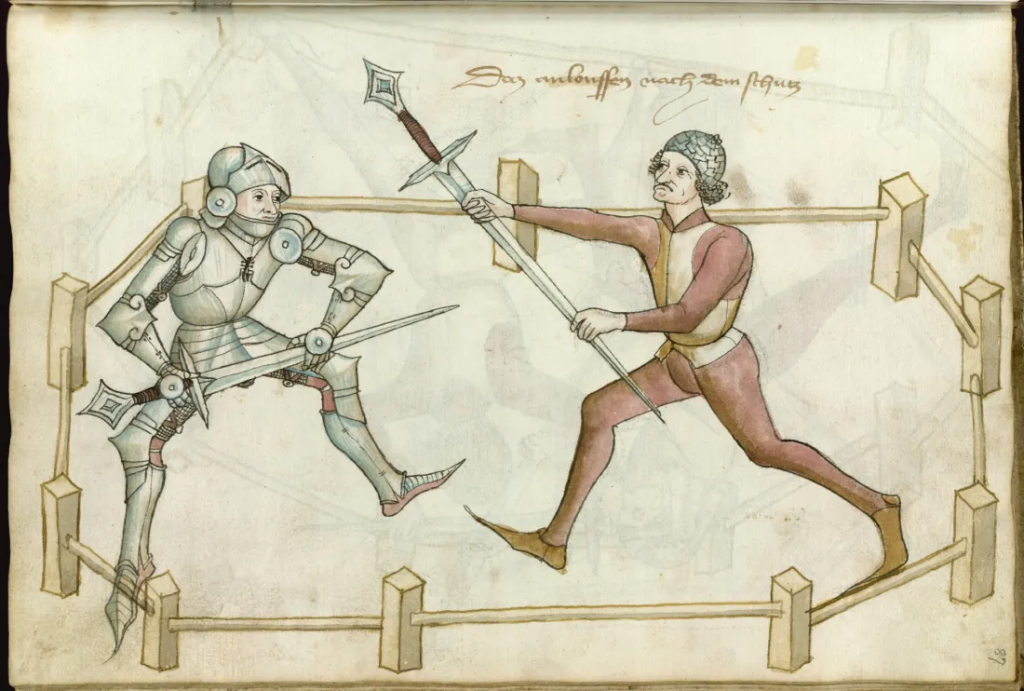
One final note here: manuscripts. Manuscripts themselves are cited by an entirely different system because providence made every part of paleography to punish paleographers for their sins. A manuscript codex consists of folia – individual leaves of parchment (so two “pages” in modern numbering on either side of the same physical page) – which are numbered. Then each folium is divided into recto and verso – front and back. Thus a manuscript is going to be cited by its catalog entry wherever it is kept (each one will have its own system, they are not standardized) followed by the folium (‘f.’) and either recto (r) or verso (v). Typically the abbreviation “MS” leads the catalog entry to indicate a manuscript. Thus this picture of two men fighting is MS Thott.290.2º f.87r (it’s in Det Kongelige Bibliotek in Copenhagen):
MS Thott.290.2º f.87r which can also be found on the inexplicably well maintained Wiktenauer; seriously every type of history should have as dedicated an enthusiast community as arms and armor history.
And there you go.
Bret Devereaux, “Fireside Friday, June 10, 2022”, A Collection of Unmitigated Pedantry, 2022-06-10.
Comments Off on QotD: Citation systems and why they were developed
December 14, 2022
Our Nuclear Alternate Future?
Big Car
Published 9 Apr 2021In the 1950s, as the Cold War was heating up and children were being urged to “duck and cover” from nuclear weapons, car companies seriously proposed powering their cars using lead-lined nuclear reactors. It seems like madness today, but while the world saw the threat of nuclear war, they also saw the seemingly limitless potential from nuclear power. Just how were these vehicles supposed to work and how far did they get to reality?
(more…)
Comments Off on Our Nuclear Alternate Future?
December 9, 2022
QotD: Computer models of “the future”
Second, the video ignores the fact that human behavior changes in response to circumstance, sometimes in radically unpredictable ways. I might predict that we will hit peak oil (or be extremely wealthy) if I extrapolate various trends. However, as oil becomes scarce, people discover new ways to obtain it or do without it. As people become wealthier, they become less interested in the pursuit of wealth and therefore become poorer. Both of those scenarios, however, assume that humanity will adopt a moral and optimistic stance. If humans become decadent and pessimistic, they might just start wars and end up feeding off the scraps.
So, interestingly, what the future looks like might be as much a function of the music we listen to, the books we read, and the movies we watch when we are young as of the resources that are available.
Note that the solution they propose to our problems is internationalization. The problem with internationalizing everything is that people have no one to appeal to. We are governed by a number of international laws, but when was the last time you voted in an international election? How do you effect change when international policies are not working out correctly? Who do you appeal to?
The importance of nationalism is that there are well-known and generally-accepted procedures for addressing grievances with the ruling class. These international clubs are generally impervious to the appeals (and common sense) of ordinary people and tend to promote virtue-signaling among the wealthy class over actual virtue or solutions to problems.
Jonathan Bartlett, quoted in “1973 Computer Program: The World Will End In 2040”, Mind Matters News, 2019-05-31.
Comments Off on QotD: Computer models of “the future”


