
I don’t understand commercials for medicine anymore. I mean, I understand what they’re trying to say when they advertise a medication and list its possible side effects. I just don’t understand why they bother anymore. Nobody takes these advertisements seriously. The other day, I saw a spot for something called Restless Legs Syndrome. I was stunned when it ended without turning into a “Good news; I just saved 15 percent on my car insurance by switching to Geico” commercial. That’s how bad it’s gotten. It doesn’t even matter how legitimate the affliction is. It could be cancer at this point. It could be a pill to stop spontaneous human combustion. Wouldn’t matter. I see these commercials and instinctively shrug them off. I suffer from Grain of Salt Disorder.
Jonathan David Morris, “Thoughts On Health”, Libertarian Enterprise, 2005-09-18.
May 18, 2026
QotD: Medical ads
May 15, 2026
Sweden – “We’re actually trying to get rid of screens as much as possible”
Back in the early days of the internet, a lot of us were enthusiastic about schools adopting digital technology, as it seemed to be the way of the future for kids to be fully immersed in the online world as part of their education. Reality has harshed the mellow for a lot of us misguided techno-fossils, as there seems to be a very strong correlation between childrens’ (computer) screen use and lower educational achievements. Sweden is trying to reverse this pattern:

“student_ipad_school – 038” by flickingerbrad is licensed under CC BY 2.0 
 .
.
According to primary school teachers, many children shamble through the doors today zombified and crying out for their iPads.
Their parents, lined at the school gates, barely say goodbye, what with the hypnotic drivel spewing from their iPhones.
The kids greet their teachers with the YouTube vernacular: “Hi, guys!” When handed a book, they swipe and tear at the unfamiliar paper. They greet each other with: “Welcome to my channel!”
Finally, when they leave, they don’t say goodbye. They say: “Remember to like and subscribe!”
I’m not taking the piss. A friend of mine, tasked with civilising these screen-addled sprogs, confirms what one reads in the newspapers. These chirpy little addicts ransack classrooms crying out for more iPad with the fanatical calculation of tweaking crackheads.
Wherever you may sit on the political spectrum, I hope you agree that a functioning democracy might one day need citizens who can read and write, and who can concentrate beyond a ten-second video clip.
At least one functioning democracy agrees. Recently, Swedish politicians reversed their digital-first obsession by announcing a return to paper and pen. The sensible Swedes have gone analogue. Why? Literacy rates in the cosy Nordic social democracy have collapsed.
“We’re actually trying to get rid of screens as much as possible,” said the Liberal party’s Joar Forsell.
Since 2025, pre-schools are no longer obliged to employ digital ‘tools’ and teachers no longer dole out tablets to kids under two. According to Mr Forsell, reading real books on paper does what schools have for decades avoided: it teaches kids to think. Tablets for toddlers is now från skärm till pärm (from screen to paper.)
High school students now drag their textbooks and notepads to classrooms stripped of screens.
The evidence piles up. Researchers found that hyper-digital tablets-for-toddlers eroded basic skills. Writing by hand, Swedish students learned more and retained more. Wiping away digital mandates, Swedish lawmakers promise more handwriting and books, fewer devices, and quiet reading time.
But it’s not just the Swedes.
Psychologists Pam A. Mueller (Princeton University) and Daniel M. Oppenheimer (UCLA) found handwriting beats typing — at least if learning something is your thing. Students who pecked down verbatim notes on their laptops wrote twice as many words as their pen-and-paper classmates. Who learned and remembered more? Take a guess.
How could this be? Writing by hand is slower. You’re forced to process and reframe information in your own words — the art of thinking. Screens hamper this essential process. When we write by hand, there’s a greater connection between the brain and the finger. This act, they say, cements the information in one’s brain. Essentially, the typists transcribed much. They absorbed little. It’s like paying someone else to have sex for you.
Researchers claim that writing on paper improves everything from recalling a random series of words to grasping and understanding complicated or conceptual ideas. Writing by hand ties down the balloons of motor, visual, and sensory memory.
When studying from their notes, the longhand writers did better on tests. This persisted even when the typists were told to rephrase the material into their own words. They didn’t absorb the material. They parroted it, much like ChatGPT doesn’t know that flipping a glass spills water. It merely knows that the words “flip” and “glass of water” are statistically related to the word “spill”.
And yet, British schools continue marching to the drumbeat of post-literate doom.
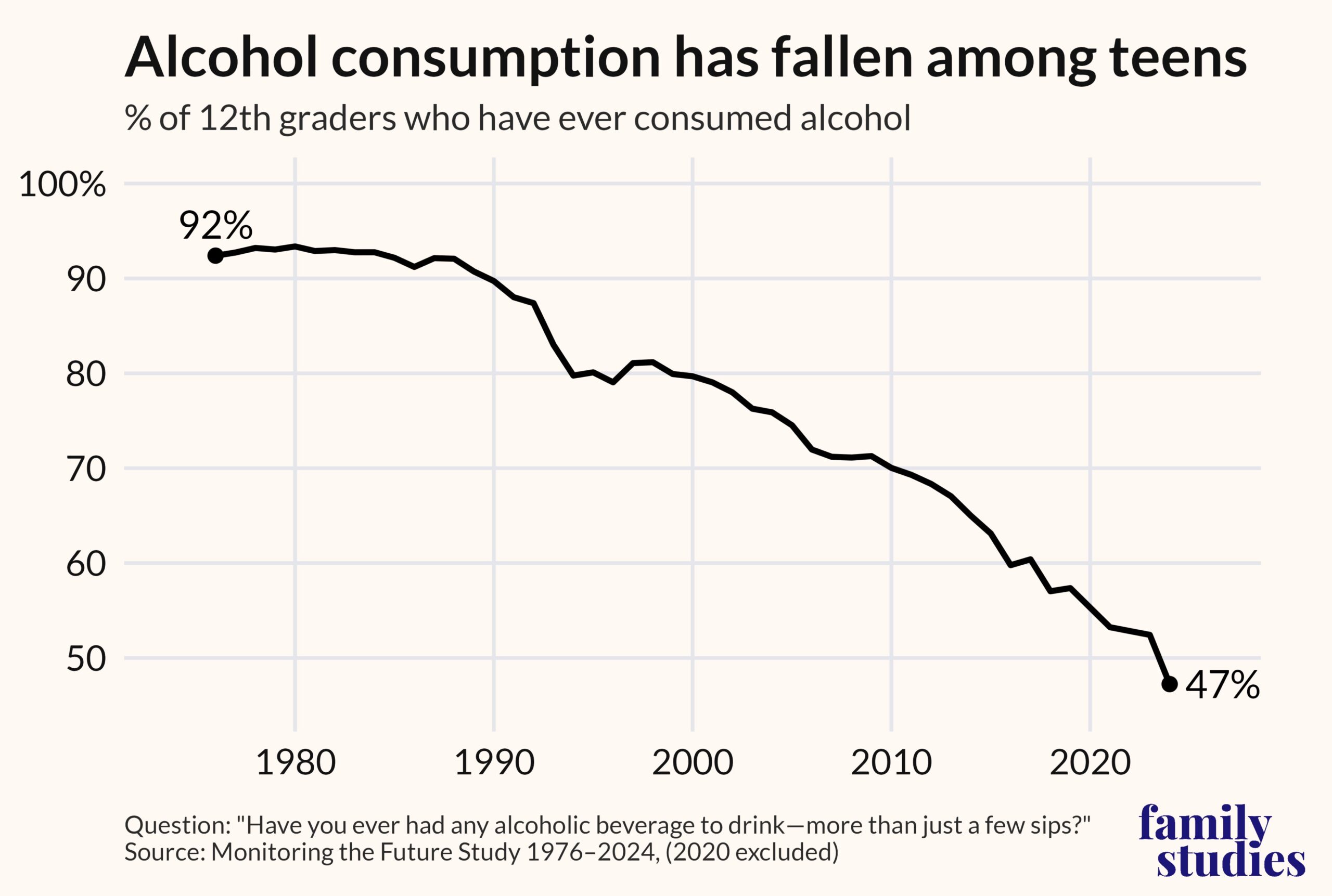
The good news: kids are drinking a lot less! But there’s also bad news …
The good news seemed to be that teenage drinking was dropping fast. Fewer underage drinkers, happier teenagers, right? Not so fast …
⚡️The deeper signal is youth risk did not disappear.
It migrated inward.
Teen drinking fell because the old physical world of adolescence got dismantled. Alcohol belonged to a social ecosystem: unsupervised time, cars, parties, local jobs, malls, basements, boredom, flirting, older siblings, house gatherings, and the chaotic peer world where teenagers learned who they were by colliding with other people in real space.
That ecosystem was replaced by phones, surveillance, parental tracking, algorithmic entertainment, social anxiety, online status games, and a much thinner physical commons.
So the surface looks healthier. Fewer kids drinking. Fewer kids using weed. Fewer kids doing reckless things in public.
The hidden layer looks worse. The young are less reckless because they are less socially embodied. Less initiation. Less unsupervised friction. Less courage-building. Less embarrassment and recovery. Less real dating. Less independence. Less contact with the physical world before adulthood demands it.
The old teenage world produced damage, stupidity, alcohol abuse, pregnancy risk, fights, accidents, and bad decisions. No need to romanticize it. But it also produced social reps. It forced young people through discomfort. It made them practice attraction, rejection, conflict, reputation, risk, repair, and status in the open.
The new world suppresses visible risk while increasing invisible fragility.
That is the trade.
A teenager can avoid drinking, avoid parties, avoid sex, avoid driving, avoid real confrontation, avoid rejection, avoid shame, avoid danger, and still arrive at 23 emotionally underbuilt. Cleaner behavior does not automatically mean stronger formation.
This is why the marriage chart and the teen drinking chart are the same story at different stages. People are not suddenly failing to pair in adulthood. The whole pathway into embodied adulthood has been slowing for years before marriage even becomes the question.
The real truth: society solved part of the teen vice problem by shrinking the arena where teenagers become adults.
It took away the dangerous commons and replaced it with controlled isolation.
The result is safer kids with weaker initiation into real life.
May 13, 2026
“The dark genius of bureaucracy”
Auto-translation on the social media site formerly known as Twitter has brought some posts from Brivael Le Pogam to my attention, like this one:
The Invisible Cemetery
Milton Friedman said a phrase that should haunt every European legislator for the rest of their life. On the FDA, he said this: there is overwhelming evidence that they have caused more deaths through delayed approvals than they have saved through early approvals.
Read it twice. More deaths from excessive caution than lives saved by caution.
And no one sees it. That’s the dark genius of bureaucracy.
Bastiat theorized the principle 175 years ago. “What is seen and what is not seen.” The economist, he said, is not distinguished from the bad economist by the ability to see the immediate effect of a decision. Everyone sees that. He is distinguished by the ability to see the invisible effects, the delayed ones, the ones diffused across the entire population.
The self-driving car is the perfect example. And it’s playing out right before our eyes.
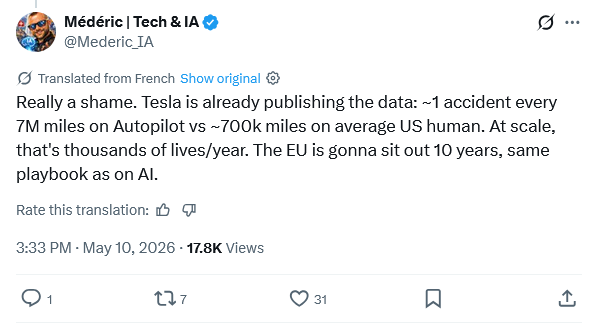
Tesla publishes the numbers. One accident every 7 million miles in Autopilot. One accident every 700,000 miles in the average American human. Autopilot is, at this stage, ten times safer than a human. And it’s only getting better, with every release.
Now France. 3,200 deaths on the roads in 2024. 91% involve human error. Speed, alcohol, fatigue, distraction. If we deployed a self-driving car ten times safer tomorrow, we’d divide the carnage by ten. We’re talking about 2,800 lives a year. Over ten years, 28,000 people. The equivalent of an average French town that disappears, because no one pressed the right button in Brussels.
You’ll never see them. No newspaper will headline: “Today, 8 people died because the self-driving car is banned in Europe”. No parliamentary commission will investigate. No bureaucrat will be fired. Those deaths will go in the “road fatality” box. We’ll run moving campaigns with their photos on 4×3 billboards. We’ll say it’s sad, that’s life.
Meanwhile, the first accident of a self-driving car will be front-page news in every paper for three weeks. The regulator will summon the manufacturers. NGOs will call for preventive bans. Deputies will write op-eds. The minister will decree a moratorium.
Five visible deaths will outweigh, in the media and political balance, five thousand invisible deaths. That’s the iron law of bureaucracy. The bureaucrat who authorizes something that goes wrong loses their career. The bureaucrat who bans something that would have saved thousands of lives is never troubled. No one holds them accountable for the deaths they could have prevented. They don’t exist in their statistics. They don’t exist in their trial.
Friedman had identified the exact mechanism: when a regulator errs on the side of laxity, their victims have names, faces, families, lawyers. When they err on the side of caution, their victims are anonymous, scattered, statistical, ghosts. The structure of incentives makes over-regulation rationally inevitable. And the invisible cemetery grows, generation after generation.
Europe is going to sit out 10 years on the self-driving car, just as it sat out on AI, as it sat out on genetic engineering, as it sat out on fourth-generation nuclear. Every time, the same playbook. Precaution, moratorium, ethics committee, white paper, directive, transposition. And every time, behind the curtain of words, deaths that appear in no official statistics.
These are deaths. Not opportunity costs. Not “economic losses”. Human beings who were alive and who died because an innovation that could have saved them was delayed by people whose literal job it is.
That’s what needs to be built, and it’s probably the most important political project of the century that’s opening. A system for accounting for invisible deaths. A registry of the cemetery that no one sees.
For every regulation, every moratorium, every preventive ban, we should be able to produce a signed, dated, quantified estimate of the human cost in lives of the decision. Not direct effects. Delayed effects, indirect ones, statistical ones. How many deaths per year caused by banning a technology that works elsewhere.
Imagine. On the desk of the European commissioner about to sign a moratorium on the self-driving car, a document: “Central estimate, 2,800 deaths per year for the duration of the moratorium. High-end range, 4,100. Low-end range, 1,900. Source: comparative analysis Tesla Autopilot vs. human average, NHTSA and ONISR data, public and audited method.”
On the desk of the European deputy who will vote on the AI Act: “Central estimate, 38 billion euros in lost GDP, 240,000 jobs not created, X deaths per year due to delays in AI medical diagnostics, Y deaths per year due to delays in deploying autonomous drones for medical delivery in rural areas.”
Today, we sign blindly. We sign without cost. We sign with a clear conscience because the deaths we cause are anonymous and the lives we protect have faces. That’s what needs to be broken.
A bureaucracy is an institution that operates without being held accountable for the invisible consequences of its decisions. As long as invisible deaths are not counted, bureaucracy is mechanically, structurally, inevitably a machine for producing deaths it will never see.
Europe isn’t losing a technological battle. It’s filling a cemetery. Year after year. And no one wears mourning. No one lays flowers. No one knows they’re there.
Friedman saw them before everyone else. Bastiat before him. Williams after him. And each posed the same question, which echoes like an accusation through the centuries: who weeps for the deaths we didn’t see coming?
That’s the work ahead of us. Making the invisible cemetery visible. Accounting for it. Auditing it. Publishing it. Confronting every bureaucrat, every day, with the exact list of lives that their signature takes with it.
Before the list becomes ours.
May 12, 2026
QotD: “… this pattern will be immune to all but the most draconian interventions, such as legally-imposed quotas”
[…] the achievement of social status and some degree of success in culturally-important domains are more strongly related to men’s than women’s reproductive prospects and success. The sex difference here is found in hunter-gatherer, pastoral, and agricultural societies, as well as in early empires, developing nations, and the modern world. One result is that men have an evolved motivation to increase their social status and to attempt to gain control of culturally-important resources, whether these resources are cows or cash. Women of course also benefit from improved status and resource control, but the evolutionary costs and benefits differ for each sex and have resulted in stronger status-related motivations and behaviors (e.g., long work hours) in men than women.
The expression of men’s status striving strongly contributes to the sex difference in occupational attainment that continually frustrates gender activists and thwarts policy edicts aimed at equality of outcomes. […] sex differences in status striving manifest in modern contexts and […] these are entirely consistent with broader patterns found across human cultures, human history, and in most species.
David C. Geary, “Sex Differences in Occupational Attainment are Here to Stay”, Quillette, 2020-11-02.
May 11, 2026
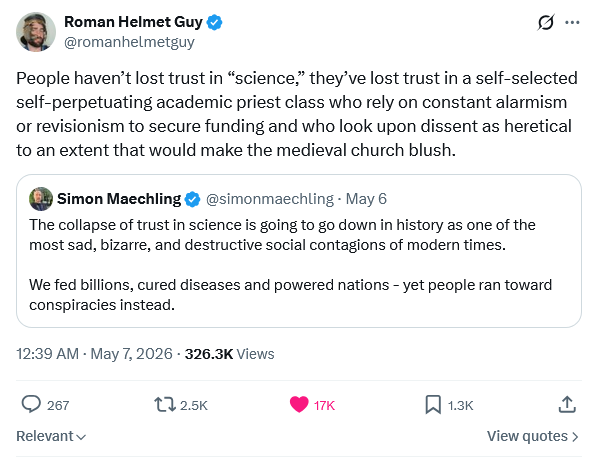
A tale of how the people lost faith in the Oracle
On the social media site formerly known as Twitter, Eve Keneinan tells a story about a people who once depended on the words of the Oracle and why they eventually stopped listening:
Once upon a time, the people of a certain land were blessed with an oracle of uncanny precision and depth in its predictions and information.
The people rose to prominence and prosperity thanks to consulting the oracle.
However, the people were never allowed to consult the oracle directly, but only through the priests that carried their questions to it, and brought the oracle’s responses back to them.
Eventually, the priests began to confuse the virtues and gifts of the oracle as their own, and began no longer to bother asking the oracle questions before deciding on what “its” answers would be.
Thus it transpired that, while the oracles was a reliable and beneficial as it ever was, since its true answers no longer reached the people, but merely the false and self-serving answers of the priests, the act of “consulting the oracle” became no longer beneficial.
So people stopped consulting the oracle.
The priests were mystified by this.
“The oracle is as reliable as ever,” they said amongst themselves. “Why do the people then no longer trust it?”
And yet they had done it themselves.
May 7, 2026
QotD: The loss of male spaces led to today’s epidemic of male loneliness
Places where men showed up without an agenda. Where conversation happened sideways, not face-to-face. Where no one asked men to perform vulnerability, explain themselves, or justify their presence.
Those places didn’t disappear because men rejected connection. They disappeared because our culture decided male-only spaces were no longer acceptable. And once they were gone, men were told that their resulting loneliness was a personal failure.
There has been a noticeable shift in recent months. A growing number of articles now
acknowledge male loneliness and even gesture toward men’s emotional needs. On the surface, this looks like progress — and in one narrow sense, it is. For decades, male loneliness was either ignored or mocked.But many of these pieces commit the same quiet betrayal.
After briefly acknowledging that men are lonely, many articles abandon subtlety altogether and place responsibility squarely on men themselves. Men don’t open up enough. Men don’t try hard enough. Men don’t build friendships properly. Men resist emotional growth.
What is missing is the most obvious factor of all: our culture systematically dismantled the spaces where men and boys once formed friendships.
Men Did Not “Forget” How to Connect, They Lost the Places Where Connection Happened
Male friendships have never primarily formed through structured emotional disclosure. They formed through shoulder to shoulder shared activity, regular presence, and low-pressure companionship. Men bonded by working alongside one another, not by facing one another across a table and “processing”.
For generations, this happened naturally in male-only spaces:
- Service clubs
- Fraternal organizations
- Trade guilds and apprenticeships
- Male sports leagues
- Scout troops
- Men’s religious groups
- Informal gathering places like barbershops and workshops
These environments weren’t about exclusion. They were containers — places where boys learned how to be men from men, and where adult men maintained connection without self-consciousness or surveillance.
Now consider what has happened.
- Barbershops are co-ed and transactional.
- Service clubs are now largely co-ed, and the informal freedoms that supported male bonding in male-only environments have largely disappeared.
- Community sports are co-ed or heavily regulated.
- Even the Boy Scouts are co-ed.
One by one, male spaces disappeared — not because men abandoned them, but because our culture increasingly viewed male-only environments as suspicious, outdated, or morally problematic.
The Asymmetry No One Wants to Name
At the same time male spaces were dismantled, female-only spaces proliferated.
- Women-only gyms are accepted.
- Women-only scholarships are celebrated.
- Women-only commissions exist at every level of government.
- Women-only networking events, parking, subway cars, retreats, and support groups are commonplace.
“Women-only” is understood as necessary, protective, and empowering.
“Men-only”, by contrast, is treated as exclusionary at best and dangerous at worst.
The result is an unspoken rule that everyone knows but few admit:
Women may gather without men. Men may not gather without women.
This is not equality. It is a double standard — and it has consequences.
Tom Golden, “The Quiet Lie Behind Male Loneliness”, Men Are Good, 2026-01-05.
May 6, 2026
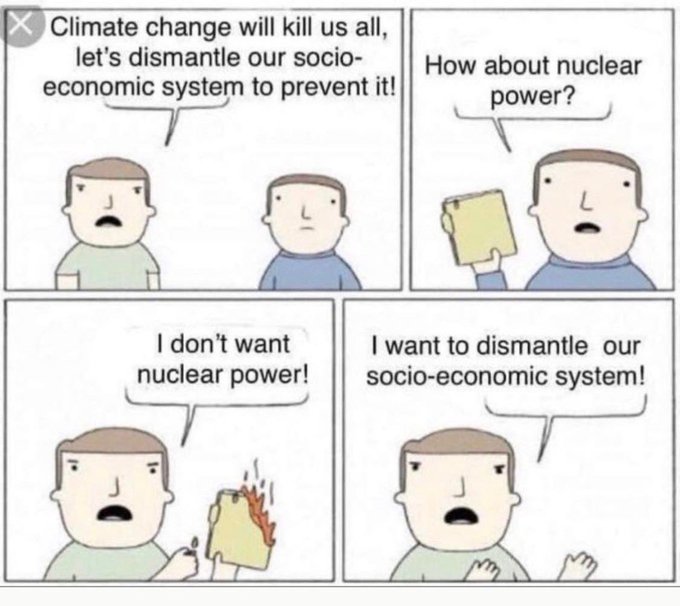
“I don’t want a solution, I want to dismantle our socio-economic system!”
On his Substack, Christopher Snowden explains how “public health” is just another of the many, many anti-capitalist branches of progressive belief:
Some people don’t really want to solve problems. They want to change the world for other reasons. That was the argument I made in Not Invented Here last year, a multi-author IEA publication that essentially elaborated on this meme …
One example is obesity, which we are told can only be tackled by fundamentally changing the food environment, banning advertising, taxing more products and demonising “Big Food”. None of this has ever actually worked anywhere. We do, however, now have GLP-1 drugs that work wonders for many people.
Plenty of “public health” academics are notably resistant to “fat jabs” because what they really want is to fundamentally change the food environment, ban advertising, tax more products and demonise “Big Food”.
Take this article from three self-described “public health scholars” in JAMA Health Forum, for example. They object to obesity being framed as a “a disease requiring individual treatment” because, they say, it undermines public support for government action. They even complain that “medical societies consistently argue that we do need to both prevent and treat obesity” because treatment — i.e. losing weight — is something that individuals can do for themselves. Moreover, studies have shown that when the public hear about people losing weight on their own initiative, they are less likely to support population-wide policies such as food taxation.
Broadcasting a “we need to do both” message, it turns out, is a counterproductive communications strategy for addressing the obesity epidemic. Studies message-testing obesity narratives find that public support for government action is highest when obesity is framed as the result of food industry manipulation and addresses toxic food environments.
The authors don’t seem particularly interested in whether this narrative is true. The main thing is that it can “build support for addressing upstream drivers of the obesity epidemic”. They conclude that medical professionals should stop talking about GLP-1 drugs in public and bang on about “BiG fOoD” instead.
While we acknowledge that public and media discourse often expect clinicians to comment on treatment efficacy and emergent therapies, in an ideal world, the medical community would move discussions about GLP-1 drugs targeting causes of individual cases in-house, while using its credibility and authority publicly to amplify much needed political discussions about the root causes of increasing obesity incidence.
This messaging should include concrete policy proposals targeting unhealthy food environments shifting the debate toward the structural causes of the obesity epidemic, such as World Health Organization–recommended sugar taxes and other policies that would effectively reverse the rise in ultraprocessed food production, marketing, and consumption and, importantly, the corporate power that has so far prevented governments from enacting these policies.
You can see why they are worried about fat jabs. The drugs work by giving people artificial willpower and prove that if obese people simply eat less food they will stop being obese. It has nothing to do with advertising, price, availability or “corporate power”.
From the perspective of the authors, these drugs are a threat, but what exactly is their perspective? The first author, Luc Hagenaars, has written a lot about sugar taxes which he compiled for his PhD thesis. He also worked at the Dutch Ministry of Health in the early 2020s when the Netherlands was undergoing its anti-liberal counter-revolution. Last year, he wrote an article titled “The Ozempic Era Could Shift Blame for Obesity From Individuals to Commercial Food Systems” which made exactly the opposite argument to the one he is making here.
Update, 8 May: Welcome, Instapundit readers! Have a look around at some of my other posts you may find of interest. I send out a daily summary of posts here through my Substack – https://substack.com/@nicholasrusson that you can subscribe to if you’d like to be informed of new posts in the future.
May 4, 2026
Our genetic heritage and our culture
On Substack, Helen Dale and Lorenzo Warby look at our genetic inheritance and how it continues to shape our culture:
From Wikipedia:
The Neolithic Y-chromosome bottleneck refers to a period around 5000 BC where the diversity in the male y-chromosome dropped precipitously across Africa, Europe and Asia, to a level equivalent to reproduction occurring with a ratio between men and women of 1:17. Discovered in 2015, the research suggests that the reason for the bottleneck may not be a reduction in the number of males, but a drastic decrease in the percentage of males with reproductive success in Neolithic agropastoralist cultures, compared to the previous hunter gatherers.
The development of farming and then animal herding greatly increased the number of humans — which continued to have evolutionary consequences for our species — and created productive assets (farms and animal herds) worth fighting over. Successful male teams (typically organised as clans) wiped out unsuccessful male teams and took their women as spoils.
Hence, there is a dramatic bottleneck in male lineages but not in female lineages. This pattern stopped with the development of chiefdoms and especially states, though not so much on the Steppes, whose states were more like super-chiefdoms and where intense competition over resources (and women) continued.1
This had consequences. A major one is that the male expression of human genes became dramatically better at forming and maintaining teams — as there was drastic selection pressure for that — but the female expression of human genes did not.
This is why young schoolboy sporting teams regularly crush adult women’s national teams in team sports such as soccer. It is not that schoolboys have the strength advantage over women associated with adult men (they are often not particularly advantaged around age 14-15). It’s simply that human males are much more likely to “get” teamwork at a visceral level.
At least some of the differences in the statistical distribution of cognitive traits between men and women comes from this genetic bottleneck’s intense selection pressure differences. This is particularly clear in social patterns. For instance, men readily form hierarchies — often using physical cues such as height to do so.
Men focus on roles, suppressing or otherwise managing their emotions to do so. They regularly test each other — hence ragging each other, making appalling jokes, etc. Such mechanisms generate trust, as they test whether you will fold under pressure, whether one can say outrageous things and still get support. Hence the popular quip:
Men insult each other but they don’t mean it. Women compliment each other but they also don’t mean it.
Men roast each other as tests because so much male interaction is about teamwork, and the roles and reliability that requires, while women typically look to emotional connection. Given that the latter requires a lot of interaction to build up trust, yes, female friendships can be quite intense, but relations between human females can also be viciously unstable and fissile.
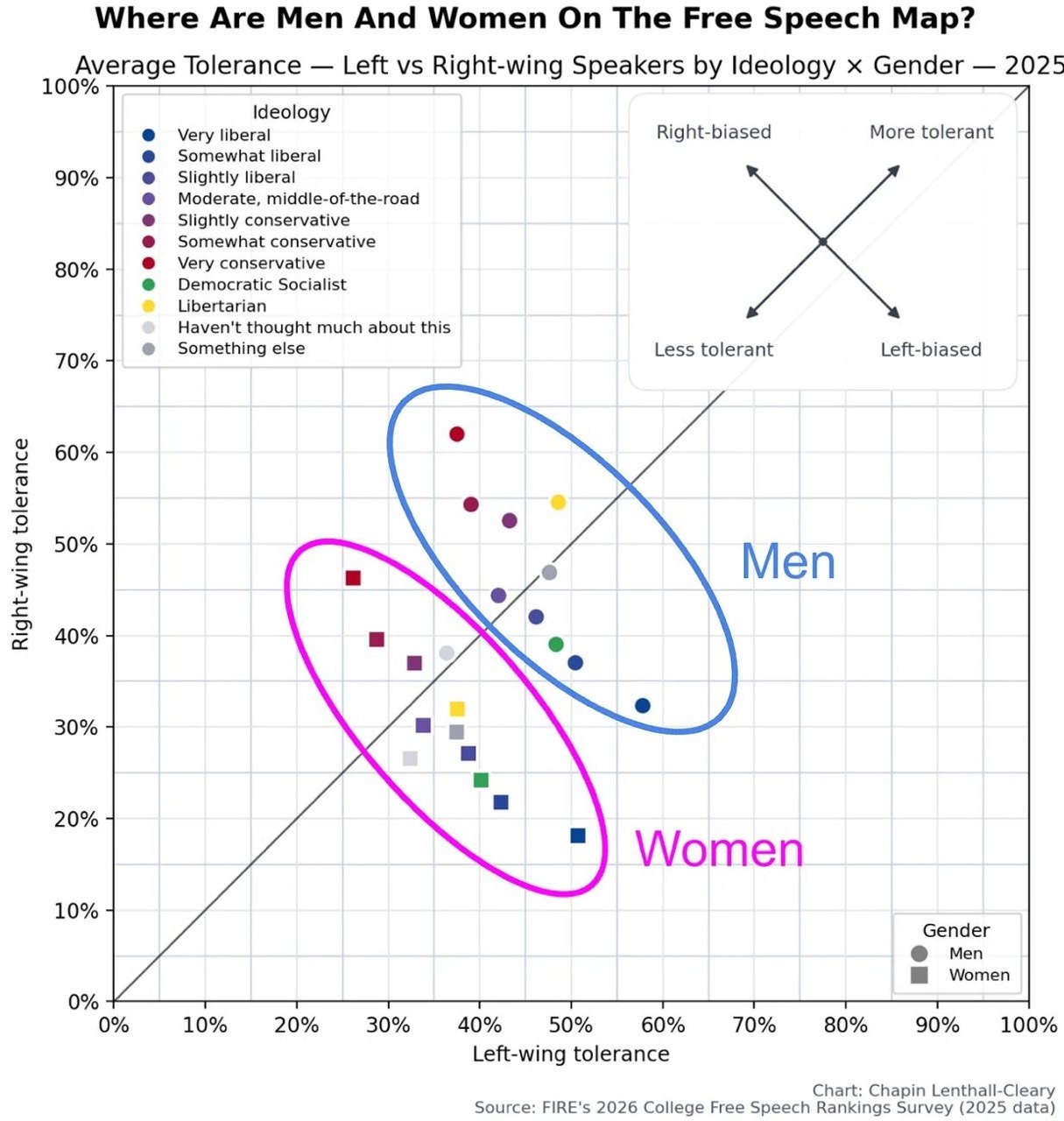
These differences have other social consequences. Men are notably more positive about free speech than women, because men often see speech as a test while women are more likely to see it as a threat. As universities have feminised, the male-female differences on free speech among students have become more pronounced. Men are systematically more tolerant of alternative points of view than are women.
Orwell’s famous comment in his novel 1984:
It was always the women, and above all the young ones, who were the most bigoted adherents of the Party, the swallowers of slogans, the amateur spies and nosers-out of unorthodoxy.
Was a great novelist doing what great novelists do: noticing.
As part of the teamwork focus, men tend to be the social solidarity sex while women are not. Women are much less likely to have friends of lower socio-economic status than are men. For women, such friends are much less likely to be worth the emotional investment. For men, they may be useful members of a future team.
As institutions, occupations and public discourse become more feminised, there has been a shift in patterns of language. A massive study of patterns of language use found a dramatic shift since the 1980s, such that:
our results suggest that over the past decades, there has been a marked shift in public interest from the collective to the individual, and from rationality toward emotion.
All this means that male-dominated institutions and spaces will be generally better, often much better, at generating and managing feedback than female-dominated spaces. When people note that feminising institutions and occupations have a strong tendency to become less functional, it is precisely because they are worse at generating and managing feedback, and at generating and maintaining trust.
- This paper attempts to explain the extreme narrowing of surviving male lineages by the adoption of patrilineal systems and polygyny. While the shift to patrilineal systems in itself does increase unequal lineage success—as does polygyny—much of the point of the shift to patrilineality was precisely that warriors who grow up together are better warrior teams.
Moreover, there is considerable evidence of violence after the shrinkage of male lineages dramatically slowed — and then reversed — with the development of chiefdoms, and especially states. These suppressed violence, but not patrilineality or polygyny. In many societies, polygyny actually intensified with the rise of states.
The bottleneck effects continued to echo down populations. The extraordinary reproductive success of particular male lineages is associated either with pastoralist violence and conquest and/or early state creation. Further, the notion that the majority of male lineages just passively accepted their reproductive exclusion flies in the face of a huge amount of evidence — especially as the examples of very successful pastoral lineages occurred in societies with notoriously high levels of violence, including as raiders, such as across the Steppes and in Ireland.
Moreover, polygyny is associated with higher rates of violence, single-spouse marriage with higher social cohesion. Nor was the creation and maintenance of states typically a peaceful process: periodic violent peaks in Chinese history, for example, were extraordinary. It was precisely the creation of a reproductively-excluded underclass that provided so much of the impetus for the banditry and mass peasant revolts that are such a feature of Chinese history. So, while patrilineality and polygyny were definitely factors in the wildly differentiated success rates of male lineages, considerable levels of violence and contestation over resources and women — that selected in favour of male teamwork — were clearly also very much in play.

April 30, 2026
QotD: The terrible economics of (most) recycling efforts
Even those calculations underestimate the cost of recycling because they include only the direct outlays, chiefly the $686 per ton that the city spends to collect recyclables. But what about all the valuable time that New Yorkers spend sorting and rinsing their trash and delivering it to the recycling bin? For a New York Times Magazine article in 1996, I hired a Columbia University student to keep track of how much time he spent recycling cans and bottles and how much material he gathered in a week. Using those figures (eight minutes to gather four pounds), I calculated that if the city paid New Yorkers a typical janitor’s wage for their recycling labors, their labor would cost $792 per ton of recyclables — over $100 per ton more than what the city pays its sanitation workers to collect it.
As the economics of recycling worsened, cities in America and Europe found that the only viable markets for their recyclables were in poor countries, chiefly in China and other Asian nations, where processing recyclables was still profitable, thanks to lower wages and lower standards for worker safety and environmental quality. But as those countries have gotten wealthier, they’ve become reluctant to accept foreign trash. As bales of unwanted recyclables pile up in warehouses, towns have had to start sending them to landfills, and dozens of American municipalities have finally had the sense to cancel their recycling programs.
John Tierney, “Let’s Hold On to the Throwaway Society”, City Journal, 2020-09-13.
Update, 1 May: Welcome, Instapundit readers! Have a look around at some of my other posts you may find of interest. I send out a daily summary of posts here through my Substack – https://substack.com/@nicholasrusson that you can subscribe to if you’d like to be informed of new posts in the future.
April 27, 2026
QotD: The false economy of reducing plastic packaging for food products
“Look at the plastic, the Styrofoam or cardboard underneath,” she told the class. “Do you need this much wrapping when you buy things?”
“Noooo,” the fifth-graders replied.
It was all so obvious to them, the fifth-graders as well as their lecturer. She was barely out of college, but she thought that she knew more about selling produce than supermarket executives and packaging engineers who had spent their careers studying this question. She was sure that plastic wrap and Styrofoam were wasteful and harmful to the environment because she had never seriously considered the alternative or wondered why those products were introduced.
To merchants and shoppers in the late 1920s, there was nothing wasteful about the revolutionary packaging material introduced by DuPont. Cellophane seemed miraculous because it was not only moisture-proof but also transparent. “EYE IT before you BUY IT,” DuPont advertised, and shoppers welcomed this new feature enabling them to judge the quality of produce and meat before they paid up. Cellophane kept things fresh much longer, an advantage advertised to everyone from homemakers to soldiers. During World War II, a DuPont ad showed a German soldier looking on enviously as American prisoners of war opened packages of cigarettes from home that were wrapped in cellophane: “The prisoners who have better cigarettes than their guards.”
Soviet citizens in the 1980s were similarly envious of Westerners’ new plastic grocery bags, which sold for $5 apiece on the black market in Moscow. The bags were coveted partly as a status symbol (a hard-to-get imported product) and partly because they were so light and compact. In a shortage-plagued economy, Muscovites never knew when a scarce item would suddenly become available in a nearby store, so they wanted to have an empty bag with them, just in case.
American merchants and shoppers switched from paper to plastic packaging because it reduced waste. Plastic was cheaper because it required fewer resources to manufacture. It required less energy to transport because it was lighter. Plastic took up less space in landfills than paper, and it further reduced the volume of household trash because it preserved food longer. The typical household in Mexico City, for example, generated more garbage than an American household because it bought fewer packaged products and ended up discarding more food that had spoiled.
But activists eager to find some reason to oppose disposable products have ignored these advantages. They blame America’s throwaway society for polluting the oceans with plastic, though virtually all that pollution comes from either fishing vessels or from developing countries with primitive waste-management systems — mostly the Asian countries that were importing plastic recyclables from America. Instead of castigating American consumers, environmentalists should blame themselves for creating the recycling programs that sent plastic to countries where it was allowed to leak into rivers. The best way to protect marine life is to throw used plastic into the trash, not the recycling bin, so that it goes straight to a well-lined local landfill instead of ending up in the ocean.
And instead of campaigning to ban plastic grocery bags, green activists should be promoting their environmental advantages. Banning them results in higher carbon emissions because the substitutes are thicker and heavier, requiring more materials and energy to manufacture and transport, and these paper bags and tote bags typically aren’t reused often enough to offset their initial carbon footprint. Greens may feel virtuous lugging groceries home in a paper or tote bag, but the shoppers choosing plastic are actually doing more to combat global warming and reduce consumption of natural resources.
John Tierney, “Let’s Hold On to the Throwaway Society”, City Journal, 2020-09-13.
April 25, 2026
Can a genuine Canadian launch capability grow from a sketchy concrete pad in Nova Scotia?
Along with many others, I was boggled to hear this week that the Canadian government was spending $20 million per year to lease a “launch facility” — photos show a pretty rudimentary concrete pad surrounded by gravel and not much else — which the Ukraine-connected lessor itself is leasing from the Nova Scotia for $13,500 per year. John Carter is somewhat more optimistic than I am that there’s a path from the dubious patch of land to a real maple-flavoured space program:

Guysborough, Nova Scotia, site of the MLS “spaceport”
Image from Google Maps.
It would be a gross exaggeration to say that Canada doesn’t have a space program. The launch of the Alouette 1 satellite in 1962 made Canada the fourth country to place an object into orbit around the Earth. Astronaut Marc Garneau nearly became the leader of Canada’s Liberal Party in 2012 (yes, we could have had an astronaut prime minister … Canadians voted for a nepo baby instead); astronaut Chris Hadfield is a minor celebrity in Canada; Jeremy Hansen became the first Canadian to visit the Moon a few weeks ago. Various iterations of the Canadarm have been fixtures of Space Shuttle missions and the International Space Station for decades. However, Canada does not yet have its own, native launch capability. The Canadian Space Agency acts as an appendage of NASA, with Canadian astronauts and satellites hitching rides on American rockets.
The announcement that the Canadian government is taking steps to develop a Canadian launch capacity has roused me from my uneasy slumber of the last several weeks, and I have awakened in a cranky mood. Several aspects of this story have annoyed me, both those relating to the government’s execution, and those emerging from the reaction from influencers whose justified skepticism of Ottawa’s intentions is intersecting with their poor understanding of space in a fashion that is leading them to beclown themselves.
The story that got everyone’s attention was a two hundred million dollar lease Ottawa signed with Maritime Launch Services for a spaceport in Nova Scotia, Canada’s largest Atlantic province, covering ten years of operations at twenty million dollars per year. The spaceport is, at the moment, essentially just a concrete pad at the end a gravel road, with no other apparent infrastructure.
The “spaceport”
Image from Postcards from BarsoomThere are several genuine reasons for serious concern with this, which have been detailed by a Nova Scotian NIMBY who’s been annoyed by MLS for several years now. MLS is a Ukrainian-American company whose original business model was to design, manufacture, and launch the Ukrainian-built Cyclone 4M, which it has never successfully done. To be fair, this effort was interrupted by the Ukrainian war, which for obvious reasons redirected Ukrainian rocketry to military production. However, it’s also worth emphasizing that MLS is an offshoot of the Ukrainian Space Agency, which is every bit as corrupt as you’d expect. The Ukrainian Space Agency has been mired in several expensive scandals over the years; one of them resulted in the theft of $10 million from Export Development Canada.
A former Liberal Party premier, Stephen McNeil, sits on MLS’s advisory board, which could be quite natural and could also be an indication of bog-standard conflict of interest.
The company’s finances are rather suspicious. It has posted operating losses of several million dollars a year, with the exception of 2025 when it lost $47 million1; revenue in 2025 was less than $15,000, and in 2024 it was zero. The incredible 2025 cash burn was apparently due to MLS acquiring Spaceport Canada. The company’s normal losses seem to be mostly due to executive compensation for its small roster of employees: the CEO and CFO between them rake in about a million dollars. This is despite the company not apparently actually have done anything yet. Other expenses include paying the Ukrainians for technical documentation for a launch vehicle MLS had already abandoned, and debt service on funding advanced by investors.
In 2024, MLS abandoned the scheme to launch Ukrainian rockets and pivoted to an “airport model”, the idea being that they would make money by charging launch service providers for the use of their spaceport. In 2025 there were precisely two launches from MLS’s concrete pad. Both of them were suborbital. One of them was a student-designed rocket from Toronto’s York University.
Even more absurdly, MLS’s concrete pad is on Crown land, which the company rents from Nova Scotia for $13,500 a year. This then looks like Ottawa renting its own land for $20 million a year.
In yet another suspicious-looking move, one of MLS’s chief financiers, Sasha Jacob, sold millions of shares immediately after the deal was announced and the stock price 10x’d; he then exercised stock options to replenish his position at below-market rates, thereby maintaining interest in the company while pocketing a couple million dollars.
All of this looks a whole lot like one more public-private partnership grift in which press releases and public relations materials project a hologram of visionary development, while the funds disappear into a complex web of regulatory compliance, stock buybacks, environmental impact studies, and executive salaries, without anything ever actually being built. This is a scam in which Canada’s Laurentian elites have learned to excel. It turns out that it is much easier, and far more profitable, to get paid for something you’re pretending to do instead of actually doing it; when the inevitable questions get asked, you simply throw up your hands and complain of unexpected engineering difficulties, tortuous regulatory pathways, or other factors beyond your control. None of the people involved – not government ministers, not government bureaucrats, not their private-sector partners – care one bit whether any given project succeeds, because they get paid by the taxpayer and the debt taken out in the taxpayer’s name regardless of outcomes. It is my working assumption that there is nothing more to this supposed space program than this. We are governed by theatre kids dancing to the tune of the Music Man, and none of them know anything about doing anything real.

April 24, 2026
Britain’s Green Party … not your weird cousin’s old Green Party
The Green Party have been more of a punchline than a party for decades in British politics, but the Green Party of today shares only a name with its earlier incarnations (the old UK party is now split into three separate Green Parties for England and Wales, Scotland, and Northern Ireland). Now, it’s become a significant threat to the Labour Party thanks to its unlikely fusion of socialist and green policies with strong support from Britain’s growing Muslim community:

The Green Party is a growing force in British politics. In February, they gained the Parliamentary constituency of Gorton and Denton in a by-election — a supposedly “safe” seat for the Labour Party. Local elections in May see them set to make big gains — perhaps sweeping to power in several town halls in London, perhaps including Camden, where Sir Keir Starmer is one of the local MPs. Opinion polls often show them roughly level with Labour and the Conservatives.
This is quite a change from previous decades when they were indulged as eccentrics on the political fringe. The Green Party (or the Ecology Party, as it was earlier named) were the sandal-wearing, muesli-munching environmentalists who wanted to go back to nature. They opposed economic growth — but their supporters tended to be affluent enough that they could afford to do so. Its leader was the aristocrat Sir Jonathon Porritt.
They were the breed George Orwell was thinking of when he wrote: “One sometimes gets the impression that the mere words ‘Socialism’ and ‘Communism’ draw towards them with magnetic force every fruit-juice drinker, nudist, sandal-wearer, sex-maniac, Quaker, ‘Nature Cure’ quack, pacifist, and feminist in England”.
Great fun. But there was a darker side to the quackery then and now. A totalitarian mentality which, as Orwell also vividly described, proves horrific when it prevails.
Increasingly, the Green Party has shifted its focus away from the environment. In the few towns and cities where it has gained power locally, such as in Bristol and Brighton, it has proved ineffective at practical work in this respect. Typical behaviour would be to pass a motion declaring a “climate emergency” but then perform lamentably when it comes to recycling or tree planting or any of the relevant matters they have the power to deal with.
There was always a distortion in its supposed concern for sustainability in that it was really an excuse to denounce capitalism. The Property and Environment Research Center, a US think tank which champions free-market environmentalism, has shown a more enlightened approach. Their work has included a comparison of privately-owned and state-owned forests. Another applies property rights to marine assets. But the role of property rights as a means of good stewardship of our planet is dismissed by the Green Party out of hand.
In any case, much of the campaigning by the Green Party now is on non-green issues. Its leadership talks a lot about foreign policy and a broader economic pitch focusing on class war rhetoric and an extreme programme of state control. Taxing the rich is always seen as the panacea, despite the reality that many entrepreneurs are already fleeing the United Kingdom due to its hostile fiscal environment.
Its Manifesto for the last election two years ago proposed a Wealth Tax, a pensions tax, and a big increase in Capital Gains Tax. A £90 billion carbon tax would have closed down much of British industry, which was probably the idea.
April 22, 2026
QotD: Traditional Chinese approaches to science
It’s not just physics. The central technique of modern science is that of boiling something down to its absolute simplest form, understanding the simplest non-trivial case as thoroughly as possible, and only then building back up to more familiar situations. In physics we start with contrived gedankenexperimenten: “what if two particles collided in a vacuum”, and build experimental apparatuses designed to mimic these ultra-simple cases. In economics we imagine markets with a single buyer and a single seller, both perfectly rational. In political philosophy we imagine human beings in a state of nature, or societies established by a primitive contract. In biology we try to understand the functions of organisms, organs, or other systems by recursively taking them apart and trying to figure out each part in isolation. In every case, what we’re engaging in is “analysis”, ἀνά-λυσις, literally a “thorough unravelling”, understanding the whole by first understanding its parts.
This approach is totally alien to the traditional Chinese understanding of reality, which held instead that no part of the world could be understood except in its relation to the rest of the universe. You can see this in the domains of science where they did maintain a lead. Is it really a coincidence that the Medieval Chinese got frighteningly far with the mathematics of wave mechanics? Or quickly deduced the causes of the tides? Or made great strides with magnetism? In each of these cases, the physical phenomenon in question was compatible with an “organicist conception in which every phenomenon was connected with every other according to a hierarchical order”. Indeed, in all of these cases real understanding was aided by the assumption that a universal harmony underlay all things and connected all things. The tides really are in harmony with the moon, and the lodestone with the earth.
This science, founded on holism rather than on analysis, made great strides in some fields but fell behind in others. It readily imbibed action at a distance, but it could not and would not tolerate the theory of atoms. In this way it serves as a strange mirror of Medieval European science, which also loved the theory of correspondences, also loved alchemy and disdained analysis. The difference is that the glorious intellectual synthesis of Neo-Confucianism was never seriously challenged, it survived the Mongol conquest, it survived the desolation of the civil wars that preceded the Ming founding, it survived everything until communism. In contrast, the eerily-similar Thomistic metaphysics of the High Middle Ages was broken apart by the Reformation, and sufficiently discredited that analytical methods could take their first tentative steps.
This is, to be clear, my own crazy theory, because Needham never really gave a solution to his own puzzle. I came up with it only as a sort of thought-experiment, because I wanted to see if I could find a solution to Needham’s puzzle that disdained material explanations in favour of intellectual tendencies, because I find such theories curiously underrated in our culture. I only half-believe this theory,1 but I find it interesting because twentieth-century Western science has in some ways come back around to the holistic view of things: from Lagrangian methods in theoretical physics, to category theory in mathematics, to systems biology and ecology. It wouldn’t be the first time that a way of viewing the world useful to one age became an impediment to reaching the next one. The question is: what are we missing today?
John Psmith, “REVIEW: Science in Traditional China, by Joseph Needham”, Mr. and Mrs. Psmith’s Bookshelf, 2023-08-14.
- The thing about material conditions is they usually are dispositive!
April 20, 2026
Civilization-building is gendered, sorry ladies
On Substack, Janice Fiamengo explains why the very different strengths and weaknesses of men and women will always lead to what appear to be unequal results, and fighting against biology is always a bad idea:
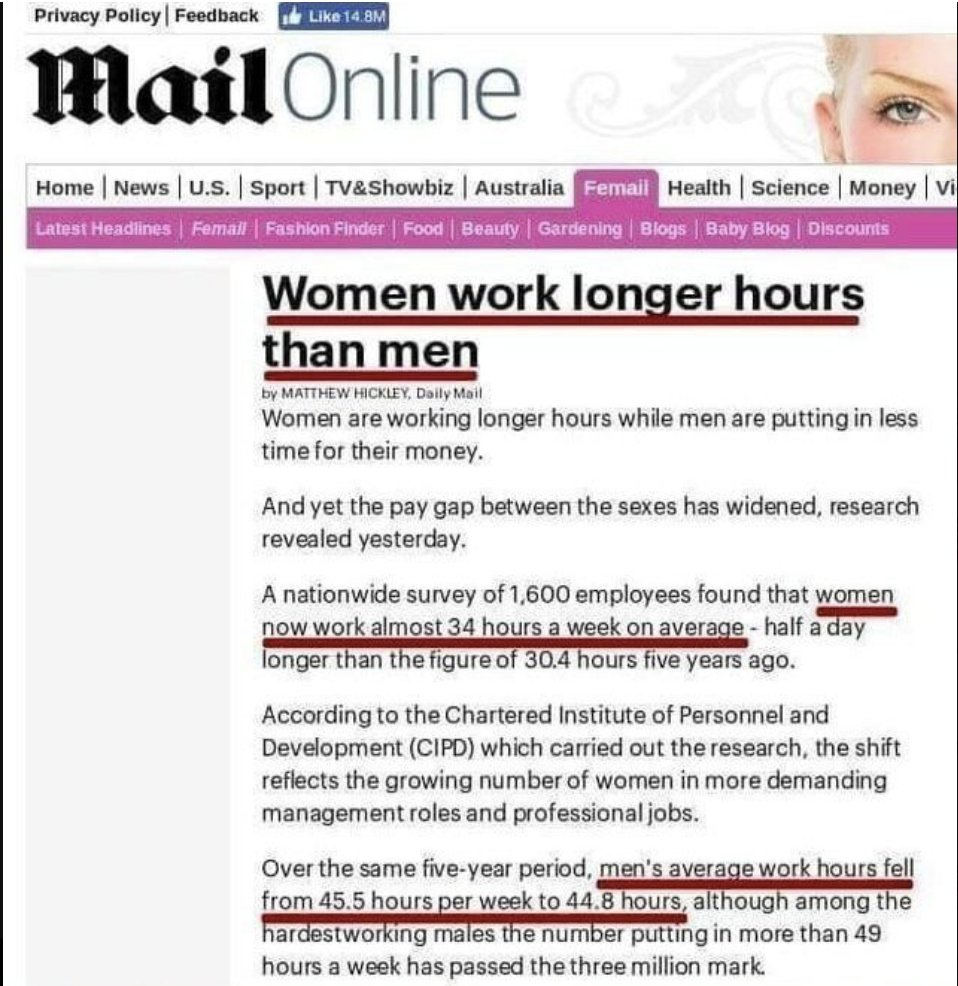
Even if the numbers don’t back it up, women feel that this is so true.
Social psychologist Roy Baumeister explored the relevant research in Is There Anything Good About Men (2010), a cautiously non-feminist book in which the author readily asserted that he, like most everyone else, prefers women to men. Women are more lovable, he claimed, and more pleasant to be around.
But he was not quite willing to accept the now-mainstream thesis that women can replace men in all areas of society.
His thesis is summed up in the book’s sub-title: How Cultures Flourish By Exploiting Men. Men are the foot soldiers of civilization as well as its leaders. They are the ones who make things work or make new things.
Men are the ones who must prove their utility to society. Their drive to be useful has powered centuries of back-breaking work, risk-taking, tool-building, self-sacrifice, and outstanding performance of a sort that has never been expected of women (and still isn’t).
Women in the main tend not to work as hard as men to succeed because they don’t have to. Women developed different strengths and tendencies.
Women’s strength, for good and ill, is in the inter-personal arena: not only in caring for those who are weaker but also in being cared for by those who are stronger. Women are good at reading people’s emotions and desires, and at expressing their own.
Men are not rewarded for expressing emotions and desires; men are oriented to acting, often under pressure to perform competently, in large groups and systems.
“The female brain,” according to Baumeister, “tends to be geared toward empathy, which includes emotional sensitivity to other people and deep interest in understanding them and their feelings. In contrast, the male brain is oriented toward understanding systems, which means figuring out general principles of how things operate and function together, and this applies to inanimate objects as much as social systems” (p. 85).
Baumeister supports his argument in a book-length exploration of men’s system-building. He shows how men are driven to work with, and in competition with, other men to make it possible for large numbers of human beings to live together in complex, efficient networks. The large social institutions that have characterized western cultures, from the army to churches, from corporations to unions, and from market places to police forces, give evidence of men’s system-building.
Women can work well within the systems that men devise, but they rarely devise new systems on their own. This is not because women are, on average, less intelligent than men (except at the very highest levels). It is because women’s motivations and sources of satisfaction are generally different from men’s.
Women’s contribution to culture in nurturing children, providing companionship, and looking after the family home has been a crucial one. But it does not drive innovation or invent new technologies.
Even the most intelligent women are rarely compelled, as highly intelligent men often are, to pursue scientific and other breakthroughs with the single-minded focus necessary for greatness. Often, as in the case involving Matt Taylor discussed above, many women do not seem to value or understand the nature and importance of such breakthroughs.
Women’s main contribution in the male civilizational sphere has been to lobby for admission and then to complain about, and work to undermine, the male culture of competitive excellence.


