
The wish is often father to the belief, never more so when our interests are in play. But even without material interests, we are often so attached to our ideas or theories that wishful thinking easily overcomes evidence that casts, or at any rate ought to cast, doubt on them. No one is immune from wishful thinking, and therefore from special pleading. Not surprisingly, the latter is easier to spot in others than in oneself.
There is a déformation professionelle that is very common among practitioners of the human sciences, namely the tendency to treat the human beings who are the objects of their study as if they were no different in principle from sticks or stones or stars. A striking example of this tendency was published in the New England Journal of Medicine in April this year, in an article titled “Stigma and the Toll of Addiction” by Dr. Nora Volkow, Director of the National Institute on Drug Abuse.
The first thing one might have looked for in an article by the director of the Institute was a certain modesty. After all, the Institute has been witness to a vast increase in the abuse of drugs, leading to hundreds of thousands of deaths, without having been able — notwithstanding claims to advance in the scientific understanding of addiction — to effect improvement in any significant way whatever. No mea culpa is required, but a tone of hectoring evangelism is not very seemly in the circumstances.
Theodore Dalrymple, “Stigma and Sympathy”, The Iconoclast, 2020-09-23.
June 21, 2026
QotD: Wishful thinking
June 20, 2026
QotD: The word “alchemy”
But the Chinese alchemists by and large weren’t after gold, their goal was eternal life instead. In fact aurifaction originated as an instrumental “warm-up” exercise for the main event. Everybody knew that the reason gold was the most perfect metal was because it was a harmonious and balanced combination of the elements. So if the same harmoniousness and lack of internal contradiction could be achieved within a living organism, then the consequences would obviously be physical immortality and superhuman abilities. Elemental harmony, biological harmony, social harmony — in the light of Chinese metaphysics these goals were all reflections and intimations of one another. And the first two at least could be brought about by the same methods: the application of various potions and elixirs designed to increase or reduce the influence of a particular element. The same principle forms the cornerstone of Chinese medicine today.2
John Psmith, “REVIEW: Science in Traditional China, by Joseph Needham”, Mr. and Mrs. Psmith’s Bookshelf, 2023-08-14.
- My favourite of these, since it seems so unlikely, is “ketchup” deriving from 茄汁 (“tomato sauce” in Cantonese), perhaps via the Malay kicap.
- Needham’s third lecture is about the most recognizable and well-traveled example of Chinese medicine — acupuncture — and contains the intriguing assertion that naloxone administration totally cancels acupuncture’s efficacy for pain relief. This suggests that acupuncture’s mechanism of action may have to do with stimulating the body’s production of naturally-occurring opioids. There’s some evidence the placebo effect could be related (fascinatingly, naloxone also appears to eliminate the placebo effect).
June 18, 2026
Rules for you young plebs, but not rules for us
The generation that defined itself as “the youth generation”, “the hippies”, etc., are now nailing down every possible way to have fun so that youngsters can’t do what they loudly and proudly did at the same age:

Part of the crowd on the first day of the Woodstock Festival, 15 August, 1969.
Photo by Derek Redmond and Paul Campbell via Wikimedia Commons.
We’re banning raves, because we don’t want you having fun where we can’t watch you. By the way let me tell you about Woodstock.
We’re cracking down on underage drinking. It’s bad for you. Yeah of course we hit up the pubs at your age it was great.
We’re banning smoking, but just for you — the smoking age will go up one year every year. Oh yes of course, we used to be able to smoke inside everywhere, it was great really.
We’re banning flavored vapes. We don’t have any evidence they’re bad for you, you just like them too much.
We’re banning dodgeball during recess, someone might get hurt. Yeah we really enjoyed dodgeball too.
We’re banning flirting, because it might make the girls uncomfortable.
We’re locking you in your room for the next two years. Yes we know you’re in no danger from the virus, but we’re worried that you’ll get us sick. By the way you have to take this needle if you want to leave your room again. Yes, twice. Well there will be boosters too. No, we aren’t worried about side effects, that doesn’t effect us at all.
We’re closing the frat houses, because we don’t want you having fun without our permission. Please join these officially sanctioned university clubs instead.
We’re bringing in labor from the third world to work the service jobs, so you can’t have a summer job.
You need to go to university to get a good job. By the way we’re raising the price of tuition. Oh look we’re raising it again. Don’t worry there are loans. At interest.
Actually we’re giving the good jobs to the foreigners we just imported, to make up for our racist past. We are very good people. No of course we aren’t sacrificing anything. You just have to take one for the team.
Also, we’re giving the foreigners the houses. We needed to increase real estate prices. For our pensions, you see. Sadly no, you’ll probably never be able to afford one yourself. By the way don’t forget to pay your taxes. Need to support those pensions somehow! Eh? No, we’re giving ourselves tax breaks of course. Seniors discount you know.
Oh by the way, that one thing you still have, now that we’ve banned joy and kicked every ladder out from under you? That social media stuff you kids like? You guessed it! We’re banning that too! Just for you though, we’re still going to watch AI videos on Facebook. It’s for your safety, you see. We’ve noticed that you’re all getting rather irate, and we think it would be better for your mental health if you shut up for a while. Why don’t you just go outside?
Eh? No of course we aren’t going to stop Ahmed and his twelve illiterate cousins from raping your sister, that would be culturally insensitive, which would make us feel very bad, and we can’t have that.
Update: Added missing URL.
June 12, 2026
The mystical powers of climate change, is there anything it can’t do?
In Canada, all problems are now blamed on US President Donald Trump. It’s a fantastic get-out-of-trouble move for politicans like Prime Minister Mark Carney, Ontario Premier Doug Ford, and even mayors of towns and cities across the Demented Dominion. But even the malign powers of the Bad Orange Man seem puny in comparison to the amazing powers of — gasp! — CLIMATE CHANGE:

Every now and then I suspect there is a game played by bored elites to see which of them can get away with the most asinine “climate change” claim. There have been some doozies: lack of UFOs, “climate change” anxiety, increased sugar consumption, engineering short people. On and on and on ad infinitum.
Today we meet what could be the winner in the contest. Experts are claiming World Cup matches could be slower. Now instead of ninety-plus minutes running around ending in zero-zero ties and dramatic shootouts, we’ll get ninety-plus minutes of somewhat slower running around ending in zero-zero ties and dramatic shootouts. Because “climate change”.
Seems to me, though, that if we really wanted to save time, we could have all matches begin at the shootouts. The whole tournament could be over in a day. Take that, “climate change”!
Here’s the claim, appropriately announced on a PR site, a site whose specialty is juicing dull and dubious headlines: “Climate Central finds climate change has increased the likelihood of heat that could slow players for 97 of the 104 matches, threatening game speed and fan safety.”
What will happen to the other 7 matches they don’t say. Probably they will end in shootouts.
Details:
Previous research shows temperatures above 82.4°F can reduce sprint frequency, total distance covered, and recovery time, impacting not only player performance and safety, but also match tempo, tactics, and overall style of play.
Previous researchers discovered — and stay with me, here — that when it’s hot outside people outside in the heat act like people act when it’s hot out.
Where would we be without previous researchers?
[…]
As you have surmised, we don’t have to believe any of this: the scenarios are all silly, proving that the stunning new research is purely performative, a way to signal the vices and predilections of the researchers. As proof, we oblige the PR site which asks us to quote this:
As global temperatures continue to rise, driven by the burning of fossil fuels, the 2026 World Cup could become another example of how climate change can disrupt sports and traditions people cherish, forcing a reevaluation of how the game is played.
This is all ridiculous, and only saved by the charge of falsity by adding that “could.” Meaning might, which also means might not.
They also provide this quote they ask us to re-quote:
Alex Jacobs, professional player formerly with the Jamaican Premier League:
Heat is not new. But extreme heat — made more likely by heat-trapping pollution driving climate change — might just be a difference maker in this summer’s edition of the biggest sporting event on the planet.Way these quotes work is that either the PR firm, or the organization employing the PR firm, write them for victims, who are sought out and asked to sign on. The people allowing their names to be used are, of course, fully responsible for the words used, and even often believe them. But there’s no mistaking that stilted prose of the manufactured quote. Nobody talks like this. This prose is not conclusive, but whenever you see it, it’s a darn good reason to dismiss the claims made.
Of course, using a highly visible public event to advance the climate change agenda is nothing new, they’ve literally been doing it for decades now. Media outlets have always had a bias toward the most dramatic outcome, if only for marketing purposes — “if it bleeds, it leads” — but even the more skeptical outlets have drifted in the climate hysteria direction over time:
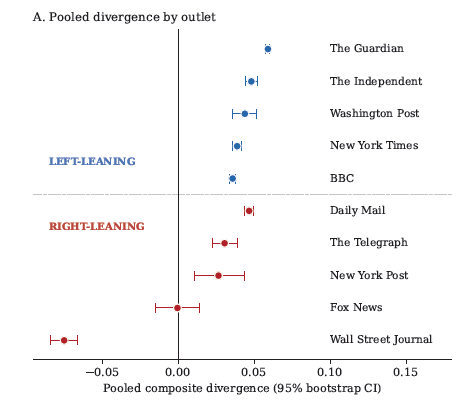
We have complained many times that the public is presented with a picture of climate science systematically biased towards alarmism. And it’s not just our anecdotal impression. We have data, in the form of a new study from the US National Bureau of Economic Research saying the government delegates who write the IPCC Summary for Policy Makers (SPM) overstate the science in the underlying report, and then the media further overstates what’s in the SPM. The study authors used multiple AI systems to extract key scientific statements in every IPCC Assessment Report since 1990, track how they were summarized and what the accompanying media coverage said. Using a statistical model they measured the way the statements get changed or twisted at each stage. There were some surprising results and some unsurprising. Unsurprisingly the data showed the UK Guardian has by far the most climate coverage of all major media outlets and is also the most biased. Another unsurprising result is that the overall media bias regarding the severity of climate change has been consistent over time. A surprising result (to many, but not to us) is that the only major media outlet exhibiting precisely zero bias was Fox News. Otherwise most right-leaning outlets adopted the left-leaning outlets’ alarmist bias as of 2007, again unsurprising to us. And there’s much more.
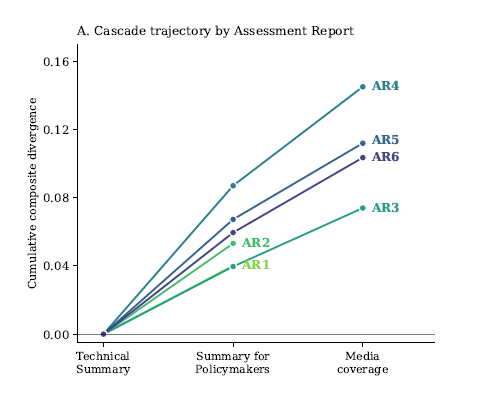
The authors identified three forms of bias: severity, in which a summary picks the upper end of a range of claims, uncertainty, in which a summary downplays caveats and qualifiers, and scenario in which worst-case scenarios get foregrounded. They used a numerical scale from -2 to +2 that captured bias in either direction: a positive number indicated that the summary was biased towards alarmism and a negative number indicated a bias in the opposite direction. Then they averaged the bias measures together and measured them at two stages in the game of telephone. The “TS-to-SPM” stage compared statements in the author-written Technical Summary to how they were worded in the government-written Summary for Policymakers. The “SPM-to-media” stage looked at how statements in the SPM were then reported in the press. The authors examined the TS-to-SPM stage for every IPCC Assessment Report from 1990 to 2023. They only looked at the SPM-to-media stage from the 2001 Third Assessment Report (AR3) because that’s as far back as their media library went.
[…]
That’s right, folks. Even the right-leaning outlets have also gone in for alarmist bias, at least since 2007. Indeed, the media’s bias converged in size and direction over time, as shown in this chart:
For the AR3 in 2001, right-leaning outlets on average understated the climate findings while left-leaning outlets overstated them. But thereafter both sides shared the alarmist bias. Which reflects the success of alarmist activists in the post-An Inconvenient Truth era (2006) driving skeptical voices out of the media. That campaign didn’t eliminate bias, it only replaced one form by another, with the result that the overall media landscape became entirely one-sided.
The uniformity of the bias can also be seen in this chart:
The right-leaning outlets in red are about as bad as the lefties in blue, except for Fox News which is the only outlet with no measurable bias and the Wall Street Journal which had an overall negative (anti-alarmist) bias.
June 8, 2026
QotD: Re-use, recycle, and contaminate
This “common cup” was the ultimate reusable product — much to the horror of public-health experts, who blamed it for spreading tuberculosis, pneumonia, diphtheria, meningitis, and other diseases. Alvin Davison, a biologist at Lafayette College in Pennsylvania, analyzed cups from public schools and reported in 1908 that a single sip from a student left a residue of 100 dead skin cells and 75,000 bacteria. He used the scrapings from one school cup to induce fatal cases of pneumonia and tuberculosis in guinea pigs.
His article “Death in School Drinking Cups” provided support to “Ban the Cup” campaigns around the country. The first successful one was led in Kansas by Samuel Crumbine, a colorful doctor who had started his career in Dodge City (he was the model for Doc Adams in the long-running Gunsmoke television series) and went on to lead various public-hygiene crusades. The term “flyswatter” comes from a slogan he popularized, “Swat the fly” (which came to him while listening to the crowd at a baseball game urging a hitter to swat a sacrifice fly ball). After watching train passengers with tuberculosis and other diseases drinking water from a common cup, Crumbine got so upset that he threw the cup out the train’s window, and proceeded to persuade his colleagues on the state board of health to ban the common cup in trains, schools, and other public places in Kansas in 1909.
The ban left Kansans with a new problem: What were they supposed to use at a public fountain? Fortunately, as Crumbine later recalled, “Necessity proved to be the mother of invention.” Shortly after banning the cup, Crumbine was visited by a former Kansan named Hugh Moore, who brought with him samples of a product that his brother-in-law had invented: round paper cups that could be stacked in a dispenser next to a fountain. Crumbine’s endorsement provided crucial help to Moore in selling his product, originally called Health Kups and later renamed Dixie Cups.
John Tierney, “Let’s Hold On to the Throwaway Society”, City Journal, 2020-09-13.
June 7, 2026
Morality and humour
Devon Eriksen suggests that there’s a correlation between a person’s morality and their sense of humour (or lack thereof):
There is probably a correlation between morality and sense of humor.
Larry Niven once theorized that humor is associated with an interrupted defense mechanism.
The idea is that you have a situation presented to you which would normally trigger a defensive response, but when you realize it is actually harmless, the response that you experience as laughter or amusement is your brain’s way of derailing that inappropriate defense mechanism.
Because it isn’t appropriate to fight or run away from harmless things.
This mechanism become easy to see when you look at very simple or developing senses of humor. To a baby, unexpected + safe = comedy gold.
And my cat Dante’s favorite joke is “I BITE your toes! … but actually, I don’t bite them! I just lick them by surprise, watch you jump, then run away mewing and looking pleased with myself!”
Humor can become quite sophisticated, but I’ve never yet seen anything funny that couldn’t be understood this way.
But there’s a certain type of evil person who is evil precisely because they don’t interrupt defense mechanisms.
They fight harmless things. Even beneficial ones. And they give you long lectures about how the harmless or even the wonderful thing is ackshually super-problematic.
This is the visible symptom of a form of neurotic hypervigilance which can, and often does, progress to the point of simply lashing out, figuratively or even literally, at random parts of the environment, because the brain has constructed some narrative whereby it’s a threat.
The humor response is our natural way of not doing this.

The Ancient Greeks: 01 – What Made Them Special? (e) Science, Art, and the Limits of Greek Freedom
seangabb
Published 31 Jan 2026Greece: A Brief History, c.700 BC – 500 AD
This final section examines what the Greeks achieved with the intellectual tools they developed — and where those tools fell short.
It discusses Greek science through figures such as Archimedes and the Antikythera Mechanism, highlighting both technical brilliance and flawed cosmology. It then turns to Greek art, explaining why Greek sculpture represents a decisive shift towards realism, embodiment, and the truthful representation of the human body.
The section concludes with an assessment of Greek democracy: its radical nature, its severe limits, and its enduring influence.
The lecture ends by drawing together the central argument: the Greeks were not morally exemplary, but they were intellectually revolutionary.
June 6, 2026
Lies “in a good cause” are still frickin’ lies
This was posted in late May, but only came to my attention today, so apologies if you’ve already waded through the details here:

The problem with this meme is … well, just read the article.
This meme keeps entering my feed and it bugs me every time I see it. For search engines and the visually impaired: it shows, on the left, a large McDonald’s French fry priced at $1.99. On the right, it shows a delectable fruit cup, including mixed berries, cubed melon, and prominent slices of starfruit priced at $5.99. The caption above both declares, “The Problem With Our Food System”.
Invariably, this meme is met with earnest rejoinders, often in thread 🧵 form, explaining the complexities of food distribution. One particularly clever one that I just saw introduces the concept of “Malicious Design” as a sort of secular creationism where the limitations imposed by nature are imagined as human systems intentionally engineered to harm the masses. Threads like these usually go on to describe how potatoes are cheap, hardy, and practically preserve themselves, while berries are delicate, seasonal, and expensive to ship. They argue that the price difference is simply the natural consequence of supply chains, not the machinations of a capitalist oligarchy trying to keep the proletariat down.
All of that might be true.
But it doesn’t matter.
Because the entire discussion rests on a premise that is demonstrably false.
Not the stuff about potatoes or berries or supply chains. Not even the stuff about the oligarchs insofar as, if they are trying to poison us, they are doing a middling job at best. The problem is that everyone accepts the meme’s starting point as if it were genuine. They never check the most basic fact: the prices themselves!!!
Let’s start with the French fries, because they are on the left and because I have the McDonald’s app on my phone. I can tell you without looking that $1.99 is the wrong price for a large fry because I am a fast-food proletarian myself.
Behold: in my market — Omaha — the price is $4.39. According to the Interwebs, this is a pretty representative price nationwide outside of larger cities. The reason we are considering a large fry instead of a small, which still comes in at a whopping $3.99, is because the meme uses a picture of a large.
Already, the price of the fruit cup and the French fries are much more comparable. Ah, but those crafty capitalists know that the stupid masses will steer toward the cheaper option, regardless of the health risks, even if it is only to save a penny. That’s how the fast-food-to-pharma pipeline gets you! By tricking you into passing on the much healthier and obviously more delicious fruit cup. (Never mind last week’s newsletter about all the poisonous chemicals they’re spraying on the fruit.)
So, I will check on the fruit cup now. The first wrinkle is that the image of the fruit cup does not come from the McDonald’s app. That’s because McDonald’s doesn’t sell a fruit cup in most — if any — markets. If they did, it would arrive to the store frozen and the kid who was supposed to move it from the freezer to the refrigerator last night will have forgotten to do so, meaning that what you will receive is a cup of brightly colored ice cubes that you can pretend to enjoy in a couple of hours. (source: 5+ years personally serving in the McTrenches coinciding with the deployment of the Fruit ‘n Yogurt Parfait™.) In other word, you will not see these two items side-by-side on the menu.
And this is where it gets tricky. Because I can’t actually find that particular fruit cup. Reverse image search turns up a big fat nada. Not on any fast food site, online grocery store, stock photo outlet, food blog, or news page.

Read the whole thing, I believe is the term d’art for this. H/T to Kim du Toit for the link.
June 5, 2026
The Lord of the Flies was just a novel
We often use The Lord of the Flies as a shorthand way to illustrate the darkness in the hearts of men, and that, absent civilizations, men descend into a hellscape of violence, hatred, and all-against-all destructive competition. Yet the real-life case of a group of boys isolated for an extended time didn’t go at all the way the novel did:

More and more I’m learning that the nihilistic claptrap we were all told was genius was just Leftist demoralization propaganda.
Situations like this have occurred, and the children didn’t turn into little monsters. In fact they survived quite well.
In June 1965, six boys named, aged 13 to 16 “borrowed” a fisherman’s boat hoping to reach Fiji or New Zealand. After a storm damaged the sail and rudder, they drifted for eight days surviving on fish and rainwater collected in coconut shells, before washing up on the rocky uninhabited island of ‘Ata.
Rather than descending into chaos during their months there the boys created a mini society. They planted vegetables, collected and stored rainwater, and maintained a permanent fire. They even built a gymnasium with homemade weights, a badminton court, and chicken pens.
They divided daily chores using rosters, resolved conflicts with time-outs instead of fighting, began and ended each day with songs and prayers. One boy, Gilligan’s Isle style, constructed a guitar from driftwood and coconut shell to boost morale. When one of the children broke his leg falling off a cliff the others set it with sticks and leaves and took over his work. They ate fish, coconuts, eggs, wild taro, bananas, and later chickens they had discovered in an ancient volcanic crater.
They endured this for for fifteen months, and never once turned into murderous thugs. A far cry from what we were told would happen.
It wasn’t just William Golding manufacturing dark stories, of course:
QotD: Modern men and the need for male spaces
Internet men believe that some kind of man-space is essential. A place for men to be men, mentor other men, and tell younger men the secret wisdom to get their lives on track. That if only we had these spaces, everything would be great for men because we’d all know the secret wisdom that doesn’t actually exist.
Internet women believe that male spaces are dens of misogyny. Places where trollish men want to gather, away from the eyes and ears of right-thinking people, so they can poison other men with hate and bigotry.
Which is silly. Men don’t hate women because other men told them to. They see women being women, and that does the trick just fine. In fact, if a man is getting hourly blowjobs from every woman whose path he crosses, then some group of troll men try to tell him women suck, he’d be confused at how uninformed these men are when women are clearly awesome.
Women’s behavior is the number-one driver of misogyny. Not men telling other men women suck.
And that’s the point of male spaces. Not secret manly-man wisdom, not chattering about woman-hate. A space where men can just be. Without women there.
Women are … a certain way.
This is especially true of middle-class and richer women, and even a little more true of white women than other kinds. But true of all women to some extent.
Women have this way about them — everything they do, say, everything about how they behave — that just subtly communicates that they do not have a lot of experience with consequences. That they are just not that used to considering consequences seriously before doing something.
I’m usually hesitant to use political buzz-words in a non-ironic way, but I think the term “privileged” is pretty perfect for this situation.
A woman’s reality — her experience — is a world where consequences just aren’t quite as big of a deal for her as they are for others. She’s never really had to consider consequences with quite the same intensity.
It’s important to note that this isn’t some kind of overt, intentional flaunting as women stride around, consequence-free, thumbing their noses at us. Women don’t even know this is a thing. They’ll deny it fiercely if you tell them. They don’t feel privileged, and their feelings are always real. They’ll even tell you that you’re the privileged one, not them. Because that feels right to them.
It’s not something they do on purpose, and it’s not even that frontal and pronounced. It’s very subtle. Just this subtle way that women are. When they talk, act, make decisions.
This makes them very irritating. Even women find each other irritating.
Archwinger, “Male spaces are because women are irritating”, Archwinger’s Substack, 2026-02-25.
May 30, 2026
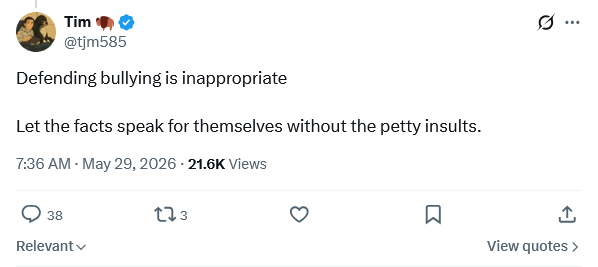
“Bullying”
I was bullied as a kid. I hated it. Most kids experience it, and either hate it or embrace it as “how things are done” (most likely both). This is basic human nature across all cultures. It’s how we learn how to conform, or appear to conform, to cultural expectations. In a pre-urban environment, the community could only handle so many non-conformists — that is: close to zero — so nipping it in the bud with the children was a pro-survival/pro-communitarian mechanism. In modern urban environments, bullying still happens because it’s part of human nature rather than being how children learn how to cope with social situations.
We’ve even migrated the notion of suppressing “bullying” to the military, as InfantryDort explains:
Any man who thinks bullying is ubiquitously inappropriate has the survival instincts of a deer gazing longingly at headlights.
For most of human history, communities had weak formal institutions. Public ridicule, shaming, and ostracism were used to enforce norms.
Examples:
> Villages mocking chronic thieves.
> Military units humiliating cowards.
> Tradesmen ridiculing apprentices who refused to learn.The positive effect was often:
> Greater conformity to community standards.
> Faster correction of disruptive behavior.
> Stronger group cohesion.It hardens individuals to harsh environments when properly applied. And enforces societal norms we want and dissuades the ones we don’t.
The lack of bullying is how people grow up to adulthood and say things like “I’m gonna kill you and your whole family” at some political protest. And have it come out of their mouth as normal as breathing.
Because nobody ever stood them down in their formative years.
You’re a JAG. You think every problem has a legal solution. It doesn’t. You don’t understand the way the world works outside of the one the law has carefully curated for you. Made possible by people who’ve been using strength to coerce others for all of human history.
Let me spank the kids while you do the dishes.
May 26, 2026
Canadian parents are increasingly adopting the “helicopter” or “bulldozer” model
Eva Chipiuk on concerning trends in Canadian parenting styles and the long-term impact on children:
Not many people have really turned their minds to the psychology of Canadians. Most are too busy reacting to the latest outrage, headline, or political controversy.
However, David Redman has cautioned about what he has identified as a trend in Canada: “helicopter” and “bulldozer” parenting, where children are either constantly hovered over or where every obstacle is removed before they ever have to face it themselves.
Over time, that kind of environment can produce people who become uncomfortable with uncertainty, overly dependent on authority, fearful of risk, and hesitant to think independently or challenge difficult ideas. As this article put it:
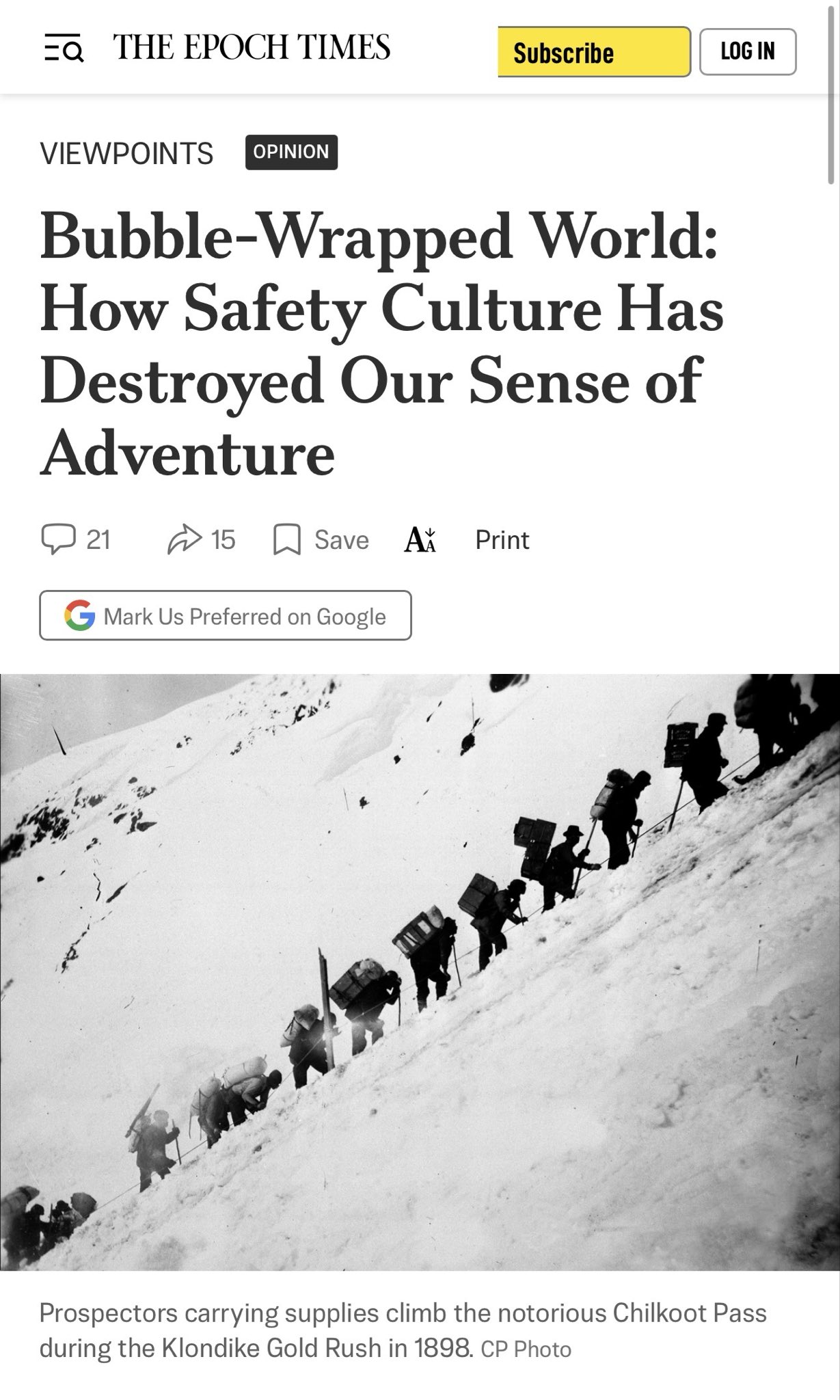
Children, the authors observed, are now deliberately shielded from any sense of risk or uncertainty. How can anyone — young boys most of all — learn about the world around them when school principals announce at the onset of every snowfall that “all snow must stay on the ground”. The ideal of adventure and resilience has been replaced by a debilitating sense of fragility and risk-avoidance …
Adventure should properly be considered a spirit, not a place. It is driven by a powerful mixture of curiosity, necessity, and an openness to experiencing new things. And it can be found wherever uncertainty reigns. Today, that might entail travelling to strange lands, meeting new people, or even engaging in uncomfortable discussions about whether Alberta should remain part of Canada forever.
Wherever the unknown lies, adventure can be found.
That mindset does not just affect childhood. It shapes entire societies. It affects how citizens respond to disagreement, political debate, uncertainty, criticism, and even new ideas.
Somewhere along the way, many Canadians lost their sense of adventure, resilience, curiosity, and willingness to engage with uncomfortable conversations or difficult questions.
Where did that spirit go? What happened to the mindset that encouraged people to explore, question authority, take risks, debate ideas openly, and build something better even when the outcome was uncertain? Somewhere along the way, discomfort itself seems to have become something to avoid rather than something people grow through.
Because if we stop exploring, questioning, debating, and taking risks, we lose something essential about what it means to live freely and think independently. A society that becomes afraid of uncertainty eventually becomes dependent on being told what is safe, acceptable, and permitted.
If we are going to move forward in any meaningful way, we need to rediscover the spirit of curiosity, resilience, and adventure that pushes people to test ideas, challenge assumptions, and engage with the unknown instead of fearing it.
Perhaps one of the most important conversations we should be having is this: what does it actually mean to be Canadian today?
Because for many, it increasingly feels like the answer is becoming less about courage, resilience, curiosity, and self-determination, and more about compliance, comfort, and avoiding difficult conversations.
May 24, 2026
The British Climate Change Committee report is “full of howlers”
Matt Ridley expands on a recent Daily Mail article on the antics of the Climate Change Committee’s latest “findings”:
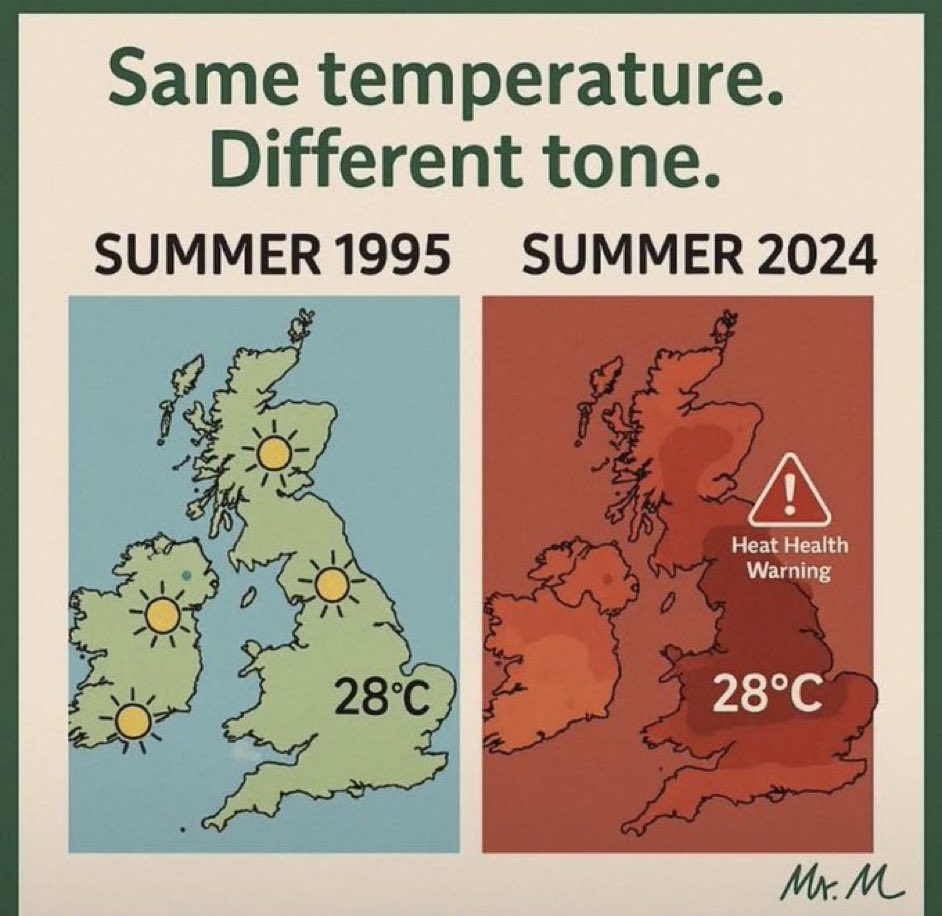
The British public has been propagandized to believe the most extreme risks are far more common than they really are … even in the way the weather is reported.
In my Daily Mail essay on the @theCCCuk‘s new report, I point out that they have a vested interest in exaggeration.
“Between the moment when these climatecrats wake in the morning and the moment they lay their overworked brains to rest on feather pillows at night, they have one all-consuming ambition: to maximise their own budget.
They achieve this goal by being as alarmist as possible.
Imagine if they found evidence that climate change was no big deal or even good news: would they want to publish this? Of course not. It would be disastrous for their (taxpayer-funded) income.
The committee has never produced a report on global greening: the remarkable 15-20 per cent increase in green vegetation on the planet over the past four decades, caused mostly by carbon dioxide emissions.
Nor do its members talk about falling deaths from cold weather anywhere near as much as they do about the smaller number of deaths from hot weather.
Good news for us, in short, is no news for them.
The report is full of howlers. It states emphatically that, by 2050, ‘sea levels will be [not “could be” or “may be”] 20–45 cm higher around UK coasts than today.’
That implies sea levels rising over the next 24 years by 8mm to 19mm per year.
But over the 35 years we have had satellites measuring it, sea levels have risen on average by just 3.4mm per year. There was a little acceleration in 2015-2020 and there has in fact been a deceleration since then: 4.5mm increase per year since 2010 and 3.7mm per year since 2015. (In some parts of the country, such as East Anglia, the land is sinking, a different effect.)
So to assume that the rate of sea-level rise could more than quadruple within the next quarter-century is completely unscientific. Neither Greenland nor Antarctica is losing ice at an accelerating rate — and they are the only possible sources for such a huge increase.
How, then, does @theCCCuk justify this hysteria over sea levels?
It bases its sea-level prediction “on a high-emissions scenario (RCP8.5), using the upper-end estimate (95th percentile)”.
RCP8.5 is an economic scenario that was produced in 2011 for the UN’s Intergovernmental Panel on Climate Change (IPCC) by a team of mathematical modellers.
Their instruction was to find out what it would take to increase CO2 emissions at a rapid rate to a very high level by the end of the century.
First, the modellers said, the world would have to massively increase the use of coal at the expense of oil and gas — using coal to make fuel for cars and planes, burning eight times much coal in 2100 as the world did in 2000, and projecting that fully half of all the world’s energy would be supplied by coal by the end of this century.
Yet even this back-to-coal fantasy was not enough to achieve the gargantuan emissions the modellers were tasked with producing. So they assumed both that the world’s population growth would also reverse its current slowdown, surging to 12 billion people by the end of the century, that innovation to make our lives more fuel-efficient would largely end, and also that we wouldn’t even try to cut emissions.
None of these are going to happen.
Scientists have been saying for more than a decade that the apocalyptic RCP8.5 scenario is extremely unrealistic, and even the alarmist BBC said in 2020 that it was “exceedingly unlikely”.
The IPCC has recently announced that it is abolishing RCP8.5 altogether, while one of the Climate Change Committee’s own members, Professor Piers Forster, wrote an article just last week “on the death of RCP8.5”.
Nobody, at all, ever, under any circumstance, should be using RCP8.5 to forecast climate. Yet the CCC is still using it to terrify the government and the British people – and even taking its “upper-end estimate”!
May 21, 2026
Explaining why more men are “opting out”
On Substack, Bettina Arndt shows some of the reasons why men are less and less willing to commit — not just to relationships, but to huge swathes of what we used to call “adult life”:
The warning signs have been there for decades. Back in 1983, American author Barbara Ehrenreich wrote a powerful book — The Hearts of Men: American Dreams and the Flight from Commitment — arguing that a male revolt was underway. Since the 1950s, she suggested, men had begun rebelling against the breadwinner ethic — inspired by Playboy culture, the counterculture, and a desire for personal freedom. They were rejecting the cultural ideology that had shamed them into tying the knot and becoming a good provider, lest they be seen as immature, irresponsible, and less than a real man.
Ehrenreich understood that marriage was the mechanism by which society harnessed male productivity. Remove the shame, and the yoke comes off.
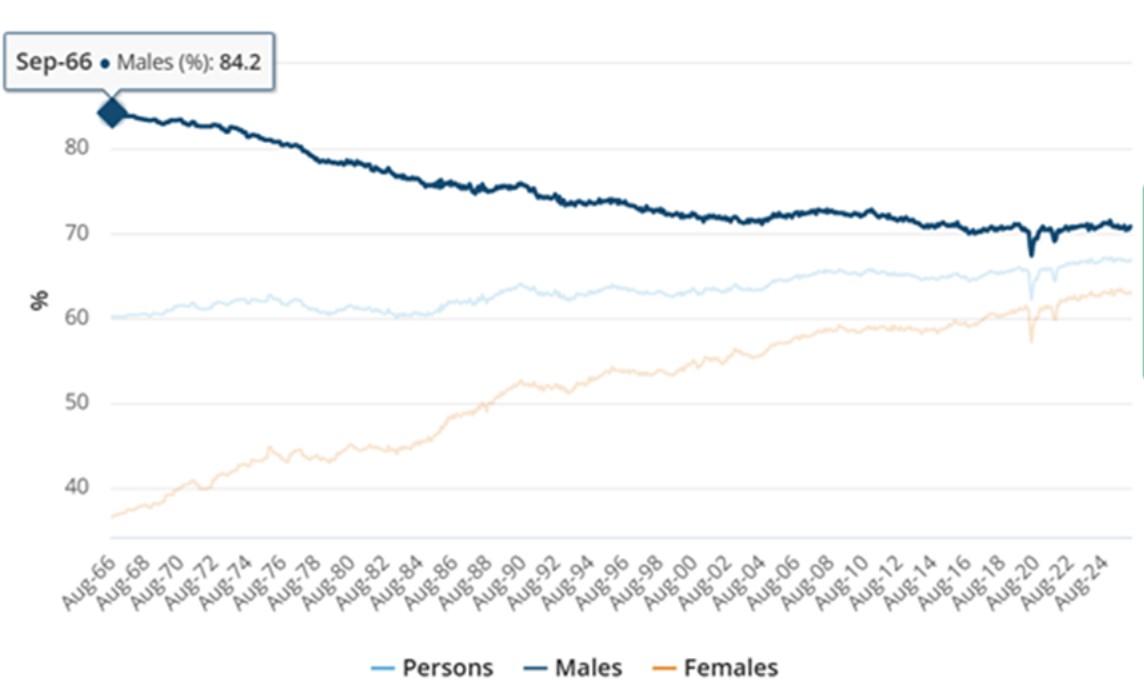
Forty years on, the yoke has disappeared. In April 2026, the American male labour force participation rate hit its lowest level since records began in the 1940s, according to the US Bureau of Labor Statistics. One in three American men — roughly 33% — were not working or actively looking for work. The overall male participation rate for men aged 16 and over stood at just 67%, down from 73.5% two decades ago and from 87% in the postwar years when Ehrenreich’s story begins.
The trend is not confined to America. Australian men’s workforce participation has fallen from around 79% in 1978 to approximately 71% today (see below), while similar declines — though less dramatic than in the United States — have occurred in the UK and Canada.
[…]
If you want to understand why men are voting with their feet, you need to look not just at what marriage now costs them — and the costs are severe — but at what it delivers. Increasingly, what it delivers is a pretty dud deal.
The modern woman: a prospectus.
- They are the most miserable, anxious, and insecure cohort in living memory — hardly great marriage material.
- Most married women go off sex — and the husband who objects is seen as the problem.
- Many women don’t actually like men very much. The more educated she is, the higher the contempt.
- They’ve gone full throttle left — and three quarters of college-educated women won’t even date a man who votes differently.
- They’ve rigged the education system and colonised corporate and institutional life, turning universities and workplaces into man-repellent factories.
- Yet their hypergamy (desire to marry up) is still running hot. Despite outnumbering men in education and careers, they demand a tall, equally high-status unicorn.
- The modern female threat-detection system is hyperactive. Almost any male behaviour — silence, opinions, jokes, breathing — gets flagged as a red flag.
- They’re extremely well-versed in the lucrative economics of divorce, including a well-timed false allegation to eliminate tedious shared parenting.
What rational man reads this list and thinks: yes, that’s exactly what’s been missing from my life?
May 20, 2026
Canadian politics can be bad for your mental health
As a rule of thumb, the more you pay attention to Canada’s political circus, the worse your state of mental health becomes, IMO anyway. On a more serious note, David Clinton got curious about a recent Manhattan Institute project tracing American mental health trends:

Image from The Audit
The Manhattan Institute’s research into the confluence of mental health trends and political leanings in the U.S. generated buzz a while back. Among other things, they discovered that, as of the 2021-22 school year, liberal students were 13-17 percent more likely to seek mental health treatment than their conservative peers. That’s a frightening gap.
I was curious to know if there’s anything like that going on here in Canada. And it turns out that there’s excellent public-facing data waiting for us to drop by and help ourselves. The most recent published version of the Canadian Election Study (CES) dates back to the period around the 2021 federal election — the full dataset from 2025 isn’t yet available.
There were 20,968 respondents in total in the CES survey data from 2021. Having now spent a couple of happy hours with the results, this looks like an excellent representation of Canadian society. The questions go both deep and wide.1
I was able to directly address the political angle to all this using responses to one core question. Participants were asked to situate themselves on a political “scale where 0 means the left and 10 means the right”.
I classified anyone who responded with a number higher than 6 as “far right”, and responses less than 4 were tagged “far left”. The far left cohort had 4,927 members, while there were just 3,891 people in the far right. Those numbers are easily large enough to make distinctions potentially statistically meaningful.
Anxiety
I explored both far right and far left cohorts for how accurately the words “anxious” and “easily upset” applied to them. A response of seven indicates a self-assessment of extreme anxiety, while zero would be Big-Lebowski-level calm.
The average for the right-coded group was 3.47, while those on the left rated themselves 3.88.
Overall Mental Health
Respondents were asked to rate their mental health in relation to their peers where “1” indicates excellent mental health and “5” indicates poor mental health. A total of 3,878 from the far right responded and 3,263 from the far left. The average of all responses on the right was 2.02 (standard deviation: 0.876859) and from the left, 2.32 (0.926268).
- In fact, the average survey took two hours and twenty five minutes to complete! I’m definitely glad they didn’t ask me.
I mentioned the other day that the US was fully justified in “pausing” their participation in the Permanent Joint Board on Defence due to the Canadian government’s continued delinquence on military matters (and Prime Minister Carney’s blatant desire to tweak American noses while neglecting joint interests with the United States. At The Line, Matt Gurney says this won’t be the only tangible sign of American impatience with our ongoing fecklessness:
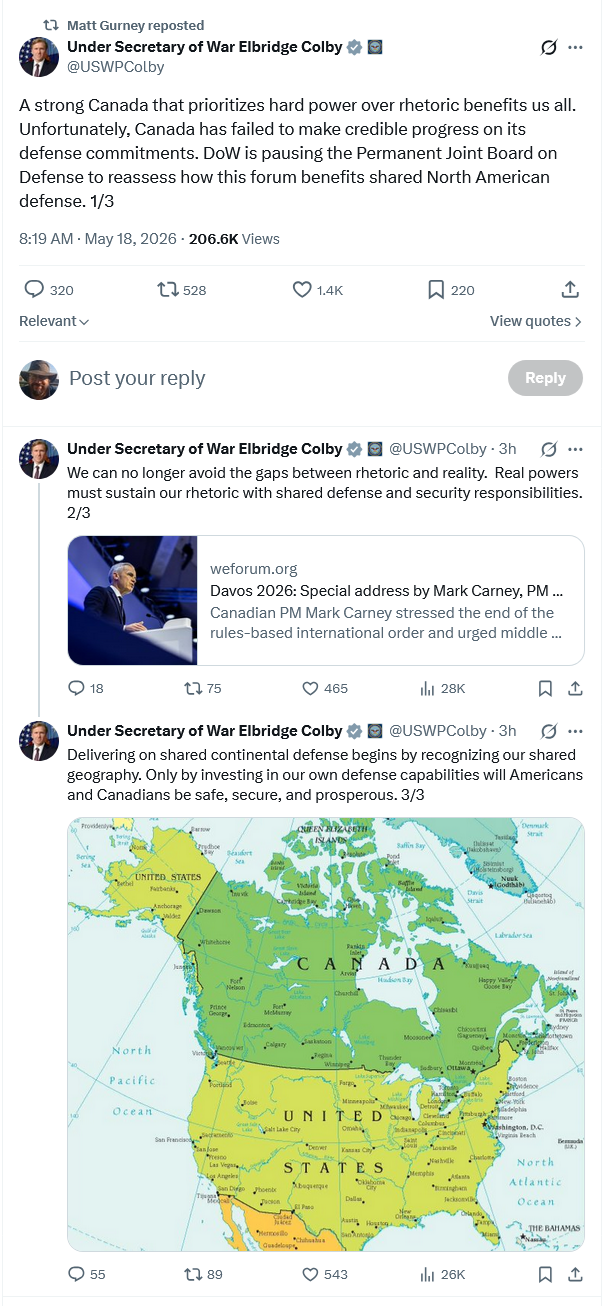
As I posted on social media when sharing this: “This is another gentle reminder to the f*ckwits in the Canadian government that they are playing with existential fire when they work to actively piss off our American allies.”
First of all, and this will annoy the Elbows Uppers to no end, the undersecretary’s comments are, fundamentally, accurate. Canada has indeed massively underinvested in defence and has also prioritized rhetoric over reality. I completely understand why Canadians hate admitting this — I hate admitting this. Having your flaws pointed out to you by someone you dislike is always a mortifying experience. But I’ve spent almost two decades writing about the very things Colby is pointing out — Canada has allowed its military capability to atrophy to a point, as I noted just a week ago in an episode of On The Line, where we’ll need many years and untold billions of dollars just to rehabilitate the armed forces. Expanding them and adding capabilities will be a whole other level of investment. This is why Canada’s recent major announcements on defence, though good and welcome, are also not enough — it will take a long time and even more money to actually repair what we have allowed to rot.
The other half of what Colby identified is also, alas, accurate. While we were massively underfunding defence and allowing core capabilities to wither and die, or while just totally missing the bus on transformational military developments (hello, drones!), Canada did indeed talk a lot about the rules-based international order and the role of middle powers and punching above our weight and all the rest. Canada focusing on rhetoric instead of reality is, alas, a fair criticism.
Many U.S. administrations called us out on this. We ignored them. Donald Trump is unique in how viciously he is prepared to exploit our weakness, but he’s hardly the first to have noticed it and called us out on it. I carry no water for MAGA or Trump, but they’ve got us dead to rights on this one. The bad orange man didn’t let the navy rust out, repeatedly defer the fighter jet replacement and hobble the army with non-serviceable equipment and recruiting and procurement systems that were actually quite awful at both those things.
We did those things. We did it to ourselves. Colby is simply possessed of the gall to bluntly call us out on our failures, in a way that Canadians aren’t accustomed to and aren’t going to enjoy.
So that’s part of it. But it’s also worth asking why the U.S. is doing this, and especially why they’re doing it now.
Part of it, probably, is just sincere frustration with us. As noted above, Colby’s remarks are accurate. But the timing is interesting. The CUSMA renegotiation deadline looms in early July And in Colby’s remarks, do I detect a whiff of the art of the deal?
The Carney government has made, and continues to make, plenty of announcements about plans, and potential deals, and future capabilities, and so on … but the Americans can’t help but notice that little is actually being done despite all the sound and fury on the PR side. Canada belatedly reached the long-agreed-upon 2% of GDP target for military spending, but most of it was a bookkeeping exercise of moving existing costs onto the Department of National Defence budget (the Canadian Coast Guard and parts of Veterans Affairs) but not much improved in Canada’s actual defence capabilities.


