
Forgotten Weapons
Published 4 Oct 2025Welcome back to Part II of our biography on Lauri Törni / Larry Thorne with author and researcher Kari Kallonen. Today we are covering Thorne’s life and exploits after emigrating to the United States. He joined the US Army, then 10th Special Forces Group in Germany, and was one of the original Green Berets in Vietnam until his death in a helicopter crash in October 1965. His remains were only recovered in 1999, and Mr. Kallonen was part of the team that traveled to Vietnam for the recovery effort.
(more…)
March 4, 2026
Larry Thorne Biography Part 2: Green Berets in Vietnam
Comments Off on Larry Thorne Biography Part 2: Green Berets in Vietnam
March 3, 2026
Iran in the news
I haven’t bothered trying to keep up with the firehose of “news” about the combined US/Israeli operations against the Islamic State, as much of what is initially reported will be re-stated, retracted, refuted, and other words starting with “R” until something vaguely resembling objective analysis can be done. There are uncounted mainstream, specialist, and advocacy sites and there’s no point trying to keep up with them (for me, anyway). Here are a few bits of internet flotsam on issues arising from Operation Brass Balls (or whatever name they chose for it):
First up, J.D. Tuccille on the legality around President Trump’s decision to strike Iran:
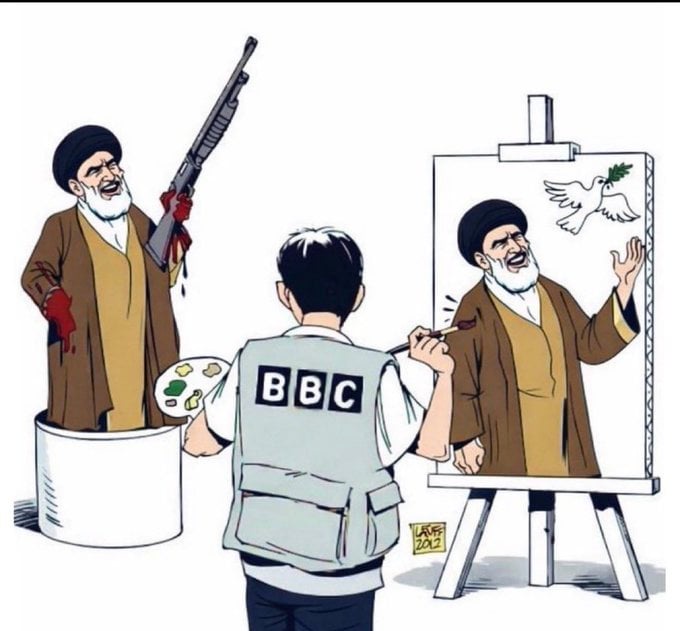
The BBC has a long history of … careful wording in describing events in Iran since 1979. I don’t think this cartoon is unfair in portraying that.
The world is undoubtedly a better place after the killing of Iran’s supreme leader Ayatollah Ali Khamenei and roughly 40 of his murderous colleagues by joint Israeli and American military strikes. Iran’s Islamist regime has slaughtered its own people while encouraging terrorism around the world for decades. But those strikes carry serious risks and costs. Are they worth the tradeoffs? The Trump administration should have made its case to Congress and the already skeptical public and satisfied the Constitution’s requirements by doing so.
War Without Debate
On Saturday, the U.S. and Israel launched much-anticipated strikes after claiming negotiations with the Iranian regime over the status of its nuclear weapons program had stalled.
“A short time ago, the United States military began major combat operations in Iran,” President Donald Trump announced. “Our objective is to defend the American people by eliminating imminent threats from the Iranian regime — a vicious group of very hard, terrible people. Its menacing activities directly endanger the United States, our troops, our bases overseas, and our allies throughout the world. For 47 years the Iranian regime has chanted ‘death to America’ and waged an unending campaign of bloodshed and mass murder, targeting the United States, our troops, and the innocent people in many, many countries.”
True enough. The president recited a litany of crimes in which the Islamist regime has been implicated, including the 1983 bombing of the U.S. Marine barracks in Beirut by Iranian proxy Hezbollah, and the October 7, 2023, Hamas attack on Israel, which Iranian forces helped plan. To this list we can add the attempted assassinations of Iranian dissident Masih Alinejad in Brooklyn and of then-presidential candidate Trump himself. Trump also called out Iran’s efforts to acquire nuclear weapons. And he urged the suffering Iranian people, who have weathered brutal attempts to suppress protests, to take advantage of the military strikes to overthrow the regime.
Unfortunately, this was the first time many Americans — members of the public and lawmakers alike — heard the Trump administration make a somewhat coherent argument for taking on Iran’s government. It came as strikes were already underway despite the Constitution reserving to Congress the responsibility to “provide for the common Defence”, “to declare War”, “to raise and support Armies”, and “to provide and maintain a Navy”. Lawmakers were informed of the attack on Iran, but only after the country was committed to hostilities and their related dangers and expense.
Congress and the People Were Never Consulted
“I am opposed to this War,” Rep. Thomas Massie (R–Ky.) objected. “This is not ‘America First’. When Congress reconvenes, I will work with @RepRoKhanna to force a Congressional vote on war with Iran. The Constitution requires a vote, and your Representative needs to be on record as opposing or supporting this war.”
Rep. Ro Khanna (D–Calif.) shares Massie’s skepticism towards military action. He and Massie might have voted against authorizing war with Iran even if they’d heard the administration’s arguments. Or perhaps they and other lawmakers would have been persuaded. We don’t know, because the president didn’t make a case until bombs and missiles had already been launched.
Andrew Doyle on the need for regime change:

The end point of armed conflict is impossible to predict. In her book On Violence (1970), the philosopher Hannah Arendt argued that when it comes to political violence, “the means used to achieve political goals are more often than not of greater relevance to the future world than the intended goals”. However well planned and executed, wars have a tendency to spiral out of control in ways never envisaged.
Whether Donald Trump’s decision to attack Iran will pay off depends upon the fates as much as anything else. The goal is regime change, which – given the appalling tyranny under which the Iranian people have suffered for five decades – is admirable and just. Yet the numerous unknown variables make this war the biggest risk that Trump has yet taken as president.
This war has the potential to escalate and engulf the entire region. Iran is already striking neighbouring Arab states allied with the US in a scattershot and desperate manner. With the death of the Ayatollah, it may be that the regime will be forced into a ceasefire while it seeks to re-establish its power. Yet the scenes of wild celebration on the streets of Iran would suggest that domestic revolution is its greatest threat. If the Islamic Revolutionary Guard Corps (not the country’s national army, but a kind of Praetorian guard for the mullahs) can be turned, the regime will fall.
Perhaps the worst case scenario is a widespread power struggle between competing militias and separatist groups. The IRGC itself could fragment, and we may see the kind of chaos that ensued after the Iraq war of 2003. The Trump administration has the advantage of the latest military technology and will insist that this enterprise will never require “boots on the ground”. It may be right, but who knows what factions will emerge with no centralised authority?
Those of us without a crystal ball should get used to the phrase: “we don’t know”. Various social media pundits are asserting with absolute certainty where all of this will lead. They would be wise to exercise greater caution. After the Twelve-Day War last June in which Israel and the US destroyed much of Iran’s nuclear infrastructure and air defence capabilities, many on the “America First” right were quick to prophesy the advent of World War III. Their claims to clairvoyance were unfounded.
CDR Salamander argues in favour of the punitive expedition as a legitimate tool in the nation’s war locker:
I support the strikes on Iran because it firmly fits into a view I have held on the use of national military power for decades, based on thousands of years of military practice. If you are not up to speed with the thousands of Americans dead and maimed by the Islamic Republic and its proxies over the last 47 years, then I have nothing more to discuss with you.
While I understand the academic argument of many that before any action takes place, there is a whole series of hoops, barriers, and puzzles of our own creation that we need to go through — I firmly believe that not only are those Constitutionally unnecessary for punitive expeditions in 2026, if done, needed and deserved strikes like we have seen in Iran could not take place without
Fortunes were made, institutions funded, and employment justified for legions under the old and failed post-WWII process swamp and GWOT nomenklatura that gave us unending and stillborn conflicts. To go that route again wouldn’t just be folly, it would be a self-destructive folly to refuse to change in the face of evidence.
I’ve seen older versions of OPLANS for Iran. Huge, bloody, and frankly undoable. They were only that way because they met the requirements of an old system that everyone nodded their heads to because all the smart people from Johns Hopkins, Harvard, Princeton and all the usual places said we had to do it this way.
Enough. Bollocks to all that. They have been measured the last quarter century and have been found wanting.
A series of events since October 7, 2023, including the 2024 election, has opened a window to do what we have not been able to do for a whole host of reasons — and there is a debt waiting to be paid.
We’ve been here before with Iran. In the modern context, we sank two warships and three speedboats of the Islamic Republic of Iran Navy in 1988 during Operation Praying Mantis as punishment for damaging USS Samuel B. Roberts (FFG 58) and Iran’s mining international waters in the Persian Gulf. We’ve played slap-n-tickle with them here and there while they have brutalized us at every turn when they are not brutalizing their own people.
Yes, it’s personal — but part of the reason we have been hesitant is that our national security intellectuals have been stuck in a world view that prevented action, by design.
Though not exclusive, the Powell Doctrine’s “Pottery Barn Rule” (that it appears he got from one of Thomas Frack’n Friedman’s columns), made it appear that we could only take action if we took the entire country and then remade it in our image.
We know how that operationalized over the last couple of decades.
We’ve done plenty of punitive expeditions in our nation’s history — but in the last few decades as a certain pedigree of policy maker held sway over our national security doctrine, it fell out of favor.
They failed the nation. Their institutions failed the nation. Their worldview was little more than a self-licking ice cream cone of self-regard.
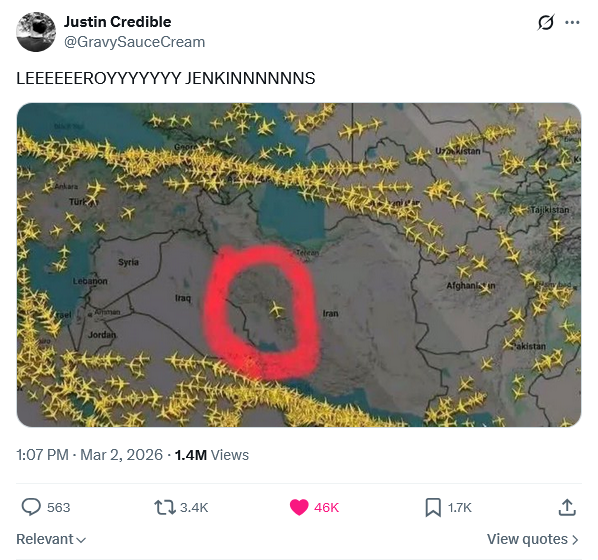
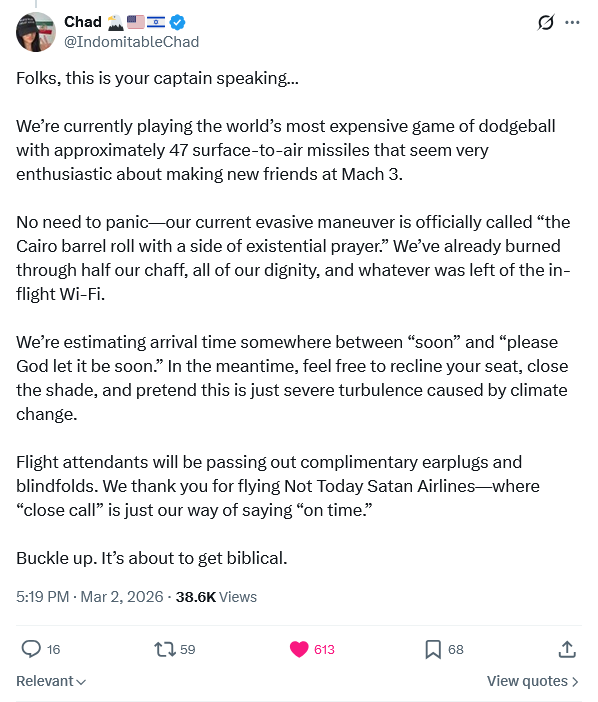
There are also those who can find the funny aspects of any serious situation:
Comments Off on Iran in the news
March 2, 2026
QotD: King Stephen and “the anarchy”
Picture the scene: it is a dark night in late November. A cross-channel ferry is about to set sail for England. A posh young man, a boy really, boards the ship with his posh mates. They’re not short of money and before long they’re seriously drunk. Some of the other passengers disembark. They hadn’t signed-up for a booze cruise — and, what’s more, the young men are carrying knives. Well, I say “knives” — what I actually mean is swords.
At this point, I ought to mention that the year is 1120; the young man is William Adelin, heir to the throne of England; and the “ferry” is the infamous White Ship.
Anyway, back to the story: the wine keeps flowing and, before long, the crew are drunk too. Not far out of port, the ship hits a submerged rock and rapidly sinks.
In all, hundreds are drowned — and yet that is just the start of the tragedy.
William’s father, King Henry I, had gone to great lengths to proclaim an heir. As the son of William the Conqueror, he knew just how messy succession could get. He had himself inherited the throne from his brother, William Rufus. This second William had died of a chest complaint — specifically, an arrow in the lungs (the result of a hunting “accident”). Henry was determined that his son would inherit the throne without mishap — and so carefully prepared the ground for a smooth transfer. Indeed, the name “Adelin” signified that the third William was the heir apparent.
The sinking of the White Ship left Henry with one remaining legitimate heir, his daughter Matilda. She was a formidable character, also known as Empress Maud (by virtue of her first marriage to the Holy Roman Emperor). She was, nevertheless, a woman — a big problem in an age when monarchs were expected to lead their men in battle. When Henry died in 1135, Maud’s cousin — Stephen of Blois — seized the throne. This was widely welcomed by the English nobility, but Maud wasn’t giving up easily, and she had powerful allies. Her second husband was Geoffrey, Count of Anjou; her illegitimate half-brother, Robert of Gloucester, was a wealthy baron; and her uncle was King David I of Scotland.
Stephen was assailed on all sides — by Geoffrey in Normandy, by Robert in England, by invading Scots and rebellious Welshmen. The civil war (if that’s what you can call this multi-sided free-for-all) dragged on for almost 20 years. There weren’t many set-piece battles, but there was lots of looting and pillaging in which countless nameless peasants perished.
In the end it was the death of another heir — Stephen’s son, Eustace — that opened the way to peace. The war-weary king agreed that Maud’s son (the future Henry II) would succeed him. And thus “The Anarchy” came to end: two decades of pointless devastation — and all because some young fool got pissed on a boat.
Peter Franklin, “Why Boris needs an heir apparent”, UnHerd, 2020-08-17.
Comments Off on QotD: King Stephen and “the anarchy”
February 28, 2026
Lauri Torni Biography Part 1: Soldier of Three Armies
Forgotten Weapons
Published 3 Oct 2025Today is the first of a two-part biography on Finnish legend Lauri Törni, later known as Larry Thorne. He fought in the Winter War and Continuation War, and was awarded the Mannerheim Cross for his actions in the Continuation War. He also travelled to Germany between the two (and again after the Continuation War), spending some time with the German army. In the early 1950s he emigrated to the United States, joining the US Army and eventually serving several tours in Vietnam.
My guest today is Finnish writer and researcher Kari Kallonen, who has written several books on Törni and was kind enough to join me to share the man’s story …
(more…)
Comments Off on Lauri Torni Biography Part 1: Soldier of Three Armies
QotD: The “Balance of Terror” in the missile age
This also meant that a devastating nuclear “first strike” could now be delivered before an opponent would know it was coming, or at least on extremely short notice. A nuclear power could no longer count on having enough warning to get its nuclear weapons off before the enemy’s nuclear strike had arrived. Bernard Brodie grappled with these problems in Strategy in the Missile Age (1959) but let’s focus on a different theorist, Albert Wohlstetter, also with the RAND Corporation, who wrote The Delicate Balance of Terror (1958) the year prior.
Wohlstetter argued that deterrence was not assured, but was in fact fragile: any development which allowed one party to break the other’s nuclear strike capability (e.g. the ability to deliver your strike so powerfully that the enemy’s retaliation was impossible) would encourage that power to strike in the window of vulnerability. Wohstetter, writing in the post-Sputnik shock, saw the likelihood that the USSR’s momentary advantage in missile technology would create such a moment of vulnerability for the United States.
Like Brodie, Wohlstetter concluded that the only way to avoid being the victim of a nuclear first strike (that having the enemy hit you with their nukes) was being able to credibly deliver a second strike. This is an important distinction that is often misunderstood; there is a tendency to read these theorists (Dr. Strangelove does this to a degree and influences public perception on this point) as planning for a “winnable” nuclear war (and some did, just not these fellows here), but indeed the point is quite the opposite: they assume nuclear war is fundamentally unwinnable and to be avoided, but that the only way to avoid it successfully is through deterrence and deterrence can only be maintained if the second strike (that is, your retaliation after your opponent’s nuclear weapons have already gone off) can be assured. Consequently, planning for nuclear war is the only way to avoid nuclear war – a point we’ll come back to.
Wohlstetter identifies six hurdles that must be overcome in order to provide a durable, credible second strike system – and remember, it is the perception of the system, not its reality that matters (though reality may be the best way to create perception). Such systems need to be stable in peacetime (and Wohlstetter notes that stability is both in the sense of being able to work in the event after a period of peace, but also such that they do not cause unintended escalation; he thus warns against, for instance, just keeping lots of nuclear-armed bombers in the air all of the time), they must be able to survive the enemy’s initial nuclear strikes, it must be possible to decide to retaliate and communicate that to the units with the nuclear weapons, then they must be able to reach enemy territory, then they have to penetrate enemy defenses, and finally they have to be powerful enough to guarantee that whatever fraction do penetrate those defenses are powerful enough to inflict irrecoverable damage.
You can think of these hurdles as a series of filters. You start a conflict with a certain number of systems and then each hurdle filters some of them out. Some may not work in the event, some may be destroyed by the enemy attack, some may be out of communication, some may be intercepted by enemy defenses. You need enough at the end to do so much damage that it would never be worth it to sustain such damage.
This is the logic behind the otherwise preposterously large nuclear arsenals of the United States and the Russian Federation (inherited from the USSR). In order to sustain your nuclear deterrent, you need more weapons than you would need in the event because you are planning for scenarios in which some large number of weapons are lost in the enemy’s first strike. At the same time, as you overbuild nuclear weapons to counter this, you both look more like you are planning a first strike and your opponent has to estimate that a larger portion of their nuclear arsenal may be destroyed in that (theoretical) first strike, which means they too need more missiles.
What I want to note about this logic is that it neatly explains why nuclear disarmament is so hard: nuclear weapons are, in a deterrence scenario, both necessary and useless. Necessary, because your nuclear arsenal is the only thing which can deter an enemy with nuclear weapons, but that very deterrence renders the weapons useless in the sense that you are trying to avoid any scenario in which you use them. If one side unilaterally disarmed, nuclear weapons would suddenly become useful – if only one side has them, well, they are the “absolute” weapon, able to make up for essentially any deficiency in conventional strength – and once useful, they would be used. Humanity has never once developed a useful weapon they would not use in extremis; and war is the land of in extremis.
Thus the absurd-sounding conclusion to fairly solid chain of logic: to avoid the use of nuclear weapons, you have to build so many nuclear weapons that it is impossible for a nuclear-armed opponent to destroy them all in a first strike, ensuring your second-strike lands. You build extra missiles for the purpose of not having to fire them.
(I should note here that these concerns were not the only things driving the US and USSR’s buildup of nuclear weapons. Often politics and a lack of clear information contributed as well. In the 1960s, US fears of a “missile gap” – which were unfounded and which many of the politicians pushing them knew were unfounded – were used to push for more investment in the US’s nuclear arsenal despite the United States already having at that time a stronger position in terms of nuclear weapons. In the 1970s and 1980s, the push for the development of precision guidance systems – partly driven by inter-agency rivalry in the USA and not designed to make a first strike possible – played a role in the massive Soviet nuclear buildup in that period; the USSR feared that precision systems might be designed for a “counter-force” first strike (that is a first strike targeting Soviet nuclear weapons themselves) and so built up to try to have enough missiles to ensure survivable second strike capability. This buildup, driven by concerns beyond even deterrence did lead to absurdities: when the SIOP (“Single Integrated Operational Plan”) for a nuclear war was assessed by General George Lee Butler in 1991, he declared it, “the single most absurd and irresponsible document I had ever reviewed in my life”. Having more warheads than targets had lead to the assignment of absurd amounts of nuclear firepower on increasingly trivial targets.)
All of this theory eventually filtered into American policy making in the form of “mutually assured destruction” (initially phrased as “assured destruction” by Secretary of Defense Robert McNamara in 1964). The idea here was, as we have laid out, that US nuclear forces would be designed to withstand a first nuclear strike still able to launch a retaliatory second strike of such scale that the attacker would be utterly destroyed; by doing so it was hoped that one would avoid nuclear war in general. Because different kinds of systems would have different survivability capabilities, it also led to procurement focused on a nuclear “triad” with nuclear systems split between land-based ICBMs in hardened silos, forward-deployed long-range bombers operating from bases in Europe and nuclear-armed missiles launched from submarines which could lurk off an enemy coast undetected. The idea here is that with a triad it would be impossible for an enemy to assure themselves that they could neutralize all of these systems, which assures the second strike, which assures the destruction, which deters the nuclear war you don’t want to have in the first place.
It is worth noting that while the United States and the USSR both developed such a nuclear triad, other nuclear powers have often seen this sort of secure, absolute second-strike capability as not being essential to create deterrence. The People’s Republic of China, for instance, has generally focused their resources on a fewer number of systems, confident that even with a smaller number of bombs, the risk of any of them striking an enemy city (typically an American city) would be enough to deter an enemy. As I’ve heard it phrased informally by one western observer, a strategy of, “one bomb and we’ll be sure to get it to L.A.” though of course that requires more than one bomb and one doubts the PRC phrases their doctrine so glibly (note that China is, in theory committed to developing a triad, they just haven’t bothered to actually really do so).
Bret Devereaux, “Collections: Nuclear Deterrence 101”, A Collection of Unmitigated Pedantry, 2022-03-11.
Comments Off on QotD: The “Balance of Terror” in the missile age
February 27, 2026
The British Are Coming! – British Fighter Aces – WW2 Gallery 09
World War Two
Published 26 Feb 2026In this gallery special, we examine five of Britain’s leading fighter aces: Archie McKellar, James MacLachlan, Robert Stanford Tuck, John Braham, and James Edgar Johnson. From the Battle of Britain to night fighting, Intruder missions, and offensive sweeps over occupied Europe, their careers reflect the RAF’s transformation from desperate air defense to sustained air superiority.
These pilots did more than accumulate victory claims. Their experiences illuminate the evolution of air combat, showing how individual skill, technology, and strategy intersected in the broader history of the Second World War.
Which of these careers best captures the changing nature of air power in World War Two?
(more…)
Comments Off on The British Are Coming! – British Fighter Aces – WW2 Gallery 09
February 26, 2026
The Decline and Fall of Sparta
toldinstone
Published 25 Feb 2026How Sparta, the most powerful Greek city-state, collapsed in only 20 years.
0:00 Introduction
0:38 Classical Sparta
1:29 Spartan politics
2:22 Helots
3:24 Population decline
4:37 Hubris
5:25 The Battle of Leuctra
6:42 Messenia liberated
7:35 Enter Macedon
8:08 Attempts at reform
9:08 Irrelevance
9:37 Roman Sparta
(more…)
Comments Off on The Decline and Fall of Sparta
QotD: “Naming of Parts” by Henry Reed
We had daily cleaning. And tomorrow morning,
We shall have what to do after firing. But today,
Today we have naming of parts. Japonica
Glistens like coral in all the neighboring gardens,
And today we have naming of parts.This is the lower sling swivel. And this
Is the upper sling swivel, whose use you will see,
When you are given your slings. And this is the piling swivel,
Which in your case you have not got. The branches
Hold in the gardens their silent, eloquent gestures,
Which in our case we have not got.This is the safety-catch, which is always released
With an easy flick of the thumb. And please do not let me
See anyone using his finger. You can do it quite easy
If you have any strength in your thumb. The blossoms
Are fragile and motionless, never letting anyone see
Any of them using their finger.And this you can see is the bolt. The purpose of this
Is to open the breech, as you see. We can slide it
Rapidly backwards and forwards: we call this
Easing the spring. And rapidly backwards and forwards
The early bees are assaulting and fumbling the flowers:
They call it easing the Spring.They call it easing the Spring: it is perfectly easy
If you have any strength in your thumb: like the bolt,
And the breech, the cocking-piece, and the point of balance,
Which in our case we have not got; and the almond blossom
Silent in all of the gardens and the bees going backwards and forwards,
For today we have the naming of parts.Henry Reed, 1942.
Comments Off on QotD: “Naming of Parts” by Henry Reed
February 25, 2026
The Korean War Week 88: Riot or Revolution? – February 24, 1952
The Korean War by Indy Neidell
Published 24 Feb 2026The tensions at Koje-do POW camp explode this week, ending in heavy bloodshed as UN forces desperately try to wrestle control of the situation. Changes will need to be made to counter the growing threat of disorder, and fast. Elsewhere, the Communist forces are on the attack this week, both in the field and through diplomatic channels, as a naval invasion of Yang-do launches and accusations of biological weapons ramp up.
00:00 Intro
00:44 Recap
01:13 Compound 62
04:44 Yang-do Island
07:45 Biological Warfare
09:55 Supervisory Committee
12:22 Notes
13:16 Summary
13:27 Conclusion
14:13 Call to Action
(more…)
Comments Off on The Korean War Week 88: Riot or Revolution? – February 24, 1952
“Allyness” in the British military
I suspect anyone who has spent time in uniform out in the field (peacetime or wartime) would recognize these traits, but so far as I know only the British army and Royal Marines have a specific term for it:
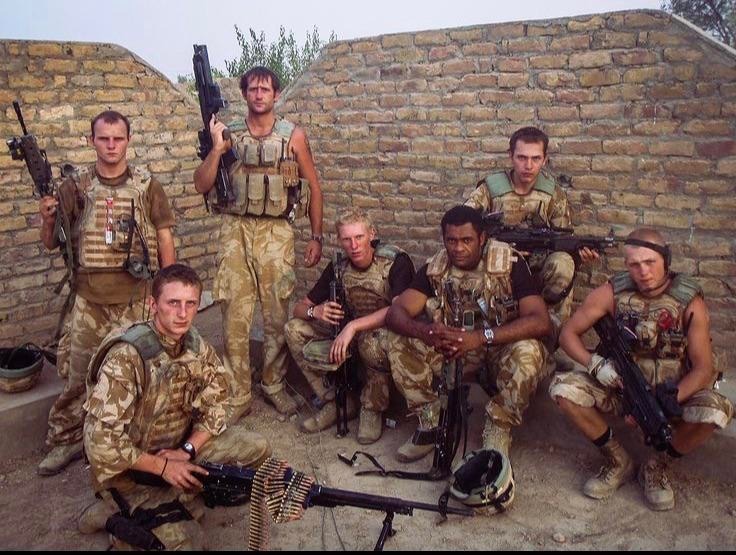
(British troops in Afghanistan, 2008, looking very ‘ally’)
Photo and caption from Combat Threads
Professor Andrew Groves is one of the few true academic experts on menswear. In fact, it was his work as the Director of the Westminster Menswear Archive that inspired me to pursue my Costume Studies MA. Recently, he has started a weekly Substack that is well worth checking out. Last week, he wrote an essay on “Ally“, a British military slang term. What exactly “Ally” is can be hard to nail down, as it has no comparable terms in the US military or civilian cultures. Broadly, it can be described as a language of visual signifiers that denote a soldier as “having been there”, or at the very least, wanting to come across that way, usually by modifying pieces of kit, or wearing it in a particular fashion.
As Groves puts it, “The quiet discipline of looking ready. It is a system that emerges precisely when regulation lags and consequences move faster than command … Allyness was awarded horizontally, not issued from above. It was recognition from peers who knew what to look for.” Groves continues:
That recognition lived in detail, but it was never a checklist. Allyness was built through small, cumulative acts, field-smart adjustments passed down through units, not rulebooks: cutting down webbing to reduce snagging, taping over buckles to kill shine, shaping berets tight to the temple, sewing in map pockets, blacking out brass, marking kit discreetly. None of this was required. All of it mattered, because it signalled experience rather than purchase.
While the origins of “ally” definitely had roots in field-wise functionality and competence (the widespread adoption of Bundeswehr boots by British Paras or the “norgi” baselayer adopted by RM Commandos come to mind), by the time the GWOT generation were forming their own sense of “allyness”, much had devolved to style. I am going to quote from Simon Akam’s wonderful book The Changing of the Guard: The British Army Since 9/11, on the evolution of “ally” in the 21st Century:
“Ally” is rifle magazines taped together — it draws inspiration from films as well as finding exhibition through the same medium. Ally is beards. Ally is non-regulation scarves and shemagh cloths. Ally is belts of 7.62mm link machine-gun ammunition draped over shirtless muscled torsos. Ally is liberal use of sniper tape on bits of kit, scrim netting pulled taut over the issued helmet, or “hero sleeves” — sleeves rolled only halfway up the forearm. A strong influence, ironically given the outcome of that conflict, is Vietnam … Of course, the two quantities of violence and ally are entwined. Fighting is ally. It seeps into Iraq, too: Major Stuart Nicholson, a Fusiliers officer serving on an exchange post with the Anglians in Basra in 2006, sees one sub-unit who keep one set of totemic combats [field uniform] to wear every time they go out on patrol, regardless of how dirty and disgusting they become. Nicholson catches one of this crew deliberately driving a Warrior armoured vehicle over a helmet cover to make it look already battered.
Later in the book, Akam recounts the “ally” origins of the British Army’s adoption of a Crye designed variant MultiCam (named Operation Peacock). The need for a new camouflage pattern was practical: British troops in Afghanistan found their DPM uniforms coming up short, and it was also based on seeing American SOF using MultiCam. I think that best illustrates the push and pull of what makes something “ally”. Some “allyness” traits can be seen as battlewise modifications to equipment, like taping down loose straps or added helmet scrim to help break up the silhouette, while others can be affectations that soldiers think look cool. And often, a bit of both.
Like anything to do with the infantry, of course, it can be taken too far and rather than improving effectiveness in the field, it can lead in very unwelcome directions:
These kinds of regulation-flouting practices can be interpreted as signs of a breakdown in unit discipline, which, in turn, can lead to more serious issues. It isn’t exactly “broken windows” theory for military units, but it also kind of is. It’s why, when Akam tells a story of an American officer who visited a British base in Afghanistan in 2006 and remarked that the British soldiers “look like our army at the end of Vietnam”, It was not meant as a compliment. Elsewhere, the desire to be “ally” led to armored vehicles flying English flags (despite its local connotations to the Crusades being an issue) and SS decals on other vehicles. “Allyness” can be a sign of the unit culture going rogue.
The result was a crackdown on the excesses of “allyness”. As Akam writes, “the ally clampdown is also a knee-jerk response to a realisation that something had got out of control. Some elements of ally survive, in particular the Paras’ interest in taping up bits of their gear. That is harder to stamp down on.”
Comments Off on “Allyness” in the British military
Bommarito: America’s First Toggle-Locked Battle Rifle
Forgotten Weapons
Published 1 Oct 2025Designed by Giuseppe Bommarito, this was one of the many independent rifle designs submitted to the US War Department in the 1910s hoping for military adoption. It is a short recoil operated, toggle-locked system chambered for .30-06 and using detachable 20-round magazines. It was tested (without much success) at Springfield and remained in development until 1918.
See a more complete article including original disassembly photos here:
https://www.forgottenweapons.com/m1-g…Thanks to the Springfield Armory National Historic Site for giving me access to this truly unique specimen from their reference collection to film for you! Don’t miss the chance to visit the museum there if you have a day free in Springfield, Massachusetts:
https://www.nps.gov/spar/index.htm
(more…)
Comments Off on Bommarito: America’s First Toggle-Locked Battle Rifle
February 23, 2026
Grand Strategy of the Roman Empire PART TWO
Adrian Goldsworthy. Historian and Novelist
Published 27 Aug 2025This should have posted earlier this morning, but for some reason did not.
This is the follow up to last week’s discussion of grand strategy, looking at the reactions and criticisms of Luttwak’s ideas, followed by some of my own thoughts.
Comments Off on Grand Strategy of the Roman Empire PART TWO
QotD: Faith, Hope, and Charity defended Malta
France has collapsed, Hitler is eating Europe alive, and Mussolini doesn’t want to miss out. He wants birthday cake without bringing a present.
Poor show
So he looks at a map and asks the Italian Air Force:
“Who can we bomb that’s really close?”
Answer: Malta, 49 miles away.
The Italians begin their great wartime contribution by flying at 14,000 feet and dropping bombs with the accuracy of a man throwing darts after fourteen pints. Half land in the sea, a few hit fields.
But accuracy wasn’t the point. They just wanted to show Berlin they were “in the war”.
For the Maltese, who had never seen modern bombing, even bad Italian bombing was terrifying.
And unfortunately for them, this was only the warm-up act.
Maynard’s Defence: Faith, Hope and Charity
Air Commodore Foster Maynard is given the job of defending Malta with basically nothing.
He had been promised four fighter squadrons.
Zero have arrived. Typical early war British brilliance.
His only aircraft were some slow, ancient Fairey Swordfish.
Great for torpedoing ships, hopeless for intercepting bombers.
These were the famous “Stringbags”. We will hear from them later on.
Then like an archaeologist opening a cursed tomb the British discover 18 Gloster Gladiators in crates on the island. They were meant for HMS Glorious and HMS Eagle.
What followed was peak British wartime admin:
- Maynard asks the Navy to release some Gladiators.
- He gets permission.
- The ground crew assemble several.
- THEN the Navy says “No actually, stop, pack them back up.”
- THEN the decision gets reversed again.
- So they unpack them, reassemble them … again.
After all this faffing, three Gladiators emerge ready to fight.
Next problem: no fighter pilots.
Big problem I feel, anyway …
Maynard asks for volunteers. Eight bomber men step forward, either heroic or mildly insane.
Problem solved.
A journalist on the island, Harry Kirk, watching these three lonely biplanes scramble day after day, nicknames them Faith, Hope and Charity after his mother’s brooch.
The names stick. The legend begins.
On 21 June 1940 Pilot Officer George Burges shoots down a Savoia-Marchetti bomber over Valletta, the island’s first air victory.
The Maltese take it as a sign from God.
(It wasn’t, but let them have the moment.)
“MALTA: PART 1, Foreboding”, WWII Matters, 2025-11-17.
Comments Off on QotD: Faith, Hope, and Charity defended Malta
February 22, 2026
QotD: The shift from “motte-and-bailey” construction to stone castles
To talk about how these designs work, we need to clear some terminology. The (typically thin) wall that runs the circuit of the castle and encloses the bailey is called a “curtain wall“. In stone castles, there may be multiple curtain walls, arranged concentrically (a design that seems to emerge in the Near East and makes its way to Europe in the 13th century via the crusades); the outermost complete circuit (the primary wall, as it were) is called the enceinte. Increasingly, the keep in stone castles is moved into the bailey (that is, it sits at the center of the castle rather than off to one side), although of course stone versions of motte and bailey designs exist. In some castle design systems, with stone the keep itself drops away, since the stone walls and towers often provided themselves enough space to house the necessary peacetime functions; in Germany there often was no keep (that is, no core structure that contained the core of the fortified house), but there often was a bergfriede, a smaller but still tall “fighting tower” to serve the tactical role of the keep (an elevated, core position of last-resort in a defense-in-depth arrangement) without the peacetime role.
While the wooden palisade curtain walls of earlier motte and bailey castles often lacked many defensive features (though sometimes you’d have towers and gatehouses to provide fighting positions around the gates), stone castles tend to have lots of projecting towers which stick out from the curtain wall. The value of projecting towers is that soldiers up on those towers have clear lines of fire running down the walls, allowing them to target enemies at the base of the curtain wall (the term for this sort of fire is “enfilade” fire – when you are being hit in the side). Clearly what is being envisaged here is the ability to engage enemies doing things like undermining the base of walls or setting up ladders or other scaling devices.
The curtain walls themselves also become fighting positions. Whether on a tower or on the wall itself, the term for the fighting position at the top is a “battlement”. Battlements often have a jagged “tooth” pattern of gaps to provide firing positions; the term for the overall system is crenellation; the areas which have stone are merlons, while the gaps to fire through are crenals. The walkway behind both atop the wall is the chemin de ronde, allure or “wall-walk”. One problem with using the walls themselves as fighting positions is that it is very hard to engage enemies directly beneath the wall or along it without leaning out beyond the protection of the wall and exposing yourself to enemy fire. The older solution to this were wooden, shed-like projections from the wall called “hoarding”; these were temporary, built when a siege was expected. During the crusades, European armies encountered Near Eastern fortification design which instead used stone overhangs (with the merlons on the outside) with gaps through which one might fire (or just drop things) directly down at the base of the wall; these are called machicolations and were swiftly adopted to replace hoardings, since machicolations were safer from both literal fire (wood burns, stone does not) and catapult fire, and also permanent. All of this work on the walls and the towers is designed to allow a small number of defenders to exchange fire effectively with a large number of attackers, and in so doing to keep those attackers from being able to “set up shop” beneath the walls.
[I]t is worth noting something about the amount of fire being developed by these projecting towers: the goal is to prevent the enemy operating safely at the wall’s base, not to prohibit approaches to the wall. These defenses simply aren’t designed to support that much fire, which makes sense: castle garrisons were generally quite small, often dozens or a few hundred men. While Hollywood loves sieges where all of the walls of the castle are lined with soldiers multiple ranks deep, more often the problem for the defender was having enough soldiers just to watch the whole perimeter around the clock (recall the example at Antioch: Bohemond only needs one traitor to access Antioch because one of its defensive towers was regularly defended by only one guy at night). It is actually not hard to see that merely by looking at the battlements: notice in the images here so far often how spaced out the merlons of the crenellation are. The idea here isn’t maximizing fire for a given length of wall but protecting a relatively small number of combatants on the wall. As we’ll see, that is a significant design choice: castle design assumes the enemy will reach the walls and aims to prevent escalade once they are there; later in this series we’ll see defenses designed to prohibit effective approach itself.
As with the simpler motte and bailey, stone castles often employ a system of defense in depth to raise the cost of an attack. At minimum, generally, that system consists of a moat (either wet or dry), the main curtain walls (with their towers and gatehouses) and then a central keep. Larger castles, especially in the 13th century and beyond, adopting cues from castle design in the Levant (via the crusades) employed multiple concentric rings of walls. Generally these were set up so that the central ring was taller, either by dint of terrain (as with a castle set on a hill) or by building taller walls, than the outer ring. The idea here seems not to be stacking fire on approaching enemies, but ensuring that the inner ring could dominate the outer ring if the latter fell to attackers; defenders could fire down on attackers who would lack cover (since the merlons of the outer ring would face the other way). As an aside, the concern to be firing down is less about the energy imparted by a falling arrow (though this is more meaningful with javelins or thrown rocks) and more about a firing position that denies enemies cover by shooting down at them (think about attackers, for instance, crossing a dry moat – if your wall is the right height and the edges of the moat are carefully angled, you can set up a situation where the ditch never actually offers the attackers any usable cover, but you need to be high up to do it!).
Speaking of the moat, this is a common defensive element (essentially just a big ditch!) which often gets left out of pop culture depictions of castles and siege warfare, but it accomplishes so many things at such a low cost premium. Even assuming the moat is “dry”! For attackers on foot (say, with ladders) looking to approach the wall, the moat is an obstacle that slows them down without potentially providing any additional cover (it is also likely to disorder an attack). For sappers (attackers looking to tunnel under the walls and then collapse the tunnel to generate a breach), the depth of the ditch forces them to dig deeper, which in turn raises the demands in both labor and engineering to dig their tunnel. For any attack with siege engines (towers, rams, or covered protective housings made so that the wall can be approached safely), the moat is an obstruction that has to be filled in before those engines can move forward – a task which in turn broadcasts the intended route well in advance, giving the defenders a lot of time to prepare.
Well-built stone castles of this sort were stunningly resistant to assault, even with relatively small garrisons (dozens or a few hundred, not thousands). That said, building them was very expensive; maintaining them wasn’t cheap either. For both castles and fortified cities, one ubiquitous element in warfare of the period (and in the ancient period too, by the by) was the rush when war was in the offing to repair castle and town walls, dig out the moat and to clear buildings that during peace had been built int he firing lines of the castle or city walls.
Bret Devereaux, “Collections: Fortification, Part III: Castling”, A Collection of Unmitigated Pedantry, 2021-12-10.
Comments Off on QotD: The shift from “motte-and-bailey” construction to stone castles
February 21, 2026
Oh Look, They Want a Mercenary Army
Akkad Daily
Published 20 Feb 2026Get a country worth fighting for. Join Restore: https://www.restorebritain.org.uk/joi…
Comments Off on Oh Look, They Want a Mercenary Army


