
World War Two
Published 12 Mar 2026Belgium might have been quickly overrun by the Germans in 1940, but many Belgian airmen continued the fight by flying with Britain’s RAF, and quite a few of them were good enough to score five or more aerial victories and become Flying Aces. Here are a few of their stories.
(more…)
March 14, 2026
Belgian Aces in Exile – Belgian Fighter Aces – WW2 Gallery 10
Comments Off on Belgian Aces in Exile – Belgian Fighter Aces – WW2 Gallery 10
Palmer Cavalry Carbine
Forgotten Weapons
Published 20 Jun 2015The Palmer was the first bolt action firearm adopted by the US military — it was a single-shot rimfire carbine patented in 1863 and sold to the US cavalry in 1865. The guns were ordered during the Civil War, but were not delivered until just after the end of fighting, and thus never saw actual combat service. The design is very reminiscent of the later Ward-Burton rifle, using the same style of interrupted-thread locking lugs. The Palmer, however, has a separate hammer which must be cocked independently of the bolt operation.
Comments Off on Palmer Cavalry Carbine
March 12, 2026
QotD: Roman armies of the middle and late Republic
Polybius remarks both on the superior flexibility of Roman soldiers (18.31.9-11) and the intensity and effectiveness of Roman rewards and punishments (6.35-38). Josephus, a Greek-speaking Jewish man from the province of Judaea who first rebelled against the Romans and then switched sides offers the most famous endorsement of Roman drills, “Nor would one be mistaken to say that their drills are bloodless battles, and their battles bloody drills” (BJ 3.5.1).
It is hard to tell if the Roman triple-line (triplex acies) fighting system created the demand for synchronized discipline or if the Romans, having already developed a tradition of drill and synchronized discipline, adopted a fighting style that leveraged that advantage. Probably a bit of both, but in any event our evidence for the Roman army before the very late third century is very poor. By the time we truly see the Roman army clearly (c. 225 BC) the system seems to already [have been] in place for some time.
A Roman consular army was a complex machine. It was composed of an infantry line of two legions (in the center) and two socii “wings” (alae) to each side, along with cavalry detachments covering the flanks. Each of those infantry blocks (two legions, two alae) in turn was broken down into thirty separate maneuvering units (called maniples, generally consisting of 120 men; half as many for the triarii), which were in turn subdivided into centuries, but centuries didn’t really maneuver independently. In front of this was a light infantry screening force (the velites). So notionally there were in the heavy infantry of a standard two-legion consular army something like 120 different “chess pieces” that notionally the general could move around on their own and thus notionally the legion was capable of fairly complex tactical maneuvers.
You may have noted that word “notionally” because now we get into the limits of drill and synchronized discipline, because this isn’t a system for limitless tactical flexibility of the sort one gets in video games. Instead, recall that the idea here is to create coordinated movement and fighting (the synchronized discipline) through rigorous, repeated practice (drill). Of course one needs to practice specific things. Some of those things are going to be obvious: a drill for marching forward, or for turning the unit or for advancing on the charge.
In the Roman case, a “standard” battle involved the successive engagement and potentially retreat of each heavy infantry line: first the hastati (the first line) formed a solid line (filling the gaps) and attacked and then, if unsuccessful, retreated and the next line (the principes) would try and so on. Those maneuvers would need to be practiced: forming up, then having each maniple close the gap (we don’t quite know how they did this, but see below), the attack itself (which also involved usually throwing pila – heavy javelins), then retreat behind the next line if things went poorly. It’s also pretty clear from a battle like Cynoscephelae (197) or Bibracte (58) that individual maniples or cohorts (the Romans start using the larger 480-man-cohort as the basic maneuver unit during the second century BC) could be “driven” over the battlefield to a degree so there were probably drills for wheeling and turning.
Now even in this “standard” battle there is a lot of movement: maniples need to open and close gaps, advance and retreat and so on. This is what I mean by saying this army is a complex machine: it has a lot of moving parts that need to move together. The men in a maniple need to move together to make that mutually-supporting line and the maniples need to move together with each other to cover flanks and allow retreats. In terms of how the individual men moved, I’ve tended to think in terms of a “flow” model akin to this video of South Korean riot police training, rather than the clunkier Spartacus (1960) model.
But once an army has practiced all of these drills, it creates the opportunity for great improvisation and more complex tactics as well. Commanders, both the general but also his subordinates, can tell a unit to perform a particular maneuver that they have drilled, assuming the communication infrastructure exists in terms of instruments, standard shouted commands and battle standards (and note [that] Roman methods of battlefield communication were relatively well developed). That, for instance, allowed Aemilius Paullus to give orders to his first legion at Pydna for each of those maneuver units to either push forward or give ground independently, presenting the Macedonian phalanx with a tactical problem (an unevenly resisting line) it did not have a good solution for (Plut. Aem. 20.8-10). Having good junior officers […] was required but it wasn’t enough – those officers needed units which were already sufficiently drilled so that their orders (to press hard or retreat and reform in this case) could actually be carried out by soldiers for whom the response to those calls had become natural through that very drill.
At the same time I don’t want to give the wrong impression: even for the Romans battles where there was this sort of on-the-field improvising led by the general were uncommon (though not extremely rare). For the majority of battles, the legionary “machine” simply pushed forward in its standard way, even when – as at Cannae (216) – pushing forward normally proved to be disastrous. Just because an army can fight flexibly doesn’t mean it will or even that it should.
Bret Devereaux, “Collections: Total Generalship: Commanding Pre-Modern Armies, Part IIIa”, A Collection of Unmitigated Pedantry, 2022-06-17.
Comments Off on QotD: Roman armies of the middle and late Republic
March 11, 2026
The Korean War Week 90: No Surrender, No Armistice … No Hope? – March 10, 1952
The Korean War by Indy Neidell
Published 10 Mar 2026Ultimatums and blackmail! Well, sort of. US President Harry Truman is trying to strong arm South Korean President Syngman Rhee into accepting any armistice negotiated, but the armistice talks are taking forever, so there are those who wish to simply give the Communists a take it or leave it ultimatum. What might such an ultimatum be? Find out this week!
00:58 Recap
01:26 Inspection Teams
03:15 Ultimatums
05:08 Epidemic Disease
07:54 Syngman Rhee
10:57 ROK Training Programs
16:30 Summary
16:46 Conclusion
(more…)
Comments Off on The Korean War Week 90: No Surrender, No Armistice … No Hope? – March 10, 1952
Britain’s reputation in the Near East just cratered
On Substack Notes, Earl explains why the inexplicable delay in getting a Royal Navy warship out to protect Gulf allies from Iranian missiles is having serious negative impact on Britain’s longstanding relations with the targeted nations:
A MASTERCLASS IN MILITARY INCOMPETENCE
The Starmer administration’s handling of the Iranian crisis is being whispered about in the corridors of Whitehall as a historic “cock up” of the highest order. Despite receiving a formal request from the Americans on 11 February — a full 17 days before the offensive actually commenced — the British government appears to have spent that critical window in a state of paralyzed indecision. The U.S. request was not an invitation for Britain to join the initial “decapitation strikes”, but rather a plea for the Royal Navy to help shield vulnerable Gulf allies from the inevitable Iranian retaliation. Instead of stepping up to protect the 240,000 British citizens living in Dubai and Abu Dhabi, the Ministry of Defence oversaw a period of baffling inaction that has left regional partners feeling utterly betrayed.
The diplomatic fallout has been described by insiders as nothing short of catastrophic, with Middle Eastern allies expressing “undiluted fury” at the lack of British support. A former minister with deep ties to Amman reports that Jordan is “fking furious”, while leaders in Kuwait and the Emirates are openly questioning whose side Britain is actually on. The Cypriots are reportedly “incandescent” after learning that military assets were actually withdrawn from their vicinity just as the threat level spiked. Only this week did it emerge that HMS Dragon would finally deploy — nearly three weeks after the initial American SOS — a timeline that military experts say is far too little and far too late to restore trust.
Strategic failures have been compounded by what veteran commanders call a total lack of foresight regarding naval positioning. The only available Astute-class submarine was permitted to continue its journey toward Australia, despite having passed through the Gulf just weeks ago when it could have been held as a vital contingency. Security officials now warn that the Trump administration is viewing the UK’s “free riding” with growing contempt. There is a palpable fear in the MOD that the Americans, tired of London’s dithering, will simply cut Britain out of the loop entirely and strike a direct deal with Mauritius to secure the long-term use of Diego Garcia for future operations.
Inside the government, the situation is being described as “incoherent” and “unconscionable”. By allowing the United States to utilize British bases like RAF Fairford for strikes while simultaneously refusing to participate in the missions themselves, Starmer has managed to achieve the worst of both worlds. Critics say they have invited the risk of being targeted by Tehran without the benefit of having any say in the coalition’s strategic direction. One former defence chief has branded this policy “reprehensible”, arguing that Britain has effectively surrendered its seat at the table in exchange for a front-row seat to its own strategic irrelevance.
The sobering reality in Whitehall is a growing sense that the UK no longer has the capacity to shape events in the Middle East. A former Downing Street adviser noted that the “intensity of Labour’s feelings” on the conflict is now matched only by their lack of influence. Allies have stopped listening because they no longer believe Britain can — or will — deliver on its security promises. As the Trump administration continues its high-tempo campaign to dismantle the IRGC, the United Kingdom finds itself sidelined, watched with suspicion by its friends and emboldened by its enemies, all due to a fortnight of inexcusable hesitation.

On March 9th, The Guardian reported that HMS Dragon will sail “in the next couple of days”, heading to Cyprus to take over duties from French, Greek and Spanish ships in providing missile defence to the British air base at Akrotiri. YouTube channel Navy Lookout posted footage of HMS Dragon leaving Portsmouth here.
CDR Salamander looks back at the naval “special relationship” that appears more and more to be just a fading memory:
We need to stop pretending we have a Royal Navy we knew in our youth or even that of two decades ago. No, we have something altogether different. Something shrunken. Something weaker. Something that is, in the end, really sad. A symptom of a nation who has lost an enthusiasm for herself or even an understanding of her national interest and led by a ruling class that seems uninterested in stewardship.
The state of the Royal Navy — a condition that took decades of neglect to manifest into its form today and will take decades to repair if there is ever the will to do so — has become, as navies can often do, a symbol of the state of the nation it serves.
There is a lesson here, not just for the United States, but all nations who consider themselves a naval power.
If you fail over and over to properly fund, develop, train, and support your navy, you can coast for quite awhile on the inertia of the hard work and investment of prior generations, but eventually that exhausts itself, and you are left with the husk of your own creation.
Yes, I’m looking at you, DC.
Comments Off on Britain’s reputation in the Near East just cratered
March 10, 2026
Iran in the news
As I mentioned last time, as I don’t try to stay on top of the “breaking news” cycle, I’m not feverishly refreshing all my social media feeds to get the latest dope about the latest confict with the Islamic State. It’s not that I don’t care, but that as with all modern wars the ratio of signal to noise renders almost all of it worthless for finding out what’s actually happening. At Postcards from Barsoom, John Carter tries to gather his thoughts on the issue, subject to the same kind of informational constraints:
When I sit down to write, I usually have some idea of what I want to say – not only a topic I want to address, but a specific message I want to communicate. This is not going to be one of those essays. My feelings on the war on Iran are conflicted, to say the least. Nor do I feel that I understand enough about what’s happening to say much of substance. Nevertheless, on a matter that is of such potentially world-shaking import, I owe it to you not to be silent. So I’m setting out here to try and organize my thoughts on the matter. Whether they come to some conclusion or not, I have no idea. If nothing else, perhaps this will serve as a jumping off point for further discussion in the comments. Many of you, I’m sure, will have strong opinions on the subject, and many will also possess insights that I do not.
Will this war be of world-shaking import? That is perhaps the core of the matter. If it is not, and the principle of Nothing Ever Happens holds, then bombing Iran will not actually matter that much. A month from now, or even a couple weeks, the bombardment will fade back into the news cycle, the storm and fury of a million passionately articulated hot takes fading back into the warm, frothing ocean of discourse.
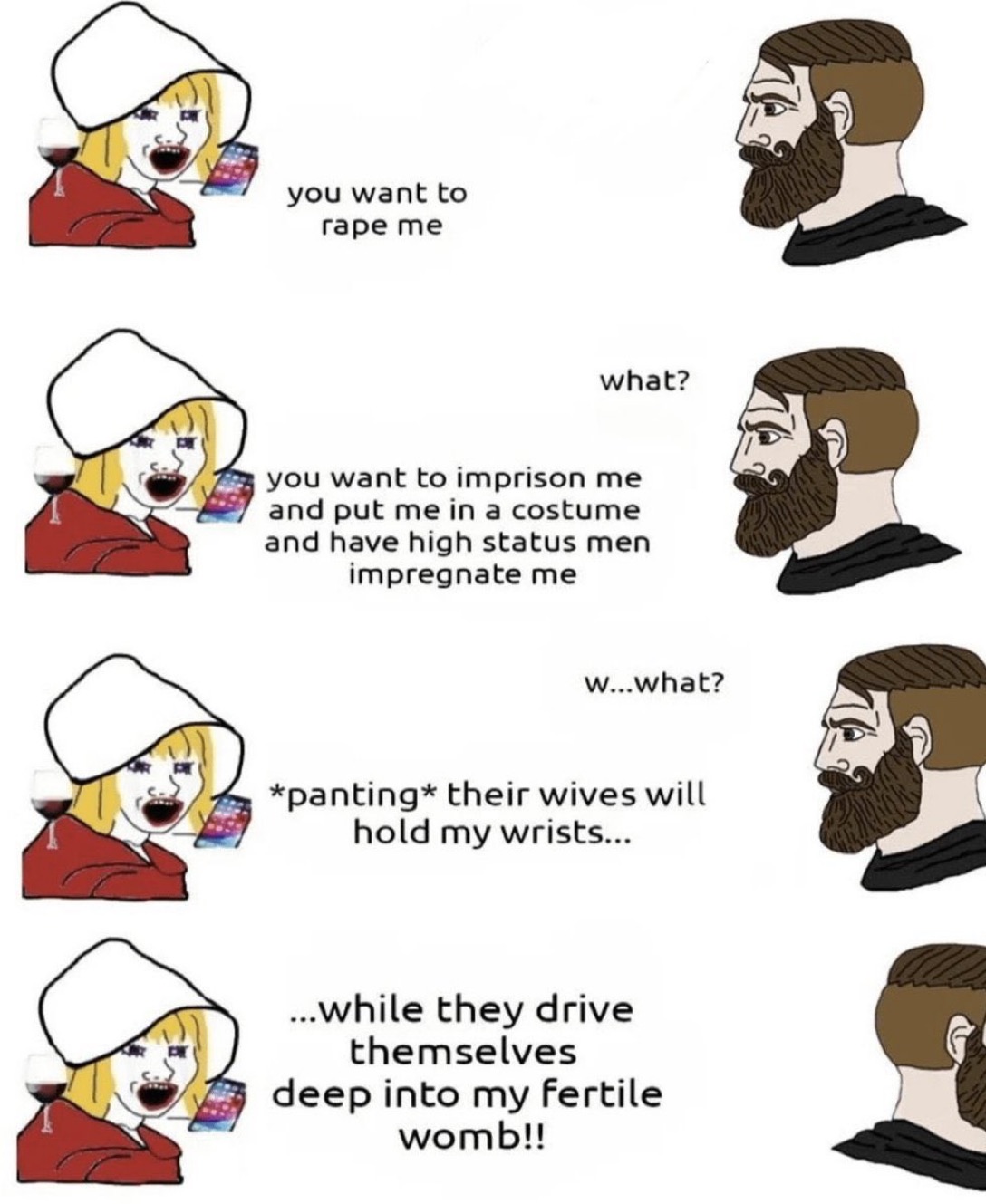
Certainly this has happened before. Trump has bombed Iran’s nuclear research facilities a few months ago, and assassinated the Iranian Revolutionary Guard Commander Qasem Soleimani a few years ago. Every time this kind of thing happens there are panicked shouts that thermonuclear Ragnarok is imminent, alongside outraged cries that Zion Don has betrayed MAGA by engaging in precisely the foreign interventionism that he repudiated, that he has been captured by the Neocohens, and that We Will Not Die For Israel. In each case, nothing much happened. Iran raised the red flag of revenge, or the gold flag of implacable annihilation, or the black flag of this time we really mean it, all of which amounted in practice to a few rockets being fired ineffectually in Israel’s general direction, to be absorbed by an Iron Dome that really seems to work quite well. There was no World War III. There were no boots on the ground. As I saw someone observe recently, We Will Not Die For Israel has become the groyper version of the Handmaid’s Tale: no one is actually asking anyone to die for Israel; there are no imminent plans for mass conscription; therefore protestations that one will resist a non-existent draft amount to the same kind of lurid masturbatory fantasy as declarations that one would never, pant, allow oneself to be confined in a harem, pant pant, and turned into, pant pant pant, breeding stock.

Brief pause for meme:
And back to John Carter:
Maybe that will change. Maybe a year from now I’ll be ruefully eating those words, as American boys are being shipped off by their hundreds of thousands to run around blinded by Russian electronic countermeasures in the cold mountain passes of the Zagros, getting picked off by snipers and shredded by Chinese drones.
But I doubt it.
Modern warfare doesn’t have much use for conscript armies. That lesson was learned in Vietnam: conscripts generally have poor morale, they aren’t highly motivated, they aren’t usually of the highest quality, and so they are of limited usefulness on the battlefield. Soldiers are highly trained professionals who have chosen the military as a career. That makes them much less likely to mutiny. Moreover, modern warfare is highly technical: soldiers have to be extremely well trained to be any use at all. The young men who volunteer for military service usually do so with some hope of adventure and even danger. As such, they often positively look forward to war.
None of this should be taken to imply that Israel hasn’t played a massive role in orchestrating and precipitating this war. They clearly have. Marco Rubio let this slip when he admitted that part of the reason the US attacked when they did was that Israel had signalled that they were going to attack with or without America’s blessing or assistance; since Iran would certainly direct some of its retaliation against the Little Satan towards the regional assets of the Great Satan, America’s hand was forced. This is a bit like when your shithead friend has had one Jameson’s too many and you sit down next to him at the bar only to find that he’s about to throw hands at some asshole you’ve never met: you’re liable to take a punch to the nose no matter what you do, so you might as well have your friend’s back. You can call him a shithead later.
Israel’s involvement goes much deeper than this, of course. Zionism’s penetration of American conservatism is hardly a secret. There are Dispensationalists all over the Republican party, including the Secretary of War Peter Hegseth, and probably Marco Rubio (though technically he’s a Catholic). Republicans who shrug off open anti-white bigotry systematically directed against America’s core population in essentially all of its universities react with fury to campus anti-Semitism, threatening to withhold funding from any institutions that tolerate hurt Jewish feelings. Then of course there’s the big guy himself. Trump has never been much of a Christian, still less an evangelical ZioChristian, but he seems to have undergone something of a religious awakening after divine intervention saved his life in Butler, Pennsylvania. And who can blame him? It certainly doesn’t seem implausible that since then, Trump has been influenced by Zionists who have convinced him that G-d saved him so that he could save America and, more importantly, G-d’s Chosen People. “You are the second coming of Cyrus the Great” would be an appealing narrative to a man with a vast ego. It would be even more appealing given the political and economic support it would come with. Certainly there would be no shortage of avenues for approach: Trump’s daughter is married into the tribe, after all.
Comments Off on Iran in the news
March 9, 2026
The FIRST Tank Battle – Villers-Bretonneux, 1918: Mark IV v A7V
The Tank Museum and Queensland Museum
Published 14 Nov 2025By spring 1918, the British Mark IV tank has been in service for almost a year. It had proved itself during the Battle of Cambrai – the males attacking concrete emplacements, and the females fending off the infantry. But the Mark IV has never been tested against another tank …
The German A7V hasn’t served on the battlefield very long. While it has mobility and stability issues, it does have thicker armour than the British tanks – and is more heavily armed. On paper, this looks like it will be a close call.
Villers-Bretonneux is the first time in history that a tank fought another tank. It’s a day that would change the face of warfare forever.
00:00 | Introduction
00:50 | The Mark IV
02:57 | The A7V
05:30 | The Battle of Villers-Bretonneux
06:44 | Mark IV vs A7V
09:09 | Who won?
(more…)
Comments Off on The FIRST Tank Battle – Villers-Bretonneux, 1918: Mark IV v A7V
March 7, 2026
ASh-78: Albania Makes the Worst AK
Forgotten Weapons
Published 11 Oct 2025Albanian AKs are both pretty scarce to find outside Albania, and also a bit unusual in the AK field. Where most countries followed Russian AK development, Albania instead patterned theirs on the Chinese Type 56. China had Russian assistance in producing the original milled-receiver AK, but the milled AKM came after the Sino-Soviet split and so China had to create their own stamped receiver design independently. We see those features in the Albanian ASh-78, in elements like the offset front trunnion rivet, gas vent holes, stock and grip style, single trigger guard rivets, and lack of a rate reducing mechanism in the FCG.
In 1960 China began providing military aid to Albania. The first rifle production there was a version of the SKS, which are made into the early 1970s. In 1974 the Albanian state arsenal began setting up AK production with Chinese help as well. Relations between the two countries broke down shortly thereafter, and by the time production began in 1978 the Albanians were working entirely independently. They added an underfolding model (the ASh-82) in 1982, and production continued past the end of the Cold War. Total production numbers are not known, as military information was pretty tightly controlled.
(more…)
Comments Off on ASh-78: Albania Makes the Worst AK
March 6, 2026
How Not to Build a Plane – TSR2 vs F-111
HardThrasher
Published 5 Mar 2026In the late Cold War, Britain and the United States tried to build the ultimate low-level supersonic strike aircraft. The result was two of the most ambitious aviation programmes ever attempted: the BAC TSR-2 and the General Dynamics F-111 Aardvark. Both aircraft were designed to solve the same terrifying problem. Soviet surface-to-air missiles had made high-altitude bombing almost suicidal. The next generation of bombers would have to fly low and fast, automatically following the terrain, navigating using primitive onboard computers, and delivering nuclear or conventional weapons deep inside enemy territory. In theory, these aircraft would be revolutionary.
In practice … things went wrong.
The TSR2 programme became one of the most controversial cancellations in British aviation history. Plagued by spiralling costs, technical ambition far beyond the computers of the era, and a labyrinth of government bureaucracy, the aircraft was cancelled in 1965 after only a handful of test flights. Meanwhile the American F-111 survived the same technological challenges and political battles — but only just. Development disasters, crashes, exploding engines, and staggering cost overruns nearly killed the programme multiple times before the aircraft finally entered service.
In this video we explore:
• Why the TSR-2 was so technologically ambitious
• How terrain-following radar and early flight computers nearly broke both projects
• The political battles inside Whitehall and Washington
• Why the F-111 Aardvark survived when TSR2 did not
• And what these aircraft reveal about Cold War military technology and procurement
The TSR2 and F-111 weren’t just aircraft. They were early attempts at something closer to a flying computer, built decades before modern electronics made such systems reliable. And that ambition nearly destroyed both programmes.
(more…)
Comments Off on How Not to Build a Plane – TSR2 vs F-111
Congress shrugs responsibility for declarations of war, as Trump expected
As many have noted, the President of the United States does not have the constitutional power to declare war, as that is explicitly assigned to the rights of Congress. But in this, as in many other areas, Congress is unlikely to interfere once a President has set the military machine in motion. It is convenient for both the sitting President and for the individual members of Congress, who can posture and speechify against or in favour, but won’t actually be held responsible by the voters regardless of the war’s outcome. President Trump’s use of trade war tactics against allies and enemies alike is also an area where Congress is apparently willing to turn a blind eye:
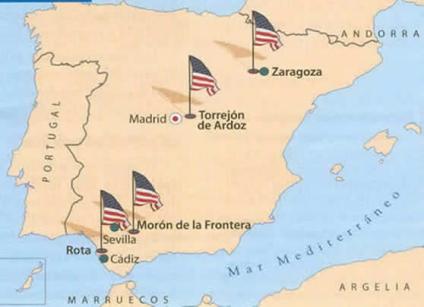
US military bases in Spain (Map from sutori.com)
No Spain, no gain? It was probably inevitable that President Donald Trump’s trade war would eventually get mixed up in his actual war.
Earlier this week, Spanish officials said they would prohibit American forces from using joint bases for war operations, unless those activities were covered by the United Nations Charter. Spanish Prime Minister Pedro Sánchez said his country would not “be complicit in something that is bad for the world”, the Associated Press reports.
On Tuesday, Trump declared that he intended to “cut off all trade with Spain”.
You might wonder: What legal authority does Trump have to unilaterally impose these sorts of revenge tariffs? After all, the Supreme Court ruled not that long ago that the authority Trump had been using to unilaterally impose tariffs based on his whims was unconstitutional. You might as well ask: On what legal authority did Trump launch a war against Iran? In theory, under the Constitution, Congress is supposed to authorize both tariffs and wars. In practice, they, uh, don’t.
Trump just does things, and the annoying constitutional worrywarts can figure it out later. (I say this as an annoying constitutional worrywart.)
In any case, yesterday, the Trump administration announced that Spain had changed its tune. “The U.S. military is coordinating with their counterparts in Spain”, White House Press press secretary Karoline Leavitt said. The implication was that the tariff threats had worked.
Spain, however, said otherwise. “I can refute (the White House spokesperson)”, Spanish Foreign Minister José Manuel Albares said. “The position of the Spanish government regarding the war in the Middle East, the bombing of Iran and the use of our bases has not changed one iota.” Maybe those tariff threats aren’t as effective as Trump thinks?
In a speech, Sánchez warned that the war could spin out of control. “Nobody knows for sure what will happen now”, he said. “Even the objectives of those who launched the first attack are unclear. But we must be prepared, as the proponents say, for the possibility that this will be a long war, with numerous casualties and, therefore, with serious economic consequences on a global scale.”
Sánchez also implicitly admonished Trump for escalating the war: “You can’t respond to one illegality with another because that’s how humanity’s great disasters begin”.
I will just note that in the Star Wars prequels, the fall of the Republic, and the descent into darkness and imperial rule, began with a planetary blockade and a trade war. At the time, people said it was wonky and boring. But here we are.
Where is Congress? The Constitution was built around the idea that each branch would fight to preserve its own powers, and this would create a system of checks and balances. But in Trump’s second term, Republicans in the legislature have been actively fighting to not preserve their power.
Yesterday, in a 47–53 vote, Senate Republicans voted against a resolution that would have required Trump to ask Congress to sign off on any further military aggression in Iran. Sen. Rand Paul (R–Ky.) voted with Democrats in favor of the measure; Sen. John Fetterman (D–Pa.) joined Republicans to vote against it.
The measure was mostly symbolic. Even a successful vote would have been subject to a House vote and a presidential veto. And the position of both the White House and the GOP Speaker of the House is that this whole situation in which America is spending billions of dollars dropping thousands and thousands of bombs on military and political targets in a foreign country is not, in fact, a war. Nothing to see here. Everyone in Congress can go home and crack open a beer.
The latest CF-188 upgrade program, Hornet Extension Project, HEP
Polyus
Published 10 Nov 2025The CF-18s are getting old. Designed in the 70s, they were introduced into Canadian service in 1982, so they’re basically as old as me and yet they’re still flying on the front line. Of course they’re not the same planes today that they were back in 1982. They’ve gone through some changes along the way.
This video is intended to be an overview of the most recent upgrade program to the CF-188 Hornet, called the Hornet Extension Project. And yes that’s its official name but everyone calls it the CF-18, including me.
0:00 Introduction
1:37 Capability Gap
2:30 HEP-1
3:05 HEP-2
4:36 Conclusion
(more…)
Comments Off on The latest CF-188 upgrade program, Hornet Extension Project, HEP
QotD: Operations, strategy, and tactics
[…]
Strategy is the upper layer of military analysis. Fundamentally strategy concerns the identification of final objectives, the way those objectives can be achieved and the resources to be used to achieve those objectives; these three components of strategy in US doctrine are termed “Ends, Ways, and Means” respectively. Strategy is thus the “big picture” thinking behind an action, including the decisions to both commence hostilities and end them.
[…]
Tactics are the lowest layer of military analysis. Tactics concern the methods to be used to win battles. Things like flanking, suppressive fire, ambushes, etc. are tactics. A military’s tactical system is often spelled out in doctrine. In theory, operations is designed to deliver forces to battles in such a way (positioning, comparative force, etc.) that their tactics can win those battles, while strategy should aim to ensure that winning those particular battles will achieve the desired political end (whatever concessions are desired). It is important to distinguish actions which are strategy (designed to directly produce a desired end to the conflict) from those which are merely tactical (designed to achieve a local success or advantage in a given engagement). It is important when assessing failures in war to distinguish between strategic failures (typically a failure to come up with realistic goals and the means to reach them), operational failures (e.g. logistics failures or unreasonable maneuver timetables) and tactical failures (e.g. failure to use combined arms effectively).
Bret Devereaux, “Miscellanea: A Very Short Glossary of Military Terminology”, A Collection of Unmitigated Pedantry, 2022-03-25.
Comments Off on QotD: Operations, strategy, and tactics
March 5, 2026
“[I]nternational law is not law; it is a set of rules and claims that pretends to be law”
Lorenzo Warby discusses the charming illusion that “international law” is a real thing and must be treated as a real thing:
In domestic (“municipal”) law, questions of illegality arise. They arise because states have laws. They have laws because their laws come with remedies — consequences for breaking the law.
So, it is a genuine question whether President Trump is exceeding his constitutional authority in his attack on Iran. But that is a genuine question because the US has a Constitution that matters. The US is a rule-of-law state, no matter how much other common law jurisdictions may point and laugh at how politicised US law is.
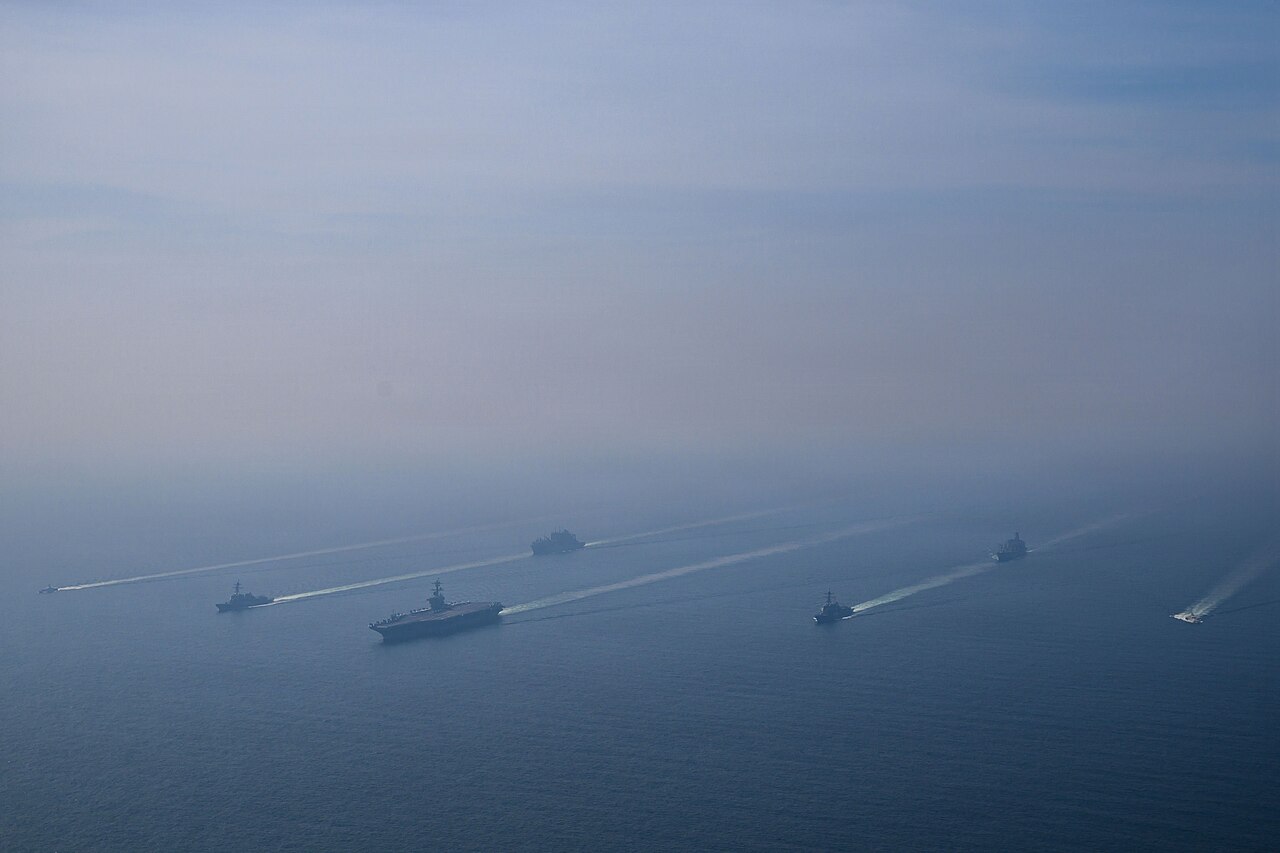
Nimitz-class aircraft carrier USS Abraham Lincoln (CVN 72), Arleigh Burke-class guided-missile destroyers USS Michael Murphy (DDG 112) and USS Frank E. Petersen Jr. (DDG 121), Henry J. Kaiser-class fleet replenishment oiler USNS Henry J. Kaiser (T-AO-187), Lewis and Clark-class dry cargo ship USNS Carl Brashear (T-AKE 7) and U.S. Coast Guard Sentinel-class fast-response cutters USCG Robert Goldman (WPC-1142) and USCGC Clarence Sutphin. Jr. (WPC-1147) sail in formation in the Arabian Sea, Feb. 6, 2026. The Abraham Lincoln Carrier Strike Group is deployed to the U.S. 5th Fleet area of operations to support maritime security and stability in the Middle East.
U.S. Navy photo by Mass Communication Specialist 1st Class Jesse Monford via Wikimedia Commons.In terms of the international order, however, there is no such thing as an illegal war, because (public) international law is not law. It is a set of rules and claims that pretends to be law. It only pretends to be law as it has no remedies — apart from declarative statements, which are not enough to make it law. (Private international law does have enforceable and enforced remedies, so is law.)
One of the consequences of this is that (public) international law, as an academic discipline, has no substantive reality-tests. There are no decisions by judges that are enforceable and enforced. This has led to academic international law being the vector by which the toxic ideas of the Critical Theory magisterium, that increasingly dominates Anglo-American universities, have infected Law Schools.
(Public) International law should not be taught at Law Schools, because it is not law. It should be taught in International Relations or Political Science Departments. A PhD in International Law should not qualify you to teach in Law Schools. Indeed, if you cannot tell the difference between actual law — with genuine remedies — and a simulacrum of law, you should not be teaching students at all.
Rules-based international order
When folk refer to the rules-based international order, they are not referring to nothing. There are various rules and conventions it is convenient for states, and other agents, to follow.
There is also a difference between the mercantile maritime order and continental anarchy. It is not an accident that the original international conventions pertained to sea travel and trade.
Within continental anarchy, it is relative power that matters. A war that depletes your resources and capacities, but depletes those of your neighbours more, is a winning proposition, within the state-geopolitics of continental anarchy. The geopolitics of continental anarchy leads states to seek weak or subordinate neighbours. The mercantile maritime order, on the other hand, is all about creating win-win interactions.
Russia, India and China are all continental Powers that live, at least to some extent, in a situation of continental anarchy. But they are also trading States that benefit from the mercantile maritime order maintained by the US-and-allies maritime hegemony. The tension between China as a trading nation becoming the biggest single beneficiary of the mercantile maritime order maintained by the US-and-allies maritime hegemony, and the interests of the CCP (the Chinese Communist Party), is the central strategic difficulty that CCP China faces.
Israel faces the strategic dilemma of operating in a region of continental anarchy but seeking support from states deeply embedded in the mercantile maritime order. Whether the Middle East has to be a region of continental anarchy, or can it become far more embedded in the mercantile maritime order, is precisely what is at stake in the latest conflict.
Any social order has to be enforced. This is even more true of international orders. As there is no such thing as international (public) law, enforcing an international order is not a matter of rules, it is a matter of those who actively support and enforce that order and those who seek to subvert it.
A vivid example of how central enforceability is to any international order is given by comparing the treatment of Germany after the two World Wars. Germany was treated far more harshly after the Second World War than after the First World War. The crucial difference was that the Versailles order was not enforceable by the victors and the Potsdam order was.
Update, 6 March: Welcome, Instapundit readers! Have a look around at some of my other posts you may find of interest. I send out a daily summary of posts here through my Substack – https://substack.com/@nicholasrusson that you can subscribe to if you’d like to be informed of new posts in the future.
“Britain’s ‘Scrap Iron Armada'” | Tonight (1962)
BBC Archive
Published 10 Nov 2025“A ship that’s built to withstand shell fire is no pushover in the breaker’s yard.”
Alan Whicker reports on the fate of obsolete naval warships, which are lying in bays around the country waiting to be scrapped or sold. Among this “scrap iron armada” is the Leviathan (R97) — a mammoth £6 million aircraft carrier — that has never sailed. It was abandoned, approximately 80 percent complete, in 1946 after the war ended.
Clip taken from Tonight, originally broadcast on BBC Television, 19 March, 1962.
Comments Off on “Britain’s ‘Scrap Iron Armada'” | Tonight (1962)
March 4, 2026
The Korean War Week 89: Is There Such Thing As Soviet Neutrality? – March 3, 1952
The Korean War by Indy Neidell
Published 3 Mar 2026The UN is not just worried that the Communists have strong air power, they’re worried that because they can’t produce more jets quickly enough, the Communist advantage in the skies will soon become insurmountable, but they at least have plans to try and stave that off. They also have plans for rotating in fresh troops, but those plans have stumbling blocks of their own, as do the negotiations about who might be part of a post-armistice supervisory team, specifically the USSR, whom the US does not see as “neutral” with regard to this war.
00:00 Intro
00:54 Recap
02:05 Supervisory Team
03:29 45th and 40th Divisions
07:14 POW Repatriation
10:29 Communist Air Power
15:52 Notes
16:36 Summary
16:55 Conclusion
(more…)
Comments Off on The Korean War Week 89: Is There Such Thing As Soviet Neutrality? – March 3, 1952


