
The Korean War by Indy Neidell
Published 24 Mar 2026The UN forces begin a huge operation to move the US 1st Marine Division to new defensive positions far to the west of the former ones, but this involves moving some 200,000 men back and forth along the lines. Behind the lines, the ROK continues building up force trying to turn itself into a well equipped and trained modern army, and above the lines the tech war marches on as the UN premieres a new night fighter.
00:55 Recap
01:40 The ROK Economy
06:40 Operation Mixmaster
07:39 Rotation Settled
10:31 Ridgway’s Recommendations
14:01 Overt or Covert POW Screening
15:54 Notes
16:22 Summary
16:34 Conclusion
(more…)
March 25, 2026
The Korean War Week 92: Operation Mixmaster! – March 24, 1952
Comments Off on The Korean War Week 92: Operation Mixmaster! – March 24, 1952
March 24, 2026
“We will no longer rely on others to defend our Arctic security”
In The Line, Matt Gurney reacts to Prime Minister Mark Carney’s unforced confession that Canada has been freeloading on US military protection for generations and yet is only now making the beginnings of moves to address it:
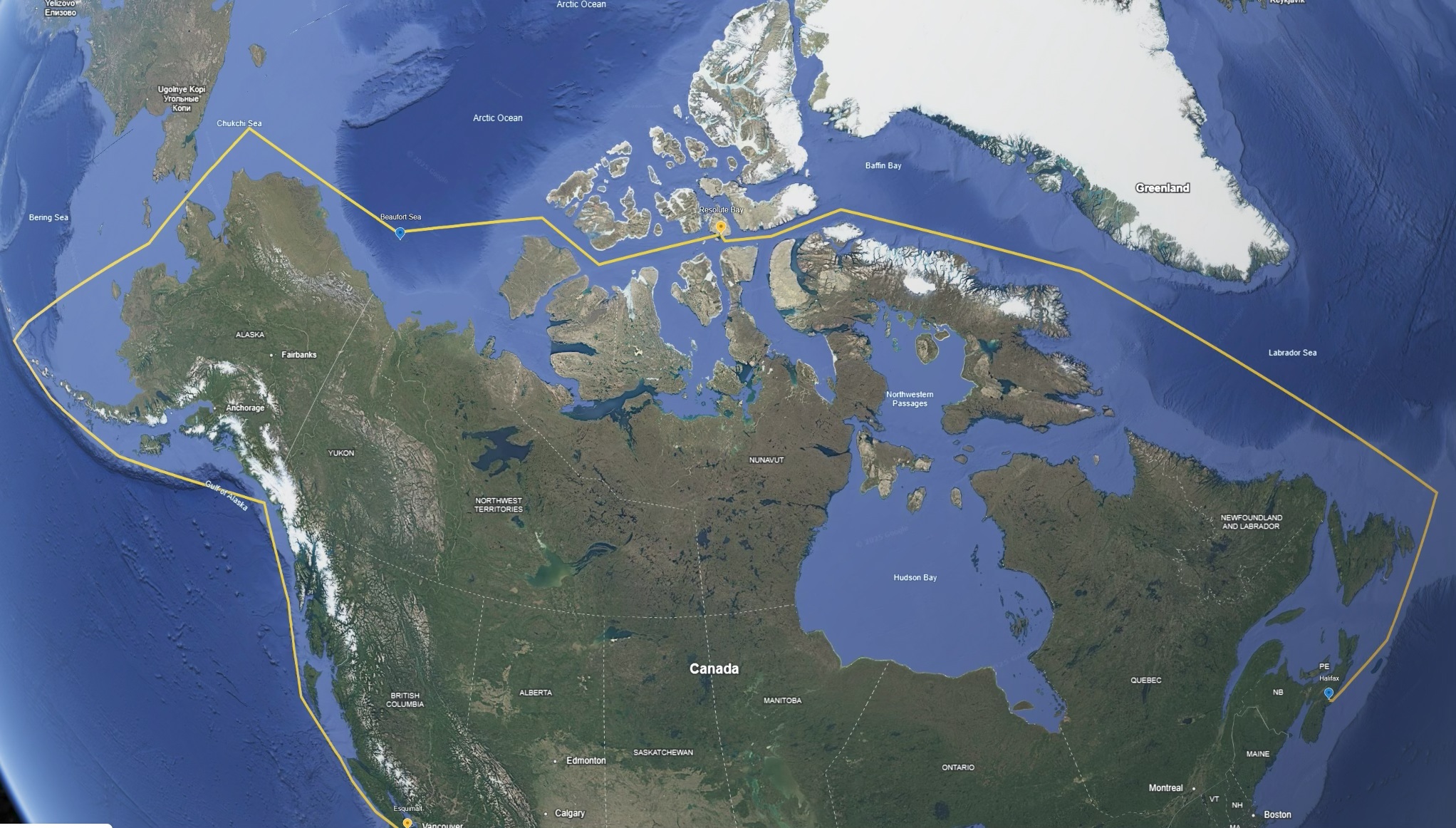
Rough transit routes to Canada’s Arctic from Esquimalt BC and Halifax NS
There is a fascinating if glum confession buried inside Prime Minister Mark Carney’s recent announcement, given in the company of Canadian Armed Forces personnel in Yellowknife, of how Canada will spend $35 billion to build and upgrade existing military infrastructure. The major spending announcement was augmented by Carney’s promise to submit four northern road, electricity and port projects to the Major Projects Office for expedited (we hope) approval and completion.
The announcements are interesting, even if the bulk of the military spending was actually just re-announcing stuff Justin Trudeau had announced years ago. Nothing new there, alas. Even so, it was the phrasing of the PM’s remarks that jumped out at me. Striking a familiar tone, Carney said, “We will no longer rely on others to defend our Arctic security or to fuel our economy. We are taking full responsibility for defending our sovereignty.”
I like it! I’m glad we’re doing it.
What the hell were we waiting for? How did we ever get to a place where no longer relying on others to defend our security and fuel our economy became a decisive shift in policy worth highlighting in an announcement?
What was wrong with us?
This is not a column aimed at Carney. I’ve been dismayed and discouraged by a lack of progress on some key files so far, but I will grant that we won’t be able to truly judge this announcement for some time, and that he does at least seem more interested than other recent PMs in getting Canada’s military capability back to where it must be. So, for all the Carney fans out there, you can sheath your swords. I get it. I’ll keep watching and waiting, but my impatience is growing.
But I still think the broader question is still worth asking, even if we agree, for now, to leave Carney himself out of it. Why were we relying on others to defend our own territory? Or fuel our economy? Why were we not taking full responsibility for defending our sovereignty? How did that even happen?
There are some admitted historical factors here, including the fact that Canada was spun up as an independent state out of the British Empire, and obviously counted on the support of that empire for much of our early history. That set a tone, clearly. In more recent generations, there was also the obvious reality that the United States’s desire for continental security was always going to involve a lopsidedly large U.S. commitment, just due to the massive disparity between our populations and economies.
Let’s grant that at the outset. Our history and geography have conditioned us to view domestic defence as a collaborative effort where we are a junior partner even in our own territory — maybe not in a legal sense, but in practical one.
The point here isn’t to lament that Canada never had a fleet as large as the Royal Navy in the 1910s, nor an air force as large as the U.S. Air Force in the 1950s. We can all agree and understand that Canada’s contribution was always going to be more modest and given our massive landmass and air and sea approaches, Canadian defence was always going to be made much simpler with the cooperation of a friendly larger ally or benefactor.
But gosh, we really leaned into the helplessness, didn’t we?
Matt is happy that the PM seems more involved in taking Canadian territorial defence seriously, and there’s no dispute that this is a national concern that has been neglected for … well … decades, generations even. I’ve heard some attribute the withering of Canada’s defence establishment to the “peace dividend” after the collapse of the Soviet Union, but it actually began in 1968 with the first Trudeau era. We’re not going to be able to rectify six decades of neglect in a couple of years, no matter how many new programs and purchases are announced.
And not to be a Debbie Downer, but remember that the federal government has been addicted to the sugar high of making announcements and getting tongue-bathed by the tame media enough that the same project would get announced and re-announced for sometimes years before anything tangible resulted. The new Arctic defence announcements were, as Matt noted, already stated government policy before Carney entered politics. How many more dips in the PR bath will it take before anything real is implemented?
Comments Off on “We will no longer rely on others to defend our Arctic security”
March 23, 2026
Canada’s NEW Rifle – the CMAR
The Armourer’s Bench
Published 22 Mar 2026The Canadian Armed Forces are set to adopt variants of Colt Canada’s MRR as the Canadian Modular Assault Rifle (CMAR). The announcement stated that more than 65,000 rifles will be procured over the next 5 years to replace the Colt Canada C7 rifles and C8 carbines currently in Canadian service.
Be sure to check out our accompanying article for this video here – https://armourersbench.com/2026/03/22/canada-adopts-new-rifle/
Comments Off on Canada’s NEW Rifle – the CMAR
March 22, 2026
The Original AR-15: Serial Number 6 in Original Configuration
Forgotten Weapons
Published 1 Nov 2025The very first AR15 rifles submitted to US government trials were extremely lightweight, with an assortment of interesting features that did not last long. They had top-mounted charging handles, one-piece hand guards, very thin barrels with plain muzzles, and a different safety selector configuration than became normal later one. Updates and modifications were made to virtually all of the original rifles, but today we have a chance to look at serial number 6 in the Springfield Armory collection — which is still in completely original configuration.
Thanks to the Springfield Armory National Historic Site for giving me access to this truly unique specimen from their reference collection to film for you! Don’t miss the chance to visit the museum there if you have a day free in Springfield, Massachusetts: https://www.nps.gov/spar/index.htm
(more…)
Comments Off on The Original AR-15: Serial Number 6 in Original Configuration
March 21, 2026
The second naval battle of Narvik
On his Substack, James Holland recounts the events of April, 1940 when British and German ships fought savagely for the port of Narvik in the north of Norway. The first battle had resulted in the loss of several destroyers on each side and the deaths of the commanders as well. A couple of days later, the Royal Navy sent in a more powerful force to eliminate the surviving ships of the Kriegsmarine and secure the port for landing allied troops:
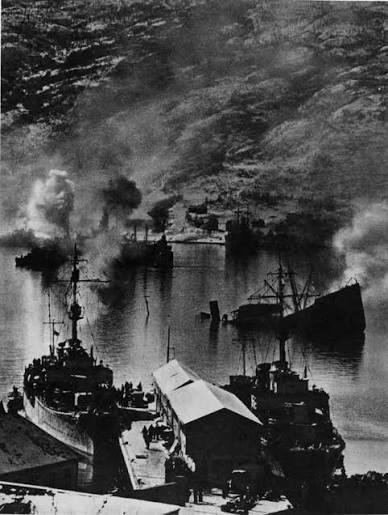
Narvik harbour after the first battle, April 1940.
The next few days were marked by caution and ponderousness by both sides. Now commanding the German flotilla was Kapitän Erich Bey. His remaining ships were trapped unless he moved them swiftly. This meant refuelling as soon as possible from the surviving oiler, making the damaged ships seaworthy, then using bad weather, darkness and supporting U-boats to sneak out past the British in the Vestfjord beyond the Ofotfjord. Although the ships were all refuelled and engines repaired, he then suffered a further calamity when the Zenke damaged her propellers manouevring around the wrecks in Narvik harbour, and the Köllner also caused debilitating damage while refuelling and made herself unseaworthy. Difficult though it was to manoeuvre in the narrow confines of Narvik, these were entirely avoidable and self-inflicted own goals. The British, meanwhile, reeling from the rapid German advances through southern Norway and uncertain what plan to now pursue, dithered from a lack of clear, unified and determined decision-making, so that it was not until the morning of 13th April that they returned, this time with four larger tribal-class destroyers, five further destroyers and the mighty battleship, HMS Warspite, all under the command of Admiral Whitworth.
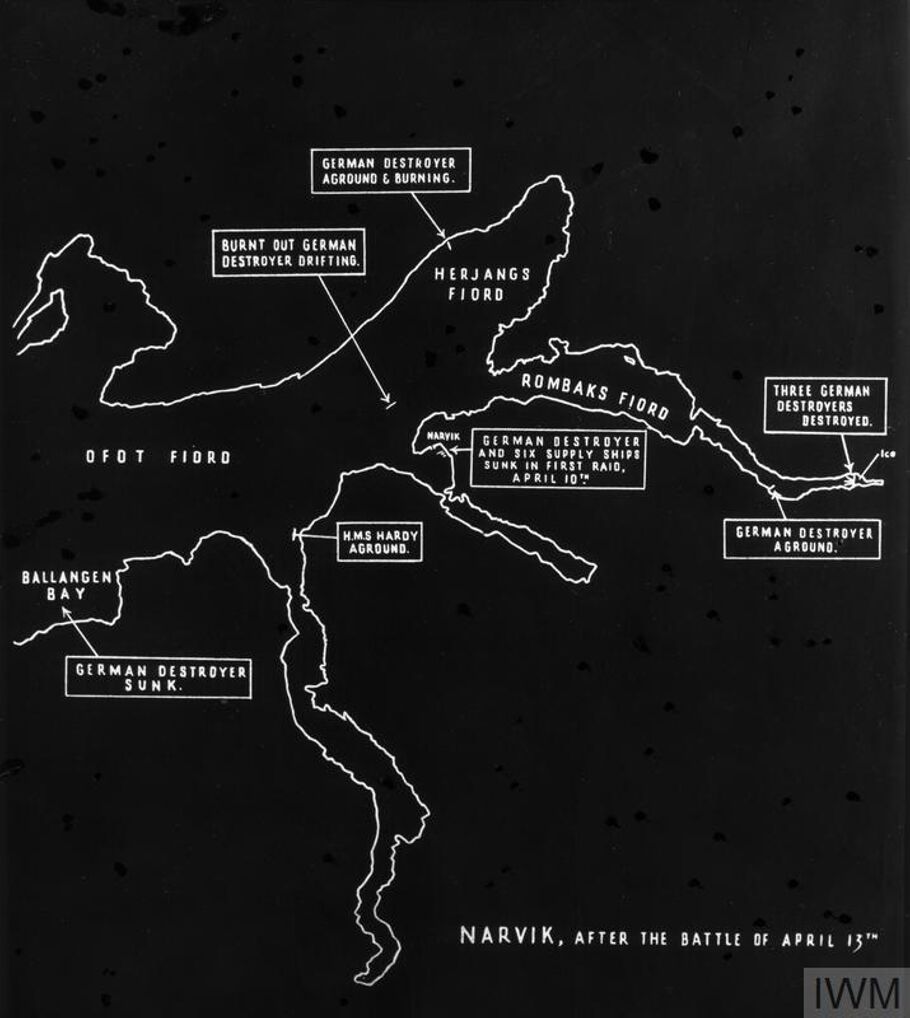
Kapitän Bey had known the Royal Navy were coming, partly because German cryptanalysts had deciphered British naval codes, but also because it was blindingly obvious they would do. He tried to deploy his ships as well as he might but knew in his heart the situation was hopeless. The crippled Köllner was towed to Taarstadt, an inlet beyond Ballangen, where it was to lie in wait, unseen, for the arrival of the British then fire her torpedoes and guns and hope for the best. She had only reached the inlet at Djupvik, some 20 miles west from Narvik, when she was spotted by the Warspite‘s Swordfish floatplane late in the morning of 13th April. As the leading British ships, Bedouin and Eskimo, turned the headland, their guns and torpedoes were trained and ready. Köllner‘s bow was ripped off by the first torpedo and the rest of her sunk soon after. That was three of the ten now at the bottom of the fjord. The remaining seven had barely begun moving before the rest of the British force were bearing down upon them through the mist, frost and snow. First, though, ten Swordfish, flown from the aircraft carrier, HMS Furious, swooped down. Their orders were to dive-bomb the German ships, a role for which they were not suited; Swordfish, slow, ungainly biplanes, were designed to fly in low and drop torpedoes, a role to which they were, in fact, very well suited. As dive-bombers, however, they hit nothing but lost two of their own in an entirely fruitless attack.
It was also completely unnecessary as Whitworth’s force had the matter firmly in hand. The German destroyers, still nursing the damage of four days earlier, swiftly fired all their remaining ammunition and were now effectively sitting ducks. Bey ordered them into the narrow Rombaksfjord, east and to the north of Narvik, where they were hotly pursued by Eskimo, Bedouin and even Warspite. Here the fjord narrowed to a few hundred yards before widening to half a mile but with the high mountain sides looming over this gloomily dark and slender channel, there was nowhere for the surviving German destroyers to go. The Künne was dispatched by Bedouin, and although the Georg Thiele fired one last torpedo that blew off the bow of Eskimo, her captain then ran her aground like the Hardy, while the surviving three, the Zenke, Von Armin and Lüdemann, steamed to the head of the fjord where they, too, deliberately ran themselves aground. The crews all then made good their escape into the mountains to join the Gebirgsjäger [mountain troops] that had disembarked five days earlier and who were still holding a shallow bridgehead around Narvik.
The second British naval action off Narvik. A diagram of the battle of 13 April 1940.
Imperial War MuseumAmazingly, Eskimo remained afloat, sailing stern-first back out of the fjord and to safety. She was repaired and would fight again, not least against the Bismarck in May 1941. But here in the waters around Narvik, the naval battle was now over, with half the Kriegsmarine‘s destroyer fleet sunk and lost — a disaster from which it could not hope to recover. A golden opportunity to send in decisive numbers of Allied troops to fight and defeat the beleaguered German troops in Narvik was now laid out on a plate. Southern Norway might have already been lost but the north — and, crucially, the iron-ore railway line and port — lay there for the taking — on paper, at any rate. British, French and Polish troops were eventually landed but this was not a part of the world where landing and maintaining supplies was at all straightforward. Britain had only a few basic landing craft at this early stage of the war, there were few beaches and its geographical remoteness and weather made a difficult task even harder. As it happened, by early June, the Allies did have victory there within their grasp, but by then, France was being overrun and facing defeat and the Allies decided the better part of valour was to pull out while they had the chance and consolidate in Britain instead. The Allied expedition to Norway was over.
The ramifications of the naval battle were significant, however. The Kriegsmarine not only lost half their destroyer fleet, but also one of two heavy cruisers, two of six light cruisers and six U-boats, leaving their navy woefully depleted. It also meant their plans for a successful surface fleet marauding in the Atlantic had been left in tatters. The U-boats, withdrawn from the Atlantic for the campaign, hit not a single vessel, largely due to problems with the magnetic ignition pistols on their torpedoes. For the three months they were tied up in the waters around Norway, they were not in the Atlantic, giving Britain a vital free pass as convoys sailed unimpeded. During the critical summer months of 1940, this was to prove a hugely important lifeline. Norway had been clinically subdued by Germany but it would cost Hitler more than half a million troops, all told, as well the costly construction of the Atlantic Wall in the years to come — a series of bunkers, coastal gun batteries and barracks in some of the remotest outposts of Europe and at an untold cost in men, resources and money. Norway would become an albatross around Nazi Germany’s neck, while its value to the Kriegsmarine was negligible.
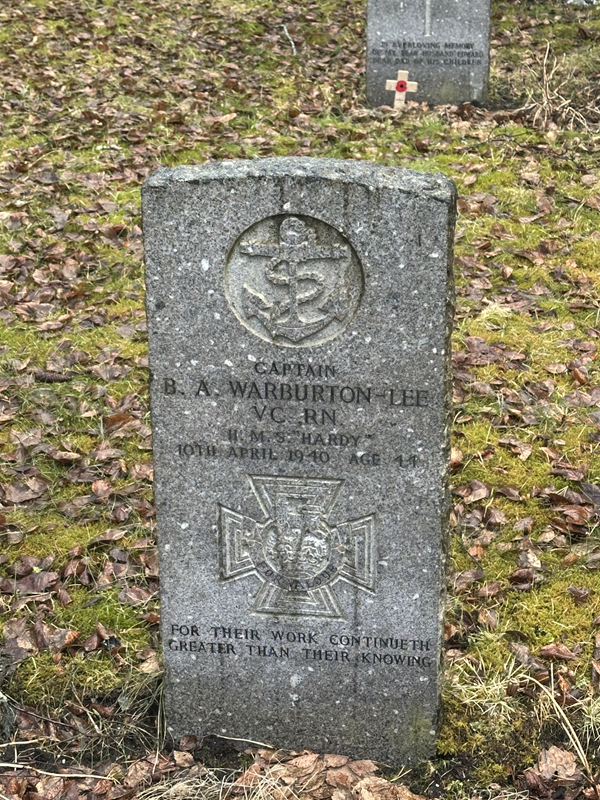
The grave of Captain Bernard Warburton-Lee, VC, RN, in Narvik.
Photo by James Holland
Comments Off on The second naval battle of Narvik
The Complete Chieftain Tank
The Tank Museum
Published 20 Mar 2026Chieftain. The world’s first main battle tank. An icon of the Cold War, it served the British Army for more than 30 years. Yet, it had something of a Jekyll and Hyde reputation. It was prized for having the best gun in the world but, for the British, it never fired a shot in anger. Loved by gunners. Loathed by mechanics. The Chieftain was often referred to as the best tank in the world as long as it broke down in the right place.
But was the gun truly as good as the stats make it out to be? And was the engine really that bad? It’s time to take a dive into the heart of the Iron Triangle to find out.
00:00 | Introduction
00:36 | Gun
03:44 | Engine
06:19 | Armour
11:07 | Just Deserts
13:53 | A Tragic HeroIn this film, join James Donaldson as he delves into the good, the bad, and the ugly sides of the Chieftain tank. With a great gun, revolutionary armour, and a misunderstood engine, Chieftain’s service with the British ensured the Cold War never turned hot. And hear from Chieftain veterans, Bob and Steve, as they share their experiences with this iconic tank.
(more…)
Comments Off on The Complete Chieftain Tank
Colt LE-901 Modular Multi-Caliber AR: A Well-Designed Failure
Forgotten Weapons
Published 29 Oct 2025Colt originally developed the 901 as part of the US Army SCAR program, with the intention being to create a 7.62x51mm rifle that could also use unmodified 5.56x45mm upper assemblies. This would allow special operations units to customize a single weapon to a variety of different configurations for different mission profiles. Mechanically, the system Colt devised to do this was quite clever, and very effective. However, the rifle ultimately failed to win a military contract.
Moved to civilian sales, the system was unsuccessful fundamentally because the modular concept is just not very desirable. A single modular rifle like this inevitably sacrifices some capability in every specific configuration in exchange for the modular capability and most people would rather have two dedicated rifles in different configurations than one swappable one. It sounds appealing on paper, but almost always fails economically in practice.
(more…)
Comments Off on Colt LE-901 Modular Multi-Caliber AR: A Well-Designed Failure
March 18, 2026
The Korean War Week 91: The South Korean Economy is Dying – March 17, 1952
The Korean War by Indy Neidell
Published 17 Mar 2026There’s tension between allies as the ROK economy worsens and worsens, part of the problem being caused by all the South Korean currency printed to respond to the demand for it by the UN forces to buy “stuff”. Inflation is growing by leaps and bounds. However, at least some tension between enemies lessens, as one more point of the agenda at the Panmunjom Peace talks is settled.
00:55 Recap
01:40 The ROK Economy
06:40 Operation Mixmaster
07:39 Rotation Settled
10:31 Ridgway’s Recommendations
14:01 Overt or Covert POW Screening
15:54 Notes
16:22 Summary
16:34 Conclusionhttps://smithsonianassociates.org/tic…
(more…)
Comments Off on The Korean War Week 91: The South Korean Economy is Dying – March 17, 1952
SPAS-12: Franchi’s Special Purpose Automatic Shotgun
Forgotten Weapons
Published 6 Nov 2024Franchi introduced the Special Purpose Automatic Shotgun (SPAS-12) for Italian military and police agencies in 1979 and it quickly became popular worldwide. Based originally on the gas-operated Franchi 500, that SPAS-12 was robust, reliable, and designed as a semiautomatic action with a backup pump action operation for use with underpowered ammunition (like beanbags or other less-lethal loads). In 1982 they began to be imported into the US through FIE, which was replaced by AAI as the importer in 1989. Eventually the 1994 Assault Weapons Ban ended SPAS-12 importation, and Franchi discontinued the model in 2000 in favor of the improved SPAS-15.
The SPAS-12 was almost always sold with a 21.5 inch barrel and 8-round magazine tube. It was available with either a solid sock or a top-folding type, complete with arm brace hook for shooting one-handed from a vehicle. In total, between 45,000 and 50,000 were made between 1979 and 2000, with the largest single purchaser being the Egyptian government (which took 18,000 of them).
Full video on the SPAS 15:
• SPAS-15: Franchi’s Improvement on the SPAS-12
(more…)
Comments Off on SPAS-12: Franchi’s Special Purpose Automatic Shotgun
QotD: Feeding a Roman Consular army
So now we have our entire “campaign community” of men, women and animals. And so it might be worth doing some quick calculations to get a sense now of exactly what a community of this size is going to require. For a general sense of scale, we’ll consider the demands of a standard Roman army of the Middle Republic: two legions plus matching allied detachments, totaling around 19,200 soldiers (16,800 infantry, 2,400 cavalry).
Let’s deal with animals next. Each contubernium (“tent group”) of six soldiers likely had its own mule, so that’s 3,200 mules for the army, plus some additional number for the siege train and any army supplies; perhaps around 5,000 total (see Roth, op. cit. on this). On top of this we have horses for the cavalry; this will be rather more than 2,400 since spare horses will have been a necessity on campaign. Judging by Roman barley rations for cavalrymen (presumably intended to feed the horse) it seems a good guess that each cavalryman had one spare; for later medieval armies the number of spares would be substantially higher (at least three per rider). But for our lean army of Romans, that’s just 4,800 horses. An early modern army might require quite a few less mules (replacing them with wagons), but at the same time it is also probably hauling both field artillery and siege guns which demand a tremendous number of draft animals (mostly horses). My sense is that in the end this tends to leave the early modern army needing more animals overall.
Next the non-combatants. The mules will need drivers and the cavalrymen likely also have grooms to handle their horses, which suggests something like 3,400 calones [slaves or servants] as an absolute minimum simply to handle the animals. Roth (op. cit., 114) figures one non-combatant per four combatants in a Roman army, while Erdkamp (op. cit. 42) figures 1:5. Those figures would include not merely enslaved calones but also sutlers, slave-dealers, and women in the “campaign community”. Taking the lower estimate we might then figure something like 4,000 non-combatants for a “lean” Roman army, with many armies being more loaded up on non-combatants than even this. And while estimating the number of non-combatants for Roman armies is tricky, we actually have some figures for pre-modern armies to give a reference. Parker (op. cit. 252) notes units of the Army of Flanders (between 1577 and 1620) as high as 53% non-combatants, including women in the campaign community; one Walloon tercio in 1629 was 28% camp women on the march. It is tempting to compare these but caution is necessary here – both Roth’s and Erdkamp’s estimates are heavily informed by more modern armies so the argument would be circular: the estimates for the Romans look like later armies because later armies were used to calibrate estimates for the Romans.
That gives us an army now of 19,200 soldiers, 4,000 non-combatants, 5,000 mules and 4,800 horses. Roman rations were pretty ample and it seems likely that many of the calones did not eat so well but the ranges are fairly narrow; we can work with an average 1.25kg daily ration per person normally, with the absolute minimum being the 0.83kg daily grain ration following Polybius (Plb. 6.39.12-14, on this note Erdkamp op. cit. 33-42) if the army was short on supplies or needed to move fast eating only those buccelatum [hardtack] biscuits. That’s a normal consumption of 29,000kg per day for the humans, with the minimum restricted diet of 19,256kg for short periods. Then we need about 2.25kg of feed for each mule and about 4.5kg of feed for each horse (we’re assuming grazing and water are easily available), which adds up to 11,250kg for the mules and 21,600kg for the horses.
And at last we now have the scale of our problem: our lean army of 19,200 fighting men consumes an astounding 61,850kg (68.18 US tons) of food daily. It also consumes staggering amounts of water and firewood. In order to move this army or sustain it in place it is thus necessary to ensure a massive and relatively continuous supply of food to the army. Failure to do that will result in the army falling apart long before it comes anywhere close to the enemy.
Bret Devereaux, “Collections: Logistics, How Did They Do It, Part I: The Problem”, A Collection of Unmitigated Pedantry, 2022-07-15.
Comments Off on QotD: Feeding a Roman Consular army
March 17, 2026
Will Canada Outpace the UK in Surface Fleet Numbers?
Warships & Warriors
Published 13 Mar 2026The Royal Canadian Navy (RCN) is facing a critical turning point in 2026. Caught between a massive 20% personnel shortfall and the urgent need to project power globally, Canada is being forced to make difficult decisions, including the early retirement of eight Kingston-class warships. However, despite these severe manning challenges and aging hardware, Canada is quietly executing one of the most ambitious naval modernisation programs in the Western world.
In this video, we break down the complete state of the Royal Canadian Navy’s surface and subsurface fleet in 2026. We explore the twilight years of the Victoria-class submarines, the heavy burden placed on the aging Halifax-class frigates, and the massive success of the new Harry DeWolf-class Arctic and Offshore Patrol Vessels.
Looking to the future, we analyse Canada’s generational leap in naval technology. With the highly advanced River-class Destroyers entering production, boasting AEGIS combat systems and Tomahawk missiles, and a new fleet of conventionally powered submarines on the horizon, the RCN is transforming into a Tier 1 maritime force. But with 15 new destroyers and up to 12 new corvettes planned, is Ottawa actually taking its future maritime defence more seriously than London?
(more…)
Comments Off on Will Canada Outpace the UK in Surface Fleet Numbers?
The mine threat in the Straits of Hormuz
CDR Salamander discusses the naval situation in Iranian coastal waters as the threat of mines in the busy seaway helps deter civilian tanker traffic even more than existing drone and missile threat:
At the end of last week, things were a’buzz’n about ‘ole silent-but-deadly … MINES!
There is a lot of bad and in some places intentionally misleading reporting from traditional media on down over this weekend, so let’s do a quick summary.
Iran has begun laying mines in the Strait of Hormuz, the Persian Gulf channel that carries 20 percent of the world’s oil, according to U.S. officials, an effort that could further complicate American efforts to restart shipping there.
While the U.S. military said it had destroyed larger Iranian naval vessels that could be used to quickly lay mines in the strait, Iran began using smaller boats for the operation on Thursday, according to a U.S. official briefed on the intelligence.
Iran’s Islamic Revolutionary Guards Corps can deploy hundreds, even thousands, of the small boats, which the Iranian force has long used to harass larger ships, including the U.S. Navy’s.
This quickly reminded everyone of a little event from the start of the year that had a memorable visual.
Via TWZ:
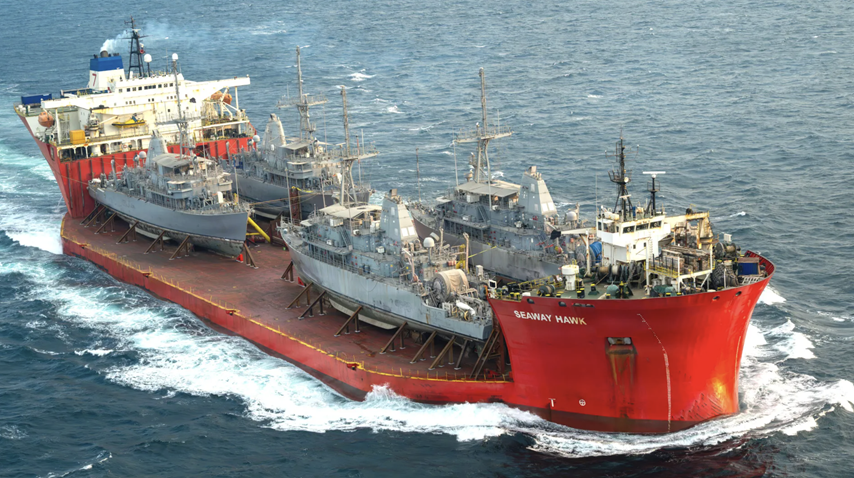
Four decommissioned U.S. Navy Avenger class mine countermeasures ships have left Bahrain on what may be their final voyage aboard a larger heavy lift vessel. Avengers had been forward-deployed to the Middle Eastern nation for years, where critical mine countermeasures duties have now passed to Independence class Littoral Combat Ships (LCS).
The public affairs office for U.S. Naval Forces Central Command (NAVCENT) and U.S. 5th Fleet first released pictures of the M/V Seaway Hawk, a contracted semi-submersible heavy lift vessel, carrying the former Avenger class ships USS Devastator, USS Dextrous, USS Gladiator, and USS Sentry last Friday. The Navy released more images and a brief statement yesterday. The date stamps on the pictures show the Avengers were physically loaded onto the Seaway Hawk in Bahrain on January 9.
This had a second echo of a seapower past.
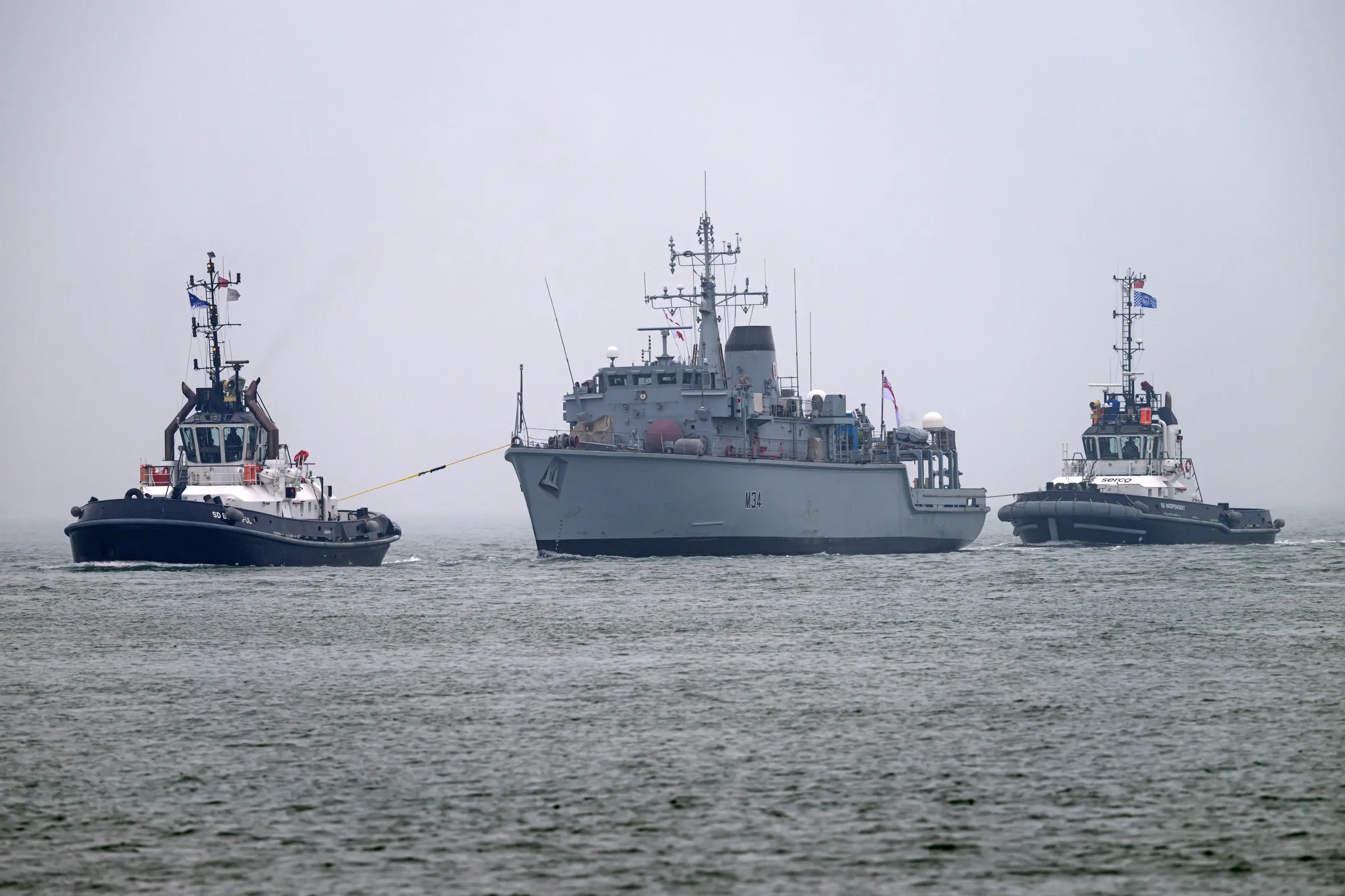
Battered and unseaworthy, HMS Middleton was dragged by tugs into Portsmouth naval base on Sunday.
The Hunt class mine countermeasures vessel (MCMV) returned to the home of the Royal Navy on March 8 after being brought back from the Gulf by a heavy-lift ship.
The ignominious piggy-back was cheaper than letting the more than 40-year-old ship make the 6,200-mile journey back from Bahrain under her own power and freed her crew to join other ships.
But her return after a journey that took weeks meant the end of the Royal Navy’s anti-mine vessel presence in the Middle East after almost 50 years. Only unmanned drone systems are left, according to the Navy.
Another metaphor, etc.
However, there is a worry that Iran might mine the Strait of Hormuz because it has been a concern — and occasionally a reality — for almost half a century.
Comments Off on The mine threat in the Straits of Hormuz
March 16, 2026
Preparing for Operation Veritable – First Canadian Army’s biggest battle of WW2
On Patreon, Project ’44 has posted an extensive article on the setup and preparation for Operation Veritable in February 1945, with the First Canadian Army under General Crerar preparing to attack into the Reichswald as part of Field Marshal Montgomery’s 21st Army Group:
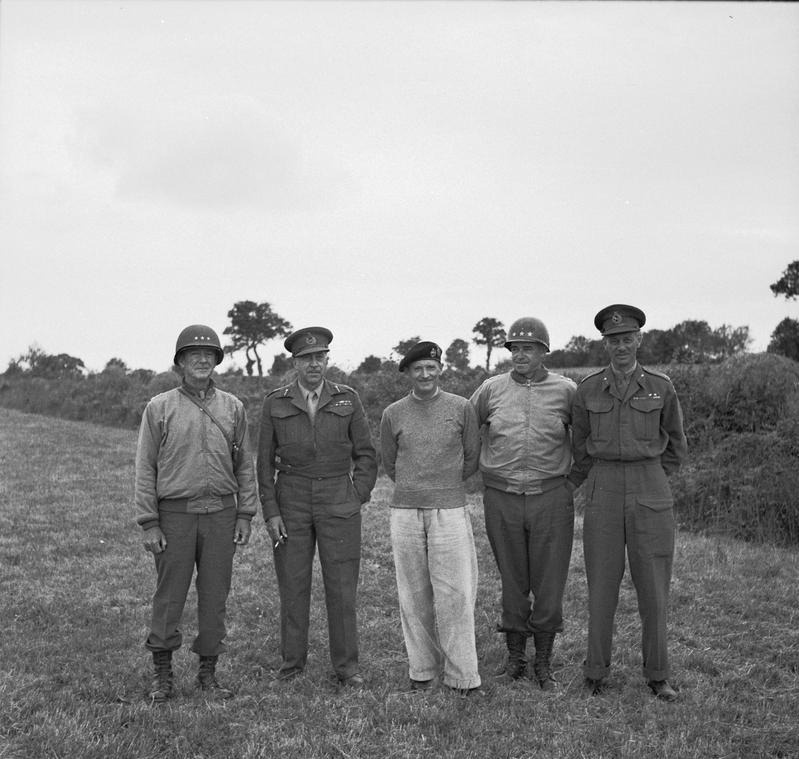
Lieutenant General Courtney Hodges (US First Army); General Harry Crerar (First Canadian Army); Field Marshal Bernard Montgomery (21st Army Group); Lieutenant General Omar Bradley (12th Army Group); and Lieutenant General Miles Dempsey (British 2nd Army), 21/08/1944 (Taken by Sgt. John Morris, No. 5 AFPS-AFPU, B9473).
In the early hours of the 8th of February 1945, the combined weight of the First Canadian Army and 21st Army Group’s massed artillery unleashed an immense orchestration of firepower, shattering any semblance of a peaceful morning and pounded German positions across the Reichswald. Massed in unprecedented density, with dump piles exceeding half a million shells, some 1,034 field, medium, heavy, super-heavy, and multi-barrelled rocket launcher platforms opened in concert. In accordance with their detailed fireplans this combined artillery effort was tasked with destroying enemy headquarters; severing lines of communication; disrupting road networks and infrastructure; rendering enemy defensive positions inhospitable; and, plainly, reducing the enemy’s force as much as possible, leaving survivors in a state of “shell happiness”. As the guns opened fire at 0500hrs, they quickly formed part of the largest artillery bombardment undertaken by Commonwealth forces since the battle of El Alamein in 1942.
This impressive symphony of artillery, along with the days of preliminary bombardments by both artillery and heavy bombers that preceded it, marked the very beginning of the month-long “Operation Veritable”. This operation was the 21st Army Group’s northern pincer movement, aimed at permitting a crossing of the river Rhine and, subsequently, a drive into Western Germany by dislodging and rupturing the German position between the rivers Mass and Rhine in the lower Rhineland.
Conceived by Canadian General Harry Crerar (commanding the First Canadian Army), part of Field Marshal Bernard Montgomery’s 21st Army Group, Veritable was set to be General Crerar’s largest and most complex undertaking of the war – and for that matter, Canada’s too. At its height, the First Canadian Army commanded almost half a million personnel, with the majority of its formations British in origin, and its personnel strewn from Canada, Britain, Poland, and the Netherlands. Though 450,000 personnel would not be involved in Operation Veritable, it would still come to command the entirety of the British XXX Corps and Canadian II Corps.
Veritable would not be the rapid breakthrough many had envisaged it to be, especially not in the style of operations the year prior. Instead, it would evolve into a month-long, multi-operation offensive fought over some of the most arduous terrain in northwestern Europe. Advancing across deep mud, inundated lowlands, and through dense forests and urban centres, against an often-fanatical enemy manning prepared defensive structures, Veritable was quickly turned into a troublesome slog.
As Sergeant Alex Troy of the 5th Field Regiment, Royal Canadian Artillery would write:
they [the Germans] fought really tough because the enemy had always before been fighting in some other poor devil’s country; now he was defending his own land.
The Allied Situation:
By early December 1944, the German force opposing Field Marshal Montgomery’s 21st Army Group had been dealt a series of important blows, none more recent than its forceful uprooting from the west bank of the river Maas as far south as Maeseyck. In that, the German position was believed to be, notably by Montgomery, strong – but undermined by a lack of equipment, trained troops, and suffering from rampant logistical shortages.
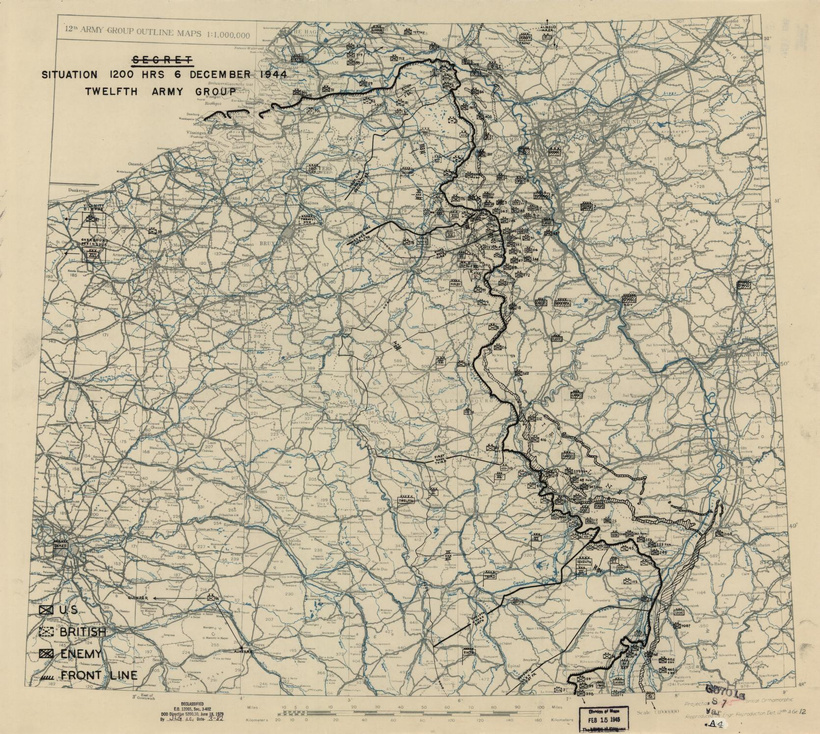
HQ Twelfth Army Group situation map, 6th December 1944. Produced by the Army Group Headquarters, 12 Engineer Section.
During a meeting on the 6th of December, Field Marshal Montgomery directed General Crerar to plan an offensive to the southeast of Nijmegen, and to support this transferred XXX (30) Corps to his command. Over the days that followed, two major operations were conceived. In the south, the British 2nd Army was to clear the triangle between Sittard, Geilenkirchen, and the river Roer as part of Operation Shears; whilst in the north, the First Canadian Army, as part of Operation Veritable, was to advance into the Reichswald, securing the settlements of Xanten, Geldern, and Sonsbeck, before taking charge of the river Rhine’s western bank.
Comments Off on Preparing for Operation Veritable – First Canadian Army’s biggest battle of WW2
Soviet Invasion of Afghanistan 1979
Real Time History
Published 24 Oct 2025Christmas 1979. Soviet armor pours across the Afghan border towards Kabul as helicopters secure the mountain passes through the Hindu Kush mountains. In Moscow, the Politburo has decided to save Afghanistan’s communist government from collapse. Afghan rebels have taken up arms against the unpopular regime and control most of the countryside. But the Red Army leadership doubts it can pacify the country – so why did the Soviet Union invade Afghanistan?
(more…)
Comments Off on Soviet Invasion of Afghanistan 1979
March 14, 2026
Belgian Aces in Exile – Belgian Fighter Aces – WW2 Gallery 10
World War Two
Published 12 Mar 2026Belgium might have been quickly overrun by the Germans in 1940, but many Belgian airmen continued the fight by flying with Britain’s RAF, and quite a few of them were good enough to score five or more aerial victories and become Flying Aces. Here are a few of their stories.
(more…)
Comments Off on Belgian Aces in Exile – Belgian Fighter Aces – WW2 Gallery 10


